In April 2015, Chuck Mingo, a Black evangelical pastor in Ohio, stood on the main stage of the Crossroads Church and declared his commitment to taking on issues of racial justice in his community. In 2016, Outreach magazine named Crossroads the tenth largest church in the nation, with an average attendance of about 23,000 people per weekend. By 2017, it was the fastest-growing church in the country, and by 2020, had grown to about 30,000 congregants per weekend (by 2021, it added a weekly viewership of 500,000 people online). As a Black pastor in one of the largest megachurches in America, Mingo was arguably preaching to more people than any other Black preacher in the country. The unrelenting rhythm of officer-involved shootings of unarmed Black people inflamed long-standing racial conflict in the country as he spoke. In the prior year, protests over the killings of Eric Garner in New York and Michael Brown in Missouri launched the Black Lives Matter movement into the forefront of national politics (Lebron Reference Lebron2017; Arora, Phoenix, and Delshad Reference Arora, Phoenix and Delshad2019). The congregation of the Crossroads Church, however, was about 80% white and the church remained culturally very white-dominant. Yet, somewhat to his surprise, Mingo received an outpouring of support for his declaration.
The response to Mingo’s sermon over the subsequent weeks is surprising because polling data shows white evangelicals are consistently one of the groups most resistant to taking action on racism in America. On a number of different measures, white Christians consistently distinguish themselves as more racist and more willing to uphold structures of whiteness than other demographic groups (Whitehead and Perry Reference Whitehead and Perry2020). The Public Religion Research Institute finds that on a racism scale it constructed that goes from zero (least racist) to one (most racist), the average American scores a 0.57, but white Christians score 0.72 (Jones Reference Jones2020). Jemar Tisby (Reference Tisby2019), the president of Witness: A Black Christian Collective, bluntly writes, “If you were recruiting for a white supremacist cause on a Sunday morning, you’d likely have more success hanging out in the parking lot of an average white Christian church—evangelical Protestant, mainline Protestant, or Catholic—than approaching whites sitting out services at the local coffee shop” (p. 185).
The enthusiastic response to Mingo’s sermon led Crossroads to develop Undivided, a program dedicated to igniting congregants around racial justice. The program begins with a six-week training program that, at first blush, should engender some skepticism. The extant scholarship on anti-bias and diversity programs, which include hundreds of studies conducted since the 1930s, demonstrate that these programs “[don’t] reduce bias, alter behavior, or change the workplace” (Dobbin and Kalev Reference Dobbin and Kalev2018, 48). A recent review article in the Annual Review of Psychology agrees, concluding that despite a burgeoning of prejudice reduction research in the past decade, “current trends in this literature may not serve the practical purposes of reducing prejudice” (Paluck et al. Reference Paluck, Porat, Clark and Green2020). Further, research on the potential of Christian congregations to become truly multiracial concludes that it remains an “elusive dream” (Edwards Reference Edwards2008). Perhaps it is too pedantic to state the obvious: racism is really hard to change, and there is no expectation that a six-week program, especially in one of the most historically intransigent demographic subgroups, should have any effect in reducing prejudice.
We provide evidence for an alternate pathway through which congregations can potentially help ignite action around issues of race in their communities. Instead of focusing on the notoriously intractable work of changing people’s minds, they can focus on equipping congregants poised for action with the information, skills, and social connectedness they need to take action on racial justice issues. Although data show that many white evangelicals have high levels of racial animus (Jones Reference Jones2020; Whitehead and Perry Reference Whitehead and Perry2020), communities as large as Crossroads have inevitable heterogeneity within them. Some white evangelicals are undoubtedly actively dedicated to upholding structures of white supremacy. Others, however, may be unreflective about the role of race in society, curious about what they are seeing in the news, or even disturbed that they do not know how to do more. Wes Markofski (Reference Markofski2018; Reference Markofskiforthcoming) argues that there is a community of “other evangelicals” that reject the conservative politics of evangelicalism dominant in the public domain and could constitute more than one–third of the evangelical community. Undivided worked by investing in that population. Our analysis shows that Undivided worked not by convincing people committed to white supremacy to change their minds, but instead by identifying people who already wanted to learn about race or were interested in getting involved in racial justice efforts, equipping them with the knowledge and tools needed to evolve their views, and then embedding them in congregational relationships that gave them the courage and sense of efficacy they needed to be willing to take ongoing action. Undivided worked, in other words, not by making racists suddenly anti-racist, but instead by equipping a self-selected group of people to develop and act on the courage of their commitments. It is potentially an important first step in learning how to mobilize segments of the evangelical community to take part in the racial justice movement.
This study uses multi-method data to explore the idea that programs like Undivided can play an important role in calling people into action around racial injustice. Utilizing pre/post surveys to construct a panel dataset, we analyze the extent to which Undivided is able to influence respondents’ feelings of efficacy, willingness to take action, and sense of connectedness. Consistent with previous research, we find that program participation has only marginal effects on people’s racial attitudes. In this case, it is likely because most of the people who signed up for the program were already relatively progressive in their racial attitudes. However, participating in the program is associated with self-reported increases in feelings of efficacy in general, and around racial justice organizing in particular, amplified perceptions of community, and an increased commitment to cross-racial perspective taking. Interviews, focus groups, and written program reflections indicate that many former participants began engaging in meaningful community action around racial justice after the conclusion of Undivided and, in some cases, continue to do so more than a year later. Though we are unable to measure the long-term impact of Undivided or further probe the causal effects with the data available to us, the fact that participants not only report greater inclination to act against racism but are also actually doing so in the short-term lays an important foundation for further research that we discuss later.
We also use qualitative data to describe how Undivided may have these impacts, and delineate the lessons we can learn for successful faith-based organizing around racial justice. We use these results to suggest that instead of focusing on prejudice reduction, congregations interested in working on racial justice may be better off focusing on a two-tiered approach that begins with equipping people predisposed to action around race and racism to become leaders or change agents in their communities, and then allowing those leaders to leverage their natural social networks to expand the circle of people interested in the work. More broadly, we use these results to postulate the principles of what it takes to move people from being passive supporters of the movement for racial justice to active participants in the struggle.
More precisely understanding the role that congregations can play in moving congregants to take action on issues of racial justice is important because of their scale, their unique affordances, and the relevance to the challenge of building a multiracial democracy. First, congregations have enormous reach in the American population. Although membership has been declining in recent decades, 50% of U.S. adults reported belonging to a church, mosque, or synagogue as of 2018.Footnote 1 Roughly 45% of adults attended religious services at least monthly in 2019.Footnote 2 Christianity is overwhelmingly dominant; 71% of Americans identify as Christian, and an estimated 91% of congregations in America are Christian (Chaves et al Reference Chaves, Anderson, Eagle, Hawkins, Holleman and Roso2020). Evangelical megachurches in particular are a growing segment of this base. A 2020 survey of megachurches showed that 74 % of the megachurches report growth over the past few years, with the average growth rate being 34%. Moreover, racial diversity is on the rise among the membership, staff, and leadership of congregations (Dougherty, Chaves, and Emerson Reference Dougherty, Chaves and Emerson2020), and these institutions have the capacity to mobilize members and contribute meaningfully to social change movements (Wood and Fulton Reference Wood and Fulton2015). Second, unlike workplaces, where most anti-bias trainings occur, people are drawn to their faith communities through bonds of commitment instead of coercion. These relational bonds are more likely to spark engagement on a topic like racial injustice than more transactional interactions in a workplace (Warren Reference Warren2010). It is possible, thus, that there is untapped potential for faith communities, even white-dominant communities, to be sites of change in ways that are not yet fully understood. Thus, even if churches face the same barriers as other institutions in reducing prejudice, they nonetheless have other opportunities to call people into action that may differentiate the impact of their work. Third and finally, one of the central challenges facing America in the twenty-first century is the question of whether the nation’s increasingly multiracial population can equitably and justly co-exist in a regime of democratic self-governance. Meeting the challenge of multiracial self-governance in society at large begins with understanding how change happens within the context of the socio-political institutions that govern people’s lives, such as churches. Thus, congregations, with their large scale and relational bonds, can greatly contribute to contemporary efforts to build a truly multiracial democracy, one that is built on the foundations of anti-racism, by moving people to take action and building a community of leaders committed to racial justice.
Congregations and Racial Justice Organizing
Scholars have long recognized that congregations play a major role in shaping political participation and activism (Verba, Schlozman, and Brady Reference Verba, Schlozman and Brady1995; Brown and Brown Reference Brown and Brown2003). Even Alexis de Tocqueville observed in the early nineteenth century that (white) churches were “indispensable” to making democracy work, because they taught people the habits of citizenship and common purpose. Historically, Black churches have played a central role in the struggle for racial equality, and have long acted as sites of refuge where Black congregants were afforded the dignity absent in so many other societal settings (Calhoun-Brown Reference Calhoun-Brown2000; Wilmore Reference Wilmore1983; Harris Reference Harris1999). The church became a meeting place for many activists in the Civil Rights Movement, including the Montgomery bus boycotts, sit-ins in Nashville and other localities, and the 1961 Freedom Rides (LaFayette Reference LaFayette2004).
The legacy of congregations in social change efforts continues today, even amongst some white-dominant churches (Fulton and Wood Reference Fulton, Wood, Braunstein, Fuist and Williams2017; Jenkins Reference Jenkins2020). In their nationally representative study of congregations, Beyerlein and Chaves (Reference Beyerlein and Chaves2020) find that in 2018–2019, 56% of congregations in their sample participate in one of eight political activities, including electoral activities such as getting-out-the-vote (26%), distributing voter guides (24%), voter registration (23%), having candidates speak (6%), endorsing candidates (4%), and non-electoral activity such as marching (17%), offering political opportunities during worship (16%), discussing sanctuary (13%), discussing politics (11%), lobbying (10%), and declaring sanctuary (4%).Footnote 3 These numbers are comparable to previous data, with slight increases in the percentage of congregations investing in electoral activity. Given these long-standing legacies, congregations are potentially well equipped to engage people in social change work.
The scale of community organizing efforts among congregations is also on the rise. Between 1999 and 2011, 102 new faith-based community organizing coalitions were established, and as of 2011, such coalitions were active in 40 states as compared to 33 in 1999 (Wood and Fulton Reference Wood and Fulton2015). A growing number of these coalitions include racial justice as one of their top priorities (ibid). For example, in 2012, one of the largest national networks of faith-based community organizing, the PICO national network, led network members and partners in a frank, cross-racial dialogue on race (ibid). The leaders then shifted the network to “systematically link its long-standing work against economic inequality to an explicit analysis of racial inequity” (p. 108). In the years since, the network, now known as Faith in Action, has put racial justice at the center of its work, prioritizing issues such as opposing mass incarceration, expanding voting rights for people of color, and advocating for immigrant justice.Footnote 4 Substantial room for growth in faith-based community organizing still remains, however. Although these efforts are on the rise, only a small proportion of congregations in the United States participate in these endeavors (Wood, Fulton, and Partridge Reference Wood, Fulton and Partridge2012), and evangelical megachurches are very unlikely to do this work. A survey of megachurches finds that although 58% report being multiracial, 63% indicate they “avoid discussing politics” when they gather, in part because 66% of megachurches indicate that political views in their congregations are quite heterogeneous (Bird and Thumma Reference Bird and Thumma2020).
Although faith institutions have long engaged in civic and political work, when it comes to changing racial attitudes, even in churches, the outlook is bleak. Racial attitudes are generally acquired early on in life and tend to remain fairly stable (Sears Reference Sears, Iyengar and McGuire1993). As such, racial attitudes are among the most “crystalized” attitudes and among the most difficult to alter (Tesler Reference Tesler2015). Attitudes can shift over time (e.g., Schuman, Steeh, and Bobo Reference Schuman, Steeh and Bobo1997) but are unlikely to change in reaction to a singular event. It should not be surprising then, that most efforts to transform racial attitudes, such as anti-racism workshops and diversity trainings, are ineffective at altering racial bias or out-group antagonisms.
Instead, the research shows that authentic social relationships are more powerful for shifting behaviors on race than training events (Warren Reference Warren2010). In examining why people take action on racial issues, Warren (Reference Warren2010) shows that white people become racial justice activists through personally witnessing racism or racial injustice, and relationship-building with people of other races and ethnicities. Warren finds that moral shock and relationship-building are more effective for sparking action around race than knowledge or information imparted through trainings (ibid). In particular, Warren finds that it is only when people develop cross-racial relationships that they understand the impact that racial injustice has on people and become motivated to take action. The challenge in these cases, thus, is not to persuade people to change their minds, but instead to put them into settings where they are likely to develop the kind of relationships needed to spark change.
Indeed, it is possible that in thinking about the role that congregations can play in animating a movement around racial justice, the goal is not necessarily to change people’s minds but instead to identify people who may be feeling isolated in their congregations, create community around them by building relationships, and through that community, call people into action. This work of building relational collective action amongst congregants in white-dominant churches who are inclined to work towards racial justice is consistent with many organizing strategies that underlie social movements throughout history. A core group begins by bringing people off the sidelines and out of the shadows to show that there is a larger base of support for action than people might have otherwise understood. That base then begins to grow as others, initially reluctant, begin to see themselves within it (Warren Reference Warren2010; Wood and Fulton Reference Wood and Fulton2015; Han, McKenna, and Oyakawa Reference Han, McKenna and Oyakawa2021; Ganz Reference Ganz, Nohria and Khurana2010; Jasper and Duyvendak Reference Jasper and Duyvendak2015). Indeed, Han (Reference Han2014) argues that what differentiates grassroots organizations that are most effective at developing activists from organizations that are less effective “is the way they transform their members’ motivations and capacities for involvement” (2) and invest in a core group of leaders to build the kind of transformative relationships needed for change. Change begins, thus, by investing in a group of transformative leaders.
Such a pathway to change implies that there is essentially a two-tiered system towards making change in some places. The first tier focuses on programs like Undivided that invests in cultivating a group of people who can become change agents (the leaders). In this first tier, the goal is not necessarily to change people’s minds on issues of race, but instead to move people interested in working on issues of race into a place where they feel like they can take action. This willingness to take action rests in a) a sense of connectedness, or community, to others, and b) a sense that their actions matter, or a sense of their own efficacy. These people, once activated, can then become agents of change within their broader church community. That is the second tier, in which the change agents draw on the organic social ties they have in their faith communities to work on changing the hearts and minds of people who might be more resistant to taking up racial justice. By working within the context of preexisting social relationships, this work in the second tier has more promise than typical diversity training programs that have been studied.
We focus on the effects of the Undivided program in the Crossroads Church on that first tier. Was the program able to shape people’s sense of connectedness, efficacy, and willingness to take action? In the first-tier, these are the people expected to become change agents; thus, our focus is on their willingness to take action, and the capacities they need to take action. Our expectations are:
-
1) As a six-week training program, Undivided will have only a marginal effect (if any) on participants’ views on race.
-
2) Undivided will increase participants’ willingness to take action on issues of race.
-
3) Undivided will increase participants’ sense of connectedness and community, especially around issues of race.
-
4) Undivided will increase participants’ sense of efficacy in taking action on issues of race.
The Undivided program is a good setting to study the effects of such relational organizing practices in animating action around racial justice because the program follows a similar model of equipping a set of leaders to become change agents around racial justice in their communities. We focus on if and how those leaders change. And, consistent with what Warren (Reference Warren2010) finds, the six-week program is strongly grounded in relationship. Participants in the Undivided program work in small, intentionally multiracial groups to foster intimate relationships. Organizers strive to ensure that each small group is at least one-third non-white in terms of participants. Each group also has two facilitators, one white and one non-white. Further, the speakers delivering the curriculum were racially balanced as well. Because relationships are at the core of the program, they work hard to ensure that people have opportunities to create cross-racial relationships. The second week of the program is titled “Relationship” and “focuses heavily on training in the relational skill of empathy because you can’t understand someone until you’ve walked a mile in their shoes.”Footnote 5 The final session of the program is followed by a dinner in the home of one of the group members that is meant to further cement these relationships. By taking cross-racial relationship building seriously, Undivided has the potential for deeper effects than more transactional diversity trainings. In addition, because the small group facilitators and the program leaders are racially diverse, the program leaders can speak about their lived experience of race across racial groups. This is also potentially impactful because, as Fulton, Oyakawa, and Wood (Reference Fulton, Oyakawa and Wood2019) find, when people of color share the ways that structural racism has personally affected them, they help mobilize their white audience to address racial inequality. In addition, the program can leverage the trust that has already been built among fellow congregants in the church. By starting each week with a Biblical grounding, and including teaching about the racial history of the local community, the science behind empathy, and data on persistent racial disparities, Undivided seeks to provide a safe and trusting space for congregants to have conversations about race, equips participants with the knowledge and skills to meaningfully participate in the struggle for racial justice, and builds a community of people committed to racial justice. Thus, we expect that even if Undivided does not substantially change attitudes, its impact is likely to be greater in sparking action among participants and building a community of action-oriented individuals.
In sum, we argue that Undivided is an effective program for developing racial justice activists because it leverages the trust already built among congregants and emphasizes cross-racial relationship building to develop a community of action-oriented individuals. Moreover, we surmise that the lessons we learn from the program are relevant for other congregations and faith leaders who are interested in racial justice work and can help inform the role that congregations can play in furthering racial justice and strengthening multiracial democracy in America.
Data and Methodology
To identify the pathways through which churches can begin to shape action around racial justice in their communities, we draw on original survey data that allows us to examine what the impact of the program is on participants’ attitudes and self-reported behaviors, and qualitative data that enables us to understand the pathways through which these behaviors emerge. The data all come from a study of the Undivided program in the Crossroads Church. Crossroads, based on its own internal data, was about 80% white and 20% non-white during the time of our study (the non-white population was majority Black). They were based in Cincinnati, Ohio, drawing congregants from all over Hamilton County, where Cincinnati sits. In 2016, according to American Community Survey data, Hamilton County was 69.7% white, 27.9% Black.Footnote 6 Because Undivided worked deliberately to put people into small groups that were at least one-third non-white, the program participants were more racially diverse than the larger community. Based on our data, participants in the program were 64% white and 27% Black.
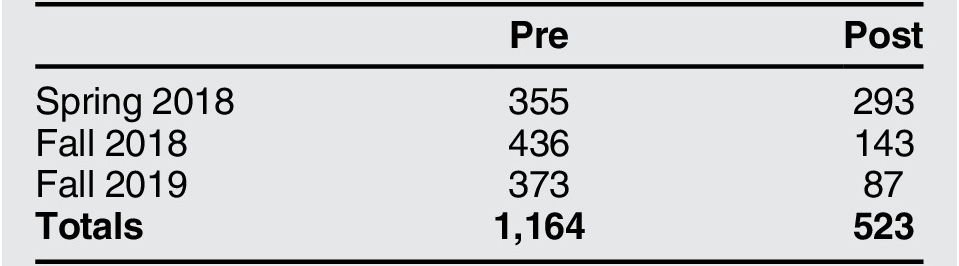
The first set of data comes from pre- and post-surveys that Undivided participants completed before participating in the program and immediately after the program ended. We collected three rounds of survey data during spring 2018, fall 2018, and fall 2019, corresponding with three iterations of the Undivided program. Program participants were asked to complete the pre-survey before or on the first day of the program and then asked to complete the post-survey on their own immediately following the conclusion of the program. We then pooled together the responses from all three iterations. Table 1 displays information about the survey samples including dates and number of observations. Using the survey data, we measure changes in attitudes and reported behaviors in participants prior to starting the program and after completing the program. Only participants who completed both the pre- and post-surveys were included in our analyses.
Dates and number of observations from each iteration of the Undivided program

The survey data, particularly due to the panel design, are a useful way to start our investigation into the impact of participating in the program. We are able to measure within-subject change without any obvious confounders. However, there are some potential problems with the data that are worth discussing. First, there is potential for social desirability bias. Survey respondents may simply have provided the answers that they believed would be viewed most favorably. Both the pre- and post-surveys were self-administered online and respondents were provided with multiple assurances that all survey responses would be anonymous. Scholarship indicates that this way of administering surveys reduces the risk of social desirability bias (see Larson Reference Larson2019 for a review). The other aspect of our study that gives us confidence that social desirability bias is not driving the results is the corroboration of survey results with qualitative data. For example, not only did we see movement in self-reported behavioral measures, but we found through interviews, focus groups, and story board reflections that people who participated in Undivided often then became more involved in racial justice efforts. So, their responses to survey questions did not seem to be driven by impression management or self-deception.
Second, the low response rates in the post-surveys particularly those conducted in fall 2018 and fall 2019 are potentially problematic. It may be that the results we find are due to selection effects (i.e., that those who were most likely to be impacted by the program were also the ones most likely to fill out the post-survey) rather than real change. Despite high attrition rates on the survey, there are several reasons to retain confidence in our results. First, as reported by the program organizers, each session of Undivided that we studied had a near 100% completion rate. Thus, the low post-survey completion rate is not driven by attrition from the program. Second, scholarship on panel studies generally finds that there is some level of attrition between waves in a panel study (e.g,. Bethlehem and Biffignandi Reference Bethlehem and Biffignandi2011; Callegaro and DiSogra Reference Callegaro and DiSogra2008; Stanley et al. Reference Stanley, Roycroft, Amaya, Dever and Srivastav2020). This is especially true of online panels that do not offer monetary incentives (Stanley et al. Reference Stanley, Roycroft, Amaya, Dever and Srivastav2020; Shih and Fan Reference Shih and Fan2007). Studies analyzing nonresponse bias in panel surveys find that “potential bias from low response and high attrition rates is less than conventional demographic wisdom would have predicted” (Rindfuss et al. Reference Rindfuss, Choe, Tsuya, Bumpass and Tamaki2015, 816). Moreover, the aggregate wave 2 completion rate in our study—45%—is similar to those found in a meta-analytic study of nonresponse rates in online surveys (Groves and Peytcheva Reference Groves and Peytcheva2008).
Third, aggregate demographic characteristics of the post-survey participants resemble the pre-survey participants, providing further confidence that our results are not driven by nonresponse bias.Footnote 7 Indeed, we find that Black respondents and female-identifying respondents were slightly more likely to take the post-survey than their white and male-identifying counterparts but only by a few percentage points. Across race, gender, education, and party identification, the aggregate demographics of the post-survey participants resemble the pre-survey participants. We also analyzed the results for Black, white, female-identifying, and male-identifying respondents separately, finding that pre-post changes moved in the expected direction for all groups, but that the effect sizes tended to be larger for white and male-identifying respondents (these results are located in the online appendix).Footnote 8 Most importantly, we complement the survey data with several interviews with former program participants, a focus group discussion, multiple rounds of participant observation, and written reflections from program participants. These qualitative data provide evidence consistent with the ideas that the pre-post changes are meaningful.
The focus group was conducted on October 21, 2018, and consisted of twelve individuals; eleven current and former Undivided participants and one staff member who helped to organize the program. Eight participants were Black, four were white. Eight participants were women and four were men. The conversation lasted roughly two hours. Between October 20–23, 2018, we also conducted three one-on-one interviews and observed one session of the Undivided program. We interviewed four additional Undivided participants between January 12–13, 2020. Of the interviewees, three were Black and four were white, while four were women and three men. The interviewer was an Asian American man. Finally, we were provided with “story blurb reflections” written by seventeen former participants who reflected on their experiences in the program. These reflections were part of an exhibit about the Undivided program and were solicited by program organizers.
Together, these conversations and reflections complemented the survey data to help us more deeply understand the effect of Undivided on program participants, and to analyze how the program does and does not impact attitudes, behaviors, and community development. Our goal is not just to show the impact of the program on respondents, but to understand what the pathways for change within a faith community might be.
Results
Attitudes
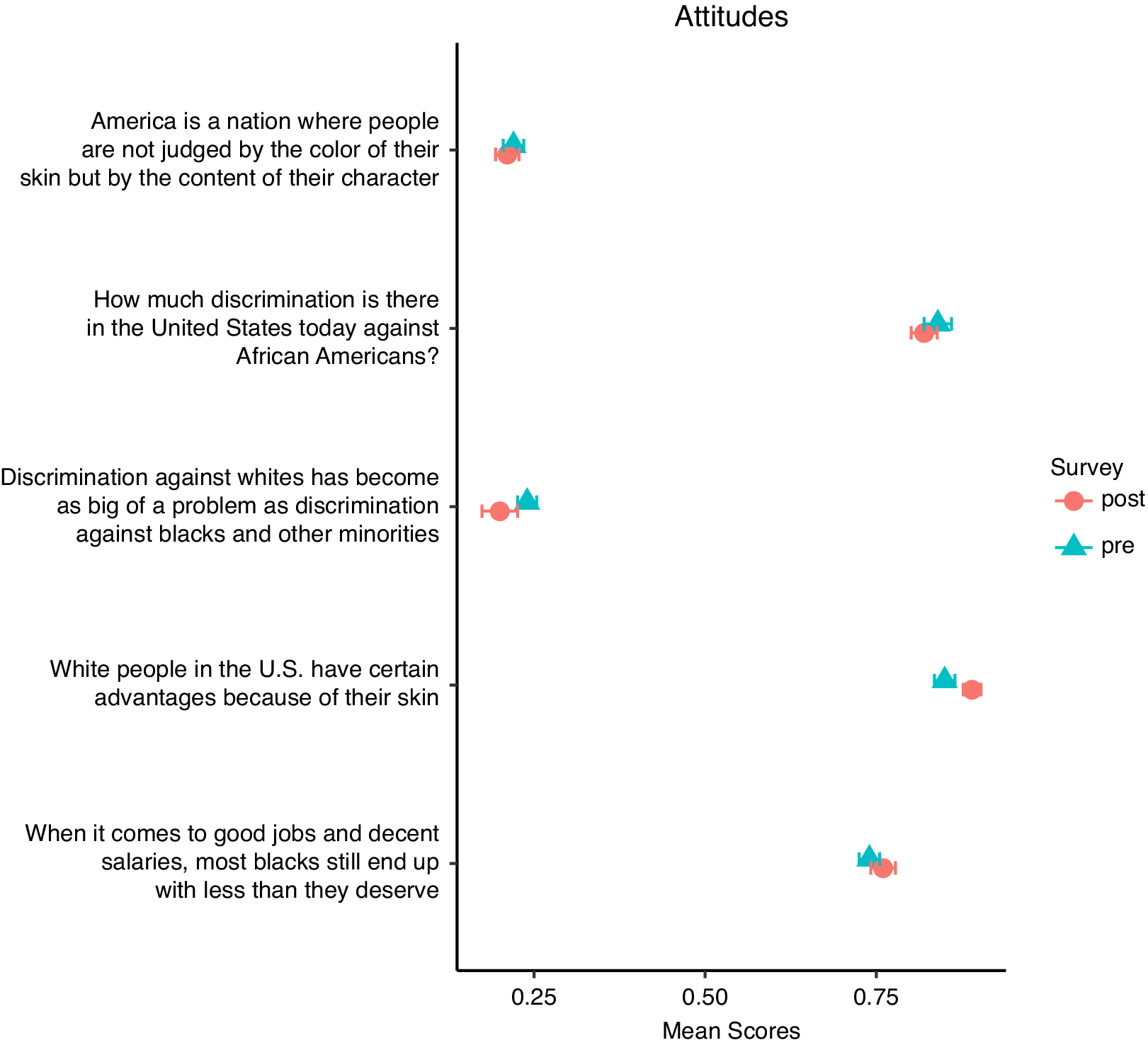
To assess changes in attitudes caused by participation in the Undivided program, we asked respondents several questions that measured racial attitudes in both the pre- and post-surveys.Footnote 9 Figure 1 shows pre- and post-survey means for each variable using the pooled data.Footnote 10 The figure indicates that there was very little change in attitudes from before participants began the program to after the program concluded. Respondents were slightly less likely to agree that “discrimination against whites has become as big of a problem as discrimination against blacks and other minorities” (p<.1) and slightly more likely to believe that “white people in the U.S. have certain advantages because of their skin” (p<.05). Though the mean differences are statistically significant, or at least marginally so, according to two-sample t-tests, the magnitudes of the differences are small.
Pre- and post-survey mean differences in attitudinal measures
Source = Pooled UNDIVIDED Sessions, 2018–19

These findings are consistent with our expectations and may result for several potential reasons. First, racial attitudes tend to be “crystallized” from an early age and very difficult to change (Tesler Reference Tesler2015). Even after an intensive six-week racial justice program, there are few aggregate changes in attitudes. Second, there are ceiling effects because the people who chose to participate in Undivided are a self-selected group. People voluntarily join and participate in the program and as measured in the pre-survey, are already very progressive when it comes to racial attitudes. For example, more than 90% of respondents in the pre-survey already somewhat or strongly agreed that white people have advantages because of their skin. Thus, there is little room for attitudes to become even more racially progressive.
The lack of any impact on shifting attitudes is consistent with much previous research and consistent with the idea that we need to explore alternate pathways through which change can happen. To understand these other pathways, we also examine the impact of the program on people’s self-report behaviors, sense of community, and feelings of efficacy.
Individual Behaviors
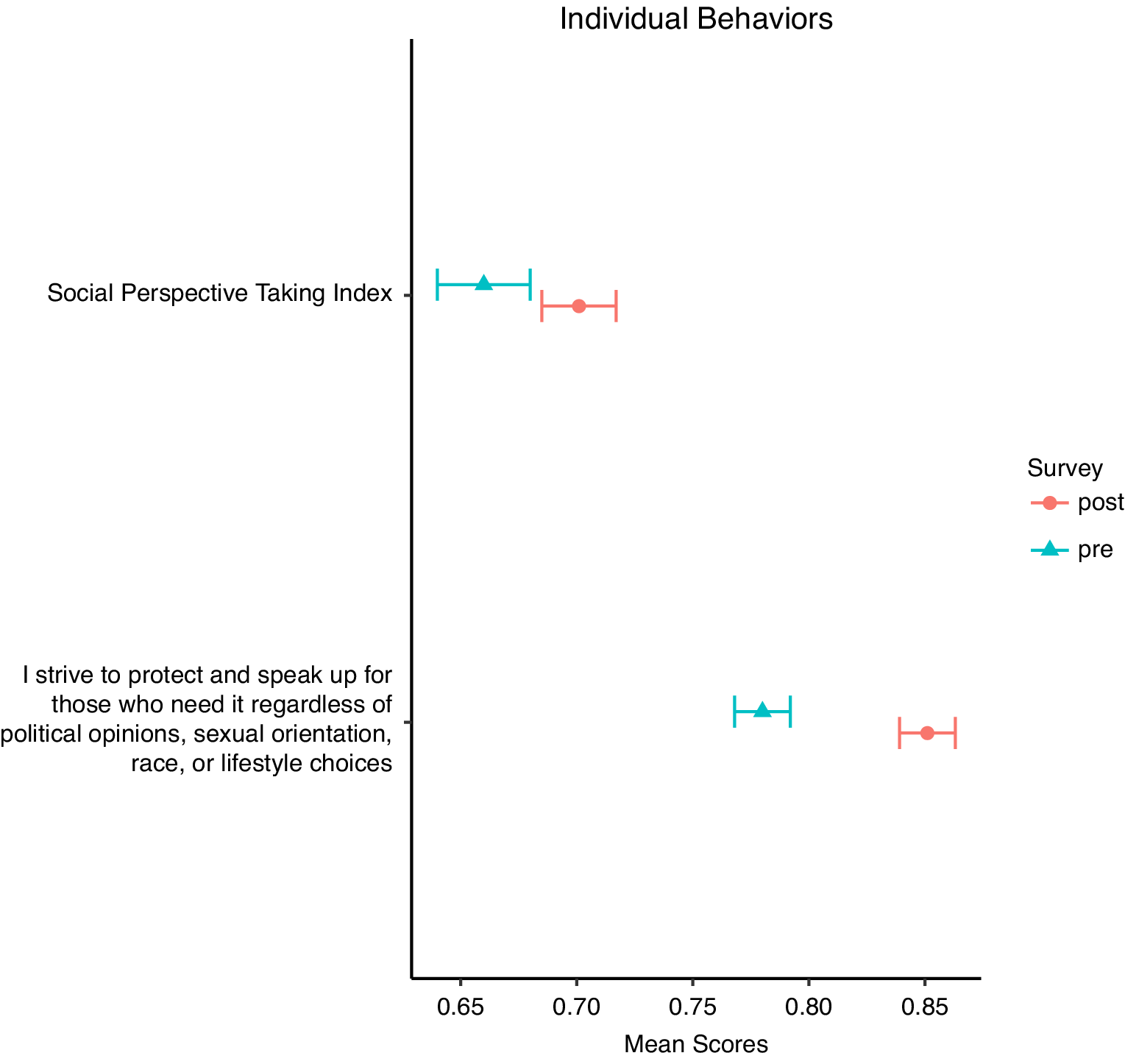
After going through Undivided, respondents were much more likely to report taking the perspective of others across race and speaking up against injustice. Figure 2 shows pre- and post-survey mean differences in the percentage of respondents who agree that they “strive to speak up for those who need it regardless of political opinions, sexual orientation, race, or lifestyle choices.” The percentage of program participants who agree with that statement increased 7.1 percentage points (p<.01) from the pre- to the post-survey.
Pre- and post-survey mean differences in individual behavior measures
Source = Pooled UNDIVIDED Sessions, 2018–19

Figure 2 also displays mean differences in social perspective taking (SPT) between the pre- and post-survey using the pooled data. The SPT variable is an additive index of six questions that ask respondents about the frequency with which they attempt to understand the perspective of someone from another race in a variety of situations.Footnote 11 Each question had five response options ranging from “almost never” (0) to “almost all the time” (1). The mean score on this variable is 4.6 percentage points higher in the post-survey than the pre-survey, statistically significant at the p<.05 level according to a two-sample t-test. In other words, participation in the Undivided program led participants to report a greater frequency in attempting to understand the perspective of people of a different race.
A major aspect of creating multiracial congregations (and multiracial democracy) is developing empathic bridges across racial divides. Indeed, extant scholarship demonstrates that perspective taking is an effective strategy in reducing both explicit and implicit forms of racial bias (Todd et al. Reference Todd, Bodenhausen, Richeson and Galinsky2011; Shih et al. Reference Shih, Wang, Bucher and Stotzer2009). The findings from figure 2 demonstrate that programs like Undivided can, at least incrementally, increase cross-racial perspective taking. The idea of cross-racial perspective taking came up often in the interviews as well. For instance, a white woman interviewee said,
It really made me think about my own privilege. In terms of race, class, etc. I learned about so much racial inequality that has been present in society, even during my own lifetime. The biggest thing was that it gave me a different view of life; from people of other races. I heard heart-breaking stories. Stories of such heart-breaking racism. It made me think about the perspectives of a friend of mine who’s Black. It made me understand her experiences in a way that I never could have before.
Our qualitative data also show the myriad actions people felt they were more likely to take after going through Undivided. At the end of each six-week training session, Undivided invites participants to partake in what they call “on-ramps” to action around racial justice. After a session of Undivided that ended in the spring of 2016, one of the on-ramps was participation in a campaign for a ballot initiative in Cincinnati that was focused on raising taxes to fund universal pre-school for low-income Black children in the city. Hundreds of volunteers from Undivided supported the campaign, prompting the campaign manager (a seasoned political operative) to say that the preschool campaign became like a “mission” for these Undivided volunteers. “They volunteered in ways you would never see for a school levy. Period” (Han, Mckenna, and Oyakawa Reference Han, McKenna and Oyakawa2021).
Our interviews and focus groups similarly showed evidence of people’s changing behaviors. One white woman told us that prior to her participation in Undivided, she had never worked on racial justice issues, but that she was now working on several community organizing projects focused on racial justice. For example, she implemented a similar program in her foster care group, which has since become institutionalized. The program brings in experts to discuss racial bias, systemic racism, know-your-rights trainings regarding encounters with law enforcement, and even a local hairdresser to talk about hair. She said that “before I went through Undivided, I always thought, who am I to work on this issue? Undivided removes the ‘who am I’ question. Instead, it pushed me to think, ‘if not me, who’?”
Other respondents mentioned individual behaviors they have been motivated or inspired to take after participating in Undivided, such as learning more about systemic racism and racial bias, purposefully building relationships with people of different races and ethnicities, and calling out injustices when they see them. During the focus group, one woman said, “Undivided has changed my perception not just about race, but about life. It has changed what I read, what news I take in, what I pay attention to. I notice things I didn’t before. I’m more aware. I bring in different perspectives now. Different racial perspectives, different political perspectives, different religious perspectives. I just didn’t notice things before. It’s eye opening.”
Still others discussed community-based actions that they now take after participating in Undivided. Several people mentioned attending rallies, protests, and demonstrations calling for racial justice.
Finally, in the Undivided story blurbs, several former participants wrote about incorporating lessons from the program into their neighborhoods, friend’s groups, and places of business. One former program participant said she is working with others in her family medicine clinic to develop an anti-racism curriculum for the medical residents that includes “implicit bias training and training on responding to micro-aggressions and allyship.” Another interviewee said he has started Undivided pilot sessions at another church in Cincinnati after going through the program.
Sense of Community
How did Undivided influence people’s behaviors? A clue can be found by examining the way it affects their sense of social connectedness and efficacy. In our qualitative interviews, one respondent talked about moving from caring about racial equality to taking action to bring about racial justice after her experience with Undivided. She says:
My conversations in the small group led to my “aha” moment. I never put myself out there to fight the good fight. Before, if someone said something racist, I wouldn’t say anything. I didn’t feel like it was my place. But after Undivided I knew that I had to do something about it. [A leader from Undivided] always said that you’re just as much a part of the problem if you don’t stand up. If you’re complicit. It was a hard pill to swallow. Now I will speak up. Tell them why it’s wrong. And why it is offensive.
She went on to explain how Undivided has influenced the approach she takes to her job. She owns a consulting company and said she is now working to actively recruit a more diverse pool of applicants for positions and provide leadership development to people of color. She said, “I feel like we all have an obligation. I didn’t feel that way before.” This woman named a particular person in Crossroads, who made her feel accountable for acting on injustice. That realization of accountability through Undivided moved this respondent not only to speak up more, but also to change her behaviors at work. Another one of our respondents, a Black woman, put it succinctly when she said, “The journeys allow you to build connections, personal relationships with others you might not have otherwise.”
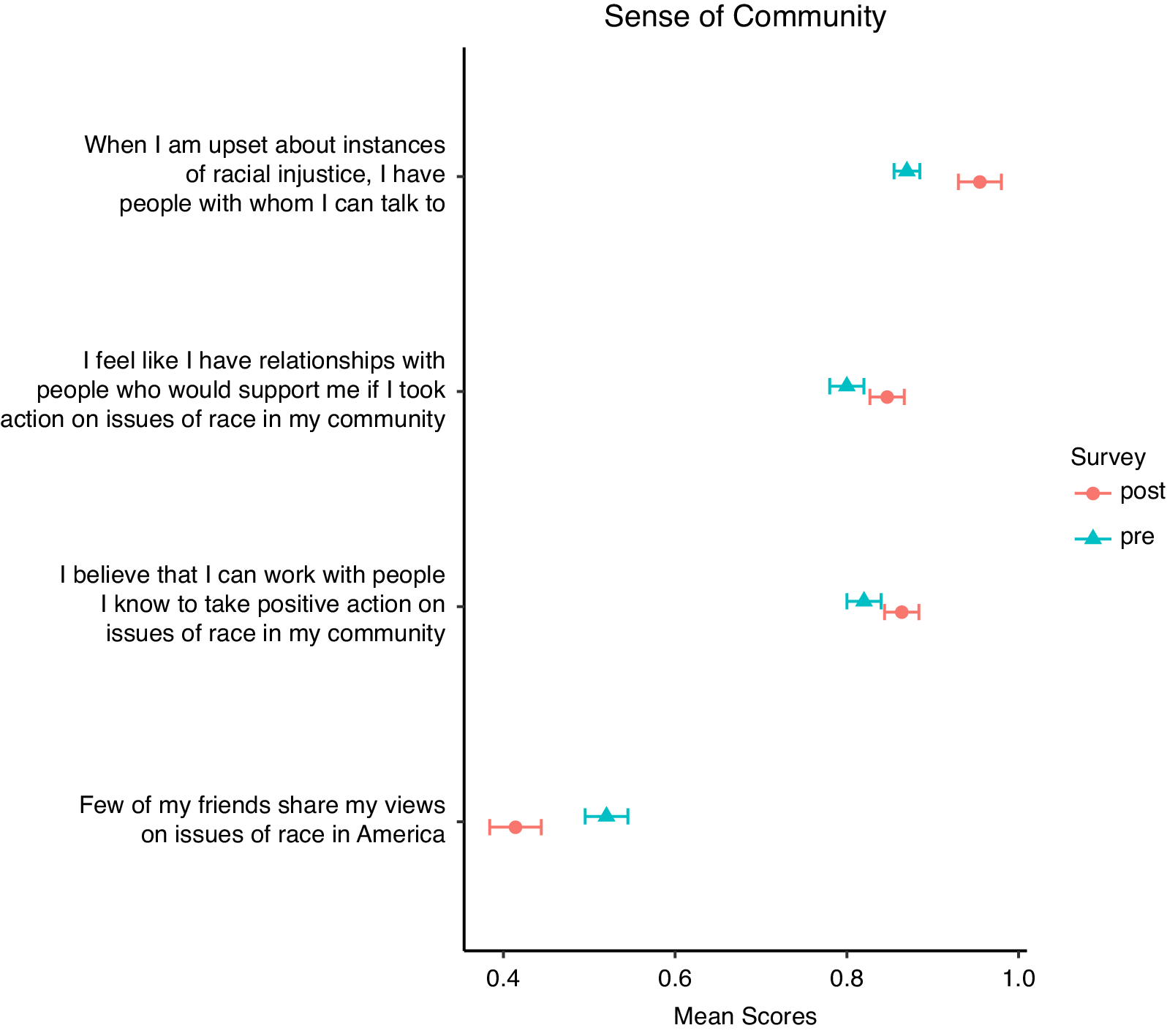
Our survey data also show that an important aspect of the Undivided program is that it builds upon the trust and sense of community that congregants have from being part of the broader Crossroads community. Often, one of the biggest barriers to action on seemingly intractable problems like racial injustice is people’s sense of isolation. People who feel like they are the only ones who feel a certain way are less likely to take action. Thus, as shown in figure 3, we examined pre- and post-survey measures on variables that capture people’s sense of community, and connectedness with each other with respect to concerns about racial injustice.
Pre- and post-survey mean differences in sense of community measures
Source = Pooled UNDIVIDED Sessions, 2018–19

Figure 3 shows pre- and post-survey mean differences in the percentage of respondents who agree with the statement “I believe that I can work with people I know to take positive action on issues of race in my community.” The figure indicates a 3.8 percentage point increase in agreement with the statement (p<.1). Further, the figure shows a similar increase of 3.6 points (p<.1) in the percentage of respondents who agree that they “have relationships with people who would support me if I took action on issues of race in my community.” There is also a substantial 12.1 point increase (p<.01) in the percentage of respondents who disagree with the statement, “few of my friends share my views on issues of race in America.” Finally, the figure shows an 8.6 point increase (p<.01) in the percentage of respondents who agree with the statement that “when I am upset about instances of racial injustice, I have people with whom I can talk to.”
In aggregate, figures 2 and 3 indicate that participating in the Undivided program helped develop a community of people who are interested in taking action on racial injustice, and who feel part of a community that is willing to take action.
Efficacy
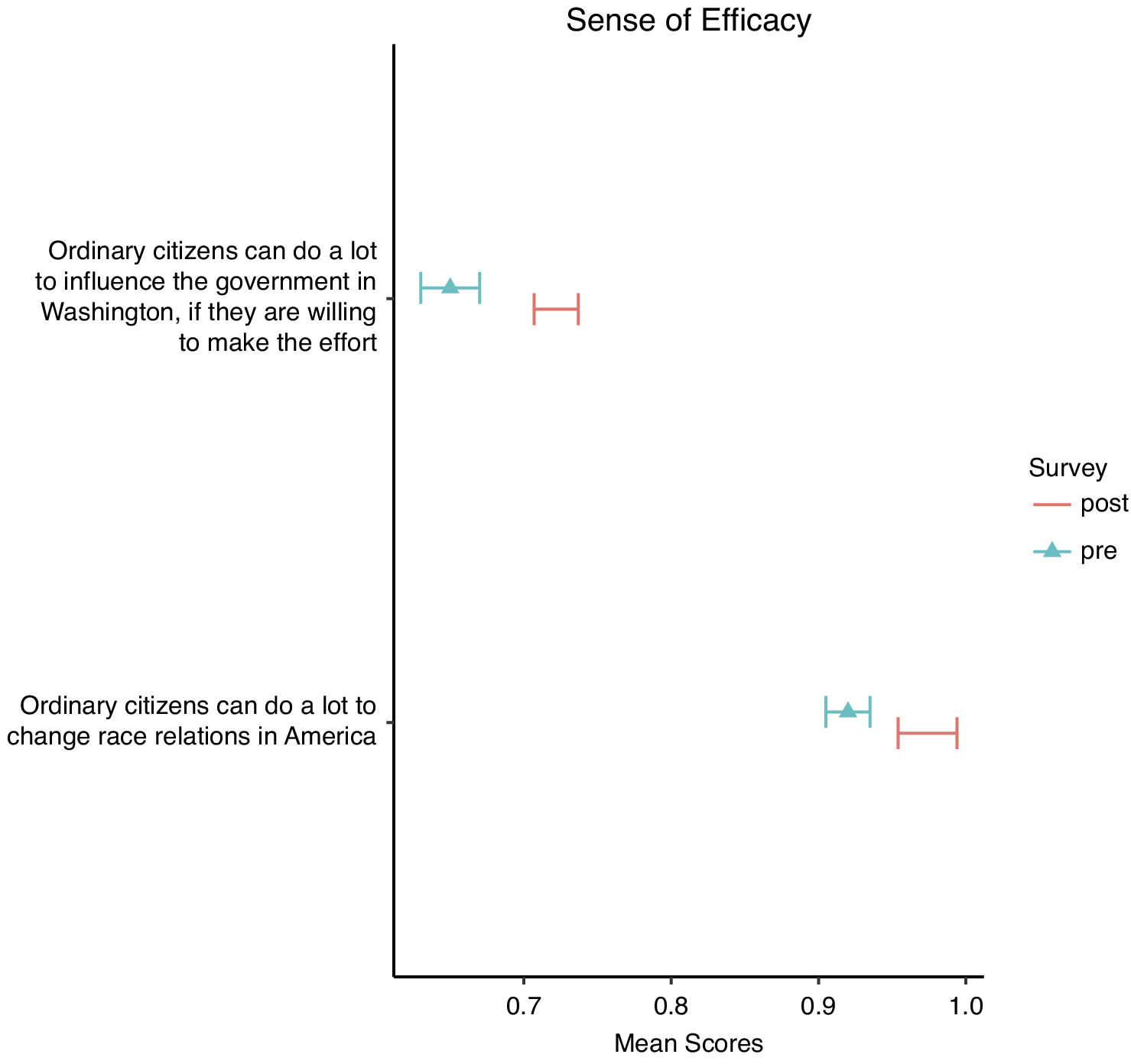
The pre/post survey results also indicate that Undivided participants are more likely to feel efficacious by the end of the program (see figure 4). In the pooled post-election survey, 73% of respondents agree that “ordinary citizens can do a lot to influence the government in Washington if they are willing to make the effort” as compared to 67% of respondents in the pre-survey. The 5.8 point increase in the mean is statistically significant at the p<.05 level. Moreover, the program leads to a 6.2 point increase (p<.05) in mean agreement with the statement that “ordinary citizens can do a lot to change race relations in America.” By the end of the program, roughly 98% of respondents somewhat or strongly agreed with the statement.
Pre- and post-survey mean differences in efficacy measures
Source = Pooled UNDIVIDED Sessions, 2018–19

Research shows that taking action on political issues like race takes a sense of efficacy, and that one of the biggest challenges in moving people to action is helping them feel like their actions matter (Han Reference Han2009; Finkel Reference Finkel1985; Bandura Reference Bandura1999). By giving people a chance to try different approaches and figure out what works, Undivided was able to help them develop their sense of their own efficacy. One white woman exemplified this idea with her comment that “it allows a space to fumble. I wasn’t confident enough before going through the program to ask questions. Going through Undivided gave me the confidence and provided that space for me to ask the tough questions.” People’s sense of their own efficacy, in other words, came from having learned a set of tools they could use to act on racial injustice.
Put together, the survey data shows that, in aggregate, participants in Undivided became more cognizant of taking the perspectives of people of other races, more efficacious regarding action on racial injustice, and less likely to feel alone in their quest for racial justice. Interviews with current and past program participants help demonstrate how participation in the program moved people from passively caring about racial justice to actively working towards it, and provide concrete examples of changes made to participants’ behavior, feelings of efficacy, and sense of community.
Discussion
Several important patterns emerge from this investigation. First, consistent with previous research, we find that Undivided did not have much impact on people’s racial attitudes. Many people who opted into the program had relatively progressive views on race from the start. Second, the quantitative and qualitative analysis both indicate that Undivided did change individuals’ self-reported behaviors. The surveys demonstrate that at an aggregate level, program participants strive to do better to speak up against injustice and more frequently try to understand the perspective of someone from another race. In our semi-structured conversations, participants discussed specific examples of real effects the program had on individual behaviors, including on what people read, where they get their news, and how they interact with people of other races. Others said they were now working on community organizing projects, providing leadership development for people of color in their companies, and implementing similar programs to Undivided in their foster-care groups and other churches.
Third, the program seems to be effective at developing personal relationships and fostering a sense of community among participants. One person in the focus group remarked that most people in the room had only known each other for a couple months, but were able to be open with each other in a way that they can’t be with others in their lives. The pre- and post-surveys showed that this feeling of community is widespread and increased after participating in Undivided. Given the importance of relationships in laying the foundation for change, this growing sense of community shows how Undivided makes possible some of the effects we witnessed.
Fourth, we observed important aggregate increases in people’s self-reported feelings of efficacy. Participants were more likely to believe that ordinary citizens can do a lot to influence the government and to improve race relations after going through Undivided. One interviewee said the program pushed her to think, “if not me, who?” Others talked about feeling a sense of responsibility to take action to improve society and their communities. This sentiment was reflected in several conversations and in many of the story blurb reflections.
Put together, we can begin to see an alternate pathway through which churches can move their congregations on issues of race. Too often, anti-racism and diversity, equity, and inclusion programs focus on trying to change people’s hearts and minds, putting them through trainings designed to root out racism. But such programs are notoriously ineffective and, in some cases, can even backfire. What the data from Undivided shows, however, is not that the program changed people’s minds, but instead that it helped identify people who were seeking to learn more or take action, and put them into the kind of relational communities that could animate action. This work reflects the first tier of change that must happen. Much research shows that moving people to political action on issues like race often starts with making them more comfortable with the kinds of social risks inherent in taking such action (Oyakawa, McKenna, and Han Reference Oyakawa, McKenna and Han2021). Our data show that programs that create a sense of community, increase people’s efficacy, and encourage them to change their behaviors can move people to action in new ways. Many of the focus group members and interviewees talked about the personal relationships they built during the program, particularly with people with difference racial backgrounds. For example, one white woman said that
I grew up with bias. I know I did. Undivided gives me an opportunity to unpack the bias by having personal relationships with people of color. I realized the burden that other people have to face every day. That there is everyday discrimination. I’ve learned to recognize my privilege. Now I want to educate other white people.
The design of the program—putting people into intimate small groups that are intentionally diverse—means that more people are likely to develop the kind of cross-racial relationships that this respondent describes.
A skeptic may ask why any of this matters when the program does not show any evidence of changing minds. In his work on community organizing, Mark Warren refers to it as a “match on dry grass.” It begins by identifying people who are ready to take action, and equipping them with the motivations, skills, and capacities they need to act. Once this first tier of change agents is developed, the goal is that they can then leverage their own social networks to expand into the second tier. Organizing puts these change agents into relationship with each other, building the kinds of relationships needed to sustain action over time. Then, operating within a bounded community like a congregation, the hope is that these evangelicals can be better equipped to change the views of their fellow congregants, reaching out to them congregant to congregant. Much research shows that for people whose views are deeply entrenched, the only way to break them out of their bubbles is for people with shared identities to engage them in sustained conversation and relationship (Wilson and Sherrell Reference Wilson and Sherrell1993; Teeny et al Reference Teeny, Siev, Briñol and Petty2021). Undivided appears to essentially be identifying, recruiting, and equipping the people who can become those ambassadors. An important avenue for future research would be exploring the effects of this second tier, to understand if and how these ambassadors can then begin to effect change within their institutions.
There are several additional avenues for future research stemming from limitations in our study. One, the data available to us only allows us to measure short-term changes in aggregate-level attitudes and self-reported behaviors. Future research should analyze the long-term impact of programs like Undivided on attitudes and behaviors. Two, Undivided was offered in a congregation that had sufficient racial and ethnic diversity among its congregants to make cross-racial relationship building possible. Fulton, Oyakawa, and Wood (Reference Fulton, Oyakawa and Wood2019) find that when people of color possess leadership positions and organizational authority within predominantly white organizations, they can play a crucial role in helping that organization confront and address racial inequality. It is unclear that a program like Undivided would be effective in a more racially homogenous congregation. Third, analyses in the supplemental appendix find that pre-post changes were largest among white respondents, male-identifying respondents, and respondents without college degrees. Future research can delve deeper into who is most influenced by programs like Undivided. Fourth, a randomized controlled trial would enable scholars to better pinpoint causal effects for which our panel data offer preliminary evidence. Fifth and finally, our data come from 2018 and 2019, when movements like Black Lives Matter were prominent on the national agenda and created a socio-political context that may have enabled programs like Undivided to be more effective than they would have been in other contexts. Studying other time periods and other congregations will be important.
Nonetheless, we offer evidence for the first step in an alternate pathway for the way in which change might be made in evangelical and other congregations around race—and, in doing so, show a pathway for any number of organizations struggling to achieve racial justice and help build a multiracial democracy. Current data on white evangelicals reveals a community that remains largely steeped in white supremacy, even though the broader evangelical community is racially diverse and more heterogeneous (Whitehead and Perry Reference Whitehead and Perry2020; Steensland and Goff Reference Steensland and Goff2014; Markofski Reference Markofskiforthcoming). Yet they represent a significant portion of the population and have the potential to play a crucial role in racial justice efforts and the development of a more just multiracial democracy. This approach takes advantage of the natural heterogeneity of views that exist within the community, as well as the trust and relationship already established through the church, to strengthen the ability of people who are open to taking action around race to actually act. That, we hope, can become like a match on dry grass.
Supplementary Materials
The online appendix includes pre- and post-survey mean differences in attitudes, individual behaviors, sense of community, and efficacy among Black respondents, white respondents, female respondents, and male respondents; and regression models that estimate the effects of demographic characteristics on pre- and post-survey mean differences.
To view supplementary material for this article, please visit http://doi.org/10.1017/S1537592722000950.
Acknowledgements
The authors would like to thank the organizers and participants of the Undivided program.
Appendix
Appendix Figure A.1 Demographic characteristics of the pre- and post-survey respondents

Appendix B.1 Question wording used to construct the Social Perspective Taking index
-
1. In general, how often do you attempt to understand African Americans better by trying to figure out what they are thinking?
-
2. In general, how often do you try to think of more than one explanation for why someone of another race acted as they did?
-
3. Overall, how often do you try to understand the point of view of African Americans?
-
4. In general, when you are angry at someone of another race, how often do you try to "put yourself in his or her shoes"?
-
5. Overall, how often do you try to figure out what emotions people of another race are feeling when you meet them for the first time?
-
6. In general, how often do you try to understand how people of another race view the situation?