Significant outcomes
∙ The European Portuguese version of the Confusion Assessment Method showed good feasibility, very good inter-rater reliability, moderate sensitivity and excellent specificity, which suggested that it emerges as a promising tool in the diagnosis of delirium in the elderly.
Limitations
∙ It was carried out only in an intermediate care unit and there was a long interval (1–7 h) between the two assessments.
Introduction
Delirium is a serious and common neuropsychiatric syndrome in elderly hospitalised patients (Reference Saxena and Lawley1). It has been associated with negative clinical outcomes that have been well documented, such as the increase of mortality, length of hospital stay and institutionalization (Reference Siddiqi, House and Holmes2). In view of the above, its early detection is very important to reduce morbidity and mortality in these patients. The use of standardised instruments in routine clinical practice can help in recognising symptoms, rating clinical improvement evaluating the effectiveness of interventions (Reference Grover and Kate3).
In this context, the Confusion Assessment Method (CAM) (Reference Inouye, Van Dyck, Alessi, Balkin, Siegal and Horwitz4) is a widely used and highly accurate delirium-screening instrument, based on the DSM-III-R criteria (5), for use by trained health professionals.
The CAM assesses the presence, severity and fluctuation of nine delirium features (long version): acute onset and fluctuating course*, inattention*, disorganised thinking*, altered level of consciousness*, disorientation, memory impairment, perceptual disturbances, psychomotor agitation or retardation, and altered sleep–wake cycle. This instrument also includes a diagnostic algorithm (short version), based on the four cardinal features of delirium (previously marked with an asterisk). Delirium diagnosis requires the presence of features 1 and 2, and either 3 or 4.
In the original study (Reference Inouye, Van Dyck, Alessi, Balkin, Siegal and Horwitz4), CAM demonstrated sensitivity of 94–100%, specificity 90–95%, when validated against the ratings of geriatric psychiatrists, and high inter-rater reliability (k=0.81–1.0). More recently, in a systematic review (Reference Wei, Fearing, Sternberg and Inouye6) of seven high-quality studies (n=1071) evaluating the performance of the CAM, combined sensitivity was 94% [95% confidence interval (CI)=91–97%], and specificity was 89% (95% CI=85–94%). The CAM has been translated and validated into various languages (Reference Martins, Simões and Fernandes7), as well as recommended by the most recent guidelines (8).
The aims of this study were to present the European Portuguese translation and cultural adaptation process and the pilot study of CAM (long version).
Materials and methods
Translation and adaptation process
This process was carried out according to the guidelines suggested by The Translation and Cultural Adaptation Group of the International Society Pharmacoeconomics and Outcomes Research (Reference Wild, Grove and Martin9), as follows:
∙ Preparation: permission to use the CAM from the author.
∙ Forward translation of the original instrument into the target language independently by two translators, health professionals.
∙ Reconciliation of the two forward translations into a single translation.
∙ Back translation into English by an independent professional, without any information about the original or other versions.
∙ Back translation review/harmonisation: the various versions were compared with detect any translation discrepancies and to ensure conceptual equivalence between versions.
∙ Cognitive debriefing
∙ Eight health professionals (psychiatrists, psychologists and nurses) read and examined the translated version to assess the level of comprehensibility, the cognitive equivalence and to detect any unclear words, concepts or other elements that they were unable to understand.
∙ One of the authors (L.F.) who is a geriatric psychiatry specialist, with clinical and research expertise regarding delirium, trained the researchers, a psychologist (S.M.) and a psychiatry resident (P.M.), based on the original training manual (Reference Inouye10). This included: four training sessions of 2 h (clinical overview about delirium, general overview on the cognitive assessment instruments, and the CAM and fulfilment of CAM pretest), one-on-one session (the researchers practiced the interview with each other), supervision of pilot interviews and inter-rater reliability assessment.
∙ Review of the cognitive debriefing results and finalisation: the findings of the debriefing process were incorporated to improve the performance of the translation. The final European Portuguese version of the CAM was a result of all the interactions described above.
Procedures
Between February and May 2012, elderly patients (≥65 years), admitted for at least 24 h into two intermediate care units (Intensive Medicine and Surgical Services) of the university hospital, CHSJ, Porto, were included in the present study. Two days per week were selected at random. Exclusion criteria were: Glasgow Coma Scale (total score ≤11) (Reference Teasdale and Jennett11), blindness/deafness, inability to communicate and not able to speak Portuguese.
In the inter-rater reliability process, each researcher completed the CAM independently and separately. In the pilot study, a blind assessment was conducted by a psychiatrist (L.F.) using DSM-IV-TR (reference standard) (12) and by a psychologist (S.M.) using CAM.
The CAM was completed based on observations made during a clinical interview (patient and family/caregiver) and a formal cognitive assessment: Mini-Mental State Examination (Reference Folstein, Folstein and Mchugh13) and Digit Span Test (Reference Wechsler14).
The Hospital Ethics Committee approved the present study. Informed consent was obtained from the patient or from their relatives if the patient was unable to decide for him/herself.
Data analysis
For statistical analysis, SPSS software version 19.0 was used. The inter-rater assessment reliability was calculated using Cohen’s κ coefficient. The strength of agreement of the κ statistics was based on the guidelines from Landis and Koch (Reference Landis and Koch15).
Concurrent validity was assessed by sensitivity, specificity, positive and negative predictive value for the European Portuguese version of CAM against the reference standard, calculated by the standard formula, using 95% confidence intervals.
Results
The European Portuguese version revealed a good level of comprehensibility and conceptual equivalence with the original English version.
In the inter-rater reliability study, 26 patients were recruited, of which six were excluded (mutism). Eventually 20 were included, 20 paired tests were carried out and 40 CAM instruments were completed.
According to the guidelines from Landis and Koch (Reference Landis and Koch15), the inter-rater reliability was very good (k>0.81) for all items and good for inattention (k=0.77) and disorientation (k=0.65).
In the pilot study, 77 elderly patients were initially enrolled, with 27 excluded (sixteen incomplete interviews, two refused and Reference Wild, Grove and Martinnine were already included in the study). The final sample (n=50), with a mean age of 77.56 (SD 8.5) were majority male (60%), married (60%), with lower educational level (90%≤4 years) and living at home (88%). The main reasons for hospital admission were cardiorespiratory (54%) and gastrointestinal (20%) problems.
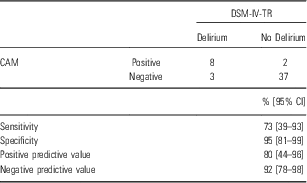
Compared with the reference standard (DSM-IV-TR), the European Portuguese version of CAM had a sensitivity of 73% and a specificity of 95%. The positive and negative predictive values are also presented in Table 1.
Comparison of DSM-IV-TR diagnosis and CAM ratings
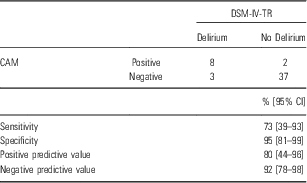
CAM, Confusion Assessment Method.
The mean time between assessments was 4 h. CAM was completed in 5 min on average.
Discussion
The psychometric proprieties of CAM seem to be consistently good, in accordance with other validation studies (Reference Inouye, Van Dyck, Alessi, Balkin, Siegal and Horwitz4,Reference Monette, Galbaud and Fort16–Reference Wongpakaran, Wongpakaran and Bookamana22).
The translation process was developed based on methodological assumptions that ensure its validity, well documented in each step. Despite the existence of a Brazilian Portuguese translation of the CAM, the translation and adaptation of this instrument for the European Portuguese population is necessary, bearing in mind the significant lexical, syntactical and semantic differences between the two varieties of Portuguese. Moreover, important Brazilian studies on CAM-ICU (Reference Ely, Margolin and Francis23), an adaptation for intensive care units, have been recently published (Reference Salluh and Vidal24–Reference Gusmao-Flores, Salluh, Chalhub and Quarantini26), along with a previous European Portuguese translation (Reference Granja and Lopes27), showing the evident socio-cultural differences.
In the present study, the agreement for the nine individuals of CAM features was substantial, considering κ values.
Moderate sensitivity and good specificity were found when compared with the original study (Reference Inouye, Van Dyck, Alessi, Balkin, Siegal and Horwitz4) and with other previous validation studies (Reference Monette, Galbaud and Fort16–Reference Wongpakaran, Wongpakaran and Bookamana22).
Delirium was incorrectly classified in two cases of moderate dementia. The differential diagnosis of delirium and dementia can be difficult because they share many common clinical features (Reference Martins and Fernandes28).
The reasons for the three false-negatives were related to fluctuations in mental state or the absence of information about the patient’s cognitive baseline.
The strength of this study was linked to the inclusion of patients with dementia and other cognitive impairments and the two blind comparisons, as well as the reference standard assessment made for all patients with or without a positive CAM score.
A limitation of this study was the selection of a convenience sample, recruited from intermediate care units in the university hospital, without previously screening all of the patients admitted in these two units. In addition, a constraint in feasibility was the long interval (1–7 h) between the two assessments. Further evaluation of this version in other settings with larger sample sizes remains a task for future research.
In conclusion, the European Portuguese version of the CAM showed good feasibility and overall very good inter-rater reliability. The sensitivity and specificity rates found also suggested that this version emerges as a promising tool in the diagnosis of delirium in elderly patients admitted into intermediate care units.
Acknowledgements
The authors wish to thank clinical staff and all patients/families for their collaboration. The present work was supported by the Foundation for Science and Technology (SFRH/BD/63154/2009). Lia Fernandes and Mário Simões participated in the definition and design of the study. Sónia Martins, Patrícia Moldes and Lia Fernandes participated in the data collection and in writing the article. Sónia Martins, Mário Simões and Lia Fernandes contributed to the analyses and interpretation of the results, as well as to the critical revision of the article with João Pinto-de-Sousa, Filipe Conceição and José Artur Paiva. All authors have approved the final manuscript.
Conflicts of Interest
None.