INTRODUCTION
As the most abundant component of periphyton communities or biofilms, periphytic diatom assemblages are responsible for the bulk of primary production of microbial food webs in many aquatic ecosystems (Oemke & Burton, Reference Oemke and Burton1986; Gold et al., Reference Gold, Feurtet-Mazel, Coste and Boudou2002; Duong et al., Reference Duong, Feurtet-Mazel, Coste, Dang and Boudou2007; Khatoon et al., Reference Khatoon, Yusoff, Banerjee, Shariff and Mohamed2007; Morin et al., Reference Morin, Duong, Dabrin, Coynel, Herlory, Baudrimont, Delmas, Durrieu, Schäfer, Winterton, Blanc and Coste2008; Debenest et al., Reference Debenest, Pinelli, Coste, Silvestre, Mazzella, Madigou and Delmas2009; Xu et al., Reference Xu, Zhang, Jiang, Zhu and Al-Rasheid2012). With their rapid responses to both hydrologic and water quality changes, periphytic diatoms have widely been used as a useful bioindicator of many pollution (e.g. acidification, eutrophications, organic pollutions and metallic pollution) issues in both European and Asian countries (Lange-Bertalot, Reference Lange-Bertalot1979; Almeida, Reference Almeida2001; Gold et al., Reference Gold, Feurtet-Mazel, Coste and Boudou2002; Blanco & Bécares, Reference Blanco and Bécares2010; D'Costa & Anil, Reference D'Costa and Anil2010; Duong et al., Reference Duong, Morin, Coste, Herlory, Feurtet-Mazel and Boudou2010; Kirta et al., 2012).
The community parameters (e.g. species richness, abundance and diversity) of a community have widely been used to evaluate water quality in aquatic ecosystems based on both traditional microscopy and molecular methods (Ismael & Dorgham, Reference Ismael and Dorgham2003; Besse-Lototskaya et al., Reference Besse-Lototskaya, Verdonschot and Sinkeldam2006; Dorigo et al., Reference Dorigo, Lefranc, Leboulanger, Montuelle and Humbert2009, Reference Dorigo, Bérard, Bouchez, Rimet and Montuelle2010; Zhang et al., Reference Zhang, Xu, Jiang, Zhu and Al-Resheid2012a, Reference Zhang, Xu, Jiang, Zhu and Al-Resheidb). However, they are subject to their dependence on sampling effort and enumeration strategy (Taylor et al., Reference Taylor, Prygiel, Vosloo, Rey and Rensburg2007; D'Costa & Anil, Reference D'Costa and Anil2010; Dorigo et al., Reference Dorigo, Bérard, Bouchez, Rimet and Montuelle2010; Kireta et al., Reference Kireta, Reavie, Sgro, Angradi, Bolgrien, Hill and Jicha2012). The effective enumeration time periods of periphytic diatoms have increasingly been important in detecting their community parameters, as these ecological features of periphytic diatom communities have been widely used to determine water quality status in aquatic ecosystems (Dang & Boudou, 2007; Dorigo et al., Reference Dorigo, Lefranc, Leboulanger, Montuelle and Humbert2009, Reference Dorigo, Bérard, Bouchez, Rimet and Montuelle2010; Lei et al., Reference Lei, Lam and Hu2011; Zhang et al., Reference Zhang, Xu, Jiang, Zhu and Al-Resheid2012a, Reference Zhang, Xu, Jiang, Zhu and Al-Resheidb).
In order to reduce the possibility of significant changes in community structures, various maximum time periods have been proposed during which the analyses of the community parameters should be performed (Hameed, Reference Hameed2003; Nayar et al., Reference Nayar, Goh and Chou2005; Morin et al., 2010). However, the influence of enumeration time periods on detecting the community parameters of periphytic diatoms has been the subject of few specific attentions.
In this study, the influence of enumeration time periods on detecting the community parameters of periphytic diatoms with different exposure times was studied using glass slides as an artificial substratum in coastal waters of the Yellow Sea, near Qingdao, northern China from May to June, 2010. Our aims were: (1) to document the influence of enumeration periods on analysing the community features of periphytic diatoms with different colonization ages; and (2) to determine an optimal enumeration strategy for assessing water quality in marine ecosystems.
MATERIALS AND METHODS
Data collection
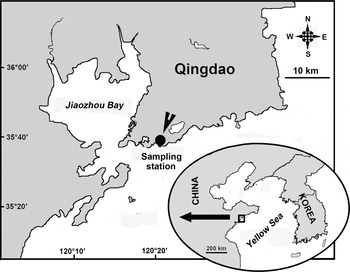
This study station was located in coastal waters of the Yellow Sea, near Qingdao, northern China from 18 May to 16 June 2010 (Figure 1). It is an area with a depth of ~8 m. The water conditions were recorded as: water temperature 14–19°C; pH ~8, salinity 30–31 psu; dissolved oxygen 6–7 mg l−1; and transparency ~3 m during the study period. The glass slide systems were designed, deployed, anchored and sampled as described by Xu et al. (Reference Xu, Zhang, Jiang, Zhu and Al-Rasheid2012).
Sampling station located at coastal waters of the Yellow Sea, near Qingdao, northern China.

A total of 100 glass slides (17.5 cm2 for each) were used as artificial substrata for collecting periphytic diatom communities at depths of 1 m below the water surface. A total of five PVC frames were used to hold these glass slides as two parallel sampling replicates. For each replicate, six glass slides were randomly collected from one PVC frame at the time intervals of 1, 3, 7, 10, 14, 21 and 28 days, during the study period. The slides were transferred into Petri dishes containing water from the sampling station, and then stored in a cooling box before transporting to the laboratory within 2 h for identification and enumeration (Xu et al., Reference Xu, Zhang, Jiang, Zhu and Al-Rasheid2012).
Identification and enumeration
Identification and enumeration of periphytic diatom species were conducted following the methods outlined by Xu et al. (Reference Xu, Zhang, Jiang, Zhu and Al-Rasheid2012). Taxonomic classification of diatoms was based on published keys and guides such as Hasle & Syvertsen (Reference Hasle, Syvertsen and Tomas1997).
For assessing the influence of enumeration on analysing community parameters of the periphytic diatoms, the enumeration was carried out in vivo at a 100–1000× magnification under an inverted microscope in two schemes — one within 24 h and the other within 24–48 h after sampling (Xu et al., Reference Xu, Zhang, Jiang, Zhu and Al-Rasheid2012). For recovering all species using each enumeration scheme, one surface of an entire slide from a total of 12 glass slides was examined at each exposure time using bright field illumination and occurrences were recorded. For the enumeration of cell densities, one entire slide surface was examined within each colonization period of <10 days, whereas for exposure times of 10 days or more, ten randomly chosen fields of view per slide were examined and the dominant ciliates were enumerated. For each replicate, cell numbers were calculated to confirm the average abundance of periphytic diatoms (cell cm−2).
Data analyses
Species diversity (H′), evenness (J′) and species richness (D) of samples were calculated as follows:
 $$H^\prime=-\sum\limits_{i=1}^s {P_i\lpar \ln Pi\rpar }$$
 $$J^\prime=H^{\prime} / \ln S$$
 $$D=\lpar S-1\rpar / \ln N$$
where H′ = observed diversity index; P i = proportion of the total count arising from the i th species; S = total number of species; and N = total number of individuals.
The standard errors of the community parameters between both enumeration schemes were summarized using the coefficient of variation (CV) (Xu et al., Reference Xu, Zhang, Jiang, Zhu and Al-Rasheid2012).
The non-parametric Kolmogorov–Smirnov test was used to evaluate the differences in the community structure parameters (e.g. species richness and cell number) based on different enumeration strategies at the 0.05 level.
All multivariate analyses and routines were conducted using PRIMER v.6.1.15 (Clarke & Gorley, Reference Clarke and Gorley2006). The matrices of periphytic diatom communities based on different enumeration strategies were analysed by cluster analysis and non-metric multidimensional scaling (MDS) ordination on Bray–Curtis similarity matrices from square root transformed species-abundance data (Clarke & Gorley, Reference Clarke and Gorley2006). The significance of differences in periphytic diatom community matrices between two enumeration strategies was verified using the SIMPROF test (Clarke & Gorley, Reference Clarke and Gorley2006).
RESULTS
Influence on detecting of species richness and abundance
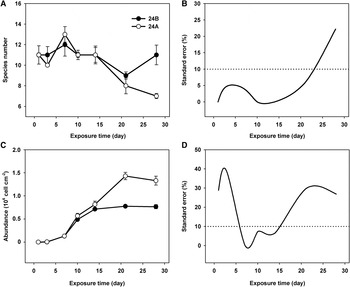
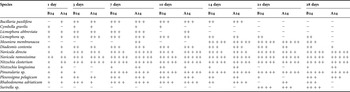
A total of 14 diatom taxa were identified with two enumeration schemes in 28 samples during the study period (Table 1). Species numbers of periphytic diatoms recorded based on two enumeration schemes in 1-, 3-, 7-, 10-, 14-, 21- and 28-day samples during the study period are summarized in Figure 2. Compared to the routine enumeration scheme, the values of species numbers were significantly low at almost all exposure times in the case of delayed enumeration (P < 0.05) (Figure 2A). The standard errors of species numbers showed a clear increasing trend with the increase of exposure times by day 10 (Figure 2B). It should be noted that the standard errors were not less than 10% after day 21 or more.
Species numbers (A) and abundances (C) of periphytic diatoms in 1-, 3-, 7-, 10-, 14-, 21- and 28-day samples, and standard errors of species number (B) and abundance (D) between two enumeration schemes within 24 h and 24–48 h (C, D) in coastal waters of the Yellow Sea during the study period. B24, enumeration within 24 h; A24, enumeration within 24–48 h.

List of the species of periphytic diatoms recorded in a total of 28 (14 A24 and 14 B24) samples collected at a depth of 1 m in coastal waters during the study period, including degree of average abundances.

B24, within 24 h; A24, within 24–48 h; +, 0–10 cell cm−2; ++ , 10–100 cell cm−2; ++ + , 100–1000 cell cm−2; ++ + +, 1000–10,000 cell cm−2; ++ + ++, over 10,000 cell cm−2.
The cell numbers of the periphytic diatoms in 1-, 3-, 7-, 10-, 14-, 21- and 28-day samples based on two enumeration schemes are summarized in Figure 2C. The abundances of periphytic diatoms were significantly lower on the routine enumeration scheme than those the delayed one (P < 0.05) (Figure 2C). The standard errors of abundance values were higher than 10% at almost all exposure times (Figure 2D).
Influence on analysis of community structures
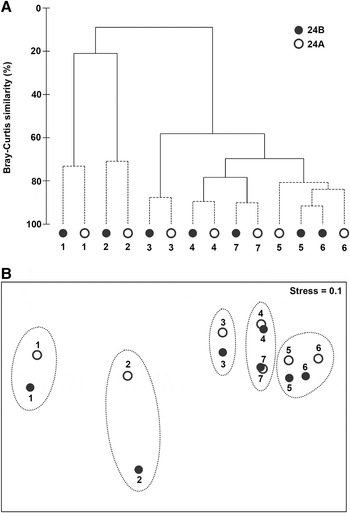
The colonization patterns of periphytic diatom communities based on two enumeration regimes were analysed using cluster analysis and MDS ordination (Figure 3A, B). The cluster analysis with SIMPROF test showed that there is a high similarity (>70%) with no significant differences between the each pair of the communities with same exposure times based on the two enumeration schemes (Figure 3). However, it should be noted that the dissimilarity coefficients of the communities at each colonization time between the two enumeration schemes were generally >10%, especially at the young ages of <10 days (Table 2).
Cluster analyses (A) and multidimensional scaling (MDS) ordination (B) on Bray–Curtis similarity matrices from square root transformed species-abundance data of periphytic diatom communities in 1-, 3-, 7-, 10-, 14-, 21- and 28-day samples, based on two enumeration schemes within 24 h and 24–48 h (C, D) in coastal waters of the Yellow Sea during the study period. B24, enumeration within 24 h; A24, enumeration within 24–48 h; Dotted lines in Figure 4A, show no significant difference among samples; dotted contour, 70% similarity level; 1, 3, 7, …, and 28, symbols of samples with 1-, 3-, 7-, …, and 28-day exposure times.

Dissimilarities between periphytic diatom communities at each exposure time of 1, 3, 7, 10, 14, 21 and 28 days based on two enumeration schemes (within 24 h and 24–48 h) in coastal waters of the Yellow Sea, near Qingdao, northern China, during the study period.

Influence on detecting diversity measures
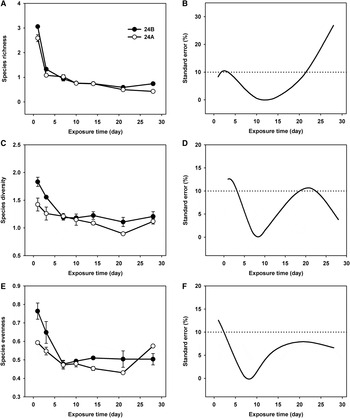
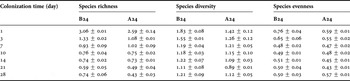
The temporal variations in all three biodiversity (species richness, species diversity and species evenness) indices of the periphytic diatom communities at all exposure times obtained from different enumeration strategies are plotted in Table 3; Figure 4A, C & E). The values of the three indices were significantly reduced by the delayed enumeration (P < 0.05) (Figure 4). The standard errors of the species richness and diversity were more than 10% at early (1–3 days) and late (21 days or more) stages, while the species evenness showed low sensitivity to the enumeration time periods compared to the other two indices (Figure 4B, D & F).
Species richness (A), diversity (C) and evenness (E) of periphytic diatom communities in 1-, 3-, 7-, 10-, 14-, 21- and 28-day samples, and standard errors of species richness (B), diversity (D) and evenness (F) indices of the samples, based on two enumeration schemes within 24 h and 24–48 h in coastal waters of the Yellow Sea during the study period. B24, enumeration within 24 h; A24, enumeration within 24–48 h.

Species richness, species diversity and species evenness of periphytic diatom communities at each colonization time at a depth of 1 m in coastal waters during the study period.

B24, within 24 h; A24, within 24–48 h.
DISCUSSION
In previous studies on periphytic diatom communities, samples were usually examined within 2–4 h after sampling (Morin et al., 2010). However, such a short time period (<4 h) is not sufficient in the cases when samples were collected in large spatial/temporal scale at a number of stations, especially where the same person is responsible for both the microscopic analyses and physicochemical measuring on the same day. Thus, the enumeration time periods during which no significant changes occur within a diatom community determines greatest flexibility of analysis without compromising accuracy. Strüder-Kypke (Reference Strüder-Kypke1999) proposed that there was no significant changes in periphyton communities when enumerated within 48 h. In the present study, the results showed that the delayed enumeration significantly reduced the community parameter values observed, although no significant changes occurred in periphytic diatom community structures between the two enumeration time strategies.
Based on our results, the delayed enumeration (after 24 h) may result in the similarity of the communities being reduced (10–29%), and in the biodiversity indices (richness, evenness, and diversity of species) significantly decreasing at almost all exposure times. The species richness and diversity showed a low sensitivity to the delayed enumeration only at early and late exposure times, compared to the abundance, of which the standard errors were higher than 10% in most samples. Of three diversity indices, the species evenness represented was insensitive to the delayed enumeration. These results suggest that the delayed enumeration represented a significant influence on detecting community parameters of periphytic diatoms for assessing water quality in marine ecosystems. However, further studies on a range of marine waters and over extended time periods using both microscopy and molecular methods are needed in order to verify this conclusion.
It should be addressed that the traditional microscopy method, i.e. identification of periphytic diatom taxa at the lowest possible taxonomic level, limits the use of periphytic diatoms for monitoring water quality due to the enumeration time period available. Thus, a variety of methodologies to reduce the time costs were expected. So far, the molecular approaches (e.g. denaturing gradient gel electrophoresis and HPLC pigment analysis) for analysing the global taxonomic composition of the photoautotrophic communities have been proved to be an effective technique for reducing the time costs of bioassessment by identifying taxa to the highest possible category (Amann et al., Reference Amann, Ludwig and Schleifer1995; Dorigo et al., Reference Dorigo, Lefranc, Leboulanger, Montuelle and Humbert2009, Reference Dorigo, Bérard, Bouchez, Rimet and Montuelle2010). It also should be noted that there were a decrease in species number and an increase in abundance by the 24–48 h enumeration method. This may be due to the significant changes in environmental conditions of the cooling box within the period of 24–48 h. For example, some rare diatom species may be dissolved under the dark conditions, while the individual abundance may have increased with the decrease of their grazers' feeding effects due to the low temperature in cooling box. Thus, this may be the reason that the species richness, diversity and evenness of the diatom communities were significantly reduced in delayed enumeration method.
In summary, enumeration time periods represented a significant influence on detecting the community features of periphytic diatoms, although no significant changes occurred in periphytic diatom community structure between two enumeration schemes (within 24 h and 24–48 h). The delayed enumeration (within 24–48 h) may result in the similarity of the communities being reduced 10–29%, and in species numbers decreasing and in abundance increasing with exposure duration, respectively. The diversity (richness, evenness, and diversity of species) indices were significantly decreased in almost all samples with >10% standard errors at some exposure times by the delayed enumeration scheme. These results suggest that the delayed enumeration may have resulted in the species richness and individual abundance of periphytic diatoms significantly decreasing and increasing, respectively, and thus significantly affected the analyses of species diversity for assessing water quality in marine ecosystems.
FINANCIAL SUPPORT
This work was supported by The Natural Science Foundation of China, project number 41076089.