Bradycardia, complete, or advanced atrioventricular block are among the factors responsible for the occurrence of Torsades de Pointes. Reference Moroe, Saku, Tashiro, Hiroki and Arakawa1 In this case report, we present a young child with syncope attacks who had Torsades de Pointes because of late-onset postoperative complete atrioventricular block.
Case presentation
A 5-year-old girl with Down syndrome was admitted from another hospital with an episode of syncope. The patient’s vital signs were within normal limits, except for marked bradycardia. When she was 6 months old, she had been operated for a ventricular septal defect. She went to post-operative follow-ups regularly and there were no problems. She had no a family history of CHD or cardiac conduction disease. Her parents had normal electrocardiograms and normal QT intervals. She was not taking any QT prolonging medications. The patient was referred to our centre for further treatment.
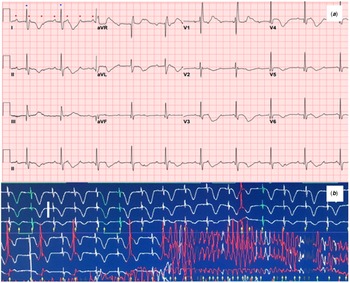
Her laboratory findings were normal complete blood count, normal liver and kidney functions, and normal serum electrolyte levels. Her initial electrocardiogram showed a complete atrioventricular block at a rate of 60 beats per minutes (bpm) (Fig 1a). The echocardiogram revealed enlarged left atrium and left ventricle. Near normal left ventricular systolic function was detected with an ejection fraction of 50%.
( a ) Complete atrioventricular block is seen (ventricular rate: 60 bpm) at the 12 lead electrocardiogram (red dots indicate atrial activity and blue dots indicate ventricular activity). ( b ) Holter recording of complete atrioventricular block patient. Torsades de pointes is appearing with prolonged QT interval and R on T phenomenon.
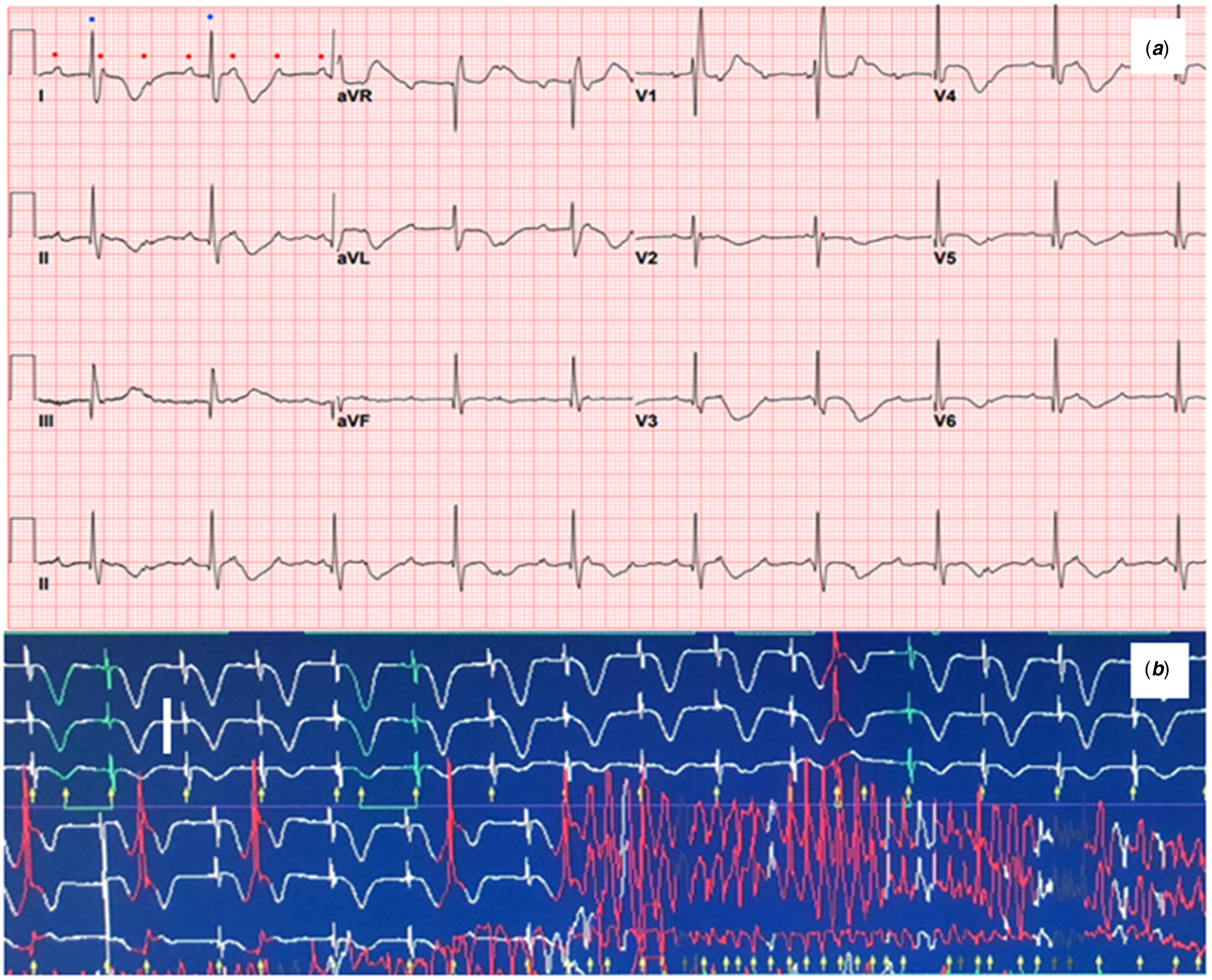
The patient was taken to the ICU, and her heart ryhythm was monitored and Holter recording was started. In the intensive care follow-up, the patient had an attack of syncope. Due to bradycardia (heart rate 30 bpm), cardiopulmonary resuscitation lasting 2 minutes was performed. While isoproteronol infusion was initiated immediately, the patient was urgently taken to the catheterisation room and a temporary pacemaker was implanted. R on T phenomenon and short-term Torsades de Pointes oscillation were observed in the Holter recordings of the patient at the time of the syncope. Also, she had a prolonged QT interval (850 ms) (Fig 1b).
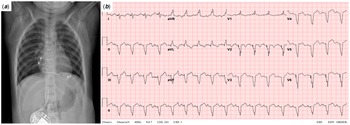
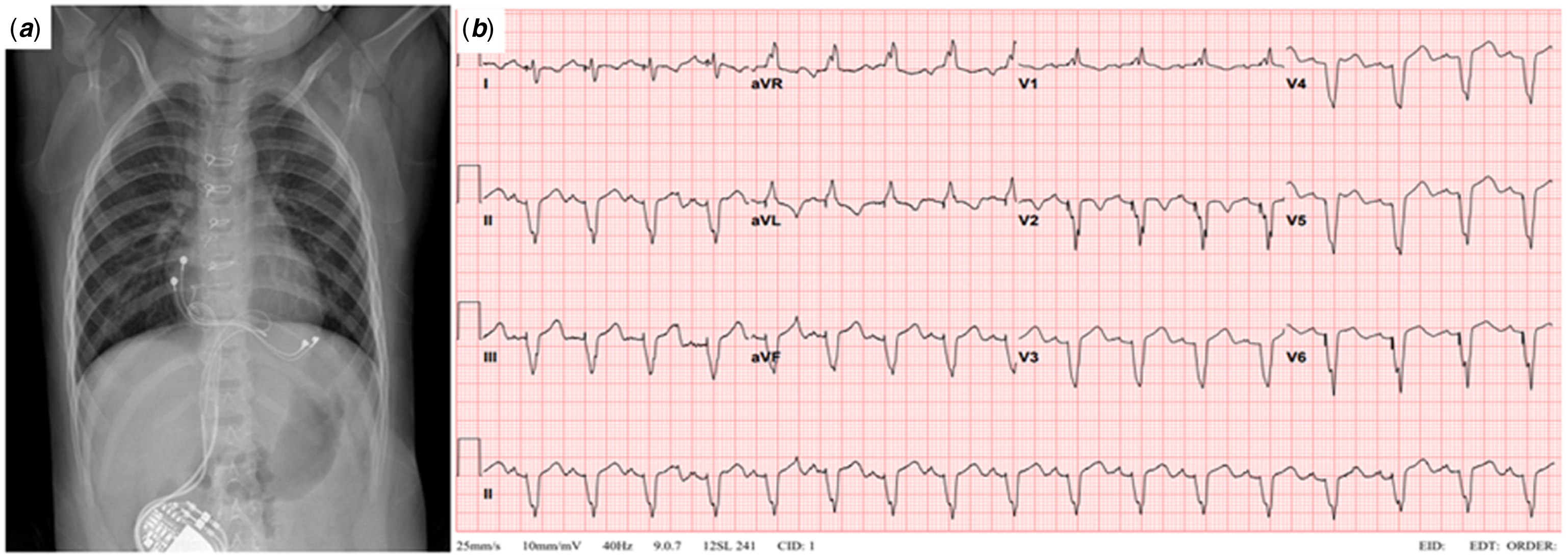
An epicardial, dual-chamber pacemaker, and two leads placed in the right atrium and left ventricle apex were surgically implanted because of late-onset post-operative complete atrioventricular block (Fig 2a). She did not have attack of syncope or ventricular arrhytmia. QT interval returned to normal at 2-month follow-up (Fig 2b).
( a ) Chest X-ray shows an epicardial, dual-chamber pacemaker, and two leads placed in the right atrium and left ventricle apex. ( b ) Normal QT interval after permanent pacemaker at the 12 lead electrocardiogram.
Discussion
The incidence of complete heart block after open-heart surgery is between 1 and 3%. Reference Gross, Chiu, Hamilton, Kirsh and Stephenson2 Especially patients with Down syndrome undergoing ventricular septal defect repair had a higher rate of heart block requiring permanent pacemaker implantation. Reference Fudge, Li and Jaggers3,Reference Tucker, Pyles, Bass and Moller4 Usually, heart block occurs immediately after surgery or in the early post-operative period. Rarely, it may occur months or years after surgery. Reference Bonatti, Agnetti and Squarcia5–Reference Ayyildiz, Kasar and Ozturk7 In this case, complete atrioventricular block developed 4 years after surgical ventricular septal defect repair. In the literature, patients who were in sinus rhythm after the surgical procedure and had a pacemaker inserted years later were described but the incidence of postoperative late-onset atrioventricular block has not been clearly determined. Reference Lin, Mahle and Frias8,Reference Liberman, Pass, Hordof and Spotnitz9
It is possible to manage in a timely manner by closely monitoring if the heart block develops in the early post-operative period. However, patients who develop heart block in the late post-operative period may be asymptomatic or present with non-specific findings such as fatigue. At worse, they may present with heart failure, syncope, and sudden death. For this reason, telemetry control is very important in the post-operative follow-ups of patients who have had congenital heart surgery, even if they are discharged from hospital in sinus rhythm.
It is possible to predict that some patients may develop heart block. Postoperatively transient complete atrioventricular block, long PR according to pre-operative telemetry, and different P and QRS morphology are among the stimulating factors. Reference Lin, Mahle and Frias8,Reference Villain, Ouarda, Beyler, Sidi and Abid10 The possible post-operative risk factors are unknown in our patient. Down Syndrome and perimembranous ventricular septal defect were predictable risks for the patient in the preoperative period. There are similar cases in the literature. Reference Nasser, Mesned, Mohamad and Kabbani11,Reference Altaweel, Kabbani, Hijazi, Hammadah and Al Ghamdi12
Our case is also an excellent example of Torsades de pointes-related syncope in complete atrioventricular block. Bradyarrhythmia is an expected finding in patients with complete atrioventricular block. However, it is rare for bradyarrhythmias to be associated with QT interval prolongation and Torsades de pointes. Reference Subbiah, Gollob and Gula13 Kurita et al. Reference Kurita, Ohe and Marui14 hypothesises that patients with complete atrioventricular block have a bradycardia-sensitive repolarisation abnormality, and therefore may develop Torsades de pointes. In our case, the heart rate was under 60 bpm and Torsades de pointes started by an ectopic ventricular complex interrupting the T wave before isoproteronol infusion.
Conclusions
The definitive treatment of late-onset post-operative atrioventricular block is permanent pacemaker implantation. It should be kept in mind that the conduction system should be carefully monitored in the long-term follow-up of patients who have had congenital heart surgery.
Acknowledgement
We thank our paediatric cardiac surgery team for their valuable support.
Financial support
The clinicians received no grants from any funding agency and no support from any commercial or not-for-profit sector.
Conflicts of interest
None.
Ethical standards
The authors assert that this work complies with the ethical standards of the relevant national guidelines on human experimentation and with the Helsinki Declaration of 1975, as revised in 2008. This case was approved by the patient’s family.