Introduction
When families can no longer cope, many people with dementia spend the end of their lives in long-term residential care facilities, which range in quality from simply excellent to extremely poor. Most will be at a stage of impairment where it is difficult or impossible to understand what is happening and why, instead of family or friends, they are dependent on care staff. The staff, themselves always extremely rushed, will be of varying quality, often poorly paid and supported, accorded low status, and sometimes minimally trained (Beck et al., Reference Beck, Ortigara, Mercer and Shue1999; Edberg et al., Reference Edberg, Bird, Richards, Woods, Keeley and Davis-Quarrell2008; Daly and Szebehely, Reference Daly and Szebehely2012). Despite this, for good or ill, care staff can be the most important part of the resident's social world, with interactions ranging from a brief smile or sharp reprimand to supporting or forcing intimate personal care. It is a symbiotic relationship in what can be highly emotional as well as physical and technical work. What staff feel and do and the way they do it affects residents’ emotional response and behavior, and what residents do and feel affects staff well-being and behavior (Berg et al., Reference Berg, Hallberg and Norberg1998; Holst et al., Reference Holst, Edberg and Hallberg1999; Wells et al., Reference Wells, Dawson, Sidani, Craig and Pringle2000; Daly and Szebehely, Reference Daly and Szebehely2012). This systematic review aims to shed light on interventions into the first part of this dynamic relationship, using data published in peer-reviewed English language journals over the last 20 years.
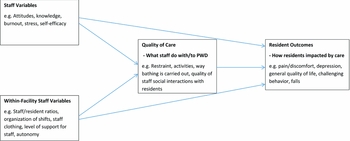
That is, we examine the effect of interventions at staff level on two possible outcomes: (i) quality of care and (ii) consequent effects on resident quality of life, broadly defined across a range of outcome variables (see Figure 1). The ideal is studies which show the effect on both outcomes but eligible papers must link the intervention with at least one of them. Thus, papers which examine effects only on staff, for example, an intervention to change attitude which only has internal staff outcome measures are ineligible. We are interested solely in interventions whereby direct care staff are educated, emotionally supported, or otherwise targeted with the explicit aim of improving and maintaining quality of care and/or physical and emotional quality of life for the resident with dementia, and where at least one of these outcomes is adequately measured. It is not enough to know that it has an effect on staff. Instead of the common assumption that, for example, changed staff attitude will automatically lead to better care or quality of life, there has to be credible evidence of change at care or resident level.
Relationships between variables.

The focus therefore is on interventions explicitly aimed at providing care staff with sufficient tools to deliver the intervention during the measurement period, and then maintain improvements after the project team withdraws. We particularly need to know what is possible in the many facilities where existing hands-on staff are the only available resource for change.
Definitions: staff variables, quality of care, quality of life
We are solely interested in staff factors that are genuinely variable: that is, potentially capable of change following interventions at the individual or collective staff level. Variables such as staff age or gender are irrelevant because they cannot be changed. Interventions trying to improve variables like level of skill or knowledge are much more salient. We also look at potentially adjustable within-facility staff variables, such as level of support, the way shifts are organized, but not at facility-level variables such as type of unit (e.g. Special Care Unit (SCU) vs. nursing home, private vs. for profit), which is not an accurate enough variable and is already heavily reviewed with equivocal results (e.g. Chappell and Reid, Reference Chappell and Reid2000).
We are then interested in what happens after an intervention – at a minimum whether anything changes in what staff actually do – quality of care. Some studies treat quality of care as a black box, an intervention is delivered and results on residents assessed, but we believe it is important to assess the mediating factors in order to more accurately target interventions. We define quality of care as anything which is done to or with the resident, such as the way showering is carried out, how staff communicate with residents, use of psychotropic medication, how much time residents spend alone. Variables such as pain or aggression or pressure sores are often used as quality of care measures in the literature, but they are only proxies for presumed poor care (Beerens et al., Reference Beerens2014). Without true quality of care measures, for example, frequency of pain assessment or level of staff skill in bathing, it is merely an assumption that they reflect poor care. We regard these commonly used proxies as quality of life variables, representing the resident's state. We define quality of life much more broadly than a score on a quality of life scale. We do include studies with such scales as an outcome but pay equal weight to specific medical/physical and psychosocial conditions that affect or reflect the residents’ state: for example, pain, depression, social engagement, malnutrition, and challenging behavior.
We accept evidence of changed quality of care as a minimum clinical target in its own right but are chiefly interested in studies which also examine whether quality of life of residents also improves. If only quality of care is measured, we do not know whether life improves for the resident – presumably the ultimate goal of the exercise. If only quality of life is measured after an intervention, we do not know what staff are doing differently to produce improvement. For all of these variables, we require validated or clearly objective measures.
Summary of aims
In summary, our aim was to answer a basic question. Which interventions aimed at residential care staff experience, practice, belief, or deployment improve the way care is carried out and, as a consequence, improve the lives of the people with dementia in their care over a sustained period?
Method
Ethical considerations
Since this review only encompasses readily available literature, the Human Research Ethics Committee at the Australian National University advised that ethical approval was not required.
We acknowledge that the terms used in this review, such as challenging behavior, are limited by the papers we have included and what has been published historically.
Search strategy
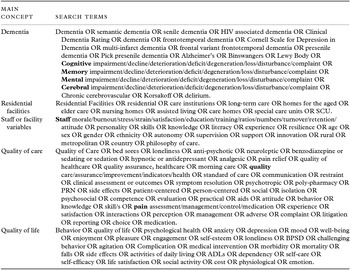
We searched six online databases: MEDLINE, EMBASE, PsycINFO, Cochrane Campbell Collaboration, PubMed, and the Cumulative Index to Nursing and Allied Health Literature (CINAHL). Search terms were developed by two of the authors (MB and KA) and added to by referring to the MESH thesaurus, Emtree thesaurus, and the Thesaurus of Psychological Index Terms. Prior to the initial search, the list of search terms were reviewed by the project consultative committee, comprising a consumer representative, industry representatives, and an expert in workforce and management change. Further adjustments to the search terms were made when indicated from initial searches and readings. To identify any potentially overlooked publications, the reference lists from retrieved publications were also manually searched and a second search was conducted in April 2015 to identify new publications. The overall search strategy used was: Dementia AND Setting AND Intervention but see Table 1 for detail under each heading. We also used truncation (for example, cogniti$ to cover terms like cognition and cognitive) and used proximity operators, to find terms that were adjacent or near each other (for example, memory adj2 (imp$ or declin$ or deterior$ or deficit$ or degenerat$ or los$ or disturb$ or complain$). To ensure coverage of the variables, all outcomes of interest were included in this review, irrespective of whether or not the authors of the included studies regarded the outcomes as primary or secondary. The review protocol was registered with PROSPERO prior to data extraction (Anderson et al., Reference Anderson, Bird, MacPherson and Blair2014).
Search terms

We used only the existing peer-reviewed literature for our review. We did not canvass work in progress, nor contact authors for more detail. We relied solely on the data available to everybody and published from January 1995 to February 2015.
Inclusion criteria
Only studies involving long-term residential aged care for people with dementia were included and we were only interested in clinical interventions with care staff aimed at developing their capacity to provide better care and/or quality of life for residents.
Participants: residents, facilities, and staff
We decided to accept papers where at least 80% rather than 100% of the sample had dementia because of a preponderance of mixed sample studies. The 80% was chosen for pragmatic reasons because it ensures that more than three quarters of the population in mixed studies had dementia. Studies had to take place in long-term residential care, defined as any facility where people with dementia are cared for on a permanent basis and could include traditional nursing homes, special care units/dementia specific units, integrated units, or group homes. Day-care, acute care, and similar were excluded. Home type was not a variable of interest but we do show the type of facilities involved in Appendix B. Staff could be any worker directly involved in the care of residents, ranging from nursing aides to senior Registered Nurses (RNs). Allied staff such as activity workers were included if involved in daily care.
We first searched for randomized controlled clinical trials (RCTs), including both randomized cross-over trials and cluster randomized trials. Given the paucity of properly conducted RCTs in this area, we broadened our search to quasi-randomized controlled trials, controlled before and after studies, interrupted time series, and before and after studies. We excluded qualitative only studies, individual case studies, or those with a sample size of less than 25.
Screening the studies
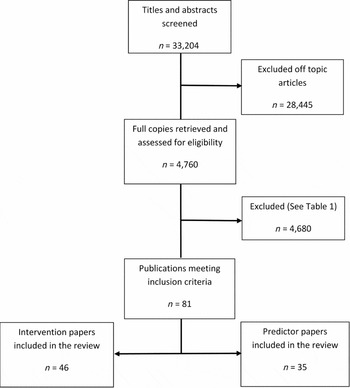
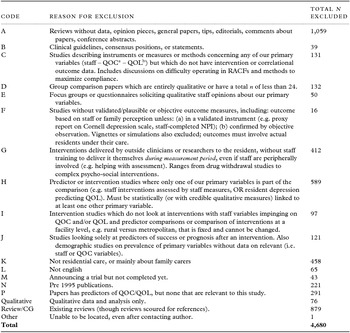
All titles and abstracts (n = 33,204) initially identified were independently screened by two of the authors (KA and SM) for obviously off-topic papers. For the 4,760 potentially relevant abstracts, the full papers were examined by MB and KA against the inclusion criteria and nearly 4,700 more excluded. The final number was 81 papers, 46 in this review, and 35 presented in an associated publication seeking to determine from cross-sectional or longitudinal prospective studies which staff variables are commonly associated with or predictive of quality of care/resident quality of life (Anderson et al., 2016). See Figure 2 for this process. Table 2 shows the reasons for exclusion. Apart from general papers, opinion pieces, editorials, and similar, the most common reasons for exclusion were: existing reviews (these were also scoured for potential references); only one part of the model in Figure 1 was present; interventions delivered primarily by outsiders rather than training staff to do them; and not being primarily about dementia (less than 80% of the sample) or long-term residential care.
Flow chart of study selection process.

Criteria for exclusion of studies

Risk of bias and quality appraisal
Risk of bias was independently assessed by MB and KA with any discrepancies resolved by SM. We used the Cochrane criteria for RCTs and also for non-randomized studies (Higgins and Green, Reference Higgins and Green2011). There is increasing sophistication in minimizing bias in intervention trials with this population (Woods and Russell, Reference Woods and Russell2014) but there remain criteria which are irrelevant to psychosocial trials with this population. For example, it is impossible for a clinician delivering a complex psychosocial intervention not to know what it is. It is not a pill. Accordingly, we grade bias realistically. We also look at quality of methodology and analysis, in particular methods used where there is, inevitably, high attrition at follow-up because of the fragile nature of this population. Of particular note is that we include studies which are less than methodologically pure. This is partly because of the difficulties of research with this population but also to provide a broader clinical overview for clinicians seeking guidance on the scope of interventions with RACF staff caring for people with dementia.
Data collection and synthesis
Extracted data were entered into Eppi-Reviewer 4 by KA or MB, with the other author validating the entries of the first by: independently evaluating the papers; checking for errors, omissions, or inconsistencies; and, highlighting required changes for discussion and referral to a third author if necessary. SM carried out a further accuracy check. The Eppi-Reviewer 4 file was developed, modified, and piloted based on the Cochrane Consumers and Communication Review Group Data Extraction (2013). Data entered included: reference details, publication type, population description, setting, method of recruitment, study aims, design, group allocation process, start and end date, study duration, risk of bias, randomization, withdrawal/exclusions, clusters, baseline imbalances, age, sex, race/ethnicity, severity of dementia, co-morbidities, other treatments, outcomes including name, time points, definition, completing person, unit of measurement, scales, whether a valid and reliable tool was used, handling of missing data, power, results (including comparisons, results, effect sizes, and confidence).
Notes on statistical analysis
The core components of the intervention(s) in the 44 included studies (46 papers) were broadly categorized into six levels of education, reflecting the amount of effort expended to try and make a change at the clinical coalface. These were: (1) didactic education only (n = 4); (2) didactic plus experiential education such as discussing typical case examples (n = 13); (3) education with ongoing group or individual supervision sessions (n = 9); (4) education with a concerted effort to embed the intervention within the facility, such as through a change champion/mentor on-site (n = 8); (5) a change in practice (e.g. instituting a new protocol) (n = 2); (6) all components (n = 9). These groupings were used in the meta-analyses below, though the number of meta-analyses was significantly restricted by inconsistencies in measurement methods, time points, and intervention types. See Table 3 for the education code for each study.
Précis intervention results

a 1. Didactic education only; 2. Didactic plus experiential education such as discussing typical case examples; 3. Education with ongoing group or individual supervision sessions; 4. Education with a concerted effort to embed the intervention within the facility, such as through a change champion/mentor on-site; 5. A change in practice; 6. All components.
b ++ high quality, + acceptable, 0 unacceptable.
To summarize the effect of interventions using the same measure (“d” values with d small ≥ 0.20, medium ≥ 0.50, large ≥ 0.80) for each study, effect sizes for meta-analyses were calculated post-test between the intervention and control groups where available along with the associated standard measure. This is consistent with previous recommendations (Higgins and Green, Reference Higgins and Green2011), using the assumption that no differences between the groups existed at baseline. To test this assumption, where a meta-analysis is used, baseline effect sizes between the intervention and control groups are also reported. Positive values indicate higher scores for the intervention group compared with the control, regardless of the type of outcome. In summary, positive values demonstrate improvements in areas like staff knowledge, but negative values would show improvements in areas like challenging behaviors or falls. We have not reported “d” values for studies where there were no effects; though, where a meta-analysis is used, results without statistical significance were included.
In reporting effects, we have used acronyms for standard measures such as CMAI (Cohen Mansfield Agitation Inventory). The full name of each measure and citation appear at the end of Appendix B.
Detailed summaries for each study appear in Appendix B. A précis of this information comprises Table 3, which includes: a sketch of the intervention; effects on quality of care and/or staff if measured; outcome for the resident, if measured; quality of the study; and, intervention code representing the intensity of the intervention. Quality is indicated by the sign system whereby ++ shows high quality, + acceptable, and 0 unacceptable (Critical appraisal: Notes and checklists, 2015). Appendix A shows the criteria for each study which facilitated these broad measures of quality.
Results
Concordance with Figure 1
A small majority of included studies do have all basic components of the model in Figure 1. That is: interventions delivered direct to staff to change how they think or act; the measurable effects of this on quality of care; and, the measurable onward effects on resident quality of life – broadly defined. Table 3, however, shows that nine studies have no measure of whether staff interventions have any effect on the residents, and consist solely of measures of quality of care after the intervention. An equal number of studies take the black box approach and have no measures of what changes have occurred at the care level in order to achieve the outcome for residents. A third of all studies have no measure of whether individual within-staff variables such as job satisfaction or knowledge have changed as a result of the intervention.
Main statistical findings
Resident quality of life outcomes
1. Quality of life scales
Of the 12 studies in Table 3 that used dementia-specific QOL scales (McCallion et al., Reference Mccallion, Tosel, Lacey and Banks1999; Chang and Lin, Reference Chang and Lin2005; Fossey et al., Reference Fossey2006; Visser et al., Reference Visser, Mccabe, Hudgson, Buchanan, Davison and George2008; Chenoweth et al., Reference Chenoweth2009; Beer et al., Reference Beer2011; Goyder et al., Reference Goyder, Orrell, Wenborn and Spector2012; Charras and Gzil, Reference Charras and Gzil2013; Clare et al., Reference Clare2013; van de Ven et al., Reference Van De Ven2013; Wenborn et al., Reference Wenborn2013; Chenoweth et al., Reference Chenoweth2014), only three found significant effects. Charras and Gzil (Reference Charras and Gzil2013) demonstrated significant improvements in QOL scale scores after the simple intervention of staff wearing street clothes rather than uniforms during care (d = 0.870). In Clare et al. (Reference Clare2013), where staff learned to recognize awareness in residents, quality of life score was only a significant outcome when assessed by family but not staff (Staff: baseline d = 0.114, follow-up d = −0.211; Family: baseline d = 0.018, follow-up d = 0.482). In a multi-facetted program by Wenborn et al. (Reference Wenborn2013), QOL scale scores were actually worse at 12-weeks post-program in the intervention compared with controls (d = −0.552).
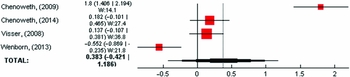
The only meta-analysis possible for QOL scales was at three to four months follow-up for education with an experiential component, with an overall g of 0.383 (CI −0.421, 1.190; Q = 85; p = 0.001; I-squared = 96.5%; tau-squared = 0.647; Baseline g = −0.001). The results are far too inconsistent to draw any conclusions (see Figure 3). Thus, no conclusions can be drawn from QOL scales. All had used dementia-specific versions.
Forest plot for QOL scales at three to four months follow-up for education with an experiential component.

2. Challenging behavior
Over half the studies in Table 3 examined challenging behavior as an outcome (Matthews et al., Reference Matthews, Farrell and Blackmore1996; Kovach et al., Reference Kovach, Weissman, Griffie, Matson and Muchka1999; McCallion et al., Reference Mccallion, Tosel, Lacey and Banks1999; Wells et al., Reference Wells, Dawson, Sidani, Craig and Pringle2000; Magai et al., Reference Magai, Cohen and Gomberg2002; Schrijnemaekers et al., Reference Schrijnemaekers2002; Sloane et al., Reference Sloane2004; Finnema et al., Reference Finnema2005; Fossey et al., Reference Fossey2006; Kovach et al., Reference Kovach2006; Davison et al., Reference Davison, Mccabe, Visser, Hudgson, Buchanan and George2007; Robison et al., Reference Robison, Curry, Gruman, Porter, Henderson and Pillemer2007; Visser et al., Reference Visser, Mccabe, Hudgson, Buchanan, Davison and George2008; Chenoweth et al., Reference Chenoweth2009; Deudon et al., Reference Deudon2009; Testad et al., Reference Testad, Ballard, Brønnick and Aarsl2010; Beer et al., Reference Beer2011; Burack et al., Reference Burack, Weiner and Reinhardt2012; Goyder et al., Reference Goyder, Orrell, Wenborn and Spector2012; Sidani et al., Reference Sidani, Streiner and Leclerc2012; Jeon et al., Reference Jeon2013; Leone et al., Reference Leone2013; van de Ven et al., Reference Van De Ven2013; Wenborn et al., Reference Wenborn2013; Gozalo et al., Reference Gozalo, Prakash, Qato, Sloane and Mor2014) but less than 40% produced significant change. However, those that did find effects, many of high quality, showed improvements sustained to medium-term follow-up (3–6 months) and in one case to two-year follow-up. Effect sizes were low to medium, as follows:
Burack et al. Reference Burack, Weiner and Reinhardt(2012) . CMAI Physical aggression baseline to 24 months d = 0.467, CMAI physical agitation to 24 months d = 0.506, verbal agitation to 24 months d = 0.382.
Chenoweth et al. Reference Chenoweth(2009) . CMAI agitation after Person Centered Care (PCC) training or Dementia Care Mapping (DCM) training: PCC: Baseline d = −0.344, post-training d = −2.058, four months d = −2.519; DCM: Baseline d = −0.633, post-training d = −2.023, four months d = −2.114.
Deudon et al. Reference Deudon(2009) . CMAI agitation baseline d = 0.283, three months d = 0.032 (see meta-analysis for immediate post effect size), overall CMAI change for intervention d = 0.539.
Goyder et al. Reference Goyder, Orrell, Wenborn and Spector(2012) . Baseline to eight-weeks follow-up disruptive behavior d = 0.734.
Gozalo et al. Reference Gozalo, Prakash, Qato, Sloane and Mor(2014) (Cross-over study). Aggression/agitation in bathing: Wave 1 baseline to 4–6 months d = −0.102; Wave 2 baseline to 4–6 months d = −0.157.
McCallion et al. Reference Mccallion, Tosel, Lacey and Banks(1999) . CMAI agitation baseline d = 0.220, three months d = −0.236, six months d = 0.026.
Robison et al. Reference Robison, Curry, Gruman, Porter, Henderson and Pillemer(2007) . Insufficient information to calculate effect sizes.
Testad et al. Reference Testad, Ballard, Brønnick and Aarsl(2010) . Baseline differences in CMAI were extensive (p = 0.002), suggesting that they were clinically different samples so comparisons would be misleading.
Wells et al., Reference Wells, Dawson, Sidani, Craig and Pringle(2000) . Agitation measured on PAS: baseline d = 0.169, three months d = 0.300, six months d = −0.503.
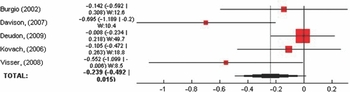
Because of different measures, time frames, or intervention types, only two meta-analyses were possible for challenging behavior. As shown in Figure 4, education plus supervision does appear to have a small to medium bearing on reducing challenging behaviors immediately following the intervention (g = −0.239, CI −0.492, 0.015; Q = 8.3, p = 0.081; I-squared = 51.8%; tau-squared = 0.042; Baseline g = −0.054).
Forest plot for challenging behaviors immediately following education and supervision.

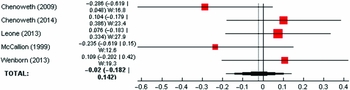
There is a different picture at medium-term follow-up. Interventions do not appear to produce sustained change, as shown in Figure 5. Meta-analysis for approximately three to four months follow-up for didactic plus experiential education showed no effect (g = −0.020, CI −0.182, 0.142; Q = 5.54, p = 0.236; I-squared = 27.8%; tau-squared = 0.009; Baseline g = 0.044). No analysis of longer term effects was possible for this or any other level of intervention.
Forest plot for challenging behaviors three to four months after didactic plus experiential interventions.

3. Pain/physical discomfort, painful skin condition
All five intervention studies with pain as an outcome found significant reductions in resident pain/discomfort in the short-term but none assessed clinically significant follow-up. Effect sizes were as follows:
Beer et al., Reference Beer(2011) . Brief Pain Inventory: four weeks d = 0.309, six months d = 0.377.
Fuchs-Lacelle et al. Reference Fuchs-Lacelle, Hadjistavropoulos and Lix(2008) . PACSLAC d = −0.020.
Kovach et al. Reference Kovach, Weissman, Griffie, Matson and Muchka(1999) . Pre–post discomfort behaviors d = −0.910.
Kovach et al. Reference Kovach(2006) . Discomfort: Baseline d = 0.048, two weeks d = −0.318, four weeks d = −0.784.
Sloane et al. Reference Sloane(2004) . Discomfort: baseline d = −0.025, directly after control versus shower d = −0.783, directly after control versus bath d = −1.184.
These studies fell broadly into two categories: those with staff education and supervision meetings (Kovach et al., Reference Kovach2006; Fuchs-Lacelle et al., Reference Fuchs-Lacelle, Hadjistavropoulos and Lix2008) and those that made a more concerted effort to embed the change through on-site change champions or mentoring (Kovach et al., Reference Kovach, Weissman, Griffie, Matson and Muchka1999; Beer et al., Reference Beer2011). The recurring problem of different intervention types and measurement already described made meta-analysis impossible. Consistency of results is encouraging but, without finding whether effects are maintained, is of limited clinical value until investigators start assessing longer term follow-up.
4. Mood/Affect (including Apathy)
Mood/affect featured as a quality of life outcome in 11 studies in Table 3 (McCallion et al., Reference Mccallion, Tosel, Lacey and Banks1999; Magai et al., Reference Magai, Cohen and Gomberg2002; Finnema et al., Reference Finnema2005; Huizing et al., Reference Huizing, Hamers, Gulpers and Berger2006; Fritsch et al., Reference Fritsch, Kwak, Grant, Lang, Montgomery and Basting2009; Verkaik et al., Reference Verkaik, Francke, Van Meijel, Spreeuwenberg, Ribbe and Bensing2011; Goyder et al., Reference Goyder, Orrell, Wenborn and Spector2012; Jeon et al., Reference Jeon2013; Leone et al., Reference Leone2013; Wenborn et al., Reference Wenborn2013; Chenoweth et al., Reference Chenoweth2014), but results were weak or mixed. Changes were mainly seen for interventions where depression was the primary focus (Verkaik et al., Reference Verkaik, Francke, Van Meijel, Spreeuwenberg, Ribbe and Bensing2011; Leone et al., Reference Leone2013), rather than as one of many outcomes measured. However, results differed even within studies. A typical example of mixed results is the Verkaik study. Improvements were seen on one measure of depression with good effect sizes (MDS/RAI-DRS: baseline d = 1.727, two weeks d = −1.62, 10–12 weeks d = −0.591), but no effects on the Cornell or FACE.
Random effects meta-analyses on those studies that implemented both didactic and experiential education demonstrated, at three to four weeks follow-up, a summary g of 0.344 (CI −0.205, 0.893). However, the large variability pervasive through the mood/depression results was again seen here in Figure 6, making it difficult to form any overall conclusions from the meta-analysis (Q = 14.3, p = 0.001; I-squared = 86%; tau-squared = 0.199; baseline g = 0.43).
Forest plot for mood/affect at three to four months after didactic and experiential education.

The variability continued at approximately 12-weeks follow-up for didactic plus experiential interventions. One of the studies found no effect (Jeon et al., Reference Jeon2013; Leone et al., Reference Leone2013) but the other (McCallion et al., Reference Mccallion, Tosel, Lacey and Banks1999) actually showed higher levels of depression in the intervention group compared to controls, though the intervention group did have higher levels of depression at baseline (d = 0.761).
In summary, no conclusions can be drawn from interventions with staff aimed at improving resident mood.
5. Falls
Two studies found significant reductions in falls following an intervention: one from a simple education program (Baseline falls = 0.375; Post-intervention d = −0.376, Bouwen et al., Reference Bouwen, De Lepeleire and Buntinx2008) and the other from the already cited study by Chenoweth et al. (Reference Chenoweth2009), which assessed multiple other outcomes following in-depth training in DCM or PCC. They found fewer falls immediately post-intervention following DCM training but more falls with PCC (PCC d = 0.263; DCM −0.098) and this pattern was maintained at four-month follow-up (PCC d = 0.104; DCM −0.289; baseline PCC d = 0.603; baseline DCM d = 0.469).
Two studies looking at whether restraint reduction impacts on falls found no significant effects on falls or fall-related injuries (Pellfolk et al., Reference Pellfolk, Gustafson, Bucht and Karlsson2010; Gulpers et al., Reference Gulpers, Bleijlevens, Ambergen, Capezuti, Van Rossum and Hamers2011) but this is a finding in itself given that restraint use did go down. There was no significant effect on falls for one of the most comprehensive multi-targeted, case-specific interventions (Fossey et al., Reference Fossey2006) and it may be that programs directly targeting falls are more effective. However, the usual inconsistencies in reporting periods precludes the use of meta-analysis.
Quality of care outcomes
1. Quality of care scales
Three studies used quality of care instruments as outcome measures (Smith et al., Reference Smith, Kerse and Parsons2005; Davison et al., Reference Davison, Mccabe, Visser, Hudgson, Buchanan and George2007; Clare et al., Reference Clare2013). All aimed to improve care with clinically relevant programs but only Smith had a significant effect (inconsistent reporting makes it impossible to report accurate effect sizes), and this study was methodologically poor and had no long-term follow-up.
2. Restraint
The most encouraging finding was that relatively straightforward interventions can impact on restraint use. Of the eight studies in Table 3 measuring restraint as an outcome (McCallion et al., Reference Mccallion, Tosel, Lacey and Banks1999; Huizing et al., Reference Huizing, Hamers, Gulpers and Berger2006; Chenoweth et al., Reference Chenoweth2009; Pellfolk et al., Reference Pellfolk, Gustafson, Bucht and Karlsson2010; Testad et al., Reference Testad, Ballard, Brønnick and Aarsl2010; Beer et al., Reference Beer2011; Gulpers et al., Reference Gulpers, Bleijlevens, Ambergen, Capezuti, Van Rossum and Hamers2011; Gulpers et al., Reference Gulpers, Bleijlevens, Ambergen, Capezuti, Van Rossum and Hamers2013), five reported reductions sustained over longer term follow-up:
Gulpers et al. Reference Gulpers, Bleijlevens, Ambergen, Capezuti, Van Rossum and Hamers(2011) . Belt restraint over time d = −0.405; Physical restraint: baseline d = −0.097, four months d = −0.227, eight months d = −0.354.
Gulpers et al. Reference Gulpers, Bleijlevens, Ambergen, Capezuti, Van Rossum and Hamers(2013) . Belt restraint over time d = −0.579; Physical restraint: baseline d = −0.276, 24 months d = −0.381.
Huizing et al. Reference Huizing, Hamers, Gulpers and Berger(2006) . Post restraint use controlling for resident characteristics d = −1.129.
Pellfolk et al. Reference Pellfolk, Gustafson, Bucht and Karlsson(2010) . Restraint: baseline d = 0.045, 1 month d = −0.493.
Testad et al. Reference Testad, Ballard, Brønnick and Aarsl(2010) . This study was methodologically flawed. Baseline differences in restraint use were marked (p = 0.000), suggesting that they were clinically different samples so comparisons would be misleading.
Most interventions involved education plus some type of ongoing support or attempt to develop a train-the-trainer model. Gains were largely maintained to the last follow-up (in some cases up to 24 months). The one exception was Testad et al. (Reference Testad, Ballard, Brønnick and Aarsl2010), with reductions present at six months disappearing by 12, coinciding with the end of on-site support. Inconsistencies in reporting periods, in addition to floor effects in restraint use in Chenoweth et al. (Reference Chenoweth2009), prevented a meta-analysis.
3. Staff resident interactions including morning/intimate personal care
Another encouraging finding is from interventions attempting to improve intimate care interactions, most involving direct hands-on training in the skills required, and assessment using direct observation of what staff actually do. All 13 of the studies that examined interactions between staff and residents in personal care showed significant improvements. There were in general large effect sizes.
Boettcher et al. Reference Boettcher, Kemeny, Deshon and Stevens(2004) . Pre–post BARS: non-verbal d = 2.20, assistance with tasks d = 2.11, conversation d = 2.09, unique details d = 1.75.
Bourgeois et al. Reference Bourgeois, Dijkstra, Burgio and Allen(2004) .
Announce care: baseline d = −6.295, four weeks d = 52.960, three months d = 40.853;
Address resident by name: baseline d = −15.512, four weeks d = 39.222, three months d = 8.024;
Wait 5-sec before helping: baseline d = −4.511, four weeks d = 76.409, three months d = 121.208;
Introduce self by name: baseline d = 15.803, four weeks d = 152.612, three months d = 25.821; Announce every ADL: baseline d = −8.483, four weeks d = 96.518, three months d = 43.966;
Short and clear instructions: baseline d = −0.076, four weeks d = 0.905, three months d = 0.698;
Positive feedback: baseline d = −0.098, four weeks d = 1.217, three months d = 0.597;
Talk about resident's life: baseline d = −0.197, four weeks d = 0.339, three months d = 0.106;
Multi-step instructions: baseline d = 0.266, four weeks d = 0.109, three months d = 0.514;
Unhelpful statements: baseline d = 0.110, four weeks d = −0.507, three months d = −0.466.
Chang et al. ( Reference Chang and Lin 2005 ; Reference Chang, Wykle and Madigan 2006 ). Post-intervention behavior in feeding d = 2.183.
Chenoweth et al. Reference Chenoweth(2014) . Care interaction quality: baseline d = 0, four months d = 0.188, eight months d = −0.406.
Dijkstra et al. Reference Dijkstra, Bourgeois, Burgio and Allen(2002) . Staff: baseline to post intervention.
Utterances d = −0.266, d = 0.150; Questions d = −0.010 − d = −0.232; Prompts d = 0 − d = −0.217;
Overall facilitators d = −0.285 – d = 0.455; Repetitions d = 0.264 – d = −0.149; Encouragements d = −0.382 − d = 0.349.
Residents: baseline – post intervention.
Utterances d = −0.269 − d = 0.151; Words d = −0.047 − d = 0.258; Unique words d = 0.033 − d = 0.583;
Information units d = −0.377 − d = 0.251; Global coherence d = −0.351 − d = 0.222; Local coherence d = −0.305 − d = 0.386; Empty phrases d = 0.088 − d = −0.126; Repetitions d = −0.348 − d = 0.314; Indefinite words d = 0.574 − d = −0.174.
Fritsch et al. Reference Fritsch, Kwak, Grant, Lang, Montgomery and Basting(2009) . Resident engagement d = 0.156.
Hoeffer et al. Reference Hoeffer(2006) . Shower versus Control, Time 1–Time 2
Gentleness d = 1.046 − d = 1.576; Verbal support d = 1.146 − d = 0.853;
Confidence d = 0.303 − d = 0.638; Ease d = 0.686 − d = 0.066; Hassles d = −0.534 − d = −0.316.
Towel bath versus Control Time 1–Time 2.
Gentleness d = 1.315 − d = 0.915; Verbal support d = 0.698 − d = 0.596;
Confidence d = 0.224 − d = 0.436; Ease d = 0.292 − d = 0.436; hassles d = 0.182 − d = −0.501.
Sidani et al. Reference Sidani, Leclerc and Streiner(2009) . Unable to calculate d.
Sidani et al. Reference Sidani, Streiner and Leclerc(2012) . Pre–post: introduction to resident d = 0.14, conversation with resident d = 0.15, caregiver approach d = 0.50, orientation to resident d = 0.37, use of tool d = 0.41, bathing, dressing grooming d = 0.44.
Sloane et al. Reference Sloane(2004) . Duration of bath: shower d = 0.544, towel bath d = 0.361.
Three studies showed the maintenance of improvements over six months or more:
Burgio et al. Reference Burgio, Stevens, Burgio, Roth, Paul and Gerstle(2002) . Positive statements: baseline d = −0.125, post-intervention d = 0.138. Verbal prompts: baseline d = 0.072, post-intervention d = 0.325; Physical assistance: baseline d = 0.046, post-intervention d = 0.241.
van der Kooij et al. Reference Van Der Kooij, Dröes, De Lange, Ettema, Cools and Van Tilburg(2013) . Baseline to seven months emotion-oriented interaction techniques d = 0.8.
Wells et al., Reference Wells, Dawson, Sidani, Craig and Pringle(2000) .
Relevance: baseline d = 0.203, three months d = 0.980, six months d = 0.891;
Personal attending: baseline d = 0.204, three months d = 0.728, six months d = 0.851;
Relaxed: baseline d = 0.447, three months d = 1.003, six months d = 1.163;
Social/flexible: baseline d = 0.168, three months d = 1.143, six months d = 1.081;
Ease of caregiving: baseline d = 0.173, three months d = 0.173, six months d = 0.504;
Stress: baseline d = −0.464, three months not assessed, six months d = −0.370.
It will be seen that three studies assessed follow-up and that effects were maintained (Wells et al., Reference Wells, Dawson, Sidani, Craig and Pringle2000; Burgio et al., Reference Burgio, Stevens, Burgio, Roth, Paul and Gerstle2002; van der Kooij et al., Reference Van Der Kooij, Dröes, De Lange, Ettema, Cools and Van Tilburg2013). All were of high quality, two of which (Burgio et al., Reference Burgio, Stevens, Burgio, Roth, Paul and Gerstle2002; van der Kooij et al., Reference Van Der Kooij, Dröes, De Lange, Ettema, Cools and Van Tilburg2013) went to considerable lengths to embed the intervention within the facility. Given the varying intervention types, along with different follow-up periods, meta-analysis was not suitable.
4. Psychotropic use
Despite being a quality of care outcome in 12 of the studies in Table 3 (Kovach et al., Reference Kovach, Weissman, Griffie, Matson and Muchka1999; McCallion et al., Reference Mccallion, Tosel, Lacey and Banks1999; Schrijnemaekers et al., Reference Schrijnemaekers2002; Fossey et al., Reference Fossey2006; Chenoweth et al., Reference Chenoweth2009; Deudon et al., Reference Deudon2009; Pellfolk et al., Reference Pellfolk, Gustafson, Bucht and Karlsson2010; Testad et al., Reference Testad, Ballard, Brønnick and Aarsl2010; Gulpers et al., Reference Gulpers, Bleijlevens, Ambergen, Capezuti, Van Rossum and Hamers2011; Gulpers et al., Reference Gulpers, Bleijlevens, Ambergen, Capezuti, Van Rossum and Hamers2013; Leone et al., Reference Leone2013; Chenoweth et al., Reference Chenoweth2014), only two – both of high quality – demonstrated significant long-term reductions in psychotropics. Fossey et al., (Reference Fossey2006) found: neuroleptics baseline d = −0.061 to 12-month follow-up d = −0.490, other psychotropics baseline d = −0.026, to 12 months d = 0.134. Gozalo et al. (Reference Gozalo, Prakash, Qato, Sloane and Mor2014) found significant reductions in antipsychotic use to four months, but insufficient information was provided for calculating d values. Both studies could be characterized as teaching and supporting practical approaches to caring for residents with dementia, more broadly in the case-specific approach of Fossey et al. (Reference Fossey2006) and specifically with bathing in Gozalo et al. (Reference Gozalo, Prakash, Qato, Sloane and Mor2014), though these definitions would also hold for some of the studies that did not see reductions. Discrepancies in the types of interventions, types of psychotropics, timeframes for follow-up, calculations, and use of psychotropics in the statistics, precludes the use of meta-analysis.
5. Acute hospital admissions
Curiously, only two studies look at whether the interventions reduced hospital admissions and neither study found a significant result (Chenoweth et al., Reference Chenoweth2009; Deudon et al., Reference Deudon2009). Both of these interventions were well-conducted, with genuine attempts to embed them within the facilities. A meta-analysis was not possible.
Staff outcomes
1. Staff feelings/attitudes/knowledge
Though changes in staff personal internal states was not a primary variable, we examined them as a possible further mediating factor between intervention and quality of care/resident quality of life. Mixed outcomes meant that these results gave us little of use. Paucity of consistent effect is well illustrated by the four studies that looked at attitude before and after interventions. Clare et al. (Reference Clare2013) showed no effects. Beer et al. (Reference Beer2011) reported changes in staff attitudes but no discernible statistical proof. Fritsch et al. (tendency to devalue d = −0.404, positive views d = 0.730, Reference Fritsch, Kwak, Grant, Lang, Montgomery and Basting2009) demonstrated more positive staff attitudes, following a ten-week story-telling program and this translated into better quality staff interactions with residents. However, this was a poor study methodologically, without means or numbers of residents, and with no follow-up. As further evidence of confusion, improvements in attitudes were seen in Chang et al. (d = 0.473, Reference Chang and Lin2005) but not in a sister paper of the same study (Chang et al., Reference Chang, Wykle and Madigan2006).
Similarly, of the four studies that measured improved staff knowledge post-intervention, McCallion et al. (Reference Mccallion, Tosel, Lacey and Banks1999) and Bourgeous et al. (Reference Bourgeois, Dijkstra, Burgio and Allen2004) showed no effects. Following their feeding intervention, Chang et al. (Reference Chang and Lin2005; Reference Chang, Wykle and Madigan2006) found large effect sizes for improved knowledge (post-training d = 1.87, four-weeks post-training = 2.172) and this translated into improved techniques such as taking more time with feeding, or washing hands before feeding, though it had no measureable effect on food intake. The study by van der Kooij et al. (Reference Van Der Kooij, Dröes, De Lange, Ettema, Cools and Van Tilburg2013) showed long-term improvement in knowledge about communication (baseline to seven months knowledge of residents d = 0.7) and this translated into more sensitive and skilled communication with residents. There was no effort to determine whether it had any effect on residents.
Summary of analysis
Interventions examining physical restraint, pain/discomfort, and staff interactions with residents in personal care were generally effective. A higher proportion of restraint studies had longer term follow-up but all the staff interaction studies which provided follow-up also produced maintained improvement. No pain study had follow-up. Falls studies had equivocal results. Few studies showed reductions in psychotropic medication. A majority of interventions with challenging behavior produced no effects on behavior but a significant minority did, including a few with maintained effects. Interventions for mood had widely divergent results so their effectiveness is doubtful. Dementia-specific quality of life scales were ineffective as outcome measures; measures of specific physical or psychosocial states were more useful. Many studies had generic but high quality education with multiple outcomes assessed but more direct interventions tended to be more effective, especially restraint and care interactions. A disappointing proportion of otherwise excellent studies failed to measure whether results were maintained and of those that did, overall results show that results were not usually maintained (again with the exception of restraint and intimate personal care). Interventions where within-staff personal variables such as attitude were assessed rarely produced significant change for residents.
It is impossible to determine the most effective intervention because, in general, level of intervention tended to depend on the target. For outcomes like restraint use, relatively straight-forward structured education sessions with some additional support appeared adequate. Programs to reduce pain required more support. For complicated issues like challenging behavior, including reducing aggression and increasing co-operation in showering, detailed, long-term, supportive, on-site interventions are required.
Discussion
We searched the peer-reviewed literature from the last 20 years for methodologically and clinically sound studies whereby direct care staff in long-term dementia facilities are educated, emotionally supported, or otherwise changed in their own practice, with the aim of improving and maintaining quality of care and thereby physical and emotional well-being for the resident over time. This included some with relatively low numbers and was not confined to RCTs. We defined quality of care as anything done to or with the resident. Commonly used proxies for quality of care (Beerens et al., Reference Beerens2014) such as depression or pain, were treated as aspects of quality of life – something experienced by the resident.
Some major studies used generic named interventions such as DCM, PCC but many others were more target-specific. We believe it is the clinical components of all programs which are important. Most interventions were sufficiently well-described to enable replication. Even where there was no long-term follow-up, techniques are described that show how change can be made as long as the intervention lasts. However, only a minimum of several months follow-up enables conclusions about whether changed staff practice can be maintained independently and therefore be worth the cost and effort of the intervention. Unfortunately, many studies had no or minimal (e.g. two weeks) follow-up after the intervention. For the studies which did tackle the attrition problems of longer term follow-up with this fragile population, some produced lasting effects and in Gulpers et al. (Reference Gulpers, Bleijlevens, Ambergen, Capezuti, Van Rossum and Hamers2013) they even generalized at two years to staff who had not received the intervention. However, in the majority of these studies, effects did not last.
The focus on interventions explicitly aimed at providing care staff with tools to continue to deliver improved care after the project team withdraws, means we have had to exclude a number of otherwise potentially useful studies. These include, in particular, interventions delivered to residents direct by an external clinical team for BPSD (e.g. Bird et al., Reference Bird, Llewellyn-Jones, Korten and Smithers2007; Cohen-Mansfield et al., Reference Cohen-Mansfield, Libin and Marx2007), even though staff will be providing information and be otherwise involved. Cohen–Mansfield notes that improvements often decline precisely because staff have not received generalizable training and support during an externally delivered intervention. Connell and McConnell (Reference Connell and Mcconnell2000) raise concerns about the internal validity of studies where staff rather than researchers deliver interventions but we contend that, to be clinically useful in the longer term, the intervention must be delivered to and through staff. Though there are facilities with on-site specialist medical and allied health as well as senior nursing staff to keep interventions alive – the case in many included studies – we need to know how improvements can be made and maintained in the many facilities (perhaps the majority in some countries) with barely adequate resources and where existing hands-on staff are the only available medium for change.
Quality of studies
Judgments in Appendix A show varied levels of quality but our results confirm that psychosocial studies with this unique population are showing increasing sophistication allied to clinical realism in controlling for bias (Woods and Russell, Reference Woods and Russell2014). This ranges from careful stratification in random selection of facilities to recruiting assessors who know nothing about the study. An example of clinical realism is acceptance that it is impossible for a clinician delivering a psychosocial intervention not to know what it is. Conversely, non-blinding of the person with more than mild dementia is low risk because, even if they sign a consent form, by definition they are likely to forget they are part of a study. It is possible in well-resourced studies for researchers assessing outcome to be blind to condition or even ignorant about dementia, though not if outcome requires skilled observation, nor if conversations with staff are part of assessment. They nearly always know what has been delivered, even though theoretically blinded to condition (Woods and Russell, Reference Woods and Russell2014).
Not all studies have controlled for attrition or, remarkably, even mentioned it (e.g. Bouwen et al., Reference Bouwen, De Lepeleire and Buntinx2008; Fritsch et al., Reference Fritsch, Kwak, Grant, Lang, Montgomery and Basting2009), despite the fact that at least 30%–45% of this frail population will be lost to medium or longer term follow-up (e.g. Testad et al., Reference Testad, Ballard, Brønnick and Aarsl2010; Beer et al., Reference Beer2011) due to death, residents moving, being medically unstable, staff turnover, or researchers running out of money. Some studies over-sample in order to cover this, but then have to deal with different baseline characteristics among survivors. Some studies recruited new residents and staff as participants died or withdrew even between Times 2 and 3 (e.g. Pellfolk et al., Reference Pellfolk, Gustafson, Bucht and Karlsson2010; van de Ven et al., Reference Van De Ven2013), but this practice is only justifiable if they are in the sample for at least two time-points, have received the intervention, and are reported as a separate sample rather than merged into the population as if they had been in the study at the start. Some studies with follow-up used the more authentic method with this heterogeneous population of reporting only on the survivors or using survivor results to authenticate the results of their intention to treat analysis (e.g. Finnema et al., Reference Finnema2005; Burack et al., Reference Burack, Weiner and Reinhardt2012). Without such authentication, studies trying to impute quality of life for the relatively large proportion of their starting sample who are now dead must be treated with extreme caution.
Comment on measures
Many studies used straight clinical data like frequency of falls, or standardized measures, or reported validity when they invented new measures. Nevertheless, there remained enough inconsistency in choice of measure, or idiosyncratic adaption of well-known measures like the CMAI (e.g. Burack et al., Reference Burack, Weiner and Reinhardt2012), to preclude meta-analysis for many outcomes.
The adequacy of generic dementia-specific QOL measures is doubtful. Most showed no effect and the 25% that did produced widely variable results. They may be too broad, justifying our decision to concentrate on what residents are actually experiencing, rather than an ill-defined general entity. There is also the problem that measurement of internal states for people with dementia consistently shows that proxy report by staff or family assesses residents as worse than they themselves report, that family and staff differ (e.g. Clare et al., Reference Clare2013), and that different factors are involved for each group (Crespo et al., Reference Crespo, Hornillos and De Quirós2013). Unfortunately, given the level of deteriorating impairment of this population, self-report is often impossible, especially at follow-up (Wenborn et al., Reference Wenborn2013; Chenoweth et al., Reference Chenoweth2014). Based on these factors, our results, and a comparable finding in our associated paper on predictors of well-being (Anderson et al., 2016), we cannot recommend use of scales like the QOL-AD as an outcome measure.
There are questions about other outcome measures. For example, there is the problem of different instruments purportedly measuring the same disorder but obtaining different results (e.g. depression in Verkaik et al., Reference Verkaik, Francke, Van Meijel, Spreeuwenberg, Ribbe and Bensing2011), or different informant groups producing the same phenomenon. Similar problems apply where measures of internal staff states such as attitude, knowledge, or stress are assessed post-intervention. They tend not to improve even when quality of care or resident quality of life does change. This presents a major problem for those deciding what to target with staff in future interventions.
Measurement of quality of care
As the most important mediating factor in this review, we were particularly interested in what good care looks like and its measurement. Aspects of QOC like frequency of physical restraint are easy to measure. Psychotropic use is also easy to measure if the responses are simply dichotomous. This is the rather primitive method used in most included papers, so we can deduce nothing about dosages. It may be that converting to equivalent doses with this heavily medicated population, often subject to frequent adjustments, is too complex. Thus, most studies settled for either the number of people on anti-psychotics/other psychotropics, or the mean number of such drugs residents were taking.
Measuring psychosocial care adequately can be more complex but some standard measures are presented in these studies, for example, the Multidimensional Observation Scale for Elderly Subjects (MOSES) used in McCallion et al. (Reference Mccallion, Tosel, Lacey and Banks1999). Others take proxy measures such as the length of time spent on showering or eating (e.g. Sloane et al., Reference Sloane2004; Chang and Lin, Reference Chang and Lin2005; Chang et al., Reference Chang, Wykle and Madigan2006) under the assumption that a relaxed approach is more effective with people with severe dementia. Others look at the frequency of use of pain instruments (e.g. Fuchs-Lacelle et al., Reference Fuchs-Lacelle, Hadjistavropoulos and Lix2008), or changes to the way bathing is done (e.g. Gozalo et al., Reference Gozalo, Prakash, Qato, Sloane and Mor2014).
Direct observation of quality of care is increasing, even in larger studies (e.g. Fritsch et al., Reference Fritsch, Kwak, Grant, Lang, Montgomery and Basting2009), using sophisticated time sampling or video recording with assessment by blinded observers (e.g. Bourgeois et al., Reference Bourgeois, Dijkstra, Burgio and Allen2004; Sloane et al., Reference Sloane2004). They produce analyzable data by reporting frequency of actions commonly regarded as beneficial in dementia care, for example, how often during care tasks each staff member gently issues short guidance messages and then waits in order to give the resident time to respond. Others are frequency of arguing with residents, or frequency of positive messages during bathing (e.g. Burgio et al., Reference Burgio, Stevens, Burgio, Roth, Paul and Gerstle2002). We believe that direct observation merits more attention. It has the great advantage of measuring what staff actually do instead of some necessarily abstract and subjective measure but the disadvantage of taking much more time and being more expensive than a general questionnaire.
Statistical findings
There were severe limitations in the number of meta-analyses we could undertake because of differences in time frames, idiosyncratic measurement, differences in education delivery, key data missing, and idiosyncratic analysis. Nevertheless, there are enough good studies to provide some useful information.
As noted, dementia-specific quality of life scales proved inadequate as an outcome measure.
Challenging behavior was the explicit or secondary target in half the studies (n = 23) but only ten produced changes in behavior, a disappointing result given that some unsuccessful studies had large samples and were of high quality (e.g. Wenborn et al., Reference Wenborn2013; Chenoweth et al., Reference Chenoweth2014). Nevertheless, the studies which did produce results are worth examining individually, some showing effects at 4–6 month follow-up and one (Burack et al., Reference Burack, Weiner and Reinhardt2012) at two years. Nevertheless, the meta-analyses suggest that obtaining long-term effects is not the norm. Studies which received education plus on-going mentoring had sufficient coherence for meta-analysis to show low to medium effect sizes immediately post-intervention but a comparable analysis looking at 3–4 months follow-up showed relapse to baseline.
Mood was an outcome in a quarter of studies, mostly as part of a suite of potential outcomes in larger studies. Our results suggest that the overall value of these interventions is doubtful. Meta-analysis for education plus mentoring at both short and medium-term follow-up shows huge variability. It is unclear why, though the study by Verkaik et al. (Reference Verkaik, Francke, Van Meijel, Spreeuwenberg, Ribbe and Bensing2011) which found effects on one depression measure but not on the highly regarded Cornell, suggests that measurement issues merit further investigation.
All five studies investigating pain and discomfort found improvement with medium to large effects. Those that paid more attention to on-site implementation tended to have stronger effects. Meta-analysis was not possible but the consistency of these findings in themselves show that pain can be relieved during an intervention. Unfortunately, none of the studies assessed follow-up, making it impossible to determine the utility of training staff to deliver long-term improvement in pain management without ongoing support.
Falls were investigated directly in one study or as secondary outcomes in seven others. Only two produced change. No positive conclusions about falls programs can be drawn from these meager results. The most interesting finding is from three restraint programs which had falls as a secondary outcome and confirm previous research (Capezuti et al., Reference Capezuti, Evans, Strumpf and Maislin1996; Evans et al., Reference Evans, Strumpf, Allen-Taylor, Capezuti, Maislin and Jacobsen1997; Capezuti et al., Reference Capezuti, Strumpf, Evans and Maislin1999; Neufeld et al., Reference Neufeld, Libow, Foley, Dunbar, Cohen and Breuer1999) that reducing restraint does not increase falls or related injuries.
Quality of care outcomes
As with QOL scales, generic quality of care scales showed minimal utility. In two studies where quality of care was tested as a mediating factor between intervention and resident outcome, there was no effect (Davison et al., Reference Davison, Mccabe, Visser, Hudgson, Buchanan and George2007; Clare et al., Reference Clare2013).
Restraint reduction is one of the two most encouraging quality of care findings of this review, with positive results over the medium or even long-term for 75% of studies, and obtained mainly by basic education plus mentoring or similar support. Our associated review showed multiple sequelae of restraint including increased pain, psychotropic medication, and excess disability (Sloane et al., Reference Sloane, Mitchell, Preisser, Phillips, Commander and Burker1998; Lin et al., Reference Lin, Lin, Shyu and Hua2011; Miu and Chan, Reference Miu and Chan2014; Anderson et al., 2016). The additional evidence here confirming it does not increase falls makes expansion of restraint reduction programs the most obvious clinical target following this review.
There is little good news about chemical restraint; psychotropic use declined in only two studies, though both are noteworthy. The multi-facetted case-specific intervention by Fossey et al. (Reference Fossey2006) was the most comprehensive, with effects still apparent at 12 months. The study by Gozalo et al. (Reference Gozalo, Prakash, Qato, Sloane and Mor2014) is clinically interesting because it followed a Bathing without a Battle intervention, presumably because increased skill reduced resistance in personal care – the situation where aggression is most common (Teri et al., Reference Teri, Larson and Reifer1988).
The second highly promising finding was from the 13 studies attempting to improve communication and more humane interactions between staff and residents. They cover several bases but all produced positive results. Some tackled the intimate personal care experience, usually morning care, for both residents and staff and best encapsulated by the Bathing without a Battle label. A feature of these studies is extensive on-site emotional and practical support while staff learn to care more effectively for their own residents. Other studies attempt to improve general responsiveness to residents’ individual needs and difficulties, including challenging behavior (e.g. Chenoweth et al., Reference Chenoweth2009). Others attempt to improve general communication with residents (Boettcher et al., Reference Boettcher, Kemeny, Deshon and Stevens2004). Humane and responsive care would fit under the PCC label and it would be almost impossible to find an RACF in English-speaking countries that does not claim to provide it, whatever the facts on the ground. Studies like these, however, show that practical hands-on techniques have to be learned as well as total attitude change.
Given these results, and the finding from our associated predictor study that the skills of staff interacting with residents and the provision of more humane care is predictive of better resident mood (Anderson et al., 2016), it is disappointing that only three of these studies had follow-up, and that not all investigated whether these mediating factors had any effect on resident well-being. The attainment of better care was seen as sufficient outcome in itself (e.g. Boettcher et al., Reference Boettcher, Kemeny, Deshon and Stevens2004; Bourgeois et al., Reference Bourgeois, Dijkstra, Burgio and Allen2004; Hoeffer et al., Reference Hoeffer2006; Sidani et al., Reference Sidani, Leclerc and Streiner2009).
Only two studies examined whether interventions reduced acute hospital admissions (Chenoweth et al., Reference Chenoweth2009; Deudon et al., Reference Deudon2009). Given the expense and poor consequences for people with dementia, we would have expected more use of this outcome measure.
What kind of intervention?
Intervention level required for a successful intervention tended to vary depending on the clinical target. For example, successful interventions around restraint use were mostly didactic with experiential education or other support. This was true for some pain studies but others required mentoring and more on-site support. For complicated issues like challenging behavior, including aggression in showering, more detailed long-term on-site interventions appear necessary.
Concordance with Figure 1
Though a small majority of studies had all three components of the model, 20% made no attempt to determine whether an intervention has improved life for the person with dementia, presumably the object of the exercise. They show only a measure of quality of care after the intervention, most commonly easy to measure variables like restraint or psychotropic use, though there are several aimed at improving the way personal care or other interactions with residents is accomplished. These studies apparently make the assumption that this automatically improves resident quality of life, a plausible belief for, say, restraint, but not necessarily for more complex presentations. Our results show that when both are measured, only half the studies showed improved QOC translating to measurable improvement in resident QOL. This is conclusive evidence that no intervention study aimed at improving life for the resident can credibly claim to have done so unless they have measured it.
A further 20% of studies took the black box approach and had no measures of change at the care level required in order to achieve the outcome. This makes it impossible to determine what staff are doing differently, and which practices need to be targeted in future interventions. This is especially the case because, in the studies where both are measured, improvement in quality of care tended to translate into improved quality of life.
The utility of measuring within-staff personal variables like attitude or job satisfaction is uncertain, unless the overt goal is to improve QOL for staff – a legitimate aim given the difficulties of the work. For our purposes, of the two-thirds of studies which used such measures, only five found effects and there was little connection with resident QOC/QOL. For example, Davison et al. (Reference Davison, Mccabe, Visser, Hudgson, Buchanan and George2007) and Visser et al. (Reference Visser, Mccabe, Hudgson, Buchanan, Davison and George2008) found within-staff effects following an intervention but no effects for residents. Conversely, more studies found no effect on within-staff personal variables but effects for residents.
It is plausible to expect that personal change will occur within staff as part of an intervention, at the very least improved knowledge or understanding, and that addressing such variables should form part of future programs. Unfortunately, if anything is changing within individual staff, it is too diffuse or our existing instruments are too insensitive to detect it. Measuring within-staff personal variables is likely to be a waste of time until we have adequate tools; this presents a major problem for those deciding what to target with staff in future interventions.
It remains our contention that the minimum outcome measures for intervention studies with this population are: a valid measure of quality of care – preferably using direct observation because we need to know what staff actually do; the effects on the resident; and, whether effects are maintained at least 3–4 months post-intervention.
Limitations and caveats
There are a number of limitations which make our conclusions tentative. The main one is the relative paucity of studies that fit our criteria. Limiting this review to interventions in long-term dementia care meant that many pain, pressure sore, and feeding difficulty studies were excluded because the sample was general or less than 80% dementia. We chose the 80% criterion to permit us to include mixed sample studies where it was clear that the bulk of the population had dementia; without it we would have had even fewer studies to include. We acknowledge that diagnosis can be problematical (most studies used a screening test – the MMSE), but we contend that a cut-off of more than three-quarters makes it highly likely that the most of the residents in this review had dementia.
The need for interventions delivered ultimately by staff rather than by outside clinicians, so they can be sustained post-project, also limited eligible studies. Finally, the need to fit Figure 1 limited eligible studies. We do need to know at the very least whether an intervention changes the behavior of staff – quality of care – but ultimately whether it makes any difference to residents’ lives.
A second potential caveat is that effects may have been weak because mainly hands-on staff received the intervention, and that absence of management engagement may be the reason effects were not maintained. It is true that senior RNs were involved in most studies and, in many, senior management were engaged. We retain our belief that interventions must be good enough to be effective in the many facilities with minimal resources. Many, for example in Holland, have access to on-site medical and allied health and extensive management support but, for many others, the only resource for change is the staff on the ground. However, none of the studies measured management engagement or organizational readiness for change. Given that care staff have very little autonomy in how and when they provide care and that managers have ultimate responsibility for the care culture and whether staff are released for training and supported in changes to care, the role of management support for care staff interventions is a gap in the literature. Future studies need to include level and nature of management support in the analysis.
Third, only some studies provided adequate control conditions, for example, wait-list controls, or ensuring that control residents or staff received the same number of visits and the same amount of engagement as the experimental group. A majority of studies used “usual care” as a control. It is therefore impossible to determine whether the effect in these studies, if any, could be due to the fact that there is an intervention rather than the content of the intervention, especially given that usual care is often poor and that staff rarely receive the kind of support available during an intervention. Until researchers start addressing this critical point, any conclusions remain tentative.
The fourth caveat is that there are some assumptions in these studies with which we concur but which are unproven, for example, that more staff interacting socially with residents, or accomplishing bathing over a longer time, are positive changes. We accept that they remain subjective.
A final caveat is that we have not contacted authors about results, or done searches of work in progress or for works that are refused publication due to non-significant results and we did not check the published trial papers against the corresponding information in trial registers. We have only looked at what was available to any researcher in the literature over the last 20 years. We think that their published results should stand by themselves.
General conclusions
There need to be more interventions aimed at teaching staff to provide better care for their residents and thereby improve states which cause or are reflective of suffering, such that they are able to maintain these effects over time. Aiming at a specific target such as mood or restraint or psychotropic medication may be more useful than more generic interventions (e.g. PCC) which sample a large suite of potential outcomes. Didactic education alone will be useless and staff need at least mentoring or similar added support for restraint reduction. For complex interventions with challenging behavior or intimate care, staff will also need a period of on-site support and practice with their own residents. These studies need to measure, at a minimum, changes several months post-intervention in care practices and effects on the resident. Failure to determine whether life improves for the resident misses the point of the intervention. Our results show that you cannot conclude that improved care will make any measurable difference to those receiving it, even less if you only measure within-staff variables – as many excluded studies did. If within-staff internal variables such as attitude are included, they are unlikely to show effects so may be a waste of time unless measures become more sensitive.
These projects will be expensive because they need relatively large samples, including over-sampling – and sophisticated design to minimize bias while remaining clinically realistic. They also need sensitive measurement, including direct observation of quality of care as well as detailed subjective measures, and consortia of researchers need to agree on the best measures to be used across multiple studies so that meta-analysis is possible. Inventing measures for individual studies clouds the picture and raises suspicion that they may have been invented to reflect the data. Generic dementia-specific quality of life measures are unlikely to show effects; measures applicable to the clinical target should be used. The purpose of training the staff is to enable them to maintain effects after the intervention team withdraws, so these studies will be largely useless if medium to longer term follow-up is not measured. There will be substantial attrition, so decisions need to be made about whether only survivors are analyzed, or the applicability of ITT techniques if 30%–40% or more of the sample (staff and residents) is lost.
The small number of studies reviewed here suggest that reducing restraint, improving staff interactions with residents and reducing pain are the most promising clinical targets, though no pain study had follow-up. Challenging behavior shows some promise though follow-up results are poor. The value of interventions with other targets is equivocal or poor.
Turnover in residential care possibly means that interventions with staff will never be enough, and that direct delivery of interventions (e.g. Bird et al., Reference Bird, Llewellyn-Jones, Korten and Smithers2007; Cohen-Mansfield et al., Reference Cohen-Mansfield, Libin and Marx2007) may always be required at some level. A large number of well conducted staff training studies may improve the picture but, at the current state of play, we can only conclude that, apart from restraint and interactions in personal care, interventions with staff are only intermittently effective and either do not maintain to follow-up, or have not had follow-up assessed.
Conflict of interest
None.
Description of authors’ roles
M. Bird and K. Anderson contributed equally to this work. M. Bird identified the need for this review and its basic outline. K. Anderson and M. Bird developed the search protocol, reviewed papers for inclusion, extracted data, and wrote and revised this paper. K. Anderson also undertook the literature search, developed the Eppi-reviewer 4 form, and conducted the statistical analysis. S. MacPherson was involved in the original screening of abstracts, searched for and collated all included papers, and conducted a final check of the facts and figures. A. Blair was involved in the initiation and conceptualization of this review and revised the paper.
Acknowledgments
This project was funded through the NHMRC Partnership Centre on Dealing with Cognitive and Related Functional Decline in Older People (CDPC). The CDPC aims to co-create and synthesize knowledge that changes policy, systems and practice, improving the lives of people living with dementia and cognitive decline. We want to express our great appreciation for the guidance provided by the members of our consultative committee: Jennifer Henderson (Consumer Dementia Research Network); Meredith Gresham (Hammond Care); Jan Van Emden (Helping Hand); Katrina Radford (Griffith University). We also want to acknowledge the assistance that Suzanne Hannan (Southern NSW LHD Librarian) provided with the initial search strategy.
Supplementary material
To view supplementary material for this article, please visit http://dx.doi.org/10.1017/S1041610216001083.