Introduction
Depression is a common mental health problem often seen in the primary care settings and in the community. It is also prevalent and disabling among the elderly population with very high suicide rates reported in studies from India (Ganguli et al., Reference Ganguli, Dube, Johnston, Pandav, Chandra and Dodge1999; Tiwari, Reference Tiwari2000; Abraham et al., Reference Abraham, Abraham and Jacob2005). There is also good evidence that screening for depression in primary care settings improves the detection rate (Whooley et al., Reference Whooley, Avins, Miranda and Browner1997; Pignone et al., Reference Pignone2002; U.S. Preventive Services Task Force, 2002). Many of the existing screening tools are too cumbersome and time consuming for routine use. More recently it has been found that asking two or three simple questions may be as effective as using longer instruments (Whooley et al., Reference Whooley, Avins, Miranda and Browner1997; U.S. Preventive Services Task Force, 2002; Arroll et al., Reference Arroll, Khin and Kerse2003; Reference Arroll, Goodyear-Smith, Kerse, Fishman and Gunn2005). Two screening questions had a high sensitivity (97%) but low specificity in primary care (Arroll et al., Reference Arroll, Khin and Kerse2003). Our study attempted to determine the sensitivity and specificity of the two-question screen to identify depression and common mental disorders (CMD) among the elderly living in the community.
Methods
A door-to-door survey of the 620 households was undertaken to map Ward 8, Kagithepetrai, a lower socioeconomic area of Vellore town. People over the age of 60 years were eligible to participate in the study; 204 subjects were chosen by systematic random sampling (every third house) with specific rules when houses did not have elderly residents. The details of the study were explained and verbal consent was obtained from the participants.
Subjects were asked the following two-question screen (Arroll et al., Reference Arroll, Khin and Kerse2003):
1. During the past month have you been troubled by feeling down, depressed or hopeless?
2. During the past month have you experienced little interest or pleasure in doing things?
The subjects were subsequently interviewed using the Revised Clinical Interview Schedule (CIS-R; Lewis et al., Reference Lewis, Pelosi, Araya and Dunn1992). The CIS-R is a commonly used standardized semi-structured interview to diagnose depression and CMD and is considered the gold standard.
The Tamil version of the two-question screen has already been employed and validated in the region in patients attending a general medical clinic (Jeyabalan et al., Reference Jeyabalan, Kuruvilla, Prasad, Abraham and Jacob2007). The Tamil version of the CIS-R has also been employed in many studies in Vellore (Manoharam et al., Reference Manoharam, John, Joseph and Jacob2001; Nambi et al., Reference Nambi, Prasad, Singh, Abraham, Kuruvilla and Jacob2002; Pothen et al., Reference Pothen, Kuruvilla, Philip, Joseph and Jacob2003; Benjamin et al., Reference Benjamin, Chandramohan, Annie, Prasad and Jacob2005; Shankar et al., Reference Shankar, Saravanan and Jacob2006) and has been shown to have high inter-rater reliability (Pothen et al., Reference Pothen, Kuruvilla, Philip, Joseph and Jacob2003). The standard CIS-R diagnostic threshold of 11/12 was employed to identify cases with depression and CMD. The two-question screen took a few minutes while the detailed interview about half an hour. The CIS-R interview was done on the day following the two-question screen. The interviewers who conducted the detailed interview were blind to the results of the two-question screen. The questions and the interview were in Tamil, the local language. The interviewers were trained in the use of the instruments and a pilot study was done to familiarize them with the technique.
Sensitivity and specificity were calculated for the different questions when employed for screening. The sample size of 204 was calculated using the formula 4pq/d2 where the prevalence was taken as 15% and the precision 5.
Results
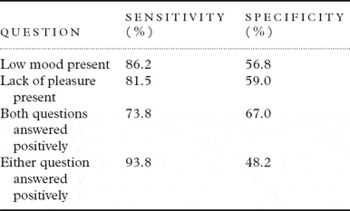
A total of 204 subjects participated in the study while five refused consent. The majority of the participants were women (124; 60.5%), living with relatives (188; 91.7%), not currently employed (160; 78%) and not in debt (120; 58.5%). The mean age of the sample was 68.2 (SD 7.6) years. The average number of years of schooling was 3.4 (SD 3.8). Sixty-five subjects (31.5%) satisfied CIS-R criteria for depression and CMD. The sensitivity and specificity of the screening questions are shown in Table 1. A positive response to either of the two screening questions (low mood; lack of pleasure) had a high sensitivity (94%) and moderate specificity (48%). The positive and negative predictive values were 46% and 94% respectively. Positive responses to both questions had moderate sensitivity and specificity.
Sensitivity and specificity of the two-question screen

The small numbers within each International Classification of Diseases-10 category did not allow for a detailed analysis of the usefulness of the screening instrument to recognize each subgroup individually. The subjects identified as having depression and CMD were referred to the Kagithapetrai outreach clinic for further evaluation and treatment.
Discussion
This study attempted to evaluate a simple screening strategy in a community sample of elderly. The strengths of the study included: the simple screening questionnaire, the objective confirmatory criteria, blind assessments, a systematic sampling strategy and a good response rate. Its limitations included the fact that it was a cross-sectional assessment and the subjects identified as depressed were referred to the local general medical clinic but were not followed up by the research team.
The Tamil versions of the two-question screen (Jeyabalan et al., Reference Jeyabalan, Kuruvilla, Prasad, Abraham and Jacob2007) and the CIS-R (Manoharam et al., Reference Manoharam, John, Joseph and Jacob2001; Nambi et al., Reference Nambi, Prasad, Singh, Abraham, Kuruvilla and Jacob2002; Pothen et al., Reference Pothen, Kuruvilla, Philip, Joseph and Jacob2003; Benjamin et al., Reference Benjamin, Chandramohan, Annie, Prasad and Jacob2005; Shankar et al., Reference Shankar, Saravanan and Jacob2006) have been used in other studies in the region. The instruments were translated into Tamil and back-translated into English by bilingual physicians with attention being paid to content, semantic, technical and conceptual equivalence. However, the local dialect of Tamil was employed. Regional variation in language would require that translations be carefully scrutinized and piloted for compatibility with regional dialects prior to routine use.
When the two questions were employed individually they had high sensitivity but the specificity was low. The specificity improved when both questions were answered as affirmative with some loss of sensitivity. The screen considered positive with affirmative responses to either question had a high sensitivity and modest specificity. The strategy of employing the two-question screen with either question answered in the affirmative has the highest sensitivity suggesting its usefulness in screening for depression and CMD in the community. However, a false positive rate of about one in two suggests the need for confirmation of the diagnosis by the physician. Nevertheless, such predictive values for screening for disorders in the community are reasonable.
Screening with highly sensitive instruments as a first stage will necessarily imply a confirmation of the diagnosis as a second stage by a physician for those screened positive. Such a strategy will identify all cases among those screened and the confirmation of the diagnosis by the physician will result in excluding those without CMD. The higher prevalence of CMD in the screen positive sample will result in better positive predictive values for the physician's confirmatory diagnosis by raising the prevalence value in the sample tested by the physician.
The simplicity of the screening strategy will also allow for its use by community health care workers. Such screening by health workers and confirmation by physicians is a feasible and cost-effective strategy for low-income countries like India. It will help identify those people in distress and may help reduced morbidity, disability and mortality. There is a need to investigate simple and cost effective screening strategies for use in different populations. Other brief screening strategies (e.g. a three-question screen; Arroll et al., Reference Arroll, Goodyear-Smith, Kerse, Fishman and Gunn2005) should also be evaluated.
Conflict of interest
None.
Description of authors' roles
S. S. Biswas, R. Gupta, H. A. Vanjare, S. Bose, J. A. Patel, S. Selvarajan, J. Aaron, E. Nitya, D. S. Iyer and N. S. M. Jacob were involved in the design, data collection, and analysis. K. R. John and K. S. Jacob conceived of the study, facilitated the project and wrote the paper. All authors read the final draft and approve of its contents.