Introduction
Rhizocarpon Ramond ex DC. (Rhizocarpaceae, lichenized Ascomycota) is a large genus of lichenized or lichenicolous fungi comprising c. 200 currently accepted species distributed widely throughout temperate to polar and alpine regions (Runemark 1956 Reference Runemarkb ; Feuerer Reference Feuerer1991; Hawksworth et al. Reference Hawksworth, Kirk, Sutton and Pegler1995; Dobrysh Reference Dobrysh2003). Most species are epilithic on siliceous rocks, although some occur on basic substrata. They are long-lived and have been widely used in lichenometric studies. Several species are lichenicolous on the thalli of epilithic lichen species of genera such as Aspicilia, Sporastatia, Lecidea, Tremolecia, and others (Poelt & Hafellner Reference Poelt and Hafellner1982; Poelt & Vězda Reference Poelt and Vězda1984; Holtan-Hartwig & Timdal Reference Holtan-Hartwig and Timdal1987; Poelt Reference Poelt1990).
Pioneering taxonomic studies of yellow Rhizocarpon species in Europe were conducted by Räsänen (Reference Räsänen1949) and Runemark (1956 Reference Runemarka , Reference Runemarkb ). The genus Rhizocarpon is very common in the Altai Mts, especially above the timberline, although this region remains underexplored (Davydov et al. Reference Davydov, Konoreva, Andreev, Zhdanov and Dobrysh2012; Davydov & Printzen Reference Davydov and Printzen2012). During fieldwork between 2008–2014 in the Altai Mts, our attention was caught by a yellow Rhizocarpon species with greenish patches growing on exposed rock surfaces in wet conditions. Only a single hyaline, muriform spore develops in its ascus, a feature previously unknown amongst yellow-thalline Rhizocarpon species. Both morphological and molecular studies independently confirmed its status as a new species, described here as Rhizocarpon smaragdulum.
A lichenicolous species on the thallus of an Acarospora species, which resembled Rhizocarpon norvegicum Räsänen but had slightly larger ascospores and a K− epihymenium reaction, was collected several times. These specimens were expected to represent a species new to science but clustered in the phylogenetic tree together with R. norvegicum, which is reported here for the first time from the Altai Mts. In addition, R. atroflavescens Lynge was recorded as new for Siberia.
The phylogeny of the Rhizocarpaceae was investigated by Ihlen & Ekman (Reference Ihlen and Ekman2002) using nucleotide sequences from the ITS region of the nuclear ribosomal DNA and the SSU region of the mitochondrial ribosomal DNA; 13 species of Rhizocarpon were included within the study. The authors concluded that spore septation and colour, amyloidity of the thalline medulla’ and the presence of both rhizocarpic acid and the stictic acid complex have changed multiple times during the course of evolution. However, the sampling did not allow testing of the monophyletic origin of a reduction in ascospore number. An evolutionary tendency towards a reduction of the spore number per ascus and an increase in septa number per ascospore was observed for Rhizocarpon by Rambold et al. (Reference Rambold, Meier and Thamerus1998) and is discussed here within the context of the phylogenetic tree.
Material and Methods
Specimens and phenotype studies
Morphological observations were made using a dissecting microscope. Cross-sections of apothecia and thalli were hand-cut with a razor blade and observed after mounting in water. Measurements are presented as follows: (smallest value recorded) (
 $\overline{x} $
−SD) –
 $\overline{x} $
– (
 $\overline{x} $
+SD) (largest value recorded), where
 $\overline{x} $
is the (arithmetic) sample mean, and SD the sample standard deviation. The two extreme values are given to the nearest 0·5 µm and the sample mean to the nearest 0·1 µm. The description below is based on nine specimens from four localities.
Secondary products were analyzed by standard thin-layer chromatography techniques (Culberson & Kristinsson Reference Culberson and Kristinsson1970). Solvents A (toluene: 1,4-dioxane: acetic acid, 180: 45: 5), B (hexane: diethyl ether: formic acid, 140: 72: 18) and C (toluene: acetic acid, 170: 30) were used for the TLC analysis. The identification of insoluble lichen pigments follows the methods described by Meyer & Printzen (Reference Meyer and Printzen2000).
Sequences and phylogenetic reconstructions
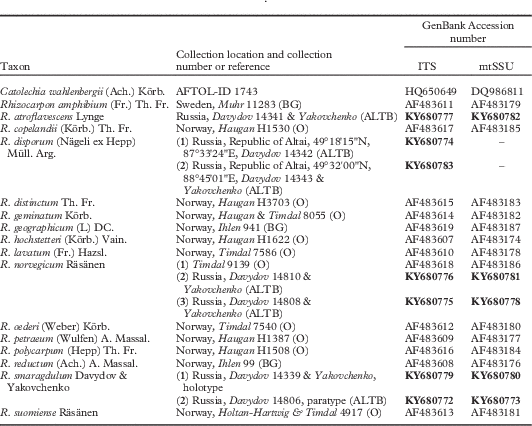
To test the monophyly, taxonomic level and phylogenetic relationships with other species, ITS nrDNA and SSU mrDNA sequences of our fresh material and other sequences retrieved from the NCBI database (GenBank) were used for molecular phylogenetic analysis. ITS nrDNA and SSU mrDNA markers were sequenced because these loci were used in the most comprehensive analyses of Rhizocarpon by Ihlen & Ekman (Reference Ihlen and Ekman2002) and sequences are also present in GenBank, whereas other loci are available only for very few species. To test the relationship between R. smaragdulum and the monosporic grey-thalline species R. disporum (Nägeli ex Hepp) Müll. Arg., original sequences of the latter species from Altai were also produced. Our sampling comprised 17 species, representing morphological variability within Rhizocarpon (including Catolechia wahlenbergii (Ach.) Körb.). Information on the samples with GenBank Accession numbers are given in Table 1.
Lichen species used for the phylogenetic analyses in this study together with their GenBank Accession numbers. New sequences in bold

Two or three apothecia were used for DNA extraction. Samples were frozen in liquid nitrogen and powdered using sterile pestles. The DNeasy Plant Mini Kit (Qiagen, Germany) or DiamondDNA Plant Kit (ABT llc., Russia) were used for DNA extraction as recommended by the manufacturers. The primer sets were ITS1F (Gardes & Bruns Reference Gardes and Bruns1993) and LR1 (Vilgalys & Hester Reference Vilgalys and Hester1990) or ITS4 (White et al. Reference White, Bruns, Lee and Taylor1990) for ITS, and mrSSU1 (Zoller et al. Reference Zoller, Scheidegger and Sperisen1999) and MSU7 (Zhou & Stanosz Reference Zhou and Stanosz2001) for mtSSU. PCR settings were as follows: 95°C for 2 min, 35 cycles of 94°C for 20 s, 53°C for 60 s, 72°C for 2 min, followed by 72°C for 15 min and maintained thereafter at 14°C. The sequences obtained in this study and the reference sequences from GenBank were aligned using Geneious 6.0 (Biomatters Ltd., New Zealand) and manually optimized. The most divergent (genetic distance) sequence was used as outgroup to root the resultant phylogenetic hypothesis. Before combining sequences into a joint ITS+mtSSU data matrix, the unambiguously aligned regions of 22 specimens for which both marker regions were obtained were used for calculations using RAxML 8.0.26 (Stamatakis Reference Stamatakis2014) to generate ITS and mtSSU single-marker phylograms (not shown), which were tested for conflicts. Because both cladograms were similar regarding well-supported clades and lacking conflicts, all sequences were combined into one matrix consisting of 1258 sites, 252 of which were variable and used for RAxML and Bayesian analyses. Optimal substitution models were inferred for the subsets ITS1, 5.8S, ITS2 and mtSSU, and combined into three partitions using PartitionFinder ver. 1.1.1 (Lanfear et al. Reference Lanfear, Calcott, Ho and Guindon2012). The models selected were Kimura 2-parameter with proportion of invariable sites and gamma-distribution (K80+I+G) for 5.8S partition, Hasegawa-Kishino-Yano parameter with gamma-distribution (HKY+G) for ITS1+ITS2 partition, and HKY-parameter with proportion of invariable sites and gamma-distribution (HKY+I+G) for mtSSU. Bayesian inference with the Markov chain Monte Carlo (BMCMC) method (Larget & Shimon Reference Larget and Shimon1999) was performed using MrBayes 3.2.3 (Ronquist et al. Reference Ronquist, Teslenko, van der Mark, Ayres, Darling, Höhna, Larget, Liu, Suchard and Huelsenbeck2012). Three parallel Bayesian analyses were run in six chains and every 200th generation was sampled. Convergence of the chains was inferred by calculating the average standard deviation of split frequencies every 100000 generations using a burn-in fraction of 0·5 and the runs terminated when the standard deviation of split frequencies dropped below 0·001. This was the case after 8·8 M generations. The first 50% of trees were discarded as burn-in and a 50% majority-rule consensus tree was calculated from the remaining trees of three runs with the sumt command implemented in MrBayes 3.2.3. Bootstrap support values and BMCMC posterior probability were noted on the best scoring tree. The most likely tree and 1000 bootstrap replicates were calculated using RAxML 8.0.26 (Stamatakis Reference Stamatakis2014) with the raxmlGUI software version 1.3.1 (Silvestro & Michalak Reference Silvestro and Michalak2012) applying the GTRGAMMA model of substitution to the subsets because RAxML does not support HKY and K80 models.
To check the relationship of R. smaragdulum to species of Rhizocarpon not included in our molecular phylogenetic analysis and absent from GenBank, particularly Rhizocarpon cookeanum H. Magn. and R. subgeminatum Eitner, a local ITS BLAST search was kindly made by Einar Timdal against c. 300 unpublished ITS sequences from c. 80 Rhizocarpon species from the sequence database of the Natural History Museum, University of Oslo (M. Bendiksby & E. Timdal, pers. comm.).
Results
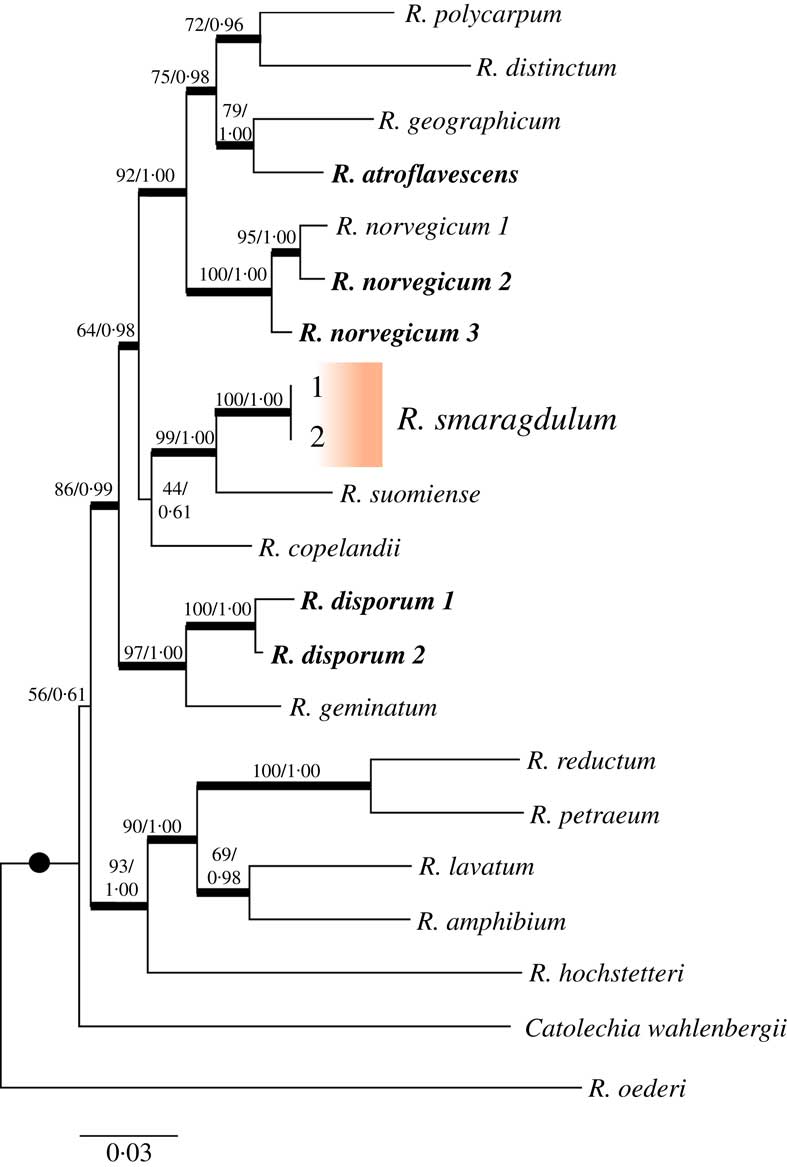
The Bayesian 50% majority-rule consensus tree had the same topology as RAxML. Both phylograms are combined in Fig. 1. The major taxon grouping was similar in the phylogenetic reconstructions of single ITS and mtSSU, as well as in the combined ITS+mtSSU datasets (Fig. 1). The latter phylogram, however, provided higher statistical support for major groups, but the backbone is still unresolved.
Reconstruction of the Rhizocarpon ITS+mtSSU phylogeny. The tree was constructed using maximum likelihood analysis, and the reliability of each branch was tested by ML and Bayesian methods. Numbers at tree nodes indicate bootstrap values for ML (left) and BMCMC posterior probabilities (right). Thicker branches indicate relationships with strong bootstrap (ML≥70%) and posterior probability (BMCMC≥0·95) support. GenBank Accession numbers are given in Table 1, new sequences are in bold. Branch lengths represent the estimated number of substitutions per site assuming the following models of substitution: HKY+G for ITS1 and ITS2, K80+I+G for the intervening 5.8S and HKY+I+G for mtSSU. An exception is the branch with a black dot which has been shortened to reduce the overall figure size.
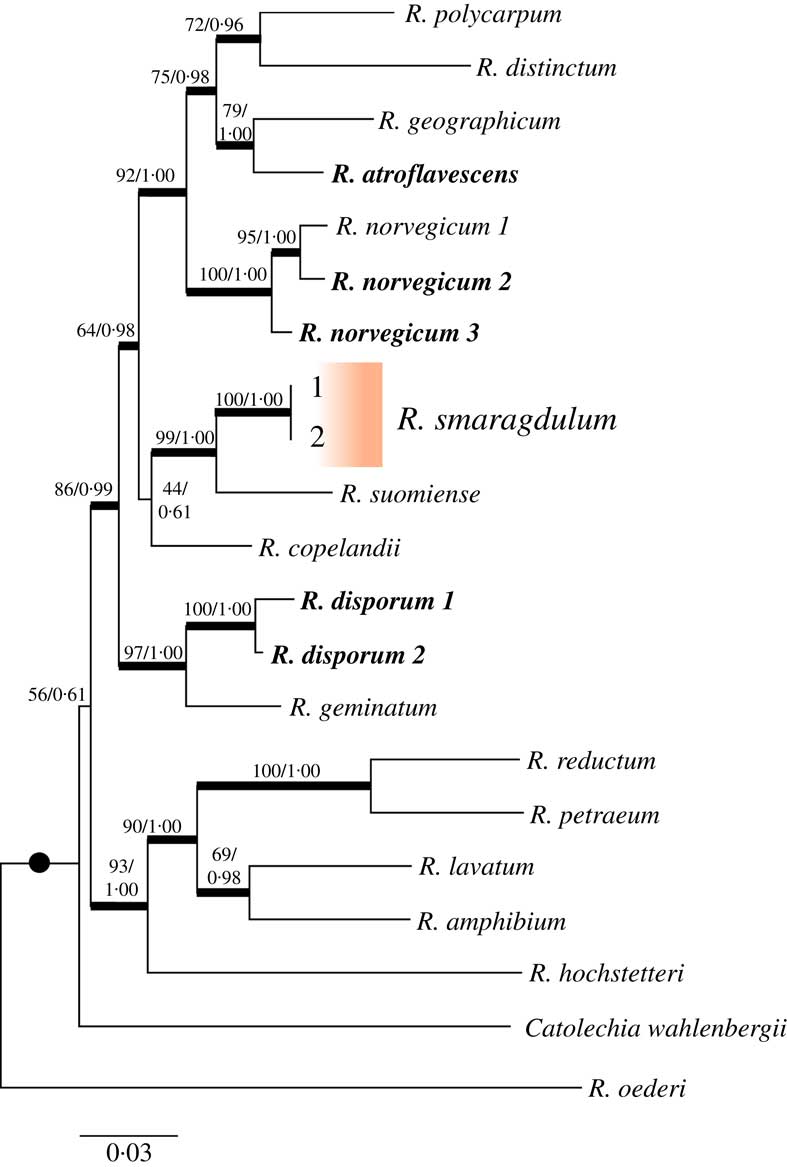
ITS and mtSSU sequences were successfully obtained from two specimens of the putative new species, described below as Rhizocarpon smaragdulum, from the two most geographically distant localities, Katunsky Range (Republic of Altai) and Mongun-Taiga Massif (Republic of Tuva). They formed a monophyletic clade in all phylograms with 100/1·00 support values (bootstrap/posterior probability) in the phylogenetic tree (Fig. 1). A supported sister clade (99/1·00) includes the sequence of R. suomiense Räsänen.
The result of the ITS BLAST search against sequences from the database of the Natural History Museum, University of Oslo, showed R. subgeminatum (specimen O–L166501, Norway) to be the closest to R. smaragdulum (92·4% similarity). Rhizocarpon suomiense, the species closest to R. smaragdulum in the ITS+mtSSU tree (Fig. 1), gave 88·2% similarity, whereas R. cookeanum (O–L184648 and O–L184647, both from USA, Montana, leg. Tim Wheeler) gave 85·8% (M. Bendiksby & E. Timdal, pers. comm.).
The Rhizocarpon atroflavescens sequence clusters as sister to a R. geographicum (L) DC. sequence obtained from GenBank with high statistical support (79/1·00).
Both our sequences of parasitic Rhizocarpon cluster together with the sequence of R. norvegicum obtained from GenBank with 100/1·00 support values and very short branches. The genetic difference between the two Altaian samples is larger than that between the European and each Altaian sample. The pairwise identity of the ITS fragment (including gap versus non-gap) is 94·8% between the Altaian samples, and 95·3% and 97·0% between the Altaian samples and the European sample (AF483618). The genetic differences are 4–8 residues in ITS1 and 6–10 in ITS2 (excluding gap versus non-gap), identical in 5.8S nrDNA, and there is one residue difference in mtSSU (KY680781).
Rhizocarpon smaragdulum Davydov & Yakovchenko sp. nov.
MycoBank No.: MB 818984
Thallus yellow, containing rhizocarpic acid; medulla non-amyloid; epihymenium Atra-red with Cinereorufa-green patches; asci with a single, eumuriform, hyaline ascospore.
Type: Russia, Republic of Tuva, Mongun-Taiginsky District, Mongun-taiga Massif, headwaters of the Orta-Shegetei River, 4·5 km upstream of the Sive-Khol’ lake, stonefield near Larix sibirica forest, 50°09'11''N, 90°01'37''E, alt. 2415 m a.s.l., on granite boulders around depressions in stones accumulating water, 9 July 2014, E. A. Davydov 14339 & L. S. Yakovchenko (LE–L13176—holotype; ALTB, H, FR, KB, M, O, OSC, TNS, UPS—isotypes).
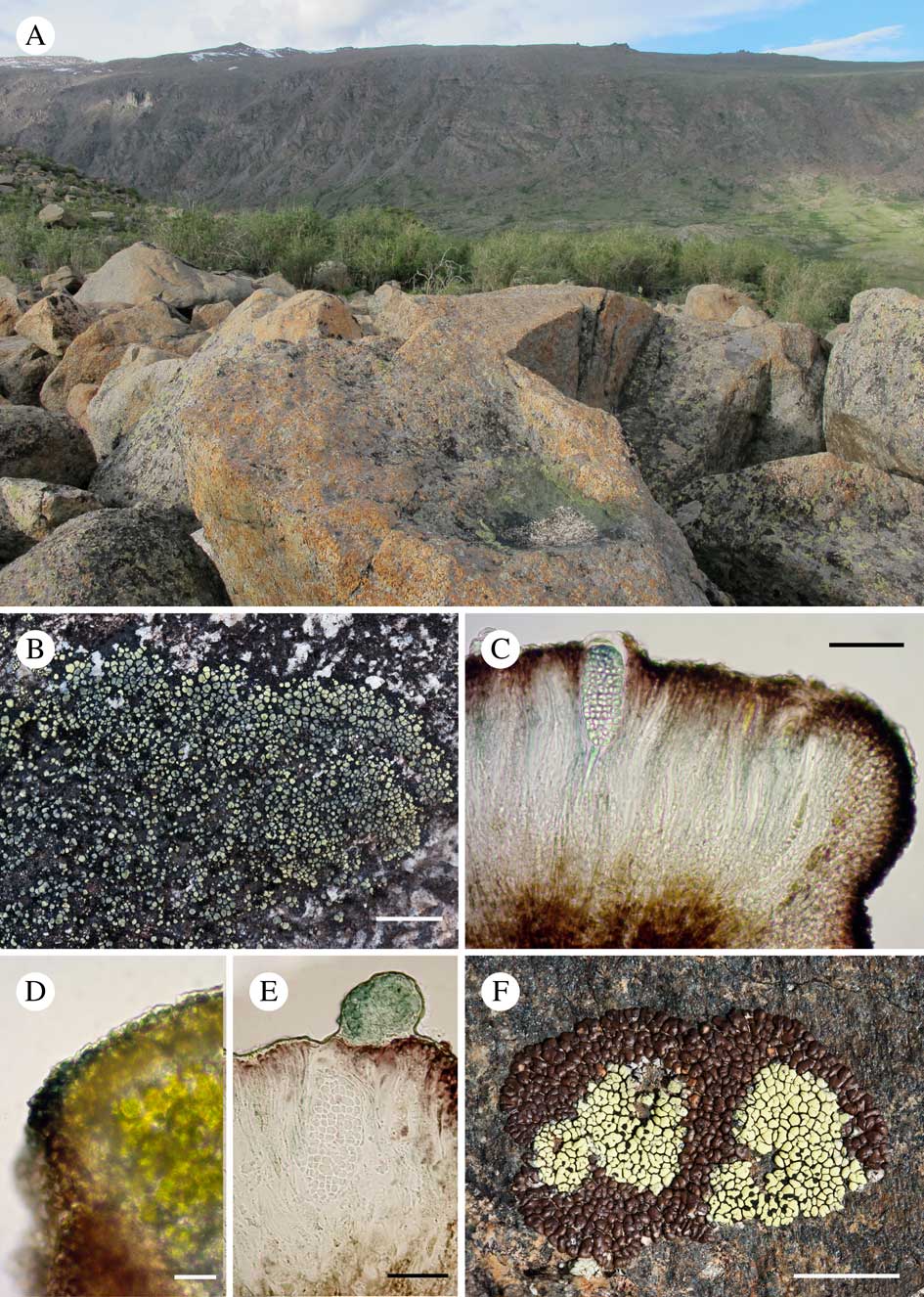
A–E, Rhizocarpon smaragdulum; A, type locality, Mongun-Taiga Massif, typical habitat is depressions in stones accumulating water; B, type specimen (in situ); C, section of apothecium with hyaline muriform ascospore; D, section of thallus with Cinereorufa-green pigment on the surface; E, section of apothecium with hyaline muriform ascospore in the hymenium and pigmented ascospore on the epithecium. F, Rhizocarpon norvegicum on Acarospora bullata. Scales: B & F=1 cm; C=50 µm; D & E=20 µm. In colour online.
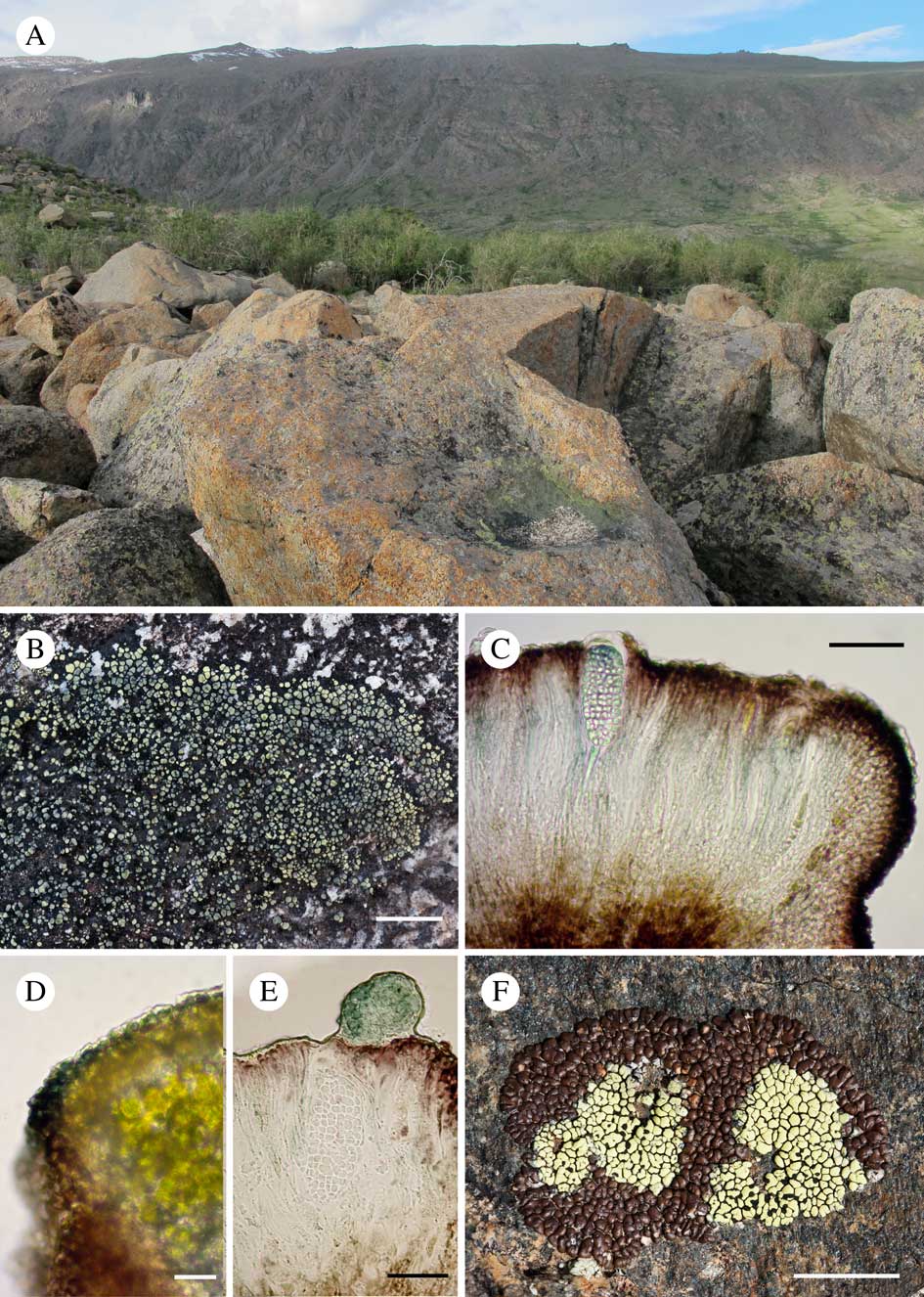
Life habit lichenized, not lichenicolous. Thallus areolate to subsquamulose, areoles (57–) 69–103–136(–208) cm–2 (n=14), flattened to convex or with depression in centre, rounded to soon irregular in outline and crenulate, closely attached initially to soon somewhat constricted at the base, scattered to crowded, (0·2–)0·5–0·9–1·3(–1·8) mm diam. (n=29) and (200–)250–290–329(–350) µm thick (n=11), lower side black, visible at the edge. Upper cortex yellow with Cinereorufa-green patches, dull, smooth, epruinose to faintly pruinose, paraplectenchymatous, without an epinecral layer, (25·0–)26·7–30·9–35·1(–37·5) µm high (n=11). Medulla I−, K−; crystals absent. Lower cortex Atra-brown peripherally, colourless internally. Photobiont layer continuous, (37·5–)80·3–99·3–119·4(–125·0) µm high (n=15); photobiont chlorococcoid, algal cells (5·0–)8·8–14·1–19·3(–22·5) µm diam. (n=11). Prothallus distinct, black. Vegetative propagules absent.
Apothecia lecideine, black, irregularly arranged, scattered to crowded, sessile on the black prothallus, (3–)27–46–65(–72) cm–2 (n=14), rounded to irregular or angular in outline, (0·2–)0·3–0·5–0·7(–1·0) mm diam. (n=23); disc flat to slightly convex, epruinose, sparingly shiny; proper margin (25–)36–51–66(–85) µm thick (n=14), distinct, persistent or rarely disappearing, above or at the same level as the disc; concolourous with the disc, epruinose, sparingly shiny. Exciple of radiating hyphae 4–7 µm wide, Atra-brown peripherally, colourless internally, (42·5–)59·8–72·1–84·3(–100·0) µm wide in uppermost part (n=17). Hymenium hyaline, frequently with Cinereorufa-green patches, (80·0–)92·4–104·7–117·1(–150·0) µm high (n=28); paraphyses septate, branched and anastomosing, c. 2·5 µm thick in mid-hymenium and 3–5 µm thick apically; epihymenium Atra-red with Cinereorufa-green patches (5·0–)8·1–12·4–16·6(–30·0) µm high (n=17). Hypothecium brown, K−, N−, (50·0–)91·0–117·4–143·7(–150·0) µm high (n=21). Asci clavate, Rhizocarpon-type; ascospores ellipsoid to widely or narrowly ellipsoid, sometimes slightly ovoid, hyaline, (25·0–)41·9–55·5–69·2(–92·5)×(15·0–)21·7–27·0–32·4(–40·0) µm, eumuriform, with (12·0–)31·1–43·5–56·0(–70·0) cells in optical view; length/width ratio (1·7–)1·9–2·1–2·1(–2·2) (n=35); mature ascospores became green after evacuation from the asci (can be observed on the epihymenium surface) (Fig. 2E).
Chemistry. Thallus K−, C− UV+ orange; medulla K−, C−; rhizocarpic acid by TLC.
Etymology. The name refers to the colour of the thallus.
Ecology. Rhizocarpon smaragdulum was found in wet conditions on exposed siliceous rocks in gravelly barrens in the upper forest belt or above the timberline (1600–2800 m a.s.l.). The species grows quite abundantly on horizontal siliceous rocks (granites) with small depressions in which water can accumulate (Fig. 2A) and was the dominant species in this habitat. The following species co-occurred with R. smaragdulum: Acarospora badiofusca (Nyl.) Th. Fr., Aspicilia cinerea (L.) Körb., Immersaria athroocarpa (Ach.) Rambold & Pietschm., Montanelia disjuncta (Erichsen) Divakar et al., Rhizocarpon atroflavescens, R. eupetraeoides (Nyl.) Blomb. & Forssell, R. geminatum Körb., R. geographicum (L.) DC., R. subgeminatum, R. superficiale (Schaer.) Malme, Rhizoplaca chrysoleuca (Sm.) Zopf and Umbilicaria cf. cylindrica (L.) Delise ex Duby (small thalli).
Distribution. Rhizocarpon smaragdulum is known only from a single locality in the Altai Mountains in the Katunskiy Range (Republic Altai) and two localities in Mongun-Taiga Massif (Western Tuva). The distance between the two most remote localities is c. 250 km.
Discussion
Rhizocarpon smaragdulum is a remarkable species having a patchily greenish yellow thallus, a non-amyloid medulla and asci with a single, eumuriform, hyaline ascospore. It is unique among species of Rhizocarpon with a yellow thallus in having asci containing only one spore and also in its lack of pigmentation in the ascospore walls; all other species have pigmented ascospores and multi-spored asci. Only two Rhizocarpon species with a yellow thallus and asci containing less than 8 spores have, so far, been reported: R. tetrasporum Runemark with 4(2–6) muriform spores, 27–40×14–21 µm, distributed in southern Europe, and R. cookeanum with bispored asci and muriform spores, 35–50×15–20 µm, known from the USA only (Runemark 1956 Reference Runemarka ). So far, monospored asci have been recorded only in Rhizocarpon species with a grey thallus, notably R. disporum and R. geminatum, which normally possesses bispored asci, and also in bisporic R. subgeminatum which can produce various numbers of spores ranging from 1 to 4 (Fletcher et al. Reference Fletcher, Gilbert, Clayden and Fryday2009; Wirth et al. Reference Wirth, Hauck and Schultz2013) or even 8 per ascus (Dobrysh Reference Dobrysh2003). A chemotype of R. geminatum containing rhizocarpic acid in the medulla was reported by Timdal & Holtan-Hartwig (Reference Timdal and Holtan-Hartwig1988) but without a detailed description of the specimens.
Morphologically, R. smaragdulum most closely resembles the poorly known species with a yellow thallus, R. cookeanum, but differs by having monospored asci and lacking stictic acid (TLC of ten specimens of R. cookeanum by M. Bendiksby & E. Timdal, pers. comm.). The ITS BLAST search showed that these two species are only distantly related (85·8%, which is less than between R. smaragdulum and e.g. R. copelandii, R. disporum, R. cinereonigrum and 13 other species).
The Scandinavian-North American species R. suomiense Räsänen (Ihlen Reference Ihlen2004; MacDonald et al. Reference MacDonald, Lundholm and Clayden2011) appears most closely related to R. smaragdulum in the ITS+mtSSU phylogeny (Fig. 1). Rhizocarpon suomiense similarly produces eumuriform hyaline ascospores but has bispored asci and a grey thallus containing norstictic acid (Ihlen Reference Ihlen2004). The different distributional ranges of these two species suggest allopatric speciation. The circumpolar species R. subgeminatum, which appeared closest to R. smaragdulum according to the ITS BLAST search, is morphologically similar to R. suomiense but differs in lacking lichen substances and in the shape of its areoles (Ihlen Reference Ihlen2004). The species clustered together in a published ITS phylogeny (McCune et al. Reference McCune, Timdal and Bendiksby2016). Rhizocarpon subgeminatum is quite common in Altai (Davydov et al. Reference Davydov, Konoreva, Andreev, Zhdanov and Dobrysh2012) and could be the ancestral taxon to both R. suomiense and R. smaragdulum, in this way representing a case of sympatric speciation. Both R. subgeminatum and R. suomiense have a grey thallus colour due to the lack of rhizocarpic acid. The presence or absence of this compound seems to require just minor genetic changes (cf. Ihlen & Ekman Reference Ihlen and Ekman2002).
The phylogram obtained has an unresolved backbone that restricts our discussion on evolutionary trends in Rhizocarpon. Octosporic asci are the predominant trait in our phylogeny. The multilocus phylogeny of Miadlikowska et al. (Reference Miadlikowska, Kauff, Högnabba, Oliver, Molnár, Fraker, Gaya, Hafellner, Hofstetter and Gueidan2014) suggests that the occurrence of octosporic asci is a plesiomorphic trait in Rhizocarpon. Two well-supported clades include species with less than eight ascospores per ascus in our phylogenetic tree, indicating that the number of ascospores per ascus has undergone a reduction more than once during the course of evolution. A case of parallelism could be observed; the reduction of spore number from two to one per ascus in both the R. suomiense – R. smaragdulum and R. geminatum – R. disporum clades. Monosporic asci therefore represent apomorphies. A similar evolutionary trend towards reduction of the spore number per ascus has also been observed in the Umbilicariaceae (Davydov et al. Reference Davydov, Peršoh and Rambold2010). Ascospore number reduction results in an increase in cytoplasmic resources for single multiseptate meiospores and might be advantageous for the early stages of fungal growth.
Additional material examined. Russia: Republic of Altai: Ust’-Koksinsky District, Katunsky Range, middle course of the Ioldo River, 49°51'52·4''N, 86°05'36·9''E, alt. 1629 m a.s.l., stonefields and rocks, on granite stones, 2008, E. A. Davydov 14806 (ALTB). Republic of Tuva: Mongun-Taiginsky District, Mongun-taiga Massif, headwaters of the Mugur River 27·5 km W of Mugur-Aksy, alpine meadows and mountain tundra with rocks, 50°18'35''N, 90°04'06''E, alt. 2800 m a.s.l., 2014, E. A. Davydov 14340 & L. S. Yakovchenko (ALTB); same massif, left side of the Toolaity River valley, 5 km upstream from the Eski-Toolaity lake, mountain tundra, fellfield, 50°11'44''N, 90°08'45''E, alt. 2565 m a.s.l., 2014, E. A. Davydov 14338 & L. S. Yakovchenko (ALTB).
Additional species reported
Rhizocarpon atroflavescens Lynge
Rhizocarpon atroflavescens is a yellow-thalline species with a distinct, white to greyish prothallus. The species was described from Novaya Zemlya and is known from Europe, North America and Asia (Dobrysh Reference Dobrysh2000) where it grows mostly on slightly calcareous rocks. In Russia, it has been reported in the north of the European part (Fadeeva et al. Reference Fadeeva, Golubkova, Vitikainen and Ahti2007; Urbanavichus et al. Reference Urbanavichus, Ahti and Urbanavichene2008, Reference Urbanavichus, Lavrinenko and Urbanavichene2009), north of the Ural Mts (Hermansson et al. Reference Hermansson, Pystina, Owe-Larsson and Zhurbenko2006), the Caucasus (Otte Reference Otte2007), and from Wrangel Island (Dobrysh Reference Dobrysh2000). The relationship between R. atroflavescens and R. geographicum indicated by the phylogenetic tree looks plausible. Both species have similar ascospore characters and secondary metabolites. However, R. geographicum is much more variable phenotypically. Rhizocarpon atroflavescens is reported here as new for Siberia. In Altai, it occurs in drier conditions than R. geographicum and grows in mountain steppes.
Material examined. Russia: Republic of Tuva: Mongun-Taiginsky District, Mongun-taiga Massif, left side of the Toolaity River valley, 3·5 km upstream from the Eski-Toolaity lake, mountain tundra, stonefield, 50°11'N, 90°09'E, alt. 2450–2600 m a.s.l., 2014, E. A. Davydov 14341 & L. S. Yakovchenko (ALTB). Altai Territory: Charyshsky District, Tigireksky Range, 4·8 km S of the community of Tigirek, Abies sibirica taiga forest, huge boulders in open place, 51°06'12''N, 83°00'56''E, alt. 1280 m a.s.l., 2014, E. A. Davydov 14682 & L. S. Yakovchenko (ALTB).
Rhizocarpon norvegicum Räsänen
The specimens investigated are parasitic on Acarospora bullata; they have a K− epihymenium and one-septate brown ascospores, 15·0–17·5×10 µm.
Rhizocarpon norvegicum is a rather inconspicuous species with a small thallus and two-celled, brown ascospores. It has a scattered distribution in the Holarctic, and in Russia has been reported from the Arctic, Murmansk Region, South and East Siberia, Yakutia and the Magadan Region (Dobrysh Reference Dobrysh2003; Urbanavichus Reference Urbanavichus2010). It grows in open lichen communities on siliceous or slightly calcareous rocks (Runemark 1956 Reference Runemarka , Reference Runemarkb ). In Russia, it has not previously been reported as being lichenicolous. However, in Europe and Greenland the species is sometimes reported as parasitic on saxicolous lichens, for example, Acarospora sinopica (Wahlenb.) Körb. (most often), A. discreta (Ach.) Arnold, Polysporina (cf.) ferruginea (Lettau) M. Steiner, Rinodina sp. and Tremolecia atrata (Ach.) Hertel (Holtan-Hartwig & Timdal Reference Holtan-Hartwig and Timdal1987; Rambold & Triebel Reference Rambold and Triebel1992; Santesson Reference Santesson1993; Hansen Reference Hansen2002). In Altai, it grows both on rocks and on Acarospora bullata Anzi. (Fig. 2F).
The new records of Rhizocarpon atroflavescens and R. norvegicum in the Altai Mts fill existing gaps in their known Holarctic distribution.
Material examined. Russia: Republic of Tuva: Mongun-Taiginsky District, Mongun-taiga Massif, left side of the Toolaity River valley, 2·7 km upstream from the Eski-Toolaity lake, 50°10'18''N, 90°09'05''E, alt. 2670 m a.s.l., mountain tundra, fellfield, on Acarospora bullata, 2014, E. A. Davydov 14808 & L. S. Yakovchenko (ALTB); same massif, left side of the Toolaity River valley, 3·5 km upstream from the Eski-Toolaity lake, mountain tundra, fellfield, 50°11'N, 90°09'E, alt. 2450–2600 m a.s.l., on Acarospora bullata, 2014, E. A. Davydov 14809 & L. S. Yakovchenko (ALTB); same massif, right side of the Khairykan River valley, 3 km upstream from its mouth (Mugur River), alpine meadows and mountain tundra with stones, 50°18'38''N, 90°12'23''E, alt. 2400–2500 m a.s.l., on Acarospora bullata, 2014, E. A. Davydov 14810 & L. S. Yakovchenko (ALTB).
We are grateful to Dr Christian Printzen for the opportunity to sequence a part of the Rhizocarpon smaragdulum collection in his laboratory, to Dr M. Bendiksby and Dr Einar Timdal for the local BLAST search and valuable comments, to Dr M. P. Zhurbenko for discussion on Rhizocarpon norvegicum hosts, and to Dr G. P. Urbanavichus for his comments on some species’ distributions. The authors also thank Dr G. E. Insarov and Dr T. V. Yashina for organizing an expedition in the Katunsky Nature Reserve (Altai), Dr G. E. Insarov and Dr A. N. Kuksin for organizing an expedition in the Ubsunur Nature Reserve (Tuva), and the directors and staff of these reserves for their great support during these expeditions. We are grateful to Dr William Purvis and Dr Alan Fryday for improving the text. The study was partly financially supported by the Russian Foundation for Basic Research (grants 16-34-50127 & 15–04–05971).