1. Introduction
The demand for food commodities is ever-increasing which calls for an increase in agricultural produce. Balancing out the demand and supply cycle, especially in the urban areas, might require an increase in the total land under cultivation [Reference Ali and Srivastava1]. This is challenging in urban areas due to shortage of available land and high population densities. The concept of vertical farming is being explored and researched to facilitate this challenge in modern agricultural practices [Reference Zhang, Rod and Hosseinian2]. It is a concept that utilizes the third dimension of space, that is, in the vertical direction to increase the number of crops that can be cultivated in a certain area. In vertical farming, the plants are kept in pipes or trays that are stacked on top of each other. Generally, the setup is in a closed space with the environmental conditions like light, temperature, humidity, etc. controlled artificially. Thus, vertical farming serves the basic concept of precision agriculture that is optimization of parameters, along with its other advantage of greater utilization of space. Precision agriculture is advantageous to farmers because the yield can be greatly improved while reducing the cost by measuring and optimizing the parameters like nutrients supplied, water, time for harvest, etc [Reference Lowenberg-DeBoer, Huang, Grigoriadis and Blackmore3]. Due to the large heights, closed space with controlled environmental conditions, need for high precision, etc., it would be difficult for humans to intervene personally in all agricultural practices. For efficiency, effectiveness, and ease of performing these challenging tasks, robotic solutions can be adopted, planned, and designed according to the requirement. Robotic assistance can help in elimination of human error which is crucial for the close control required in precision agriculture. Along with this, robotic assistance makes continuous operation possible, with the least halts, which can give better control, increase yield, and enable farmers to take full advantage of the closed environmental conditions in vertical farming. Thus robotic assistance can be of help in both situations that is to precisely control the parameters and to remove limits on the height of vertical farms which are otherwise set by limitations of human reachability.
Various researchers have worked on providing robotic assistance in agriculture. Iqbal et al. [Reference Iqbal, Xu, Halloran and Li4] developed a mobile manipulator with a
 $3$
-DoF robotic arm using off-the-shelf actuators to perform plant phenotyping and soil sensing. Arad et al. [Reference Arad, Balendonck, Barth, Ben-Shahar, Edan, Hellström and van Tuijl5] developed a mobile manipulator for harvesting sweet pepper. The prototype was developed using Fanuc LRMate 200iD robotic arm placed on a mobile platform. Strisciuglio et al. [Reference Strisciuglio, Tylecek, Blaich, Petkov, Biber, Hemming and Fisher6] developed a mobile manipulator for rose pruning and bush trimming. The system consists of a
 6
-DoF Kinova robotic arm mounted on a mobile platform. The platform is a modified version of Bosch lawnmower. Roure et al. [Reference Roure, Moreno, Soler, Faconti, Serrano, Astolfi and Matteucci7] developed a mobile manipulator for plant health monitoring in vineyards. It consists of a
 6
-DoF Kinova robotic arm mounted on a Husky platform. The arm was placed on the side of the platform to increase the workspace although restricting the operation to one side. Lehnert et al. [Reference Lehnert, English, McCool, Tow and Perez8] developed a mobile manipulator for harvesting sweet pepper. The authors used a UR5
 6
-DoF robotic arm attached to the prismatic lift joint. This permitted greater movement in the vertical direction thus making it easy to reach fruits at greater heights. A modular robotic system has been designed and developed by Schütz et al. [Reference Schütz, Pfaff, Baur, Buschmann, Ulbrich and Idea9] for harvesting sweet pepper, apples, and grapes and precision spraying of grapes. The authors have proposed two redundant manipulators, one with 7 DoF and the other with 9 DoF, for performing the required tasks. Other studies in the field of agricultural robotics are presented in refs. [Reference Grimstad and From10–Reference Bascetta, Baur and Gruosso12]. The environment and the plant being grown affect the configuration of the manipulator required to perform the task as has been presented by Levin et al. [Reference Levin and Degani13]. The authors designed link and joint modules for fruit harvesting and conducted the optimization analysis for minimizing the harvesting time by simulating various configurations of 3 DoF manipulator on a mobile platform. The study resulted in different optimal configurations for different trees due to variation in the distribution of fruits on them. This highlights the effect of variation of the tasks and the dynamic nature of the environment of the agricultural farms and thus points out the requirement of custom robotic configurations, as one single configuration cannot perform all the required tasks.
To realize the customized configurations as per the requirement, modular and reconfigurable systems provide effective solutions. Through modular and reconfigurable systems, any
 n
-DoF manipulator can be realized for the required tasks. The various design of modules for reconfigurable manipulators proposed by different researchers can be seen in refs. [Reference Althoff, Giusti, Liu and Pereira14–Reference Kang, Han, Xu, Wang and Yang25]. These works are able to achieve the conventional configurations in serial manipulators as well as other robotic systems such as quadruped but further study on task-based approach highlights the need to assemble unconventional configurations of serial manipulators as well. To get the required configurations, generally, the task-based optimization approach is followed in which the configuration is synthesized with respect to various performance parameters [Reference Patel and Sobh26]. Mostly the objective is to minimize the error of the reachability for the given task while avoiding the obstacles [Reference Valsamos, Moulianitis and Aspragathos27–Reference Icer, Hassan, El-Ayat and Althoff33]. The approaches in these works are based either on optimizing the composition of the modules or synthesizing the robotic parameters of the configuration. Efforts have been reported for the synthesis of unconventional configurations for the cluttered environment as in ref. [Reference Singh, Singla and Singla34]. The related works which consider the design and synthesis of unconventional configurations can also be seen in refs. [Reference Stravopodis, Valsamos and Moulianitis35,Reference Brandstotter, Angerer and Hofbaur36,Reference Dogra, Sekhar Padhee and Singla38]. Following are the observations from the current literature survey.
-
1. Most of the robotic designs proposed for agricultural practices are focused on a particular task, and no general solution is found to design the system which can perform a variety of tasks.
-
2. Standard off-the-shelf robotic arms are used in most cases, which do not have customizability. The standard robotic manipulators usually have fixed DoF. Modularity, as a solution to provide customization, is explored to a very little extent in agricultural robotics.
-
3. The payload capacity of these robotic arms is more than that required for agriculture processes, where very light payloads are to be lifted. This means that there is a scope of optimization by using modules with lighter and more compact actuators.
In this paper, a thorough study of the processes which are involved in the farming of leafy vegetables like lettuce, spinach, and broccoli has been conducted to define the variation in the tasks and the environments. It is observed that processes have a lot of variations with respect to the end-effector required to perform the process, the payload, the complexity, and level of control required, etc. Thus, each process requires a different robotic configuration. To achieve the level of customization and to provide a unified solution, modular and reconfigurable solutions are adopted here as proposed by the authors’ group in ref. [Reference Dogra, Sekhar Padhee and Singla38]. The paper aims at providing an optimal solution which is reconfigurable to achieve the aspect of customization required for each task in the vertical farming scenario. The optimal configuration for the different agricultural tasks is found based on reachability and then realized it using a modular architecture. All the modular libraries studied in literature provide a system to assemble configurations with conventional parameters but the results of optimal configuration synthesis demonstrate the need to achieve unconventional parameters as well. Thus, the library proposed by Dogra et al. [Reference Dogra, Sekhar Padhee and Singla38] is adopted to realize the configurations resulting from the constrained optimization.
The organization of the paper is as follows. Section 2 discusses the study of various processes involved in vertical farming along with the definition of parameters of each. Section 3 presents the methodology to find the configurations best suited to perform these processes followed by an overview of the modules used to realize these configurations. The results of selected case studies are presented in Section 4, with the conclusion in the last section.
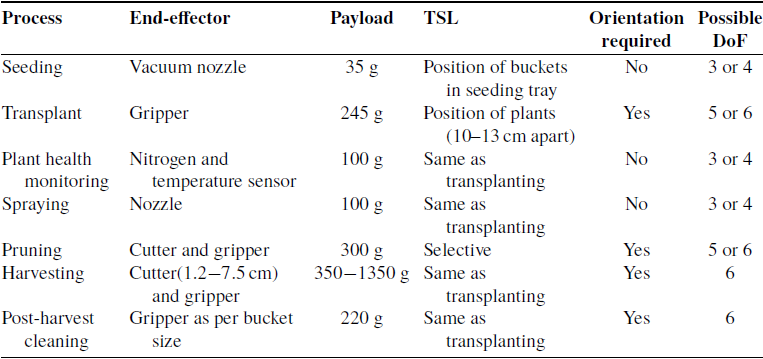
Parameter definition of different agricultural processes for leafy vegetables.

2. Task Definition for Synthesis of Configurations
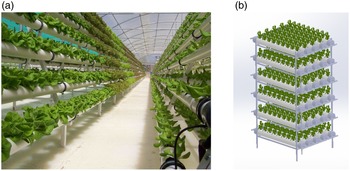
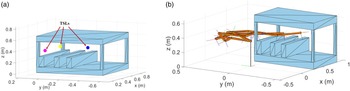
For the design and application of a robot manipulator in agriculture, it is important first, to identify the tasks and the features around which the manipulator has to be designed. This requires a study of the processes involved in vertical farming as well as defining the various parameters of each process, such as the task space locations (TSLs), payload, environment clutter in which the task is needed to be performed, etc. An example of a vertical farm setup is shown in Fig. 1(a) and its model is shown in Fig. 1(b). The crops under consideration are lettuce, spinach, and broccoli, and the processes involved in the vertical farming of these crops are identified as, seeding, transplanting, plant health monitoring, spraying, pruning, harvesting, and post-harvest cleaning. A thorough study of the processes is done along with the parameters and are summarized in Table I. A brief description of the processes involved in the farming of these vegetables is as follows.
-
1. Seeding – It involves picking the seeds from the container and placing them in the planting media in the seeding tray where the plants would grow initially. The planting media can be coir compost (cocopeat) or clay balls. It is contained in small buckets which function as a support for the saplings to grow as well as ease the process of transplanting. The end-effector can be a vacuum suction tube to pick up the seed. The payload of this process is the least of all, that is, around 35 g including the end-effector.
-
2. Transplanting – It involves picking of the saplings along with the planting media from the seeding tray and placing it in the vertical farm setup where the plants would grow. The end-effector for this process can be a 2 or 3 finger gripper. The orientation of the end-effector must be controlled because the saplings have to be inserted vertically in the setup. The payload for the manipulator in this process is found to be around 245 g which includes the weight of the sapling, that is, 45 g [40].
-
3. Plant health monitoring – It involves collecting data about humidity, temperature and nitrogen with the appropriate sensors. The data are collected to get an idea of the plant health so as to make changes, if necessary, in the nutrient supply, the controlled environment, etc. The end-effector in this process would be the sensors necessary for these measurements. The plants are not fully grown at the time of the process, and thus, do not contribute much to the environmental clutter.
-
4. Spraying – It involves spraying the plant with any herbicides, if required. The end-effector for this process would be a spray nozzle. The payload is around 100 g. Plant clutter is the same as in plant health monitoring.
-
5. Pruning – It involves trimming the plant so that it does not spread out too much and hinder the growth of other plants. The end-effector would be a fine cutter which can trim certain branches without affecting other branches. Orientation control is highly required in this process and a variety of preferable orientations are desired according to the trimming requirement.
-
6. Harvesting – It involves holding and cutting the yield and placing it in the appropriate tray. The end-effector would include a cutter and a gripper, both of which will vary according to the plant. The orientation of the end-effector has to be controlled in this process to correctly grip, cut, and pick the crop. The payload here is the most of all processes that is 1.35 kg for lettuce, 500 g for broccoli and 350 g for spinach.
-
7. Post-harvest cleaning – It involves removing the buckets and the planting media from the vertical farm setup so as to make it ready for the next transplanting process.
(a) An example of a vertical farm setup, (b) Model of the vertical farm setup.

Following variations are observed with respect to the requirement of the robotic assistance in the tasks defined above
-
1. The payload varies from 35 g in the seeding process to 1.35 kg in harvesting of the lettuce.
-
2. A specific orientation of the end-effector is required in three of the seven tasks – transplanting (for the sapling to be vertical), pruning (to trim the leaves at certain angles), and harvesting (to pick the plant at a certain angle and place it).
-
3. Plant height varies from 15 to 20 cm for lettuce to 45–75 cm for broccoli leading to the variation in the amount of clutter as well as in the TSLs to be reached.
-
4. Different end-effectors are required including vacuum nozzle, gripper, cutter, and sensors. Cutter size varies from around 1.2 cm for spinach to 7.5 cm for lettuce. There is also a possible variation in gripper sizes.
The variations lead to changes in the environment around the robotic manipulator, the reachable positions, end-effector, and the payload during the farming processes. Plant clutter is present during pruning and harvesting thus adding to the complexity of the task. The amount of clutter also varies from crop to crop as the average size of every crop is different. This variation in workspace may lead to the requirement of different configurations for each process. A single robotic manipulator configuration cannot cater to all the needs. The processes which require a specific orientation of the end-effector may need a configuration with more DoF than the positional reachable manipulators with only 3-DoF. The variations in payload are also observed, such as payload in the seeding process requires much lower torques at the joints than those required for harvesting. Thus, selecting actuators based on the harvesting process would make the manipulator overpowered for seeding when actuators with lower output torque can be used. Therefore, this need for a reconfigurable solution is proposed to be tackled using modularity and reconfigurability. This provides the possibility of synthesizing the different configurations as required to perform the specific set of tasks in the given environment of vertical farms.
3. Optimal Configuration Synthesis: A Minimized DoF Approach
Due to the variations in the different processes of vertical farming, different manipulator configurations would be required to perform each set of tasks. The variation in the configurations arises from the factors like reachability, payload carrying capacity, orientation requirements, cluttered environment, etc., as mentioned in Section 2. Therefore, the objective here is to synthesize an optimal configuration based on the given task in the given environment. The manipulator should reach the desired locations while avoiding collision with the environment and possess minimum number of DoF.
3.1. Binary search for minimization of DoF
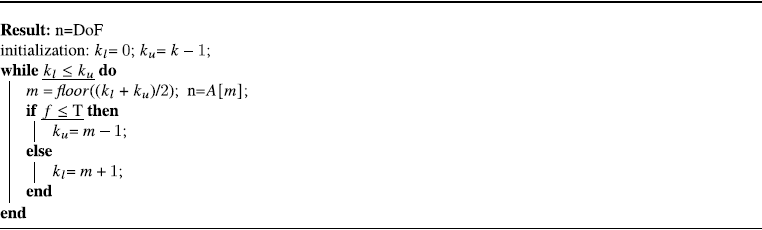
A nested bi-level optimization problem has been formulated [Reference Singh, Singla and Singla34], in which the first level is used to compute the DoF of the manipulator and the second level provides the optimal robotic parameters, that is, the Denavit–Hartenberg (DH) parameters. The resulting robotic parameters are mapped to the modular compositions using the proposed unconventional modular library [Reference Dogra, Sekhar Padhee and Singla38]. Binary search method is applied for the computation of DoF as a unidirectional search problem during optimization at the upper level. Algorithm 1 is shown for the upper level, where
 $k_l$
and
 $k_u$
are the lower and the upper limits on the number of DoF of the configurations and are stored in an array, say
 $A$
, with the range of number of DoF as
 $2-7$
.
 $f$
is the objective function value and
 $n$
is the number of DoF. The value of the DoF from the outer level goes into the lower (inner) level, where the optimization routine runs for that number of DoF, and iterations occur accordingly with respect to the function value until the solution is found with minimum DoF.
Binary search algorithm to initialize DoF for configuration synthesis

3.2. Objective function based on reachability
The aim is to find the optimal configuration of a robot manipulator which can execute the set of tasks. To execute a task, the manipulator has to avoid the obstacles and reach the working locations that is the TSLs with the desired orientation of the end effector. The input variables are the position coordinates and the orientation parameters of the TSLs. The design variables are the number of DoF,‘
 $n$
’, and the Denavit–Hartenberg (DH) parameters,
 $a_{i-1},\, \alpha _{i-1},\, d_i$
and
 $\theta _{i}$
for
 $i\, \epsilon \, 1\,{:}\,n$
which stand for the link length, twist angle, joint offset, and joint angle, respectively. Out of these,
 $\theta _i$
is different for different TSLs whereas the other variables are fixed when the manipulator is reaching all the TSLs. Thus, for
 $N$
TSLs and an
 $n-$
DoF configuration, there are
 $(3+N)\times n$
number of design variables
 $(\mathbf{x})$
given by [
 $a_{i-1},\, \alpha _{i-1},\, d_i,\, \theta _{i}^j$
] where
 $i\, \epsilon \, 1\,{:}\,n$
and
 $j\, \epsilon \, 1\,{:}\,N$
.
The optimal configuration is found based upon reachability, while avoiding the obstacles of the environment. The objective function
 $(f(\mathbf{x}))$
is formulated as to minimize the sum of the position and orientation errors between the desired points to be reached (TSLs) and the actual points of location of the end-effector to satisfy reachability, as given in Eqs. (1)–(3).
 \begin{align} f(\mathbf{x}) = P_e + O_e \end{align}
 \begin{align} P_e = \sqrt{(x_d-x_a)^2+(y_d-y_a)^2+(z_d-z_a)^2} \end{align}
 \begin{align} O_e = \sqrt{(\phi _d-\phi _a)^2+(\beta _d-\beta _a)^2+(\gamma _d-\gamma _a)^2} \end{align}
with the design variables vector,
 \begin{align*} \textbf{x}= [a_{i-1},\, \alpha _{i-1},\, d_i,\, \theta _{i}^j]^T \\[3pt] \,\,\,\,\,\,\,\,\,\forall \, i\in \{1\,{:}\,n\} \,\& \,j\in \{1\,{:}\,N\}. \end{align*}
In Eqs. (2) and (3),
 $(x_d,\, y_d,\, z_d)$
are the position coordinates of the desired TSLs and
 $(\phi _d, \beta _d, \gamma _d)$
represents the desired orientation at the corresponding TSLs, both of which are given as input to the optimization model.
 $(x_a,\, y_a,\, z_a)$
are the position coordinates of the end effector and
 $(\phi _a, \beta _a, \gamma _a)$
represents the orientation of the end-effector.
 $(x_a, y_a, z_a)$
and
 $(\phi _a, \beta _a, \gamma _a)$
are formulated using the forward kinematics routines through homogeneous transformations given by
 \begin{align} ^{i-1}_{i}T = \left[\begin{array}{c@{\quad}c@{\quad}c@{\quad}c} \cos\theta _i & -\sin\theta _i \cos\alpha _{i-1} & \sin\theta _i \sin\alpha _{i-1} & a_{i-1} \cos\theta _i\\ \\[-8pt] \sin\theta _i & \cos\theta _i \cos\alpha _{i-1} & -\cos\theta _i \sin\alpha _{i-1} & a_{i-1} \sin\theta _i\\ \\[-8pt] 0 & \sin\alpha _{i-1} & \cos\alpha _{i-1} & d_i \\ \\[-8pt] 0 & 0 & 0 & 1 \\ \end{array}\right] \end{align}
 \begin{align} ^{0}_{n}T = \,^{0}_{1}T\,\,^{1}_{2}T\,\,^{2}_{3}T\ldots \,^{n-1}_{n}T . \end{align}
Here,
 $^{i-1}_{i}T$
represents the transformation of the
 $\rm{ith}$
coordinate frame with respect to the
 ${i-1}\textrm{th}$
coordinate frame in the manipulator configuration.
3.3. Constraints on the optimization formulation
The optimization formulation described above is subjected to the following constraints
 \begin{align} a_{i-1}^l\leq a_{i-1}\leq a_{i-1}^u \end{align}
 \begin{align} \alpha _{i-1}^l \leq \alpha _{i-1}\leq \alpha _{i-1}^u \end{align}
 \begin{align} d_i^l \leq d_i \leq d_i^u \end{align}
 \begin{align} \theta _i^l \leq \theta _i\leq \theta _i^u \end{align}
 \begin{align} -SD + \delta \leq 0 \end{align}
The constraints given by Eqs. (6)–(9) represent the lower and the upper bounds on the DH parameters (design variables) of the robotic configuration, where the superscripts
 $l$
and
 $u$
stand for the lower and upper limits, respectively.
3.3.1. Nonlinear constraint for collision avoidance with obstacles
To avoid the collisions of the manipulator with the environment and with itself, a nonlinear constraint is added given by Eq. (10), where, SD is the separation distance that is the minimum distance between any two bodies. It is computed by assuming the environment and the manipulator links as triangulated meshes and using the algorithm given by Gilbert et al. [Reference Gilbert, Johnson and Keerthi37]. Thus, any configuration which collides with itself or the environment lies in the infeasible region.
 $\delta$
is used as a safety margin to avoid just touching of links. The complete optimization routine is formulated in MATLAB and is solved using the optimization toolbox
 $-$
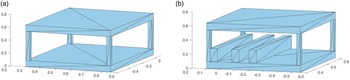
fmincon of MATLAB. Estimated environment of a vertical farm setup as shown in Fig. 1(b) is modeled in MATLAB as shown in Fig. 2.
Collision environment modeled in MATLAB – (a) without plant clutter, (b) with plant clutter.

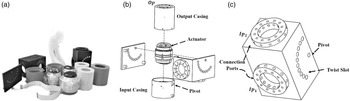
The configurations obtained from the constrained optimization routine are realized using a modular library as proposed by Dogra et al. [Reference Dogra, Sekhar Padhee and Singla38]. The library consists of joint modules and link modules as shown in Fig. 3(a) which can be assembled as required to realize any
 n
-DoF configuration, even with unconventional parameters. The authors have provided a mechanism shown in Fig. 3(b) for achieving unconventional twist angles which make it suitable for building the configurations resulting from the constrained optimization. The library is available in
 $2$
variants of the joint modules – Heavy (H) and Light (L), based upon the size of the actuators. Each joint module has
 $2$
input connection ports (
 $Ip_1$
and
 $Ip_2$
) and 1 output connection port (Op). The detailed methodology of assembling the modules for different configurations can be seen in ref. [Reference Dogra, Mahna, Padhee and Singla39].
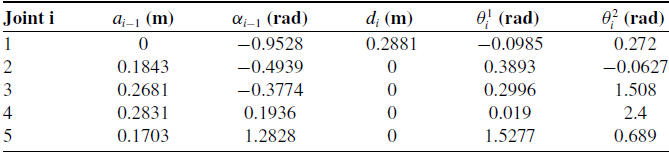
DH parameters of optimal configuration for task A.

Modular library [Reference Dogra, Sekhar Padhee and Singla38] shown in (a) is used to realize the configurations. Assembly of one module is shown in (b) and the mechanism provided to adjust the twist angle to unconventional values is shown in (c).

4. Results and Discussions
The proposed methodology of the optimization is implemented on different set of tasks and environments involved in vertical farming, as briefed in Section 2. The resulting optimal configurations are realized using the modular architecture, discussed in Section 3. To demonstrate the approach through examples, three agricultural processes viz., transplanting, plant health monitoring, and harvesting are shown as case studies.
4.1. Task A: Transplanting
Transplanting activities involve picking the saplings along with the planting media from the seeding tray and placing it in the corresponding slot. Thus, the coordinates of the TSLs are the positions of the slots in the trays/pipes in the vertical farm setup. Two extreme TSLs are chosen which are to be satisfied by synthesizing a configuration for its reachability. The coordinates of the TSLs are
 $[0.377,\,0.05,\,0.18]$
and
 $[0.7,\, -0.2,\, 0.18]$
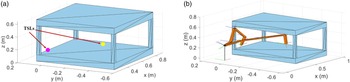
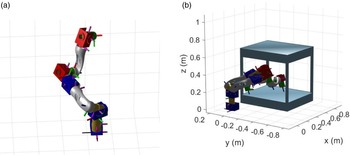
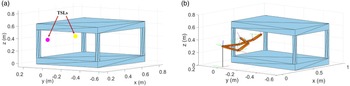
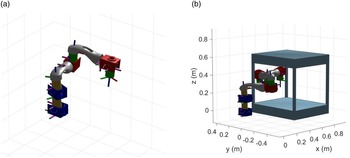
(in meters), with respect to the base of the robot as origin. The TSLs along with the collision environment are shown in Fig. 4(a). Orientation of the end-effector should be nearly vertical for the proper entry of the bucket into the slot. The results of the configuration synthesis are shown in Fig. 4(b) with the corresponding DH parameters in Table II. It is observed that the optimal configuration in this case is a 5-DoF system, which represents the minimum number of DoF required to work in the prescribed locations, avoiding the obstacles as well as avoiding self-collision of the links. To realize the obtained optimal DH parameters, five joint modules and two link modules are assembled together with the combination of 3 H and 2 L joint modules, as shown in Fig. 5. Although the result of configuration synthesis shows that the link length varies from 0.17 to 0.28 m, the same cannot be achieved exactly with the modular library as the link modules are available with fixed lengths. Thus, the library is used to achieve a configuration as close as possible to the one obtained. Even after this approximation, it can be observed that the manipulator built using the modules is able to satisfy the conditions of reachability while avoiding collisions with the environment. For more precise working, more link modules with different sizes can be designed and used. The configuration is assembled using a particular combination of modules, but this combination represents only one of the possible solutions. There might be a possibility of existence of other combinations of modules as well, which can satisfy the reachability conditions. These combinations can be found out with optimal composition approach which is not covered in this paper.
(a) TSLs and (b) optimal configuration based on reachability for Task A. The result is a 5 DoF configuration.

Configuration for Task A realized using joint module combination of H-H-H-L-L from the modular architecture.

4.1.1. Verification for reachability at intermediate locations for Task A
The TSLs chosen to demonstrate the results in Section 4.1 are the selected extreme locations to satisfy the reachability condition. However, to validate the ability of the obtained configuration to perform the entire task, inverse kinematics has been solved at an increased number of locations to verify that the manipulator can reach all the locations without colliding with the environment. The TSLs chosen are
 $[0.65,\,-0.22,\, 0.18],$
 $[0.6,\, -0.22,\, 0.18],$
 $[0.5,\,-0.22,\, 0.18],$
 $[0.377,\, -0.22,\, 0.18],$
 $[0.7,\, -0.13,\, 0.18],$
 $[0.65,\, -0.13,\, 0.18],$
 $[0.6,\, -0.13,\, 0.18],$
 $[0.5,\, -0.13,\, 0.18],$
 $[0.377,\, -0.13,\, 0.18],$
 $[0.377,\, -0.05,\, 0.18],$
 $[0.5,\, -0.05,\, 0.18],$
 $[0.6,\, -0.05,\, 0.18],$
 $[0.7,\, -0.05,\, 0.18],$
 $[0.7,\, 0.05,\, 0.18],$
 $[0.6,\, 0.05,\, 0.18]$
and
 $[0.5,\, 0.05,\, 0.18]$
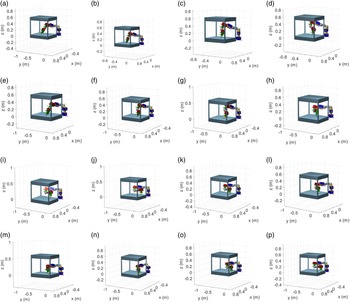
. The results are shown in Fig. 6. The results show that the manipulator is able to reach all these TSLs with the required orientation while avoiding collision with the environment, and thus, can perform the required task.
Manipulator for Task A satisfying reachability at the intermediate TSLs from (a) [0.65 -0.22, 0.18] to (p) [0.5, 0.05, 0.18].

4.2. Task B: Plant health monitoring
Plant health monitoring activities involve collecting data using humidity, temperature, and nitrogen sensors. The sensors will have to be above the plants and thus the path of the end effector will be in a plane above the plants. The TSLs that are chosen are thus located above the plants. The coordinates of the TSLs are
 $[0.377,\, 0.05,\, 0.38]$
and
 $[0.7,\, 0.05,\, 0.38]$
and are shown in Fig. 7(a). Orientation control is not required in this process and is thus omitted from the procedure. Optimization routine has been executed for the given locations and the results are shown in Fig. 7(b) with the corresponding DH parameters in Table III. It is observed that the result is a 4-DoF system. The variation in twist angle is much less in Table III compared to Table II and thus all the joint axes are almost parallel, which is expected as the working locations are lying in one plane without the need for any specific orientation. On comparison with the values obtained in Table II, it is observed that the first link is greater in height, which is due to the increase in height of the TSLs. The obtained configuration is realized using four joint modules and two link modules using the same mapping for link length as discussed in Section 4.1. A combination of 2 H and 2 L joint modules is used as shown in Fig. 8.
(a) TSLs and (b) optimal configuration based on reachability for Task B. The result is a 4 DoF configuration.

DH parameters of optimal configuration for Task B.

Configuration for task B realized using joint module combination of H-H-L-L from the modular architecture.

4.2.1. Verification for reachability at intermediate locations
The reachability at intermediate TSLs has been verified for Task B as well to validate the availability of a collision-free path for the manipulator while performing the entire task. The TSLs chosen are
 $[ 0.6,\, 0.05,\, 0.38],\,[0.5,\, 0.05,\, 0.38],\,[0.377,\, 0.05,\, 0.38],\,[0.6,\, -0.05,\, 0.38],\,[0.5,\,-0.05,\, 0.38],\,$
 $[0.377, \, -0.05,\, 0.38],\,[0.6,\, -0.13,\, 0.38],\,[0.5,\, -0.13,\, 0.38]$
and
 $[0.377,\, -0.13,\, 0.38]$
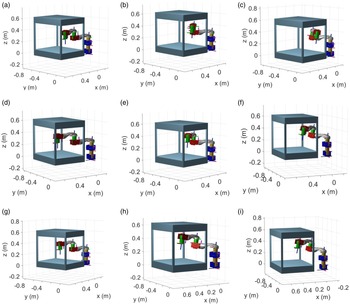
. The results are shown in Fig. 9. The results show that the manipulator is able to reach all the TSLs while avoiding collision with the environment. Although the reachability of the manipulator obtained for Task B is less than that of other tasks, the performance of the task will not be affected as the required TSLs are covered.
Manipulator for Task B satisfying reachability at the intermediate TSLs from (a) [0.6 0.05, 0.38] to (i) [0.377, –0.13, 0.38].

4.3. Task C: Harvesting
Harvesting involves holding and cutting the yield and placing it in the appropriate tray. Thus, the end effector will have to travel above the plant, grip it, cut it, and pick the plant up. The TSLs are located just above the plants at coordinates
 $[0.377,\, 0.05,\, 0.38]$
,
 $[0.55,\, -0.1,\, 0.38]$
and
 $[0.7,\, -0.2,\, 0.38]$
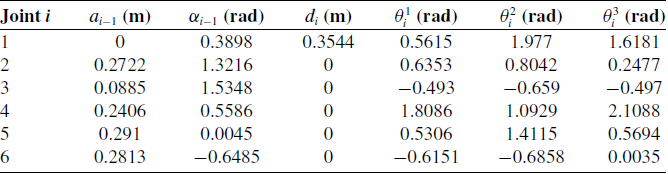
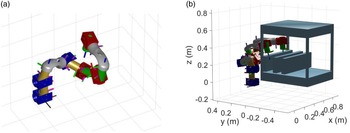
(in meters) as shown in Fig. 10(a). Orientation of end effector should be nearly vertical to properly grip, cut, and pick the plant. The results are as shown in Fig. 10(b) with the corresponding DH parameters in Table IV. It can be observed that the result is a 6 DoF configuration to satisfy the orientation requirement. Due to the highly specific orientation requirement in a constrained space, the solution does not converge with the start point provided in the previous tasks. Hence, a new start point was provided using the algorithm given by Huczala et al. [Reference Huczala, Kot, Pfurner, Heczko, Oščádal and Mostýn41]. Thus, the optimal configuration for task C looks different from those of the previous tasks. To realize the optimal DH parameters obtained, six joint modules and two link modules from the modular library are assembled together with the combination of 3 H and 3 L joint modules using the same mapping for link length as discussed in Section 4.1. As shown in Fig. 11, the configuration is able to satisfy while avoiding collision with the environment.
(a) TSLs and (b) optimal configuration based on reachability for Task C. The result is a 6 DoF configuration due to the specific orientation requirement and increased plant clutter.

DH parameters of optimal configuration for Task C.

Configuration for task C realized using joint module combination of H-H-H-L-L-L from the modular architecture.

The results obtained from the realistic case studies presented here have validated the requirement of different configurations for the variety of tasks in vertical farming. The modular and the reconfigurable system has been used to cater to the large varieties in the same environment and is useful for different maintenance tasks. This will be useful throughout the year for different types of services required in vertical farming in different seasons and crop cycles.
5. Conclusion
A comprehensive strategy for the design of a reconfigurable robotic manipulator for assistance in vertical farming has been presented in this paper. A thorough study of the processes involved in agriculture is done which form the tasks to be performed by the manipulator. Constrained optimization based on reachability while minimizing DoF is performed to find the optimal configurations which can perform the given tasks. The configurations are realized using a modular library and verified to satisfy the reachability condition for the given TSLs while avoiding collision with the cluttered environment. The novelty in the approach is that since the configurations are built using a modular library, one configuration can be reconfigured into another using the same set of modules. This solves the problem of the requirement of customization in robotic systems for assistance in vertical farming throughout the year with different seasons and crop varieties.
Author Contributions
The conceptualization, analysis, code generation, validation, and writing the original draft has been done by Neeraj Chitre. Anubhav Dogra contributed with module design, code generation, assembly of manipulators using the modules, and reviewing the draft. Ekta Singla supervised the entire work along with reviewing and editing the draft.
Financial Support
This research received no specific grant from any funding agency, commercial, or not-for-profit sectors.
Conflicts of Interest
The author(s) declare none.
Ethical Standards
Not applicable.