Studies seeking to understand decision-making often distinguish between rational thought processes (Murnighan & Ross, Reference Murnighan and Ross1999), in which different options are consciously weighed to choose the one that will provide greater benefits (maximization of economic utility or self-interest), and unconscious, intuitive processes, in which the pros and cons are not explicitly calculated (Haidt, Reference Haidt2001). In general, a dual process account of decision-making is assumed in humans: Stanovich and West’s (Reference Stanovich and West2000) Systems 1 and 2, or Kahneman’s (Reference Kahneman2011) fast and slow systems. Several studies can be viewed as spelling the unconscious factors that may drive the fast, system 1, decisions. Thus, it has been suggested that decisions arise from the recognition of the subjects’ own identity and the application of their social rules to the surrounding situations (March, Reference March1994). Some authors emphasize the influence of contexts of uncertainty (van Dijk, Wilke, Wilke & Metman, Reference van Dijk, Wilke, Wilke and Metman1999), social norms (Kallgren, Reno & Cialdini, Reference Kallgren, Reno and Cialdini2000), or emotional (affective) settings (Loewenstein, Weber, Hsee, & Welch, Reference Loewenstein, Weber, Hsee and Welch2001) as also relevant for decision-making.
Regarding decisions on cooperation, however, it is usually assumed that subjects are rational –in the sense that they choose the option that maximizes their benefit even if they don’t calculate gains and losses– as the most plausible hypothesis to explain their behavior (Guttman, Reference Guttman1996). At first glance, it would be the best choice for the individuals. However, this hypothesis implies that subjects can know and deal with all the existing information about the situation they face, and can somehow calculate the costs and benefits of their alternatives, and choose from all the potential cooperators, selecting the most appropriate: the one who can provide the greatest benefit and who also ensures long-term reciprocity.
However, humans are known to have cognitive limitations to handle large amounts of social information (Stiller & Dunbar, Reference Stiller and Dunbar2007), and it would also be too complex and costly to rationally consider all the possibilities and hazard a guess about people’s future behavior. This situation would lead to a state of uncertainty and risk that is difficult to assimilate by beings that are highly dependent on others, as in the case of humans. It is this kind of consideration that has led to recognizing the existence of fast, automatic, and heuristic decision processes, as already mentioned. The search for one’s own benefit also contradicts the possibility of maintaining long-term cooperation (Bowles & Gintis, Reference Bowles and Gintis2011), so it seems that the decision to cooperate should also take place like this type of process. In particular, we propose that these decisions are based on trust, which is a mechanism that combines cognitive and affective aspects, and which facilitates fast decision-making. The idea is simply that agents prefer to cooperate with those they trust.
Evolutionary considerations reinforce this argument. The evolutionary history of the human species has developed around the need for group efforts to deal with difficult survival environments. The long period of brain maturation in humans has also forced them to rely on others for a long time to meet their basic needs. The development of the ability to trust other individuals has been an adaptive evolutionary mechanism to overcome these dependency situations and ensure efficient cooperation over time.
Trust is a psychological capacity that simplifies the complexity of managing excessive information (Luhmann, Reference Luhmann1979). This is done by creating an expectation of repetition of the positive behaviors towards those people with whom one has shared such positive experiences (Acedo-Carmona & Gomila, Reference Acedo-Carmona and Gomila2012) and even towards people who, while not having shared such experiences directly, show greater probability of positive behavior through indirect bonds (Acedo-Carmona & Gomila, Reference Acedo-Carmona and Gomila2014). This psychological mechanism of trust not only reduces anxiety and uncertainty, which arises when interacting with unpredictable subjects, but also to a higher likelihood of successful reciprocity (cooperation itself fosters trust). Also considering that humans have interacted within small groups for most of their evolutionary history, one might think that trust has been especially configured to deal with close and familiar relationships (Acedo-Carmona & Gomila, Reference Acedo-Carmona and Gomila2013, Reference Acedo-Carmona and Gomila2014).
This work intends to provide further support for this view of the role of trust in cooperative decision-making. In particular, our goal is to explore whether trust is also associated with cooperation in a cultural setting that is far removed from our own. For this purpose, we carried out fieldwork in northern and upper-eastern Ghana. They are particularly relevant regions because of the great variability and ethnic interaction that takes places there. If cooperation were to be based on kin relationships there, very few cooperation would be found among ethnic groups. But if cooperation is related to trust, cooperation across groups is to be found.
In addition, this study can also shed light on the reasons for the maintenance of different ethnic groups that interact over time in many African societies –instead of merging into a single group. African history, not always well known, is characterized by a great diversity of small groups that have survived by constantly roaming to take advantage of natural resources (Cleveland, Reference Cleveland1991). The difficult conditions of the environment and the scarcity of resources help explain why the specific cultural features of each migrant group have been maintained despite their constant interaction. This situation is also present in Ghana, where –despite the emergence of State institutions that seek to create a “national” identity– there is great ethnic diversity, especially in areas with harsher economic conditions (Adams, Reference Adams2005; Adams & Plaut, Reference Adams and Plaut2003). Such cultural differentiation is accompanied by linguistic differentiation (Bemile, Reference Bemile, Lentz and Nugent2000).
Scientists offer very diverse reasons to explain why such cultural diversity is created and maintained (Schlee, Reference Schlee2004). Authors like Lentz (Reference Lentz2000), for example, attributed the cultural diversity of Ghana not to its historical past but to artificial creations motivated by colonial or political influences or by the categories that were artificially created by anthropologists. Either way, it is clear that the Ghanaian society is fragmented through lineages, clans, and ethnic groups, whether or not these cultural appropriations can be considered to be fully differentiated (Ranger, Reference Ranger, Hobsbawm and Ranger1983). Such cultural fragmentation is maintained in the common imaginary and in individuals’ real affiliation. From our point of view, after recognizing the role of trust relationships in the structuring of social life, it seems reasonable to think that the existence of such cultural variety is effective to adapt not only to an ecological environment but also to an economic, political, and historical environment in more complex societies. This work explores the hypothesis that small groups with specific cultural traits are an effective way to enhance trust relations and ensure cooperative decisions, especially in difficult situations.
In summary, this work aims to explore the following hypotheses: i) cooperative decisions are largely based on trust relationships; (ii) trust and ego networks move around small groups; (iii) trust bonds need close relationships, familiarity, or identity, as a feature acquired during evolution, despite cultural differentiation; (iv) close relationships with high levels of trust are related to prosocial emotions that contribute to increase cooperative decisions.; and (v) cultural identity promotes this kind of closeness (sense of affective and prosocial bonds among cultural group members) and, as a result, extend the decision to cooperate with a greater number of people, particularly, in the most demanding situations -precisely when cooperation is most needed for survival.
Ultimately, this work provides support for the explanations of cooperative decisions that are strongly based on more intuitive mental processes, conditioned by the individuals’ environment, highlighting the important role of affect-based decisions, such as the ones based on trust, as an evolutionary adaptation to ensure the success of long-term cooperation. The field study in Ghana seeks, therefore, to analyze how cooperative decisions are made, examining in more depth the elements involved in the creation and maintenance of trust relationships. After briefly describing the context that characterizes the studied groups, we shall present the methodology and the results of our study.
Historical and Cultural Context
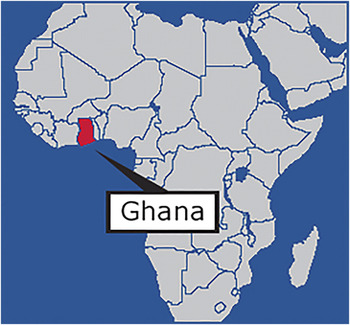
In Ghana (Fig. 1), the wide variety of existing ethnic and linguistic groups offers a suitable framework to deepen the search for the universal elements that appear in cooperative preferences, despite cultural diversity.
Geographical location of Ghana (missions.awana.org/site/News2?id=6343).

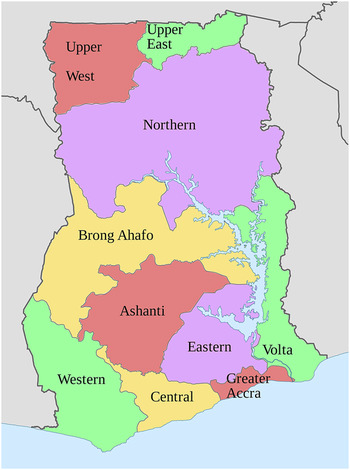
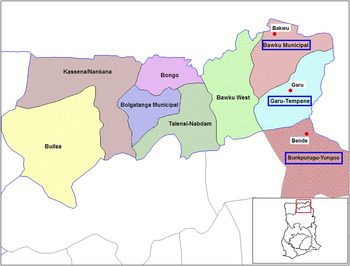
Ghana has a population of more than 24 million inhabitants, distributed in 10 administrative regions, including regions in the north and the high-east (Fig. 2) where the study was conducted, specifically in the populations of Bawku and Garu of the Upper-east region, and Bende of the Northern region (Fig. 3).
Administrative regions of Ghana (commons.wikimedia.org/wiki/File:Regions_of_Ghana_en.svg).

Geographical location of the visited populations. (en.wikipedia.org/wiki/File:Upper_East_Ghana_districts.png). Figure modified by Authors.

In these arid regions of the northeast of the country, located in the White Volta basin, savanna, with areas of pasture, baobabs, and acacia trees are predominant. The people live mostly from slash-and-burn farming and livestock.
Bawku is the largest population, capital of the Bawku Municipal District (Fig. 3), with a population of about 56,000 inhabitants. It is a city that is home to various ethnic groups. Our study involved groups settled in the area, like the Kussasis (Hilton, Reference Hilton1962), Frafras (Hart, Reference Hart1971), Bissas and Mossis (Zahan, Reference Zahan, Forde and Kaberry1967); and others from other regions of the country like the Ashanti (Rattray, Reference Rattray1932), established in the Ashanti region, and the Sissala and the Waala established in the Upper-west region (Fig. 2).
In the region of Garu, capital of the district Garu-Tempane (Fig. 3), we mainly visited the Kussasi, who live scattered in rural areas.
In Bende, a small town located in the district of Bunkpurugu-Yunguo (Fig. 3), we visited several ethnic groups that live in the area, such as the Mamprusi (Drucker-Brown, Reference Drucker-Brown1975), Bimoba (Assimeng, Reference Assimeng1990), Konkomba (Tait, Reference Tait1961) and Fulani (Tonah, Reference Tonah2005).
The participants of Bawku live in an urban environment and the participants of the areas of Garu and Bende live in rural areas.
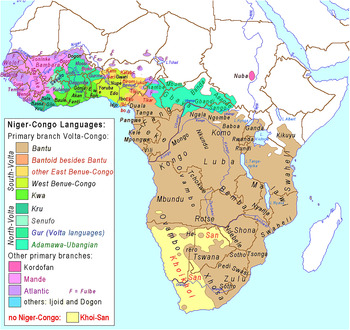
The different languages of all these ethnic groups are part of the set of Nigerien-Congolese languages, among which are included the Kwa (Ashantis), Gur (Bimobas, Mamprusis, Mossis, Kussasis, Sissalas, Waalas, Frafras, Konkombas), Mande (Bissas), and Fulbe (Fulanis) languages (Fig. 4). However, each of these branches has derived in different languages and dialects for each of these groups.
Classification and location of the various branches of Nigerien-Congolese languages. (http://en.wikipedia.org/wiki/File:Niger-Congo_map.png).

The origin of these ethnic groups and their history are not very clear. Sub-Saharan migrations due to trade in gold and salt and the slave trade led to frequent movements of various groups in the area. Already in the 10th century, the south of Ghana was part of the Ashanti Empire. The Mole-Dagbane kingdoms (Mamprusis, Dagombas, and Mossis), from the northeast and strongly hierarchical, settled in the northern area of Ghana between the 13th-15th centuries, and dominated the acephalous groups installed there. The Kussasi, Frafra, and Sissala seem to have originally come from the west of Sudan, migrating to the area in the 17th century, although other Sissala seem to be descendants of the Mole-Dagbane groups. The Ashanti are part of the Akan groups that moved from West Africa between the 10th–12th centuries, whereas the Fulani came from Niger and Senegal in the 16th century, they but emigrated to northern Ghana practically at the beginning of 20th century. The Bissa or Busanga settled in the White Volta in the 14th century. With regard to the Bimoba, they came from the mixture of the Moba, who emigrated from Burkina Faso in the 17th century with Mamprusis and Konkombas, after being driven to the north by the Mamprusi and the Dagomba. The Konkomba seem to be one of the few original groups in these lands, and the Waala, originating in the city of Wa, capital of the region of the high-west, came from the conjunction in the 17th century of the warrior traditions of the Dagomba and Mamprusi and Islamic traditions transmitted through small groups of immigrant Mande from Niger. Both the Mamprusi and the Mossi in the north of the country and the Ashanti in the center formed centralized and hierarchical groups that gained more power compared to rest of the mentioned groups, which were acephalous.
In the 15th century, the Portuguese took advantage of the mineral resources of the area, and later, the British, French and Dutch arrived (XVI century). In the 17th century, the Confederation of the Ashanti unified the diverse groups. Solidarity among the groups was very convenient due to the competition to acquire farming land, control trade routes, and for protection. In 1901, the areas of northern Ghana became an English protectorate. The rivalries that existed among certain ethnic groups because of fights for territory or the slave trade increased with English colonization, which promoted power inequality among them and granted certain social and economic privileges to certain groups, to the detriment of others. In 1957, the country became independent of the English Crown but the differences before and during the colonial era are still the causes of the current inter-ethnic tensions.
Such diversity in the groups in terms of origin and language extends not only to merely cultural aspects, such as beliefs, customs, festivals, etc. but also in some groups to the economic activities they engage in.
Currently, 90% of Ghana’s population lives in urban areas and economy have grown mainly due to improvements in agriculture, but also due to the development of the extractive industries of the natural resources of the country (oil, gas, and minerals), services sector, and manufacturing. However, in the north of the country, there are still conflicts over the distribution of farmland and the small-scale, rudimentary farming techniques, forcing its inhabitants to live in a subsistence economy.
Social and economic structures
In northern Ghana, family plays an important social role. In general, for many of these ethnic groups, the concept of family has a more extensive meaning than the nuclear family, which is seen in their language through the use of the same term for different individuals within the family environment. Apart from the family that coexists, there are lineages and clans, which are cultural forms that are very important to the way trust and cooperative relationships are structured. These cultural groups influence the distribution of land, properties, and titles, and create identity signs in the individual, by including him or her in a reference group that serves both to receive help and to decide about alliances or marriages.
Social researchers have tried to define concepts such as lineage (Kuper, Reference Kuper1982), clan, tribe (Ekeh, Reference Ekeh1990) or ethnic group (Cohen, Reference Cohen1978), although each culture may attribute different meanings to these concepts. Even the concept of the family can adopt different meanings in different cultural groups. In the case of Ghana, all these concepts become complex from the very moment when so much ethnic diversity is found. Thus, each ethnic group has its own cultural way of creating bonds. In general, lineage defines the way of family social organization and is relevant to designate the identity-group to which the individual belongs, with the above-mentioned social and economic implications. In the ethnic groups that are present in this work, some lineages are matrilineal and others are patrilineal. Lineages, which are inbred, range from nuclear bonds to the inbred lines extended over time. This means that the larger lineages, corresponding to the most distant ancestors, are subdivided into other smaller lineages until reaching the nuclear family unit.
The clans in these areas can link different lineages within a particular territory, because the clan also assimilates a territorial aspect which, in some cases, can be considered as the minimum unit at the political level (district). In general, the tribe consists of a set of districts or clans of the same ethnic group in a larger territory. Thus, an ethnic group can be composed of several tribes. However, the concept of tribe does not appear as clearly in all cases, nor is it used as much as the rest of the terms in these regions.
The most important example of matrilineal ethnic groups is the Akan groups, among which are the Ashanti. The rest of the ethnic groups analyzed have a patrilineal social organization.
There are similarities in the household composition among different ethnic groups in rural areas of northern Ghana. The family group that coexists is based on a set of cabins oriented in a circle. Each cabin is assigned to different members of the family. The features of the set regarding shape, composition, and location vary according to group ethnicity. This family set tends to be led by a man with one or more wives. Polygamy depends on religious, economic, and educational factors. Also included in the household are the children and their spouses, depending on the type of culturally acquired lineage, and the grandchildren, as well as the possibility of including other relatives. A family group can range from 4 or 5 people to more than 50. The number of people who coexist in urban households is decreasing, although the number of family members coexisting in rural areas is greater.
Not all ethnic groups in the area have historically shown the hierarchical form of social organization. Whereas the Ashanti, Mossi and Mamprusi are heirs of empires with a marked hierarchical and centralized social structure, the other groups did not have chiefs. After the colonial era, some of the acephalous groups have created new leadership systems in an attempt to regain power over the territory.
Agriculture is the most frequent way of life in these areas, as well as livestock, hunting, fishing, and gathering fruits. The different authorities play a role in managing the agricultural resources. Land tenure is customary in northern Ghana. This is a traditional system based on the community’s control of the use of the land and its resources (Agbosu, Awumbila, Dowuona-Hammond, & Tsikata, Reference Agbosu, Awumbila, Dowuona-Hammond and Tsikata2007). This means that the community assigns to individuals the rights of use or usufruct of certain plots of land, which they may exploit and transmit by inheritance to their descendants, but they may not sell it. The community can sometimes reserve the right to reassign such uses. This system usually also entails the right of use by all community members of all the resources provided by the communal property, beyond the cultivation areas. Decisions about land are made by the head of the household (Kotey, Reference Kotey1995), the so-called “Lord of the land”. People from outside the community have to ask permission for them. The head of the household transmits his cultivation areas hereditarily to his descendants, but in order to sell the land, he must inform the community or the leader. However, cases of land sales are unusual.
It seems clear that social structures play an important role in the economic management of the agricultural areas in northern Ghana (Woodman, Reference Woodman1963). However, in this paper, we try to show that the culturally created social groups also have an enormous influence on the cooperative decisions of individuals toward certain groups, to the detriment of others. All of this is based on the attribution of trust assigned to these groups. But it is necessary to understand how trust functions among such groups.
Method
Participants
Two different groups of people participated in each of the methods of data collection used in this study –ego networks (personal networks of usual cooperators) and interviews. We detail below the features of each group.
Ego networks
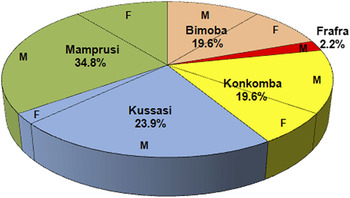
In this study, a total of 46 people participated: 33 (71.7%) males and 13 females (28.3%). The ethnic groups of the participants are: 9 Bimobas (19.6%), 1 Frafra (2.2%), 9 Konkombas (19.5%), 11 Kussasis (23.9%) and 16 Mamprusis (34.8%). The distribution of these ethnic groups by gender is shown in Fig. 5.
Distribution of ego networks by ethnic groups and gender.

Interviews
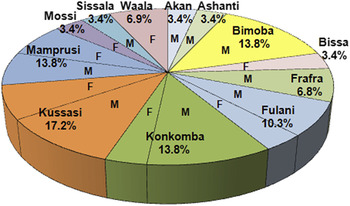
For the interviews, we collected a sample of 29 people: 19 males (65.5%) and 10 females (34.5%). The ethnic groups of the participants are: 1 Akan (3.4%), 1 Ashanti (3.4%), 4 Bimobas (13.8%), 1 Bissa (3.4%), 2 Frafras (6.8%), 3 Fulanis (10.3%), 4 Konkombas (13.8%), 5 Kussasis (17.2%), 4 Mamprusis (13.8%), 1 Mossi (3.4%), 1 Sisala (3.4%), and 2 Waalas (6.9%). The distribution of these ethnic groups by gender is shown in Fig. 6.
Distribution of the interviewed ethnic groups by gender.

Materials and Procedure
Below the different methods used for data collection are explained. The materials used for this purpose (templates to register the ego networks of cooperation and the interview questions) were presented in English to those who spoke that language. For participants who did not speak English, we used collaborators who helped to translate the ego network templates to the participants’ native language and served as intermediaries in the interviews. The terms used were translated as accurately as possible in the different languages. The controls carried out to achieve the highest possible degree of accuracy in translations consisted in assuring that collaborators who served as translators in interviews and tests (ego networks) understood well what was asked. Collaborators were trained for explaining faithfully the forms when collecting personal networks of cooperation. In the case of interviews, the researcher, as well as ensure that the translator understood the question and require him a reliable translation, controlled this aspect throughout the interview adding questions for both the translator and the interviewee facing any possible doubt or mistake derived from responses.
Ego networks
To obtain the ego networks of cooperation, we asked the participants to make a list with the names of the persons with whom they habitually cooperated, the ethnic group to which these cooperators belonged, the kind of relationship that linked them, whether the cooperation was unilateral or mutual, the type of cooperation, and the level of trust they felt towards them (Annex 1).
Interviews
We also conducted a recorded interview with 21 questions with each of the participants (Annex 2). Through this means, we sought to inquire about the factors involved in the creation, maintenance, and breakdown of trust decisions: questions about what to take into account when deciding to trust for the first time and to maintain the acquired trust; whom they trust more and with whom do they trust their secrets; whether it is possible to always trust the family, the meaning of the family for them and what family relationships are like; exchanges that require higher levels of trust; when they consider that their trust was betrayed, whether they could forget this betrayal and how they would punish it; what the relationships are like within the clan; whether they trust other ethnic groups and what their relationships with them are like; whether activities are carried out in the community to promote trust and integrate new members; whether reputation is important in the community and in what way; whether they believe that religion or the government’s attitude can influence cooperation among individuals; the level of safety of the interviewees and their values as a group.
Procedure
The field work was carried out in January-February 2013, with participants from different ethnic groups settled in Bawku, Garu, and Bende. The data obtained through ego networks and interviews came from people chosen at random. Collaborators handed out forms for getting personal networks of cooperation (ego networks) and also helped us to find people for interviews. Given the temporal limitation of the fieldwork, besides these data and the observations conducted during this time, we used information from the literature about such groups to elaborate our conclusions.
The study aims to describe participants’ ego and trust networks (cooperation and personal trust networks) and unravel the motivations that drive them to decide to trust and cooperate with the individuals from their networks compared to the rest. The objective is to understand which elements influence decisions concerning cooperation.
Data analysis
The results of the ego networks and the interviews were computed in percentages, except for the statistical measures used to explain the sizes of the trust and cooperation groups. In the case of interviews, the responses were grouped in mutually exclusive categories before computing them.
Results
Results are presented firstly describing the data obtained from the ego networks concerning decisions on cooperation that participants make habitually, and subsequently studying in more depth the factors that affect trust decisions (interviews) and that can ultimately explain such cooperation decisions. In addition to the data provided in the text, the full information collected both from ego networks and interviews are detailed in tables contained in Supplementary Material, which allows obtaining more qualitative information.
Cooperation Decisions
We will explain the essential points to highlight the cooperation decisions reflected in the ego networks:
Cooperation groups
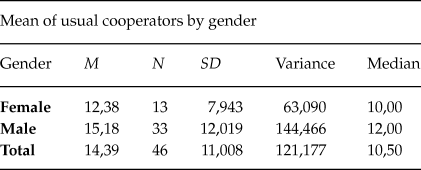
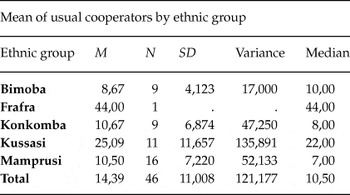
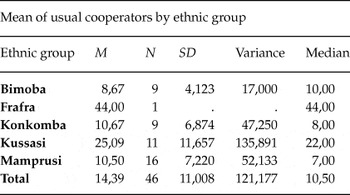
The habitual cooperator group is not very large: it contains an average of about 14 people, without much difference between men (15.18) and women (12.38) (Tab.1), but with a slight difference regarding the ethnic groups (Tab.2). Noteworthy are the Kussasi (25.09) and the Frafra (44.00) with a larger average of habitual cooperators than the rest.
Average number of cooperation relations by gender

Average number of cooperation relations by ethnic group
The composition of the cooperation groups consists, firstly, of friends (49.24%), then, relatives (28.33%), to a lesser extent, neighbors (11.67%), some coworkers (6.36%), and very few acquaintances (3.18%) or strangers (0.76%). The vast majority of them are people they trust (very high: 35.48%; high: 45.95%). The group of relatives is that with a higher percentage of very high trust (16.36%), followed by friends (14.00%) and neighbors (3.33%), but when the level of high trust is also considered relatives are outnumbered by friends in the composition of cooperation groups: relatives (9.09%), friends (25.00%) and neighbors (6.06%).
Types of exchanges
Both family and friends stand out in most of the exchanges, especially advice (10.55% and 14.18%), information (6.70% and 8.33%), secrets (7.30% and 6.61%), and learning (4.04% and 6.02%). Family members cooperate slightly more than friends in activities such as loaning money (4.12% and 2.92%), exchanging services (3.86% and 1.38%) and secrets. Friends slightly outnumber family members in the exchange of advice, information, learning, and work (3.57% and 1.44%).
What is mostly exchanged with neighbors is advice (2.67%) and work (1.28%), although in low proportions. Coworkers do not play a large role as cooperators. Their most important role is in the transmission of advice (1.56%), information (1.21%), and learning (0.95%). To improve one’s reputation and obtain contacts, acquaintances (0.34% and 0.26%), friends (0.34% and 0.86%), and neighbors (0.34% and 0.26%) are appointed. Family members also contribute to obtaining new contacts (0.68%).
Reciprocity
A high percentage of cooperation is reciprocal (73.61%), especially among cooperators with very high (27.32%) and high (34.46%) trust levels.
However, with family members, in whom higher levels of trust are placed, there is a lower level of reciprocity in their exchanges as a whole, compared to friends or coworkers (66.8%, 83.4%, and 73.8%, respectively). In contrast, cooperators who are only acquaintances (52.4%) or strangers (60%), and neighbors (36.4%) show relative higher level of donations to the participants, surpassing the proportions of reciprocity (acquaintances: 42.9% and strangers: 40%), although the proportions of these cooperative activities are very small with respect to the total.
The ethnic groups with a higher number of cooperators –Kussasis and Frafras– are those that, in turn, display greater ethnic diversity among their habitual cooperators. However, even in this case, about one half of their cooperators are from their ethnic group (51.4% and 47.7%). The Mamprusi also show great ethnic diversity among their habitual cooperators (67.1%). However, the Konkomba and Bimoba have a high percentage of ethnic endogamy in their networks of habitual cooperators (95.8% and 83.3%).
Trust Decisions
In this section, we describe the composition of trusted groups and the main factors considered by the interviewees when deciding to trust others, and that affect the creation, maintenance, and breakdown of trust.
Trust groups
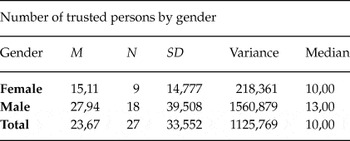
According to the interviewees, the average number of trusted people (trustees) is slightly larger than the cooperation group, about 23 people (Tab.3).
Statistical measures of the number of trusted people

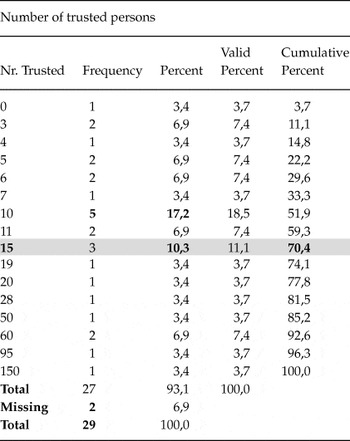
However, most of the interviewees trust fewer than 15 people (70.4%) (Tab.4).
Number of interviewees' trusted people

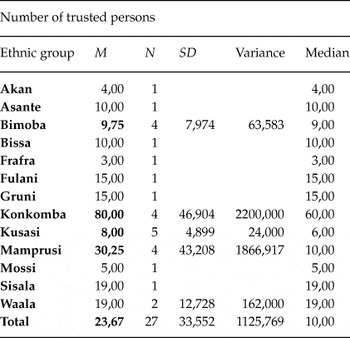
The mean increases in the Konkomba participants, who show a higher average of trusted people (80 persons). This is not so surprising if we consider that in the family settlements of the Konkomba, a large number of members coexist, which leads to their mentioning practically the whole group members as trusted persons. Also notable are the Mamprusi, with an average of 30.25 trusted people. However, the samples are small and the variances are high in both cases. The Bimoba and Kussasi show lower means of trusted people (9.75 and 8) (Tab.5).
Statistical measures of the number of trusted people by ethnic groups

Family.
Relatives are, again, the people most frequently mentioned as being more highly trusted (66.22%), and secondly, friends (13.52%), although number of cooperative friends is greater than that of relatives.
However, having a family relationship does not ensure the existence of trust. Although the role of kinship ties is very important in the Ghanaian society, the decision to trust depends, ultimately, on individuals’ behavior. Behavior is first among the reasons to decide to trust for the first time (behavior, 48%) and to maintain trust (behavior, 47.06%, and help, 29.42%).
The interviewees are divided practically equally among those who say they always trust the family and those who do not (both answers: 44.83%). Although a large percentage declares having a good relationship with their relatives (68.97%), 31.03% admits having problems with the family. However, with regard to the meaning of family among the interviewees, a large percentage defines it as the support or help group (29.70%), or the people with whom they live (26.57%) or identify with (14.05%).
The clan against other ethnic groups.
Although there is a high level of interaction between the ethnic groups created by marriage ties, cohabitation, and high tolerance of religious beliefs, there are still important divisions in the relations among them, as well as language differences. Clans are present in individuals’ feelings and daily behavior, despite academic concerns about their reality. Thus, it has been argued that clans, including the same ethnic groups, are not always the result of a clear cultural and historical differentiation, but are shaped by the groups’ needs, and are not static (it even seems that the ethnic groups are sometimes modified by migratory movements).
Proof of this relevance of clans in daily life is that many of the interviewees declared having good relations with the members of their clan (78.13%), whereas only a very low percentage said the same thing about other ethnic groups (14.92%). Among the few participants who mention having conflicts with members of the same clan (21.87%), practically mostly refer to a problem with the land (6.25%), whereas in the case of other groups, there is a mixture of problems due to the distribution of the land (4.26% of responses), political problems (2.12%), power (4.26%), misunderstanding (4.26%), lack of unity (2.12%) trust (2.12%), language differences (2.12%), etc... Moreover, a little less than half of the interviewees (44.44%) state that they trust other ethnic groups. Affinity with the clan is understood, moreover, if it is taken into account that 28.58% of the responses refer to the help or support received as an advantage of belonging to a clan, and another 28.57% refer to the feeling of unity that the clan provides.
There is a long history of relationships underlying the various ethnic groups. In addition to cultural differences and origins, there have been confrontations between different ethnic groups, mainly because of the appropriation of territory and resources, the attempt to gain power and supremacy over others, and even to try to make a profit from the slave trade. This has been the case of the struggles that have existed in the 20th century between Konkombas and Bimobas, in the upper-east area, to gain leadership; between Konkombas and Dagombas (Hippolyt, Reference Hippolyt2003); or Konkombas and Mossis. The Konkomba were invaded in the 16th century by the Nanumba, the Gonja, and the Dagomba (who have fraternal relations with the Mossi). They were their vassals and forced to pay taxes for the use of the land. In the 18th century, the Ashanti conquered the Dagomba and demanded tributes. Among these tributes the Konkomba were captured and handed over to the Ashanti as slaves. Currently, Dagombas and Konkombas continue to fight for the right to land, and there are still some religious tensions among them (the Dagomba are Muslims and the Konkomba are traditionalists). There are also tensions between the Kussasi and the Mamprusi for supremacy in Bawku and due to the appropriation of land: the Kussasi allege their authority on the basis of their original settlement in this city, whereas the Mamprusi, accustomed to being the leaders, received greater powers from the British government during the protectorate in this area. The rivalry between ethnic groups is also observed in the data of this study with the problems in Bende between the Bimoba, who are the majority, and practically all the other ethnic groups in the area. Moreover, in Bende, the Fulani do not relate much with other groups, except for work-related reasons (care of livestock). The interviewees also commented on the confrontations of other groups that have a strong hierarchical tradition, like the Ashanti, with ethnic groups like the Konkomba or Kussasi, although in the northern region there are not very many Ashanti.
Factors that affect trust decisions
Creation and maintenance of trust.
When deciding to trust for the first time, nearly half of the interviewees take any evidence of the person’s behavior into account (48%). Very few people choose to trust in advance (18%), notice others’ appearance (14%), or use others’ references (12%). Few of them only consider what they can achieve with the bond (social capital, 6%). For some ethnic groups, like the Ashanti, the Mamprusi, or the Sissala, the way of greeting is very important to create a first link towards trust.
According to the interviewees, economic exchanges (22.85%) –financial affairs (4.15%), trading animals (4.15%), business (4.15%), work plans (4.15%), and agricultural affairs (6.25%) – are the ones that most frequently require a higher level of trust. Help in general (20.85%) and exchange of secrets (14.58%) also require high doses of trust. However, in absolute terms, exchanging secrets is the most frequently mentioned response among exchanges that requires higher levels of trust.
The activities that are carried out jointly stimulate an approach to trust, according to the interviewees. Among them, the most frequently mentioned are the different types of meetings (43.65%): the festivals of each ethnic group (8.45%), parties (7.03%), funerals (2.82%), sacrifices that are carried out in the traditionalist religion to satisfy the ancestors (2.82%) –intermediaries with the spirits of the land–, religious meetings (5.63%), marriages (1.41%), etc... Funerals are very important in these areas because they are done in two parts: the Kumian (burial) and Kukoan (the party held one year after the death). During the Kukoan, all the guests share a feast in honor of the deceased until the early hours of the morning, with music, food, drink, and dance.
In these societies of northern Ghana, sharing tasks (29.58% of the responses), working together in the field (5.63%) or in the forestation tasks (1.41%), help to create bonds of trust, as do chatting (9.85%), games (1.41%), songs (1.41%), and religious activities (2.82%). Showing an attitude of respect toward others (1.41%) and making the other feel accepted and at home (1.41%) are equally important to promote trust.
As when creating trust, the basic indicator to maintain trust is the individual’s behavior (47.06%), although the help received (29.42%) and good communication (17.64%), through greetings, conversations, sharing secrets, etc., are also mentioned as relevant factors. Exchanging advice is very important in these societies.
For the interviewees, reputation is very important (93.10%), and it mainly serves to be respected (29.17% responses), to obtain help if necessary (27.10%), and to have people nearby (10.42%); people of ill-repute receive ostracism, lack of respect and of support.
The system of values that listed the participants in this study creates bridges of union within the members of each ethnic group. For example, the Kussasi mentioned promoting the maintenance of their culture and traditions as group values; the Bimoba mentioned among their values, apart from the above, the need to maintain their rights as members of their community and build a better community; the Frafra emphasized the value of helping other Frafra; the Ashanti stressed maintaining their language and heritage; for the Gruni, speaking their language and using their traditional clothing is highly valued, similar to the Waala and the Mamprusi; for the Konkomba, their group unity is very important; and for the Fulani sharing what they have, especially milk, with their relatives and ancestors is very important.
Although many interviewees stated that religion influences people’s cooperative attitude (89.65%), there is a lack of coherence between this claim and their behavior, as will be seen, when it comes to forgetting or forgiving the betrayal of trust, or forgetting the existing conflicts with individuals from different clans or ethnic groups.
This is a society that has a notable percentage of insecurity among its citizens (43.33% of the interviewees feel unsafe in their environment). The most frequently mentioned reasons are economic (12.74%), security (17.84%), or health (12.75%), which could influence the attitude of trust.
According to almost all of the interviewees, the above deficiencies and problems are the reasons given by the participants to declare why the government has a positive influence on the trusting and cooperative attitudes among its citizens (91.67% of the interviewees). The alleged reasons are the creation of security policies (23.38%), the arrangements made (19.77%), the laws or rules established (14.37%), the economic policies (10.78%), the policies that promote unity among the citizens (12.59%), and the educational policies (3.59%). Those who believe otherwise (8.33%), point to the negative influence of bad government policies (1.28%), the need for greater promotion of education among individuals (1.28%), and the predominance of the politicians’ private interests over the general interest (1.28%), among other reasons.
Breach of trust.
The most frequently mentioned cause of breach of trust is the failure to keep secrets (21.28%), more so than not receiving help when needed (19.14%). They also mentioned not respecting agreements (8.51%), bad behavior (8.51%), lying (6.38%) and non-reciprocity of trust (6.38%).
Although 48.28% of the interviewees claim they can forget the betrayal of trust, it will depend on type of betrayal, the strength of the emotional bond maintained, the amount of help received previously and, sometimes, whether or not the person acknowledges his error. However, 34.48% of the interviewees declare they cannot forget the breach of trust; some of the interviewees say they have more difficulty forgetting the betrayal than forgiving the betrayer. While all participants interviewed have religious beliefs (37.93% Muslims, 31.03% Christians, 6.90% Pentecostals, 10.35% Protestants, 13.79% Traditionalists), 34.48% of them declares not to forget the betrayal of trust and the 17.24% puts limitations to forget it.
Concerning breach of trust, 52.73% of the interviewees would punish the betrayal, especially with different forms of avoidance (43.63% of the mentioned forms of punishment). Few would approach the person (21.81%), talk about it (10.90%), give them time (3.64%), or advise the individual (7.27%); and 25.46% of the responses about punishment of betrayal of trust is negative.
According to the interviewees, in the event of conflict, the most widely used form of approach is some kind of communication (48.10%), and some interviewees mention the importance of mediators (15.19%). Participants point to relatives (2.53%), heads or traditional leaders (6.32%), religious leaders (1.27%) or the government (2.53%) as mediators. Other interviewees mention the option of forgetting and forgiving as a way of resolving disputes (10.12%), as well as rectifying the behavior (8.86%), good manners (7.60%), understanding the problem (8.86%) and praying to God (1.27%).
Discussion
Our study sheds light on the association between trust and cooperation, and particularly on how this association takes place in a particular environment where scarcity of resources puts a premium of cooperation.
It was mainly observed that the decision to cooperate lies mostly in those people with whom a bond of trust is maintained (hypothesis i), as revealed through the ego networks: the 81.43% of usual cooperators mentioned in ego networks were highly or very highly trusted by participants. Just a tiny proportion of low trusted people are part of the ego networks of cooperation, which also show lower levels of reciprocity. This seems to indicate that less trusted cooperators are maintained, although perhaps not in the long term, because they provide a benefit to the individual and are used for less risky issues.
We also detected that the decision to cooperate normally depends on a small group of people (size of ego networks: mean of usual cooperators was 14.39), which largely corresponds to the trust circles –small groups too: mean of trustees was 23.67 and cumulative percentage of participants with less of 15 trustees was 70.4%– (hypothesis ii). This limitation of size is in keeping with the evolutionary hypothesis of the psychology of personal trust, which argues that this psychology emerged in the setting of close relationships, and was maintained through coexistence in small groups during the greater part of human history (Acedo-Carmona & Gomila, Reference Acedo-Carmona and Gomila2013). This would explain the need for familiarity or proximity to create bonds of trust and cooperation (ego networks composition: 49.24% were family and 28.33% friends; trustees in interviews: 66.22% were family and 13.52% friends) (hypothesis iii), even creating concepts of cultural affiliation like lineage and clan, which extend close bonds to more people (from interviews, 78.13% of participants had good relationships with their same clan members but just the 14.92% of them declared the same respect to other ethnic groups; the 55.56% of participants did not trust other ethnic groups). This closeness in ties, extended to larger number of people by culture is necessary in these environments where survival is so difficult (hypothesis v). In this sense, the meaning of family (help: 29.7% and people living together: 26.57%) and role attributed to the clan in Ghanaian societies (help: 29.9% and unity: 28.57%) as support groups are similar.
Living in a difficult environment may also explain the maintenance of groups with their own cultural identity (ethnic groups) –particularly in difficult environmental, political and historical conditions, as in the case of northern Ghana. These cultural brands seem to foster group values, pro-social attitudes that promote sharing specially with the same ethnic group through feelings of affection (Hatfield & Rapson, Reference Hatfield, Rapson, Lewis and Haviland2000; Nelissen, Dijker, & de Vries, Reference Nelissen, Dijker and de Vries2007), and reputation (hypothesis iv). This association is also related to group cohesion as ego networks of cooperation mostly involve members of the same ethnic group: a minimum of 50% of usual cooperators belong to the participant’s same ethnic group; in the case of Konkombas and Bimobas, more than the 80% (hypothesis v). Ethnic groups, thus, can be seen as serving the function of enhancing cooperation, where it is most critical for survival.
However, the level of trust changes according to the proximity of the groups: first come lineages and clans; then, one’s own ethnic group; and lastly, other ethnic groups. We therefore note that, to meet the needs of cooperation, the network of people extends beyond the family. In any case, the important result is that it is not kin per se that suffices for cooperation, but trust, as in any other social relationship, so that it can be said that cooperation is associated with trust, even if high levels of trust are established among family members.
In other words, in a hostile environment with adverse weather conditions, in which predominate a semi-arid savannah landscape and precarious agriculture, individuals need more support from others to survive. In northern Ghana, the amount of rainfall is lower than in other regions of the country, and the effects of the Harmattan –dry desert wind– which decreases the moisture and brings hot days, last longer than in the southern region (about four months of the year). Under these difficult conditions, the clan offers an extension of the support group, as does the ethnic group, besides the basic unit of kinship and lineage. Trust provides the bond that promotes group cohesion and help for members of the same group.
In this sense, we observe a twinning with certain support groups, in this case lineages, clans and ethnic groups in contrast to a distancing and sometimes confrontation with other ethnic groups due to the appropriation of resources and historical privileges. In places with scarce resources, confrontation due to the distribution of power and land is expected. Under these circumstances, the differences between the ethnic groups and their conflicts have been maintained. Not even the existence of a central Government has been able to unify such cultural diversity, although regulatory structures and political efforts may lead to a general improvement to maintain citizen cohesion. However, such “state” cohesion as citizens is weaker and the bonds provided are not the most frequently used in cooperation –even when some participants claim that Government influences cooperative behaviors. According to the results of this study, cooperation mostly operates in the sphere of small groups of personal trust.
Reputation is a surrogate of trust in people not directly known. Reputation serves to expand social networks, according to the indirect reciprocity theory (Alexander, Reference Alexander1987). This is in line with the central role reputation plays in in Ghanaian groups. However, direct behavior is what is taken into account in the habitual small lineage and clan networks, where it is personal trust that plays the upper hand.
By another side, religion does not seem to have more influence on trust and cooperation than the values inculcated in the individuals, as many interviewees mentioned help and respect for others as important in their values system. Religious values can somehow affect a general attitude of openness and cooperation towards strangers, but this only involves a general cooperative disposition, which is not the most common among the participants (as shown in the ego networks), nor is it the firmest one in times of difficulties. Besides, religion does not seem to have much influence on forgiving and still less on forgetting the breach of trust. By contrast, this greater difficulty in forgetting the betrayal than forgiving the betrayer makes evolutionary sense, as a protection against the risk of interacting with someone who betrayed in the past.
In general, as has been shown, the cooperative attitude appears more frequently related to trust and personal relationship, than to religion or reputation. In addition, trust is primarily and ultimately acquired through direct interaction, which also guarantees greater possibilities of success in reciprocity, even when referred to family, one’s lineage, or clan. Therefore, interaction, communication, and shared activities increase the chances of creating bonds of trust. By the other side, the mentioned notable percentage of insecurity among Ghanaian citizens could influence the attitude of trust towards strangers but this does not seem so much directed towards people of the lineage or clan, who are the people with whom they cooperate habitually.
Therefore, cooperative decisions are driven mostly by bonds of trust, which in their turn are influenced by the subjects’ environment. Emotional bonds based on trust are adaptive in evolutionary terms because they increase the chances of reciprocal cooperation (Authors, 2014), and facilitate decisions to cooperate (system 1 process), over resorting to a rational calculus of gains and losses. As has been shown, the ego networks, which include the bonds of higher trust, are also those with a higher percentage of reciprocity. Only a few cultural figures (e.g., families) do not demand such level of reciprocity, which reinforces the strength of the bond to ensure cooperation in the most costly situations (riskier exchanges, which require higher doses of trust). Families are less demanding in terms of reciprocity, but they too require trusting relationships.
While there are clear limitations to this study, related to the number of participants, and short time available for the fieldwork, and the descriptive nature of the instruments used, we think it offers evidence in support of the role of personal trust in the evolution of cooperation in the human lineage. It also contributes to understand the particular configuration of cultural groups in Northern Ghana; as a matter of fact, the view of social relationships in Ghana that we found is convergent with previous studies using a completely different methodology (Adams, Reference Adams2005; Adams & Plaut, Reference Adams and Plaut2003; Acedo-Carmona & Gomila, Reference Acedo-Carmona and Gomila2015). If this is so, there is a further moral that follows from this study: even in economically developed societies, small groups based on personal trust are to be found as key to cooperation, especially in times of crisis. Our evolutionary past has equipped humans with the disposition to create and keep affective bonds based on trust as a sort of heuristic that orients our cooperative decisions.
This research was funded by the research projects FFI2010-20759 and FFI2013-44007-P (Ministerio de Economía y Competitividad – Secretaría de Estado de Investigación, Desarrollo e Innovación). Cristina Acedo was supported for this study by a PhD scholarship from the Spanish Ministry of Education (AP2009-3369). We are especially grateful to Manuel Calvo Trias for the opportunity he gave us to make this experience in Ghana possible and the help he and his group provided. We also thank John Mabila, Abu Gazare, Batowami Sunday, and Mammara Yahaya very much for their help to carry out the fieldworks. A previous version of this paper was presented in the report of the 13th Congress of Anthropology of Tarragona entitled “Peripheries, borders and dialogues”. I appreciate the comments received.
Annex 1
Ego network of cooperation

Annex 2
Interview
-
1. What do you have in mind when you decide to trust people that you don’t know?
-
2. What do you need to maintain your trust in people you know?
-
3. It is possible to always trust the family?
-
4. Which people do you trust more? Number.
-
5. When do you consider that one of your trustees has betrayed you?
-
6. Do you perform activities to foster an atmosphere of greater trust and rapprochement among you?
-
7. What kind of exchanges requires a higher level of trust?
-
8. How you punish people who betray your trust?
-
9. Is it important here to have good reputation? What implications does a good or a bad reputation have?
-
10. What forms do you have to encourage reconciliation of individuals with conflicts?
-
11. Is it possible to forget the betrayal (of trust)?
-
12. What do you think about other ethnic groups? Can you trust them? Do you have a good relationship with them? What is this relationship is based on? Has this relationship always been this way?
-
13. How should an individual behave to be considered a good Kussasi, Mamprusi, etc...?
-
14. Do your religious beliefs make you interact and cooperate more with others, even with strangers?
-
15. When somebody becomes part of a new family or begins to work in a new market are there activities, customs or shared attitudes to facilitate this new integration?
-
16. Do you feel protected where you live or work, or you are afraid of something?
-
17. What do you think about Government authorities, do they help with their policies or their example to facilitate the lives of citizens and promote coexistence among all?
-
18. What does family mean to you? How are the relationships among family members?
-
19. How are relationships among members within the same clan, among members of different clans, and among members of different tribes?
-
20. With which people do you trust your secrets or personal issues?
-
21. Is there trust and cooperation among workers in the market? What do you think this trust or distrust is based on?