Introduction
To what extent has Traditional Ecological Knowledge (TEK) been meaningfully incorporated into the international political decision-making process? The use of TEK in wildlife management has been a prominent topic for several decades (Berkes, Reference Berkes1999). Some authors believe that TEK has practical significance for wildlife management and ecology (Berkes, Reference Berkes1999). Indigenous values, spirituality, and worldviews constitute a large part of TEK (Houde, Reference Houde2007; Nadasdy, Reference Nadasdy2005). However, meaningful engagement, inclusion and participation of Indigenous communities, who are holders of TEK, into a policy-making process remains challenging (Houde, Reference Houde2007). Thus, the process of integration of TEK into Western science is still difficult, fiddly, and not well understood by scholars and policymakers.
TEK is a type of information that has been discussed at the international level. The UN “Earth Summit” held in Rio de Janeiro in 1992 recognized the important role of TEK for a sustainable development (UNESCO website, 2020). The Rio Summit globally recognized the importance of local and indigenous knowledge. It was planned to incorporate TEK through Rio Conventions: the Convention on Biological Diversity (CBD), the Convention to Combat Desertification (UNCCD), and most recently the Cancun Agreements of the UN Framework Convention on Climate Change (UNFCCC) (UNESCO website, 2020). Thereby, large international organizations have noticed the utility and value of TEK, particularly, in the environmental policy.
The United Nations Framework Convention on Climate Change Conference of Parties (UNFCCC COP) recognized an indigenous method of decision-making process called Talanoa Dialogue. The COP 23 welcomed with appreciation the design of the 2018 facilitative dialogue, to be known as the Talanoa Dialogue, and launched the dialogue, which started in January 2018 (decision 1/CP.23, paragraphs 10–11 and Annex II) (UNFCCC website, 2018). So, the Talanoa Dialogue, as an indigenous tool of policymaking, has been accepted by the UNFCCC.
Talanoa Dialogue is the Pacific tradition and it reflects a process of inclusive, participatory, and transparent dialogue. The process of Talanoa involves the sharing of ideas, skills, and experience through storytelling (UNFCCC website, 2018). According to Tecun, Hafoka, ‘Ulu‘ave, & ‘Ulu‘ave-Hafoka (Reference Tecun (Daniel Hernandez), Hafoka, ‘Ulu‘ave and ‘Ulu‘ave-Hafoka2018), instead of attempting to indigenize a Western paradigm, Talanoa suggests adapting indigenous paradigms. Stories told through indigenous research tools, such as Talanoa, can be weaved together by researchers, individuals, and groups to coproduce/construct knowledge where story is knowledge, and knowledge is gathered through story (Tecun et al., Reference Tecun (Daniel Hernandez), Hafoka, ‘Ulu‘ave and ‘Ulu‘ave-Hafoka2018). Although the UNFCCC website does not offer any outcomes of incorporation of Talanoa Dialogue into global policymaking process, it is quite clear that the UNFCCC has recognized the crucial role of TEK and Indigenous methodologies in climate change policies.
Yet, although the role of TEK has been noticed by the global policymakers, the process of incorporation of TEK into science and decision-making has never been tracked and evaluated from scholarly perspectives. It is still quite unclear how TEK should be integrated into Western science and then translated into a policy.
The Arctic Council (AC), established in 1996, made a serious attempt to engage Indigenous peoples of the Arctic into international negotiations. The AC is an intergovernmental organization that brings eight Arctic countries (Russia, the United States, Canada, Sweden, Denmark (Greenland), Finland, Iceland, and Norway) and eight Indigenous organizations (also known as Permanent Participants [PPs]) together (Arctic Council website, 2020). The creation of the AC was great hope for a better understanding of TEK.
Since the establishment, the AC strongly underlined the importance of Indigenous participation and TEK. The Ottawa Declaration (1996), which founded the AC, referred to the incorporation of TEK as one of its founding principles. Subsequently, TEK has become one of the most protuberant topics in the AC (CAFF, 2019). Several working groups of the AC recognized the incorporation of TEK as one of their main objectives. For example, the Sustainable Development Working Groups Strategy (2017) called the promotion of traditional and local knowledge one of its priorities. Another AC working group, the Conservation of Arctic Flora and Fauna (CAFF), admitted that it has a longstanding recognition of the importance of TEK and community-based monitoring (CAFF, 2015). Moreover, almost every declaration of the AC emphasized the inclusion and integration of TEK as one of its main priorities (Fairbanks Declaration, 2017 (Arctic Council, 2017); Inari Declaration, 2002 (Arctic Council, 2002), Iqaluit Declaration, 1999 (Arctic Council, 1999); Kiruna Declaration, 2013 (Arctic Council, 2013); Nuuk Declaration, 2011 (Arctic Council, 2011); Ottawa Declaration, 1996 (Arctic Council, 1996); Reykjavik Declaration, 2004 (Arctic Council, 2004); Salekhard Declaration, 2006 (Arctic Council, 2006); Tromso Declaration, 2009 (Arctic Council, 2009)). Hence, the AC has obviously recognized the value of TEK.
The Indigenous organizations – PPs – were expected to provide expertise on TEK. At the SAO meeting in 2007 in Narvik, Norway, on November 28–29, 2007, it was mentioned that PPs were considered to be the primary source of TEK (Arctic Council, 2007). Thus, the inclusion of TEK into the AC work was planned to be implemented with the help of PPs.
However, it is not quite obvious how exactly and to what extent has TEK been incorporated in to work of the AC. Mary Simon, the former Inuit Circumpolar Council’s chair, stated that “Indigenous peoples’ knowledge gets ‘a lot of lip service’” (Mary Simon, cited in Tennberg, Reference Tennberg2000, p.69).
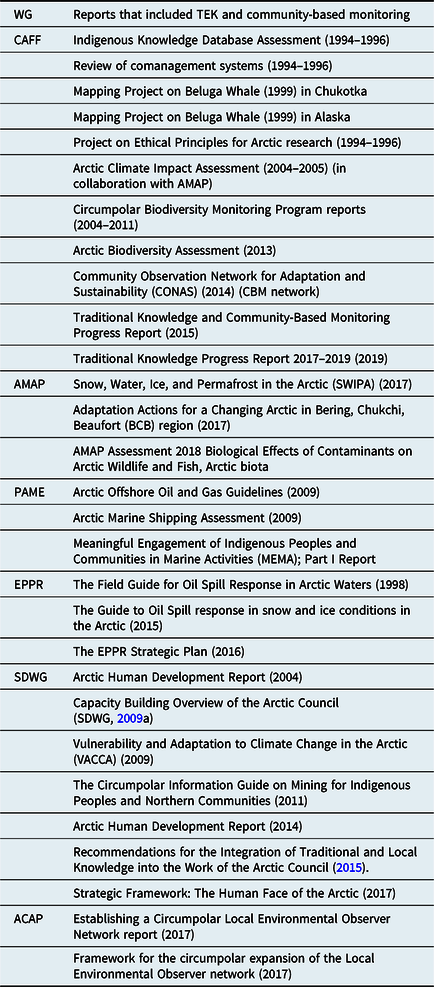
This study examines to what extent has TEK been incorporated into the AC. The author applies the qualitative content analysis of publicly available sources such as meeting minutes, reports, documents, and scientific assessments in order to investigate how has the discussion in the incorporation of TEK (or knowledge coproduction) been framed (see Table 1). These sources are available online on the AC website (arctic-council.org).
Methodology
This study uses qualitative content analysis. Content analysis is a method of analyzing the content of written documents, transcripts, and other types of written communication (McNabb, Reference McNabb2004). Content analysis is used to describe attributes of messages without reference to the intentions of a message sender. Content analysis is used in political science quite often. Counting how many times in a speech a candidate denigrates the character of a political opponent is an example of the application of content analysis in political science (McNabb, Reference McNabb2004).
Within the context of the social sciences, possible materials for qualitative content analysis might include interview transcripts, focus groups, open questionnaires, protocols, newspapers, and study reports (Mayring, Reference Mayring2014). The interpretation process starts by reading the text several times, in order to understand a sense of the entire content and to discern the essential features of the text. The statements that correspond to a specific topic are recognized and transformed into meaningful units and then coded into themes and subthemes (Severinsson, Reference Severinsson2003). The data analysis includes interpretation of the meanings and functions of interactions in the given context. The final stage is an interpretation of the text as a whole, where the understanding received from the story is combined to form a new comprehensive opinion (Severinsson, Reference Severinsson2003). Therefore, the process of qualitative content analysis involves coding of textual material into themes and categories, and then the interpretation of these themes to create a new understanding.
The study applies qualitative content analysis to the AC meeting minutes to investigate whether TEK has been incorporated into the AC work. To what extent has TEK been incorporated into science and policy?
Literature review
The literature indicated that TEK is a reasonably broad concept; it can also include any information about the local fauna and flora, for example, skinning, butchering, fishing, and hunting (Houde, Reference Houde2007). TEK is local, kept by knowledge holders in local languages, and exists for several centuries. According to the Blueberry River First Nations report, in comparison with Western science, TEK provides a broader area of nature observations and longer timelines of observations (Leech, Bates and the Blueberry First Nations, Reference Leech and Bates2016).
While local hunters observe nature and animals for years and perceive nature in a different way, not as an object of research, but as a native environment, an equal partner, like a mother, everything is essential for the hunter: the position of the clouds in the sky, the temperature of the rainwater, the wind speed, and the color of the leaves. TEK provides “rules of thumb,” which were developed by ancient resource managers, and these rules are, in many ways, as good as Western science (Gadgil and Berkes, 1991, cited in Berkes, Reference Berkes1999, p.5).
Researchers, especially in Western science, are strictly subdivided into disciplines: oceanographers, ecologists, biologists, and hydrologists are engaged only in their research and are focused on constant experiments on their samples, rarely intersecting with colleagues (Houde, Reference Houde2007; Nadasdy, Reference Nadasdy2003). A hunter or an Indigenous fisherman is an ecologist, a hydrologist, and a biologist. He sees the connections between seemingly distinct observations that could be studied by scholars from different fields of science. Houde (Reference Houde2007) highlights six faces of TEK, including factual observations, management systems, past and current uses of nature, ethics and values, culture and identity, and cosmology. Hunter does not write articles on his observations, and does not analyze publications in scientific journals, but relies on his or his grandfather’s experience. TEK is transferred from one generation to the other generation through conversation (Nadasdy, Reference Nadasdy2003). It is clear that from a scientific point of view, traditional knowledge is not an accurate, confirmed source (Berkes, Reference Berkes1993). Sometimes traditional knowledge can complement scientific knowledge (Berkes, Reference Berkes1993). Local/Indigenous systems of resource management suggest more sustainable use of common-pool resources than privatization/nationalization (Bocking, Reference Bocking2004; Wiener, Reference Wiener1995). Many authors point out that local communities are more flexible in terms of restricting their use of resources. Local users know their limits of resource use even if they have never experienced ecological collapse (Bocking, Reference Bocking2004; McGoodwin, Reference McGoodwin2006).
For the past several decades, comanagement boards have been facilitating the process of TEK incorporation into resource management. In northern Canada and Alaska, comanagement boards have long been practiced between wildlife management officials, scientists, and Indigenous peoples (Binder & Hanbidge, Reference Binder and Hanbidge1993; Mann, Reference Mann2003). The purpose of these negotiations is to reach a consensus on the discussion of problems in the field of protection of local nature and avoid the clash of interests between stakeholders (Osherenko, Reference Osherenko1988; Thomas & Schaefer, Reference Thomas and Schaefer1991). The Alaska Eskimo Whaling Committee, established in Alaska, includes Alaska Native whalers who, in collaboration with the state and federal environmental agencies, monitor the whaling industry by setting quotas for whaling (NOAA website, 2020). The U.S. Marine Mammal Protection Act (MMPA) of 1972 has included an amendment on comanagement with Indigenous peoples (NOAA website, 2020). The changes in MMPA were introduced in 1994 and were intended to recognize Alaska Native organizations’ right to participate in comanagement of subsistence resources (North Slope website, 2001). Thus, comanagement regimes allow Indigenous peoples to participate in wildlife management in circumpolar regions.
Why are such comanagement boards needed? Regarding the distribution of resources, hiring Indigenous people saves the cost of hiring personnel from the mainland. The remote local and extreme conditions in the NWT, for example, have meant difficulties in habitat management because of the expensive costs of administration and complications such as high prices for obtaining reliable data on the caribou population, recruitment, mortality rate, and harvest level (Thomas & Schaefer, Reference Thomas and Schaefer1991, p.74).
The second advantage of such a policy is the “reconciliation” of the settler population with Indigenous communities. As Cruikshank (Reference Cruikshank2004) notes, increased participation of Inuit in scientific and industrial projects empowered Inuit in bureaucratic management strategies. TEK brings up positive social and cultural changes into Indigenous communities by empowering and engaging Indigenous peoples. Local Indigenous peoples and especially poor people should have a voice in industrial projects (Sillitoe, Dixon & Barr, Reference Sillitoe, Dixon and Barr2005). Hence, comanagement regimes provide an opportunity for Indigenous peoples to engage into decision-making process. Comanagement regimes set up the preconditions for the TEK incorporation.
At the international level, in 1994, the experience of comanagement in Canada and the United States was considered by Conservation of Arctic Flora and Fauna to be useful and deserves a separate study (CAFF, 1994). The Ottawa Declaration of 1996 indicated the application of traditional knowledge of Indigenous peoples as one of essential principles of the work of the AC.
Therefore, according to the literature, TEK is a broad concept that is closely tied to local areas. All Arctic states have their own perceptions of TEK. The domestic legislations on TEK have distinct approaches toward its incorporation and utilization. This feature of TEK creates certain challenges in the process of knowledge coproduction at the regional and international levels, which are discussed below.
The discussion of TEK in the AC: Short overview
The concept of TEK and the regimes of its utilization are different depending on a country. Even though the concept of TEK is flexible enough to be applied beyond the Arctic to any region of the world, the utilization of TEK varies from country to country (Beach, Reference Beach1981, Bjørklund, Reference Bjørklund1990; Klokov, Reference Klokov1997, Murashko & Dallmann, Reference Murashko and Dallmann2011). The Arctic region includes eight significant states, but due to differences in colonial pasts, Indigenous cultures, traditional ways of living, and states’ environmental policies, the practical uses of TEK are variable depending on the community, be they Sami, Russian, North American, or Greenlandic regimes.
Not all regimes of practical implementations of TEK such as comanagement boards are legally institutionalized in the Arctic. The recognition of traditional knowledge and the well-being of northern communities were established as significant objectives by the Ottawa Declaration of 1998. This is the reason why the debate on TEK and sustainability will eventually come to the table. Nation-states and PPs will have to discuss how to integrate practical uses of TEK into the international legal system.
Trends in the development of discussion of TEK in the AC: How has TEK been incorporated into the AC work?
The study analyzes the meeting minutes, reports, and scientific assessments of the CAFF, SDWG, EPPR, AMAP, PAME, and ACAP working groups. The first issues that noticed were the lack of instructions and rules that could explain the process of TEK incorporation. The lack of guidelines and rules on the incorporation of TEK into the AC work has been noted by the AMAP and the SDWG working groups. The Arctic Marine Assessment Programme board meetings raised the issue of how TEK should be utilized in scientific reports several times (AMAP, 2015, 2016, AMAP, 2017). In 2015, the SDWG working group presented the Recommendations for the Integration of Traditional and Local Knowledge into the Work of the Arctic Council. The Recommendations recognized that there is a lack of guidelines on how to utilize TEK in scientific assessments and reports. The report also stated that there is an existing need to create an inventory of best practices of TEK integration (SDWG, 2015). Yet, even though the CAFF report acknowledged the lack of understanding of the process of the integration of TEK, the Recommendations did not propose any specific systematic approach to the knowledge coproduction process.
As the study indicated, the AC had through several trends in the knowledge coproduction process. Each trend was determined in accordance with general directions in which the process of the TEK incorporation into the work of the AC working groups was developing.
The study divided the process of discussion of TEK into the following trends:
- The first trend (initial excitement) of the incorporation of TEK emerged after the AEPS establishment (early 1990s). This stage included several TEK projects that were mostly created within the CAFF working group. This trend could be characterized as early attempts to study knowledge-co-production.
- The second trend is lip service (or tokenism) when TEK is incorporated only with the purpose to meet the formal requirements of the study (Chapman & Schott, Reference Chapman and Schott2020). Lip service surrounded the process of knowledge coproduction throughout the entire history of the AC, and it was prevalent during 1998–2017.
- The third trend of TEK incorporation (large projects) is characterized by the emergence of large AC projects that claimed to incorporate TEK: Arctic Climate Impact Assessment, Arctic Human Development Report, and Arctic Biodiversity Assessment. Unlike other TEK studies, these large studies were richly financed and included data collection.
- The fourth trend (Indigenous-led TEK studies) refers to the Indigenous TEK projects led by PPs in collaboration with the working groups. The PPs projects had the lack of application to policy.
First trend: Initial excitement about early projects on the incorporation of TEK (predominantly the CAFF group)
As the CAFF meeting minutes indicated (CAFF, 1993), in the early 1990s, the CAFF working group started working on four projects that included TEK. The Canadian and American scholars set the task of finding methods for working with Indigenous knowledge through three projects: Project on Ethical Principles for Arctic research (lead – the United States), Indigenous Knowledge Database Assessment (the United States and Canada), a Review of comanagement systems (the United States and Canada), and the Pilot Beluga Whale study project in Chukotka and Alaska (leads: the United States and Canada) (CAFF, 1994).
The Project on Ethical Principles for Arctic research was presented by the United States. Nine statements were received from universities, governments, and Indigenous peoples’ organizations in response to a request to CAFF countries (CAFF, 1994). These responses were divided on common themes, which included the notion of informed consent based on full information regarding the purposes, methods, and funding of research projects (CAFF, 1994). Other themes involved local participation in project design and implementation, including the training and employment of local assistants and respect for cultural traditions, language, and local knowledge as a component in scientific research. Respect for the dignity, privacy, and confidentiality of participants; acknowledgement of the community, participation, and contribution in the final report; and a return of all final reports to participating communities were also recognized as project themes (CAFF, 1994, p.30). According to the presentation, there were two completely new approaches in research. One of these new approaches was a proposal for a model of participatory research in which researchers and Indigenous communities work closely in selecting research topics and methodology and cooperate in data collection and analysis (CAFF, 1994). Another approach suggested a negotiated research agreement between the researcher and Indigenous community which would provide clear and binding provisions on the roles and responsibilities of all parties (CAFF, 1994, p.30). The Senior Arctic Officials asked the International Arctic Science Committee (IASC) to assist with this project. IASC considered draft guidelines of ethical principles for Arctic research at a meeting in Bremerhaven in April 1996, but was unable to reach consensus.
The IASC prepared a statement which said, “a circumarctic set of ethical principles appears not to be only elusive… but perhaps undesirable and unnecessary.” The report suggests that this results from the tremendous social and political diversity in the Arctic countries and from the fact that other universally accepted ethical principles and national codes of ethics continue to operate (CAFF, 1996). Therefore, IASC refused to adopt proposed research ethics standards, calling the proposed ethical standards “undesirable and unnecessary.” Meanwhile, the adoption of a new set of ethical standards at the international level would have sufficiently increased the quality of collecting TEK data, as the new rules proposed a participatory approach in research and respect to language, culture, and traditions.
The Indigenous Knowledge Data Directory project was supposed to develop the data directory, exploring formats that provide the flexibility and accessibility to reflect the dynamic nature of Indigenous knowledge and the extent of Indigenous and other data available in electronic media (CAFF, 1995). Inuit Circumpolar Council and Canada decided to build a framework data directory and upload it to the Internet. The new catalogue was supposed to contain information on an individual, community, and organizational experts who possessed TEK and would allow anyone to contact the information required for their individual needs (CAFF, 1995). Yet, the original aim of the project was to prepare a summary report on Indigenous knowledge databases, and an assessment of them proved to be impractical because of an insufficient number of databases to give such an assessment (CAFF, 1995). Therefore, the idea of creating a database of TEK failed.
In 1994, the United States and Canada started preparing a report on a review of comanagement systems that described the structure, strengths, and weaknesses of comanagement systems in the United States, Canada, and all over the Arctic (CAFF, 1994, p.15). The review of the comanagement system project revealed that there was no universal definition of comanagement. The CAFF project also showed that comanagement as a model for effective participation of Indigenous communities in resource management needed to be further explored (Tennberg, Reference Tennberg2000). However, common elements of comanagement were also identified. The common components of comanagement included the sharing of responsibility, cooperation and balancing of power between agencies and users, communicating and networking, recognizing and overcoming cultural and linguistic barriers, a consensus style of decision-making, and the use of both TEK and scientific knowledge in resource management (CAFF, 1996). There were several significant differences in the way how the term “traditional knowledge” was used (CAFF, 1996). The conference identified many advantages of comanagement, most of which emerged in better communication and consensus-building. Among the disadvantages recognized were lack of political goodwill, overlapping jurisdictions, ambiguous authority, and cultural differences. It was emphasized that comanagement committees only succeed to the extent that they retain effective communication with local hunters (CAFF, 1996). Hence, according to the report, the success of comanagement regime mostly relied on the establishment of effective communication with TEK holders. Therefore, the project identified differences in the use of definitions and concepts of TEK and comanagement in the North American Arctic. More importantly, it was not possible to come up with one universal model of comanagement, and additional studies were required.
The timeline of the Beluga Whale Pilot Project was from May 15, 1995 until October 31, 1998 (North Slope Science Initiative website, 2020). The US National Science Foundation funded the research, and the principal investigator was Dr. Henry Huntington (North Slope Science Initiative website, 2020). This work complemented a Pilot Project on TEK on Beluga Whales (CAFF, 1994, p.112).
The pilot project was divided into two parts: a fieldwork and a seminar (CAFF, 1994, p.110). According to the report, TEK was recognized as a valuable source of natural history data, which, nevertheless, must compete with other sources of data (CAFF, 1994, p.111). In the report, TEK was viewed as (a) coherent worldview, and (b) embodying a holistic view of ecology (CAFF, 1994, p.112). Overall, the Beluga Whale project was going to establish a future framework for incorporating TEK into scientific knowledge. This is one of the early projects that recognized equality between Western science and Indigenous knowledge. The US National Science Foundation funded this project, so TEK was taken seriously on high-level decision-making process. Yet, it was reported that although the necessary data were collected, the project coordinators were uncertain about the use and application of TEK in wildlife management (CAFF, 1996).
Overall, early CAFF attempts to run the projects specifically designed to utilize TEK (1993–1996) were unsuccessful. The results of these projects did not meet the expectations to develop a mechanism of incorporation of TEK into Western science. There was no guidance on how to incorporate TEK, the lack of explanation of how the process of incorporating TEK works and should be organized. As a result of these three projects, TEK appeared as a dynamic concept that is hard to capture and digitalization (CAFF, 1996). It was impossible to investigate how to apply TEK in conservation and environmental protection (CAFF, 1996). Some of these early CAFF projects were either rejected by the AC (Project on Ethical Principles for Arctic research) or not finished (Indigenous Knowledge Database Assessment, Review of comanagement systems). The workshop on comanagement systems resulted in the conclusion that there was a lack of the universal definition of comanagement in the Arctic countries. The lack of common terminology led to confusion about the structure and roles of comanagement units (CAFF, 1996).
Most of the data on comanagement came from the North American Arctic (CAFF, 1996), and it was reported that it is impossible to transform comanagement regime into the universal model (CAFF, 1996). The epistemology of TEK did not allow the researchers to transfer this knowledge in a computer database (CAFF, 1996). Despite the long-term work with Inuit communities in Russia and the United States, Indigenous Knowledge Mapping Project on Beluga Whale also produced unsatisfactory results. It was reported that although the necessary data were collected, the project coordinators were uncertain about the use and application of TEK in wildlife management (CAFF, 1996). The Beluga Whale Pilot project resulted in two scientific articles, published in the journal the Arctic in 1999 (Mymrin, Communities of Novoe Chaplino, Sireniki, Uelen, and Yanrakinnot, & Huntington, Reference Mymrin and Huntington1999). After the failure of the pioneer projects, the discussion of introducing traditional knowledge into Arctic politics faded for a short time.
Second trend: Lip service
Lip service in the process of knowledge coproduction has started when the AC scientific projects only mentioned the definition of TEK and referred to its utility and value instead of collecting, documenting, and incorporating TEK into scientific data. The study and collection of traditional environmental knowledge are acknowledged to be useful and valuable; yet, many scientific reports and assessments did not include TEK data into their contents. As Chapman and Schott (Reference Chapman and Schott2020) note, integrating TEK can often result in tokenism, when the incorporation of TEK has “the sole objective of benefitting the researchers by appeasing formal requirements or to look good” among other scholars.
For example, AMAP project Snow, Water, Ice, Permafrost in the Arctic (SWIPA): it included TEK into the list of policy recommendations but did not specify how exactly TEK should be applied to science and resource management. According to the SWIPA summary for policymakers (AMAP, 2017), this report is based on observations, methods, and studies that include contributions from traditional and local knowledge. Yet, the actual report only acknowledged the utility of TEK (“TEK can help to detect the change and adapt to it”) (AMAP, 2017), but did not integrate TEK into the scientific study (AMAP, 2017). At the AMAP 30th Meeting in 2016, the SWIPA Chair Morten Skovgaard Olsen noted that the SWIPA group was having difficulties with taking into account Indigenous and local knowledge (AMAP, 2017). Therefore, due to the lack of guidelines, the SWIPA report only mentioned the importance of TEK, but did not incorporate it into its data. Similar to the SWIPA, projects that claimed that they incorporated TEK, mostly emphasized the definition of traditional knowledge as well as the description of the benefits of its practical application.
Other examples of lip service include the Field Guide for Oil Spill Response in Arctic Waters (1998) released by EPPR, which only recommended to incorporate local knowledge and input from local inhabitants into the decision-making process (EPPR, 1998). TEK data were not collected and not documented, and the process of collection and documentation of TEK was not described. The SDWG report Vulnerability and Adaptation to Climate Change in the Arctic (VACCA) (SDWG, 2009b) stated that knowledge sharing is needed, especially incorporating traditional and local knowledge, but it is not described how the process of incorporating TEK should go. It was also stated that traditional knowledge should be collected, shared, and used in teaching, but the process of collection and utilization was not described (SDWG, 2009b). In the Arctic Offshore Oil and Gas Guidelines released by PAME in 2009, the use of TEK was only recommended for various purposes (impact assessments, training, consultations). The detailed guidelines, instructions, and approaches that could specify the procedures of integration of TEK in Western science are lacking. TEK was not documented, and recommendations are not based on TEK (PAME, 2009). This study investigated that each AC working group had at least one report that tuned the incorporation of TEK into lip service.
The WG reports and projects that claimed to incorporate TEK commonly referred to the arctic Indigenous communities as one group of people who belong to the same ethnicity and culture (Indigenous). The reports mentioned above, including SWIPA, VACCA, and the Field Guide for Oil Spill Response, all referred to Indigenous communities in the Arctic as one general group of people, without making specific distinctions between these communities (e.g. the Inuit, the Inupiaq, the Evenki, or the Saami) (AMAP, 2017; EPPR, 1998; PAME, 2009; SDWG, 2009). Meanwhile, as it was discussed in the literature review, TEK has a local nature, so it belongs only to a specific local community and cannot be considered as a universal type of knowledge applicable to any Indigenous groups in the Arctic region.
The main reason why the reports still mention TEK is that the inclusion of TEK into scientific studies has been pushed by the Senior Arctic Officials (especially Canada) and PPs. In 1999, Norway developed a project named an “Arctic Council Action Plan (ACAP) to Eliminate Pollution in the Arctic” (Arctic Council, 1999). Canada stated that it had some language on how to use “traditional knowledge” in the plan and would bring specific projects to the February meeting (Arctic Council, 1999). In 2002, Canada initiated the development of the AC capacity-building strategy, which subsequently involved the utilization of TEK as one of its recommendations (Arctic Council, 2002). SDWG meeting minutes indicate that at Task Force on Scientific Cooperation VII Meeting, Reykjavik, Iceland in 2015, Canada noted the importance of work on traditional knowledge and its inclusion in the tracking plan. The traditional and local knowledge recommendations were approved (Arctic Council, 2015). At SAO Plenary meeting in 2016, Canada expressed its wish to see in the future a CAFF presentation to SAO’s on “Arctic Traditional Knowledge and Wisdom” (Arctic Council, 2016). At the SAO Plenary meeting in Fairbanks in 2016, Canada suggested developing a lexicon for AC use when speaking or writing about TEK (Arctic Council, 2016). Thus, Canada has been pushing the agenda with the incorporation of TEK during the SAO meetings.
PPs also actively encouraged the AC working groups to incorporate TEK. In 1996, the chair of the Inuit Circumpolar Council, Mary Simon said: “Indigenous peoples’ knowledge gets ‘a lot of lip service.’” (Simon, cited in Tennberg, Reference Tennberg2000, p.69). At SAO meeting in Narvik, Norway, on November 28–29, 2007, during the discussion of the Arctic Biodiversity Assessment, the Arctic Athabaskan Council offered to be a lead author to incorporate TEK (Arctic Council, 2007).
At SAO meeting in Kautokeino, Norway, on November 19–20, 2008, SAOs and PPs asked for better participation of PPs and inclusion of TEK in the SWIPA process (Arctic Council, 2008). In 2014, the PP representatives developed the project ‘Fundamental Traditional Knowledge Principles,” and it included a working definition of TK as well as 13 fundamental principles to strengthen the use of TK (Arctic Council, 2014). Thus, both SAOs and PPs encouraged WGs to incorporate TEK, but they did not suggest any instructions or the universal model of knowledge coproduction.
As a result, the ongoing political pressure to incorporate TEK into the AC work combined with the lack of guidelines on this process resulted in lip service. Lip service in the AC projects was expressed through mentioning TEK benefits and value, as well as with an expression of respect for the Indigenous peoples of the Arctic. Lip service has become a quite common in the AC scientific reports and assessments. The application of traditional knowledge turned into a common rule in the AC because it is believed that TEK is supposed to provide greater empowerment and engagement of Indigenous peoples in the Arctic. Indigenous knowledge was viewed as common knowledge of the Arctic, and all Arctic Indigenous peoples were perceived as the same group. As meeting minutes and reports indicated, the SAOs and PPs encouraged participating countries and working groups to start traditional knowledge projects. So, the concept of TEK has become politicized. The politicization of TEK by turning this type of knowledge into “indigenized” concept results in the promotion of the value of TEK.
Because the early projects on TEK were led by Canada and the United States, the concept of TEK has become strongly politicized. In North America, traditional knowledge is a “political crowbar,” which has become politicized more than anywhere else in the Arctic (Butler, Reference Butler2006; Sejersen, Reference Sejersen2004). In a colonial context, TEK is a claim on indigeneity, on the rights of lands and resources, which symbolizes a need for self-management of natural resources (Butler, Reference Butler2006; Sejersen, Reference Sejersen2004). The politicization of the TEK concept resulted in the pressure to incorporate TEK in the AC. The lip service trend occurred because of the lack of instructions on how to organize the process of knowledge coproduction.
The AC working groups projects on TEK.

Third trend: Large AC projects that claimed to incorporate TEK: ACIA, AHDR, and ABA
Finally, in 2004, the ice started moving slowly with the release of the large project Arctic Climate Impact Assessment (CAFF and AMAP). The project was available in two versions: as a scientific report, and as a summary for policymakers (Arctic Council, 2020), the collaboration with Indigenous communities was recognized as an essential partner for the project (U.S. State Department, 1999). Policy recommendations were supposed to incorporate traditional knowledge of the Arctic peoples into Western scientific findings of climate change. But, as it resulted, the scientists collected and documented TEK, but they only utilized TEK to justify their scientific observations of climate change (U.S. State Department, 1999). Arctic Climate Impact Assessment did include quotes from Indigenous observations into the report. For example, the scientific observations of climate change impacts, such as thawing permafrost and melting ice, are followed by Indigenous observations: “There used to be different levels of snow back then. The wind would not blow hard, not make the snow as hard as it is now. It’s really hard to make shelters with that kind of snow because it’s usually way to hard right now to the ground” (AC, 2004, p.96). Thus, some quotes from TEK served as a supplementary evidence for scientific discoveries; yet, the actual incorporation of TEK in Western science was not implemented. The ACIA report distillated the TEK data into separate quotes that supported already existing scientific evidence of climate change.
No methodology and recommendations for combining traditional knowledge with scientific discoveries were given. Indigenous observations were reflected on the maps, and then included into policy recommendations. However, policy recommendations in the report did not specifically refer to Indigenous communities and their advice regarding resource management regulations. Despite the use of maps and tables that reflected TEK, policy recommendations of the report do not refer to Indigenous peoples’ knowledge and their expertise (e.g. based on TEK, Indigenous communities noted). Furthermore, no specific participatory method, such as interviews or workshops, was identified in the report. Therefore, there might be a chance that policy recommendations were mostly based on scientific observations, and TEK observations were used to justify scientific discoveries. Thus, TEK was not translated into policy recommendations.
The project “Arctic Biodiversity Assessment” (CAFF and AMAP) implemented a similar strategy: most of the policy recommendations were based on scientific findings, and only several quotes from interviews with Indigenous communities were used in a scientific report and a report for policymakers. The introduction states that it draws on a vast number of scientific publications, supplemented by “eye witness” observations from Indigenous peoples in the context of TEK (CAFF, 2013, p.23). However, the report did not indicate that maps and figures documented TEK. There are many scientific maps in the report, but there is no sign that these maps were at least partly based on TEK observations. Policy recommendations did not include Indigenous perspectives. Therefore, TEK was collected but not utilized.
The Arctic Human Development Report released by SDWG in 2004 provided an overview on the utilization of TEK in the Arctic states in Chapter Resource Governance. There were examples of how TEK can be applied to resource use (e.g. cultural practices of hunting in Russia, Canada, the United States, and Alaska), but there was no primary TEK data (AHDR, 2004). The report did not provide examples of how TEK could be documented in maps and graphs. Thus, despite the fact AHDR offered excellent examples of knowledge coproduction, it did not utilize the primary data and only analyzed already existing cases, particularly in northern Canada.
Unlike previous TEK projects, these large studies were generously funded. Furthermore, in comparison with lip service projects, the large studies included knowledge gathering stage, which lip service studies missed. Knowledge gathering includes data collection through participant workshops and follow-up surveys (Chapman & Schott, Reference Chapman and Schott2020).
Overall, ACIA, ABA, and AHDR experiences with knowledge coproduction lead to the conclusion that obstacles with TEK utilization are complex, and not necessarily related to remoteness of northern Indigenous communities or the lack of funding for these projects. The challenges of knowledge coproduction will be further discussed below.
Fourth trend: Indigenous projects on TEK
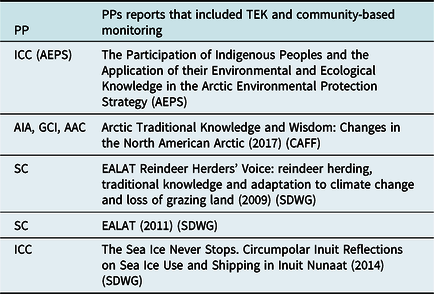
Finally, Indigenous organizations (PPs) have become engaged in TEK projects (see Table 2). In the AC, TEK has always been perceived as Indigenous knowledge, not just local or traditional (Ottawa Declaration, 1996). That being said, the conception of TEK is strongly connected to Indigenous communities and their political empowerment in the AC. Since the beginning of the development of the AC, TEK has been promoted as an important question for Indigenous actors. The PPs were expected to provide their expertise on TEK in the AC.
PPs reports that included TEK and community-based monitoring.

The first TEK project released by the Inuit Circumpolar Conference under the Arctic Environmental Protection Strategy was the Participation of Indigenous Peoples and the Application of their Environmental and Ecological Knowledge in the Arctic Environmental Protection Strategy (AEPS) in 1993. The ICC hired the expert, Lorraine Brooke, to write this report about the application of TEK to AEPS (Brooke, Reference Brooke1993). This report gives some information about the roots of the discussion on TEK in the AEPS. The report has some background information on issues that gave Indigenous peoples the opportunity to participate in the AEPS. (Brooke, Reference Brooke1993). The use of TEK in the Arctic was considered as an approach to include Indigenous peoples in the process of implementation of the AEPS (Brooke, Reference Brooke1993).
The collaborative initiatives between CAFF and PPs at CAFF 2003–2004 meetings were a positive tendency within CAFF Working Group. This means that CAFF welcomed PPs expertise and knowledge on TEK (CAFF, 2004). As a result of these initiatives, in 2017, a few PPs, including GCI, AIA, and AAC, published a report “Arctic Traditional Knowledge and Wisdom: Changes in the North American Arctic.”
In 2009 and 2011, the Saami Council organized two projects called EALAT to study the life of reindeer herders in Scandinavia and Russia. The AIA, GCI, and AAC prepared a report on the traditional knowledge of the peoples of North America, and the ICC prepared a study called Sea Ice Never Stops. The collection and documentation of TEK in all projects were a success. Several reports used Indigenous methodologies combined with Western scientific methods. EALAT (Magga, Mathesen, Corell & Oskal, Reference Magga, Mathiesen, Corell and Oskal2011, 2009a) introduced a novel method that was developed for Siida-based monitoring of snow change and grazing conditions. The researchers also used the Sami language and terminology.
Anthropologists and linguists, political scientists and sociologists, were involved. TEK data were collected and documented; each Indigenous community was referred to and approached independently. Yet, TEK observations were not translated into policy recommendations. The recommendations were mostly related to support of Indigenous communities (e.g. “it is important to support capacity building for Indigenous societies facing climate change”) (SDWG, 2009, p.15). The message about socioeconomic conditions could include examples such as “degradation of pasture lands combined with the consequences of a changing climate present substantial challenges to the future of reindeer husbandry” (SDWG, 2009, p.2). The examples of key messages for actions included: “Increase financial and other support for Indigenous peoples and organizations to engage in research and science initiatives actively and to address their concerns effectively” (CAFF, 2017, p.66), “determine the status of reindeer pastures within each of the Arctic states and facilitate the process of surveying and registration of reindeer pastures with in-state” (SDWG, 2009, p.65).
In 2017, ICC organized the study The Sea Ice Never Stops. Circumpolar Inuit Reflections on Sea Ice Use and Shipping in Inuit Nunaat. The report was published with the SDWG working group. The report investigates the Inuit use of sea ice. According to the document, Inuit Traditional Knowledge has provided a tremendous amount of data for researchers and decision-makers regarding climate change and its impact on the environment and communities (SDWG, 2017). The conclusions mostly referred to Inuit perspectives (e.g. Inuit are adaptable and strong), but they did not apply Inuit TEK to policy-making process. TEK observations were not documented, and report conclusions were not based on TEK. Similar to EALAT and ATK &W, this report provided Indigenous perspectives on the development of the Arctic region, but these recommendations/insights were not based on TEK.
Successful examples of the application of TEK to the policy-making process can be found in Brooke’s report (Reference Brooke1993). “There exists ample evidence that the European ban on sealskin products and pressures to reduce or eliminate whaling, for example, have had serious economic impacts on many Indigenous peoples and local communities in the circumpolar region” (Brooke, Reference Brooke1993, p.78). Another example is related to documentation of TEK:
“Experiences from various regions in the circumpolar area have shown that the mapping of Indigenous land-use patterns and their environmental and ecological knowledge is a very successful and productive way of moving information from an oral tradition into a format that can be understood by western scientists and researchers” (Brooke, Reference Brooke1993, p.80).
Knowledge application was missing in the PPs’ reports. During the knowledge interpretation and application process, TEK must be applied to policy outcomes through the review of the study results and group discussion of the validity of the results and potential application (Chapman & Schott, Reference Chapman and Schott2020). For example, the potential application to policy could be related to the cost of hunting compared to the offered compensation through community food distribution programs (Chapman & Schott, Reference Chapman and Schott2020).
Instead of providing policy recommendations based on TEK, almost each of the PPs’ project on TEK included the call for socioeconomic action such as “Increase financial and other support for Indigenous peoples and organizations to engage in research and science initiatives actively and to address their concerns effectively (CAFF, 2017). “It is important to support capacity building for Indigenous societies facing climate change and loss of grazing land, both in terms of supporting the recruitment of young scientists from reindeer herding communities, and in terms of supporting institution building in local reindeer herding communities for local competence building” (SDWG, 2009). Therefore, PPs’ reports did not translate TEK into policy recommendations but, instead, they suggested the policies for socioeconomic action that could improve the lives of Indigenous communities. While scientists used individual quotes from interviews to support their scientific discoveries and facts, Indigenous organizations used TEK projects to attract more attention to the socioeconomic problems of northern Indigenous communities. Both of them utilized the concept of traditional knowledge to pursue political goals.
The outcomes of analysis of the discussion on TEK: Lip service?
The qualitative content analysis of the AC meeting minutes, reports, and assessments during the period (1994–2013) indicates that after more than 20 years of the beginning of a discussion of TEK, the AC is still continuously struggling with the incorporation of TEK. The initial excitement of the AC toward the inclusion of TEK has subsided due to the lack of success. Instead of consolidating their efforts and finding the best strategies and approaches on how to utilize TEK, eight Arctic states and six PPs have been involved in lip service.
The outcomes of the study show that TEK has been incorporated into the AC to a quite small extent. Thereby, the process of incorporation turned into lip service. The lip service tendency has been noticed regarding the practical integration of TEK in the AC and its working groups. Many reports of the working groups, including AMAP, PAME, and EPPR, state that TEK is valuable and is needed to be included in their scientific reports and assessments. Nonetheless, they do not specify the procedures of utilization and integration of TEK into the research and decision-making process. Why has TEK not been incorporated into the AC work?
The reasons of lip service: What has not been working
Confusion with terms and definitions
Almost each AC declaration mentions traditional knowledge. Yet, these declarations use inconsistent terminology. The analysis of the AC declarations indicated that they use different terms for TEK: traditional and Indigenous knowledge (Iqaluit Declaration (1996); traditional knowledge (Ottawa Declaration, 1998); traditional knowledge (Inari Declaration (2000); Indigenous and traditional knowledge (Reykjavik Declaration, 2004); Indigenous and traditional knowledge (Salekhard Declaration (2006); traditional knowledge (Tromso Declaration (2009); Arctic Indigenous Peoples’ traditional knowledge (Nuuk Declaration (2011); traditional and local knowledge (Kiruna Declaration, 2013); traditional and local knowledge (Iqaluit Declaration, 2015); and traditional and local knowledge (Fairbanks Declaration, 2017). So, many terms were used regarding TEK in the AC work.
At the SAO Plenary meeting in Fairbanks in 2016, Canada suggested developing a lexicon for AC use when speaking or writing about TEK (Arctic Council, 2016). Several PPs expressed concern about investing additional time to develop a lexicon when past efforts were not successful; those voicing concerns emphasized the need for the process to be conducted with respect for PP culture and that any lexicon would need to be acceptable to the PPs (Arctic Council, 2016).
Hence, the reason why the discussion on TEK, despite many challenges, is still prevalent in the AC is because connection of TEK to indigeneity turns this conversation into a very political discussion related to decolonization and Indigenous empowerment. According to Berkes, (Reference Berkes1999), the use of TEK is political because it threatens to change the balance of power between Indigenous groups on the one hand versus governments, developers, and conventional resource management scientists on the other (p.173). The politicization of TEK resulted in lip service due to the lack of instructions combined with ongoing political pressure.
Lack of guidance on how to apply TEK
Since the beginning of the TEK discussion, the process of knowledge coproduction was not specified. In 2015 and 2019, CAFF and SDWG working groups released the reports that suggested recommendations on the integration of TEK into the AC work.
Recommendations for the Integration of Traditional and Local Knowledge into the Work of the Arctic Council (2015) released by SDWG suggested that TEK should be included in the AC work, but the process of incorporation of TEK was not explained. The document only described how the AC projects mentioned how the working groups claimed to include TEK into their projects, but neither evaluated nor provided the analysis of the process of TEK incorporation. The main focus of this document was on recommending WGs to integrate TEK into the AC work.
Similarly, the reports released by CAFF: Traditional Knowledge and Community-Based Monitoring Progress Report (2015) and Traditional Knowledge Progress Report 2017–2019 (2019) only tracked the emergence of the TEK projects in the AC, but did not assess the actual progress in knowledge coproduction.
Thus, the process of the incorporation of TEK has not been guided by the AC. The SDWG and CAFF reports indicated that the AC has been forcing the WGs and PPs to incorporate TEK under the conditions of the lack of guidance.
Lack of engagement between scientific knowledge and TEK
Western science and TEK have quite distinct epistemologies and methodologies. TEK is holistic; Western science is compartmentalized; TEK is qualitative and nonwritten and based on inductive reasoning; Western science is written and mostly quantitative (Thomas & Schaefer, Reference Thomas and Schaefer1991). It was noted that there was a need in sufficient funding for the collection, compilation, and integration of traditional knowledge as well as the need to create a database on TEK (Arctic Council, 1999). Furthermore, the studies of climate change have shown that scientific and Indigenous observations have difference in scale: scientists look at regional scale; local observers tend to capture observations on the local scale (Arctic Council, 2004).
Besides this, TEK is often viewed by scientific communities as data that can be separated from its local context, which makes its utilization challenging (AHDR, 2004, 2014). Unlike scientific knowledge, TEK is strongly tied to the local area. Due to the fast changes in climate variability, it was noted that TEK might no longer be reliable as it comes with a high degree of uncertainty (AMAP, 2017). Therefore, the differences between Western science and TEK make the translation of TEK into science and policy quite challenging. The process of TEK incorporation needs additional studies.
The Western scholars mostly do not understand the importance of the Indigenous engagement into the projects and the crucial role of the content. The “lip service” reports and assessments do not use Indigenous participation as a method at all (e.g. SWIPA, 2017). They also tend to refer to Indigenous communities as one group of people (e.g. Indigenous communities in the Arctic). The scientific reports do not attempt to use Indigenous methodologies (e.g. Siida method), and do not apply TEK to policy recommendations except a few quotes from the in-person interviews. Many of these reports include recommendations to utilize TEK without any instruction or guidance on how to organize the process of collecting and utilizing TEK. For instance, EPPR Field Guide for Oil Spill Response in Arctic Waters (1998) states “Local knowledge (the Arctic Council uses terms such as local knowledge, TEK, and Indigenous knowledge interchangeably) also is used in the assessment of environmental concerns or issues, as there frequently exists a strong connection between the environment and subsistence or economic activities” (EPPR, 1998). All these reports nominally include TEK, and some of them did even conduct the fieldwork studies with Indigenous communities.
The scientific resistance toward the inclusion of TEK and the lack of understanding of TEK as a concept might be obstacles on the way of meaningful incorporation of TEK. The other challenge in this process could be the extreme politicization of TEK as a political crowbar of Indigenous engagement. The politicization of TEK resulted in the lack of translation of TEK data into the language of policymakers.
The politicization of TEK is a double-edged sword. On the one hand, the politicization of TEK turns the process of TEK incorporation into a difficult enterprise, as researchers and policymakers have become extremely responsible when it comes to the meaningful integration of TEK. The knowledge coproduction has to involve respect, reciprocity, trust, and other important values to recognize. On the other hand, the politicization of TEK provides the chance to Indigenous communities to empower themselves, and keeps this conversation about knowledge coproduction still ongoing.
The politicization of TEK as a political crowbar resulted in the shift of attention toward the call for socioeconomic action. Because TEK is a politicized concept, there is a tendency among PP studies to put an emphasis on socioeconomic issues of Indigenous peoples. The study recommendations in EALAT (Magga, Mathesen, Corell & Oskal, Reference Magga, Mathiesen, Corell and Oskal2011, 2009a), The Sea Ice Never Stops (SDWG, 2017), and Arctic Traditional Knowledge and Wisdom (CAFF, 2017) reflect general information about Indigenous peoples of a case study (e.g. “Inuit are adaptable and strong”) (SDWG, 2017), report about socioeconomic conditions of Indigenous peoples, and provide key messages for action regarding Indigenous knowledge. Yet, despite having a large amount of TEK data, these reports did not translate TEK into policy solutions.
Recommendations on the incorporation of TEK: How should it be done?
In the end, the article discusses the possible scenario of how the incorporation of TLK should be done in the AC. TEK, as a conception, has been claimed to be crucial in the work of the AC. Nevertheless, when it comes to the incorporation of TEK, lip service is predominant in the AC work. Lip service is a result of the lack of instructions and guidance in the process of incorporation, the pressure to incorporate TEK, scientific misunderstanding of TEK and resistance toward knowledge coproduction and epistemological and methodological distinctions between Western science and TEK, and the perception of TEK as a political tool for Indigenous empowerment. Does the presence of lip service mean that TEK will never be meaningfully incorporated into the AC?
At last, how to incorporate TEK into science and policy? The concept of TEK has to be reconstructed and stopped being perceived as a political crowbar. Instead, more attention should be paid toward cross-cultural communication, Indigenous participation, understanding of TEK, and the process of application of TEK into the policymakers’ language.
Although the comanagement model is an excellent intermediate step in the incorporation of TEK, due to the differences in legislation, political, and legal structures, and histories of colonialism, it might not be possible to establish similar regimes all over the Arctic. Therefore, the degree to which TEK is incorporated in the Arctic region might not be the same in all Arctic regions. TEK projects in areas such as North America and especially Canada might better incorporate TEK because there are already well-established regimes that allow researchers to collect, document, and incorporate TEK. Meanwhile, it still can be challenging to incorporate TEK in other Arctic regions such as Russia and Scandinavia. However, it is still possible to reach the goal when all TEK projects in the AC incorporate TEK meaningfully and to avoid “lip service.”
This study proposes a set of recommendations that could contribute into more meaningful incorporation of TEK into policy. According to these recommendations, significant incorporation of TEK into TEK projects can be achieved through five objectives as follows:
- Use of participatory methodology. Researchers involved in TEK projects should use participatory methodology such as interviews, focus groups, photovoice, and so on, during their work with Indigenous communities. The use of these methods provides equal engagement with Indigenous peoples. Most of the AC reports did not indicate that they utilized any of participatory methods in their studies.
- Use of Indigenous methodologies. The projects that incorporate TEK should use Indigenous methodologies such as Siida (Saami), Indigenous languages, and terminology. Alternatively, Indigenous peoples should be involved into projects as coresearchers and coauthors. Almost all TEK projects did not utilize Indigenous methods.
- Recognition that TEK is local. Researchers should recognize that TEK is local and belongs only to a local area. Indigenous cultures, languages, and knowledges should be recognized locally, e.g. TEK of the Yakut people from Eastern Siberia, Russia, but not as TEK of the Arctic Indigenous peoples in Russia. Most AC reports recognized Indigenous communities of the Arctic as one group of people with the same language, traditions, and culture.
- Application to policy. TEK should be applied to a policy. For this purpose, TEK should be documented and translated into a map, graph, or any in other scientific formats. Translating TEK into policy requires policymakers to understand how TEK looks like in a scientific format. The policy recommendations should include references to TEK and to Indigenous communities who possess this TEK. As it was investigated in this study, even PPs’ projects did not translate TEK into policy.
- Cross-cultural understanding. TEK projects should involve intercultural understanding between researchers and Indigenous communities. TEK projects should invite social scientists who have training on how to work with Indigenous peoples (e.g. social anthropologists, political scientists, psychologists, and so on). Most WGs’ projects did not invite social scientists into their projects, and the lack of intercultural communication negatively affected the understanding of TEK data.
Conclusion
Overall, the ongoing politicization of the concept of TEK, the view of TEK as a political crowbar, and the lack of guidance and instruction on the process of the TEK incorporation resulted in lip service. This study argues that the process of incorporation included several trends: (1) initial excitement about first projects and frustration; (2) lip service; (3) the emergence of large TEK projects; and (4) the involvement of PPs in the TEK projects. Each of these trends has its challenges, such as the lack of funding for PPs and scientific resistance toward the incorporation of TEK.
The research investigated that the process of incorporation had several obstacles: the first challenge is the confusion of TEK definition and a concept of TEK in general. The concept of TEK is mostly perceived as Indigenous knowledge, not merely local knowledge about nature. Thus, TEK is indigenized in the AC. The perception of TEK is Indigenous knowledge resulted in the view of the incorporation of TEK into science and policy as a political crowbar for Indigenous empowerment and engagement in the decision-making process. This is also the reason why PPs were expected to provide their own expertise on the projects.
The second challenge in the process of incorporation refers to the scientific resistance and skepticism toward TEK. TEK and science come from different epistemological and methodological perspectives. Therefore, the first projects on Indigenous database and the universal system of comanagement failed. TEK cannot be easily translated into scientific data as it is expressed in an oral format, transferred through discussions and conversation, and has a complex nature. TEK cannot also be divided on parts and perceived separately from its context. These features make the incorporation and translation of TEK quite challenging for scientists. The lack of intercultural communication between TEK holders and scientists, as well as the lack of scholars, possesses skills in qualitative methodologies, and turns the process of knowledge coproduction into the situation when only several quotes from Indigenous observations are utilized in scientific reports and assessments. Scientific resistance can also be explained the lack of understanding of the TEK data. Even larger scientific projects such as ACIA and ABA did not translate the TEK data into scientific maps and graphs successfully.
The only Arctic state that has rich experience of working with comanagement regimes and incorporation of TEK is Canada. Other Arctic states, especially Russia and Scandinavian countries, do not have historical and cultural predispositions for comanagement regimes. The lack of engagement between scientific knowledge and TEK might explain the issues with collection, documentation, and translation of TEK into science and policy solutions. Both PPs and WGs encountered difficulties with TEK projects, and ongoing politicization led all TEK projects to the lack of meaningful engagement with TEK. TEK is a political tool that has to be reframed as a concept.
The study suggests the set of recommendations that could potentially guide the TEK projects in the process of knowledge coproduction including the use of participatory methodology, the use of Indigenous methodologies, a recognition that TEK is local, application to policy, and better cross-cultural communication could result in the more meaningful integration of TEK into scientific projects as well as wildlife management policies. TEK has quite a high potential of improving wildlife governance and increasing the level of knowledge about ongoing processes in nature, such as climate change. However, the road to more meaningful knowledge coproduction is still bumpy.