INTRODUCTION
Echinococcus is a hermaphroditic cestode that lives in the intestine of carnivores (generally canids) during the adult phase of its life cycle. The larvae usually develop in the liver and lungs of herbivorous mammals such as rodents, artiodactyls and perissodactyls. The natural cycle is maintained through predator-prey interactions, and the domestic cycle is completed when dogs eat the uncooked viscera of infected intermediate hosts (sheep, cattle, goats etc). Echinococcosis is a globally prevalent zoonosis with considerable economical impacts. The genus Echinococcus is undergoing a taxonomic revision (Thompson and McManus, Reference Thompson and McManus2002) as its most common and widely distributed species, E. granulosus, contains a high degree of genetic variation correlating to its intermediate host species. Thus, some genotypes or strains of E. granulosus that had adapted to different intermediate hosts were recently split in separate species (Thompson and McManus, Reference Thompson and McManus2002; Nakao et al. Reference Nakao, McManus, Schantz, Craig and Ito2007).
It has been generally accepted that selfing causes strain variation within the genus Echinococcus (Smyth and Smyth, Reference Smyth and Smyth1964). An opposing but less-accepted explanation for strain divergence is natural selection (revised by Thompson and Lymbery, Reference Thompson and Lymbery1988). Rausch (Reference Rausch and Thompson1986) proposed that gene flow and cross-fertilization are extensive in E. granulosus, and he attributed strain differentiation to the association with distinct domestic host species. Evidence for the traditional view is the highly significant deficiency of heterozygotes and linkage disequilibrium in E. granulosus populations from Australia and Brazil (Lymbery et al. Reference Lymbery, Constantine and Thompson1997; Haag et al. Reference Haag, Araújo, Gottstein, Siles-Lucas, Thompson and Zaha1999). Nevertheless, some degree of outcrossing must occur to account for the presence of heterozygotes (Badaraco et al. Reference Badaraco, Ayala, Bart, Gottstein and Haag2008).
Outcrossing is believed to be more advantageous than selfing because it produces more variable offspring that might better respond to various selection pressures and suffer less from the expression of deleterious mutations (Wright, Reference Wright1977; Maynard Smith, Reference Maynard Smith1978). In Schistocephalus solidus, a hermaphroditic tapeworm whose cycle is maintained through fish-eating birds (definitive hosts), copepods (first intermediate hosts) and sticklebacks (second intermediate hosts), outbred parasites showed higher infectivity and developmental rates (Christen et al. Reference Christen, Kurtz and Milinski2002). Model simulations used to estimate extinction probabilities have suggested that hermaphroditism associated with selfing in the free-living nematode Caenorhabditis elegans must have arisen relatively recently, or that low levels of outcrossing and other factors are key to the species’ persistence into the present day (Loewe and Cutter, Reference Loewe and Cutter2008).
Most models on mating system evolution predict that a mixture of selfed and outcrossed progeny should not exist. Uyenoyama (Reference Uyenoyama1986) found that mixed-mating systems (with both outcrossing and selfing) would be evolutionary stable only when self-fertilization and bi-parental inbreeding occur simultaneously. Indeed, it was shown that adults of S. solidus self-fertilize a fraction of their eggs, but the amount of selfed progeny is highly variable among individuals (Lüscher and Milinski, Reference Lüscher and Milinski2003). A mixed-mating system seems to be maintained by stochastic density fluctuations in the host (uncertainty in finding a mate increases the benefit of selfing). In Echinococcus, microscopy studies of adult worms show contradictory results, indicating either that self-insemination is the normal process of sperm transfer in E. granulosus (Smyth and Smyth, Reference Smyth and Smyth1969), or that mating between worms is the main form of reproduction (Wang, Reference Wang1998).
Understanding the mode of reproduction in the Echinococcus would enable us to predict how parasite populations respond to drugs or vaccines. Resistance mutations may spread rapidly in an outcrossing population. However, genetic studies within the group have focused mainly on uni-parental mitochondrial markers and on the larval (asexual) stage. To our knowledge, this is the first study that assesses the genetic structure of adult E. granulosus populations using both mitochondrial (uni-parental) and nuclear (bi-parental) markers.
MATERIALS AND METHODS
Sampling and preparation of parasite materials
Echinococcus adults measuring between 2 and 3 mm were obtained from 6 dogs on 3 farms in the rural area of Santana do Livramento, Southern Brazil. Dogs were purged with 3 mg/kg arecoline (Schantz, Reference Schantz1973). Worms were collected from the feces, washed in 1X PBS (pH 7·4), and stored at 4°C in 70% ethanol. To account for the possibility that the eggs within a gravid proglottid originated from cross-fertilization between 2 genetically distinct worms, the last proglottid was separated from the rest of the body with a scalpel. Each body part was first dried for 30 min at 37°C and then incubated in 50 μl of a 3 ng/μl proteinase K solution at 58°C for 2 h. Proteinase K was inactivated at 95°C for 20 min, and the eluates were stored at −20°C until use.
PCR, SSCP and sequencing
Three targets were amplified by PCR and subsequently analysed: (1) a 366 bp fragment of the mitochondrial cytochrome oxydase gene (cox1, Bowles et al. Reference Bowles, Blair and McManus1992); (2) a 106 bp region including the first intron of the cytosolic malate dehydrogenase gene (mdh, referred to as EgAg4 in Haag et al. Reference Haag, Araújo, Gottstein, Siles-Lucas, Thompson and Zaha1999); and (3) a 214 bp fragment containing the second intron of the same nuclear gene (Badaraco et al. Reference Badaraco, Ayala, Bart, Gottstein and Haag2008). PCR reactions were performed as previously described using 2 μl of the thawed eluates as templates.
To screen for nucleotide polymorphisms of the nuclear mdh gene, we used Single Strand Conformation Polymorphism (SSCP) to identify intron I and II alleles and to search for heterozygous genotypes. SSCP was performed using the GeneGel Clean SSCP kit on a GenePhor Electrophoresis Unit (GE Healthcare) following the manufacturer's instructions. The gels ran for 1 h at 14°C and 500 V (intron I), or 2 h at 12°C and 200 V (intron II). After electrophoresis, gels were silver stained using a conventional protocol.
We confirmed allele and genotype assignments for mdh introns I and II by sequencing the PCR fragments that showed distinctive SSCP patterns. All cox1 PCR products were analysed by nucleotide sequencing. Briefly, amplicons were purified using ExoSAP-IT (USB) and sequenced automatically in both directions (Macrogen). Chromatograms were inspected for quality and used to search for nucleotide polymorphisms with the CodonCode Aligner software.
Statistical analyses
We hierarchically grouped parasite genotypes into infra-populations (worms collected from a single dog) and populations (worms from all dogs on a single farm). Genetic variance was analysed by AMOVA (Excoffier et al. Reference Excoffier, Smouse and Quattro1992) using the Arlequin 3.5 software (Excoffier and Lischer, Reference Excoffier and Lischer2010), and was classified into the following categories: within dogs (infra-populations), among dogs within farms (populations) and among farms (meta-population). To estimate inbreeding, we performed a second molecular variance analysis for each individual worm.
RESULTS
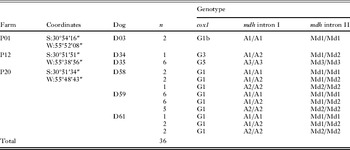
From a total of 49 worms, 36 showed successful amplification for the 3 markers (see Supplementary table in online version). Results for each body segment were always identical, with no exception, allowing us to pool the data from a single individual. Malate dehydrogenase introns I and II also showed consistent results (Table 1). Four mitochondrial haplotypes were present in our sample: G1 and G1b (sheep strain), G3 (buffalo strain) and G5 (cattle strain). According to the taxonomic classification proposed by Nakao et al. (Reference Nakao, McManus, Schantz, Craig and Ito2007), G1, G1b and G3 correspond to E. granulosus sensu stricto, and G5 to E. ortleppi. For convenience, we use here the suffix sensu lato to refer to all mitochondrial haplotypes found in our study. As Table 1 shows, every dog was parasitized by a single mitochondrial haplotype with 1 exception: dog P20D59 contained 22 worms with haplotype G1 and 1 with haplotype G1b (Supplementary table). However, because the eluate derived from this individual did not amplify the nuclear markers, it was excluded from further analyses.
Genotypes of the 36 Echinococcus granulosus sensu lato adults analysed in our study

There was a slight but not significant, deficiency in mdh heterozygotes in farm P20 (n=27). Other populations have rather low sample sizes for testing Hardy-Weinberg proportions. One infra-population (dog P12D35, n=6) was monomorphic (Table 1). The inbreeding coefficient (F) could be estimated by the deviation from H-W proportions as F=1-H/He (Nei, Reference Nei1987), where H is the actual population heterozygosity and He is the expected heterozygosity under equilibrium. In farm P20, F equals 0·26. So if F is interpreted as the proportion of selfed individuals (McCauley et al. Reference McCauley, Whittier and Reilly1985), that means the parasite on that farm outcrosses 74% of the time.
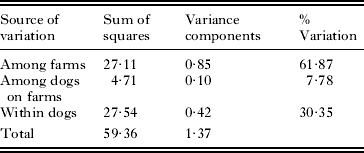
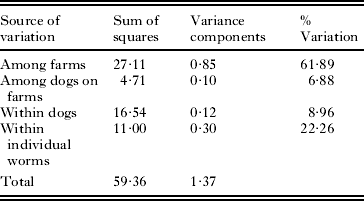
When genetic variance is partitioned using AMOVA (Table 2), more than half of the total variation (61·87%) is found among farms (i.e. within the entire meta-population). However, an expressive fraction of the total genetic variation (30·35%) occurs among worms from the same definitive host (within infra-populations). Conducting the molecular variance analyses on the individual level shows that the largest fraction of the infra-population variability occurs within individual worms (22·26%, see Table 3). The estimated fixation indexes are as follows: FIS=0·29 (P=0·02); FSC=0·18 (P=0·03); FCT=0·62 (P=0·00); FIT=0·77 (P=0·00).
Analysis of molecular variance (AMOVA) without the individual level

Analysis of molecular variance (AMOVA) considering the individual level

DISCUSSION
Transmission and implications for echinococcosis control
Four Echinococcus granulosus sensu lato haplotypes (G1, G1b, G3 and G5) are circulating among the 6 farms included in our study. However, these genetic variants are not randomly distributed among dogs and, with a single exception, no dog ever harboured more than 1 parasite haplotype. Transmission seems to occur mainly within farms. The 3 dogs from farm P20 played host to only G1 and G1b adults, while dogs from farm P12 hosted haplotypes G3 and G5. AMOVA shows that the largest fraction of genetic variance occurs among farms (61·87%). The genetic differentiation (fixation index) of infra-populations (dogs) from different farms (FCT=0·62) is much larger than within farms (FSC=0·18), pointing to a scenario where the parasite is transmitted primarily by the habit of feeding dogs uncooked viscera. Dogs in our study area do not move far from the main farmhouse (de la Rue, personal observation). Furthermore, although taeniid eggs might be passively dispersed over distances up to 10 km (possibly by the wind or insects), their viability is rather low (Lawson and Gemmel, Reference Lawson and Gemmel1983).
These findings suggest that educational or other control programmes performed on a farm-by-farm basis would have a good chance of successfully reducing parasite transmission. They also explain the success of a similar control programme against echinococcosis in Tasmania in 1965, which led to the eradication of the parasite (see Jenkins (Reference Jenkins2005) for a review). With no wild definitive hosts transmitting the parasite across farms, denying domestic dogs access to offal and dosing them with anti-helmintics, together with public education and vigilance at abattoirs and farm quarantine policies, would interrupt the transmission cycle. A similar programme conducted in Uruguay in 1991, in which all domestic dogs were treated with praziquantel monthly, resulted in a remarkable decrease in the prevalence of ovine echinococcosis (Oku et al. Reference Oku, Malgor, Benavidez, Carmona and Kamiya2004). Farias et al. (Reference Farias, Malgor, Cassaravilla, Bragança and De La Rue2004) also conducted a dog-treatment programme in the region in Brazil where the present samples were obtained. This programme also successfully decreased the prevalence in dogs; however, because it was difficult to introduce behavioural changes in the rural population and stop the feeding of uncooked sheep viscera to dogs, the infection rate increased quickly soon after the programme finished.
Selfing versus outcrossing
Previous studies from our group on a large set of markers using the larval stage of E. granulosus sensu lato (Haag et al. Reference Haag, Araújo, Gottstein, Siles-Lucas, Thompson and Zaha1999) suggest that the Smyth and Smyth (Reference Smyth and Smyth1964) and Rausch (Reference Rausch and Thompson1986) models of strain evolution in Echinococcus are not mutually exclusive. We proposed that both selfing and outcrossing might occur in E. granulosus populations. No study since then has taken up the question, leaving reproduction modes in Echinococcus populations still a matter of some speculation, despite their clear epidemiological implications (e.g. evolution and spread of resistant phenotypes). Mitochondrial genes became the most popular markers for studying Echinococcus molecular epidemiology, but due to their uni-parental and non-recombining properties, they are inadequate to assess questions about breeding systems. Nuclear markers have frequently been considered to be less variable, with the exception of a microsatellite (EmsB, Bart et al. Reference Bart, Knapp, Gottstein, El-Garch, Giraudoux, Glowatzki, Berthoud, Maillard and Piarroux2006), which is unfortunately repeated inside the genome, and therefore useless for assessing breeding systems as well.
Moreover, population studies have focused almost exclusively on the asexual metacestode stage. However, comparing Echinococcus population polymorphisms in both intermediate and definitive hosts is essential to understanding the dynamics of genetic variation during the parasite's life cycle. Although it does not provide direct evidence for the mode of reproduction, it can help test hypotheses. In this present work on the adult stage of Echinococcus, as well as in our former study on the larval stage (Haag et al. Reference Haag, Araújo, Gottstein, Siles-Lucas, Thompson and Zaha1999), we found no significant heterozygote deficiencies. Lymbery et al. (Reference Lymbery, Constantine and Thompson1997) and Badaraco et al. (Reference Badaraco, Ayala, Bart, Gottstein and Haag2008) on the other hand, found significant heterozygote deficiencies. In light of the results obtained in the present study, which show that transmission among domestic animals seems to be restricted to a single farm, it is possible that the heterozygote deficiencies previously described are a consequence of subdivision (Wahlund effect). Pooling genotypes from different farms with distinct allele frequencies could lead to statistically significant heterozygote deficiencies, resembling an inbreeding effect. Badaraco et al. (Reference Badaraco, Ayala, Bart, Gottstein and Haag2008), for example, tested the Hardy-Weinberg equilibrium for the mdh locus in a pooled sample of bovine isolates from southern Brazil corresponding to haplotype G1 (n=115). The frequency of alleles Md1, Md2 and Md3, was 0·42, 0·56 and 0·02, respectively, leading to an expected frequency of genotype Md1/Md2 under H-W equilibrium equal to 0·47. However, the bovine hosts came from different farms, which may have had different parasite allele frequencies. If, for instance, samples from 2 farms showing allele frequencies of Md1 equal to 0·8 and 0·04 (0·42 on average) and of M2 equal to 0·18 and 0·94 (0·56 on average) would have been pooled, the expected heterozygosity under H-W equilibrium would be 0·29 for the first farm and 0·08 for the second! Heterozygotes have consistently been found both in E. granulosus sensu lato (Lymbery et al. Reference Lymbery, Constantine and Thompson1997; Haag et al. Reference Haag, Araújo, Gottstein, Siles-Lucas, Thompson and Zaha1999; Badaraco et al. Reference Badaraco, Ayala, Bart, Gottstein and Haag2008) and in E. multilocularis (Knapp et al. Reference Knapp, Bart, Glowatzki, Ito, Gerard, Maillard, Piarroux and Gottstein2007), suggesting that cross-fertilization is not uncommon.
Indeed, the difference between the observed and expected heterozygosity in farm P20 (F=0·26), and the fixation index of infra-populations averaged over all loci (FIS=0·29) suggests that outcrossing is actually the most common mode of reproduction. In the extreme case of a completely selfed population, F should equal 1, although selfing rates may vary from one region to another, depending on particular ecological conditions. Cheptou and Dieckmann (Reference Cheptou and Dieckmann2002) showed that, contrary to previous models of breeding system evolution, the outcomes of breeding system evolution are not confined to either complete selfing or full outcrossing – even under demographic equilibrium – and that intermediate selfing rates arise under a wide range of conditions depending on the nature of competitive interactions between inbred and outbred individuals. Thus, it seems more plausible that the Smyth and Smyth (Reference Smyth and Smyth1964) and Rausch (Reference Rausch and Thompson1986) models of Echinococcus strain evolution represent two ends of a continuum of selfing rates.
ACKNOWLEDGEMENTS
This project was supported by the National Council of Scientific Development and Technology (CNPq, Brazil, grant number 472329/2008-1).