INTRODUCTION
Social cognitive abilities are higher order cognitive processes used to process and interpret social information to successfully interact with others (Adolphs, Reference Adolphs2009; Henry, Phillips, Ruffman, & Bailey, Reference Henry, Phillips, Ruffman and Bailey2013). Such abilities include cognitive theory of mind (ToM; the ability to make inferences about the thoughts, intentions, and beliefs of others), affective ToM (i.e., the ability to make inferences about the feelings of others), understanding of social norms, moral judgement, and empathy (Baez et al., Reference Baez, Herrera, Villarin, Theil, Gonzalez-Gadea, Gomez, Mosquera, Huepe, Strejilevich, Vigliecca, Matthäus, Decety, Manes and Ibañez2013; Love, Ruff, & Geldmacher, Reference Love, Ruff and Geldmacher2015).
With an increasingly ageing population, it is vital to examine whether social cognition shows the same age-related changes found in other cognitive domains (Hedden & Gabrieli, Reference Hedden and Gabrieli2004; Salthouse, Reference Salthouse2009). Understanding the impact of age on social cognition is important since social cognition is associated with real-world social functioning such as close social network size (Radecki, Cox, & MacPherson, Reference Radecki, Cox and MacPherson2019; Stiller & Dunbar, Reference Stiller and Dunbar2007) and the number of relationships individuals maintain (Kardos, Leidner, Pléh, Soltész, & Unoka, Reference Kardos, Leidner, Pléh, Soltész and Unoka2017). This is particularly relevant for ageing populations due to the high levels of loneliness observed in older adults (Victor & Yang, Reference Victor and Yang2012).
Studies examining age-related differences in social cognition have yielded inconsistent results. Some have shown that older adults perform poorer than younger adults (Bailey, Henry, & Von Hippel, Reference Bailey, Henry and Von Hippel2008; Baksh, Abrahams, Auyeung, & MacPherson, Reference Baksh, Abrahams, Auyeung and MacPherson2018; Bottiroli, Cavallini, Ceccato, Vecchi, & Lecce, Reference Bottiroli, Cavallini, Ceccato, Vecchi and Lecce2016; Henry et al., Reference Henry, Phillips, Ruffman and Bailey2013; Moran, Jolly, & Mitchell, Reference Moran, Jolly and Mitchell2012). However, others have shown no differences (Castelli et al., Reference Castelli, Baglio, Blasi, Alberoni, Falini, Liverta-Sempio, Nemni and Marchetti2010; Keightley, Winocur, Burianova, Hongwanishkul, & Grady, Reference Keightley, Winocur, Burianova, Hongwanishkul and Grady2006; Li et al., Reference Li, Wang, Wang, Tao, Xie and Cheng2013; MacPherson, Phillips, & Della Sala, Reference MacPherson, Phillips and Della Sala2002; McKinnon & Moscovitch, Reference McKinnon and Moscovitch2007; Phillips, MacLean, & Allen, Reference Phillips, MacLean and Allen2002; Wang & Su, Reference Wang and Su2006) or even improved performance in older adults compared to younger adults (Happé, Winner, & Brownell, Reference Happé, Winner and Brownell1998).
Age-related changes in social cognition may be the result of impairments in other cognitive abilities (Bernstein, Thornton, & Sommerville, Reference Bernstein, Thornton and Sommerville2011). It is well-documented that older adults’ executive functions (EFs) decline with age (Craik & Salthouse, Reference Craik and Salthouse2011; Hedden & Gabrieli, Reference Hedden and Gabrieli2004; Salthouse, Reference Salthouse2009). There is also evidence from studies of older adults (Bradford, Brunsdon, & Ferguson, Reference Bradford, Brunsdon and Ferguson2016, Reference Bradford, Brunsdon and Ferguson2017; Phillips et al., Reference Phillips, Bull, Allen, Insch, Burr and Ogg2011) and patients (Apperly, Samson, & Humphreys, Reference Apperly, Samson and Humphreys2005) that EF abilities are important for performance on social cognition tests.
In particular, EF abilities appear to mediate the effect of age on ToM performance. Bottiroli et al. (Reference Bottiroli, Cavallini, Ceccato, Vecchi and Lecce2016) found that cognitive ToM performance, assessed using the Faux Pas test (Stone, Baron-Cohen, & Knight, Reference Stone, Baron-Cohen and Knight1998), was correlated with age, updating, and inhibition, with updating mediating the effect of age on cognitive ToM performance. Similarly, updating partially mediates age-related differences in false belief (Phillips et al., Reference Phillips, Bull, Allen, Insch, Burr and Ogg2011) and explains the variance in performance on the Strange Stories Film Task (while age does not) (Johansson Nolaker, Murray, Happé, & Charlton, Reference Johansson Nolaker, Murray, Happé and Charlton2018). Inhibition has been found to mediate age-related differences on false belief (Li et al., Reference Li, Wang, Wang, Tao, Xie and Cheng2013) and belief–desire reasoning tasks (German & Hehman, Reference German and Hehman2006). When Bailey and Henry (Reference Bailey and Henry2008) considered both cognitive and affective ToM using false-belief reasoning and the Reading the Mind in the Eyes (RME) (Baron-Cohen, Wheelwright, Hill, Raste, & Plumb, Reference Baron-Cohen, Wheelwright, Hill, Raste and Plumb2001) tests, respectively, inhibition mediated age-related differences in cognitive ToM but only partially mediated age differences in affective ToM. Inhibition, updating, and set shifting have also been found to mediate the relationship between age-related differences on the Strange Stories Test (Charlton, Barrick, Markus, & Morris, Reference Charlton, Barrick, Markus and Morris2009). Therefore, some evidence suggests that the variance in ToM performance in older adults is explained by EF abilities.
Yet, other studies report that age-related differences in ToM tests are independent of EF abilities. Using story-based tests, age-related differences in cognitive ToM remained significant when considering EF abilities (Cavallini, Lecce, Bottiroli, Palladino, & Pagnin, Reference Cavallini, Lecce, Bottiroli, Palladino and Pagnin2013; Maylor, Moulson, Muncer, & Taylor, Reference Maylor, Moulson, Muncer and Taylor2002; Wang & Su, Reference Wang and Su2013). Moreover, Bernstein et al. (Reference Bernstein, Thornton and Sommerville2011) showed that age, but not EF abilities, significantly contributed to variance on a continuous false-belief task. On affective ToM, performance on the RME was not related to age-related declines in inhibition, set shifting, or updating (Duval, Piolino, Bejanin, Eustache, & Desgranges, Reference Duval, Piolino, Bejanin, Eustache and Desgranges2011), and there were no age-related differences in inhibitory control on the Cambridge Mindreading Face–Voice Battery (Mahy et al., Reference Mahy, Vetter, Kühn-Popp, Löcher, Krautschuk and Kliegel2014). Other studies have also failed to show that age-related declines in affective ToM are explained by EF performance (Keightley et al., Reference Keightley, Winocur, Burianova, Hongwanishkul and Grady2006; Sullivan & Ruffman, Reference Sullivan and Ruffman2004; Wang & Su, Reference Wang and Su2013). Therefore, it is unclear whether age-related changes in social cognition are the result of impairments in EF abilities or they occur independently (Bernstein et al., Reference Bernstein, Thornton and Sommerville2011).
One aspect of ToM that has been examined less in relation to EFs in older adults is perspective taking (i.e., the selection of a specific perspective, self vs. other). In particular, individuals demonstrate biases towards their own perspective (Samson, Apperly, Kathirgamanathan, & Humphreys, Reference Samson, Apperly, Kathirgamanathan and Humphreys2005); consequently when asked to complete tests that require making ToM inferences about another individual, effortful processing is required (Samson, Apperly, Braithwaite, Andrews, & Bodley Scott, Reference Samson, Apperly, Braithwaite, Andrews and Bodley Scott2010), including inhibitory control (Decety et al., Reference Decety, Grezes, Costes, Perani, Jeannerod, Procyk, Grassi and Fazio1997; Kemp, Després, Sellal, & Dufour, Reference Kemp, Després, Sellal and Dufour2012). Therefore, age-related differences in perspective taking may be dependent on declines in EF abilities.
The inconsistencies across ageing studies may be due to the types of social cognition test administered. Previous research have shown that performance on different social cognition tests is associated with other cognitive processes such as verbal comprehension and perceptual reasoning (Baker, Peterson, Pulos, & Kirkland, Reference Baker, Peterson, Pulos and Kirkland2014; Charlton et al., Reference Charlton, Barrick, Markus and Morris2009; Maylor et al., Reference Maylor, Moulson, Muncer and Taylor2002; Sullivan & Ruffman, Reference Sullivan and Ruffman2004). For instance, Charlton et al. (Reference Charlton, Barrick, Markus and Morris2009) found that the association between age and ToM abilities measured by the Strange Stories Test was fully mediated by perceptual reasoning and partially mediated by verbal comprehension. Further studies have found correlations between ToM and verbal abilities (Maylor et al., Reference Maylor, Moulson, Muncer and Taylor2002) and have shown that perceptual reasoning accounts for age-related differences on the Strange Stories Test (Sullivan & Ruffman, Reference Sullivan and Ruffman2004). Therefore, the psychometric properties of the different ToM tests may underlie the disproportional overlap with EF abilities in older adults.
Our primary aim was to further examine the relationship between social cognition and EF abilities using our new test of social cognition called the Edinburgh Social Cognition Test (ESCoT; Baksh et al., Reference Baksh, Abrahams, Auyeung and MacPherson2018). The ESCoT is an animation-based test that assesses four different aspects of social cognition in the same test: cognitive ToM, affective ToM, interpersonal understanding of social norms, and intrapersonal understanding of social norms. We considered the ESCoT as an ideal test to explore the relationship between ToM, as well as other aspects of social cognition, and EF abilities because, unlike other tests, performance on the subtests of the ESCoT is not affected by perceptual reasoning abilities or verbal comprehension performance (Baksh et al., Reference Baksh, Abrahams, Auyeung and MacPherson2018). Therefore, any relationship between social cognitive abilities and EFs would be independent of these factors. Furthermore, an important feature of social cognition not typically examined in the ageing literature is the ability to understand social norms from interpersonal and intrapersonal perspectives. In one of the few studies to examine social norm understanding, Halberstadt, Ruffman, Murray, Taumoepeau, and Ryan (Reference Halberstadt, Ruffman, Murray, Taumoepeau and Ryan2011) found that older adults were poorer at discriminating between socially appropriate and inappropriate behaviours from short videos of social interactions compared to younger adults. The ESCoT provides an opportunity to study the relationship between social norm understanding and EF. Finally, we included the Visual Perspective Taking task (VPT) developed by Samson et al. (Reference Samson, Apperly, Braithwaite, Andrews and Bodley Scott2010) to encompass a ToM test thought to be reliant on EF abilities to compare with the ESCoT in the same groups of younger and older adults.
METHOD
Participants
Sixty-one participants were recruited through online advertisements and a research volunteer panel at the Department of Psychology, University of Edinburgh. Participants were subdivided into two age groups: 30 younger adults (20–31 years old, 12 males) and 31 older adults (65–80 years, 16 males). The mean age was 22.57 years (SD = 2.36) for the younger group and 72.29 years (SD = 3.99) for the older group. The younger and older age groups did not significantly differ in years of full-time education (M = 16.73, SD = 1.14; M = 16.12, SD = 3.27 respectively, p = 0.22). Participants were native English speakers, with corrected to normal vision and hearing, and normal colour vision. No participant self-reported any history of neurological or psychiatric disorders based on exclusion criteria listed in the Wechsler Adult Intelligence Scale-IV (WAIS-IV; Wechsler, Reference Wechsler2008). Written informed consent was obtained from each participant. This study was approved by the School of Philosophy, Psychology and Language Sciences Research Ethics Committee, University of Edinburgh (Reference number: 208-1617/8).
Measures
Edinburgh Cognitive and Behavioural ALS Screen
The Edinburgh Cognitive and Behavioural Amyotrophic Lateral Sclerosis (ALS) Screen (ECAS; Abrahams et al., Reference Abrahams, Newton, Niven, Foley and Bak2014) is a commonly used screening measure of general cognitive functioning. It assesses language, verbal fluency, executive functioning, memory, and visuospatial abilities. Higher scores demonstrate better performance, and the published cut off for atypical performance is 105 out of 136.
Edinburgh Social Cognition Test
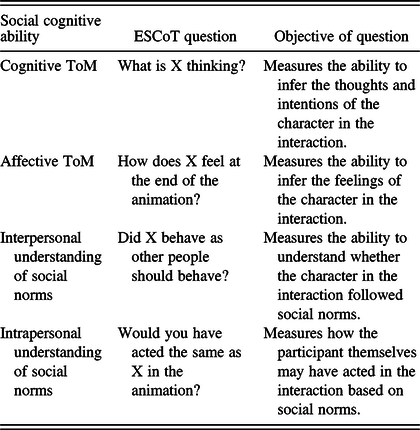
The ESCoT (Baksh et al., Reference Baksh, Abrahams, Auyeung and MacPherson2018) is an animation-based measure of social cognition. It assesses four social cognitive abilities: cognitive ToM, affective ToM, interpersonal understanding of social norms, and intrapersonal understanding of social norms, using self-contained contextually driven social interactions (see Table 1). It consists of 11 social interactions in total: 1 practice, 5 interactions involving social norm violations, and 5 interactions without social norm violations. Each interaction consists of five questions: a general comprehension question and four questions assessing each social cognitive ability.
ESCoT social cognitive domains and questions for each interaction

ESCoT = Edinburgh Social Cognition Test; ToM = theory of mind.
The animation was presented in the middle of a computer screen, and at the end of each animation, a static storyboard depicting a summary of what occurred in the interaction was presented onscreen. This storyboard remained onscreen while participants answered questions relating to the interaction. Participants were asked a general comprehension question (which was not scored) where they described what they saw in the interaction. Participants were then asked one question to assess each of the four subtests of social cognition. To allow optimal interpretation of each interaction and to capture the quality of their response, participants were prompted if they gave a limited response or their response lacked important information from the interaction. They were prompted with the question, ‘Can you tell me more about what you mean by that?’ or ‘Can you explain that in a little bit more detail?’ Each participant was prompted only once for each question.
Each response was scored on the quality of the answer with emphasis on the interaction that occurred and the animation context. To achieve full marks, participants were required to extract and integrate the contextually relevant information into their response. Of note, the most important aspect of participants’ responses was the quality of their answer, not the length. For the intrapersonal understanding of questions on social norms, full marks were given for responses that highlighted the subtle social nuances of the interaction rather than personal attributes of the participants. Each question was awarded a maximum of 3 points, resulting in a score of 12 points for each social interaction and a maximum of 30 points for each subtest. The total maximum score for the test was 120 points, with higher scores indicating better performance.
Visual Perspective Taking Task
The VPT (Samson et al., Reference Samson, Apperly, Braithwaite, Andrews and Bodley Scott2010) is a computerized test in which participants are presented with a lateral view of a room. Zero to three discs are presented on the walls. A human avatar is positioned in the centre of the room and always faced towards the left or right wall. In half of the trials, the avatar’s point of view was consistent with the participant’s view and, in the remaining trials, the avatar’s point of view was inconsistent. The position of the avatar was always kept constant across both consistent and inconsistent conditions but the position of the discs changed.
At the beginning of each trial, participants saw a fixation cross for 750 ms, followed by the words ‘YOU’ or ‘SHE’ for another 750 ms, indicating which perspective they were to take (self-condition or other condition). Subsequently, a number between 0 and 3 appeared on the wall for 750 ms, to indicate the number of discs (perspective content) participants had to verify. Following a 500-ms interval, an image of the avatar appeared and the participant had to respond as quickly and accurately as possible to whether the number they saw (0–3) matched the number of discs that could be seen from the ‘YOU’ or ‘SHE’ perspective (i.e., consistent or inconsistent). If no response was given within 2000 ms, the next trial was presented. It consisted of four conditions, namely, self-consistent, self-inconsistent, other consistent and other inconsistent conditions.
On the ‘yes’ response trials (matching) for consistent and inconsistent conditions, the number onscreen matched the number of discs seen from the relevant perspective (self-condition or other condition). On the ‘no’ response (mismatching) inconsistent trials, the number onscreen indicated the number of the discs that could be seen from the irrelevant perspective. For ‘no’ response (mismatching) consistent trials, the number onscreen did not correspond to either the self or other perspective. It had a block of 26 practice trials. The experimental trials were divided into four blocks of 52 trials (48 tests and 4 filler trials) that were counterbalanced across participants. Only responses from matching trials were analysed (Samson et al., Reference Samson, Apperly, Braithwaite, Andrews and Bodley Scott2010), and processing costs based on Qureshi, Apperly, and Samson (Reference Qureshi, Apperly and Samson2010) were calculated by dividing the mean response time by the proportion correct. Lower processing costs indicated better performance.
Delis-Kaplan Executive Function System colour–word interference test
The Delis-Kaplan Executive Function System (D-KEFS) colour–word interference test (Delis, Kaplan, & Kramer, Reference Delis, Kaplan and Kramer2001) was administered to measure inhibition. In the first condition, participants were asked to name aloud a sequence of coloured squares as quickly as possible. In the second condition, participants were required to read aloud and as quickly as possible the colour of words printed in black ink. Finally, in the third (inhibition) condition, participants were presented with coloured words printed in an incongruent colour of ink (e.g., ‘GREEN’ printed in blue ink) and were asked to name the colour of the ink rather than reading the word itself as quickly as possible. Inhibition was measured by subtracting the time taken to complete the inhibition condition from the time taken to complete the word-reading condition. Lower scores indicated better inhibitory control.
Trail Making Test
The Trail Making Test (TMT; Reitan & Wolfson, Reference Reitan and Wolfson1993) is a pencil-and-paper test of set shifting consisting of two parts. Part A required participants to connect a series of numbers in numerical order (e.g., 1-2-3-4) as quickly as possible without lifting the pencil from the paper. In Part B, participants were asked to alternate between connecting numbers and letters in numerical and alphabetical order (e.g., 1-A-2-B) as quickly as possible. Set shifting was measured as the time taken to complete Part B minus the time taken to complete Part A. Lower scores indicated better performance.
Digit Span sequencing subtest from the WAIS-IV
The digit span subtest (Wechsler, Reference Wechsler2008) was administered to assess updating. It required participants to listen to a sequence of numbers and then reorder and recall the numbers in ascending order, starting with the lowest number (e.g., 8, 3, 5 into 3, 5, 8). The final score was the total number of correctly recalled trials, out of a maximum possible score of 16. Higher scores indicated better updating.
Coding subtest from WAIS-IV
The coding subtest (Wechsler, Reference Wechsler2008) was administered to measure processing speed (Salthouse & Ferrer-Caja, Reference Salthouse and Ferrer-Caja2003). Participants were provided with a key that included nine digits, each paired with a unique symbol. Participants were presented with digits and had to draw the matching symbols below the digits as quickly as possible. Each participant was given 2 min and correct responses were those drawn correctly in accordance with the digit–symbol key. Participants could achieve a maximum score of 135 points, with higher scores demonstrating faster processing speed.
Statistical Analysis
The relationship between performance on the ESCoT subtests, VPT, and EF abilities was examined using multiple regression analyses. Similar to our previous paper (Baksh et al., Reference Baksh, Abrahams, Auyeung and MacPherson2018), in the first model, the background predictors (age group, gender, years of education) which significantly correlated with the outcome variables from the ESCoT and VPT at a prespecified significance level of p < 0.20 were entered into the analysis (Altman, Reference Altman1991) using the enter method. We chose a significance level of p < 0.20 over traditional levels since p < 0.05 can fail to identify variables known to be important to the outcome variable, and simulation studies have shown that a cut off p < 0.20 yields better models (Bursac, Gauss, Williams, & Hosmer, Reference Bursac, Gauss, Williams and Hosmer2008; Lee, Reference Lee2014). We added processing speed (Model 2) and then our EF measures (inhibition, set shifting, and updating; Model 3) into the models using a stepwise method (entry criterion p < 0.05, removal criterion p > 0.10). Correlational analyses examined the relationship between the ESCoT and VPT. We used the raw scores for all social cognition and EF tests in our analysis to allow for examination of age-related changes. The α values were set at p < 0.05 and Holm correction was used to adjust for multiple comparisons. Finally, given our modest sample size, Bayesian analysis of covariance (ANCOVA) was conducted on the ESCoT outcome variables using JASP version 0.10 (JASP Team, 2018) to compare the strength of the evidence supporting the null model (including the significantly related control variables) and the alternative model (including processing speed and EF abilities) (Bayarri, Benjamin, Berger, & Sellke, Reference Bayarri, Benjamin, Berger and Sellke2016). Bayesian ANCOVA was used rather than Bayesian regression analyses as the models included binary (i.e., gender) as well as continuous variables. An estimated Bayes Factor (BF01) provides a likelihood ratio of the probability of the data occurring under the null model over the probability of the data occurring under the alternative model. For instance, if BF01 = 5, the observed data are five times more likely to have occurred, given the null hypothesis than the experimental hypothesis. BFs of above 3 provide ‘moderate’ evidence, above 10 provide ‘strong’ evidence, and above 30 provide ‘very strong’ evidence (Lee & Wagenmakers, Reference Lee and Wagenmakers2014).
RESULTS
ESCoT data from one of the older participants were omitted due to being outliers. Data from a second older participant were omitted from the VPT analyses and another older adult’s VPT other inconsistent condition data were removed as they were outliers. In the younger adult group, one participant’s self-consistent, other consistent, and other inconsistent processing cost data were removed due to being outliers, and another younger adult’s self-inconsistent processing cost score was also removed.
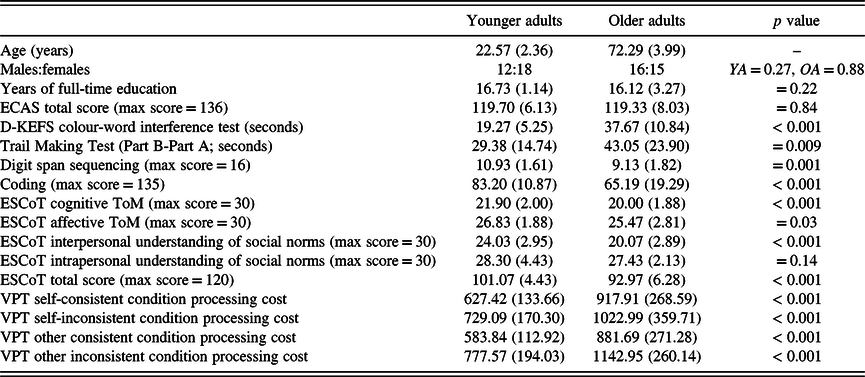
Descriptive statistics and differences tests are reported in Table 2. The two age groups did not significantly differ on the ECAS. Older adults performed poorer than younger adults on EF abilities and processing speed. Older adults exhibited poorer performance on cognitive ToM, affective ToM, interpersonal understanding of social norms, and ESCoT total scores compared to younger adults. No age-related difference in intrapersonal understanding of social norms was observed. On the VPT, older adults produced significantly larger processing costs compared to younger adults in all conditions.
Demographic information and means and standard deviations (in parentheses) for the cognitive and social cognitive test performance of the younger and older groups

ECAS = Edinburgh Cognitive and Behavioural ALS Screen; D-KEFS = Delis-Kaplan Executive Function System; ToM = Theory of Mind; ESCoT = Edinburgh Social Cognition Test; VPT = Visual Perspective Taking Task; processing cost = mean time/proportion correct; YA = younger adults; OA = older adults. We used the Holm correction to adjust for multiple comparisons.
Correlational analyses between the background variables and ESCoT subtests and VPT revealed that years of education did not correlate with any variable (p > 0.20) and was not included in the regression analyses. Gender did not correlate with cognitive ToM (p > 0.20) or any VPT condition (p > 0.20) and was not included in those regression analyses. Years of education did not correlate with VPT self-consistent, other consistent, and other inconsistent conditions (both ps > 0.20) and were not included in the regression analyses for these conditions.
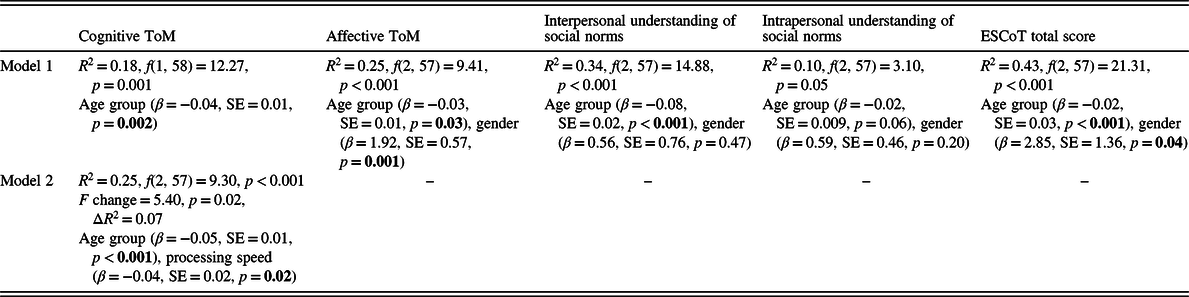
Table 3 provides the regression analyses involving the ESCoT and EF abilities. On cognitive ToM, performance was significantly associated with age group and processing speed. Younger adults and those with slower processing speed showed higher scores on cognitive ToM. On affective ToM, there was a significant relationship between performance and age group and gender. Better performance was associated with being younger and female. Performance on interpersonal understanding of social norms was significantly associated with age group, with younger participants performing better. The regression analysis for intrapersonal understanding of social norms was not statistically significant. A significant relationship was observed between ESCoT total score, age group, and gender. Being younger and female were associated with better overall ESCoT performance. In all models, EF abilities were not significantly associated with performance on the ESCoT.
Summary of multiple regression analyses for the ESCoT and EF abilities

ToM = theory of mind; ESCoT = Edinburgh Social Cognition Test; EFs = executive functions; Model 1 = age group, gender, years of education; Model 2 = processing speed; Model 3 = EF abilities (inhibition, set shifting and updating); Boldface text indicates statistical significant associations. The Holm correction for multiple comparisons was applied.
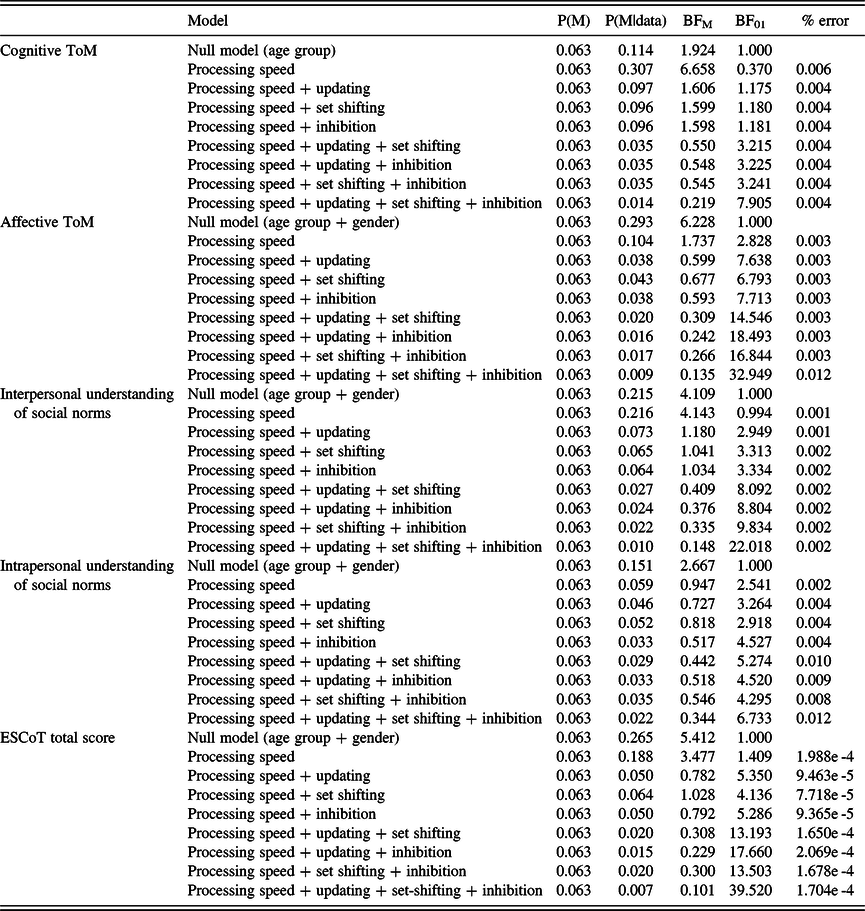
Table 4 illustrates the Bayesian ANCOVA. For cognitive ToM, the BF01 ranged between 1.175 and 7.905 when EF abilities were included, indicating anecdotal to moderate evidence in favour of the null model. For affective ToM, the BF01 ranged between 6.793 and 32.949 when EF abilities were added, indicating moderate to very strong evidence in favour of the null model. For interpersonal understanding of social norms, when the EF measures were entered into the model, BF01 ranged between 2.949 and 22.018, indicating anecdotal to strong evidence in favour of the null model. For intrapersonal understanding of social norms, BF01 ranged between 2.918 and 6.733 for the inclusion of EF abilities, providing anecdotal to moderate evidence for the null model. Finally, for the ESCoT total score, BF01 ranged between 4.136 and 39.520 when the EF measures were entered into the model, indicating moderate to very strong evidence in favour of the null model.
Summary of Bayes ANCOVA for the ESCoT and EF abilities

ANCOVA = analysis of covariance; ToM = theory of mind; ESCoT = Edinburgh Social Cognition Test; EF = executive function; BF = Bayes Factor.
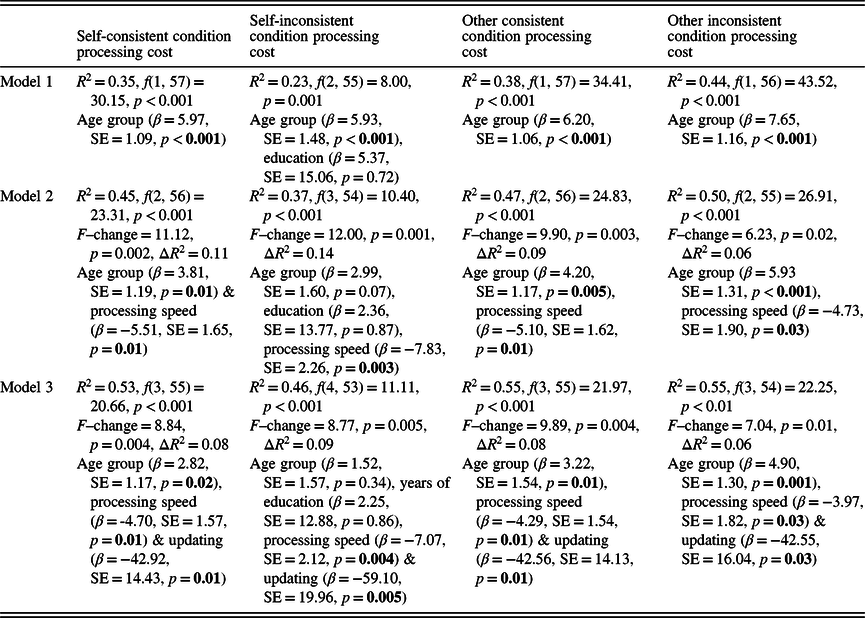
Table 5 shows the regression analyses for the sub-scores of the VPT. The relationship between higher processing costs and age group in the self-consistent condition was partially mediated by poorer processing speed and updating performance. In the self-inconsistent condition, poorer processing speed and updating fully mediated the relationship between age group and processing costs. Higher processing costs in the other consistent condition were related to older age, but this relationship was partially mediated by poorer processing speed and updating. There was a significant relationship between higher processing costs and the older age group; however, this relationship was partially mediated by processing speed and updating performance.
Summary of multiple regression analyses for the VPT and EF abilities

EF = executive function; Model 1 = age group, gender, years of education; Model 2 = processing speed; Model 3 = EF abilities (inhibition, set shifting, and updating). Boldface text indicates statistical significant associations. The Holm correction for multiple comparisons was applied.
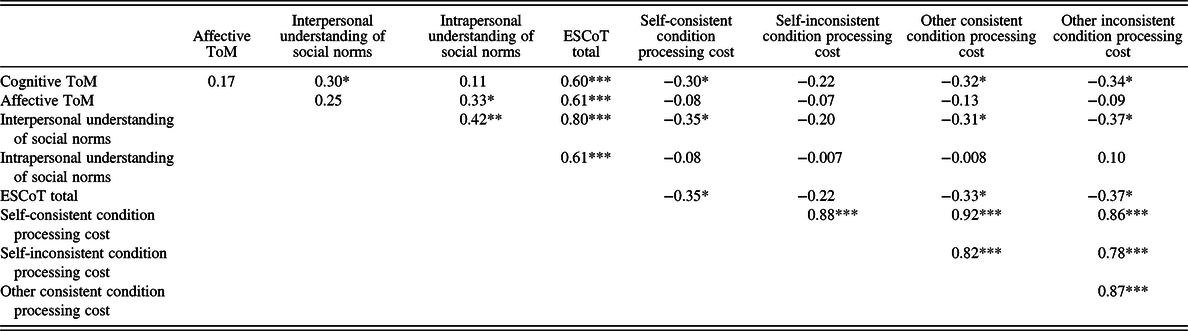
Table 6 provides the correlational analyses between the ESCoT and VPT conditions. Performance on cognitive ToM positively correlated with performance on interpersonal understanding of social norms, while affective ToM correlated with intrapersonal understanding of social norms. All ESCoT subtests significantly correlated with ESCoT total score. Performance on the cognitive ToM subtest significantly correlated with self-consistent, other consistent and other inconsistent processing costs of the VPT. The same significant negative relationships were found between the interpersonal understanding of social norms and ESCoT total scores and self-consistent, other consistent, and other inconsistent processing costs. All VPT conditions significantly correlated with each other.
Summary of correlational analyses between the ESCoT and VPT conditions

ToM = theory of mind; ESCoT = Edinburgh Social Cognition Test; VPT = Visual Perspective Taking task. he Holm correction for multiple comparisons was applied.
Note. * p < 0.05; ** p < 0.01; *** p < 0.001.
DISCUSSION
The current study examined the influence of different EF abilities on performance on the ESCoT. We found that performance on the subcomponents of the ESCoT was not significantly associated with any EF abilities (i.e., inhibition, set shifting, or updating) but age group and gender influenced performance. Processing speed was negatively associated with performance on cognitive ToM. In contrast, age-related associations with VPT were either fully or partially explained by the relationships with updating and processing speed performance.
Our finding that cognitive ToM performance on the ESCoT was not related to EF abilities is similar to previous findings in the literature (Bernstein et al., Reference Bernstein, Thornton and Sommerville2011; Cavallini et al., Reference Cavallini, Lecce, Bottiroli, Palladino and Pagnin2013; Maylor et al., Reference Maylor, Moulson, Muncer and Taylor2002; Wang & Su, Reference Wang and Su2013). However, other studies have reported an association between cognitive ToM and EF abilities (Bailey & Henry, Reference Bailey and Henry2008; Bottiroli et al., Reference Bottiroli, Cavallini, Ceccato, Vecchi and Lecce2016; Duval et al., Reference Duval, Piolino, Bejanin, Eustache and Desgranges2011; German & Hehman, Reference German and Hehman2006; Johansson Nolaker et al., Reference Johansson Nolaker, Murray, Happé and Charlton2018; Li et al., Reference Li, Wang, Wang, Tao, Xie and Cheng2013; Phillips et al., Reference Phillips, Bull, Allen, Insch, Burr and Ogg2011). Some variability in the ageing literature in terms of whether EF abilities underlie the performance on social cognition measures might be due to different tests being administered with distinct psychometric properties (e.g., Bailey & Henry, Reference Bailey and Henry2008; Duval et al., Reference Duval, Piolino, Bejanin, Eustache and Desgranges2011; Henry et al., Reference Henry, Phillips, Ruffman and Bailey2013). Indeed, our own work has shown that ESCoT performance is not associated with perceptual reasoning or verbal comprehension abilities (Baksh et al., Reference Baksh, Abrahams, Auyeung and MacPherson2018) compared to other social cognitive tests (Baker et al., Reference Baker, Peterson, Pulos and Kirkland2014; Charlton et al., Reference Charlton, Barrick, Markus and Morris2009; Maylor et al., Reference Maylor, Moulson, Muncer and Taylor2002; Sullivan & Ruffman, Reference Sullivan and Ruffman2004). On the VPT, however, performance was fully or partially explained by updating performance but not inhibition and set shifting. VPT is likely to be more reliant on updating, as it requires participants to retain, process, and respond to information regarding an avatar’s perspective. In terms of our EF measures, we selected them to tap the EF abilities proposed by Miyake et al.’s (Reference Miyake, Friedman, Emerson, Witzki, Howerter and Wager2000) model, and previous studies have used similar EF tests (Charlton et al., Reference Charlton, Barrick, Markus and Morris2009; Duval et al., Reference Duval, Piolino, Bejanin, Eustache and Desgranges2011). Therefore, it is unlikely that our results can be explained by heterogeneity across EF measures.
On affective ToM, we found that EF abilities were not related to performance, which is in line with most previous ageing studies (Bottiroli et al., Reference Bottiroli, Cavallini, Ceccato, Vecchi and Lecce2016; Duval et al., Reference Duval, Piolino, Bejanin, Eustache and Desgranges2011; Keightley et al., Reference Keightley, Winocur, Burianova, Hongwanishkul and Grady2006; Mahy et al., Reference Mahy, Vetter, Kühn-Popp, Löcher, Krautschuk and Kliegel2014; Sullivan & Ruffman, Reference Sullivan and Ruffman2004; Wang & Su, Reference Wang and Su2013). However, Johansson Nolaker et al. (Reference Johansson Nolaker, Murray, Happé and Charlton2018) found that updating, gender, and cognitive empathy explained 41.7% of the variance on affective ToM performance, suggesting that this ability is not associated with age-related changes. There are some differences between our two tests. In the Strange Stories Film Task, participants are asked to make logical reasoning judgements about lies, irony, double bluffs, etc. (Murray et al., Reference Murray, Johnston, Cunane, Kerr, Spain, Gillan and Happé2017), which may be more reliant on EF abilities. The interactions in the ESCoT examine social norm violations and may be less dependent on specific EF abilities. Moreover, in the ESCoT, participants rely on the individual contexts of the animations to inform their answers; indeed, responses are scored more highly if participants include contextual information from the interaction. However, the importance of context is not as explicit in the Strange Stories Film Task scoring instructions. Our current findings indicated that the ESCoT has the advantage that poor performance on the different subtests is unlikely to be due to impaired EF abilities. These findings may have implications for social cognition assessment in clinical populations with frontal involvement when one wishes to determine social cognitive impairment independent of dysexecutive syndrome.
The current study replicates our previous findings of a negative association between age and performance on cognitive ToM, affective ToM, interpersonal understanding of social norms, and ESCoT total scores (Baksh et al., Reference Baksh, Abrahams, Auyeung and MacPherson2018). Again, being female was associated with better performance on inferring how someone is feeling, which was also found in Johansson Nolaker et al. (Reference Johansson Nolaker, Murray, Happé and Charlton2018). Yet, gender does not appear to influence cognitive ToM, or intrapersonal or interpersonal understanding of social norms. While performance on cognitive ToM was significantly related to performance on several VPT measures, we found no significant relationship between affective ToM and VPT performance. These findings provide further evidence of overlapping but distinct aspects of cognitive and affective ToM (Baksh et al., Reference Baksh, Abrahams, Auyeung and MacPherson2018; Sebastian et al., Reference Sebastian, Fontaine, Bird, Blakemore, De Brito, McCrory and Viding2012; Shamay-Tsoory et al., Reference Shamay-Tsoory, Shur, Barcai-Goodman, Medlovich, Harari and Levkovitz2007). Our results suggest that VPT should be considered a test of social cognitive abilities, processing speed, and EF abilities. Indeed, Qureshi et al. (Reference Qureshi, Apperly and Samson2010) showed that the performance of a concurrent executive task increased the processing costs on all VPT conditions. Here we provide evidence that the ESCoT is perhaps a purer measure of social cognition that does not tap EF abilities.
The negative relationship between cognitive ToM and processing speed is surprising. Charlton et al. (Reference Charlton, Barrick, Markus and Morris2009) showed that the relationship between ToM and age on the Strange Stories Test is mediated by processing speed, performance IQ, and EF abilities and partially mediated by verbal IQ. However, Charlton et al. (Reference Charlton, Barrick, Markus and Morris2009) found that poorer processing speed was related to poorer cognitive ToM. Here we found that poorer processing speed was associated with better cognitive ToM on the ESCoT, but poorer processing speed was associated with poorer performance on VPT. While the mechanisms behind this finding are unclear, one possible explanation is that cognitive ToM inferences take more time to process in social interactions and thus favour those who take more time to process the information. However, we do not have cognitive ToM response time data to confirm that there is a speed-accuracy trade-off. Another potential explanation is that the coding subtest from the WAIS-IV assesses more than processing speed, and these abilities play an important role when making cognitive ToM inferences in the ESCoT. There is also the possibility that these opposing findings are an artefact of insufficiently powered analyses. Future work should investigate this relationship further using different measures of processing speed in a larger group of participants.
Certain study limitations should be noted. First, while including a middle-aged group would have allowed us to consider age as a continuous variable and increase our statistical power, due to limited resources and time constraints, we focused on studying younger and older adults only. Moreover, although our study was sufficiently powered to detect a medium-sized effect of EF abilities on ESCoT performance, our sample size prohibited the reliable estimation of small effects. Regardless, our sample size did permit us to demonstrate an effect of updating on VPT performance. We also present BFs (BF01) to quantify the extent to which our data support the null hypothesis over the alternative one (Wagenmakers et al., Reference Wagenmakers, Verhagen, Ly, Matzke, Steingroever, Rouder, Morey, Lilienfeld and Waldman2017). When comparing the null model including the significant covariates to the alternative models encompassing the processing speed and EF abilities, our evidence was in favour of the null model and ranged from anecdotal to very strong evidence. However, other measures of cognition declined with age (Hedden & Gabrieli, Reference Hedden and Gabrieli2004), which might in turn show associations with performance on the ESCoT. Future work might consider other cognitive and EF abilities to examine the psychometric properties of the ESCoT and how these affect performance.
Our current study showed that EF abilities are not associated with performance on the ESCoT, at least using our current measures. Only age group and gender predict performance on the task, with younger age and being female resulting in better ESCoT performance. However, age-related associations on VPT are either fully or partially mediated by updating and processing speed. Altogether our results suggest that the previously reported associations between social cognition and EF abilities may be due to the underlying psychometric properties of the social cognition tests administered. The ESCoT does not appear to tap EF abilities and may provide a purer assessment of distinct social cognitive abilities in the same test.
ACKNOWLEDGEMENTS
TB received partial funding by the Endeavour Scholarship Scheme (Malta) via a scholarship part financed by the European Union – European Social Fund (ESF) – Operational Programme II – Cohesion Policy 2014–2020.
CONFLICTS OF INTEREST
The authors have nothing to disclose.