Why can't the future be more like the past?
Future planning often starts in the past. Practically, planning reports supply a description of the city's planned history, culminating in previous professional successes. More theoretically, today there is much interest in the sub-discipline of planning history.Footnote 1 The recent congress of the Association of European Schools of Planning (AESOP), held in July 2009 in Liverpool to celebrate the centenary of the first British department of Civic Design, was titled ‘Why can't the future be more like the past?’ The chosen theme was meant to encourage reflection and celebration of the history of planning. The main focus of the conference was evaluating ‘how the lessons from the past can be used to deal with the many challenges and opportunities facing planning and planners in the future’.Footnote 2 Papers in the dedicated track described biographies of established planners and local manifestations of various planning paradigms, as well as planning histories of specific cities and countries. The readings tended to be positive and monolithic, acknowledging the importance of studying the past for its own sake, and inevitably raising some crucial concerns. Is it really so simple and straightforward, to study the past and learn from it? When we wish the present (or as planners, the future) to be more like the past, what exactly are we aiming for? Finally, when we tell a historical story in planning, which past do we choose to dwell on, and why?
In his book, The Past Is a Foreign Country (1985), David Lowenthal claims that the past holds many benefits for its visitors from the future. The basic notion underlying the discussion is that the past is a foreign realm. Its attractiveness lies mainly in its ambiguity and its readiness to be used as needed; ‘It is no longer the presence of the past that speaks to us, but its pastness . . . The more it is appreciated for its own sake, the less real or relevant it becomes.’Footnote 3 Thus, argues Lowenthal, the past supplies exemplary guidance and ensures the stability of the present. It supplies the familiarity of recognition, supporting validation of present attitudes by affirming their resemblance to former ones. The past supports personal and communal identity by legitimizing a people in their own eyes, either by magnifying traditions or by adopting native antiquities as exotic. The past can also offer alternatives to an unacceptable present by supporting the nostalgic notion of a lost golden age.Footnote 4 However, history is more often than not changed in the process, making the past as we know it partly a product of our present. Lowenthal describes this phenomenon as follows: ‘The golden age that time travelers revisit bears little resemblance, of course, to any time that ever was, creating an imagined landscape with all they find missing in the modern world.’Footnote 5
Present circumstances, according to Leonie Sandercock, are also the main filter through which planners tell of a disciplinary past, producing more a reflection of their contemporary planning notions than actual heritage. Employing Lowenthal's insights within a disciplinary framework, Sandercock argues that disciplinary history creates a composite sense of solidarity and pride, making the recovery of one's history a first step in constructing or reconstructing professional identity.Footnote 6 However, as inquiries tend to be conducted on internal concerns of the profession and its practices,Footnote 7 the past is often changed and even twisted in the course of the disciplinary mission. Successive generations of scholars do not so much rewrite history as revisit it and re-present it’, claims Sandercock, ‘investing it with contemporary meaning’.Footnote 8 Unavoidably, omissions as well as systematic exclusions occur, as events which do not accord with a chosen image are forgotten, while more conformist memories are enhanced.Footnote 9 Chosen planners are crowned as undisputed heroes, their lives are mythologized.Footnote 10 The absence of any critical or theoretical perspective is inevitable; according to such a reading, planning, described retrospectively, can have no flaws.Footnote 11 Present planners therefore often travel back in time in order ‘to better present circumstances by changing what has led up to them’Footnote 12 in an act which allows them to go back to the future, to aim at the refashioning of life according to the resurrected merits of the past.
This article examines the planning history of Tel Aviv, the first Hebrew city planned and built in Israel (then – Palestine). One of the planning heroes of the city is the celebrated Patrick Geddes, who had submitted the first official plan for the city in 1925. Although Tel Aviv has grown dramatically both in size and in numbers since Geddes’ time, his plan is now hailed as the iconic image of the successful modern city, and many of its merits are accredited to Geddes’ vision. In fact, of all Tel Aviv's planners over the years, Geddes is the only one known to, and celebrated by, the public.Footnote 13 Positive attitudes towards Geddes are prominent in current planning, as present planners are trying to decipher Geddes’ local planning elements in a process which resembles uncovering the plan's DNA in order to savour and reproduce it.
Perceptions of Geddes as a planner have changed considerably over the years, reflecting global ideas in planning.Footnote 14 The prevailing image of Geddes as the celebrated planner of Tel Aviv is a construct of the 1970s. In fact, only a few years earlier Geddes and his plan were blamed for many of Tel Aviv's urban flaws. In this article, I claim that the reinterpretation of Geddes’ role in the history of Tel Aviv reflects above all the rewriting of the city's official biography. Moreover, I argue that Geddes’ plan is used by contemporary planners in order to strengthen current ideas in planning and to pave the way for its future development. The article thus traces the way Geddes’ plan and the city's history have been intertwined over the years, finally showing the important role Geddes’ plan has played in recent planning, as reflected in the image of the city and perpetuated through its current planning.
The origins of the myth: Tel Aviv and Patrick Geddes
The city of Tel Aviv, today the primary city of the largest metropolitan area in Israel, started out in 1909 as an offshoot of the adjacent Arab city, Jaffa. It was not the first Jewish neighbourhood built outside Jaffa, but it was the first one to have a clear self-identity and urban aspirations.Footnote 15 The purpose of its founders was to offer modern living based on European conventions of modernization of infrastructure, sanitation and architecture. It was constructed as a complete contrast to Jaffa,Footnote 16 which was pictured at the time as a typical Middle Eastern city on account of its crowdedness and lack of sanitation, and which was subjected to a mixture of residential and commercial land uses;Footnote 17 ‘Unlike cities of the gentiles’, wrote Arieh Weiss, one of the founders, ‘Tel Aviv was meant to be clean and pure.’Footnote 18 Attitudes towards Tel Aviv also reflected, on the one hand, the threats posed by the great modern city, generally conceived of as a dark and stagnated centre of poverty and crime, and, on the other hand, the particular Zionist fear of repeating and perpetuating Jewish life in the Shtetl, the provincial eastern European town. The hope was that Tel Aviv would overcome all of the problems above: ‘The First Hebrew City’ represented the national resurrection project at its best.Footnote 19 Tel Aviv also embodied the Zionist narrative inasmuch as it was a new creation rising out of nowhere, epitomizing in its history the rebirth of the Jewish state on supposedly vacant land which was nevertheless inhabited by several Arab villages. Originally called Ahuzat Bayit – ‘Estate of Home’, it soon became Tel Aviv – ‘Mound of Spring’, symbolizing a new beginning in the old ancestors’ land. Significantly, it was also the name of a book by Theodore Herzl, the visionary prophet of the Zionist movement.
Part plan of Jaffa-Tel Aviv, 1922 Source: Reproduced by the Survey of Egypt, the Jewish National & University Library, Eran Laor Cartographic Collection, the Hebrew University of Jerusalem.

Geddes’ plan of 1925 was soon associated with ideological feelings regarding the mythological city. Representing civilization, the planned city was contrasted with the emptiness allegedly surrounding it. It symbolized the light of Europe, contrasted with the darkness of the east in general and the emptiness of the local land in particular, and, finally, it was to signify the idea that shaping space by planning was a crucial aspect of the modern city.Footnote 20 Geddes, who was the first planner to supply the city with a comprehensive planning concept, introduced a new spatial system which would eventually give rise to a complete civic revolution.
By 1925, Patrick Geddes, the Scottish, self-educated town planner, had already been working across the British Empire for over 25 years. In his personal biography as well as in his professional endeavours, Geddes was seen as a representative of the conception of planning and its early development. Even now, Geddes is considered by planning historians as one of the forefathers of the discipline.Footnote 21 For various reasons, however, he was never very successful, as the vast majority of his plans were never implemented.Footnote 22 Having taken a great interest in Zionism and the urbanization of the old-new country, Geddes had visited Palestine three times between 1918 and 1925, working mainly for the Zionist commission but also for the authorities of the newly established British Mandate. He wrote reports and submitted plans for old cities such as Jerusalem, Haifa and Tiberius, and suggested suburban development along the popular lines of the Garden City paradigm for newly established village settlements and several urban neighbourhoods.Footnote 23
In 1925, Meir Dizengoff, the mayor of Tel Aviv, asked Geddes to plan an extension for the city. Since its inception in 1909 and more so since it had been declared an independent township in 1921, Tel Aviv was growing rapidly and with no official plan. What had started out as a modest garden suburb had turned, by 1925, into an independent, bustling town of 34,200 inhabitants and a built-up area of 2.58 km2.Footnote 24 The Zionist commission was soon expanded by the assistant district commissioner and chairman of the local town planning commission, as Jaffa was also in need of proper planning according to the new planning laws. Eventually, Geddes was commissioned to work on a plan for both Tel Aviv and Jaffa, over a period of two months; one third of the project was to be devoted to the planning of Jaffa.Footnote 25 Finally, an elaborate legal document was approved by the planning board of the British Mandate in 1927. In the years that followed, however, it gave rise to complex political intrigue in Tel Aviv itself until its final approval.Footnote 26 This plan, amended significantly in 1938, has remained the only official plan for the city since then.Footnote 27
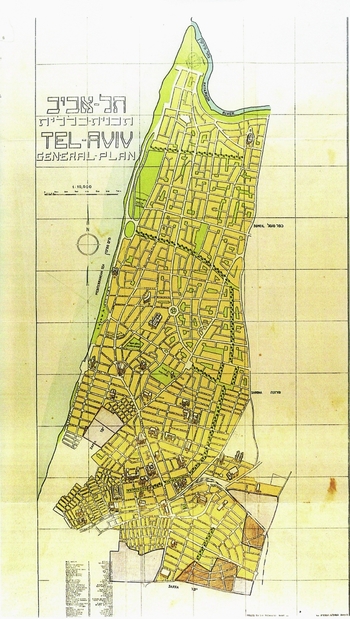
Tel Aviv plan, 1926 Source: Tel Aviv–Yafo Municipal Historical Archives

Tel Aviv town-planning scheme 1927 (1938 amendment) Source: Tel Aviv–Yafo Municipal Historical Archives

Planning report – Jaffa and Tel Aviv
Geddes’ original plan for the city (which unfortunately has gone missing) was accompanied by a detailed report, ‘Planning report – Tel Aviv – Jaffa’.Footnote 28 The report attests to a very practical, detailed and applicable plan. In this sense, the Tel Aviv commission, which was in fact also Geddes’ swan song, was one of his most successful projects, having been accepted and mostly implemented, and it bears witness to Geddes’ intimate knowledge and understanding of the area. Nevertheless, the report also clearly manifests Geddes’ complex and foreign urban paradigm, and, in that sense, it is very similar to many of his earlier reports, all of which were based on a Western worldview and reflect overt imperial ideas, as will be described below.
In the historical and cultural scheme within which Geddes operated, the ancient Hebrew civilization had a special and an important place. According to this cultural interpretation, the biblical people of Israel formed the earliest stage of the Western civilization, and had traits which Geddes wished to revive, such as spiritual leadership and a rich educational heritage. Geddes admired the Zionist revival in Palestine, seeing in it an ultimate manifestation of local restoration. He pictured the Zionist homecoming as the reinstatement of a biblical entity in the Holy Land and foresaw the role of the ancient Hebrew culture as a regional rallying point amongst its neighbouring countries.Footnote 29 This notion was well expressed in the report: ‘Clearly realized then, is not once more the high function of a renewing Zionism, to repeat her ancient message upon our modern spiral . . . and to recall the ancient conception of Unity throughout the whole Universe?’Footnote 30 The result in Tel Aviv was a plan which aimed at restoring the region of the Mediterranean basin to its biblical glory, rehabilitating the ancient regional and cultural order.
Thus, in spite of the official name of the report, and although Geddes himself describes his planning commission as ‘Greater Jaffa’, he never treated the two cities as one, and the Arab city of Jaffa itself is almost absent from the plan. As a result, Geddes also failed to respond adequately to planning challenges which were set before him, such as the renewal of Jaffa's port,Footnote 31 tending mainly to its practical connections with Tel Aviv.Footnote 32 Additionally, although Geddes had many useful insights regarding the existing city, his plan dealt only with the potential area for development, stretching from the already built city to the Yarkon river to its north.Footnote 33 The report was largely devoted to the development of Tel Aviv as a modern Jewish Garden City, based on the popular urban paradigm which Geddes repeatedly employed, and, presenting the best traits of the renewing city to serve as a global example for old-new development. The plan is thus based on an intricate layout of major roads and inner roads, showing a clear separation between commercial and residential areas, vehicles and pedestrians. The report describes desirable building types, accentuating low building densities and laying a vast system of gardens on neighbourhood as well as municipal levels.
Geddes’ vision for the new society was also a reflection of his Western notions of a civilized society on the eve of the twentieth century. These are reflected in the cultural institutes which he prescribes for the city in the final chapter of the reportFootnote 34 and which supply a glimpse into his unique view of modern society and its local revival. For example, Geddes believed that modern education was vital to improving the lot of women as mothers; and where in the world, asked Geddes, was there a better place for these new understandings than here, in Tel Aviv? ‘For here . . . is as yet the most homogenous of modern cities, united by common origins and sufferings, in common ideals, and towards common endeavour.’Footnote 35 The following is a passage worth quoting in length, for it gives a good idea of Geddes’ own views, which were far removed from those held by members of the local community:
Though the vast majority of women find their life-course and their educational career in the home, there is perhaps no social invention and advance more definite in the West than their increasing development of educational facilities, preceding their life-settlement in homes of their own . . . these first begin with domestic economy and Child-Care, matters nowadays becoming seen to demand definite scientific knowledge with even refinements of corresponding technical skill, both and physiological and psychological than the past had ever dreamed, and even than the vast majority of any modern community have yet adequately come to see . . . it is time to be realizing that it is the sex especially occupied with conducting this . . . it is full time for future mothers to be prepared anew towards understanding, protecting and guiding this, far more understandingly than hitherto.Footnote 36
Although Geddes found the modern garden suburb scheme the most suitable paradigm for renewing urban society, and while he wished to improve Jewish society along the lines of modern European thought, he also advocated the re-Orientalizing of Jews in their region. In this sense, ‘light to the nations’ as they might be, when it came to art in general and architecture in particular Geddes believed the Jews had much to learn from their surroundings; searching for a local tradition, Geddes turned to the city which Tel Aviv had ignored. For example, regarding architecture, he wrote:
The present magnificent recovery of classical Hebrew as the spoken language of the Jews in Palestine is of course a first step or re-Orientalization; but others are needed. Without recommending any more adoption of Arab Architecture, either in its simplest form in the hillside village . . . or still less desiring the ever elaborate magnificence of later developments of the Arabian style as in Cairo, it is important to realize that this [Arabic] architecture and decorative art, at her best, are second to none in the world.Footnote 37
For illustrations, Geddes refers to his plans for the Hebrew University of Jerusalem, which presented an Oriental image of the city and its inhabitants. Geddes further describes traditional local arts which he wanted to reintroduce in the city of Tel Aviv. These can be illustrated in his recommendations to renew various local, traditional crafts, which were mainly practised by local Arabs; one example is ‘the magnificent old oriental industry of Carpet Weaving’, as ‘the abundance of camels in this whole region also invites the question of how far their very valuable contribution to textile industry may be better obtained and utilized’.Footnote 38
In the aftermath of the plan
By the time Geddes’ plan was approved, the speed of planning needed to match the rapid development of the city. Private market activity led to growing gaps between land supply and demand, resulting in ascending land prices. Additionally, as the execution of the new town plan of Tel Aviv coincided with the new architectural ideas of the Modern Movement, the plan was considered restrictive by architects who criticized the individual building plots and the alignment of the buildings.Footnote 39 Thus, although the road layout which Geddes suggested was generally carried out, many of his other suggestions for the city were soon discarded.Footnote 40 Over the years, height limitations were loosened and floor area ratio changed. The population density indicated in the report was also over-ruled and the area intended for 100,000 inhabitants was soon to accommodate as many as 200,000.Footnote 41 In addition, the proposed interior gardens were often converted into more residential blocks and the municipality's financial shortage prevented it from any private land acquisitions needed for the realization of the vast public open spaces called for in the plan.Footnote 42 Finally, the 1938 amendment added a layer of uses which changed the original plan's principlesFootnote 43 and the Garden City envisaged by Geddes was transformed into a different city altogether.Footnote 44 The actual development patterns of housing in Tel Aviv ridiculed the spirit of the scheme and the changes in plot and building size constituted a crude violation of the spirit of the Geddes report, leaving ‘only the street layout in Tel Aviv as a witness to the ideals of the time and of the man presenting them’.Footnote 45 The more cultural aspects of the report were never even discussed.
Geddes, who had retired to France and died there in 1932, did not live to see the greater expansion of the city. Due to great waves of migration, the city grew from 54,000 inhabitants in 1931 to 100,000 in 1934. It had 160,000 inhabitants by 1940 and 195,000 in 1947.Footnote 46 In 1936, the municipal area of the city was 6.5 km2; 16 years later the city was 7.5 times bigger.Footnote 47 The constrained area which the Geddes plan had covered soon became engulfed by new developments, only one of which partially imitated Geddes’ road layout and as a matter of convenience only, bearing no more than a basic physical resemblance to it.Footnote 48 On a visit to Israel in 1952, Patrick Abercrombie noted: ‘Many criticisms have been leveled against Tel Aviv . . . the small Geddes Plan was an attempt for a limited area, but it had, even for that great prophet, far too limited a vision.’Footnote 49
A deteriorating city, a plan forgotten
By 1948, the year of the formation of the state of Israel, 248,000 inhabitants were living in Tel Aviv, almost half of the population of the new state.Footnote 50 The city was then ten times bigger than it was in Geddes’ time. By now, Tel Aviv incorporated many Jewish neighbourhoods built around it as well as Arab villages which had been deserted during the War of Independence. It also engulfed the original city from which it had originated almost 40 years earlier, now inhabited mainly by Jewish refugees, thus creating the greater ‘Tel Aviv – Jaffa’. Coupled with a great wave of migration, the city's population rose to 350,000 by 1952.Footnote 51 By now, ‘Geddes’ plan’ was to be the name of a small part of the new city's map, but it became marginal in more ways than one. Under the guidance of the new mayor and several city engineers who represented the modernist ethos in Tel Aviv, the city and its planning were going in totally different directions.Footnote 52
The extensive growth of the city was accompanied by great plans, based on a forecast of 600,000 inhabitants and a quick growth in economic activity. As in many other places across the world, plans were made on a large scale. They were also invested with great imperatives, such as the improvement of large urban areas, and characterized by mass housing, vast transportation networks and mass urban renewal. In addition, the plans advocated a greater separation of land uses.Footnote 53 These projects included the plan for a new Central Business District between Tel Aviv and Jaffa over the ruins of the Arab neighbourhood Manshiya, and major transportation plans, including the Ayalon highway routes and the central bus station.Footnote 54 Other plans included new neighbourhoods of modernist urban blocks intended for immigrants and war veterans, mainly in the recently vacated areas to the south-east of the city, as well as plans for upper-class residents further north, crossing the Yarkon river for the first time.Footnote 55 None of these plans, needless to say, related to Geddes’ plan.
The decline
The rapid growth of Tel Aviv stopped in the mid-1950s. There was no more room for territorial expansion, and land within the city was expensive.Footnote 56 Additionally, the national imperative, which demanded decentralization, strove to disseminate immigrants across the country rather than letting them concentrate in Tel Aviv and its dense metropolitan area. To this factor was added the contemporary trend of suburbanization, which brought many inhabitants from the centre of the Tel Aviv metropolitan area to seek better housing in the metropolitan peripheries, mainly from the 1970s onwards. For the first time in Tel Aviv's existence, the number of inhabitants was in decline.Footnote 57 From 1963 to 1988, Tel Aviv lost about one fifth of its population, going from 394,000 to 317,800 inhabitants in 25 years.Footnote 58
In spite of the new neighbourhoods and urban quarters developed since 1949, as well as the creation of a new university in 1965, Tel Aviv appeared as an aging city in a process of deterioration, stagnation and decay.Footnote 59 This picture of urban twilight was most relevant to the historic city, where flats were turned into offices and the younger population was leaving. At some point, as many as 20 per cent of the flats in the inner city were empty.Footnote 60 The great plans were stopped. Aside from a growing polarization between more established northern neighbourhoods and impoverished ones in the south, the city also suffered from inadequate infrastructure, mainly regarding transportation and parking.Footnote 61 By the 1970s, Tel Aviv was a dirty and tired middle-sized town, described by one of its poets as ‘a city of no concept’ and ‘an unexciting, desperate hovel’.Footnote 62
Where is Geddes?
The end of the stage of ‘The First Hebrew City’ in the cultural history of Tel Aviv was a gradual process.Footnote 63 The destruction, in 1959, of the Gymnasium building, one of the earliest buildings in Ahuzat Bayit and a symbol of its modern Jewish identity, and its substitution by a commercial high rise, symbolized the priorities of the new era, in which historical consciousness gave way to a more modernist outlook.Footnote 64 The deterioration of the urban fabric as well as the declining importance of the urban legacy also accounted for the decline in interest in Geddes and his plan. The development of the city, in any direction, took almost nothing from its earlier development.
The anniversaries of Tel Aviv marking 25 and 50 years to the city's establishment were greatly celebrated and written about; however, no mention was made of Geddes. Moreover, a book describing the work of Dizengoff, the city's successful first mayor, published in 1936 did not mention Geddes at all, although it was Dizengoff who initially brought him to the city.Footnote 65 A unique mention in 1959 by Nathan Dunevitz, a local journalist, supplies a sarcastic account of both Geddes’ plan and its aftermath:
The building of north Tel Aviv was somewhat affected by the plan of the known urban planner Sir Patrick Geddes. Dizengoff invited him in 1925 to come and plan the north part of the city . . . it was a bright thing to do, but old Sir Patrick was apparently affected by the original plans of Ahuzat Bayit and of the dreams of the city elders, who still hoped to see in Tel Aviv a Garden City, and prepared the plan for which today every driver curses the streets Ben Yehuda and Dizengoff. You want a Garden City? There you are. With lots of greenery. Let there be two main roads from South to North, 18 meters wide, the rest be small and narrow. And each of these roads will end with a dead end in the shape of a tennis court. No other game seemed to suit Sir Patrick.
What did the city heads and their clerks at the Technical department do? Mocked Geddes for his Gardens plan, but [they were] greatly affected by the plan and the road layout. Thus was created the city which started with neighbourhoods glued on to one another, with no general plan and no traffic routes; and its second part a large quarter built after the distortion of a none suitable plan. . . ever since then, the municipality brings on urban planners and traffic experts to fix the distorted plan, but it is too late.Footnote 66
Reinventing Tel Aviv, re-locating Geddes
The state of Tel Aviv during the 1970s brought forth two almost simultaneous processes, which complemented but also competed with one another. One was the eventual transformation of Tel Aviv's image into ‘a city which doesn't stop’. This was a process accompanied by rehabilitation on various scales. The other was a wave of nostalgia and a search for the past which was disappearing fast in the face of the swift rate of building in the city. Geddes and his plan had a crucial role to play in both movements. His role was well reflected in an abundance of writings about Geddes in local geography and history but also on an international plane.Footnote 67 At this time, the original area planned by Geddes, which by now constituted only about 7.5 per cent of the city's overall area,Footnote 68 was held accountable for the overall apparent or desired success of the city, its newly discovered history and its hopes for the future. The plan's merits were extended to the city at large, and moreover, it was from that small square in the city map that all lessons had to be learned for the future of the great city of Tel Aviv – Jaffa.
Geddes’ plan, 7.5 per cent of the overall area of Tel Aviv Source: Tel Aviv–Yafo Municipality www.tel-aviv.gov.il (last accessed 15 Mar. 2010).

Reinventing Tel Aviv: a city which doesn't stop
In 1989, the year in which Tel Aviv celebrated its 80th anniversary, a campaign was started to advertise it as ‘a city which doesn't stop’, giving it the image of a living city, active both in the day and the night. A new urban vision was thus created of a reviving city, attracting a young population and developing a new urban lifestyle.Footnote 69 Turning Tel Aviv from the ‘First Hebrew City’ into ‘a city which doesn't stop’, claims Azaryahu, meant tying together the pioneers on the dunes with the city's modern nightlife in a celebration of the ultimate victory of the Zionist vision, while also marking a change in its history. Moreover, it meant to show that the passing depressed stage in the life of the city was really only a stage, soon to be forgotten.Footnote 70 Tel Aviv was again the successful secular city of no bounding history or burdening heritage. Moreover, its mythological fabric of urban squares proved a crucial element of the city's new-found civic identity.Footnote 71
As the city began to undergo this transformation, Geddes’ plan was dusted off, reinterpreted, almost reinvented. In fact, it was seen to hold the key to many of the new ideas about the city. The reinterpretation of Geddes saw him as icon of Israeli planning and Zionist history. He was perceived as a planner who sensitively served the local, traditional community, having studied its history and traced its social, political, economic and overall cultural entity. Thus, according to the newly prevailing reading of Geddes’ writing, he had complied with the Zionist project by planning according to the needs of his Jewish employers. By apprehending the landscape, Geddes offered ‘clues to the returning Zionists on how to resettle their homeland and to return to the essence of their culture’.Footnote 72
Planning according to Geddes
Geddes’ planning ideas were found to be quite useful in the current planning of Tel Aviv as his plan allegedly matched the current planning notions of the time, according to the Tel Aviv municipal engineer.Footnote 73 Thus, Geddes’ plan was commended for its comprehensive approach, its attention to private and public open spaces and the high priorities it gave to environmental issues, such as the provision of a low level of vehicles. The pedestrian-scaled city, together with an appropriate mixture of land uses, supported an active civic life and promoted a great sense of community, both of which were found to be crucial to the city's identity.Footnote 74 In fact, for its ‘level of pedestrian friendliness, spatial integrity, functional variety, and neighbourhood feel’, the plan offered an early prototype of contemporary urban notions which even ‘advocates of the “New Urbanism” could applaud’.Footnote 75
All of these issues related to Geddes’ plan were now being incorporated within new plans ranging in scale from the rehabilitation of the Tel Aviv urban core to a master plan for the Tel Aviv metropolitan area. Geddes was finally getting his due. Two major additions to the city were designed according to Geddes’ original suggestions, including new residential areas to its north and highway routes.Footnote 76 Even today, the strategic planning process which started in 2000 is carried out under the slogan of ‘Public Participation in Planning’, reflecting once again the idea that Geddes’ sensitive approach should be imitated in order to ensure the city's success.Footnote 77
However, in more than one case, Geddes’ newly amalgamated vision had to be corrected, updated or altogether revised, as current needs were, after all, different from what he had allegedly suggested. For example, the transformation of slum areas into attractive cultural zones contradicted the initial Geddesian conception in which the central areas were planned as quiet residential zones.Footnote 78 In other older neighbourhoods of the city, measures were taken to constrain the growing Central Business District by building new office towers and giving more building rights to existing buildings, again contradicting Geddes’ notion of low density.Footnote 79 Matters of infrastructure were also debated. Urban transportation in Geddes’ plan was claimed to be inefficient, and was given as one of the prime reasons for the deterioration of the urban core. The current lack of municipal gardens was attributed to the fact that they were insufficient in the original Geddes’ plan to begin with.Footnote 80 Geddes’ plan was also charged with one of Tel Aviv's greatest deficiencies: it was claimed that Geddes had failed to see the full potential of the sea as a generator of urban activity.Footnote 81 Finally, and most importantly, the actual development of the city went in a totally different direction, as much greater building densities were now favoured fostering, amongst the rest, an abundance of skyscrapers; the exact opposite of what Geddes had envisioned for Tel Aviv.
Nostalgia for old Tel Aviv and its vicinity
The rapid changes which took place in Tel Aviv since the end of the 1970s, and more so since the 1990s, brought forth great concern for its built landscape, as the lament for the stagnation and decay of the city changed almost overnight to criticism of its uncontrolled, even destructive, development.Footnote 82 The destruction of the Gymnasium building in 1959, by now considered a great loss, symbolized the danger posed to the city's history and the need for a local heritage. The lack of historic depth stood in the way of the amalgamation of urban identity, a local drawback which led to feelings of rootless temporality and lack of spirituality. The attempt to give the city some history created the idea of a place with a history of its own, a symbolic stance based on its own merits.Footnote 83
The need for historical urban anchors which would give the city a dimension of stability and depth was manifested in a growing nostalgia for buildings and institutes which had disappeared from the landscape, as well as old trees and open spaces which once comprised important elements in the cityscape.Footnote 84 Thus, the city's 80th birthday celebrations also sparked a search for ‘Small Tel Aviv’ as it was nostalgically termed, as the first Hebrew city was reclaimed and reinvented as an idyllic location. Additionally, new sites which had not before been considered part of the city or its heritage were being acknowledged and researched. These included Jaffa and adjacent Jewish neighbourhoods which were for the first time being woven into its heritage, their own history annexed to that of Tel Aviv.Footnote 85
While totally forgotten at earlier periods in the city's history, in the current era, Geddes and his plan were retrieved and studied for their contribution. Geddes was immediately recognized as the planner of the former Tel Aviv now so cherished and marked for preservation. The idea of the Garden City which was never fully accomplished became the subject of collective idealization and nostalgia. ‘Geddes’ City’ along with other urban elements – not necessarily related – came to represent the city as many would have liked it to be.Footnote 86
Geddes and the White City
The Council for the Preservation of Buildings and Sites became operational in 1984. In 1991, a special municipal committee in Tel Aviv composed a list of 400 buildings intended for conservation, mainly at the heart of the city.Footnote 87 Some streets were renovated altogether as a new attitude developed towards planning complete urban fabrics rather than single buildings.Footnote 88 The newly discovered appeal of the city and its unique merits culminated two decades later, with the official recognition and declaration of UNESCO of the older parts of the city as a World Heritage Site in July 2003. The site chosen was the northern part of the urban core, consisting of the original Geddes’ plan area and the area built immediately to its east. This area, now termed ‘The White City’, was found to contain a unique ensemble of over 4,000 houses (out of which 127 were listed) built mostly in the 1930s and onwards in a new functionalist style by architects who studied in the established Bauhaus school and practised mainly in the newly developing city. Considered the largest urban concentration of the Early International Style, the city was described as an experimental arena for the basic principles of modern architecture.Footnote 89 The chosen image described the physical appearance of the celebrated buildings and the overall urban effect, and also enhanced the parallel notion of a newly born city, rising from the white and empty sands.Footnote 90
From the start, a connection was made between the White City and Geddes’ plan, and these became inseparable terms in describing the celebrated city. It was claimed that Geddes represented both Zionist idealism and the neutral targets of the Modern Movement, since both were aimed at creating a better world for a new egalitarian society. The result was to be simplicity and minimalism in materials, cheap and quick housing solutions for the new society and, ultimately, a new social order. Similarly, Geddes embodied the urban affinity between the Garden City Movement and the Modern Movement manifested through Zionism. His plan was to be a unique combination of modern urban planning and modern architecture.Footnote 91 However, the connection formed between the plan and the architectural style was mainly a matter of timing, and necessitated the overlooking of discrepancies between Geddes’ stated goals and those of the builders. Ultimately, it was these modern architects who found Geddes’ plan restrictive and eventually created an urbanscape different from what he had envisioned.
The fact that Geddes was a profound advocate of local architecture is well acknowledged in the UNESCO report mentioned above, as is the fact that he ‘ignored the Modern Movement and its influences at that time . . . He related to the place as having a settlement culture thousands of years old’, but this was possibly not enough, as ‘lack of reference in Geddes’ report to an architectural code or any other system made all options possible’.Footnote 92 Along these lines, the report also made an easy comparison between Geddes’ work in Palestine and Le Corbusier's work in Chandigarh, almost 30 years later: ‘Both planners foresaw the block as a means of developing social life.’Footnote 93 This notion was echoed by writers around the world who displayed a sudden interest in Geddes and his work in Tel Aviv, and who agreed that Geddes, who was already dead by the time these building were being built, set the scene for architects inspired by the formal language and examples of Le Corbusier, Mies van der Rohe and Walter Gropius. Tel Aviv was thus described as a city of opposites, a transitional environment located between the overpopulated European cities and rural Palestine.Footnote 94 As a city planned ‘while Le Corbusier was working on the Plan Voisin for Paris’,Footnote 95 the international style apparently ‘could hardly have found a better place to develop’.Footnote 96
Actual references to Geddes’ plan in the declaration were limited to listing those elements which related to its architectural materialization or to the quality of life they assured, and closely resembled the traits of the plan which were celebrated elsewhere.Footnote 97 In fact, most of the sections in the report which relate to Geddes do not discuss actual architecture but rather repeat the already established traits of his plan, counting its contributions to quality of life in the great city and its active social life, and reflecting the general idea of living in the city in the twenty-first century.Footnote 98 As the White City came to represent the built quality of Tel Aviv, the limited area planned by Geddes became the symbol of the city as a whole. Nevertheless, since the declaration related mainly to the area planned by Geddes it totally ignored other buildings built in the same style all across Tel Aviv, including Jaffa.Footnote 99
Conclusions
Although Tel Aviv is a young city, uniquely conceived, many of the urban processes it underwent resemble cities worldwide. Thus, the fact that the modern city flourished between the two world wars did not protect it from later brutal comprehensive planning, and, later, the deterioration of its urban core and the neglect of its urban heritage. The present urban regeneration is also a familiar global process. All of this is reflected in Geddes’ image at each and every period, correlating as well with the myth of Tel Aviv.
As Tel Aviv's first planner, Geddes was regarded as a representative of the modern discipline and its modern imperatives. However, while Geddes, like his local employers, viewed the Garden City street layout as the physical key to a modern city, his more conceptual notions regarding the renewal of society, either stemming from his Victorian outlook or Orientalist orientations, were totally unacceptable and were soon overlooked. The plan itself did not suit the growing needs of the city and was dramatically changed over the years. With the rise of modernist building and planning, Geddes and his traditional urban ideals were pushed aside. When discussed, Geddes’ plan was blamed for many of the city's shortcomings. Ironically, when the city's cherished heritage was finally brought forth, Geddes’ planned area was reinterpreted as the perfect manifestation of Zionism and was easily linked with both the city's unique humble roots and its global aspirations. Having become a symbol of the city, Geddes was given credit for almost anything considered good about it.
Thus, Geddes’ plan is often used as a beacon, enhancing communal and national identity, legitimating Tel Aviv as a pioneering Zionist endeavour but also as a leading global enterprise. It supplies a sense of tradition and familiarity to a city of very little recent history. The plan offers guidance by setting a good example for future planning and ensures the stability of the glorified present by suggesting the inevitable alternative; ‘if only we had done what Geddes had suggested’ being a common refrain. Nevertheless, while Geddes and his plan have contributed significantly to the development of Tel Aviv, their availability as part of its past has far more to contribute to its present image and future aspirations.
Lately, new studies in the history of Tel Aviv reveal different themes and ideas in the city's celebrated past. The idea of the White City is contrasted with the inevitable Black City which surrounds it, a notion which has far-reaching colonial imperatives and many local implications. Cherished sites are being examined, their role in the overall urban narrative questioned and new sites which have been left out of the narrative altogether are discussed for the first time.Footnote 100 Still, many sites and neighbourhoods in Tel Aviv are left out of its official story, and many notions are yet to be explored in order to provide a more balanced and inclusive urban narrative. Similarly, Geddes’ plan for the city still awaits true and bold interpretation.Footnote 101 As Geddes’ merits today resemble too closely contemporary planning idioms, certain elements in it – such as the absence of Jaffa, the Arab city – are embraced, while others, which have never suited the city in the first place, are still overlooked.
This article shows how planning perceptions, crafted in the present, are not only used to plan our future, but are also used to shape the way we read our past. By revealing the way reading Geddes’ plan today above all reflects planning in Israel in general and in Tel Aviv in particular, Geddes’ plan is shown to be mostly what we make of it today; planning history is found, once again, to reveal more about the reader than about its actual past.Footnote 102 Using Geddes and his plan as the ultimate past of the city is mainly done for the sake of self-justification, adoration and validation of the present city as we comprehend it and its future planning; the way we read Geddes today reveals most of all our own inherent view of the city and the way we would like it to be.