Introduction
A safe environment is a prerequisite for meaningful recovery for acutely hospitalized psychiatric patients, yet violence is endemic in acute psychiatric units. Threats and acts of violence jeopardize recovery and degrade the safety and effectiveness of acute psychiatric treatment programs; preventing violence is a clinical and administrative imperative.
Much of the literature has focused on development of assessment tools that accurately and reliably predict near-term violence with the hope that timely interventions may prevent violent incidents. Although most validated risk assessment instruments forecast only the long-term likelihood of future violence, structured assessments that weight current clinical factors heavily have been shown to be more successful in the prediction of violence in the short-term.
Currently the most efficacious efforts to prevent violence by psychiatric inpatients are a range of behavioral, psycho-pharmaceutical, and environmental interventions. Individualized, skillful behavioral management and de-escalation may serve to defuse dangerous situations, even when agitation is already overt. Judicious use of nonscheduled medications and proper psycho-pharmaceutical regimens often calms agitation dramatically and, thereby, forestalls violence. Further, the architectural design of a psychiatric unit can affect base rates of violence.
Methods
We conducted PubMed searches utilizing the following Medical Subject Headings (MeSH): violence, aggression, psychiatry, inpatient, hospital, community, and agitation. We identified 120 articles, and each article was reviewed to identify the most clinically relevant information. The authors utilized their discretion and best clinical judgment to determine topics in the field that are relevant to inpatient community psychiatry settings. This is not intended to be an all-inclusive review. The choice of articles and topics reflect the authors’ qualitative assessment of current themes that are of the greatest clinical value to clinicians and administrators who are actively delivering care.
Discussion
Incidence of violence and aggression
Violence by patients is a common problem on acute inpatient community psychiatric units worldwide.Reference Carr, Lewin and Sly 1 , Reference Dack, Ross, Papadopoulos, Stewart and Bowers 2 However, available data are unreliable as to the incidence of violence and aggression in psychiatric settings, especially in community hospitals. Systematic reviews have found that the prevalence of violence varies significantly from study to study and institution to institution.Reference Davis 3 This variance has been attributed to many factors, such as the great variety in incident reporting practices, a lack of clear definitions as to what constitutes violence and aggression, and lack of standard measurement instruments.Reference Irwin 4 , Reference Bowers, Stewart and Papadopoulos 5 Of particular concern, evidence suggests that violent incidents are underreported.Reference Khoshknab, Tamizi, Ghazanfari and Mehrabani 6 Figure 1 lists some of the factors that may result in failure by staff to report a violent incident.
Possible spheres of influence that may contribute to an individual’s decision to refrain from reporting a violent incident. Self Valuation: Individual deems his or her safety as lacking value. Interpersonal Dynamics: Individual’s decision to refrain from reporting the violent act is influenced by the relationship he or she has with the assailant. Organizational Culture: An individual does not report a violent incident because of group staff pressures to normalize the incident or view it as “part of the job.” Larger Cultural Values: An individual refrains from reporting violence because of religious or moral convictions from the larger culture.

Notwithstanding these caveats, the available data demonstrate that inpatient violence is common. In a large-scale meta-analysis, Bowers et al Reference Bowers, Stewart and Papadopoulos 5 found that the overall mean incidence of violence across 7 different measurements (eg, violent patients per month/admissions per month*100, violent patients/total patient bed days*100, etc) was 32.4% across different psychiatric inpatient settings in multiple countries. Forensic settings have substantially higher rates of violence (47.7%) than acute psychiatric wards (22.1%) or general psychiatric wards (26.2%). The highest rates of patient violence were found in the United States (31.92%), United Kingdom (41.73%), and Sweden (42.90%).Reference Bowers, Stewart and Papadopoulos 5 A study of 11 psychiatric inpatient units in Australia showed that a reportable violent incident occurred in 11–15% of all admissions in community psychiatric settings.Reference Carr, Lewin and Sly 1 Another study conducted in the US found similar results.Reference Kay, Wolkenfeld and Murrill 7 A minority of patients is disproportionately responsible for multiple episodes of violence: Approximately 45% of violent patients were involved in more than one incident, with each violent patient, on average, being responsible for 4 incidents.Reference Bowers, Stewart and Papadopoulos 5
Consequences of violence
Appreciating the impact of violence is problematic because its effects are wide ranging. Aggressive patients threaten the physical and mental well-being of other patients and of the staff. Violence has the potential to affect the therapeutic milieu in profound, negative ways, traumatizing and demoralizing all involved. A Danish study found that over 90% of staff working in psychiatric hospitals have been victims of some form of violence by patients during their careers.Reference Benjaminsen and Kjaerbo 8 Psychiatric nurses are disproportionately victimized and suffer the highest incidence of violence in inpatient community psychiatric settings,Reference Foster, Bowers and Nijman 9 resulting in physical, mental, and emotional distress.Reference Flannery, Anderson, Marks and Uzoma 10
Risk factors contributing to violence and aggression
Factors related to increased violence risk are of great interest to clinicians. An understanding of these factors informs effective risk management and enables clinical staff to select appropriate interventions. Literature focused on patient-related factors contributing to violence, such as history, symptoms, behaviors, and psychopathology, is abundant. Bowers et al emphasize that patient-related factors cannot be taken out of context, and interpersonal variables, such as patient–patient and patient–staff interaction, may play an even more important role.Reference Bowers, Stewart and Papadopoulos 5 Staff-related factors and environmental issues within units are also crucial.Reference Bowers, Stewart and Papadopoulos 5
Patient-related factors
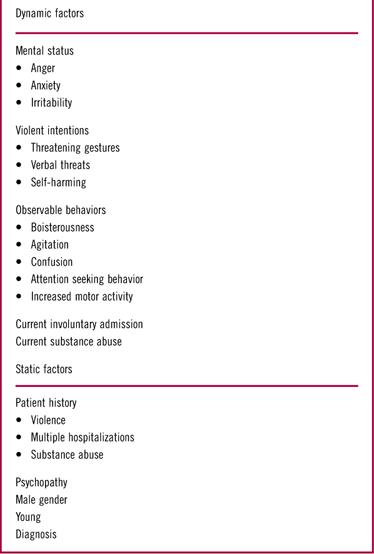
A host of risk factors specific to the patient have been found to bear on the likelihood of future violence. These patient-related variables can be categorized into 2 major groups: (1) dynamic factors, such as acute clinical presentation, and (2) static factors, such as patient history, demographic features, and enduring character traits.
Clinical experiences inform us that acute clinical presentations are more likely to respond to clinical interventions than well-established static factors. McNiel et al found that the strongest predictive relationships for aggression in the acute setting were obtained from clinical risk factors rather than historical risk factors.Reference McNiel and Binder 12 , Reference McNiel, Binder and Greenfield 13
Studies show that most inpatient violent outbursts do not arise abruptly, but occur after a period of escalating agitation or other change in behavior.Reference Bowers, Stewart and Papadopoulos 5 Psychomotor agitation is an established short-term risk factor for physical aggression. Acute behavioral cues often observed prior to violent incidents include boisterousness, irritability, confusion, attention-seeking behavior, and increased motor activity.Reference Bowers, Stewart and Papadopoulos 5 , Reference Woods and Almvik 14 – Reference Abderhalden, Needham and Miserez 16 Threatening behaviors are often reported prior to aggressive acts; such behaviors include posturing, throwing objects, attacking or destroying property, self-harming behaviors, and direct verbal and physical threats,Reference Quanbeck, McDermott, Lam, Eisenstark, Sokolov and Scott 17 among others.Reference Powell, Caan and Crowe 18 Some reports have identified changes in mental states including angerReference Crowner, Peric, Stepcic and Lee 19 and anxiety (75% of reported cases)Reference Sheridan, Henrion, Robinson and Baxter 20 as antecedents to violent incidents. Triggers for violence may be highly individual, but stressors commonly associated with violence include being forced to take medications and involuntary hospitalization itself.Reference Foster, Bowers and Nijman 9 , Reference Ketelsen, Zechert, Driessen and Schulz 21
Static variables, including history, age, gender, and diagnosis, are well-established predictors of violence over the long term.Reference McNiel, Gregory, Lam, Binder and Sullivan 22 , Reference Harris and Rice 23 History of previous violence remains a vigorous static predictor of future aggression throughout most literature.Reference Steinert 24 However, other static variables, such as sex, age, and alcohol abuse, seem to play a lesser role in acute inpatient settings, while current clinical presentation, illicit substance use, and psychopathological variables may be more significant contributors in the short term.Reference Steinert 24 Some studies have concluded that patients with diagnoses of schizophrenia, bipolar disorder, and mental retardation are more likely to engage in violent acts in the hospital setting than are patients with other diagnoses.Reference Davis 3 , Reference McNiel and Binder 12
Other static factors associated with increased risk include a history of substance abuse,Reference Cornaggia, Beghi, Pavone and Barale 25 – Reference Fountoulakis, Leucht and Kaprinis 27 brain injury,Reference McKinlay, Brooks, Bond, Martinage and Marshall 28 and antisocial and other personality disorders.Reference McNiel, Gregory, Lam, Binder and Sullivan 22 , Reference Fountoulakis, Leucht and Kaprinis 27 , Reference Hare 29 Many of these patient-related factors are summarized in Table 1.
Patient-related factors contributing to violence and aggression in inpatient settings

Staff-related factors
Psychiatric nurses, and staff in general, play a highly meaningful role in shaping patient experience and the social environment on the ward, interpersonally and on a group dynamic level.Reference Kanerva, Lammintakanen and Kivinen 30 , Reference Pulsford, Crumpton, Baker, Wilkins, Wright and Duxbury 31 Staff who are psychologically astute and who are engaged with and empathetically responsive to patients can provide a powerful stabilizing influence on patients in crisis and a milieu vulnerable to chaos. Conversely, staff who communicate negative or punitive attitudes to patients may contribute to patients’ frustration or rage.Reference Duxbury and Whittington 32
Bowers et al found that staff–patient interactions precipitate an estimated 40% of aggressive and violent incidents.Reference Bowers, Stewart and Papadopoulos 5 Staff interventions that may lead to patient violence include limiting patients’ freedom,Reference Bowers, Stewart and Papadopoulos 5 , 33 , Reference Flannery, Corrigan, Hanson and Walker 34 administering or discussing medications,Reference Powell, Caan and Crowe 18 , Reference Duxbury and Whittington 32 , Reference Flannery, Corrigan, Hanson and Walker 34 and placing patients in seclusion or restraints.Reference Quanbeck, McDermott, Lam, Eisenstark, Sokolov and Scott 17 , Reference Powell, Caan and Crowe 18 , Reference Cooper and Mendonca 35 Attempts at de-escalating an already agitated patient were also found to precipitate violet outbursts.Reference Rasmussen and Levander 36 Engaging in a power struggle has been shown to decrease therapeutic communication and trigger violence.Reference Duxbury and Whittington 32 , 33
Of particular concern, recurrent violence on inpatient units may lead to poor job satisfaction and frank psychopathology in staff. In turn, this may result in negative staff–patient interpersonal interactions and possibly poor patient outcomes.Reference Kanerva, Lammintakanen and Kivinen 30 , Reference Pulsford, Crumpton, Baker, Wilkins, Wright and Duxbury 31
Patient–patient factors
Interactions with and reactions toward other patients are often found to contribute to violent incidents. Patient–patient factors include physical contact and/or intrusion into one another’s “personal space,”Reference Longo and Bisconer 37 , Reference Bowers, Allan, Simpson, Jones, Van Der Merwe and Jeffery 38 competition,Reference Crowner, Peric, Stepcic and Lee 19 and retaliation.Reference Quanbeck, McDermott, Lam, Eisenstark, Sokolov and Scott 17 , 33
Environmental/unit-related factors
Environmental and unit-related factors have a major role in influencing the risk of violence. Units that are overcrowded,Reference Nijman and Rector 39 – Reference Virtanen, Vahtera and Batty 41 physically restrictive,Reference Barlow, Grenyer and Ilkiw-Lavalle 42 or inadequately staffedReference Hamrin, Iennaco and Olsen 43 experience higher rates of patient violence, as do those where patients experience either excessive sensory stimulationReference Flannery, Corrigan, Hanson and Walker 34 or lack of stimulation and/or boredom. 33 , Reference Hamrin, Iennaco and Olsen 43 A lack of psychological space, having little privacy, or not being able to spend time alone when needed may be important in triggering aggression.Reference Nijman and Rector 39
Violence on psychiatric inpatient units appears to fluctuate throughout the day, with the highest incidence of violence occurring during staff shift changes, particularly during the swing shift (3pm to 11pm). Medication times and meal times were also found to be associated with higher incidence of violence.Reference Bader, Evans and Welsh 44
Risk assessment
The ultimate goal of risk assessment is prevention of violence. The ability of clinical staff to recognize an increased likelihood of violence is crucial if interventions targeted at reducing that risk are to be deployed in time. Predictions aside, no two situations involving potential violence are ever identical; clinical skill and judgment will always inform risk assessment. Although unaided clinical judgment is notoriously inaccurate, it is more predictive than chance.Reference Mossman 45
Formal risk assessment tools offer the hope of predicting violence more accurately and with less dependence on individual clinical acumen. Most validated instruments are actuarial in nature, and as such they reliably predict life-long risk.Reference McNiel, Gregory, Lam, Binder and Sullivan 22 , Reference Harris and Rice 23 Actuarial models use statistically derived static risk factors, such as age, gender, psychopathological state, diagnosis, and many other factors. However, they do not provide the near-term predictions required for treatment planning and intervention on acute units, and generally do not lend themselves readily to clinical interventions. Tools such as the Violence Risk Appraisal Guide (VRAG), Sex Offender Risk Appraisal Guide (SORAG), and Static-99 are some examples.
More recently, instruments that combine actuarial calculations of probability of violence with clinical observations and professional expertise, frequently called structured clinical instruments, have been shown to increase the accuracy and consistency of risk assessment. Instruments of this type include the Violence Prediction Scheme (VPS) and the Historical, Clinical, Risk Management-20 (HCR-20).Reference Douglas, Ogloff, Nicholls and Grant 46 , Reference Wong and Gordon 47 A 2010 meta-review counted 126 instruments developed to assess risk in such structured forms.Reference Singh and Fazel 48
Actuarial and structured clinical instruments are, however, time consuming, require specific training to use, and require the collection of information that may not be readily available in an acute setting.Reference Steadman, Silver and Monahan 49 , Reference Allen 50 Further, most of these instruments have been developed to assess violence risk in forensic and community settings, not for use in community inpatient psychiatric hospitals, and, moreover, have been shown to perform less well in nonforensic settings.Reference Steinert 24 , Reference Palmstierna and Wistedt 51
Few instruments are available for acute settings. In community psychiatric hospitals, risk assessments must be performed quickly, and predictions must be accurate over the short-term.Reference Harris and Rice 23 , Reference Almvik, Woods and Rasmussen 52 Clinicians working in acute psychiatric settings may be under time pressure to make decisions, may lack advanced training, and may not have access to predictive historical information.Reference Elbogen, Tomkins, Pothuloori and Scalora 53 Often, logistical constraints make it difficult to obtain much needed information, some patients may be too ill to provide accurate information, or collateral may not be available.Reference Elbogen, Tomkins, Pothuloori and Scalora 53 , Reference Gardner, Lidz, Mulvey and Shaw 54
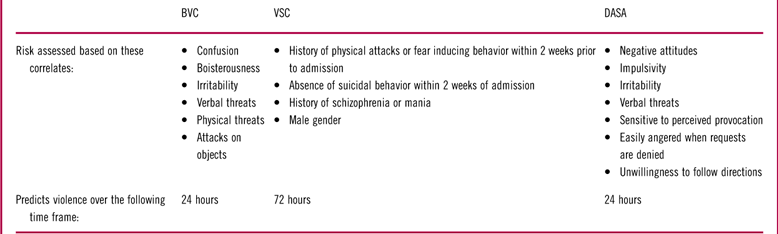
For these reasons, brief, simple screening tools based on immediate clinical features and readily available information prove to be more practically useful in acute hospital settings.Reference Abderhalden, Needham, Dassen, Halfens, Haug and Fischer 55 , Reference Ogloff and Daffern 56 Examples of these types of instruments (Table 2) include the Brøset Violence Checklist (BVC),Reference Woods and Almvik 14 , Reference Abderhalden, Needham and Miserez 16 , Reference Abderhalden, Needham, Dassen, Halfens, Haug and Fischer 55 , Reference Almvik and Woods 57 the McNiel–Binder Violence Screening Checklist (VSC),Reference McNiel, Binder and Greenfield 13 , Reference McNiel, Gregory, Lam, Binder and Sullivan 22 and the Dynamic Appraisal of Situation Aggression (DASA).Reference Ogloff and Daffern 56 These instruments show significantly better predictive accuracy than either structured clinical judgment or actuarial ratings in forecasting near-term violence.Reference Chu, Daffern and Ogloff 58
Short-term risk assessment tools
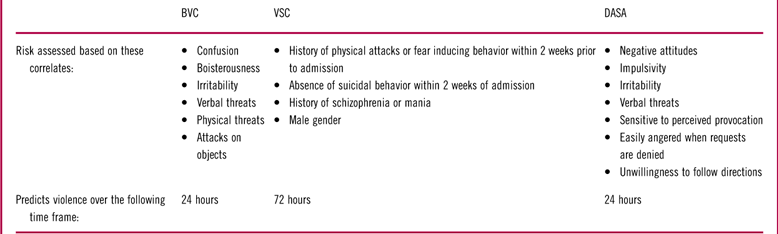
The Brøset Violence Checklist (BVC) assesses 6 patient clinical correlates of imminent patient violence: confusion, boisterousness, irritability, verbal and physical threats, and attacks on objects. Sensitivity and specificity results show that the BVC accurately predicts at a rate of 85% which patients will commit violence, and which will not, over the next 24 hours. The BVC was validated in a public-sector facility, relies on observed patient behaviors, and requires documentation during each shift. The McNiel–Binder Violence Screening Checklist (VSC) is based on likely available information upon presentation, and consists of 4 items: (1) history of physical attacks or fear-inducing behavior within 2 weeks prior to admission, (2) absence of suicidal behavior within 2 weeks of admission, (3) history of schizophrenia or mania, and (4) male gender. Developed in a university hospital setting, these factors have been found to correlate to inpatient aggression that occurs within 72 hours of admission. The Dynamic Appraisal of Situation Aggression (DASA) assesses short-term risk of aggression by patients in psychiatric hospitals, as well as other secure settings. It consists of 7 clinical items: negative attitudes, impulsivity, irritability, verbal threats, sensitive to perceived provocation, easily angered when requests are denied, and unwillingness to follow directions. DASA was shown to predict violence within 24 hours with 82% accuracy.
Interventions
Behavioral, psychopharmacologic, and environmental/unit-related interventions have established roles in minimizing the incidence of patient violence on acute inpatient units. Although the available data are limited, they do support a growing consensus on best practices for preventing violence.
Behavioral management
Staff who are skilled in recognizing behavioral cues are better equipped to preempt and minimize the likelihood of a violent incident occurring. Verbal de-escalation and/or medication administration performed properly have been shown to be effective at reducing rates of containment procedures.Reference Beck, White and Gage 59 These are important findings, as these methods are frequently used in response to violence and aggression. Staff therefore should receive routine, ongoing training in the use of verbal de-escalation techniques and other behavioral management approaches. The American Psychiatric Association (APA) Task Force on Psychiatric Emergency Services recommends yearly training in these methods.Reference Allen, Forster and Zealberg 60
The culture of an inpatient unit can be optimized for safety by improving the therapeutic relationship between staff and patients.Reference Hamrin, Iennaco and Olsen 43 Patients who feel staff are accessible, listen to and advocate for them, and strive to involve them in treatment planning may be less prone to engage in violence.
Psychopharmalogical interventions
When an acutely hospitalized patient is physically agitated or threatens harm to others, clinicians often attempt to prevent a violent event by administering psychotropic medication on an as-needed basis (prn). Nonscheduled medications are also given acutely after an act of aggression has occurred to reduce time spent in seclusion and/or restraints and to prevent further violence.
Routes of administration, from most to least invasive and fastest onset of action, are intravenous (onset of action 15–30 seconds), intramuscular (20–30 minutes), and oral (60 minutes). Aside from the longer onset of action, oral administration is always preferred. However, intramuscular administration must often be resorted to when an uncooperative patient is in seclusion and/or restraints in order to assure adherence and to expedite release. Intravenous medications are typically only given in medical emergency departments.
A number of parenteral antipsychotic agents are effective in the treatment of psychotic agitation and aggression. The first-generation antipsychotic haloperidol is available in parenteral forms and has been used for decades in community hospitals. An anticholinergic agent (diphenhydramine, benztropine, or trihexyphenidyl) should always be co-administered with haloperidol in order maximize effectiveness,Reference Huf, Coutinho and Adams 61 to reduce the need for additional medication intervention,Reference Raveendran, Tharyan, Alexander and Adams 62 and to prevent extrapyramidal side effects,Reference Powney, Adams and Jones 63 primarily dystonic reactions. Of the atypical antipsychotics, only olanzapine, ziprasidone, and aripiprazole have intramuscular formulations. They are at least as effective as haloperidol alone (without an anticholinergic agent) in controlling agitation, more effective at controlling aggression,Reference Baldaçara, Sanches, Cordeiro and Jackoswski 64 and carry a lower side effect burden.Reference Bosanac, Hollander and Castle 65 In a study comparing the effectiveness of olanzapine and aripiprazole for the treatment of agitation in acutely ill patents with schizophrenia over a 5-day period, both were equally effective, but olanzapine was significantly more likely to increase fasting glucose and triglycerides.Reference Kinon, Stauffer, Kollack-Walker, Chen and Sniadecki 66
Clinicians often use benzodiazepines alone or in combination with antipsychotics to control psychosis-induced aggression and agitation. However, a recent Cochrane Database Review found little research evidence to support this common practice.Reference Gillies, Sampson, Beck and Rathbone 67 Comparing benzodiazepines to placebo found little difference on most outcome measures; adding benzodiazepines to antipsychotics did not further reduce agitation and aggression 4 hours after administration, and the combination of haloperidol and midazolam actually increased aggression 12 hours after administration. In an experimental paradigm that was designed to test aggressive responding during a competitive game, male subjects given diazepam were more likely to select higher shock levels for their opponents than those given placebo.Reference Wallace and Taylor 68 Concerns have been raised regarding the safety of concurrent intramuscular administration of benzodiazepines with olanzapine due to the potential for excessive sedation, hypoxia, cardiorespiratory depression, and, in rare cases, death.Reference Wilson, MacDonald, Vilke and Feifel 69 Benzodiazepines may be best indicated for acute nonpsychotic agitation and aggression.
In 2012, the US Food and Drug Administration (FDA) approved loxitane inhalation powder (Adusave) for the treatment of agitation in persons with schizophrenia and bipolar disorder. Inhaled loxitane results in rapid absorption through the alveoli, and maximum loxitane concentrations are reached in 2 minutes with reduced agitation seen at 10 minutes after administration.Reference Keating 70 Loxitane is non-invasive and simple to administer, but it requires some cooperation from the patient and is not an alternative to intramuscular injection during a psychiatric emergency.Reference Citrome 71 Further, inhaled loxitane cannot be used in those with clinically significant pulmonary disease, and facilities administering this drug must be equipped to effectively treat bronchospasm in the event of this potentially serious adverse effect.Reference Currier and Walsh 72
Environmental/unit-related interventions
The architectural design of a psychiatric unit can affect base rates of violence. Environmental psychologists have identified features in the built environments of psychiatric units that are related to rates of violence. Psychiatric staff recognize that non-corridor designs, which provide good visibility, create safer environments.Reference Sheehan, Burton, Wood, Stride, Henderson and Wearn 73 Nursing stations that are enclosed do not protect staff from violence; no change in the prevalence of aggression is observed when enclosed nursing stations are converted into open stations.Reference Southard, Jarrell, Shattell, McCoy, Bartlett and Judge 74
Other design features that can reduce violence include single-patient rooms and personal bathrooms.Reference Ulrich, Zimring and Zhu 75 Private rooms give patients an opportunity to speak with caregivers without being disturbed and can be a place where they receive visits from family and friends. Psychiatric hospitals designed with sound-absorbing surfaces and that provide access to natural light and nature, such as in an outdoor garden, can help reduce the stress inherent in detention on a locked psychiatric ward.Reference Ulrich, Berry, Quan and Parish 76 From the patient perspective, an ideal psychiatric unit design would replicate a home-like environment that helps normalize their current situation, and allows the ability to move throughout a unit without excessive restriction.Reference Douglas and Douglas 77
Conclusion
An encouraging development in preventing inpatient psychiatric violence has been the validation of risk assessment tools that accurately predict violence over the short-term. For inpatient clinicians and program managers, the immediate challenge is to translate better recognition of risk into practical interventions that are focused on patients who have been identified as more likely to be violent. Violence prevention begins with a strong clinician–patient relationship to empower patients to gain recovery from mental illness. However, coupling improved risk assessment with behavioral and psychopharmacologic interventions that have established benefit offers the real hope of improved safety for patients and staff.
Inpatient violence is an extraordinarily complex problem. No risk assessment strategy is always accurate, and no clinical intervention is always effective. Although the total elimination of inpatient violence may be an unrealistic goal, addressing fundamental infrastructural weaknesses, including inadequate numbers and training of staff, and unsafe architecture, among other factors, may help to address the problem in the future.
Disclosures
Katalin Szabo, Stephen Cummings, Raziya Wang, and Cameron Quanbeck do not have anything to disclose. Christopher White has the following disclosure: American Psychiatric Association, APA Public Psychiatry Fellow, reimbursement for accommodation and travel costs.