INTRODUCTION
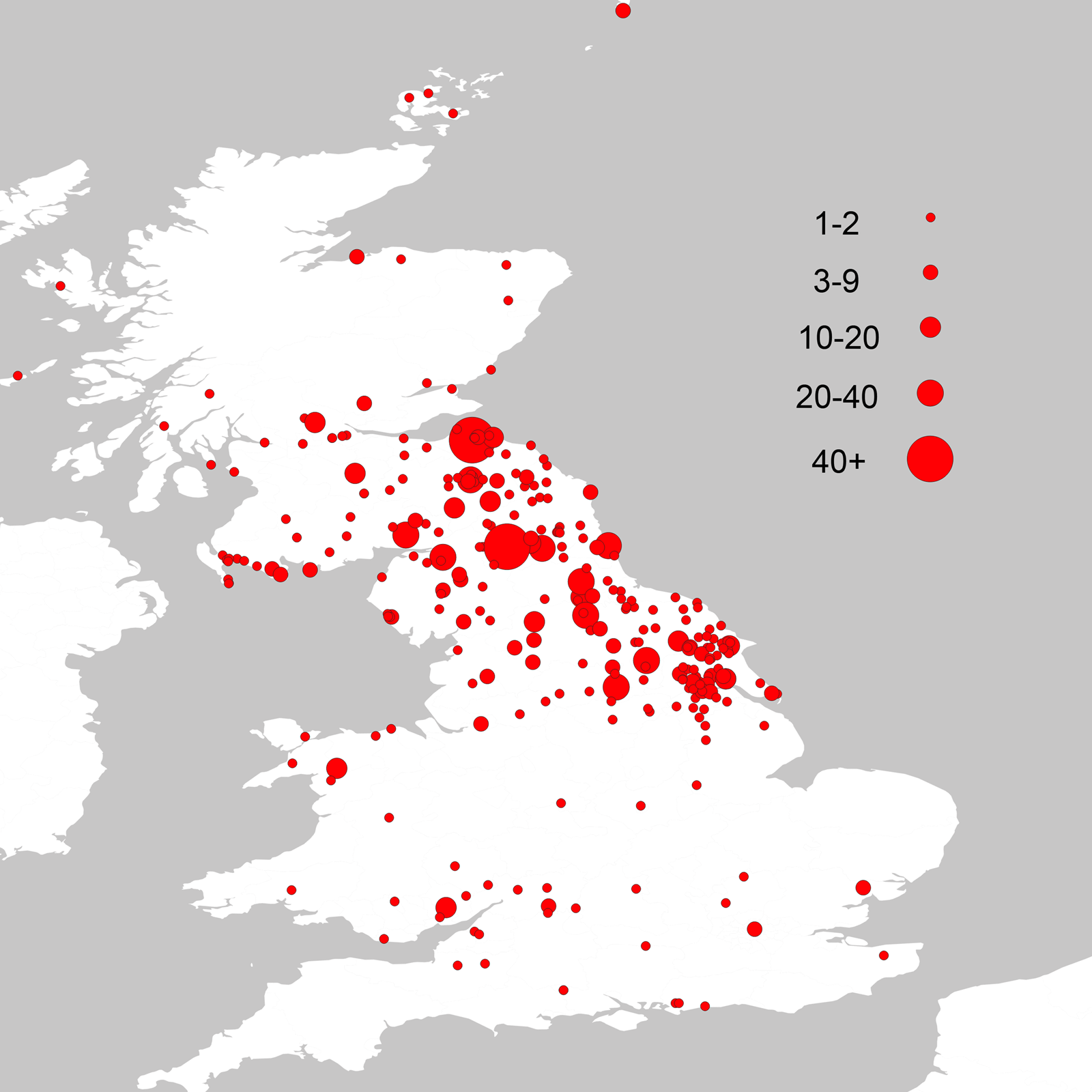
During the late Iron Age (LIA) and Roman period, north-western Europe exhibited a conspicuously high occurrence of glass bangles – seamless, annular-shaped adornments made of coloured glass. Starting in the late fifth century b.c. in the heart of central Europe's La Tène cultural area, the craft quickly spread further west and north-west into Gaul and the Lower Rhine region.Footnote 1 With the arrival of the Romans in north-western Europe in the early first century b.c., the circulation of glass bangles waned, though the craft reappeared on the periphery of the Roman Empire, in Roman Britain, where it peaked from the late first to mid-second centuries a.d. In Britain, glass bangles seem to have appeared first in the south, later spread further north and, for a period spanning two centuries, were distributed primarily in north-eastern England. They occur frequently on military, urban and rural sites in Yorkshire, on sites along Hadrian's Wall and are also prominent in south-eastern Scotland (fig. 1).
Distribution of glass bangles.

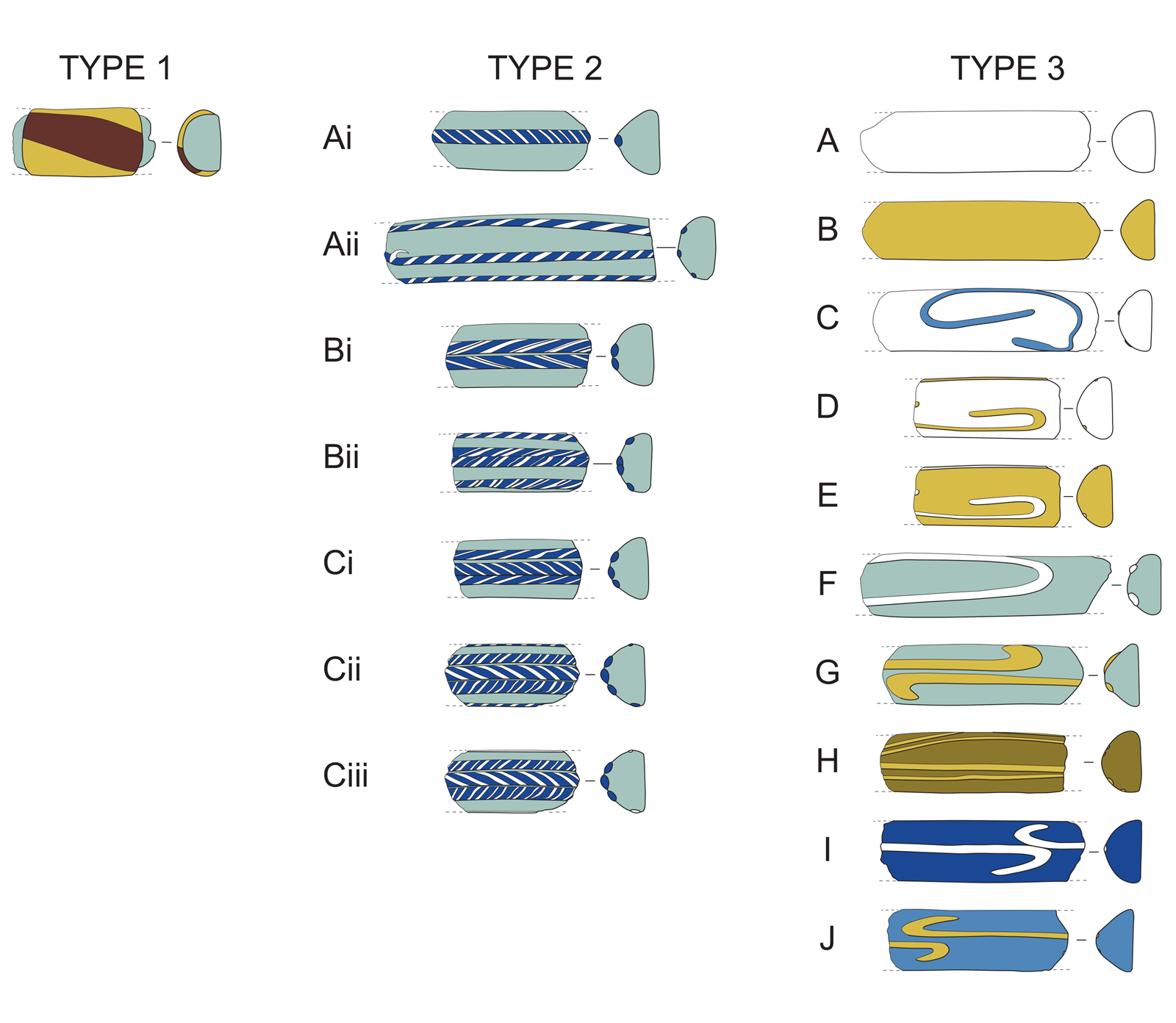
Romano-British glass bangles are usually divided into three types (fig. 2).Footnote 2 Type 1 is relatively heavy, with a core of translucent blue-green or milky-white glass covered by obliquely laid bands, usually of opaque yellow and red. The other two types are lighter in weight and either triangular or D-shaped in cross section. The major difference between types 2 and 3 lies in the base colour and decoration. Type 2 is usually made in translucent blue-green (natural) or ice-blue glass and decorated with one or more cords laid horizontally on the apex. The cords are made by twisting together glass rods of opaque white and cobalt blue, either clockwise or anticlockwise. Type 2 is subdivided into seven subtypes based on the number of cords and the patterns that they create.Footnote 3 Type 3 is made in various colours and does not have cords as decoration but trails with curved terminals, or so-called ‘pot-hooks’. It is divided into ten subtypes based on the dominant colour of the bangle's body and the colours of the decorations; whereas types 3A and 3B are undecorated opaque white and yellow, respectively, types 3C–J are decorated and display various colours ranging from intense cobalt blue to opaque yellow.
Typology of Romano-British glass bangles. (Drawing by Vicki Herring)

The aim of this article is to revisit the emergence of glass bangles in Britain, which has usually been characterised as a one-off event limited to the south of the island beginning with the Claudian invasion in a.d. 43.Footnote 4 Instead, this paper proposes that glass bangles should be conceived within the context of interregional relations with continental Europe and longer-term indigenous developments in objects of material culture associated with bodily adornment in southern Britain before a.d. 43. It also suggests that the emergence of bangles occurred during the late pre-Roman Iron Age (LPRIA). This proposition follows a framework unconstrained by the rigid chronology pivoting on the Claudian invasion of a.d. 43 that acknowledges various processes in the LPRIA-to-Roman transition within a wider scope of spatio-temporal settings.Footnote 5 By situating the genesis of bangles within the context of the development of material culture as well as societal and political changes in the LPRIA, this article aims to show that the emergence of bangles did not occur in a vacuum after the Roman invasion but was an integral part of globalising networks of cross-Channel trade and connections with the European mainland in the early first century a.d.Footnote 6 That glass and glass bangles were integral to developments in material culture in southern Britain before a.d. 43 has not been recognised previously.
THE EMERGENCE OF GLASS BANGLES IN BRITAIN: THE TRADITIONAL INTERPRETATION
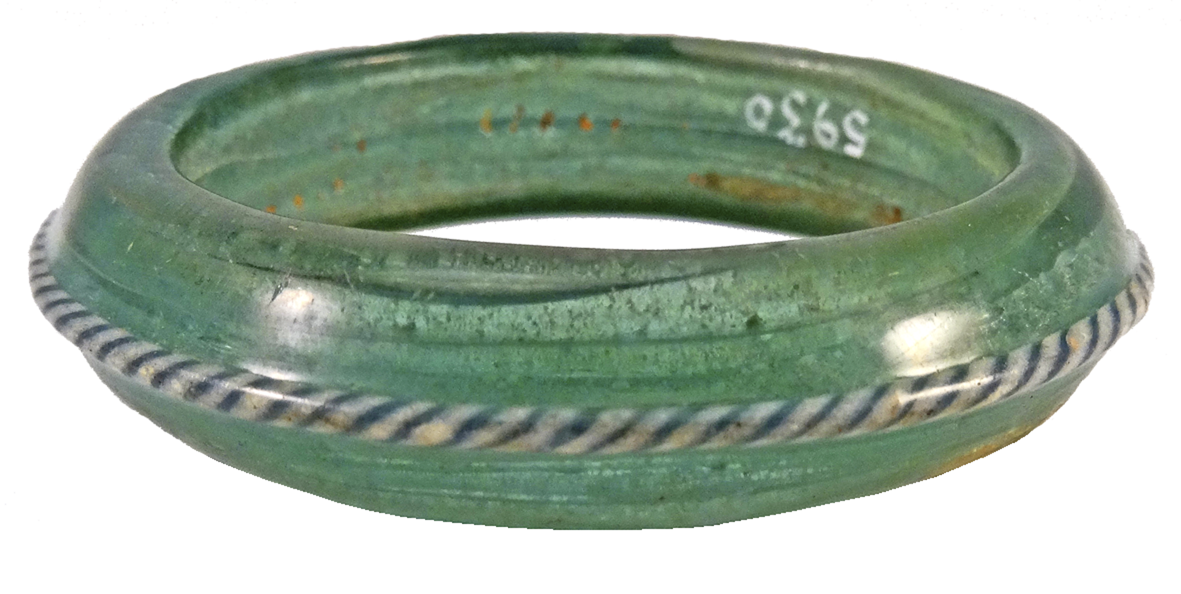
Jennifer Price first recognised that type 2 glass bangles were the earliest bangles produced in Britain (fig. 3).Footnote 7 She argued that these bangles were first developed in southern Britain in the late Claudio-Neronian period (a.d. 43–65/70) and that in subsequent periods the craft of bangle-making quickly spread further north with the advance of the Roman army.Footnote 8 In northern England, new types were introduced; type 3 became popular in north-eastern England and south-eastern Scotland, and type 1 across most of Scotland, never crossing the line of Hadrian's Wall.Footnote 9 Since this article focuses on the emergence of the craft, attention will now be limited to the type 2 glass bangles found in southern England. While two other types seem to be descendants of type 2, they follow a different trajectory in terms of their development and will be treated separately in subsequent publications by the author.Footnote 10 The further development of type 2 bangles in northern England is also a subject worthy of a separate study.Footnote 11
An example of a complete type 2Ai glass bangle from Vindolanda, SF5930; image not to scale. (© Vindolanda Trust)

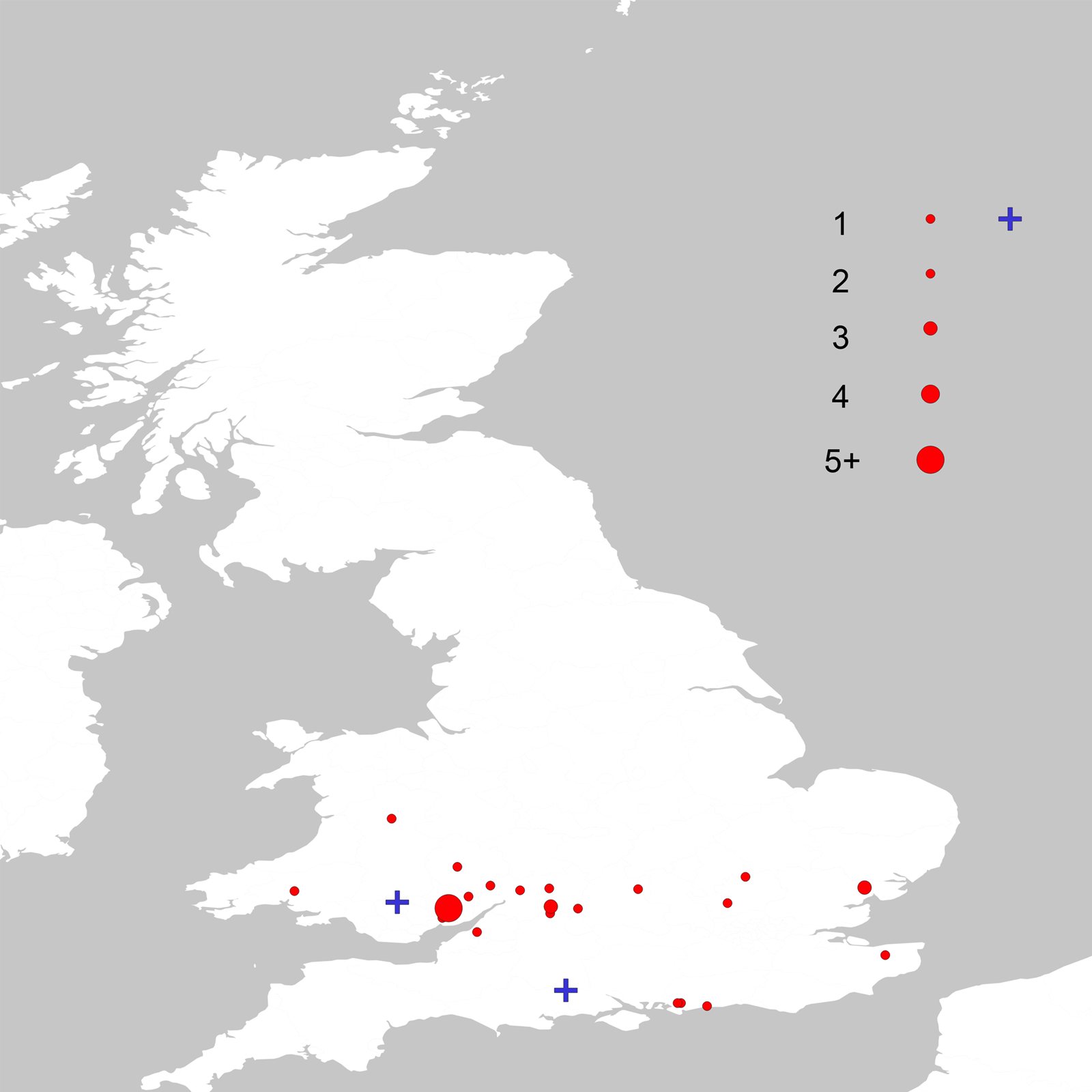
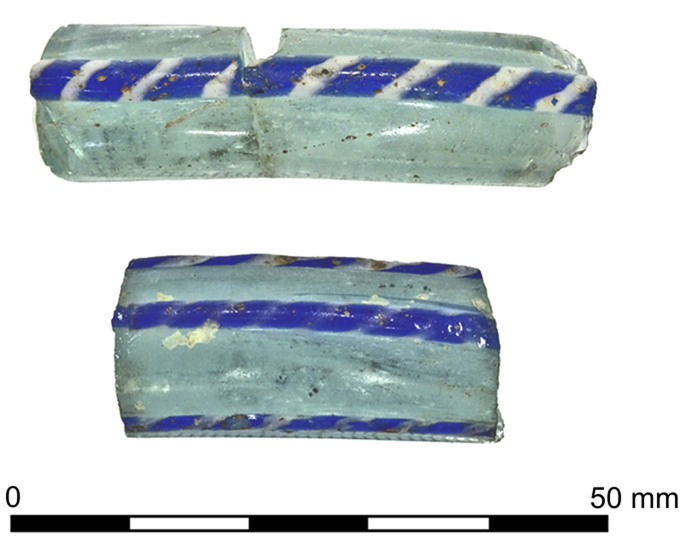
At present, 35 fragments of type 2 glass bangles from 23 sites in southern England are known,Footnote 12 with two having dubious provenance and imprecise records (appendix 1; fig. 4).Footnote 13 A common feature of the bangles is that they are made from translucent blue-green, so-called ‘natural’, and ice-blue glass (22 specimens), or cobalt-blue glass (four specimens).Footnote 14 Most belong either to type 2Ai or to 2Aii, though three represent types 2Bii, 2Ci and 2Ciii. Another noticeable feature is the large internal diameters (i.e. 70–90 mm) of 17 of the 35 bangles.Footnote 15
Distribution of type 2 glass bangles in southern Britain; dots = confirmed find-spots; crosses = unconfirmed find-spots.

The suggestion that type 2 bangles are the earliest rests upon evidence of bangles on pre-Flavian military sites in southern England. At Fishbourne, two fragments found in period 1 contexts of Barry Cunliffe's excavations in the late 1960s are roughly dated to before a.d. 75 (fig. 5).Footnote 16 One fragment found outside Britain, at the site of a Roman auxiliary fort in Valkenburg (the Netherlands), was located in a context dated to a.d. 47–69.Footnote 17 Other fragments have been found on sites with known or suspected Claudio-Neronian or early Flavian phases of occupation, including legionary fortresses at Usk, Kingsholm and Leaholme.Footnote 18 Fragments are also known from Carmarthen, Baldock and Caersws, with find contexts dated to the early Flavian period.
Two fragments of type 2Ai and 2Aii glass bangles from Fishbourne. (Courtesy of the Sussex Archaeological Society)

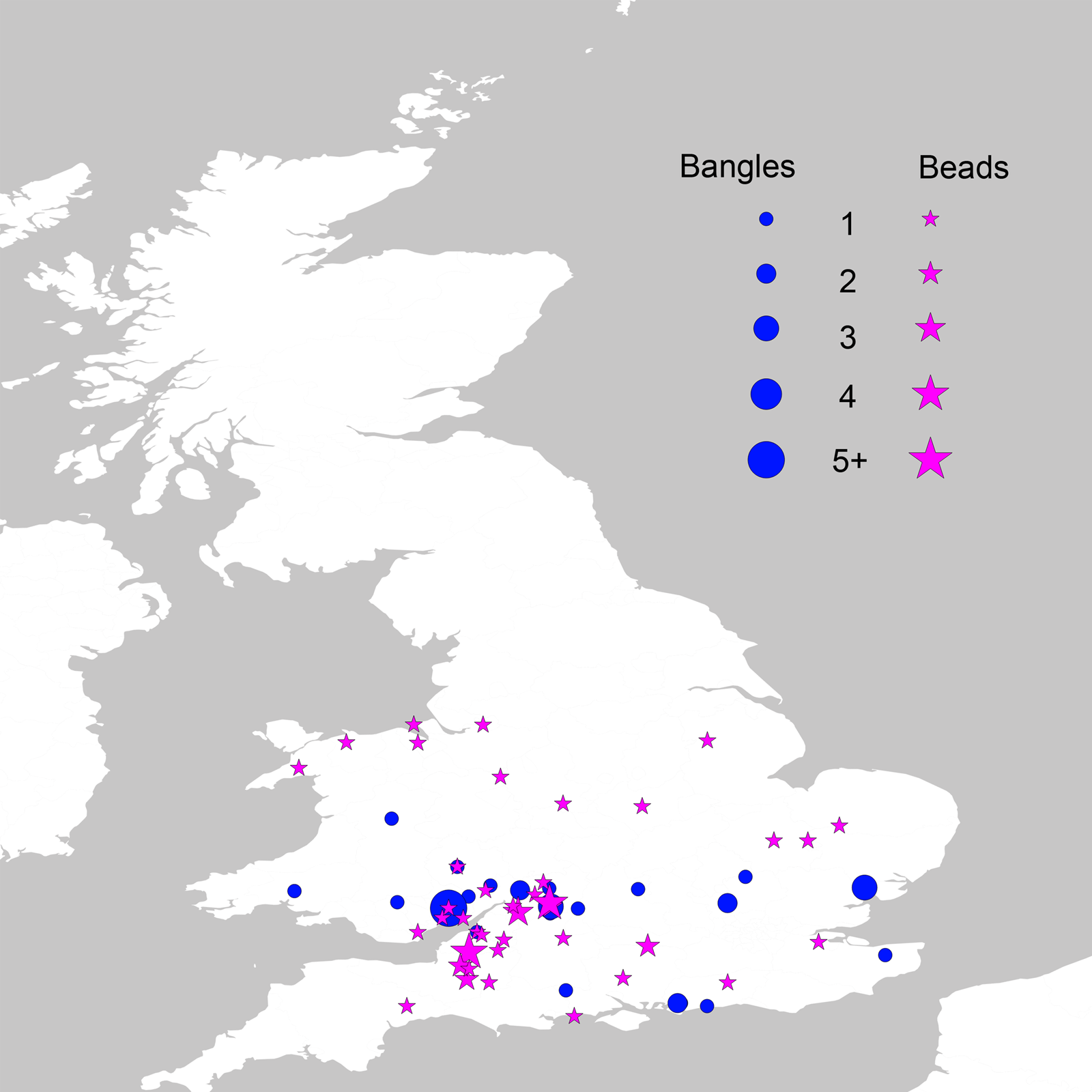
Because it was thought that glass bangles were mostly confined to military sites in the south, their appearance has usually been viewed in connection with the Roman army, which introduced a large quantity of glass immediately after a.d. 43. The idea was put forward that local artisans began using the new material to create products that would suit the tastes of the newcomers. These new products had, however, a specific local design: the artisans used pre-Roman techniques to decorate the bangles; they made cords from rods of coloured glass and twisted them clockwise.Footnote 19 Scholars have suggested that such cord decoration is indigenously British.Footnote 20 Twisted, bi-chrome cords in various colours appear on beads of Guido type 9, usually found south of a line from Chester to Lincolnshire. There is a marked concentration in Somerset and the Bristol Channel area, where glass bangles with similar cords appeared in the pre- and early Flavian period (fig. 6).Footnote 21 Accordingly, one hypothesis is that the production of type 2 glass bangles is closely related to – or may well have been developed from – the production of Guido type 9 beads; in other words, it was ‘a Roman-inspired development of an existing late Iron Age skill’.Footnote 22
Correlation of find-spots of beads and bangles with cable decoration in southern Britain (beads data based on Guido Reference Guido1978; Foulds Reference Foulds2017).

The traditional interpretation thus views glass bangles in Britain as an isolated local development. Starting near the Bristol Channel area and Gloucestershire, the craft later spread to other southern regions, including Sussex and East Anglia, where, however, only a handful of bangles have been found. Such a haphazard distribution in southern and south-eastern Britain may reflect the rapid movements of the Roman army during the decades after the Claudian invasion.
PROBLEMS AND QUESTIONS
The discovery of two glass bangles in period 1 contexts at Fishbourne has provided scholars with an apparent terminus post quem for the emergence of glass bangles in Britain: a.d. 43. Such a clear watershed suggests not only the absence of type 2 bangles prior to that year but also that their arrival should be equated with the Roman invasion and, in turn, with the Roman army. However, problems with this chronology have arisen as a result of reinterpretations of earlier phases of Fishbourne based on various finds and excavations in the 1990s by the Sussex Archaeological Society.Footnote 23 For one, various unambiguous features and artefacts found at locations in and around the site provide cumulative evidence of the occupation of the Fishbourne landscape a generation earlier than a.d. 43.Footnote 24 Although the unified phasing of Fishbourne remains incomplete, the site's use during the LPRIA complicates the presumed initial date of bangles and raises the question of whether phases originally dated to a.d. 50–60 to 60–75/80 in Cunliffe's excavation should be moved back on the timeline.
Glass vessels found at Fishbourne present another dilemma. While the site's assemblage of pottery suggests occupation during the LPRIA,Footnote 25 glass has never been mentioned in the contexts of such discussions, though it should have been. The site has mosaic wares dated to the first half of the first century a.d. and gold-band glass vessels in circulation on the continent in the first half of the first century b.c.Footnote 26 The report on the glass finds was written when Fishbourne was still considered to have a post-a.d. 43 foundation; hence the suggestion that early glass pieces ‘were probably brought over as treasured possessions and not as new purchases on the market’.Footnote 27 However, if Fishbourne's earliest phases were indeed LPRIA, then its pre-invasion inhabitants could have acquired mosaic wares and gold-band glass at the height of their fashion, not as cast-offs decades later.
Another potential problem is the cord decoration on glass beads and bangles. Margaret Guido dates beads with cable-wave decorations to a period covering the first century b.c. to the end of the first century a.d.Footnote 28 Combining Guido's data with new additions to these classes of beads, however, the date now skews towards the Roman period.Footnote 29 Even though the concentration around Somerset, the Bristol Channel area and Gloucestershire still holds (fig. 6), one may ask which came first: a cord on a bangle or a cord on a bead?
Yet another major complication lies in conceiving cord decoration as a genuinely British invention. Many continental beads, as well as some bangles dated to the late first century b.c., have similar corded decorations.Footnote 30 Twisting the glass rods of multiple colours together is, moreover, a familiar method used in the production of glass stirring rods commonly thought to have been used to stir or mix ointments or cosmetics. For the former, a peculiar technique used in the decoration of beads known on the continent, and called Überfangtechnik, can be considered. It involved an opaque, porous, faience-like glass core being fully covered with glass of another colour, onto which thin rods of glass of a third colour were applied.Footnote 31 The process has often been dated to the late first century b.c., or La Tène D1, based on examples from Manching and Stradonice.Footnote 32 Manching and Bibracte have rather interesting beads, the faience-like glass cores of which are covered with cobalt-blue glass, onto which thin, opaque white rods are placed horizontally and topped by light-blue rods laid diagonally.Footnote 33 Visually, the result is nearly indistinguishable from that of British cord decoration; in fact, one bead from Bibracte uncannily resembles a bead of Guido type 9 from Britain.Footnote 34 A fragment of a glass bangle from the same site, decorated by following the same technique, was at first glance mistaken by the author for a piece of a British bangle.Footnote 35 This complicated continental technique may have been the first step in developing cord decoration; thus cords on British bangles and beads could have been a later, simplified version, whereby one rod of cobalt blue was twisted with two rods of opaque white.Footnote 36
The idea that twisted cords originate in Britain is also weakened by the glass stirring rods produced by twisting glass rods of multiple colours together, which were in use from the second century b.c. to the fourth century a.d. These stirring rods were usually manufactured by winding a thin glass trail around a thick glass rod – i.e., opaque white around a cobalt-blue thick rod;Footnote 37 this is a different method from the manufacture of cords on glass bangles discussed above. They are also much thicker than bangle cords, with measurements of c. 0.6 cm versus 0.1 cm for the cords. However, a very brief survey conducted by the author has revealed some continental stirring rods that were produced by a technique similar to that used for the bangle cords.Footnote 38 One may therefore hypothesise that these objects could have served as an inspiration for the development of bangle cords, although an in-depth study, which includes spatio-chronological analysis of glass stirring rods found in Britain, is required in order to resolve this question.
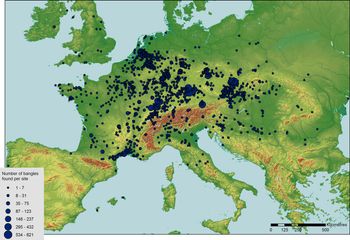
Such evidence prompts a final problem as well as a question: how did continental knowledge of making seamless bangles and decorative elements for them reach Britain, especially when seamless glass bangles, or bead Überfangtechnik for that matter, were not of Roman origin? Seamless glass bangles are strictly phenomena of LIA continental Europe, ‘a cultural and temporal landmark of Celtic civilization’.Footnote 39 Approximately 11,000 fragments of glass bangles have been found on the continent, dating to between the fifth and the first centuries b.c. (fig. 7).Footnote 40 This stands in stark contrast to the number of continental bangles found in Britain: the current count is 20 (appendix 2; fig. 7).Footnote 41 The utter lack of interest in continental glass bangles in LIA Britain and their ‘apparent’ rather abrupt re-emergence in new designs from a.d. 43 onwards in southern Britain require more profound analysis, especially if the craft was neither indigenous to Britain nor Roman inspired.
Distribution of glass bangles of continental origin across the European mainland and Britain, fifth to first century b.c. (continental data from Rolland Reference Rolland2019, 37; British data: appendix 2 this paper). (Image courtesy of and © Joëlle Rolland)

The suggested association of glass bangles with the Roman army is similarly problematic. The traditional view sees a marked association between the distribution of glass bangles and the military in south-western England, because some of the bangles were found on military sites and legionary vici. However, that association now looks rather ambiguous, as only 13 of the 35 known examples come from military sites or legionary vici (appendix 1).Footnote 42
Given all these conflicts, the traditional view is certainly open for revision, especially when viewing British bangles in the light of their continental counterparts and contextualising them within the political, social and cultural processes of southern Britain at the time. To quote John Manley and David Rudkin's thinking about Fishbourne, ‘If we hold our nerve and stay this side of AD 43, what else can we see?’Footnote 43
TECHNOLOGICAL AND STYLISTIC TRANSFER
The question of how glass bangles in the LIA and Roman period were made to be seamless has consistently puzzled scholars, albeit those on the continent more than those in Britain.Footnote 44 Because no written sources are available, apart from a medieval treatise (On Divers Arts) describing a method of making glass rings without visible soldered joints,Footnote 45 continental scholars have turned their attention to alternative sources. Ethnographic evidence available from other countries where seamless glass bangles are known to have been produced has provided clues about the technology,Footnote 46 as have analyses of how complex beads were made and detailed visual as well as microscopic analyses of bead and bangle fragments.Footnote 47 Piecing various strands of evidence together and replicating some of the techniques in experimental work enables support of some hypotheses and dismissal of others.Footnote 48
The technologies in question are the winding and stretching of glass with two wrought-iron rods, or ferrets, or the stretching of it with a cone-shaped mandrel.Footnote 49 La Tène glass bangles in continental Europe were produced in various types, and their outer surfaces were modified while the glass was hot by adding peculiar shapes, such as knots, horizontal and diagonal lines, squares and waves, which were incised with a simple knife or a small blade. To achieve the desired shape, craftspeople plausibly followed different operational sequences in each case and used different tools to support the glass while applying the decoration.Footnote 50 However, not all glass bangles from the LIA have incised decorations. In the later periods of La Tène (i.e. LT D1), simple monochrome glass bangles, either triangular or D-shaped in cross section and in a variety of colours, but mostly in purple and blue, were produced,Footnote 51 and some were additionally decorated with zigzag patterns, mostly in opaque yellow.Footnote 52 Known as series 36–9 in Rupert Gebhard's typology, these objects were created by following the simple technique of winding and stretching the glass with two wrought-iron rods.
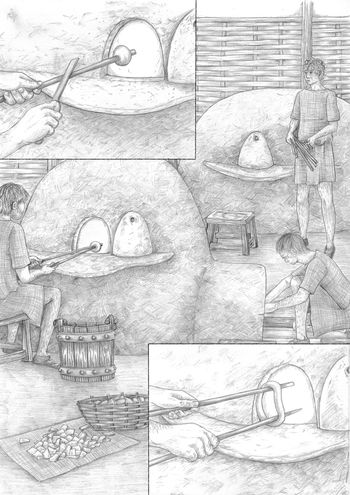
The first stage in the production of this type of monochrome glass bangle is to pick up a gather of glass from its crucible and wind it around an iron rod (fig. 8).Footnote 53 At this stage, the bangle resembles a rounded bead. Gravity and the constant spinning of the rod create a small opening in the middle of the ‘bead’, into which the second rod, or ferret, is inserted. By carefully pulling the glass in different directions with two rods, the opening is enlarged and widened, and the bead is transformed into an annular seamless object: a bangle.Footnote 54 Despite the difficulty of producing a perfectly round bangle, experiments have shown that, with enough skill and excellent hand-eye coordination, symmetrical bangles can be created. After the basic bangle is created, decoration is applied onto its outer surface as a final step.Footnote 55
Artistic impression of the winding and stretching technique used in the production of glass bangles (based on Rolland and Clesse Reference Rolland and Clesse2014, fig. 1). (Drawing by Vicki Herring)

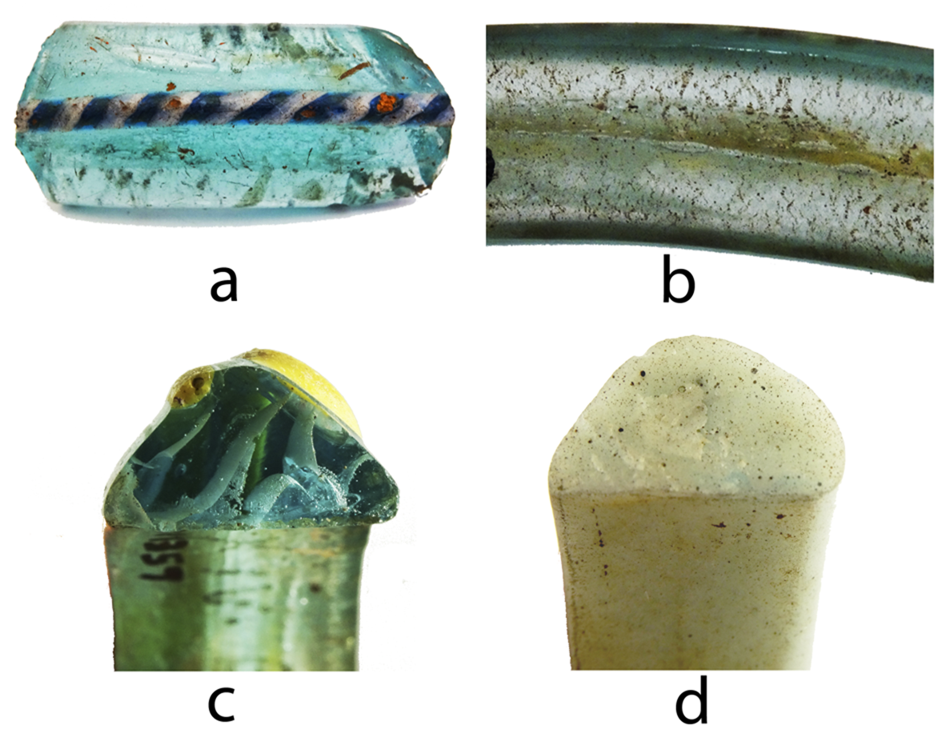
A visual comparison of approximately 500 Romano-British fragments with a few La Tène D1 continental bangles and four present-day Nigerian glass bangles produced by the said method suggests that this technique was also used to manufacture the type 2 glass bangles found in southern and northern England, as well as the type 3 glass bangles that are widespread across northern England and southern Scotland.Footnote 56 Most Romano-British glass bangles of these types exhibit the following four features associated with the winding and stretching method (fig. 9).Footnote 57
Features applied to evaluate the technique used to produce British bangles (images not to scale): (a) elongated gas bubble as seen on a type 2Ai specimen from Seamills (Bristol Museum and Art Gallery, register no. F945); (b) matted inner surface with greyish residue as seen on a fragment of a type 2Ai bangle from Usk (National Roman Legion Museum, Caerleon, acc. no. 82.10H); (c) internal folds as seen on a type 3G specimen from Corbridge (English Heritage Trust, acc. no. CO11357); (d) cross-sectional asymmetry as seen on a type 3A fragment from Corbridge (English Heritage Trust, acc. no. CO32989). (Image (b) courtesy of Amgueddfa Cymru/National Museum Wales)

(1) Elongated gas bubbles. Gas bubbles appear in the glass body matrices of some bangles due to low temperatures being used in their production.Footnote 58 Such bubbles are circular before the glass is spun, but stretch because of the constant spinning motion.Footnote 59 This feature is visible with the naked eye in bangles made from translucent blue-green and cobalt-blue glasses (fig. 9a). Oblong channels, each once a gas bubble, can be observed in the broken cross sections of opaque white and opaque yellow bangles.
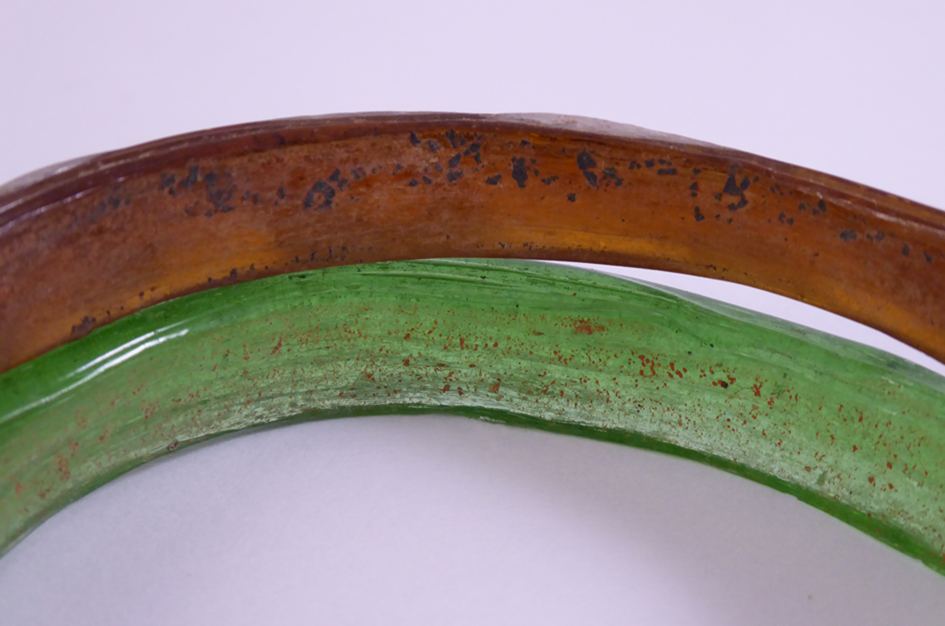
(2) Matted inner surfaces, sometimes with embedded iron scales. The inner surfaces of many type 2 and type 3 Romano-British bangles are matted with tiny greyish or brownish dots, and show horizontal striations, sometimes appearing as wavy lines (fig. 9b). These features do not occur on the outer surfaces of bangles. Similarly matted inner surfaces are observable on the continentalFootnote 60 and today's Nigerian bangles (fig. 10).Footnote 61 The Nigerian craftsmen cover the tips of their wrought-iron rods with clay to prevent objects from adhering to the rods and to allow their easy release.Footnote 62 This procedure is akin to modern bead-making, in which steel rods are covered with a material known as bead release, roughly half of which is clay. Many modern beads thus have the same matted inner surfaces as modern Nigerian bangles due to their contact with rod tips covered in bead release. Although many scholars have assumed the dots on Romano-British glass bangles to be dirt accumulated over centuries as pieces have lain in the soil, it is much more likely that this effect is a residue from the parting layer used to cover the tips of the rods to prevent bangles sticking to them.Footnote 63 Another feature of the inner surfaces of some bangles are flakes of iron fused onto the surfaces that now appear corroded. These are scales that form on the surface of hot iron tools, which fuse with the softened surfaces of hot glass masses during the stretching process.Footnote 64 As a brown Nigerian glass bangle reveals, scales also form when too little clay is applied to the rod (fig. 10).
Inner matted surface with some iron scales on two Nigerian glass bangles.

(3) Internal folds. Folds are clearly observable in the cross sections of bangles made of translucent glass (fig. 9c). Appearing when individually gathered chunks of glass are wound around an iron rod during the first stage of bangle production, the folds represent badly fused glass worked without constant heat.Footnote 65
(4) Visible asymmetry in cross sections. A final feature deriving from the manipulation and constant rotation of glass around a rod is the asymmetrical height of the sides, as clearly observable in the cross sections of broken bangles (fig. 9d). On some fragments, one edge is slightly flatter and thicker than the other, which is conversely slightly elongated and thinner. Such asymmetry may derive from rotating and turning the hot, liquefied glass on a rod; the glass shifts from one side to another, but cools and stiffens too quickly to allow the surface to regularise itself into a semicircular shape. The asymmetry could also stem from annealing, as one side of a bangle is liable to slump slightly under the weight of the glass when placed in an annealing oven.Footnote 66
These four features are also noticeable in the continental glass bangles from the LIA, as well as in today's Nigerian glass bangles and glass bangles produced during experiments undertaken by a French team supervised by Joëlle Rolland.Footnote 67 Many of these features are the result of the low temperature in the small, wood-fired furnaces in which the Nigerian and experimental bangles were produced. During their experiments, Rolland and her colleagues noticed that objects made in modern gas furnaces, where temperatures easily exceed 1,000 degrees celsius, lack these features.Footnote 68
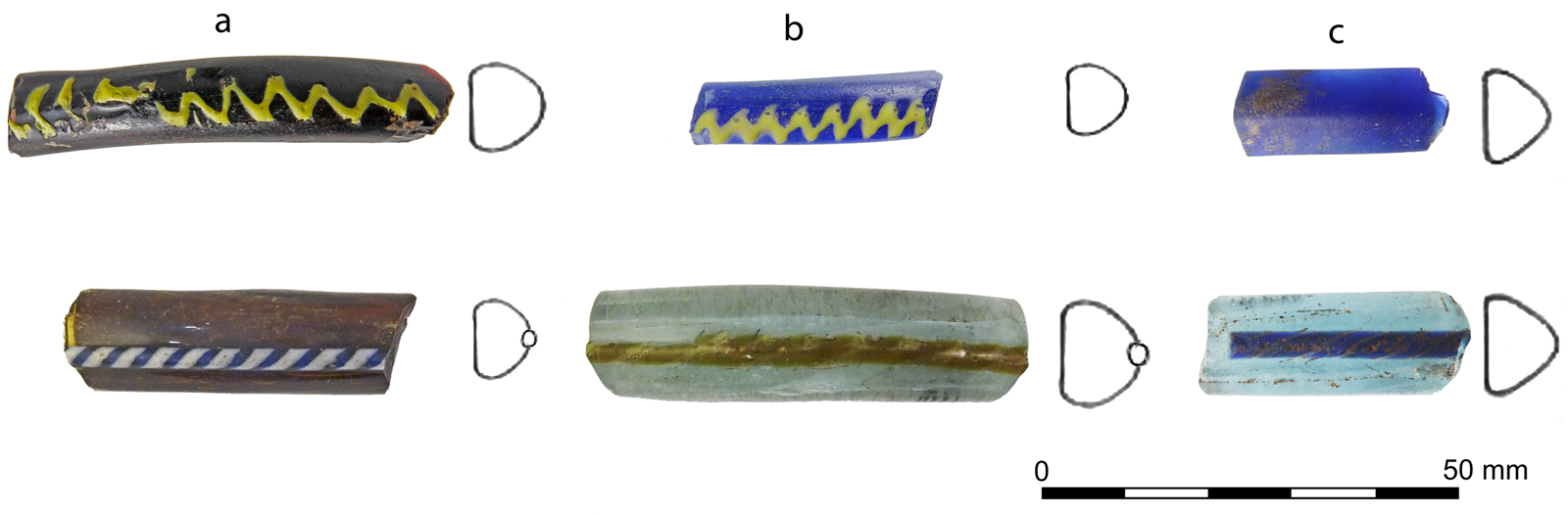
Without a doubt, the winding and stretching method was used to produce both continental LIA and Romano-British type 2 and type 3 glass bangles. Closer inspection suggests that they also share elements of design. Many scholars who have addressed the appearance of, and inspiration for, Romano-British bangles have emphasised the differences in their decoration and quality from those found on the continent. Indeed, continental bangles are more spectacular in their design, given their incised knots, their multiple horizontal and vertical lines that form a chequered pattern and their wavy lines that sometimes resemble running dogs. However, scholars have generally compared Romano-British bangles to continental ones from a different period, since the more spectacular bangles are all from a much earlier era: La Tène C2 (170–110 b.c.), or what is sometimes called the ‘baroque period’ in the development of glass bangles.Footnote 69 The continental bangles that are geographically, chronologically and stylistically most similar to the British ones are Gebhard's series 36–9, which are dated to La Tène D1 (c. 110–50 b.c.; fig. 11). The production of series 36 (i.e. undecorated, D-shaped, purple bangles), series 38 (i.e. undecorated, D-shaped, blue bangles), series 38b (i.e. blue bangles with opaque yellow zigzag decoration) and Haevernick type 3b (i.e. purple bangles with opaque yellow zigzag decoration) is strongly suspected to have been undertaken in the Netherlands and the southern German Rhineland.Footnote 70 These simple, monochrome, D-shaped bangles have a pronounced regional distribution: roughly 2,600 fragments have been found in the Netherlands, accounting for nearly 60% of all glass bangles recorded there.Footnote 71
Schematic comparison of continental and British bangles: (a) Haevernick 3b: purple with opaque yellow (PAN-00040944, Maasdriel, the Netherlands) and type 2Ai from Usk (National Roman Legion Museum, Caerleon, acc. no. 82.10H); (b) Gebhard 38b: blue with opaque yellow (PAN-00024950, Geldermalsen, the Netherlands) and type 2Ai from Usk (National Roman Legion Museum, Caerleon, acc. no. 82.10H); (c) Gebhard series 39 (PAN-00022824, Zaltbommel, the Netherlands) and type 2Ai from Whittington Court (The Museum in the Park, Stroud, acc. no. CM.3560). (Images (a) bottom and (b) bottom courtesy of Amgueddfa Cymru/National Museum Wales)

Although cross-Channel connectivity is implied by the shared technology of the production and style of continental and British bangles, a chronological conundrum persists. If the supposedly Romano-British glass bangles indeed descended from continental ones, then a gap of two or three generations occurred between the disappearance of glass bangles from the continent in the Augustan period and their appearance in Britain in the Claudio-Neronian period. This chronological discrepancy and other problems raised can be overcome, as long as the initial date of the glass-bangle revolution in Britain is shifted. The technological and stylistic borrowing proposed in this section brings a LPRIA start date for British bangles within the bounds of possibility. What other arguments might also support this hypothesis?
SOCIOCULTURAL TRANSFER
A chief premise of this article is that the development of type 2 bangles cannot be studied in isolation from processes in southern England before a.d. 43. While a complete review of the changes within the historiographical tradition of interpreting the transition from the LIA to the Roman period is beyond the scope of this article, principles central to the argument will be highlighted in the following subsections in order to showcase strands of evidence supporting an earlier date for the beginning of glass bangles.
CROSS-CHANNEL CONNECTIVITY
The LPRIA-to-Roman transition in southern England has been characterised as a time when various new cultural trends were either directly introduced or borrowed from across the English Channel and the North Sea. The emergence of new cremation burial rites and new dining habits, for example, along with the appearance of indigenous coin imagery based on images borrowed from Gaulish coins and new ways of bodily adornment have been interpreted as resulting from long-established links with the continent.Footnote 72 However, caution has also been exercised in conceiving these changes as being entirely externally driven, and such interpretations are now widely questioned and mostly discarded.Footnote 73 External factors enhanced various developments in most spheres of southern British society, though scholars tend to agree that they were already taking hold in the middle or earliest decades of the LIA.Footnote 74
Current understandings of the transformation of LIA southern England suggest that the Claudian invasion of a.d. 43 was not as transformative as previous histories of the period have tended to imagine.Footnote 75 The shift was more complex and drawn out, and a.d. 43 does not mark a strict watershed.Footnote 76 The long-term character of this transition is seen through the close dialogue of the ‘sophisticated Iron Age society [of Britain] … with the Roman world’, which intensified after the Caesarean campaigns and, in particular, during the Augustan period.Footnote 77 This ‘Roman world’ was not simply the Mediterranean world; on the contrary, Gallic Gaul, Belgic Gaul and the Rhine region acted as vital intermediaries between southern England and the Mediterranean core.Footnote 78
Cross-Channel relations were not uniform, either. There is enough evidence to determine discrepant patterns of consumption in southern England, including the incorporation of elements from various continental areas, rather than from a single continental source, and the existence of different axes of connections between various regions and the continent.Footnote 79 These regional variations point to societies in southern England during the LPRIA that exercised individual as well as communal preferences about what to appropriate, adapt or recreate from a widely dispersed repertoire of putatively continental trappings.Footnote 80 Martin Pitts suggests seeing this ‘complex worldview in which cultural change could be multidirectional and differently negotiated in individual localities’ as part of the globalising processes of the LPRIA-to-Roman transition.Footnote 81 Such global networks allowed southern British society to choose from a range of diverse continental practices those that suited regional cultural prerogatives.Footnote 82
HUMAN MOBILITY
Cross-Channel connectivity during the LPRIA was underpinned by the significant mobility of people and goods across the English Channel and the North Sea, though there is no consensus about the nature of such mobility.Footnote 83 Propositions have included the large-scale migration of people from northern GaulFootnote 84 and mid-scale Gallic colonisation,Footnote 85 as well as the migration of élite groups from Gallia Belgica.Footnote 86 Although the large-scale movement and settlement of immigrants from the continent into southern England have been largely rejected in favour of contact via commerce, mid-scale migration has been supported by archaeological evidence.Footnote 87
Close, ongoing contact between different continental and British societies involving the regular crossing of people and goods over the Channel and the North Sea may explain the occurrence of continental glass bangles in Britain. Of the 13 find-spots currently known, eight are in southern England (appendix 2; fig. 7). Since all bangles were found as fragments, they might have been imported to the sites as broken items for the purpose of recycling.Footnote 88 Large-scale recycling could explain why so few La Tène glass bangles have been found. However, continental glass bangles may not only have been imported or collected for reuse, but might also have been worn by immigrants from northern Gaul.
Furthermore, consideration should be given to the possible service of Britons across the Channel, either as mercenaries fighting against the Caesarean army or as auxiliaries in the early Imperial Roman army. Concerning the former, in The Gallic Wars Caesar recalls that, on numerous occasions, Gauls received support from across the Channel, and a particular type of Gallo-Belgic coin found in southern England has been interpreted as a form of payment to British mercenaries.Footnote 89 Concerning the latter, in contrast, the evidence is mostly archaeological and includes finds of Republican military equipment at various sites across the region. However, extreme caution has to be exercised in drawing the conclusion that such artefacts indicate the service of Britons as auxiliaries, for these items could represent diplomatic gifts or objects of plunder or cross-Channel trade.Footnote 90
NEW FORMS OF OUTWARD DISPLAY
One of the results of these connections and mobility was the transference of knowledge of various continental practices to Britain.Footnote 91 However, this transfer was not the ‘blanket acceptance of imported practices’; these innovations occurred with a particularly British sheen and were regionally dependent.Footnote 92 Instead of constituting the simple adoption of elements, the process involved the selection and customisation of various cultural forms and artefacts to fit regional circumstances.Footnote 93 This section concentrates on one example of such selection and customisation, focusing on transformations in outward display and bodily presentation in southern England during the LPRIA.
The rise in the number of objects associated with dress and bodily adornment in the LPRIA archaeological records of settlements in southern England has been interpreted as the start of ‘a new kind of body’.Footnote 94 Of the various strands of evidence indicating that attention was increasingly paid to the body, its care and appearance, the best known is the massive appearance of brooches in what Sophia Jundi and J.D. Hill have called a ‘fibulae event horizon’.Footnote 95 Its primary features are the increasing number and changing importance of brooches in the first centuries b.c. and a.d. in Britain, the multitude of styles and typological diversity, and the increasingly visible prominence of ever-more massive and decorative brooches.Footnote 96 Another noticeable pattern is the rise in the number of toilet instruments, such as nail-cleaners, tweezers and ear-scopes, as well as the beginning of the use of cosmetic grinders, all of which suggests growing concern for personal hygiene and bodily upkeep.Footnote 97 The archaeological record indicates that other accessories and items associated with personal appearance – mirrors, earrings and dress fittings – also became increasingly common.Footnote 98 Alterations in self-presentation and clothes as well as changes in regimens of bodily care imply new lifestyles resulting from the construction of new social relations and the reconfiguration of identities in the population, all directly linked with other sociocultural changes and forms of cross-Channel connectivity.
The visual and sensory worlds were thus changing for the LPRIA inhabitants, but were also changed by them.Footnote 99 Regardless of whether such alterations in personal appearance and lifestyle were conscious choices by a few individuals, whole communities or entire regions,Footnote 100 the users of these new technologies were proactive and decisive in their choices.Footnote 101 Though many of the objects and visual trends had continental predecessors, they were selectively adapted and reinvented from that repertoire to suit local preferences and demands.Footnote 102 This dynamic is discernible in metal artefacts associated with the adornment of human and animal bodies. One example is the group of torcs from the Winchester Gold find.Footnote 103 Torcs were common in Britain and continental Europe during the LIA, though the ones found in Winchester differ in their production technique. This involved Roman or Hellenistic technical expertise by an artisan either long familiar with the technology or trained in a workshop specialising in the manufacture of gold jewellery in a similar style.Footnote 104 Such foreign technology was deployed to create a popular object, albeit in a rather distinctive way. Although the identity of the artisan remains unknown today, it is telling that such a culturally and technically entangled object found its way to southern England during the LPRIA.Footnote 105
The case of nail-cleaners is another such selective adoption from the continental repertoire. Bronze toiletry sets featuring various instruments used for cleaning and grooming the body were popular on the European mainland in the LIA and in the early periods of Roman annexation. By the Augustan period, however, some of the implements had fallen from favour. In particular, nail-cleaners were no longer used on the continent but later became quite popular in Britain, where they feature prominently in many grooming sets.Footnote 106 Another delineation from continental practice and style is the Nauheim derivative brooch, which had a continental type as a predecessor, but in Britain during the LPRIA evolved into something unrecognisable from its forerunner.Footnote 107
The same pattern of selective adoption from the continent is discernible for British glass bangles as well. The diameters of the earliest British glass bangles range from 70 to 90 mm. Continental Iron Age glass bangles were also produced in a variety of diameters, with a large proportion of them being 70 mm or more.Footnote 108 Experimental research suggests that such large bangles cannot be worn on the wrist or lower arm; they would simply slip off.Footnote 109 The best location on the body for them is the upper arm, immediately above the elbow.Footnote 110 Evidence from continental finds at burial sites dated to the LIA further supports this interpretation, since large bangles have frequently been discovered on the upper arms of osteologically sexed females.Footnote 111 Therefore, the large internal diameters of the earliest British bangles could be an example of the transfer of associated knowledge from the continent concerning the appropriate place on the body to wear such objects. Later, perhaps to accommodate changing practices and customer choices, the diameters of bangles narrowed to allow them to be worn on the forearm or even the wrist.Footnote 112
REDATING GLASS BANGLES?
Given the discussion above, the appearance of British glass bangles combining a continental production method and visual elements but delineated by their final style cannot be coincidental; it must be the result of convoluted processes and the amalgamation of various cultures during the LPRIA.Footnote 113 Put differently, the bangles are products of their time, born from the intermingling of various elements of an interconnected southern England and European mainland. Such objects of personal adornment were made by using technical expertise from the continent, and, though their development may have been inspired by contacts with societies from across the English Channel and the North Sea, they were not copies or antecedents of continental glass bangles or beads. Rather their design was likely a reinterpretation of those objects in the light of the interplay of the selective borrowing of visual aspects of continental bangles and beads that were more consistent with the tastes of local consumers. In this sense, British bangles represent a clear case of ‘a British particularisation of a universal category of circulating object’.Footnote 114
Glass and glass artefacts are too often studied in isolation from other contemporary objects of material culture. This approach neglects connections already suggested for objects made in other materials – in this case, the appearance of new dress accessories and changes in visual appearance. Bangles may have been developed in parallel with other objects of personal adornment to signify new lifestyles and new forms of outward presentation. Responding to common stimuli, they emerged as a result of selection and customisation instead of in a singular, typological sequence of development.Footnote 115
However, it is of course not enough simply to state that the emergence of glass bangles in Britain should be redated to the LPRIA, from the period ‘after a.d. 43’. A few issues complicate the hypothesis. The first is the absence of direct chronological evidence. No bangles found in southern England date to the pre-conquest period; however, the dating of the genesis of particular types of material culture in southern England during the hiatus of the mid-first century a.d. to either the pre- or post-conquest period is fraught with major problems.Footnote 116 What is sometimes assumed to be LIA material has been shown later to have been persistently used in the late first century a.d. and vice versa, while a few objects once presumed to be in the Roman style have been recognised later as stemming from the LPRIA.Footnote 117 Many sites in southern England have yielded artefactual assemblages that show clear signs of the continued use of materials from the LPRIA into the Roman period.Footnote 118 There is also of course the problem of residuality, with some LPRIA-to-Roman transition sites exhibiting a pattern of pre-conquest artefacts finding their way into post-conquest contexts.Footnote 119
In this regard, information about the contexts in which bangles have been located warrants attention. Of the 35 specimens, contextual data have been recorded for 22, with a few discovered in rubbish deposits dated to the Neronian and pre-Flavian phases of occupation at sites of Roman forts.Footnote 120 For these few, Neronian and pre-Flavian dates mark their deposition or discard, not their manufacture. The durability of a given bangle is unknown; though abrasions and dull surfaces could indicate wear and use over some time.Footnote 121 In terms of bangles found at forts founded in the a.d. 50s, such as Kingsholm, Leaholme and Usk,Footnote 122 with LPRIA activity detected at Kingsholm,Footnote 123 it is theoretically possible (but not proven) that the bangles arrived at those sites earlier than their foundation dates.
Chronological and contextual evidence for bangles found in rural and smaller urban contexts is also patchy, but permits the hypothesis that they originated before the Roman invasion. Most examples come from contexts broadly dating from the early first to early second century a.d. Such bangles are either unstratified or recorded rather broadly as being associated with ‘occupation secondary deposits’, meaning that the original date of their deposition or discard cannot be established at present. Evidence suggests the uninterrupted occupation of these rural sites from the LIA until after the conquest, and a few likely endured into the later Roman period.Footnote 124 For example, a bangle from Littlehampton, a rural site with evidence of continuous occupation, was found in a refuse pit along with domestic and construction rubbish dated from the mid-first to late second century a.d.,Footnote 125 which may have been part of the levelling deposit of a farmstead from an ‘earlier date’.Footnote 126 As another case in point, an unstratified bangle from Claydon Pike came from an area dated from the early first to the early second century a.d., along with many associated finds dated to either side of a.d. 43 and into the Flavian period.Footnote 127 A small industrial Romano-British town, Ariconium (now Weston-under-Penyard), has revealed particularly strong evidence of pre-Roman occupation. The area in which an unusual bangle was found had been continuously used for rubbish disposal with ‘occupation debris of predominantly first and second century’ and ‘significant quantities of Late Iron Age/Transitional period material’; this suggests that the area was already actively in use during the pre-Roman period.Footnote 128
Neronian and pre-Flavian deposits indicating the date of discard but not manufacture or actual use, coupled with the occurrence of glass bangles in levelling deposits alongside early material from rural sites, cast doubt on any automatic dating of bangles to after a.d. 43. Such evidence also weakens the association of bangles with the Roman military. Given the possibility of the non-military origin of British bangles, it is appropriate to consider the people who may have propelled the emergence of the craft. Throughout this article, ‘southern England’ has been used as shorthand for their location; however, the bangles’ centre of gravity seems to be in the Severn-Cotswolds region, given the cluster of type 2 bangles there (fig. 4). This territory has been assigned generally to the Dobunni, and though it may be tempting to call type 2 bangles ‘Dobunnian artefacts’, such a label is problematic. It is a somewhat artificial creation, derived from a second-century a.d. map compiled by Ptolemy and adapted to the later Iron Age landscape,Footnote 129 and may not mirror tribal or social entities living in the region during the LPRIA or early Roman period.Footnote 130 Nevertheless, it is clear that, sometime during the first century a.d., some group or groups living in the region began appropriating glass bangles into their social practices. This certainly fits more generally with societal developments of the LPRIA Severn-Cotswolds groups which Tom Moore has characterised as societies in the process of ‘breaking away from existing well-defined relationships and adopting various attributes of different lifestyles’.Footnote 131 If the origin of British glass bangles is indeed continental, then continental craftspeople might have arrived in this part of Britain in the LPRIA and begun producing bangles in a new style to accommodate the tastes of local customers. However, evidence points more towards the existence of strong regional exchange networks than to long-distance trade with continental societies.Footnote 132 In fact, the relative proximity of the Severn-Cotswolds groups to the middle and late Iron Age lake villages of Glastonbury and Meare in Somerset, with evidence of glass-bead manufacture spanning four centuries, could indicate some sort of regional continuity in glass craftsmanship involving local glass-workers open to external influences in the development of new products.Footnote 133
Although the character of the Glastonbury and Meare lake villages, which were in existence until the late first century b.c., is debatable, in terms of their seasonality, permanence and ceremonial use, it is clear that highly specialised crafts were practised there, including glass-bead manufacture.Footnote 134 The existence of a glass workshop at Meare is considered by Julian Henderson to be ‘a virtual certainty’, given abundant evidence of manufacturing occurring on site from the fifth century b.c. onwards.Footnote 135 Another site in the south that has provided circumstantial evidence of glass-working is Hengistbury Head in Dorset.Footnote 136 Lumps of imported raw glass in purple and opaque yellow showing signs of cutting have been found there, and indicate either trade in raw glass on the site or the working of glass into objects – beads, most likely.Footnote 137 Although no glass-working debris has ever been found, the possibility of glass-working is strengthened by the occurrence of various high-temperature industries on the site.Footnote 138 The assemblages from both Meare and Hengistbury Head have yielded continental La Tène bangles of series 36, 38 and Haevernick type 3b, all of which morphologically resemble the earliest bangles attested in Britain (fig. 11).Footnote 139 One can, therefore, imagine that skilled indigenous glass-workers started catering to the new tastes of consumers who required novel products to satisfy their desire to change their dress and outward appearance. As a result, the type 2 glass bangle was born. Nevertheless, this theory remains plagued by another complication: the absence of evidence for experiments and misfires.
A MISSING LINK: STYLISTIC GENEALOGIES
As products of human actions and individual agency, objects do not develop in a linear, progressive sequence; their development depends very much on the growth of knowledge of a craftsperson involved in their production.Footnote 140 For type 2 bangles, evidence of a linear typological developmental sequence and progression is nearly non-existent, and that of misfires, failures and trial and error is limited. In fact, all bar two bangles display a high level of conformity in their technical proficiency and design. Indeed, the geographical spread of bangles in the south – from Wales to Kent, with very little difference in design between those from Usk and those from Canterbury – suggests either that knowledge of how to manufacture them was widely shared or that production was carried out in a limited number of centres. However, evidence of the production of bangles in southern England is restricted to a mere 16 mm-long piece of premade twisted cord of opaque white and cobalt blue in the assemblage from the Leaholme legionary fortress.Footnote 141
Two unusual examples come from the small towns of Kenchester and Weston-under-Penyard.Footnote 142 The bangle with a twisted cord from Weston-under-Penyard is unique insofar as its base colour is opaque yellow. Type 3B bangles with opaque yellow as a base colour are known only from northern Britain, but they are all, save one, entirely undecorated.Footnote 143 The Kenchester bangle, while having most features of a typical type 2Aiii bangle, is also exceptional (fig. 12). Not only is it additionally decorated with opaque yellow dots on the apex, but, more importantly, it is extremely large and chunky, with an internal diameter of 90 mm and a height of 12 mm. Experiments with wearing bangles of a similar diameter have shown that such a bangle would have been extremely uncomfortable to wear for any length of time.Footnote 144
Fragment of a glass bangle from Kenchester (acc. no. unknown): outer and inner surfaces and side views. (Courtesy of Herefordshire Museum Service)

Both instances of deviation amid an otherwise uniform collection can be interpreted as attempts by local artisans to recreate a popular design due to demand by using the material at hand, their own knowledge and observation. A similar pattern is noticeable on a set of 25 fragments of possibly seven bangles from a so-called ‘native’ stone-walled fort in Bryn y Castell, Ffestiniog, Gwynedd, Wales.Footnote 145 The fragments found at this iron-working site, occupied between 300 b.c. and the mid-first century a.d., were most likely produced from recycled glass just before the end of the site's occupation.Footnote 146 The pieces were produced in translucent blue-green, cobalt-blue and dark-green glass, and decorated either with twisted cords or trails and lines applied directly onto the apex and edges, thus broadly resembling type 2 glass bangles.Footnote 147 In contrast to standardised bangles circulating in southern England, the cords on these examples meander and curtail on the apex and sides. Instead of being purposeful, the distortion of the cords and manner of their application suggest that whoever applied them did not have sufficient manual dexterity to handle both a bangle on a rod and the application of a cord, or else lacked sufficient knowledge or skill to judge how much cord was needed.Footnote 148 Though the Kenchester bangle differs from examples found at Bryn y Castell – the cords are laid with mathematical precision – its thickness and large diameter imply that its maker may have misjudged how much glass was necessary.
Altogether, while both products might derive from trial and error, they could be interpreted as the products of artisans with different levels of manual dexterity and training, who produced bangles for local needs and consumption. Such craftspeople probably made popular objects based on their observations of templates received from elsewhere, likely from Gloucestershire or Roman period rural settlements in southern Wales. In either case, bangles could have been produced in a wide range of workshops, from highly specialised ones to smaller, more regional ones specialising in other crafts, to even smaller-scale, possibly peripatetic ones, rather than production having been confined to a limited number of centres.Footnote 149
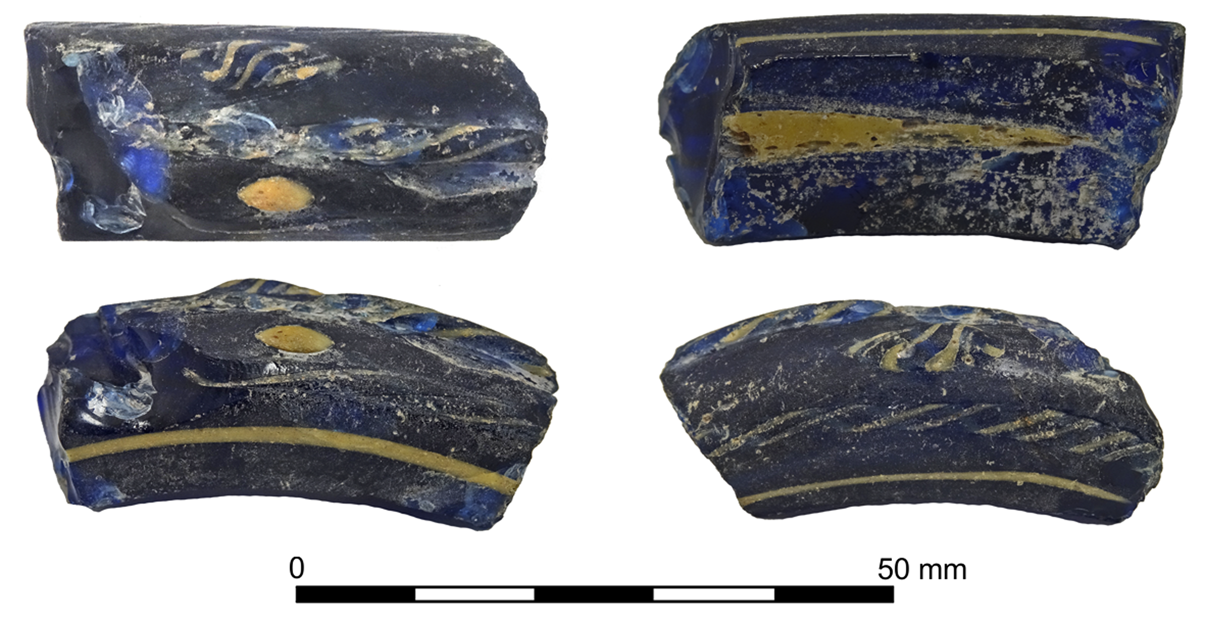
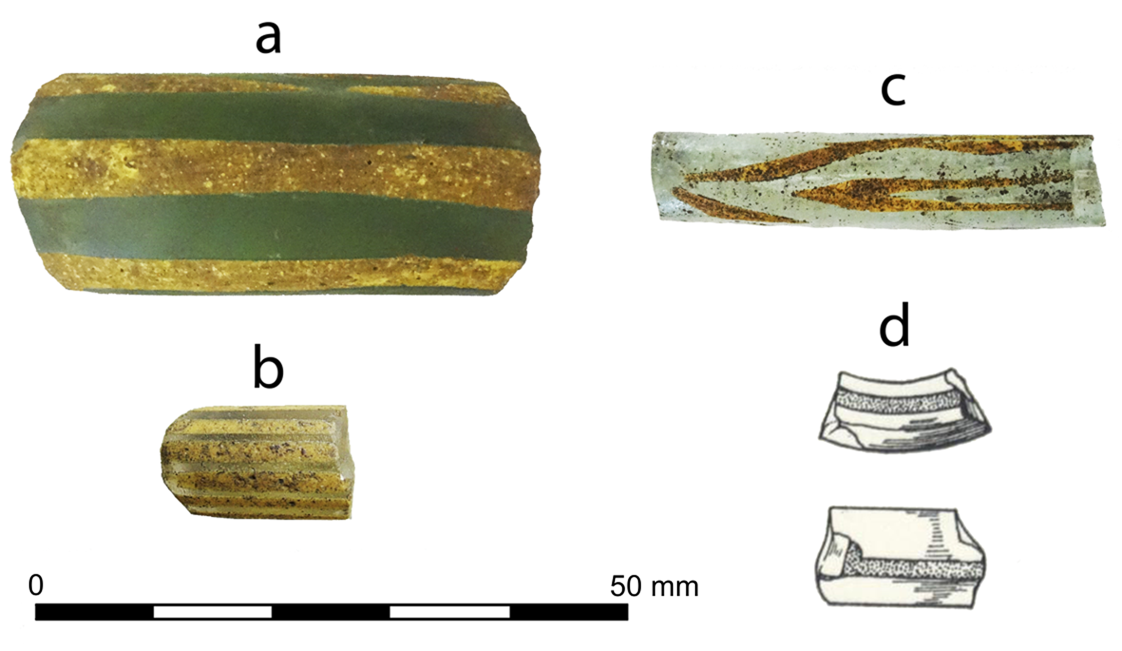
Other evidence suggesting the plausibility of manufacture by a local artisan or artisans are the finds of fragments of four enigmatic bangles at four locations in south-western England. These pieces have not been considered previously in discussions on the emergence of glass bangles in Britain. Ascribed to type 3G, they are usually assumed to be exports from the north, where 18 examples of bangles of that type have been recorded.Footnote 150 Typological group 3G is described as being made of a translucent blue-green glass body and decorated with an opaque yellow inlay, usually in a pot-hook pattern (see fig. 2).Footnote 151 The four bangles from the south stand in contrast to the northern specimens; instead of bearing a pot-hook decoration they have lines applied horizontally on the surface and sides. Base glass colours differ as well. The large bangle found at Shepton Mallet, the Roman period settlement at Fosse Lane, is of emerald-green glass with five such lines; a much smaller but very similar bangle, albeit in greenish-yellow, recorded as ‘possibly from the Meare lake villages’ and now in the collection at Wiltshire Museum, has six lines (fig. 13a and b).Footnote 152 Two other similar bangles are from the Isles of Scilly's Nornour islet and Meare East lake village. Made in translucent nearly colourless glass, they are decorated with opaque yellow lines; the one from Meare East shows a swirling pattern, while the Nornour fragment is too small to establish the nature of its pattern (fig. 13c and d).Footnote 153
Miscellaneous glass bangle fragments from Somerset/Wiltshire: (a) Shepton Mallet (Somerset Heritage Centre, Taunton, acc. no. TTNCM 99–1996); (b) possibly from the Meare lake villages; (c) Meare East (Somerset Heritage Centre, Taunton, acc. no. 84.AA.13/7); (d) from Nornour (after Dudley Reference Dudley1968, 24, fig. 9, no. 39). (Images (a) and (c) © Somerset County Council and South West Heritage Trust, 2018; (b) courtesy of and © Wiltshire Museum, Devizes)

Instead of attempting to categorise these specimens as type 3G, which is northern in distribution, or creating a new type or subtype when only four examples have been recorded thus far, it seems more reasonable to assign them tentatively to a miscellaneous category. Deriving from contexts with limited dating information, it is uncertain whether the four examples are of a much later date than type 2 or an earlier one. What adds some credence to the former notion is the context, dated a.d. 250–300, of the Shepton Mallet piece; this was found in a pit backfilled with domestic rubbish broadly dated from the late first to the third century a.d.Footnote 154 And what adds some credence to the latter is the base glass colour. Emerald-green glass was popular in the early to mid-first century a.d., peaking in the decades leading up to the mid-first century, with glass bowls produced in this colour reaching Fishbourne and Colchester.Footnote 155 However, with the current state of knowledge it is not possible to determine whether the Shepton Mallet glass bangle was produced from the recycled emerald-green glass that found its way to mid-first-century a.d. Somerset. At present, it is simply reasonable to assume that such miscellaneous pieces were created somewhere in the Somerset/Wiltshire area, since no other parallels, neither elsewhere in Britain nor on the continent, have been recorded. We could also consider a range of scenarios: bangles similar to this fragment might have been the predecessors of type 2 bangles – the missing link between continental Augustan and British Claudio-Neronian ones – or an analogous type developed in parallel with type 2 but falling from favour for reasons unknown. Until more examples from stratified contexts are found in southern England, the nature of these enigmatic bangles will remain unclear.
The cases of these four bangles along with the Bryn y Castell pieces emphasise how much remains unknown about the development of the glass-bangle industry in southern England. The existence of possible other types and variability in their production suggest that the development of bangles did not proceed linearly and sequentially, but the current state of the evidence prevents us from drawing a clear picture of this process.Footnote 156 In short, the stylistic genealogies of the artefacts cannot be established beyond their continental La Tène lineage.Footnote 157
ISSUES OF AVAILABILITY
There are other pieces of the puzzle missing, and they will be addressed here briefly.
The first issue concerns information about the availability of bangles. Given the paltry number of bangles found and since they are unusual, innovative objects, they may have been restricted to a privileged few and associated with wealth, exclusivity and exoticism. However, there is no strong evidence that these bangles had any special value or ritual significance. Only one fragment has been found in a location associated with ritual activity – debris of a temple at St Albans – but the dating points to the third century a.d., implying a residual context (appendix 1, no. 25). Apart from this specimen, no bangles to date have been reported from conspicuous places within sites associated with religious practice in southern England.Footnote 158 There is also no indication that bangles had any monetary or similar value – none came from hoards. Furthermore, none have been identified from graves.
Bangles are indeed under-represented in the archaeological record of southern England, especially in the core region of the Severn-Cotswolds. Nonetheless, the quick manufacturing process, with ten minutes being the maximum production time for a single piece,Footnote 159 and the thin distribution patterns of standardised bangles in southern England suggest that knowledge about the objects spread far and wide. It is thus almost certain that many more existed than are currently known, but it remains unclear whether their low recorded number is a product of a dearth of excavations, a limited number of recorded and published reports on small finds or recycling activity in the past.
Regarding the latter, a high level of recycling has been proposed for continental bangles in Britain during the LIA, and recycling of – and trade in – scrap glass was indeed common in antiquity.Footnote 160 Even in later periods, when glass-working in Roman Britain was performed on a far larger scale, finds of glass waste or cullet dumps have been rare, as the craftspeople would have recycled everything available to them.Footnote 161 Even broken glass bangles were suitable for recycling. A type 2 glass bangle from Gloucester (appendix 1, no. 17) may have been prepared for recycling of its blue-green glass. The apex of this artefact, where the twisted cord is usually located, exhibits many conchoidal fractures, suggesting preparation of the piece for recycling through deliberate removal of the multicoloured cord.Footnote 162
A second factor is the limited availability of glass itself and knowledge of how to handle the material. If, as this article suggests, the origins of glass bangles lie in a pre-a.d. 43 horizon, then the evidence should at least indicate that glass was available, as were craftspeople who were knowledgeable and skilled enough to make bangles. As emphasised previously in this article, a regional connection – from Somerset to Gloucestershire – in the spread of knowledge about producing glass objects is possible, and the same can be said about the availability of glass. The Meare lake villages had access to enough glass to make hundreds of beads, and the possibility of glass-working at Hengistbury Head should not be excluded.Footnote 163 Indeed, Strabo mentions that glass vessels were traded with Britain from the continent at the end of the first century b.c.Footnote 164
Additional evidence of regional continuity, not only in terms of skill and glass availability but also with reference to visual preferences for colours, includes the use of opaque yellow glass. Few glass bangles found in south-western England made use of such glass in their decorative schemes.Footnote 165 Opaque yellow was a popular, plausibly widely available, colour in south-western Britain during the LIA, as emphasised by the Hengistbury Head lump of imported opaque yellow glass and the opaque yellow decorations on most beads from Meare East.Footnote 166 However, all the opaque yellows found from this time in Britain differ in their chemical composition, meaning that different opacifiers were used to colour the base glass.Footnote 167 Since evidence of its production in Britain is non-existent, the colour likely reached the sites at which it has been found from different continental workshops.Footnote 168 Scientific analysis of the opaque yellow used in British bangles would thus be welcome, in order to determine where the base glass originated and to compare it with other LIA opaque yellows analysed by Henderson.Footnote 169 A similar conclusion can be reached regarding yet another colour of continental glass bangles from the LIA: cobalt blue.Footnote 170 This colour appears in four fragments from south-western England, but it is currently not possible to determine from where and when it came.
Continuing on the theme of colour and glass availability, it is worth noting that the most common colour of glass finds from post-a.d. 43 Britain is blue-green. This is the colour of popular tubular, unguent glass bottles used to store cosmetics, oils and ointments.Footnote 171 By way of example, vessels made of bluish-green glass from Colchester form a high proportion of such finds from the first period post-conquest.Footnote 172 An analysis of glass consumption in Essex during the early Roman period conducted by Angela Wardle reveals that the overall assemblage of glass is dominated by vessels and bottles made of blue-green glass alongside coloured-glass objects.Footnote 173 Twenty-two of the type 2 bangles from southern Britain are blue-green. Moreover, Usk and Cirencester both have glass bangles of dark brown, golden brown (amber) and emerald green; these are the typical colours specific to the glass produced in the decades leading to the mid-first and the second half of the first century a.d.Footnote 174 Yet again, it is not clear when exactly such glass reached Britain. In line with the comment from Strabo, the presence of a very few early Roman continental glass vessels dating from the late first century b.c. to the early first century a.d. at sites dated to the LPRIA in southern England suggests that some glass arrived in Britain prior to the Claudian invasion.Footnote 175 These vessels tend to be in the polychrome cast tradition, with monochrome blue-green glass vessels beginning to dominate glass assemblages only after the mid-first century a.d.Footnote 176 Thus, it can be speculated that the opaque yellow and cobalt blue glass used in British bangle-making have their origins in the LIA. In other words, the type 2 glass bangles from the south produced in these colours belong to the pre-a.d. 43 horizon. In contrast, bangles produced in blue-green and strongly coloured glass belong to the Claudio-Neronian period. As speculative as it sounds, this may explain why most early type 2 glass bangles are in these colours: it was a matter of scrap glass availability, not of consumer or symbolic preference.Footnote 177
SUMMARY
Building upon the work of Price, I concur that type 2 bangles are the earliest glass bangles produced in Britain and that the appearance of the craft of bangle-making should be placed in the context of south-western Britain. The origins of the artefacts should be placed, however, in the LPRIA, rather than after a.d. 43. The viewpoint that bangles were an exclusively Roman period phenomenon confined to Roman military sites can no longer be sustained in the light of new context information as well as greater awareness of the social and cultural developments and transformations in the transitional LPRIA, of which bangles were plausibly an integral part. Current approaches view the artefactual changes in this period in Britain as a result of the construction of new social relations and the reconfiguration of identities of people who were proactive in their choices as consumers.
In his research on various imported vessels found in southern England, Pitts draws an image of integrated societies in which goods and people traversed a globalised network of cross-Channel links.Footnote 178 Such global networks allowed southern British societies to participate in continental cultural practices and to choose from a range of divergent continental trappings to suit their regional cultural trajectories.Footnote 179 As a product of these networks, British bangles were not simple copies of continental counterparts but reflect the complex processes of innovation, adaptation, cultural connectivity and glocalisation.Footnote 180 While simultaneously sharing and maintaining a cultural genealogy from across the Channel, these objects were reinterpreted to correspond better with local cultural practices.Footnote 181 Arguably, British bangles were regional, innovative variations of pan-regional LIA continental glass bangles, on which the British bangles depended technically and stylistically.Footnote 182
Who brought the craft of bangle-making to Britain, who first made them and who wore them are all unknown, due to the limited available data and thin distribution patterns that reveal only general tendencies. There are tantalising hints that these bangles developed in response to various stimuli and changing circumstances in Britain in the LPRIA and the early Roman period. In particular, the development of how an individual presented their body may have acted as an impetus in the emergence of this new accessory alongside many other objects associated with personal appearance and grooming, including nail-cleaners, mirrors and brooches.Footnote 183
This article advocates for longer chronologies of the development of bangles, suggesting that the idea for them developed in a pre-a.d. 43 horizon. Although some bangles may have been Claudio-Neronian products, the aim of this critical analysis is to show that we should allow for the possibility that other bangles may have appeared earlier than a.d. 43. While the craft may have been continental in origin, the uptake of bangles was strictly regional in south-western England, plausibly due to the history of glass-working in this area, marked by workshops and craftspeople open to the development of new glass products.Footnote 184 We can speculate that the glass-bangle revolution began in two areas: Wiltshire and Somerset, characterised by failed attempts, and Gloucestershire and Avon, which successfully introduced new designs to the market, probably because artisans here could mobilise faster, cheaper production methods that sparked a rise in demand among consumers. The different regional trajectories in the uptake of bangles might also relate to different cultural and social aspirations within the populations. In his research on Severn-Cotswolds material culture, Moore observes that the adoption of material was variable and locally specific, and this could partly explain why northern Somerset has yielded more beads with cords, whereas the Severn-Cotswolds area has yielded more bangles (fig. 4).Footnote 185
Thus, the development of glass bangles in Britain had more to it than meets the eye, to borrow Jundi and Hill's phrasing.Footnote 186 British bangles had become forgotten artefacts, absent from discussions on objects of body adornment from the LPRIA. This article has shown the necessity of adding bangles to analyses of changing practices of personal presentation and the altered identities that were achieved during the period.Footnote 187 Undoubtedly, wearing a colourful, lustrous, glass bangle made an impact within the changing visual and sensory worlds of Britain's inhabitants during this transitional period.
ACKNOWLEDGEMENTS
I wish to thank heartily the following people for permitting me to use particular images of bangles and for granting me access to their collections: Barbara Birley (Vindolanda Trust), Gail Boyle (Bristol Museum and Art Gallery), Alexia Clark (The Museum in the Park, Stroud), Glynn Davies (Colchester Museums), Amal Khreisheh (South West Heritage Trust, Somerset Heritage Centre), Mark Lewis (Amgueddfa Cymru/National Museum Wales, National Roman Legion Museum), Frances McIntosh (English Heritage Trust), Judy Stevenson (Herefordshire Museum Service) and Rob Symmons (Sussex Archaeological Society). Thanks are due to Hilary Cool for sharing the unpublished information on bangles from Gloucester, and Joëlle Rolland and Lesley Lababidi for discussing the production technology of continental and Nigerian bangles as well as sharing films, images and maps.
Lindsay Allason-Jones, Martin Pitts, Angela Wardle and two anonymous referees each offered valuable comments on an early draft of this article, which helped me to sharpen the development of its arguments. Special thanks go to Dr Pitts for also sharing chapters of his book with me, which at the time of writing was forthcoming. I am also grateful to Peter Crew for discussing with me various issues related to the Bryn y Castell fragments; we professionally agreed to disagree about the nature of the pieces. Special thanks are also due to Joep van Rijn for sorting out the maps and images.
The research on which this article is based was funded through the European Union's Horizon 2020 research and innovation programme under grant agreement no. 657309 in the framework of Marie Skłodowska-Curie Actions. I am grateful to the Roman Finds Group, which generously funded the illustration of the Romano-British glass bangle typology, and to the Roman Research Trust, which provided support for the drawing of the manufacturing technique. This article was written during my postdoctoral fellowship in the Leiden Global Interactions Programme at the Faculty of Archaeology, Leiden University. While the article is not a direct outcome of this project, my experiences in Leiden on account of the fellowship greatly contributed to the ideas developed in the text.
Naturally, I remain responsible for the interpretations offered here and any errors.
APPENDIX 1: FINDS OF TYPE 2 GLASS BANGLES IN SOUTHERN BRITAIN (AS OF 2020)
1. Alchester, Oxfordshire
Measurements: H: 8 mm, T: 10 mm, L: 40 mm
Type: 2Ai
Description: colour of the base glass and cord unknown, but description suggests a dark-brown glass used for the base; cord in clockwise twist
Context: –
Location: –
Source: unpub. report; Fraser Hunter (pers. comm.)
2. Baldock, Hertfordshire
Measurements: –
Type: 2Ai
Description: cobalt-blue glass decorated with one cord in cobalt blue and opaque white in clockwise twist; D-shaped cross section
Context: pre-Roman and Roman settlement, Site C, context 36: pit, fill dated to a.d. 70–90
Location: –
Source: Charlesworth Reference Charlesworth, Stead and Rigby1986, 195, no. 897, fig. 84
3. Caerleon, Gwent
Measurements: D (int.): c. 60 mm, H: 8.2 mm, T: 11.5 mm, L: 52 mm
Type: 2Aii
Description: translucent blue-green glass decorated with one cord on the apex and two monochrome marginal lines on both sides; the cord on the apex is cobalt blue and opaque white in clockwise twist; two lines are in cobalt blue; D-shaped cross section
Context: found in block A (barrack), phase III/IV (very mixed layers – the earlier materials found on top, etc.), context 2351, SF 1771
Location: –
Source: Allen Reference Allen, Evans and Metcalf1992, 185, no. 46
4. Caersws, Powys
Two fragments from the same bangle
Measurements: D (int.): c. 62 mm, H: 8 mm, T: 13.5 mm
Type: 2Ai
Description: ‘fragment A: translucent blue-green glass with one cord in cobalt blue and opaque white in clockwise twist, one blob of cobalt blue and opaque white, D shaped; Fragment B: fragment is distorted (twisted and flattened) in a semi-molten state; one end has been heat-smoothed and the other has a fresh break; the cord has been partially (towards one end and part of it) lost due to the fresh break’ (Crew Reference Crew and Britnell1989, 49)
Context: fragment A: find no. 377, context 1234, early Flavian, period 1 destruction levels; fragment B: find no. 416, context 1302, early Flavian, period 1, building 1
Location: –
Source: Crew Reference Crew and Britnell1989, 49, nos 132, 133, fig. 26
5. Canterbury, Kent
Measurements: D (int.): 60 mm, H: 8.29 mm, T: 9.26 mm, L: 64.88 mm
Type: 2Ai
Description: translucent blue-green glass decorated with one cord in cobalt blue and opaque white in clockwise twist; two cobalt-blue and opaque white blobs on the sides; triangular-shaped cross section
Context: C XIII CW 36, defences south of Riding Gate, pre-bank occupation material, c. a.d. 100–80
Location: unknown, not found in the Canterbury Museums and Galleries collection
Source: Charlesworth and Price Reference Charlesworth, Price, Frere, Bennett and Rady1987, 230, no. 65, fig. 92
6. Carmarthen, Carmarthenshire
Measurements: D (int.): 50 mm, H: 7 mm, T: 14 mm, L: 35 mm
Type: 2Aii
Description: translucent blue-green core with a light cobalt-blue glass outer coat decorated with three widely spaced cords; central cord is cobalt blue and opaque white in anticlockwise twist; side cords are grey (weathered yellow?) and opaque white; one side cord is in anticlockwise twist; the nature of the twist on the other side is not possible to determine from the published image; one cobalt-blue and opaque white blob; D-shaped cross section
Context: found in a third-century pit containing some residual Flavian material mixed with late black burnished ware
Location: –
Source: Boon Reference Boon, James and Boon1978, 85, fig. 9.39; Price Reference Price, Price and Wilson1988, 344
7. Chichester, Sussex
Measurements: D (int.): 70 mm, H: c. 8 mm, T: 14 mm, L: 39 mm
Type: 2Ai
Description: translucent ice-blue glass decorated with one cord in cobalt blue and opaque white in clockwise twist; joining of the cords’ ends is visible on the apex; triangular-shaped cross section
Context: found during excavations in Chapel Street, area 8, context X105, possibly late first century
Location: Collections Discovery Centre, Fishbourne, acc. no CHCDM: A02082
Source: Charlesworth Reference Charlesworth and Down1981, 296, fig. 15.3.25; Price Reference Price, Price and Wilson1988, 344
8. Cirencester (Leaholme), Gloucestershire
Measurements: H: 7.5 mm, T: 14.5 mm, L: 17.5 mm
Type: 2Ai
Description: translucent blue-green glass decorated with one cord in cobalt blue and opaque white in clockwise twist; D-shaped cross section
Context: site context DK I 107: occupation levels within the Leaholme fort, phase III occupation, top layer
Location: unknown
Source: Charlesworth Reference Charlesworth, Wacher and McWhirr1982, 106, no. 91, fig. 34.91; Price Reference Price, Manning, Price and Webster1995, 100
9. Cirencester (Leaholme), Gloucestershire
Measurements: D (int.): c. 82 mm, H: 7.5 mm, T: 13 mm, L: 55 mm
Type: 2Aii
Description: translucent ice-blue glass with some streaks of cobalt blue, making it appear cobalt blue; decorated with three widely spaced cords in opaque white and cobalt blue in clockwise twist; D-shaped cross section
Context: site context AM I 56: south-eastern part of insula II, above the filled ditches I and II of the Leaholme fort, possibly late first century
Location: Corinium Museum, acc. no. 1980/53/6
Source: Viner Reference Viner and Holbrook1998, 313, no. 13, fig. 188
10. Cirencester, Gloucestershire
Measurements: D (int.): c. 80 mm, H: 8 mm, T: 11.5–12.6 mm, L: 40.5 mm
Type: 2Ci
Description: golden-brown (‘amber’) glass decorated with three cords laid close to each other on the apex; cords are in opaque white and cobalt blue in clockwise twist; iridescent glass; D-shaped cross section
Context: found during excavations of Parsonage Field in building 2 (private dwelling), tessellated corridor, mortar base of a pavement in use in the third and fourth centuries
Location: Corinium Museum, acc. no. A291/142
Source: Charlesworth Reference Charlesworth and Rennie1971, 88, fig. 11.22; Price Reference Price, Price and Wilson1988, 344
11. Colchester, Essex
Measurements: D (int.): 46.7 mm, H: 8 mm, T: 10.5 mm
Type: 2Ai
Description: translucent blue-green glass decorated with one cord in cobalt blue and opaque white in clockwise twist; visible overlap between two ends; D-shaped cross section
Context: –
Location: Colchester and Ipswich Museums; unrecorded in Colchester Museums Resource Centre; on the bangle itself: no. 596.03
Source: brief mention in Price Reference Price, Manning, Price and Webster1995, 102 (one of the two unpublished examples). The fragment is unpublished; information on the bangle and its context courtesy of Glynn Davies (pers. comm.)
12. Colchester, Essex
Measurements: –
Type: 2Ai
Description: translucent blue-green glass decorated with one cord in cobalt blue and opaque white; twist unknown
Context: –
Location: –
Source: brief mention in Price Reference Price, Manning, Price and Webster1995, 102 (one of the two unpublished examples)
13. Colchester, Essex
Measurements: –
Type: 2Aii
Description: translucent blue-green glass with three widely spaced cords, twisted in the same direction, but unknown whether clockwise or anticlockwise; two edge cords in cobalt blue and opaque white; central cord in yellow-brown and opaque white
Context: –
Location: –
Source: brief mention in Price Reference Price, Price and Wilson1988, 344
14. Claydon Pike, Fairford, Gloucestershire
Measurements: D (int.): c. 70 mm, H: 7 mm, T: 12 mm, L: 27 mm
Type: 2Bii
Description: cobalt-blue glass decorated with four cords in cobalt blue and opaque white in clockwise twist; D-shaped cross section
Context: unstratified, from phase 2 of a settlement in Longdoles Field, trench 13 (possible domestic area)
Location: Corinium Museum, acc. no. 1998/21/3764
Source: Price Reference Price, Price and Wilson1988, 345; Cool Reference Cool2007a, 83, no. 11, fig. 4.7
15. Fishbourne, Sussex
Measurements: D (int.): c. 78 mm, H: 7.5 mm, T: 12.5 mm, L: 45 mm
Type: 2Ai
Description: translucent ice-blue glass decorated with one cord in cobalt blue and opaque white in clockwise twist; D-shaped cross section
Context: FB64/202, 12: period 1, pre-a.d. 75 (pre-Flavian)
Location: Collections Discovery Centre, Fishbourne, acc. no. CHCFB: FB64/G109
Source: Harden and Price Reference Harden, Price and Cunliffe1971, 366–7, fig. 144, no. 109, pl. XXV
16. Fishbourne, Sussex
Measurements: D (int.): c. 75 mm, H: 6.5 mm, T: 14.5 mm, L: 32 mm
Type: 2Aii
Description: translucent ice-blue glass decorated with three widely spaced cords in cobalt blue and opaque white in clockwise twist; D-shaped cross section
Context: FB62/82, 13: 1b–c, occupation, pre-a.d. 75 (pre-Flavian)
Location: Collections Discovery Centre, Fishbourne, acc. no. CHCFB: FB62/G108
Source: Harden and Price Reference Harden, Price and Cunliffe1971, 366–7, fig. 144, no. 108, pl. XXV
17. Gloucester (Kingsholm), Gloucestershire
Measurements: D (int.): c. 75–80 mm, H: 8 mm, T: 14.5 mm, L: 59 mm
Type: 2Ai
Description: translucent blue-green glass with yellow impurities; scar on the apex formed from many conchoidal fractures; cord is missing, possibly deliberately removed; D-shaped cross section
Context: adjacent Coppice Corner (site code 9/83W), XII(9A), SF50; possibly Neronian, as found within Kingsholm fortress; no further information is available as only short interim report was published in Garrod Reference Garrod1984
Location: unknown; not found in Gloucester Museum
Source: brief mention in Price Reference Price, Manning, Price and Webster1995, 100. The fragment is unpublished; information on the bangle and its context courtesy of Hilary Cool (pers. comm.)
18. Gloucester (Kingsholm), Gloucestershire
Measurements: D (int.): c. 75–80 mm, H: 8 mm, T: 15 mm, L: 68 mm
Type: 2Aii
Description: translucent blue-green glass decorated with three widely spaced cords in cobalt blue and opaque white in clockwise twist; one outer cord shows overlap between two ends; D-shaped cross section
Context: adjacent Coppice Corner (site code 9/83W), III(14), SF9; possibly Neronian, as found within Kingsholm fortress; no further information is available as only short interim report was published in Garrod Reference Garrod1984
Location: unknown; not found in Gloucester Museum
Source: brief mention in Price Reference Price, Manning, Price and Webster1995, 102. The fragment is unpublished; information on the bangle and its context courtesy of Hilary Cool (pers. comm.)
19. Kenchester, Herefordshire
Measurements: D (int.): c. 90 mm, H: 12 mm, T: 16.5 mm, L: 40 mm
Type: 2Aii
Description: cobalt-blue glass decorated with three widely spaced cords in opaque yellow and cobalt blue in clockwise twist; two opaque yellow marginal lines on both sides; one blob of opaque yellow and cobalt blue, and another blob of opaque yellow located on the apex on either side of the central cord; D-shaped cross section
Context: found during either the 1912–13 or 1925 excavations; no stratigraphical evidence available
Location: Hereford City Museum, acc. no. unknown
Source: Walton Reference Walton1950, 190, no. 10
20. Littlehampton, Sussex
Measurements: –
Type: 2Ai
Description: green glass decorated with one cord in cobalt blue and opaque white; it is not clear from the published image whether there is a joining of the cords’ ends or a blob placed upon the cord; the nature of the twist cannot be determined from the image; D-shaped cross section
Context: from the excavations of Gosden Road ‘villa’, pit 11, possibly remains of the farmstead levelled for the construction of the villa and then cobbled surface (Gilkes Reference Gilkes1993, 3)
Location: recorded as retained in the Littlehampton Museum, but the object has been misplaced (Jonathan Parrett, pers. comm.)
Source: Gilkes Reference Gilkes1993, 13, no. 3, fig. 6
21. Monmouth, Monmouthshire
Measurements: –
Type: possible 2Ai
Description: a very small fragment of translucent blue-green glass; part of one cord is visible on the apex
Context: found during the excavation of 20–24 Monnow Street, pre-Flavian deposit
Location: in the possession of Jennifer Price in 2018; current location unknown
Source: Price Reference Price, Manning, Price and Webster1995, 100
22. Sea Mills, Bristol
Measurements: D (int.): c. 80 mm, H: 7.3 mm, T: 14.2 mm, L: 32 mm
Type: 2Ai
Description: translucent ice-blue glass decorated with one cord in opaque white and cobalt blue in clockwise twist; D-shaped cross section
Context: from the antiquarian collection of A.G. Selley
Location: Bristol Museum and Art Gallery, register no. F945
Source: Stevenson Reference Stevenson1953–55, 219
23. Somerford Keynes, site at Neigh Bridge, Gloucestershire
Measurements: D (int.): c. 80 mm, H: 8 mm, T: 14 mm
Type: 2Ai
Description: translucent blue-green glass decorated with one cord in cobalt blue and opaque white in clockwise twist; D-shaped cross section
Context: –
Location: –
Source: Cool Reference Cool2007a, CD-ROM sections 5_03_1 bracelets, 5_03_b object no. 868
24. St Albans, Hertfordshire
Measurements: L: c. 20 mm
Type: 2Aii
Description: translucent blue-green glass decorated with three widely spaced cords in cobalt blue and opaque white in clockwise twist
Context: insula V
Location: St Albans Museum, acc. no. 1981.327
Source: unpublished; David Thorold (pers. comm.)
25. St Albans, Hertfordshire
Measurements: –
Type: 2Ciii
Description: cobalt-blue glass decorated with three closely set cords forming herringbone pattern; two side cords in anticlockwise twist, central cord in clockwise twist; image suggests that the central cord is twisted from rods in three colours: opaque white, cobalt blue and an unknown colour; two side cords in cobalt blue and opaque white; joining of the cords is visible on one side cord; marginal opaque white lines on both sides; D-shaped cross section
Context: found in third-century debris over the ‘triangular’ temple (insula VII)
Location: –
Source: Wheeler and Wheeler Reference Wheeler and Wheeler1936, 210, fig. 45.47; Kilbride-Jones Reference Kilbride-Jones1938, 374; Stevenson Reference Stevenson1976, 46
26. Usk, Gwent
Measurements: D (int.): 70 mm, H: 6.5 mm, T: 12 mm, L: 40 mm
Type: 2Ai
Description: dark-brown glass decorated with one cord in cobalt blue and opaque white in clockwise twist; D-shaped cross section
Context: found in post-fortress metalling of road SII, probably residual pre-Flavian or second century
Location: National Roman Legion Museum Caerleon, acc. no. 82.H10
Source: Price Reference Price, Price and Wilson1988, 344; Reference Price, Manning, Price and Webster1995, 104, no. 24, fig. 30
27. Usk, Gwent
Measurements: D (int.): 92 mm, H: 8 mm, T: 14 mm, L: c. 83 mm
Type: 2Ai
Description: dark-brown glass decorated with one cord in cobalt blue and opaque white in clockwise twist; D-shaped cross section
Context: found in a pit in the north-western quarter of the fortress, which may be of the legionary fortress phase; ISF (3)
Location: National Roman Legion Museum Caerleon, acc. no. 82.11H
Source: Price Reference Price, Price and Wilson1988, 344; Reference Price, Manning, Price and Webster1995, 104, no. 25, fig. 30
28. Usk, Gwent
Measurements: D (int.): 90 mm, H: 7 mm, T: 13 mm, L: 78 mm
Type: 2Ai
Description: emerald-green glass decorated with one cord in cobalt blue and opaque white in clockwise twist; D-shaped cross section
Context: found in a pre-Flavian fortress rubbish pit west of the granaries (fortress abandonment or demolition phase); APY (1)
Location: National Roman Legion Museum Caerleon, acc. no. 82.10H
Source: Price Reference Price, Price and Wilson1988, 344; Reference Price, Manning, Price and Webster1995, 104, no. 26, fig. 30
29. Usk, Gwent
Measurements: D (int.): 70 mm, H: 7 mm, T: 13 mm, L: 39 mm
Type: 2Ai
Description: cobalt-blue glass decorated with one cord in cobalt blue and opaque white in clockwise twist; D-shaped cross section
Context: found in pre-Flavian fortress pit and occupational layer outside east gate of the fortress (early Neronian); DSI (5)
Location: National Roman Legion Museum Caerleon, acc. no. 82.10H
Source: Price Reference Price, Price and Wilson1988, 344; Reference Price, Manning, Price and Webster1995, 104, no. 27, fig. 30
30. Usk, Gwent
Measurements: D (int.) on one side: 95 mm, on the other: 80 mm, H: 7 mm, T: 19 mm, L: 55 mm
Type: 2Ai
Description: translucent ice-blue glass with one cord in golden brown and opaque white in clockwise twist; visible overlap between two ends; D-shaped cross section
Context: found in a pre-Flavian fortress pit and occupational layer outside the east gate of the fortress (early Neronian); DSI (2)
Location: National Roman Legion Museum Caerleon, acc. no. 82.10H
Source: Price Reference Price, Price and Wilson1988, 344; Reference Price, Manning, Price and Webster1995, 104, no. 28, fig. 30
31. Usk, Gwent
Measurements: D (int.): 80 mm, H: 9 mm, T: 17 mm, L: 37 mm
Type: 2Ai
Description: translucent blue-green glass decorated with one cord in cobalt blue and opaque white in clockwise twist; D-shaped cross section
Context: unstratified; DSP (1)
Location: National Roman Legion Museum Caerleon, acc. no. 82.10H
Source: Price Reference Price, Price and Wilson1988, 344; Reference Price, Manning, Price and Webster1995, 104, no. 29, fig. 30
32. Weston-under-Penyard, Herefordshire
Measurements: D (ext.): c. 65 mm, H: 6 mm
Type: 2Ai
Description: opaque yellow glass with some dark-brown streaks decorated with one cord in cobalt blue and opaque white in clockwise twist
Context: A/67, trench AII, context 5: indeterminate occupation with many finds but no features
Location: –
Source: Cool Reference Cool2012, 138–9, fig. 4.37, no. 22
33. Whittington Court, Stroud, Gloucestershire
Measurements: D (int.): c. 55 mm, H: 9.5 mm, T: 11.8 mm, L: 27 mm
Type: 2Ai
Description: translucent blue-green glass decorated with one cord in cobalt blue and opaque white in clockwise twist; triangular-shaped cross section
Context: –
Location: The Museum in the Park, Stroud, acc. no. CM.3560
Source: unpublished
34. Unknown, recorded as found at Rockbourne, Hampshire
Measurements: –
Type: 2Ai
Description: translucent blue-green(?) glass decorated with one cord in opaque yellow and another completely weathered colour
Context: –
Location: –
Source: RCHM 1983, 141; Price Reference Price, Price and Wilson1988, 344; Reference Price, Manning, Price and Webster1995, 102
35. Unknown, recorded as found at Penydarren, Glamorgan, but could be Pennal, Gwynedd
Measurements: –
Type: –
Description: –
Context: –
Location: –
Source: Price Reference Price, Manning, Price and Webster1995, 103
APPENDIX 2: FINDS OF LA TÈNE CONTINENTAL GLASS BANGLES IN BRITAIN (AS OF 2020)
1. Balby Carr, Doncaster
Measurements: –
Type: Haevernick 3a; Gebhard series 36 or 37
Description: dark-purple glass, no decoration
Context: associated with first-century b.c. roundhouse
Location: –
Source: Cool and Price Reference Cool, Price, Cool and Mason2008, D11–228
2. Ballacagen, Isle of Man
Measurements: D (int.): 90 mm
Type: Haevernick 10.1; Gebhard series 30
Description: translucent colourless glass with applied opaque yellow glass on the inner surface, making the object appear golden yellow; three ribs; two side ribs are cut in cable pattern
Context: cutting XIII, phase 1
Location: –
Source: Bersu Reference Bersu1977, 63, A43
3. Ballacagen, Isle of Man
Measurements: –
Type: unknown, as found in molten state
Description: translucent colourless glass with applied opaque yellow glass on the inner surface, making the object appear golden yellow; found in molten state
Context: cutting XIII, phase 1, found near A43
Location: –
Source: Bersu Reference Bersu1977, 63, A.81
4. Ballacagen, Isle of Man
Measurements: D (int.): 90 mm
Type: –
Description: translucent pale-green glass, three ribs
Context: cutting XXI, phase 1
Location: –
Source: Bersu Reference Bersu1977, 63, A.44
5. Bath, Somerset
Measurements: –
Type: Haevernick 7b; Gebhard series 14 (broad)
Description: cobalt-blue glass; five ribs; opaque white zigzag pattern on the central and side ribs
Context: –
Location: The Roman Baths Museum, misplaced
Source: unpublished; Verity Anthony (pers. comm.)
6. Castle Dore, Cornwall
Measurements: –
Type: Haevernick 14; Gebhard series 1
Description: translucent blue glass decorated with lines of knots
Context: unstratified
Location: –
Source: Fitzpatrick Reference Fitzpatrick1985, 133; Henderson Reference Henderson1985, 141
7. Castle Dore, Cornwall
Measurements: –
Type: possible Haevernick 6a or 6c; Gebhard series 25
Description: translucent colourless glass with applied opaque yellow glass on the inner surface, making the object appear golden-yellow; D-shaped cross section
Context: ‘later’ post-hole in the area of hut 5
Location: –
Source: Fitzpatrick Reference Fitzpatrick1985, 133; Henderson Reference Henderson1985, 141
8. Hamworthy, Dorset
Measurements: –
Type: Haevernick 3b; Gebhard series 38b
Description: cobalt-blue glass decorated with opaque yellow zigzag pattern
Context: –
Location: –
Source: Smith Reference Smith1935, iii
9. Harlow, Holbrooks site, Essex
Measurements: –
Type: Haevernick 3b; Gebhard form 6
Description: purple glass decorated with opaque yellow zigzag pattern
Context: –
Location: –
Source: Cool and Price Reference Cool, Price, Cool and Mason2008, D11–228
10. Hengistbury Head, Dorset
Measurements: –
Type: Haevernick 3b; Gebhard form 6
Description: purple glass decorated with opaque yellow zigzag pattern; D-shaped cross section
Context: ‘Roman context’
Location: –
Source: Henderson Reference Henderson and Cunliffe1987b, 161, fig. iii.116, no. 129
11. Hengistbury Head, Dorset
Measurements: –
Type: Haevernick 6a/6c; similar to Gebhard series 11a, broad
Description: purple glass; three ribs; opaque yellow zigzag pattern on the central rib; lines of opaque yellow on the side ribs
Context: ‘LIA context’
Location: –
Source: Henderson Reference Henderson and Cunliffe1987b, 161, fig. iii.116, no. 130
12. Hengistbury Head, Dorset
Measurements: –
Type: Haevernick 2; Gebhard series 37
Description: purple glass; triangular-shaped cross section
Context: –
Location: –
Source: Henderson Reference Henderson and Cunliffe1987b, 161, fig. iii.116, no. 131b
13. Hengistbury Head, Dorset
Measurements: –
Type: Haevernick 3a; Gebhard series 36
Description: purple glass; D-shaped cross section
Context: –
Location: –
Source: Henderson Reference Henderson and Cunliffe1987b, 161, fig. iii.116, no. 131a
14. Hengistbury Head, Dorset
Measurements: –
Type: Haevernick 3a; Gebhard series 38
Description: cobalt-blue glass; D-shaped cross section
Context: –
Location: –
Source: Henderson Reference Henderson and Cunliffe1987b, 161, fig. iii.116, no. 131c
15. Llanmaes, Vale of Glamorgan
Measurements: D (int.) on one side: 60 mm, on the other: 58 mm, H: 5 mm, T: 10.5 mm, L: 39 mm
Type: Haevernick 3a; Gebhard series 38 (small)
Description: cobalt-blue glass; D-shaped cross section
Context: late Bronze Age/early Iron Age feasting site with some evidence for Romano-British activity; from backfill
Location: National Roman Legion Museum Caerleon, acc. no. 2008.59H/9.3
Source: unpublished; Mark Lewis (pers. comm.)
16. Meare East lake village, Somerset
Measurements: D (int.): cannot be determined, fragment too small, H: 10.5 mm, T: 17.6 mm, L: 12 mm
Type: Haevernick 7b; Gebhard series 14 (broad)
Description: cobalt-blue glass; five ribs; opaque white chequered decoration on the central rib; a small dot of opaque yellow on the side rib
Context: –
Location: Somerset Heritage Centre, acc. no. 256/1987/75
Source: Coles Reference Coles1987, 87, G66.55, fig. 3.23
17. Messingham, Belle Vue Farm, North Lincolnshire
Measurements: D (int.): 70 mm, H: 12.67 mm, L: 26.77 mm
Type: Haevernick 3b; Gebhard form 6
Description: ‘black-appearing’ glass (possibly very dark purple) decorated with opaque yellow zigzag pattern
Context: –
Location: Scunthorpe Museum
Source: Evans Reference Evans2007, 122, no. 61
18. Piercebridge, Durham
Measurements: H: 4.5 mm, T: 8 mm, L: 22 mm
Type: Haevernick 3b; Gebhard series 38b
Description: cobalt-blue glass decorated with opaque white zigzag pattern; D-shaped cross section
Context: contaminated late Roman ditch fill
Location: –
Source: Cool and Price Reference Cool, Price, Cool and Mason2008, D11–228, fig. D11.82, no. 1716
19. Welwyn Garden City, Hertfordshire
Three pieces of one bangle, possibly used as gaming pieces
Measurements: piece A: L: 38 mm; piece B: L: 18 mm; piece C: L: 2.5 mm
Type: Haevernick 3b
Description: golden-yellow (amber) glass decorated with opaque yellow zigzag pattern on the apex
Context: La Tène III cremation burial, found together with complete glass gaming pieces and three broken beads
Location: –
Source: Stead Reference Stead1967, 17–18, fig. 10, pl. 1, b
20. West Heslerton, North Yorkshire
Measurements: D (int.): 60 mm, T: 11 mm
Type: Haevernick 3b
Description: dark-purple glass decorated with opaque white zigzag pattern; D-shaped cross section
Context: inhumation grave 26 of an Anglican cemetery; associated assemblage indicative of a female. A bangle fragment found together with other glass objects, such as beads and cullet; possibly all were placed in a purse
Location: –
Source: Haughton and Powlesland Reference Haughton and Powlesland1999, 38