Introduction
Sensorineural hearing loss is one of the most common conditions encountered in an otological practice, and it is estimated that 48 million Americans suffer from hearing loss in at least one ear.Reference Lin, Niparko and Ferrucci1 Adults in particular are more likely to have hearing loss in a sloping, high-frequency configuration that is particularly challenging to fit with hearing aids.Reference Pittman and Stelmachowicz2 When using traditional hearing aids, these patients may suffer from over amplification of their own voices (the so-called ‘occlusion effect’) or high-frequency feedback.Reference Lerner3,Reference Boeheim, Pok, Schloegel and Filzmoser4 Other patients with sensorineural hearing loss (SNHL) may simply not tolerate hearing aids because of chronic irritation, poor fit, or chronic otitis externa, making alternative amplification strategies particularly attractive. There is a segment of the hearing loss population that is searching for alternatives because hearing aids have not been an optimal choice (as a result of poor performance, lifestyle issues or other medical issues).
Totally implantable active middle-ear implants are piezoelectric systems which are surgically placed in the mastoid and middle-ear space. This piezoelectric system is composed of a sensor coupled to the body of the incus that transduces incoming sound waves into an electrical signal to a driver coupled to the head of the stapes that then converts the electrical signal to a mechanical force directly on the stapes. The overall effect is direct application of mechanical force as close to the oval window as is practical. The battery and sound processor are completely subcutaneous.Reference Bittencourt, Burke, Jardim Ide, Brito, Tsuji and Fonseca5
When compared with traditional bilateral amplification in larger series, active middle-ear implants demonstrate improved clarity, as measured by word recognition scores and lower speech-reception thresholds.Reference Shohet, Gende and Tanita6,Reference Barbara, Filippi, Covelli, Volpini and Monini7 These results were robust over long-term follow up.Reference Shohet, Kraus, Catalano and Toh8 In particular, implantable middle-ear coupling devices may provide improved high frequency gain in sloping SNHL.Reference Boeheim, Pok, Schloegel and Filzmoser4,Reference Lee, Jeon, Moon and Choi9 Beyond audiometric outcomes, authors suggest that active middle-ear implant users score better on quality of life measures than traditional hearing aid users, even when matched for degree of hearing loss.Reference Ihler, Bewarder, Blum, Matthias and Canis10 Systematic reviews have established that active middle-ear implants are a viable alternative to traditional amplification, making active middle-ear implants an important option for patients who may dislike or struggle with conventional amplification.Reference Butler, Thavaneswaran and Lee11
Critics of active middle-ear implants have cited cost and need for a formal surgical procedure as downsides to these devices. Though cost has been a major concern regarding these implantable middle-ear devices, there is emerging evidence that they still may remain a cost-effective solution for patients with SNHL, as measured by quality-adjusted life-year cost and cost relative to the willingness-to-pay threshold for healthcare systems in a number of nations.Reference Bruchhage, Leichtle, Schonweiler, Todt, Baumgartner and Frenzel12–Reference Snik, van Duijnhoven, Mylanus and Cremers14 However, large studies of outcomes of patients with active middle-ear implants are lacking, and many patients who may benefit from these devices may not be offered an active middle-ear implant as an option. Therefore, it is necessary to continue to report long-term outcomes for these devices so that ideal candidacy can be further refined.
This study represents a large, single-surgeon experience in implanting active middle-ear implants in patients who have failed traditional amplification.
Materials and methods
The Esteem® is the only totally implantable active middle-ear implant approved by the Food and Drug Administration (FDA) in the USA. This implant was used in all study patients.
A retrospective review of 116 implants placed between November 2011 and August 2016 was performed in an effort to capture roughly the first 100 patients implanted by the senior author. Patients were selected based on FDA-approval criteria which are as follows: patient age 18 years or older, stable bilateral SNHL, moderate-to-severe SNHL defined by pure tone average (PTA), unaided speech discrimination test score of 40 per cent or greater, normal Eustachian tube function, normal middle-ear anatomy, normal tympanic membrane, adequate anatomic space for device implantation on high-resolution computed tomography (CT) scan, and a minimum of 30 days of experience with appropriately fitting hearing aids.
These patients reported significant issues with traditional amplification including subjective suboptimal performance and lack of desire to continue using hearing aids. Demographic data were recorded for all patients. Both pre-operative and post-operative audiometric data were collected. Standard audiometry was performed using headphones. Pure tone average in the implanted ear was obtained at 500, 1000, 2000 and 4000 kHz. Word recognition score was obtained at a hearing level of 50 dB to mimic low level conversational speech conditions. Word recognition score was also obtained at PTA plus 40 dB (phonetically balanced maximum). Phonetically balanced word lists were used for word recognition score testing. Although all patients had pre- and post-operative PTA tests, only a subset of patients (n = 18) had a word recognition score at a hearing level of 50 dB performed both before and after surgery. Pre-operative audiograms were done in unaided conditions as all patients being implanted no longer used amplification regularly.
Surgery was performed under general anaesthesia using a transmastoid, extended facial recess approach. Briefly, a postauricular incision was made and a posterior subperiosteal pocket created. A bony well was drilled to accommodate the processor. A complete mastoidectomy was performed, the facial nerve identified and the facial recess was drilled with preservation of the incus buttress. Mobility and vibration of the ossicular chain was verified using laser doppler vibrometry. The incudostapedial joint was separated and a diode laser was used to remove 3–4 mm of the lenticular process of the incus. The laser was also used to clear soft tissue from the stapes capitulum. The sensor was then placed on the incus body and the driver was placed on the stapes capitulum. These are both secured with glass ionomer cement; the mastoid was partially filled with hydroxyapatite cement to assure transducer stability. The wound was then closed in a multilayer fashion. The patient was discharged on the same day of surgery. The device was activated eight weeks post-operatively and programmed by a trained audiologist.
Statistics were performed on Microsoft Excel® spreadsheet software. A Z-test (two-tailed test) was performed for continuous variables. P-values less than 0.05 were considered significant indicating a less than 5 per cent chance of type I error.
Results
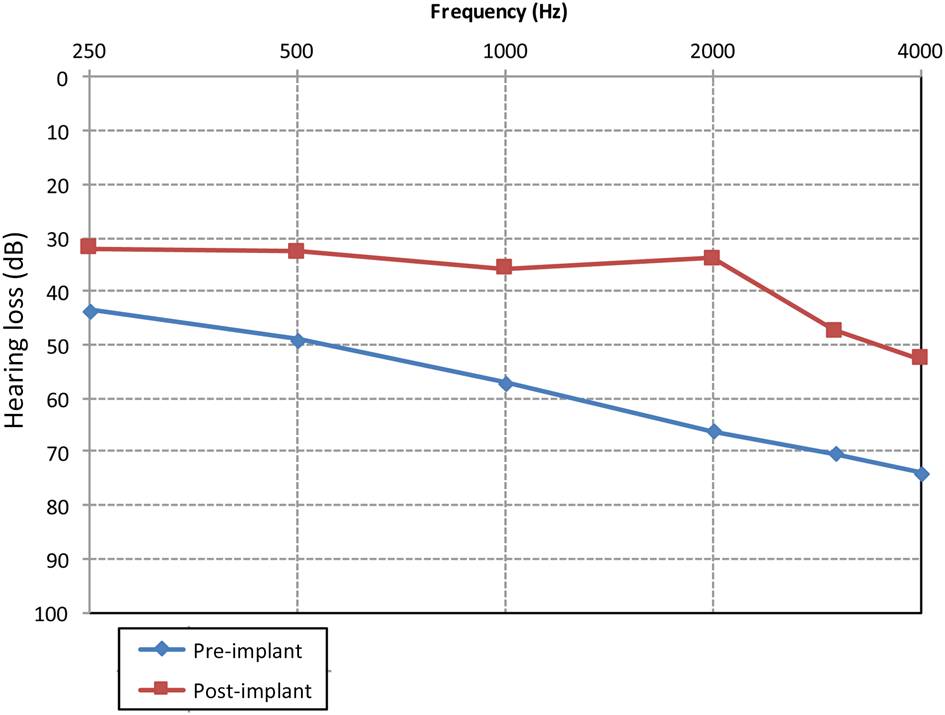
Mean patient age was 58.1 years with a range of 18–89 years (Figure 1), and the majority of the patients were male (66 per cent, n = 76). The most recent post-operative audiograms were used for comparison with pre-operative audiograms; these were obtained at a mean of 10.5 months post-operatively. There were 106 patients who had both pre- and post-operative audiometric data available. The mean pre-operative unaided PTA compared with post-operative values are displayed in Figure 2. Mean PTA pre-operatively was 57.6 dB and was 34.1 dB post-operatively, signifying a mean gain in PTA of 23.5 dB. This difference was statistically significant (p = 0.0002).
Patient ages at time of implantation.

Mean pure tone air thresholds pre-operatively (unaided) and post-operatively for 106 patients. Mean pure tone average (PTA) pre-operatively was 57.6 dB and was 34.1 dB post-operatively, signifying a mean gain in PTA of 23.5 dB (p = 0.0002).

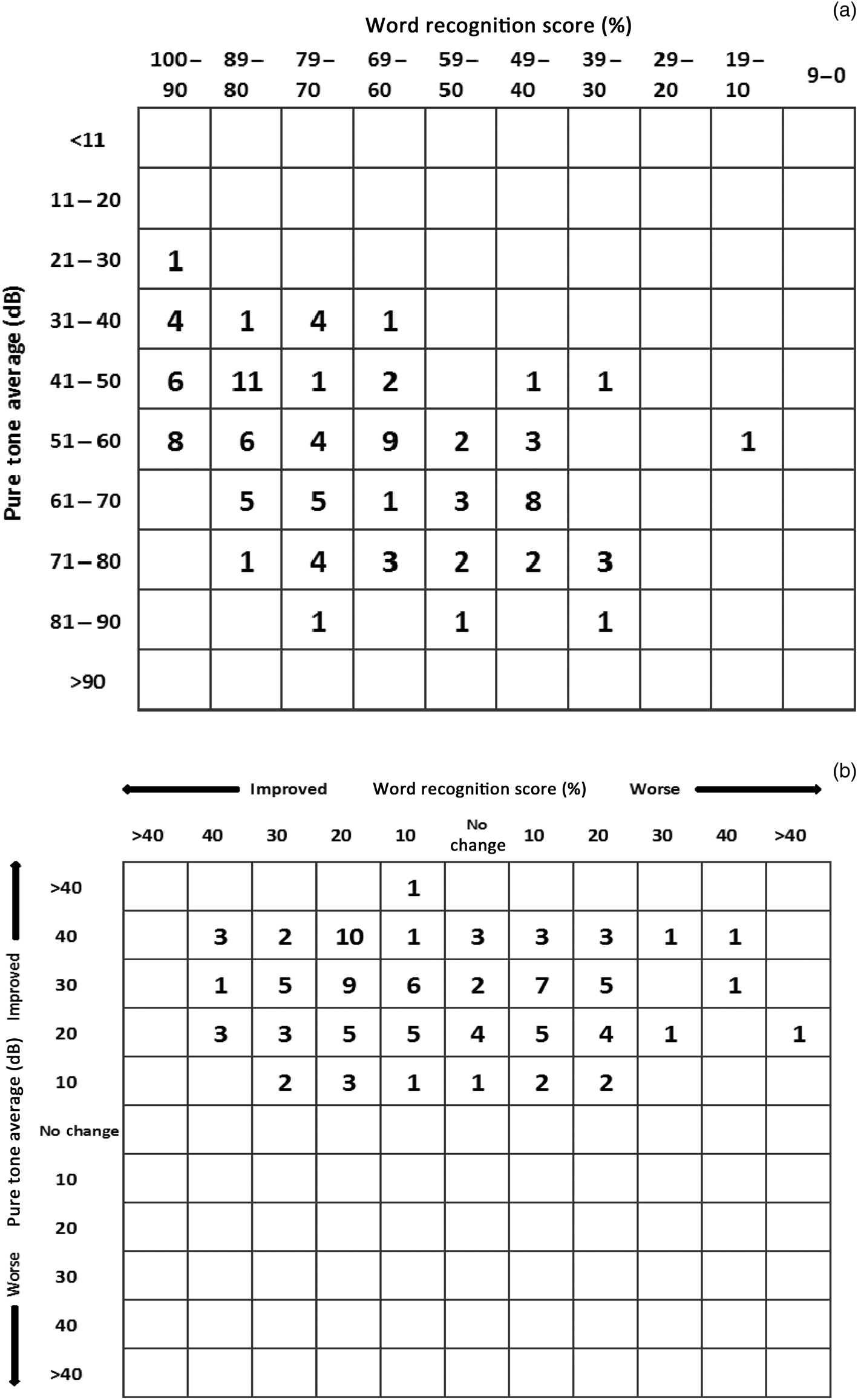
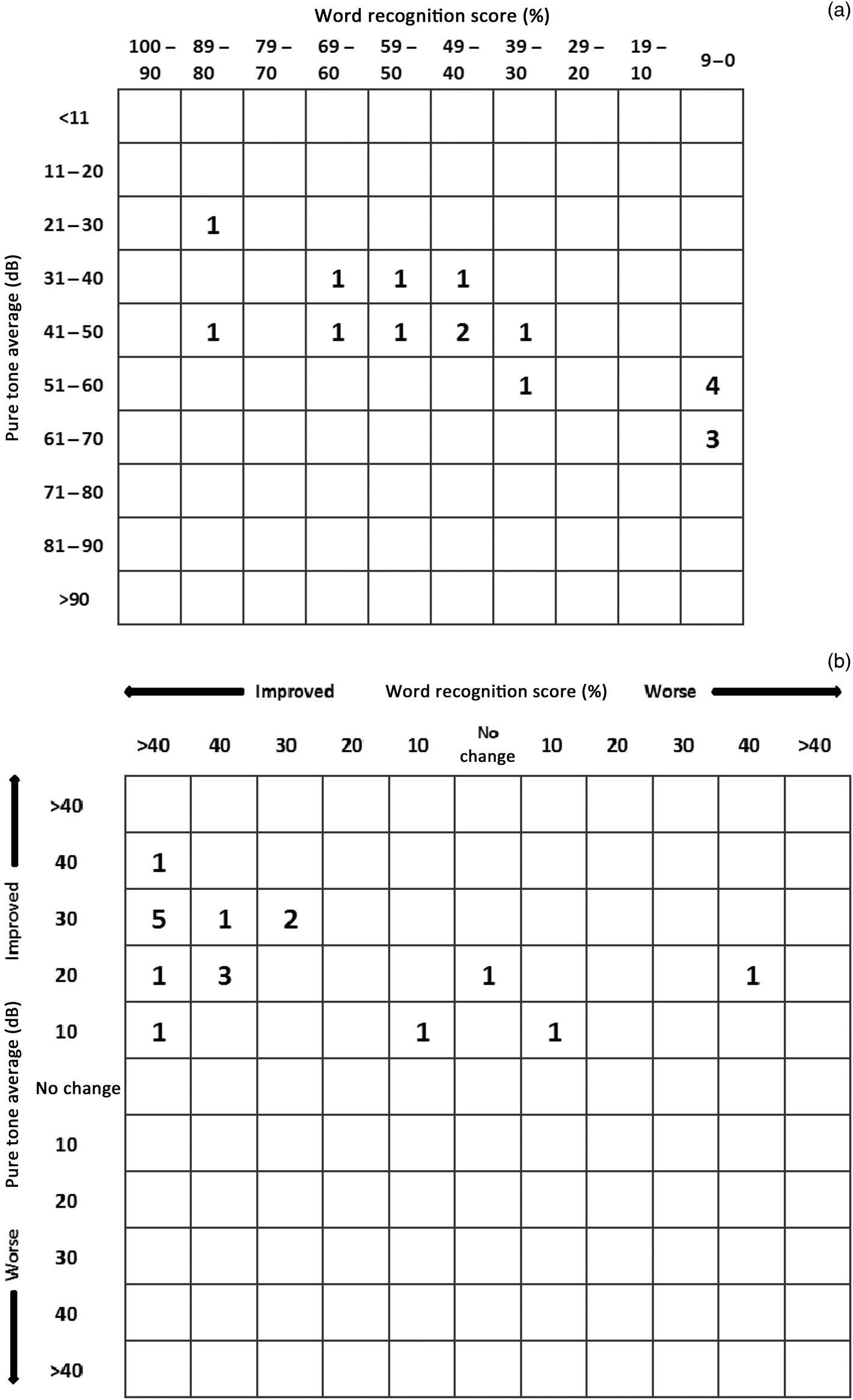
The pre- and post-treatment scattergrams from these patients are depicted in Figure 3. Word recognition score in this group represents the phonetically balanced maximum word recognition scores, which before and after surgery were 70.5 per cent and 75.8 per cent, respectively. This difference was not found to be statistically significant (p = 0.416). Only a small subset of patients (n = 18) had a word recognition score at a hearing level of 50 dB value recorded both pre- and post-operatively. These mean values were 14.4 per cent pre-operatively and 70.4 per cent post-operatively. This difference was statistically significant (p < 0.0001). These data are shown in Figure 4.
American Academy of Otolaryngology–Head and Neck Surgery recommended scattergram summary of hearing pre- and post-implantation. (a) Baseline unaided pure tone average (PTA) and phonetically balanced maximum word recognition score and (b) post-implantation change in PTA and phonetically balanced maximum word recognition score.

American Academy of Otolaryngology–Head and Neck Surgery recommended scattergram summary of hearing pre- and post-implantation. (a) Baseline unaided pure tone average (PTA) and word recognition score at a hearing level of 50 dB and (b) post-implantation change in PTA and word recognition score at a hearing level of 50 dB.

Ultimately, 116 of 122 patients were successfully implanted in our series. Intra-operative abortion of implantation occurred overall in 6 of 122 cases (4.9 per cent) that underwent an attempt at implantation. Five of these cases occurred in the first 60 implantations, while only 1 occurred in the subsequent 66 surgical procedures. Reasons for procedure abortion included low ossicular vibration per laser doppler vibrometry (n = 4), incompatible anatomy with small facial recess or ossicular abnormality (n = 2).
Overall, either revision or explantation was needed in 16 of 116 cases (13.8 per cent). This does not include battery changes, which are expected to occur at an average of five years after initial implantation. Revisions were performed in 10 patients (8.6 per cent). All but one of these was performed for suboptimal hearing outcomes; revision was done via transcanal approach in four cases and transmastoid approach in 6 cases. Revision resulted in a mean 6.4 dB improvement in PTA compared with the initial post-operative result. One patient required soft tissue augmentation with a temporalis flap for impending device exposure.
Device explantation was performed in 6 of 116 cases (4.9 per cent). Four of six explantations were because of sterile dehiscence and device exposure. This patient subgroup is noted to have had risk factors for poor wound healing, including long-term steroid use, overall thin subcutaneous tissue or positive smoking status. The remaining two devices were explanted due to culture-positive infection refractory to antibiotic therapy (Staphylococcus aureus and Pseudomonas aeruginosa). The mean duration of time between implantation and explantation was 183 days (range, 39–584). Patients who were not explanted prior to device activation did get benefit from the device but were explanted nonetheless because of their wound complications. None of the explanted patients were offered repeat implantation ipsilaterally, and none elected for contralateral implantation. All explanted patients had reconstruction of their ossicular chains with appropriate closure of their air–bone gap. Severe complications such as cerebrospinal fluid leak, intracranial haemorrhage, meningitis, facial nerve injury and death were not seen in this series. Other minor complications such as mild taste disturbance and occasional soreness over the implant were not specifically tracked in this case series but were generally self-limiting.
Surgical revision rate dropped substantially over time. In the first 60 cases, there was a need for a second procedure in 21.8 per cent of cases, whereas in the subsequent cases the rate of a second procedure was 6.6 per cent. These include any follow-up procedure excluding battery changes (wound revisions, device adjustments and explantations). This difference was found to be statistically significant (p = 0.026). The rate of aborted implant was also examined in the first 60 versus the later cases, and although a lower rate was found (8.3 per cent versus 1.8 per cent), this was not found to reach significance (p = 0.086). The rate of explantation was similarly examined and did not significantly differ in the first 60 cases versus the subsequent cases (p = 0.379).
Discussion
This study represents a large, single-surgeon experience with active middle-ear implants. Overall improvement in PTA and word recognition score at a hearing level of 50 dB were seen, and these improvements were statistically significant. As a result of a lack of pre-operative patient utilisation, all pre-operative data were obtained in the unaided condition. We saw a mean 23.5 dB improvement in PTA and a 56 per cent improvement in word recognition score at a hearing level of 50 dB. This is consistent with other data reported in the literature, although there are few high-quality studies. Surgical technique, though technically demanding, can be learned by a surgeon with appropriate training and experience in middle-ear and mastoid dissection. There was no statistically significant improvement in phonetically balanced maximum word recognition score. As amplification is not expected to improve upon this value, this result was expected.
Shohet et al. performed a large retrospective case review of 172 ears implanted with active middle-ear implants and found significant improvement in PTA and word recognition score at a hearing level of 50 dB.Reference Shohet, Gende and Tanita6 Post-operative word recognition score at a hearing level of 50 dB achieved in this series was 65.6 per cent, which is comparable to ours at 70.4 per cent. Their study did include data pertaining to baseline aided conditions and showed superior word recognition score at a hearing level of 50 dB in patients using active middle-ear implants when compared with traditional hearing aids. Furthermore, many subjects experienced complete resolution of their tinnitus after implantation.Reference Shohet, Gende and Tanita6 Tinnitus was not specifically addressed in our case series.
• Active middle-ear implants are a safe and efficacious option for patients with sensorineural hearing loss who have failed traditional amplification and meet criteria
• Although technically demanding, implantation is readily learned by an experienced otological surgeon
• Complication rates are low and decrease with time as the surgeon gains experience
• Further prospective data are needed to establish superiority of active middle-ear implants compared with traditional hearing aids
As a result of the general lack of insurance reimbursement, there are few systematic reviews examining active middle-ear implants in the literature. Some studies are of relatively poor quality and limited in scope. However, these studies do indicate good benefit to implanted patients with regard to PTA and word recognition score versus baseline unaided conditions. Comparison of active middle-ear implants versus baseline aided conditions were mixed.Reference Klein, Nardelli and Stafinski15,Reference Pulcherio, Bittencourt, Burke, Monsanto, de Brito and Tsuji16 Ihler et al. performed a small retrospective analysis showing advantages in patient satisfaction using the Glasgow Benefit Inventory of active middle-ear implants over conventional hearing aids.Reference Ihler, Bewarder, Blum, Matthias and Canis10 For a full review of the existing data, the authors direct you to an up to date review by Seidman et al.Reference Seidman, Janz and Shohet17 Of note, most of the patients in our series had previously failed hearing aids and no longer wished to consider using them; active middle-ear implants represented an attractive alternative. Comparing baseline aided data in those patients was therefore not possible because many of them no longer used hearing aids.
Overall, active middle-ear implant complication rates are low. Explantation rates and reasons for it vary, with large studies suggesting a rate of less than 5 per cent, although figures as high as 15 per cent have been reported.Reference Shohet, Gende and Tanita6,Reference Barbara, Filippi, Covelli, Volpini and Monini7,Reference Gerard, Thill, Chantrain, Gersdorff and Deggouj18 Some patients may desire removal because they feel they derive little perceived benefit, while others may experience issues with wound healing. Our explantation rate of 4.9 per cent was related to sterile wound breakdown and infection. No patient in our series has yet desired removal of the implant because of dissatisfaction with hearing. Our rate of revision procedures at 8.6 per cent is lower than the figure reported by Shohet et al. (15.7 per cent).Reference Shohet, Gende and Tanita6 Further, our revision rate dropped substantially after the first 60 cases in this series. This may indicate a substantial learning curve with respect to the procedure; more experience with patient selection, improvement in surgical technique and improvements with device programming may have contributed to this dramatic decline in secondary surgery rate.
Although other authors have reported delayed facial nerve palsy with these implants, none were seen in our series.Reference Barbara, Volpini and Monini19 Six cases (4.9 per cent) were aborted because of limited anatomic space or inadequate ossicular vibration. Pre-operative high-resolution CT of the temporal bone must be obtained prior to surgery to ensure adequate space for the implant. Particular attention should be paid to the distance between the stapes head and the sigmoid sinus, which should be at least 22 mm. In addition, distance between the incus body and the middle cranial fossa should be at least 2.5 mm.Reference Marzo, Sappington and Shohet20 Unfortunately, there is no pre-operative study to ensure appropriate vibration of the ossicular chain in the patient who qualifies for the implant audiometrically and radiographically.
Limitations
Weaknesses of our study include its retrospective nature, which results in unwanted bias and some lack of available data for analysis. For example, because there was lack of baseline aided audiometric data (mainly because of patients no longer using hearing aids pre-operatively), this study does not allow for direct comparison between the active middle-ear implants and traditional hearing aids in our population. In addition, more patient-focused data such as satisfaction scores, tinnitus measures and overall quality of life assessments would be useful moving forward.
Particularly with regard to the word recognition score at a hearing level of 50 dB, there was a lack of data limiting our sample size. This is likely because of the degree of hearing loss present in the unaided condition. Most patients did not have any useful word recognition pre-operatively; therefore, it was not recorded. There were many instances of lack of word recognition score at a hearing level of 50 dB being recorded in patients after surgery as well. We would expect this finding to extrapolate to a larger sample size but cannot conclude that definitively based on our data.
Conclusion
This was a large, retrospective, single-surgeon study showing excellent post-operative results with active middle-ear implants with regard to PTA and word recognition score at a hearing level of 50 dB. Our data further reinforce the safety and efficacy of active middle-ear implants in patients who have failed traditional amplification and meet criteria for active middle-ear implants. Review of existing audiometric data shows a likely advantage of this device over baseline unaided hearing in carefully selected patients, but with some risk related to the surgery.
Complication rates in this case series were significantly lower with increasing experience of the surgeon and were generally lower overall than other published active middle-ear implant reports. Active middle-ear implants should be considered in appropriate patients with moderate-to-severe SNHL who have struggled with traditional hearing aids and are deemed good surgical candidates. There remains a lack of high quality, prospective data in the literature to establish active middle-ear implant superiority compared with traditional hearing aids. Active middle-ear implants represent a viable alternative for those not able or willing to use hearing aids if they meet the strict FDA pre-operative implant criteria for this device.
Competing interests
None declared