




No CrossRef data available.
Article contents
Is eye contact the key to the social brain?
Published online by Cambridge University Press: 20 December 2010
Abstract
Eye contact plays a critical role in many aspects of face processing, including the processing of smiles. We propose that this is achieved by a subcortical route, which is activated by eye contact and modulates the cortical areas involve in social cognition, including the processing of facial expression. This mechanism could be impaired in individuals with autism spectrum disorders.
Information
- Type
- Open Peer Commentary
- Information
- Copyright
- Copyright © Cambridge University Press 2010
References
Bailey, A. J., Braeutigam, S., Jousmaki, V. & Swithenby, S. J. (2005) Abnormal activation of face processing systems at early and intermediate latency in individuals with autism spectrum disorder: A magnetoencephalographic study. European Journal of Neuroscience
21:2575–85.CrossRefGoogle ScholarPubMed
Chawarska, K. & Shic, F. (2009) Looking but not seeing: Atypical visual scanning and recognition of faces in 2 and 4-year old children with Autism Spectrum Disorder. Journal of Autism and Developmental Disorders
39:1663–72.CrossRefGoogle ScholarPubMed
Elsabbagh, M., Volein, A., Csibra, G., Holmboe, K., Garwood, H., Tucker, L., Krljes, S., Baron-Cohen, S., Bolton, P., Charman, T., Baird, G. & Johnson, M. H. (2009) Neural correlates of eye gaze processing in the infant broader autism phenotype. Biological Psychiatry
65:31–38.CrossRefGoogle ScholarPubMed
George, N., Driver, J. & Dolan, R. J. (2001) Seen gaze-direction modulates fusiform activity and its coupling with other brain areas during face processing. NeuroImage
13:1102–12.CrossRefGoogle ScholarPubMed
Johnson, M. H. (2005) Subcortical face processing. Nature Reviews Neuroscience
6:766–74.CrossRefGoogle ScholarPubMed
Kleinhans, N. M., Richards, T., Sterling, L., Stegbauer, K. C., Mahurin, R., Johnson, L. C., Greenson, J., Dawson, G. & Aylward, E. (2008) Abnormal functional connectivity in autism spectrum disorders during face processing. Brain
131:1000–12.CrossRefGoogle ScholarPubMed
Magnée, M. J., Stekelenburg, J. J., Kemner, C. & de Gelder, B. (2007) Similar facial electromyographic responses to faces, voices, and body expressions. NeuroReport
18:369–72.Google Scholar
McIntosh, D. N., Reichmann-Decker, A., Winkielman, P. & Wilbarger, J. L. (2006) When the social mirror breaks: Deficits in automatic, but not voluntary, mimicry of emotional facial expressions in autism. Developmental Science
9:295–302.Google Scholar
Oberman, L. M., Winkielman, P. & Ramachandran, V. S. (2009) Slow echo: Facial EMG evidence for the delay of spontaneous, but not voluntary, emotional mimicry in children with autism spectrum disorders. Developmental Science
12:510–20.CrossRefGoogle Scholar
Senju, A. & Johnson, M. A. (2009a) The eye contact effect: Mechanisms and development. Trends in Cognitive Sciences
13:127–34.Google Scholar
Senju, A. & Johnson, M. H. (2009b) Atypical eye contact in autism: Models, mechanisms and development. Neuroscience and Biobehavioral Reviews
33:1204–14.CrossRefGoogle ScholarPubMed
Senju, A., Yaguchi, K., Tojo, Y. & Hasegawa, T. (2003) Eye contact does not facilitate detection in children with autism. Cognition
89:B43–51.CrossRefGoogle Scholar
Tomalski, P., Johnson, M. H. & Csibra, G. (2009) Temporal-nasal asymmetry of rapid orienting to face-like stimuli. NeuroReport
20:1309–12.CrossRefGoogle ScholarPubMed
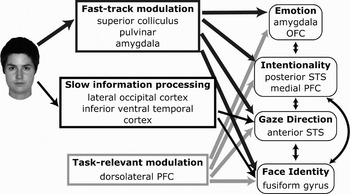
Figure 1. An illustration of the fast-track modulator model (FTM). Perceived eye contact (upper left) is initially detected by a subcortical route that projects to various regions of the social brain network (thick black lines). This signal from the subcortical route then interacts with contextual modulation based on the task demands as well as the social context (thick grey lines) to modulate the response of these regions to the following input from a cortical route (thin black lines). These pathways are based on previous analyses of cortical and subcortical face processing, as well as top-down voluntary attention. OFC=orbitofrontal cortex, PFC=prefrontal cortex, STS=superior temporal sulcus. Reproduced with permission from Senju and Johnson (2009b).
The Simulation of Smiles (SIMS) model proposed by Niedenthal et al. emphasizes the core role of eye contact, which is hypothesized to trigger embodied simulation of the perceived smile. The authors also speculated that the same mechanism may also mediate the processing of other facial expressions. However, eye contact is known to modulate a far wider range of cognitive processes, such as the encoding of gender, identity, and gaze (Senju & Johnson Reference Senju and Johnson2009b). We recently reviewed this phenomenon, which we have termed the “eye contact effect,” and proposed the fast-track modulator (FTM) model to explain its neural and developmental basis (Senju & Johnson Reference Senju and Johnson2009b). In this commentary, we present a brief overview of the FTM model and discuss several areas in which the FTM model complements the SIMS model, and thus would facilitate further exploration of the neural, cognitive, and developmental mechanism underlying the effect of eye contact on face processing.
The FTM model proposes that the eye contact effect is mediated by a subcortical face detection pathway hypothesized to include the superior colliculus, pulvinar, and amygdala. This route is fast, operates on low spatial frequency visual information, and modulates cortical face processing (see our Figure 1). Evidence that the route is fast comes from event-related potential and magnetoencephalographic studies showing that components associated with this pathway can occur at shorter latencies than those usually associated with the cortical processing of faces (Bailey et al. Reference Bailey, Braeutigam, Jousmaki and Swithenby2005). In addition, evidence that the subcortical route modulates cortical processing comes from several functional imaging studies indicating that the degree of activation of structures in the subcortical route (amygdala, superior colliculus, and pulvinar) predicts or correlates with the activation of cortical face processing areas (George et al. Reference George, Driver and Dolan2001, Kleinhans et al. Reference Kleinhans, Richards, Sterling, Stegbauer, Mahurin, Johnson, Greenson, Dawson and Aylward2008). It has also been proposed that the subcortical route is also responsible for face preference in newborn infants (Johnson Reference Johnson2005) and even in adults (Tomalski et al. Reference Tomalski, Johnson and Csibra2009). We hypothesize that the combination of this subcortical pathway and contextual modulation given by the task demands and social context directly or indirectly modulates key structures involved in the cortical social brain network.
An illustration of the fast-track modulator model (FTM). Perceived eye contact (upper left) is initially detected by a subcortical route that projects to various regions of the social brain network (thick black lines). This signal from the subcortical route then interacts with contextual modulation based on the task demands as well as the social context (thick grey lines) to modulate the response of these regions to the following input from a cortical route (thin black lines). These pathways are based on previous analyses of cortical and subcortical face processing, as well as top-down voluntary attention. OFC=orbitofrontal cortex, PFC=prefrontal cortex, STS=superior temporal sulcus. Reproduced with permission from Senju and Johnson (Reference Senju and Johnson2009b).
The FTM model shares several key features with the SIMS model. However, there are several differences between these two models, wherein the FTM model expands and broadens the SIMS model. First, the FTM model proposes the neural mechanism linking eye contact and facilitation of cortical face processing, including the embodied simulation. The FTM model proposes that perceived eye contact directly activates a subcortical route, which then modulates the cortical areas involved in different aspects of social cognitive processing. Thus, it is possible to incorporate the SIMS model by arguing that the subcortical route also modulates the motor cortex, which controls mimicry. The FTM model also provides new predictions about the effect of eye contact on the processing of smiles: It should be fast and operate on low spatial frequency visual information.
Second, the FTM model can also provide alternative hypotheses about the mechanism by which eye contact facilitates the processing of smiles. The FTM model hypothesizes that the subcortical route receiving input from perceived eye contact directly modulates the cortical face processing areas. This contrasts with the SIMS model which assumes that eye contact must elicit the embodied simulation first in order to facilitate the processing of smiles. As we discussed above, the FTM does not rule out the possibility that the subcortical route mediates the embodied simulation in response to eye contact. However, the FTM also leads us to propose a more parsimonious hypothesis: that the subcortical route directly modulates visual cortical areas, which then facilitates the processing of facial expression, including smiles. For example, the FTM model predicts that eye contact modulates the processing of smiles even when the activation of the motor cortex is experimentally suppressed. By contrast, the SIMS model would not predict that eye contact facilitates the processing of smiles under this condition, because embodied simulation is suppressed.
Third, the FTM model presents a unique perspective on the development of the eye contact effect. In the target article, Niedenthal et al. have suggested an interesting hypothesis that the preference for eye contact in infants reflects an evolutionary-based mechanism for triggering embodied simulation, even though they do not discuss how such a mechanism develops. By contrast, the FTM model assumes that infants are born with widespread connections between the subcortical route and cortical structures. As a consequence, input from perceived eye contact initially activates widespread cortical structures, which combines with architectural bias to form specific connections between the subcortical “eye contact detector” and relevant cortical and subcortical structures during the course of development. Interestingly, recent studies on the early development of autism spectrum disorder (ASD), with manifest atypical patterns of eye contact behaviour, are consistent with the predictions based on the FTM model. Even though infants and young children with autism show apparently typical eye contact behaviour (Chawarska & Shic Reference Chawarska and Shic2009), neuroimaging studies demonstrate more widespread and non-specific cortical activation in response to eye contact (Elsabbagh et al. Reference Elsabbagh, Volein, Csibra, Holmboe, Garwood, Tucker, Krljes, Baron-Cohen, Bolton, Charman, Baird and Johnson2009), and behavioural studies demonstrated that eye contact does not facilitate cognitive processing in children with ASD (Senju et al. Reference Senju, Yaguchi, Tojo and Hasegawa2003). These studies suggests that infants and young children with ASD are sensitive to eye contact, but that it fails to modulate cortical face processing in the same specialized way as typically developing children (Senju & Johnson Reference Senju and Johnson2009a). Future studies will need to test whether eye contact elicits facial mimicry and affects the processing of smiles in individuals with ASD, especially since current evidence is inconsistent as to whether individuals with ASD show spontaneous facial mimicry (Magnée et al. Reference Magnée, Stekelenburg, Kemner and de Gelder2007) or not (McIntosh et al. Reference McIntosh, Reichmann-Decker, Winkielman and Wilbarger2006, Oberman et al. Reference Oberman, Winkielman and Ramachandran2009).
Eye contact plays a critical role in face-to-face communication, and we propose it is the key to adaptively modulate many aspects of social cognition, including the processing of smiles. We hope the areas of overlap and contrast between the SIMS and the FTM models will generate empirical studies, and help further understand the neural, cognitive, and developmental mechanisms underlying human social behaviour.
ACKNOWLEDGMENTS
Atsushi Senju was supported by an ESRC Research Fellowship (RES-063–27–0207), and Mark H. Johnson was supported by the UK Medical Research Council (G0701484).