Recollections
When I was a teenager, no matter how much time I put into my daily practice I was still anxious going to instrumental lessons as I was afraid of making mistakes. The physical symptoms I felt before these lessons were sweaty hands and butterflies in the stomach.
The good teachers have spent more time and used different learning strategies to help me to overcome my difficulties. The music teachers who have influenced me greatly have similar characteristics, those of caring, encouraging, and providing a wide range of musical styles. They have never given up on me, devoted time to listen to me and were careful in interpreting musical ideas and did not over-criticise my mistakes.
One of my instrumental teachers would spend more time with students who would perform in musical competitions and who would gain musical scholarships rather than spending time with ‘less able’ students. I felt under-valued and couldn't do anything about it.
The music teachers I thought weren't so good often had low expectations of me. However, the attitude towards students who they thought were talented was very different. (Quotes from a music pupil's learning diary)
These recollections of a music pupil's experience of learning with different instrumental teachers highlight the impact of teaching styles and behaviours on motivation and enjoyment of learning. Can we accept that negative learning experiences hinder progress? Is there a ‘map’ or a model of teaching styles and behaviours that promotes effective instrumental teaching and learning? What actually count as positive learning experiences? Can these be acquired in any instrumental teaching context? Clearly, this particular pupil had negative as well as positive experiences while learning – in this case – a string instrument. At several points she was made to feel bad about her progress, to the extent that it affected her general well-being. Are these experiences commonplace among other pupils?
Blame is a negative and antagonistic strategy that is far too often used by teachers in their teaching, as this pupil experienced. The hierarchy between the instrumental teacher and pupils can create a conceptual gap and a relationship of unbalanced power (Jorgensen, Reference JORGENSEN2001; Durrant, Reference DURRANT2003). Indeed, Jorgensen described how teachers adopt more dominant behaviour in the teacher–pupil relationship and ‘practice routines seemed to be left totally to the students’ own initiative and responsibility’ (p. 69). In the early instrumental learning experiences described above, the teaching approach was mainly teacher-centred rather than pupil-centred.
Similarly, the blame culture can have an impact on physical well-being and develop tensions that themselves can affect belief-systems, self-perceptions and ultimately self-esteem (Gorman, Reference GORMAN1999; Thurman & Welch, Reference THURMAN and WELCH2000; Durrant, Reference DURRANT2003). Trying and controlling pupils are born out of a history of threats to well-being – of not being ‘good enough’ and of disappointing a parent or teacher, followed by some sort of abandonment or other unpleasant consequences.
In order to gain further insight into aspects of effective teaching and learning, this study sets out to explore in detail the teaching of one particular instrumental teacher, who is recognised within her profession and the local education authority as effective. It sets out to determine the factors that constitute effective instrumental teaching and the interactions and interdependence between these factors.
Teacher effectiveness
Any model of effective instrumental teaching has a wide range of contributing factors (Abeles et al., Reference Abeles, Goffi and LEVASSEUR1992; Tschannen-Moran et al., Reference TSCHANNEN-MORAN, HOY and HOY1998). Hamann et al. (Reference HAMANN, LINEBURGH and PAUL1998) acknowledged that the teacher's social skills such as presentation and delivery, energy and enthusiasm, verbal and nonverbal communication skills and the ability to relate to and interact with pupils contribute significantly to overall effectiveness. They noted that effective music teachers tend to possess excellent skills in delivery and communication as well as in planning. Yarbrough & Price (Reference YARBROUGH and PRICE1989) put forward three stages of direct instruction: (i) attention grabbing before presenting the task; (ii) presenting the task to be learned (teacher's verbalisation) and requiring the pupils to interact with the task and the teacher (pupils’ participation); (iii) reinforcing by immediate praise or corrective feedback to pupil's right or wrong responses (approval versus disapproval). This model was introduced in elementary music teaching and ensemble rehearsals and results showed significant improvement in instrumental intonation and performance, a high rate of pupil attentiveness and positive pupil attitudes. Mackworth-Young (Reference MACKWORTH-YOUNG1990) found that the pupils' experience of their lesson affected the quality of their learning and their enthusiasm to continue. This point is reflected in the pupil's reactions illustrated above. Although there is a tendency in the professional music world to base the evaluation of instrumental teaching and learning on pupils’ performance and examination results, we need to open our minds to look for the true value of the teaching and learning process.
Grant & Drafall (Reference GRANT and DRAFALL1991) conducted a literature review on for teacher effectiveness and found that the term was commonly used to mean ‘the consequences of teachers’ actions on pupil learning as measured by standardized achievement tests’ (p. 31). They also acknowledged that teacher effectiveness is a matter of definition and it is a misconception to evaluate it by achievement tests only. Schmidt (Reference SCHMIDT1998) explored the definitions of ‘good’ teaching and found that understanding its principles depended largely on teachers’ own individual experiences with parents, colleagues, assistant teachers and pupils. The definitions of the good teachers were constructed through the collection of experiences which had transformed their individual definitions and beliefs about what ‘good’ teaching was. Furthermore, Schmidt wondered whether the characteristics of good teaching can ever be universally defined and objectively evaluated.
Hamann et al. (Reference HAMANN, LINEBURGH and PAUL1998) acknowledged that social skills, identified as emotional expressivity, emotional sensitivity and social control, significantly enhance teaching effectiveness. Creech & Hallam (Reference CREECH and HALLAM2003) stressed that a fundamental element of effective teaching is good interpersonal communication. Effective teachers maintain a dynamic dialogue between the in-school and out-of-school lives of their pupils and demonstrate dimensions of mutual control, responsiveness and involvement as part of their teaching. They also found that teachers who are highly involved share decision making with the pupils and parents.
Teaching aims and approaches
Reid (Reference REID2001) remarked that the goals of learning music are more than just gaining the technical skills of playing an instrument and performing, and that music teachers who only focus on the outcome of pupils’ performance have a limited conception of instrumental teaching and neglect the quality of the pupils’ total learning. Mills & Smith (Reference MILLS and SMITH2003) studied 134 instrumental teachers for local education authority music services in England and found the common aims for instrumental teaching were for pupils to have fun, participate and make progress. Clearly, this was not always the case in the pupils’ experiences. Rife et al. (Reference RIFE, SHNEK, LAUBY and LAPIDUS2001) reported that there were differences between pupils’ and teachers’ goals, attitudes and learning objectives in private music lessons and elementary school music education. For example, ‘students liked playing melodies on musical instruments, whereas teachers favoured listening, acquiring knowledge of harmony, melodic rhythm, and musical structure’ (p. 23). This possibly suggests that instrumental teaching has a more ‘serious’ edge than the music taught for enjoyment's sake in the classroom.
Reid (Reference REID2001) observed that teachers needed to use different teaching strategies and techniques to adapt to the needs of different pupils, and they were encouraged to design activities to allow pupils to encounter all aspects of musicality within a musical and communicative framework. According to Mills & Smith (Reference MILLS and SMITH2003), some instrumental teachers focus on the progress pupils make through lessons, other teachers focus on opportunities available to the pupils, and yet others focus on the particular teaching skills the teachers should develop. Therefore, teachers have different teaching aims in their practices and form a variety of teaching approaches accordingly.
Mackworth-Young (Reference MACKWORTH-YOUNG1990) acknowledged that ‘the conventional piano lesson is teacher-directed, the teacher has the dominant role and the pupil is seen as a subordinate, dependent learner’ (p. 74). She found that encouraging pupil-directed and negotiated learning with secondary school-age pupils contributed to effective teaching. The pupil-directed methods have been found to encourage, challenge, foster curiosity, develop self-responsibility and create favourable attitudes. However, teacher-directed methods may be more effective to achieve certain aims and objectives for different pupils. The negotiation between the teacher and the pupils could increase enjoyment, interest, positive attitudes, motivation and progress and develop a better teacher–pupil relationship.
Mawer (Reference MAWER1999) advocated incorporating music analysis to enhance instrumental teaching. The study used a string teaching method called ‘voice-leading for strings’ developed by Nelson, Rolland and Suzuki, supplemented with Kodály's hand-signs. The result of this research was that this method stimulated intellectual enquiries and creative interpretation, honed improvisation skills and aided technical issues of pitching, fingering, position shifting, ornamentation, phrasing and bowing. This approach is based on a holistic educational ethos that ‘sought to keep physical skills, aural awareness, and reading ability in balance within whole-class teaching’ (p. 180). Such an approach moves beyond the exclusive concentration on performance technique in instrumental teaching that was found to be de-motivating in the pupil's experiences illustrated above, and may well contribute to a more interactive and creative teaching style.
There is an implicit notion, probably promoted by the conservatoire model of instrumental teaching, that one-to-one teaching represents the optimum learning experience. Such a model fails to recognise the value of interaction among the learners themselves. Thompson (Reference THOMPSON1984) investigated the effectiveness of group teaching and proposed that, at the outset, lessons should be more frequent than once a week and between 40 and 45 minutes long. Detailed preparation was necessary in the early stages of teaching a group in order to involve all pupils at all times. Schmidt (Reference SCHMIDT1998) acknowledged that, in order to keep all the pupils involved, factors such as the teacher's pacing, working alternately with individuals, small sections and the ensemble are extremely important within the group teaching context.
In summary, researchers in the field have studied a range of factors in the development of effective instrumental teaching and learning. Although there may not be an agreement about universal characteristics of an effective instrumental teacher, the researchers agree that teaching aims which emphasise fostering pupils’ learning, facilitating a learning environment and promoting independent learning contribute greatly to effective instrumental teaching. In order to gain further insight, we decided to carry out an in-depth study on one particular string teacher teaching in a variety of group and one-to-one contexts, to ascertain what characteristics are identified as effective in each situation.
Methodology: a qualitative research perspective
This study focuses in depth on a single case – one violin teacher in four teaching situations. The teaching situations occurred in formal school music classes and less formal private ensemble and individual instrumental lessons. The analysis explores the dynamics and processes that the teacher undergoes in these situations. We also investigate the complexities and interdependence of various factors that occur in effective instrumental teaching by deciding upon a single case study as the research method (Hamel et al., Reference HAMEL, DUFOUR and FORTIN1993; Travers, Reference TRAVERS2001). The research questions in this study are:
(i) how does the subject set the teaching goals and the use of various teaching methods?
(ii) what are the characteristics of the subject's teaching strategies?
(iii) what is the subject's meta-level of reflecting on her teaching experience?
(iv) what does instrumental teaching reveal about the relationship between the teacher and pupils?
(v) what does effective instrumental teaching and learning actually mean?
We choose a single case study as a research method based on the following reasons: (i) it can be used to advance understanding of contributions in the single case and draw more valid inferences from the investigation; (ii) the design of a single case study can assess generalisation, and dismantle compound elements in the study (Kratochwill, Reference KRATOCHWILL, Kratochwill and Levin1992). We find that through conducting a qualitative single case study, we can focus more on generating rich and complex descriptions and explanations to develop understanding and interpretation of phenomena on the subject's instrumental teaching in different contexts. This study aims to contribute to some holistic and evolving understanding (Bisesi & Raphael, Reference BISESI, RAPHAEL, Nauman and McCormick1995) of effective instrumental teaching.
Neuman (Reference NEUMAN2003) stated that the characteristics of qualitative research reveal social reality and cultural meaning. In this study, the data are gathered through interactive processes and events from observations, field notes and interviews. The authenticity of the collected data is confirmed by the subject for its integrity and reliability. This study presents a picture of the specific details of a situation and relationships and reasons ‘why things are the way they are’ (Neuman, Reference NEUMAN2003: 31).
The research follows naturalistic and phenomenological approaches (Aigen, Reference AIGEN and Wheeler1995) to investigate different instrumental groups and interactions in their natural settings. The intention is to discover essential constituents of instrumental teaching and underlying themes as they emerge, drawing comparisons between styles of music teaching in the different observational settings.
The criteria of the single case selection are on the basis that the teacher:
• was recommended by the local authority and, in particular, by one experienced headteacher in that authority who is a music graduate;
• has a great deal of instrumental teaching experience;
• has experiences in instrumental teaching in a variety of contexts and teaches pupils across a wide age range (from primary school to college);
• is teaching string ensembles in the contexts of small groups and whole-classes in different schools;
• was available during the research period: April–May 2005.
One single case was chosen for observations and interviews and as a representation of string teaching. The subject was contacted in person and on the telephone and agreed to take part in the study. She had also taught in the Tower Hamlets Project (Nelson, Reference NELSON1985) and had supportive working relationships with colleagues who had also worked in the Project.
Many hours were spent in direct personal contact with the subject (hereafter referred to as ‘D’), who was interviewed and observed in her classroom and private teaching. Analysis was made of the (recorded) conversations. Analysis of observations included consideration of non-verbal communication in order to understand the subtle interactions between D and her pupils in each learning situation.
The data were collected from:
(i) one observation of large group teaching in a north London primary school;
(ii) observations of four small group teaching situations in the same school;
(iii) observations of two small private group ensembles in D's house;
(iv) one observation of an individual pupil in D's house;
(v) an extensive interview with D.
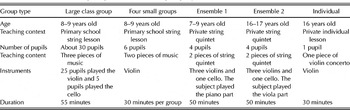
After completing the observation and interview, all the verbal data were recorded on a minidisk. In the observation section, there were eight different group string teaching lessons taught by D. In the interview, D explained her personal philosophy on the teaching methods and relevant issues. The data were collected, coded and indexed so that they can be managed into meaningful categories. A systematic and logically progressive approach is required for analysis of qualitative research. Observational methods (Delamont, Reference DELAMONT1992; Neuman, Reference NEUMAN2003) were used to collect the data in a detailed and systematic way. The primary school observation for the group lessons is located in a densely populated, low socio-economic status area in north London. Table 1 indicates the nature of and the differences between the groups.
The basic information regarding the differences among the groups

Data analysis
This study adopts a paradigm which attempts to describe systematically an instrumental teaching phenomenon and provide information about the teaching and learning situations of D and the pupils. The following observational reports describe how D designed her teaching aims and approaches in different settings.
Observations
The large class group
In the large group string lesson, pupils showed keen attentiveness and concentration particularly in the singing activities. Teaching focused on playing through the pieces many times and having fun.
The small groups
The four small groups were the back-up lessons for the large class group and reinforced techniques and music reading by practising the difficult passages in the music. In these sessions, pupils focused on playing smaller phrases by taking turns. D's feedback to the pupils focused on rhythm and fingering rather than intonation.
Ensemble one and two
In the ensemble lessons, the teaching content focused more on technique, intonation, pitch, harmony and dynamic change. Pupils rehearsed one to two pieces in string quintet format, concentrating on sight reading; they practised certain difficult passages with differing instrumental combinations.
Individual lesson
In the individual violin lesson, there was a great deal of interaction between the pupil and D. Contrary to Thompson's (1984) belief, the pupil initiated the discourse and learning activities most of the time. D's emphasis in the discourse was on musicality, musical understanding, technical issues and intonation. She sang the phrases and counted beats when the pupil struggled with playing.
Interview
During D's interview, she stressed the importance of effective organisation and design of a lesson which is determined primarily with teaching aims and objectives. D thought it more important for pupils to learn and enjoy playing the instrument than to sit grade examinations. The learning goals appeared to be non-negotiable; she sets some informal targets for the pupils to be able to play after one or two years of learning. She structured and planned for them to take part in a small concert and, regardless of their state of readiness, they played to their parents at the end of each term. This was considered to be a good discipline in their instrumental learning. For the private pupils, the performance arena was a familiar environment with small, empathetic audiences. These occasions were not threatening, very informal and normally provided good performance experience for the pupils. ‘Trying to do something’ had become the motivating factor for D to organise all the performance events for the pupils.
A more general aim was to teach the pupils how to solve problems themselves. ‘To develop students’ independence in their learning is important’ and they might find their own ways to deal with various problems. D declared that finding the appropriate repertoire was the most important aim, which increases the motivation to learn.
If you give a child a piece that they really like, even it is really difficult, they will improve . . . They will learn it and they will come on a lot. If you gave them a piece they hate, they won't learn it in a hundred years. So I suppose a very important aim is to engage every child, try to make sure every child gets something they like playing and they are interested in.
D also considered it important to give pupils certain pieces based on their own initiative. She reported being always delighted when pupils showed their enthusiasm for playing certain pieces that other pupils played in the concert and encouraged them to try the piece they liked, whether the piece was too difficult for them or not. After a year, they would review musical repertoire together. This was a good way to help them to evaluate their learning. To conclude, D indicated that her teaching priorities were:
• Having fun and interesting lessons
• High expectations and informal targets
• Developing problem-solving skills
• Developing independence in learning
• Appropriate repertoire
• Motivation in learning
• Engaging pupils’ learning
• Providing performance opportunities and positive experiences
D needed to prepare for the pupils’ performance by choosing appropriate repertoire. Sometimes she would give them a challenging piece and an easy piece according to individual ability. Concert performance pieces were only ones that had been thoroughly prepared, put away for a while and then revised.
The students could learn the challenging piece, put it away for a while and relearn it again. The easy piece is for them to play in the concert.
The music has time to rest and mature in the students’ brains, when they revise the piece the performance tended to be more satisfying.
In her teaching, she adopted flexible approaches for individual needs and took into account the different pace of each individual's progress.
Some of the students had a good ear, learned things quickly and remembered them afterwards. Other students might not be so able in this respect and it took longer for them to learn.
D thought that teachers needed to be patient, encouraging and able to adjust the pace with differing materials at the same level to help pupils to learn. She thought that pupils enjoyed the things they could do and they could always learn. Therefore, it was evident that providing new pieces at the same level may actually prevent tedious, unchangeable routine and ‘provide a freshness in students’ learning’. Furthermore, finding the appropriate repertoire or rearranging music for the players who have a slower learning pace was considered necessary.
When I try to allow some of them to go slower, that sometimes gets hard on ensembles. It is obvious if a younger child who was very good and the older one who is not and the younger one's sort of overtaking all the time and you have to be a bit tactful. And find the right repertoire, to make easier paths and to rewrite things sometimes.
Reading notation was an important objective in D's teaching. She used letters, fingers and the sol-fa system to teach pupils music notation. In the observations in the primary school, the pupils were getting to read the notes and letters and link up with the violin fingering. This emphasis on notation was in contrast to the Suzuki method. D remarked that
in Suzuki method, the pupils play more advanced pieces with faster progress but their reading skills were usually less advanced . . . I prefer the pupils’ progress to go more slowly, but with their reading keeping up with their playing.
D often used the piano to provide an accompaniment in the lessons. She thought that piano accompaniment was ‘very important because it provided a harmonic basis’. This method especially worked well with less advanced pupils:
they needed many easy pieces with interesting piano parts to make the piece sound good.
Together with a mixture of different musical styles, pupils’ performance would ‘sound fantastic’ and it increased their satisfaction in their learning.
The inter-personal skills of the teacher also influence teaching effectiveness. One of D's professional responsibilities was being the leader of the large string group in the school and she needed to ensure that the lessons were running smoothly with her team. If there was a problem in lessons or in teacher–pupil relationships, D needed to work out the issues with the others. It was also essential that the relationships between her and the assistant teachers were well established and the communication was fluent.
In communicating, D used positive feedback to encourage the pupils most of the time. She tried to think of something good to say to them, such as ‘you were standing very nicely’ rather than ‘it sounds awful’ or ‘your playing is completely out of tune’. She indicated that it was important to focus on one aspect at a time, set the priorities for the pupils and have realistic goals.
If young students are struggling in reading, then they are probably not listening to their intonation very well.
She often asked pupils to learn an easier piece by heart and concentrate on intonation. In doing so, she created opportunities to tell pupils that their playing was really well in tune. She found that if a teacher praised her pupils, in general the pupils learned better. She mentioned that:
it is not difficult to give out praise and it could help in pupils’ learning.
During the interview, it became apparent that D considered it essential to reflect upon and evaluate her own teaching. As a result, we wanted to understand more deeply her beliefs and the assessment criteria she utilised in this discourse, since there are interdependent relationships between beliefs, intentions and actions in teaching. Her self-evaluation criteria included:
• Low drop out rate
• Pupils enjoying the lesson and coming willingly
• Pupils’ improvement in performance
• Pupils’ attitudes when they talked about the music lesson
• Developing skills in problem solving and independent learning
• Peer learning
• Recognising what the pupils think they are capable of
• Active learning and motivation: pupils gained something they could remember and they wanted to play
• Enabling pupils to feel comfortable in their playing and in their posture
• High enrolment rate: popular with abundant supply of pupils
• Pupils had good, positive and valuable experience in learning
• Capability of coping with frustration
D explained that it was unusual for her pupils to give up instrumental learning and they often carried on for years. Most pupils were pleased to come to the music lesson and enjoyed the lesson. Teaching effectiveness could also be judged by the pupils’ improvement and their concert performance. In the school situation, pupils were interested in the learning experiences of other groups and wanted to do the same musical activities. Their curiosity in experiencing the same learning processes suggests effective teaching. D noted that the best learning moment was
when the pupils realise and work out things for themselves and learn from each other . . . [they] are so excited when they discover new things for themselves.
D would encourage pupils to improvise between pieces and this could give them a more accurate picture of what they thought they could play. It is important to recognise what the pupils think they are capable of doing. She recalled that pupils often had quite good self knowledge and it was a good sign that they liked the music and the instrument. She wanted them to have a
comfortable and positive physical experience – that it felt nice to play the violin.
She hoped they would remember it as a positive experience. If the pupils had a good experience in learning violin, they could transfer that experience into other areas of learning. D viewed herself as a facilitator and supporter in her teaching. She saw her role on the one hand as being a good educator and helping many children in the communities in which she operated, and on the other hand she saw herself as ‘a good musician and not a fantastic technician’ in her own playing.
Discussion
The findings of this study reveal that effective instrumental teaching and learning involves various interactive and overlapping factors. Observations showed that the group teaching and ensemble lessons motivated pupils to play, fostered learning and enjoyment (Hallam, Reference HALLAM1998) and enabled collaborative peer learning (Thompson, Reference THOMPSON1984). The lessons were structured so that the pupils spent most of the time playing the instruments, but there was also flexibility built in for questions and answers (Rife et al., Reference RIFE, SHNEK, LAUBY and LAPIDUS2001) in all the different teaching contexts. D adopted a pupil-centred approach and would respond spontaneously to the pupils’ needs and requests (Mackworth-Young, Reference MACKWORTH-YOUNG1990; McPherson & McCormick, Reference McPHERSON and McCORMICK2000; Atlas et al., Reference ATLAS, TAGGART and GOODELL2004). She also applied various teaching strategies to address individual needs and to develop their musical skills (Howard, Reference HOWARD1996; Mawer, Reference MAWER1999; Reid, Reference REID2001).
The acoustic effect of music in the large class group with accompaniments of cello and keyboard sounded impressive and the pupils seemed to be having fun. In small groups and ensembles, pupils were able to evaluate their own playing quality and feedback with each other. In the individual lesson, D spent a great deal of time in demonstrating and modelling music phrases and she played together with her pupil most of the time. In comparison with the ensemble groups, the individual lesson had less off-task behaviour in evidence, together with a high level of technical problem-solving and a generally high level of concentration throughout the lesson. The effectiveness of instrumental teaching depended on the interactions between D and the pupils and peer tutoring. Some classes were more effective than others, depending largely on the peer learning, teacher's instruction and management skills. Indeed, it was evident that motivation and problem-solving skills were enhanced during peer interaction.
D demonstrated considerable interpersonal skills in her social interactions and relationships with the pupils, giving instant positive feedback to them and offering encouragement. She also gave general feedback to the pupils at the end of each session and showed empathy with their feelings. D's effective interpersonal skills and positive relationships with assistant-teachers and pupils enabled effective instrumental teaching (Hamann et al., Reference HAMANN, LINEBURGH and PAUL1998; Creech & Hallam, Reference CREECH and HALLAM2003).
During the interview, D explained her different teaching aims for the pupils in different settings; she used a variety of methods and activities to facilitate instrumental learning according to these aims. She focused on the quality and process of pupil learning rather than their examination results (Reid, Reference REID2001). D acknowledged that the social dynamics and technical capabilities between pupils could sometimes overtake the ensemble and small group string teaching and learning – even to the extent of making management of the ensemble challenging. Teachers need to be aware of these interplaying factors and handle them with care: the support of the head teacher is crucial.
In self-reflection, D recognised that she needed to improve her skills in teaching pupils how to practise. However, she was aware of their general practice habits and acknowledged the importance of efficiency, accuracy and self-reward in practice (Barry, Reference BARRY1992; Nielsen, Reference NIELSEN1999; Pitts et al., Reference PITTS, DAVIDSON and McPHERSON2000). Effective teaching is also determined by the teacher's social skills (Hamann et al., Reference HAMANN, LINEBURGH and PAUL1998) and problem-solving skills when faced with different challenges. D created opportunities to praise her pupils in order to confirm their confidence (O'Neill & Sloboda, Reference O'NEILL and SLOBODA1997) and to enhance their capability (Rostvall and West, Reference ROSTVALL and WEST2003). Most of the time, D would praise her pupils positively. Whilst she did not want to hurt her pupils’ feelings or to disappoint them, at times she might have challenged them more. Pupils appeared to respond to D's approach after they got to know her.
There are many identified factors interacting in this single case study. The interdependence and complexities of the factors in effective instrumental teaching and learning include teaching aims, teaching approaches, inter-personal skills and relationships, challenges in the processes of teaching and self-evaluation. D was influenced both by her own role model and by professional development (including a music therapy training course), which reinforced her creative teaching styles and contributed to her aims and approaches. She also admitted that she needed to deal with the challenges of the teaching environment and classroom management issues. The teaching content was strongly related to the teaching aims that she set the pupils for specific lessons. The relationships between D, the assistant-teachers, school staff and the head teacher were important in forming a good team in group instrumental lessons; pupils’ responses and their interaction with D also revealed strongly bonded relationships. D's self-evaluation reveals in-depth reflection on her own professional practice.
Conclusion
To conclude, Grant & Drafall (Reference GRANT and DRAFALL1991) pointed out that teacher effectiveness is a matter of definition and to equate teacher effectiveness with producing gain on achievement tests only is a misconception. As D revealed, the criteria for effective instrumental teaching and learning are not confined to teaching pupils to become professional performers, or gain examination success, but rather to address learning in a more holistic way. Effective teachers help to develop problem-solving skills, enhance pupils’ independence, stimulate their motivation and provide positive learning experiences. For both teachers and pupils, a mutual satisfaction and pleasure is derived from the learning process. When the teacher is able to facilitate pupils’ learning, encourage them to make progress and expand their mental horizons in making their own music, they both benefit from the experience. This in turn may have far-reaching benefits in other areas of learning.
We have concentrated on the single case study, not to put our subject on a pedestal, but rather to examine more closely the elements that contribute to effective teaching in the variety of situations described. There are strategies and techniques that promote effective learning in a non-threatening and supportive environment. If we agree on D's criteria of being a good and effective instrumental teacher as mentioned above, then she has satisfied the standard. However, there is still room for improvement in D's practice, as is the case for all of us. Firstly, the notion of negotiating pupils’ learning priorities has a valued role according to the literature: this was not particularly witnessed in the observations. Secondly, classroom management needed to be improved in certain settings, with firm and fair rules applied to every pupil during the teaching session. Some classes were more disruptive, noisy and off-task than others and there is a need for a greater awareness and consideration of the other pupils’ learning opportunities in the class or in the group. Thirdly, it was felt that D could challenge students a little more with an appropriate balance of positive and critical feedback (Duke & Madsen, Reference DUKE and MADSEN1991). Instant praise can provide encouragement and appropriate challenge can motivate pupils’ attitudes in learning and performance.
While there are a number of issues that go towards effective instrumental teaching, in this study we have shown that there are strategies and approaches that will hopefully obviate some of the negative pupil reactions to instrumental learning that were illustrated at the beginning of this article. Our subject is but one of many successful and effective teachers and we have carried out this study simply to provide more insight into the phenomenon in a variety of instrumental learning situations.