Beyond our rich visual experience lays a complex set of perceptive processes, most of which seem to be completed in the absence of our conscious awareness. Our initial visual input is an ambiguous 2D retinal image composed of different intensities of light and wavelengths, therefore, how can this ambiguous retinal input become individual objects coherently arranged into meaningful scenes? The answer refers to the processes of perceptual organization.
Perceptual organization operations are responsible for the initial structuring of the retinal mosaic into the global stimuli of perceived objects (Palmer, Reference Palmer1999) and they comprise a multiplicity of processes (e.g. contour processing, grouping operations, figure-ground segmentation or modal and amodal completions) with different completion time courses within the visual system hierarchy (Behrmann & Kimchi, Reference Behrmann and Kimchi2003).
A notable organizational phenomenon occurs in the perception of the illusory form. Illusory form perception – which is commonly studied using Kanizsa-like stimuli (Kanizsa, Reference Kanizsa1979) –, is based on three different perceptual processes: (a) An amodal completion of the inducers (typically subtracted circles or “pacmen”), which refers to the ability of the visual system to determine which surfaces are hidden behind others; (b) a modal completion, also called illusory contours (IC), consisting of perceived borders and surfaces across homogeneous luminance regions; and (c) a brightness enhancement of the illusory surface, which looks brighter than the background (Spillman & Dresp, Reference Spillmann and Dresp1995). Most importantly, the surprising mismatch between the physical stimulation and the subjective experience that occurs in the perception of illusory forms provides vision researchers with a unique opportunity to look at how unified global shapes are constructed from sparse local elements (Seghier & Vuilleumier, Reference Seghier and Vuilleumier2006; Spillmann & Dresp, Reference Spillmann and Dresp1995).
Early research on Kanizsa-like stimuli suggested that a long scrutiny of the stimuli was required for its perception (Reynolds, Reference Reynolds1981; Ringach & Shapley, Reference Ringach and Shapley1996). However, more recent studies have challenged this view by providing strong evidence supporting illusory form perception when attention is withdrawn or impaired (Vandenbroucke, Fahrenfort, Slighte, & Lamme, Reference Vandenbroucke, Fahrenfort, Sligte and Lamme2014; Vuilleumier & Landis, Reference Vuilleumier and Landis1998). A complementary approach tries to elucidate whether the perception of the illusory form occurs under conditions of unawareness, for which a variety of subliminal paradigms have been used, e.g. Continuous Flash Suppression (CFS), breaking-CFS (b-CFS), visual masking, and for which results still provide contradictory evidence on the rapid-late processing debate of the illusory form (Harris, Schwarzkopf, Song, Bahrami, & Rees, Reference Harris, Schwarzkopf, Song, Bahrami and Rees2011; Jimenez, Montoro, & Luna, Reference Jimenez, Montoro and Luna2017; Moors, Wagemans, van Ee & de-Wit, Reference Moors, Wagemans, van Ee and de-Wit2016; Poscoliero, Marzi, & Girelli, Reference Poscoliero, Marzi and Girelli2013; Wang, Weng & He, Reference Wang, Weng and He2012).
A common control condition used in previous studies on Kanizsa-like figure perception (e.g., Poscoliero et al., Reference Poscoliero, Marzi and Girelli2013; Wang et al., Reference Wang, Weng and He2012) consists of the rotation of the inducers to avoid the perception of the illusory form. Wang et al. (Reference Wang, Weng and He2012) presented Kanizsa-like figures under b-CFS technique to show that standard configurations of the Kanizsa pacmen would break interocular suppression faster than their rotated counterparts. Initially, these results were important suggesting that the perception of the illusory form may occur unconsciously, while at the same time showing that the rotation of the inducers produced a suitable control condition when Kanizsa-like figures were studied under very restrictive visual conditions. Recently, however, Moors et al. (Reference Moors, Wagemans, van Ee and de-Wit2016) replicated the study by Wang et al. (Reference Wang, Weng and He2012), but introducing different stimulus configurations and their rotated counterparts as control conditions. Their results showed that the advantage in suppression times was not specific to the Kanizsa configuration, as all the stimulus conditions produced the advantage for the standard vs. rotated stimuli. The authors proposed that the mechanisms behind this advantage in suppression times might respond to low-level spatial features such as the orientation or the edge alignment of the inducers. Those stimuli arranged following cardinal orientation (for which the visual system is most sensitive) would break interocular suppression faster.
Although Wang et al.’s (2012) and Moors et al.’s (2016) studies produced interesting results, it has been recently stressed that techniques such as CFS and b-CFS might not be well suited for the study of the early processing of illusory contours (Banica & Schwarzkopf, Reference Banica and Schwarzkopf2016; Stein, Hebart, & Sterzer, Reference Stein, Hebart and Sterzer2011). An alternative method for studying Kanizsa-like figures under restrictive visual conditions is combining response priming and visual masking (Jimenez et al., Reference Jimenez, Montoro and Luna2017; Poscoliero et al., Reference Poscoliero, Marzi and Girelli2013). Specifically, response priming refers to the experimental design in which participants respond to a target stimulus as quickly and accurately as possible. The target is preceded by a prime stimulus that is either mapped to the same response as the target (congruent prime) or to the alternative response (incongruent prime). Typically, congruent primes will speed the response to the target while incongruent primes will slow it down (see Schmidt, Haberkamp & Schmidt, Reference Schmidt, Haberkamp and Schmidt2011, for a review).
The study of Kanizsa-like figures using masked response priming has also used the rotation of the inducers as a control condition (Poscoliero et al., Reference Poscoliero, Marzi and Girelli2013). Yet, when Kanizsa-like figures are presented as primes under masked response priming, a potential confound in the interpretation of the priming results may arise due to the fact that the same percept associated to the illusory figure may be also generated by the perceptual grouping -or corner integration- of the rotated inducers. Poscoliero et al. (Reference Poscoliero, Marzi and Girelli2013) used meta-contrast masking to present Kanizsa-like figures (squares and diamonds) as primes for 26 ms (prime-mask SOA of 65 ms). Importantly, they introduced four different control conditions consisting in both the rotated pacmen as well as inducers with different shapes and sizes placed in the same spatial locations as the standard Kanizsa configuration. Results showed that both the standard configuration and all the control conditions lead to significant priming effects, therefore making impossible to strictly attribute priming effects to the illusory form or to the perceptual grouping of the different local elements. Significant differences in priming magnitudes between illusory and control conditions could therefore be produced by the differences in size, edge alignment or cardinality of the different local elements.
The problem of correctly attributing priming effects either to the illusory percept or to the grouping of the inducers is accentuated due to recent findings showing that corner integration of disperse local elements may occur unconsciously (Breitmeyer, Ogmen, Ramon, & Chen, Reference Breitmeyer, Ogmen, Ramon and Chen2005), and the lack of previous evidence on the interactions between the illusory form perception and underlying perceptual grouping operations. In fact, when different perceptual grouping operations are presented together, evidence shows that they may interact in very complex ways (Ben-Av & Sagi, Reference Ben-Av and Sagi1995; Claessens & Wagemans, Reference Claessens and Wagemans2005; Kubovy & van den Berg, Reference Kubovy and van den Berg2008; Montoro & Luna, Reference Montoro and Luna2015; Rashal, Yeshurun, & Kimchi, Reference Rashal, Yeshurun and Kimchi2017). Previous evidence suggests that different types of grouping have different temporal courses and neural origins and, consequently, different grouping cues have been related to different processing latencies. While a “short latency grouping” would involve the activity of the striate cortex and would be linked to the most basic Gestalt principles such as proximity or collinearity, a “long latency grouping” would involve activation in the extrastriate and occipito-temporal areas and would be associated to more complex grouping principles such as similarity or symmetry (Sasaki, Reference Sasaki2007). Consistent with that view, recent evidence has shown that the grouping of discrete elements by proximity and similarity is completed in the absence of awareness (Montoro, Luna, & Ortells, Reference Montoro, Luna and Ortells2014). Moreover, when different grouping cues are presented together, Gestalt perception may be highly dynamic. For example, different cues may work together in an additive manner (Claessens & Wagemans, Reference Claessens and Wagemans2005, Kubovy and van den Berg, Reference Kubovy and van den Berg2008, Montoro & Luna, Reference Montoro and Luna2015; see also Luna, Villalba-García, Montoro, & Hinojosa, Reference Luna, Villalba-García, Montoro and Hinojosa2016, for a similar account), or following a subtractive pattern (Rashal et al., Reference Rashal, Yeshurun and Kimchi2017). On the other hand, interactions between perceptual grouping operations may vary dynamically with increasing processing time. Examples of the dynamic nature of the competition between perceptual organization operations have been found by Ben-Av and Sagi (Reference Ben-Av and Sagi1995) and Rashal et al. (Reference Rashal, Yeshurun and Kimchi2017), showing that with increasing processing time, a later grouping cue may dominate over an earlier grouping cue, or they even can alternate their dominance over a range of SOAs.
In sum, while masked response priming is considered an adequate method in the study of illusory form perception under restricted awareness, a potential confound in the interpretation of the priming results may arise due to the fact that the same percept associated to the illusory figure may be also generated by the perceptual grouping -or corner integration- of the rotated inducers used as control condition. However, to our knowledge no previous study using Kanizsa-like figures has systematically explored the dissociability and the temporal dynamics between illusory form perception and the subjacent grouping of the inducers across a variety of SOA using response priming and conditions of restricted awareness.
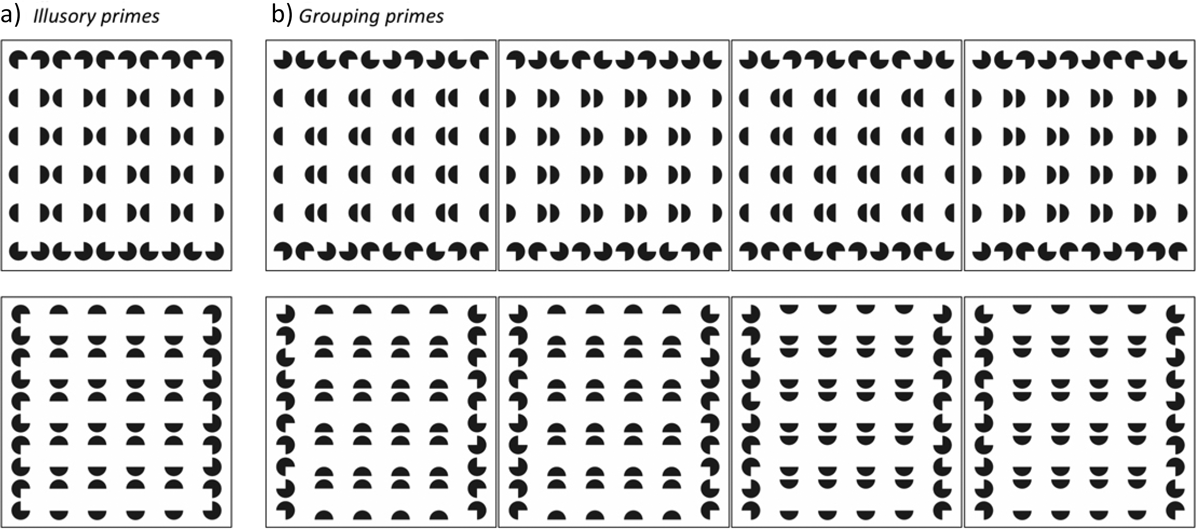
In the present study, we conducted two experiments combining visual masking and response priming paradigms in order to systematically explore the dissociability and temporal dynamics of the priming effects generated by illusory form and those produced by the underlying perceptual grouping operations when Kanizsa-like figures are presented as primes and the rotated inducers as control condition. With this aim, we generated novel stimuli consisting of horizontal or vertical illusory bars (illusory primes, see Fig. 1a) that were masked and could be congruent or incongruent in their orientation with subsequent probe stimuli. In addition, we generated a control condition by rotating the inducers used in illusory primes in a way that no illusory figure was perceived (Fig. 1b, grouping primes), but which may allow inducers to group together following proximity cues (they were accordingly labelled grouping primes). As previously mentioned, proximity grouping is an early grouping cue which is completed under very restrictive visual conditions (Montoro et al., Reference Montoro, Luna and Ortells2014), and allows pairs of elements (here, the closest semicircles in the grouping primes) to group together, as “the closest dots group perceptually” (Palmer, Reference Palmer1999, p. 258). Crucially, the semicircles within the grouping primes were located in the exact same spatial coordinates as in the illusory primes, resulting in matched proximity cues in both illusory and grouping primes. Moreover, the rotation of the inducers did not alter their cardinal orientation neither the edge alignment of the semicircles (all the edges of the semicircles were aligned in both the illusory and grouping primes).
a) Illusory primes; b) Grouping primes

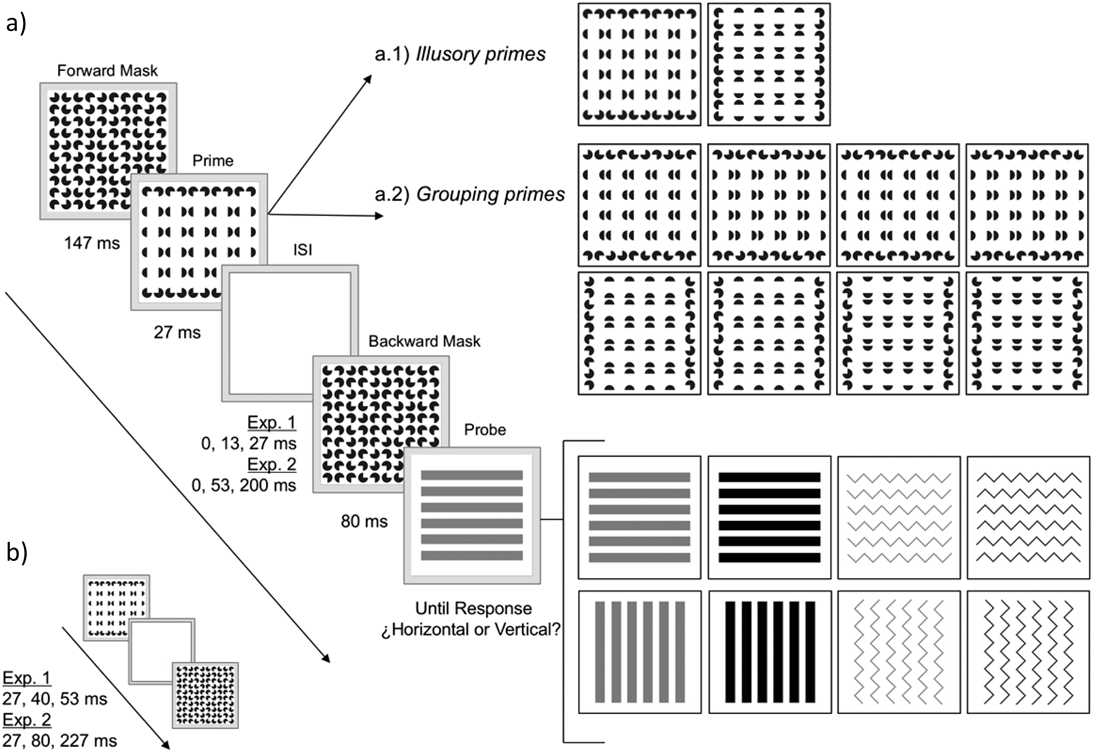
In order to explore the dissociability as well as the temporal dynamics of the priming effects generated by both prime types under restrictive visual conditions, we introduced five different stimulus onset asynchronies (SOAs; 27 ms, 40 ms, 53 ms, 80 ms and 227 ms) which would allow the primes’ increasing perceptual processing across SOAs. Furthermore, we decided to mask our primes using pattern masking (see Fig. 2), which is usually associated to a type-A masking function. Type-A masking is characterized by producing the lowest visibility of the prime at the shortest SOA and increasing visibility with increasing prime-mask SOA. Conversely, type-B masking (or U-shaped masking), is characterized by producing the lowest prime visibility at medium SOAs and higher visibility at shorter and longer SOAs. This latter masking function is usually associated to meta-contrast masking (Schmidt et al., Reference Schmidt, Haberkamp and Schmidt2011, Bachmann & Francis, Reference Bachmann and Francis2013). Therefore, we expected the SOA manipulation to produce increasing prime awareness as measured by accuracy performances in a prime discrimination task. We predicted that the primes in the most restrictive SOA conditions (i.e. 27 ms SOAs in Experiment 1 and 2) would be discriminated at strict chance level, while increasing processing times would allow above chance level discriminations as a result of increasing awareness of the primes.
a) Stimuli and Sequence of Events for Experiments 1 and 2: a1) Illusory primes, a2) Grouping primes. b) SOA conditions in Experiments 1 and 2.

Regarding the priming task, our predictions were as follows: If the illusory percept generated by Kanizsa-like stimuli and the underlying grouping of the inducers produced dissociable representations, we should expect significant priming effects for both illusory and grouping primes across SOA conditions and, in addition, significant differences in the priming magnitudes between prime types. On the other hand, if the illusory percept generated by Kanizsa-like stimuli and the underlying grouping of the inducers produced no dissociable representations, we would expect significant priming effects for both illusory and grouping primes and, more importantly, no significant differences in priming effects between prime types across SOA conditions. In relation to the grouping primes, significant positive priming effects were expected at very short SOAs due to the early nature of proximity grouping (Montoro et al., Reference Montoro, Luna and Ortells2014).
The present study consisted of two experiments. Experiment 1 included very restrictive masking conditions (i.e. SOAs 27, 40 and 53 ms; from now on SOA27, SOA40 and SOA53 conditions), while in Experiment 2, the most restrictive SOA (i.e. 27 ms, which served as an inter-subject control measure between experiments), and longer SOAs of 80 and 227 ms (from now on SOA80 and SOA227 conditions) were introduced to test possible priming differences when allowing increasing processing times for the primes. A forced-choice prime discrimination task was included to assess participants’ visibility in each SOA condition. We avoided displaying the primes as visible targets to exclude the possibility of subliminal priming effects being due to that fact. Figure 2 shows the sequence of stimuli and the different SOA conditions for both Experiment 1 and Experiment 2.
Experiment 1: Masked SOAs 27, 40 and 53
In the first experiment, we used SOAs 27, 40 and 53 ms to address possible priming differences between illusory and grouping primes under very restrictive masking conditions.
Method
Participants
Thirty-five undergraduate students (26 females and 9 males, age range = 19–51 years, M = 29; SD = 8.4) from the Universidad Nacional de Educación a Distancia (UNED) participated in the experiment. All of them had normal or corrected-to-normal vision and received course credits for their participation.
Stimuli and apparatus
The stimuli were displayed on a 19–in. LCD–LED Samsung 943N color monitor with a 75–Hz refresh rate, a 5:4 aspect ratio and a resolution of 1280 x 1024 controlled by a computer running E-Prime 1.2 software (Psychology Software Tools, 1996–2002). Viewing distance was approximately 57 cm. All the stimuli were displayed in the center of the screen subtending a visual angle of 11° x 11°. The illusory figures presented as illusory primes consisted of black “pacmen” and semicircles (inducers from now on) arranged in such a way that they produced horizontal or vertical illusory bars (see Fig. 1a). The grouping primes consisted of the same inducers rotated in a way they did not produce illusory figures (see Fig. 1b). The distance between the closest semicircles (pairs of semicircles) within an orientation axis was 12 pixels, while the longer distance between semicircles in that same axis was 72 pixels. The distance between semicircles in the opposite orientation axis was 80 pixels. The size of the “pacmen” was 1°.
Masks were composed of the same “pacmen” used in the primes, but randomly rotated. Each pattern included one hundred “pacmen” arranged in a 10 x 10 matrix. Six different masks were generated by rotating the patterns in different ways, which were randomly assigned as forward or backward masks in the stimuli sequence (see Fig 2).
The target stimuli consisted of continuous zigzag or straight lines which varied in their orientation (vertical vs. horizontal) and luminance (dark vs. clear). There were eight different target stimuli in order to force participants to base their response on the global orientation of the stimuli regardless of the physical appearance of the stimulus (see Fig. 2). All the stimuli were generated using Adobe Illustrator CS5.
Procedure and design
According to a dissociation paradigm (Reingold, & Merikle, Reference Reingold and Merikle1988), participants performed two consecutive tasks: a) a masked priming task and b) a prime visibility discrimination task, both of them completed individually in a dimly lit room, with a five-minute break between tasks. In the masked priming task, participants had to carry out a forced-choice reaction time (RT) task. Subjects were told that they would see target lines displayed on the screen, and that they would have to indicate, as fast as possible but avoiding making mistakes, their vertical or horizontal orientation by pressing one of two response buttons (number 1 or 2, respectively) with their middle and index fingers of their dominant hand. Importantly, subjects were not told about the masked primes, but were merely informed that each trial would begin with the presentation of a “flash signal”, which would warn them that the target stimulus was going to appear afterwards.
The sequence of events of a masked priming trial within Experiment 1 is depicted in Fig. 2. Each trial started with a mask pattern (147 ms), followed by an illusory or grouping stimuli (27 ms, counterbalanced presentations across the whole experiment), an inter-stimulus interval (ISI) stimuli for either 0 ms (non-present), 13 ms or 27 ms (SOA: 27 ms, 40 ms or 53 ms; randomized so that each condition was equally presented across the experiment), followed by the second mask pattern (always different from the first one, displayed during 80 ms) and finally the target stimulus that remained until response. After the end of the trial, a pause of 800 ms was ensued before the start of the next trial. There was a practice block with 32 trials and six blocks of 96 trials each, for a total of 576 experimental trials (half were congruent trials and the other half were incongruent ones). Feedback was provided only for the practice trials.
Immediately after the end of the priming task, participants were fully informed of the nature of the “flash signal” and were asked to perform a forced-choice prime discrimination task designed to obtain an objective index of prime visibility. In this task, consisting of 16 practice trials followed by 2 blocks of 144 trials each, with a total of 288 trials, participants were instructed to pay attention to the prime stimulus that was displayed between the two masks, and to perform a forced-choice discrimination task indicating whether they had seen horizontally oriented illusory bars (“horizontal condition”), vertically oriented illusory bars (“vertical” condition) or no illusory bars at all (“neutral” condition). For this task, the sequence of events was identical to that of the priming task, with the following exceptions: a) the target stimuli were displayed during a fixed time of 500 ms, b) after the target offset, three rectangles including the three response options (“horizontal”, “vertical” or “neutral”) were displayed on the screen so that participants could provide their response by clicking the mouse on the selected rectangle without any response time demand; and c) the trials were self-administered in order to ensure that participants were as ready as possible to discriminate the masked prime. Participants were instructed to try to be as accurate as possible and to guess on trials in which they could not identify the primes.
Results
Priming task
Mean accuracy (correct responses) ranged between 97% and 99% across all conditions (SOA: 27, 40, 53; Congruency: Congruent vs. Incongruent). Individual accuracy performance was between 95% and 100% (correct responses). Given that the participants responses were highly accurate (average error rate was 2%), only data on RTs was analyzed.
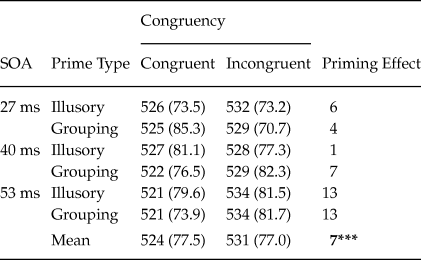
Mean RTs for correct responses were submitted to a 3 (SOA: 27, 40, 53) x 2 (Prime: Illusory vs. Grouping) x 2 (Congruency: Congruent vs. Incongruent) ANOVA. Short and long RTs (shorter than 200 ms and longer than 1500 ms) were excluded from the analysis. Analysis showed a significant main effect only for Congruency, F(1, 34) = 15.17, MSE = 358.26, p < .001, η2p = .31, where RTs on congruent trials were significantly shorter (524 ms) than those on incongruent trials (531 ms), both for illusory and grouping primes, across all SOA conditions (Table 1, Fig. 3). We did not find any first or second order interaction effects between factorsFootnote 1. Therefore, no significant priming differences were found for the percept generated by the grouping of the inducers and the illusory percept under very restrictive masking conditions.
Mean (SD) RTs (in ms) for the Congruent and Incongruent Trials in Experiment 1 for the Three Different SOAs, and the Amount of Priming (Incongruent-congruent) as a Function of Prime Type.

***p < .001. Significant results are shown in bold
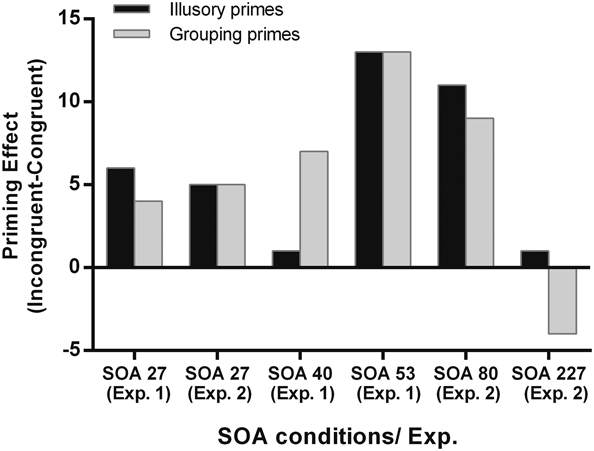
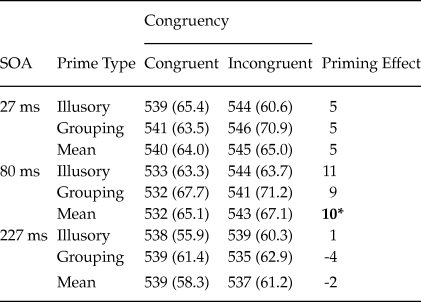
Priming Results (in ms) across SOA Conditions in both Experiment 1 and Experiment 2.

Prime visibility discrimination task
When asked informally after completing the priming task, none of the participants reported having seen any horizontal or vertical patterns before the presentation of the target. This suggests that participants had no subjective awareness of the primes.
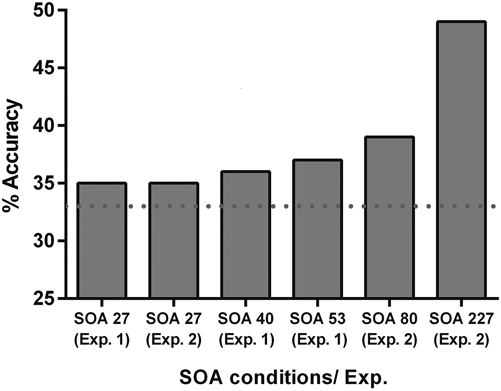
Group mean accuracy in the prime visibility discrimination task was .35 (SD = .04, individual rates from .25 to .42) for SOA27 condition, .36 (SD = .05, individual rates from .26 to .49) for SOA40 condition and .37 (SD = .05, individual rates from .29 to .48) for SOA53 condition. A chi square goodness of fit statistic was calculated for each participant in order to test if observed hits vs. miss individual distributions were due to chance, therefore comparing expected chance level frequencies on hit vs. miss responses to actual hit vs. miss responses. Individual chi squares were then combined into a group chi square (Fleiss, Levin, & Paik, Reference Fleiss, Levin and Paik2013). Individual chi square results for SOA27 condition showed that no participant was discriminating above expected chance performance, while the combined chi square test was at chance level, χ2(35) = 24.89, p = .663. Individual chi square results for SOA40 condition showed that 5 participants were discriminating the primes above strict chance level (all 4.68 ≤ χ2(1) ≤ 10.54, all .001 ≤ p ≤ .030), while the combined chi square test showed that group level discrimination was also above strict chance level, χ2(35) = 54.05, p = .020. Individual chi square results for SOA53 condition showed that 4 participants discriminated the primes above strict chance level, all 4.68 ≤ χ2(1) ≤ 9.18, all .002 ≤ p ≤ .030, while the combined chi square test showed that group level discrimination was also above strict chance level, χ2(35) = 52.03, p = .031 (see Fig. 4).
Prime Discrimination (% Accuracy) across SOA Conditions in both Experiment 1 and Experiment 2. Chance level accuracy (33%) is shown as a dotted line.

Therefore, discrimination results showed that the shortest SOA of 27 ms produced chance level discrimination performance, while longer SOAs of 40 and 53 ms produced slightly above chance objective performances. Importantly, and following our predictions, discrimination performances increased for increasing presentation times of the primes.
Experiment 2: Masked SOAs 27, 80 and 227
In this experiment, we introduced a longer SOA of 80 ms and a very long SOA of 227 ms to test possible priming differences between illusory and grouping primes under less restrictive masking conditions, which would allow longer processing of the primes. Condition of SOA 27 ms was included as an inter-subject control measure between experiments.
Method
Participants
Thirty-six undergraduate students (30 females and 6 males, age range = 19–52 years, M = 25; SD = 6.1) from the UNED participated in the experiment. All of them had normal or corrected-to-normal vision and received course credits for their participation.
Stimuli and apparatus
The stimuli and apparatus were identical to those on Experiment 1.
Procedure and design
The experimental procedure was the same as in Experiment 1, but different SOAs were used. The inter stimulus intervals (ISIs) in the present experiment were 0, 53 and 200 ms (SOA = 27, 80 and 227 ms).
Results
Priming task
Mean accuracy (correct responses) ranged between 97% and 98% in all the conditions (SOA: 27, 80, 227; Congruency: Congruent vs. Incongruent). Individual accuracy performance was between 89% and 100% (correct responses). One participant was over the 10% error rate; therefore, these results were excluded from the analysis. Given that the participants responses were highly accurate (average error rate was 3%), only data on RTs was analyzed.
Mean RTs for correct responses were submitted to a 3 (SOA: 27, 80, 227) x 2 (Prime: Illusory vs. Grouping) x 2 (Congruency: Congruent vs. Incongruent) ANOVA. Short and long RTs (shorter than 200 ms and greater than 1500 ms) were excluded from the analysis. Analysis showed a significant main effect only for Congruency, F(1, 34) = 6.37, MSE = 333.60, p = .016, η2p = .16, showing that RTs on congruent trials were significantly shorter (537 ms) than those on incongruent trials (541 ms) (Table 2, Fig. 3). We did find an interactive first order effect between SOA and Congruency factors, F(2, 68) = 3.76, MSE = 350.46, p = .028, η2p = .10. Pairwise comparisons following the Bonferroni correction showed that only the SOA80 condition produced significant priming effects (Δ10 ms; p = .002) Footnote 2. Therefore, no significant priming differences were found neither for the grouped nor the illusory percepts when the primes were presented for longer SOAs.
Mean (SD) RTs (in ms) for the Congruent and Incongruent Trials in Experiment 2 for the Three Different SOAs, and the Amount of Priming (Incongruent-Congruent) as a Function of Prime Type.

*p < .05. Significant results are shown in bold
Prime visibility discrimination task
When asked informally after completing the priming task, participants reported that, in some trials, they had seen horizontal or vertical patterns before the presentation of the target. This was expected, as we had included a supraliminal condition (SOA227) in this experiment.
Mean accuracy in the prime visibility discrimination task was .35 (SD = .05, individual rates from .24 to .47) for SOA27 condition group, .39 (SD = .08, individual rates from .27 to .67) for SOA80 condition and .49 (SD = .17, individual rates from .19 to .81) for SOA227 condition.
A chi square goodness of fit statistic was calculated for each participant in order to test if observed hits vs. miss individual distributions were due to chance, while individual chi squares were then combined into a group chi square (Fleiss, Levin, & Paik, Reference Fleiss, Levin and Paik2013). Individual chi square results for SOA27 condition showed that 2 participants were discriminating above expected chance performance, all 4.68 ≤ χ2(1) ≤ 7.92, all .005 ≤ p ≤ .030, while the combined chi square test was at chance level, χ2(35) = 36.52, p = .398. Individual chi square results for SOA80 condition showed that 8 participants were discriminating the primes above strict chance level, all 4.68 ≤ χ2(1) ≤ 48.00, all .001 < p ≤ .030, while the combined chi square test showed that group level discrimination was also above strict chance level, χ2(35) = 142.08, p < .001. Individual chi square results for SOA227 condition showed that 26 participants discriminated the primes above strict chance level, all 4.68 ≤ χ2(1) ≤ 99.18, all .001 < p ≤ .030, while the combined chi square test showed that group level discrimination was also above strict chance level, χ2 (35) = 784.36, p < .001 (see Fig. 4).
Therefore, discrimination results showed that, in line with our predictions, the shortest SOA of 27 ms produced chance level discrimination performance, while longer SOAs of 80 and 227 ms produced above chance objective performances. Importantly, discrimination performances increased for increasing presentation times of the primes but peaked at 49% accuracy rates, showing that in all cases the visibility of the primes was restrictive.
Discussion
A common control condition used in the study of Kanizsa-like figures under conditions of restricted awareness consists of the rotation of the inducers in order to prevent the formation of the illusory form. If these control stimuli are used in the context of a masked priming paradigm, a potential confound in the interpretation of the priming effects may arise since the same response associated to the illusory figure may be also activated by the perceptual grouping -or corner integration- of the rotated inducers. In the present study, we conducted two experiments combining visual masking and response priming paradigms in order to systematically explore the dissociability and temporal dynamics of the priming effects generated by illusory form and those produced by the underlying perceptual grouping of the rotated inducers. By using five different stimulus onset asynchronies (27 ms, 40 ms, 53 ms, 80 ms, 227 ms) we allowed primes increasing perceptual processing time which, according to the individual and group discrimination performances, followed the expected pattern of increasing accuracies as the awareness of the primes increased (Fig. 4). Importantly, discrimination performances across all SOA conditions suggest that the visibility of the primes was restricted.
Results in the priming task in Experiment 1 showed a main effect for Congruency, indicating that RTs on congruent trials were significantly shorter (524 ms) than those on incongruent trials (531 ms). Crucially, no significant priming differences were found for illusory and grouping primes. In Experiment 2, a significant main effect for Congruency was observed showing that RTs on congruent trials were significantly shorter (537 ms) than those on incongruent trials (541 ms) and, additionally, an interactive first order effect between SOA and Congruency factors was found: Pairwise comparisons showed that only the SOA80 condition produced significant priming effects (Δ10 ms; p < .05). Interestingly, no significant priming differences were found for either the illusory or the grouping primes (see Fig. 3).
According to our predictions, if the illusory percept generated by Kanizsa-like stimuli and the underlying grouping of the inducers produced dissociable representations, we should expect significant priming effects for both illusory and grouping primes across SOA conditions and, in addition, significant differences in the priming magnitudes between prime types. Conversely, if the illusory percept generated by Kanizsa-like stimuli and the underlying grouping of the inducers produced no dissociable representations, we would expect significant priming effects for illusory and grouping primes, and, importantly, no significant differences in priming effects between prime types across SOA conditions. Our results are therefore in line with this latter prediction, showing that when Kanizsa-like figures are presented within visual masking and very restrictive visual conditions, the priming effects generated by the illusory form and those generated by the underlying proximity grouping of the inducers may not be dissociable. Furthermore, the present findings suggest that significant priming differences between standard Kanizsa configurations and different control conditions (rotated pacmen and different inducer types) found in previous studies (i.e. Poscoliero et al., Reference Poscoliero, Marzi and Girelli2013) may respond to –or at least be influenced by- differences in size, edge alignment or collinearity of the inducers used as control conditions.
Interestingly, Jimenez et al. (Reference Jimenez, Montoro and Luna2017) recently used masked response priming in order to explore the early processing of illusory form construction. In this study, the percept generated by the grouping of the local elements (i.e. the inducers) was associated to a different response from that of the illusory percept: when an illusory figure was presented as a prime the grouping of the local elements produced either an opposite shape (square or diamond) or a neutral shape (circle). Once the illusory form and the grouping of the local elements were mapped to different responses, the priming effects found for the illusory primes could be strictly attributed to the illusory percept, and therefore, an early –unconscious– construction of the illusory shape could be proposed. In the light of the studies by Poscoliero et al. (Reference Poscoliero, Marzi and Girelli2013) and Jimenez et al. (Reference Jimenez, Montoro and Luna2017), our current findings suggest that a clear dissociation of the responses assigned to both the illusory and the grouping percepts is a crucial methodological approach in the study of illusory form perception under conditions of restricted awareness.
Our results may also allow different interpretations on the temporal dynamics between illusory form perception and the underlying grouping of the local inducers. Firstly, it could be argued that only one representation is generated by each prime type at each particular SOA, and thus the underlying grouping of the local elements would be responsible for the priming effects obtained when Kanizsa-like stimuli (illusory primes) are presented under conditions of restricted awareness. Alternatively, however, the illusory primes may generate an illusory percept of the same strength of the grouped pattern generated by the grouping primes. Therefore, it would be possible that illusory forms are represented but the priming magnitude, when presented under such restrictive perceptual conditions, reaches a “ceiling effect” at the same priming magnitude for both illusory and grouping primes. In line with this interpretation, previous studies have shown that priming magnitudes using pattern masking are usually very weak (Montoro et al., Reference Montoro, Luna and Ortells2014; Seydell-Greenwald & Schmidt, Reference Seydell-Greenwald and Schmidt2012) and that the illusory form may produce significant priming effects in the absence of awareness (Jimenez et al., Reference Jimenez, Montoro and Luna2017). Finally, it may be hypothesized that the two representations are generated within the illusory primes but they interact in a hierarchical manner, the strongest perceptual representation dominating the weakest one. Importantly, if we had found significantly higher priming effects for illusory primes at longer SOAs, it could have been hypothesized that both illusory and grouped percepts interacted in an additive manner.
Overall, and following previous studies on the interactions and temporal dynamics of different perceptual grouping cues (Ben-Av & Sagi, Reference Ben-Av and Sagi1995; Claessens & Wagemans, Reference Claessens and Wagemans2005; Kubovy & van den Berg, Reference Kubovy and van den Berg2008; Montoro & Luna, Reference Montoro and Luna2015; Rashal, Yeshurun & Kimchi, Reference Rashal, Yeshurun and Kimchi2017), we consider of great interest the future comprehensive exploration of the interactions and temporal dynamics between the illusory form and the subjacent grouping of the inducers when the illusory form perception is studied using Kanizsa-like figures. Taken the findings of the present study, a future study should dissociate the percept generated by the grouping of the inducers from the illusory percept and, crucially, both representations should be assigned to either compatible or competing responses.
Finally, the absence of priming effects at the longest SOA of 227 ms may respond to a more complex interpretation. Looking at the nature of the illusory primes, it may be tentatively proposed that they allow the perception of amodally completed ovals behind - or partially occluded by- the illusory bars. These capsule-shaped ovals would require long scrutiny for its perception as they may group according to proximity, good continuation, and collinearity, thus producing the opposite orientation of the illusory bars, which would interfere with the orientation of the illusory form at the longest SOA. Whereas the possibility of amodally completed ovals was not a controlled condition in the present study, we consider this a very interesting question for a study on its own, where time course interactions between illusory form construction and amodally grouped local elements could be comprehensively explored. Furthermore, the strength of the amodal perception of the capsule-shaped ovals might be varied by manipulating the width of the illusory figure.
Smaller priming effects for groping primes starting at SOA of 80 ms and negative (yet not significant) priming effects for grouping primes at the longest SOA227 (see Fig. 4), on the other hand, may suggest that good continuation operations may be interfering with proximity cues at longer SOA conditions. Good continuation refers to the grouping principle by which “all else being equal, elements that can be seen as smooth continuations of each other, tend to be grouped together” (Palmer, Reference Palmer1999, p. 259). Accordingly, it may be argued that the rounded parts of the semicircles smoothly follow each other within the same axis, creating pointing directions in the opposite orientation (left or right in the horizontal axis for grouping primes generated from the vertical illusory prime; and up and down in the vertical axis for grouping primes generated from the horizontal illusory prime) of that generated by proximity cues.
Alternatively, the absence of priming effects for both illusory and grouping primes at the longest SOA may suggest that the processing of the primes when their visibility is increased interferes with the forced-choice motor response task. Interestingly, similar results have been previously found when inter-stimulus intervals (ISI) between prime and target ranged from 100 to 200 ms (e.g. Eimer & Schlaghecken, Reference Eimer and Schlaghecken2001; Praamstra & Seiss, Reference Praamstra and Seiss2005), producing an inhibition of the response that usually leads to a negative priming effect (the Negative Compatibility Effect, NCE). This NCE consists of greater RTs for congruent trials and shorter RTs on incongruent ones (Sumner, Reference Sumner2007). Our results, however, do not show a statistically significant negative priming effect. Tentatively, we could argue that with prime-probe delays longer than 200 ms, the NCE may fade out into no effect at all.
In sum, the findings in the present study suggest that underlying perceptual grouping operations and the illusory percept may not generate dissociable priming effects when Kanizsa-like figures are presented as primes under conditions of restricted visual awareness, therefore showing that the mere rotation of the inducers is neither an appropriate nor an exhaustive control condition in this type of studies. Overall, our results suggest that a dissociation of the percept generated by the grouping of the inducers from that generated by the illusory form is crucial in the study of illusory form perception under conditions of restricted awareness. In addition, they emphasize the need of a comprehensive exploration of the dynamic interactions between illusory form and underlying grouping operations when Kanizsa-like figures are studied under conditions of restricted awareness. The pattern of priming effects found for the grouping primes, on the other hand, support previous studies showing that proximity grouping is processed at an early perceptual stage (Ben-Av & Sagi, Reference Ben-Av and Sagi1995; Kurylo, Reference Kurylo1997; Montoro et al., Reference Montoro, Luna and Ortells2014). Furthermore, significant priming effects in both Experiment 1 and Experiment 2 are in line with previous studies which suggest that perceptual organization operations may occur under conditions of restricted awareness (Jimenez et al., Reference Jimenez, Montoro and Luna2017; Montoro et al., Reference Montoro, Luna and Ortells2014; Poscoliero, et al., Reference Poscoliero, Marzi and Girelli2013).