Introduction
The aetiopathogenic role of human papillomavirus (HPV) in cervical carcinogenesis is well established. Studies have shown that more than 90 per cent of cervical cancerous and pre-malignant lesions are HPV related.Reference Monk and Tewari1, Reference Shukla, Bharti, Mahata, Hussain, Kumar and Hedau2 Syrjänen et al. first described the presence of HPV in head and neck cancer lesions in 1983.Reference Syrjänen, Syrjänen, Lamberg, Pyrhonen and Nuutinen3 Since then, numerous studies have evaluated the association of HPV with both benign and malignant head and neck tumours using various HPV detection techniques. In the head and neck region, the association of HPV infection with squamous cell carcinoma of the oropharynx is well established; it is now accepted that more than 50 per cent of such lesions are associated with oncogenic HPV.Reference Mehanna, Beech, Nicholson, El-Hariry, McConkey and Paleri4–Reference El-Mofty and Patil9 In previously published reviews, the overall incidence of oncogenic HPV in head and neck cancer was between 22.0 per cent and 46.5 per cent, regardless of anatomical subsite.Reference Mehanna, Beech, Nicholson, El-Hariry, McConkey and Paleri4, Reference Hobbs, Sterne, Bailey, Heyderman, Birchall and Thomas10–Reference Miller and Johnstone13 Studies have also demonstrated favourable outcomes for HPV-associated cancers, particularly oropharyngeal carcinomas, because of their increased sensitivity to radiotherapy.Reference Dayyani, Etzel, Liu, Ho, Lippman and Tsao14 It is therefore important to know the HPV status of a tumour, especially when making treatment decisions.
Salivary gland tumours account for 6 per cent of all head and neck neoplasms; the annual incidence ranges from 1.0 to 6.5 cases per 100 000 individuals worldwide.Reference Stenner and Klussmann15, Reference Hafed, Farag, Shaker and El-Rouby16 Although studies evaluating HPV association with mucosal tumours of the head and neck region have been widely reported, only a handful of studies (with variable findings) have reported HPV association with salivary gland tumours.Reference Mehanna, Beech, Nicholson, El-Hariry, McConkey and Paleri4, Reference Hafed, Farag, Shaker and El-Rouby16–Reference Descamps, Duray, Rodriguez, Chantrain, Depuydt and Delvenne22 Contradictory evidence means that the aetiological role of HPV in salivary gland tumorigenesis is currently unclear.
This study aimed to examine a range of benign and malignant salivary gland tumours for HPV involvement by p16INK4 immunohistochemical analysis of tumour tissue samples followed by in situ hybridisation analysis for HPV DNA.
Materials and methods
Study design and data gathering
Cases were identified using the National Health Service Central Register Community Health Index (‘CHI’) number (a unique number allocated to each patient when they register with a family doctor in Scotland) from pathology records at Ninewells Hospital, Dundee, UK. This number was correlated with clinical data obtained from medical case notes. Archived paraffin-embedded tissue blocks were obtained for a range of primary and metastatic salivary gland tumours operated on between 1997 and 2012. Tissue samples representing all major types of benign and malignant salivary gland tumours were selected (n = 61).
Human papillomavirus detection
The tissue blocks were processed to construct a tissue microarray. HPV status was initially determined immunohistochemically by screening the tissue microarray for strong p16INK4 expression. The interpretation of p16INK4 immunohistochemical staining can be somewhat variable; thus, at our institution, samples with at least 70 per cent strong nuclear and cytoplasmic staining are considered p16INK4 positive (this is currently the most widely used scoring system).Reference Singhi and Westra23 However, as p16INK4 positivity is not an absolute indicator of HPV status, tissue sections were also processed for in situ hybridisation using probes specific for HPV, including genotypes 16 and 18. This analysis was performed at the Department of Oral Pathology, Centre for Oral Health Research, Freeman Hospital and University of Newcastle upon Tyne, UK. Positive control samples were cervical and tonsillar lesions with established evidence of HPV infection; negative control samples were chronic sialadenitis lesions with no evidence of HPV infection.
Results
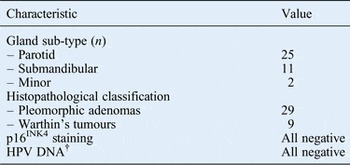
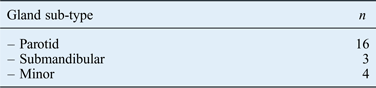
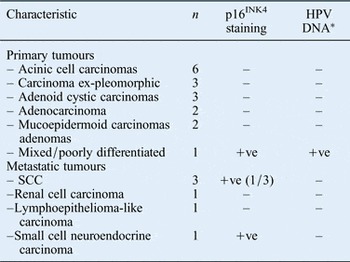
Paraffin-embedded tissue samples from 61 salivary gland tumours were deemed suitable for the study. Twenty-three samples were from malignant tumours (17 primary, 6 metastatic) and 38 were from benign tumours (Tables I–III). Immunohistochemical analysis of p16INK4 expression yielded three (4.9 per cent) positive samples: one small cell neuroendocrine carcinoma, one squamous cell carcinoma and one poorly differentiated carcinoma. In situ hybridisation assessment of HPV demonstrated a positive signal in the latter sample only (1.6 per cent). The oncogenic HPV genotype 16 was detected in all positive samples. The remaining tumours were negative for both p16INK4 immunohistochemical staining and HPV infection. It is important to note that none of the benign tumours were p16INK4 positive by immunohistochemical staining or HPV DNA positive by in situ hybridisation.
Benign tumour sub-types and histopathology*

* n = 38 patients (16 men, 22 women); mean age, 45.4 (range 17–79) years. †In situ hybridisation. HPV = human papillomavirus
Malignant tumour sub-types*
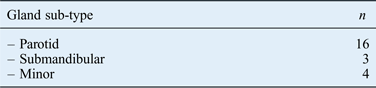
* n = 23 patients (8 women, 15 men); mean age, 54.8 (range 21–93) years
Malignant tumour histopathology

* In situ hybridisation. HPV = human papillomavirus; +ve = positive
Discussion
This Scottish study demonstrated no significant association between HPV infection and salivary gland neoplasia. Although three tissue samples were p16INK4 positive, two were metastatic carcinomas and the other was a mixed or poorly differentiated carcinoma that was subsequently found to be HPV16 positive by in situ hybridisation assessment. It is therefore reasonable to suggest that primary salivary gland tumours (benign and malignant) do not exhibit an association with HPV and that in the rare cases in which HPV is detected, the patient should be assessed very carefully for the possibility of a metastatic carcinoma.
Although this study included very limited sample numbers, previous studies have reported variable HPV detection rates in salivary gland tumours (range 0–77.8 per cent).Reference Hafed, Farag, Shaker and El-Rouby16–Reference Descamps, Duray, Rodriguez, Chantrain, Depuydt and Delvenne22 In 2007, Vageli and colleagues were the first to detect HPV in salivary gland tumours.Reference Vageli, Sourvinos, Ioannou, Koukoulis and Spandidos20 They analysed nine parotid tumours (benign and malignant) by polymerase chain reaction and identified oncogenic HPV in six (66.7 per cent) cases and low-risk (benign) HPV in one (11.1 per cent). p16INK4 over-expression has been reported in three studies. Skálová et al. evaluated a mixed group of benign and malignant tumours (n = 55) and found p16INK4 over-expression in 81.8 per cent.Reference Skálová, Kašpírková, Andrle, Hostička and Vaneček17 However, only 9 per cent of these had strong nuclear and cytoplasmic staining (score of greater than 3) and there was no detection of oncogenic HPV DNA by polymerase chain reaction in any of the cases. Brunner et al. studied 38 minor salivary gland carcinomas of different histological sub-types and demonstrated p16INK4 over-expression in 71 per cent.Reference Brunner, Koperek, Wrba, Erovic, Heiduschka and Schoppper19 However, only two (5.3 per cent) cases (mucoepidermoid carcinoma) had strong or diffuse nuclear and cytoplasmic staining. Interestingly, both were positive for oncogenic HPV by in situ hybridisation (and none were positive for benign HPV genotypes). In addition, Descamps et al. reported a very low incidence of p16INK4 over-expression (weak positivity in 7.6 per cent of cases).Reference Descamps, Duray, Rodriguez, Chantrain, Depuydt and Delvenne22
• There was a very low human papillomavirus DNA detection rate in 61 salivary gland neoplasms
• Human papillomavirus is unlikely to play a significant role in salivary gland tumour development
• Human papillomavirus positive salivary gland tumours should be carefully assessed to exclude the possibility of a metastatic carcinoma
Different rates of HPV detection by various DNA analysis techniques (including polymerase chain reaction) have been reported for benign and malignant tumours. Hafed et al. examined 34 salivary gland tumours (19 malignant and 15 benign) and 7 control salivary tissue specimens (chronic sialadenitis) by in situ hybridisation for the presence of oncogenic HPV genotypes (16 and 18).Reference Hafed, Farag, Shaker and El-Rouby16 Only one (5.3 per cent) malignant and seven (46.7 per cent) benign cases were HPV positive, whilst all control specimens were HPV negative. These findings differ from those of the current study, especially regarding benign tumours. Worldwide, there is wide variation in the reported incidence of HPV-associated head and neck cancers from various countries.Reference Oliveira, Andrade, Menezes and Vanden24 This is also true for salivary gland tumours, as discussed in the literature review included in this report. Hafed et al. examined an Egyptian patient cohort in which the prevalence of HPV infection is likely to be very different from that of a Scottish cohort.Reference Hafed, Farag, Shaker and El-Rouby16 Anderson et al. previously studied 100 head and neck cancer cases from south-east Scotland and reported a relatively low incidence of HPV-positive cases (10 per cent).Reference Anderson, McLaren, Rae, Sanderson and Cuschieri25 The current study was also performed in south-east Scotland, where the overall HPV infection prevalence in the population may be low, as reflected in the results presented here. Descamps et al. studied 79 parotid lesions (40 benign and 39 malignant tumours) for the presence of benign and oncogenic HPV genotypes using real-time quantitative polymerase chain reaction: four (7.5 per cent) benign tumours were positive for HPV DNA and one (2.6 per cent) malignant tumour was positive for oncogenic HPV genotype 16.Reference Descamps, Duray, Rodriguez, Chantrain, Depuydt and Delvenne22
Conclusion
This study demonstrated a very low HPV DNA detection rate in 61 salivary gland neoplasms of a range of different histological sub-types. From this Scottish cohort, it is reasonable to conclude that HPV infection is unlikely to play a significant role in salivary gland neoplasia. The rare samples positive for p16INK4 staining or HPV DNA should be carefully evaluated to exclude the possibility of a metastatic carcinoma.
Acknowledgements
We would like to thank Dr. A Mehta, Division of Medical Sciences and Tayside Institute of Child Health, and Mr. R Mountain, Department of ENT – Head and Neck Surgery, (both Ninewells Hospital and University of Dundee Medical School, UK) for providing us with invaluable advice on this study. We thank Dr S Bray and the Tayside Tissue Bank team, Ninewells Hospital and University of Dundee Medical School, UK, for their invaluable support in providing archival pathological tissue samples. We also gratefully acknowledge the Royal College of Surgeons of Edinburgh for supporting the work with a small research grant.