INTRODUCTION
Corporate philanthropy as a specific dimension of CSR (corporate social responsibility) has drawn close attention from scholars, practitioners, and the public (Du, Jian, Du, Feng, & Zeng, Reference Du, Jian, Du, Feng and Zeng2014). Nevertheless, there is relatively rare literature to address whether the institutional environment and its change impact corporate philanthropyFootnote 1 . Actually, along with corporate globalization and the mounting interaction of philanthropic consciousness among multinational companies, internationalization is playing an important role in promoting corporate philanthropy (Brammer, Pavelin, & Porter, Reference Brammer and Millington2009; Campbell, Eden, & Miller, Reference Campbell, Eden and Miller2012). In this regard, extant studies provide insufficient evidence on the relation between internationalization and corporate philanthropy. Our intuition is that multinational companies often use corporate philanthropy as an effective instrument to satisfy the interests of stakeholders and obtain the legitimacy in host countries. This study adds to the existing literature by investigating whether internationalization affects corporate philanthropy and the moderating effect of CEOs’ political participation.
In our study, internationalization is measured as the ratio of overseas sales to total worldwide sales revenue (Hitt, Hoskisson, & Kim, Reference Hitt, Hoskisson and Kim1997; Geringer, Tallman, & Olsen, Reference Geringer, Tallman and Olsen2000). Using a sample of Chinese family firms over the period of 2005–2011, our findings show that internationalization is significantly positively associated with corporate philanthropy. Moreover, CEO’s political participation reinforces the positive association between internationalization and corporate philanthropy.
In China, along with the rapid economic growth, social problems have become increasingly prominent (Wang, Reference Wang2004). As the largest emerging market, the ‘China Miracle’ attracts worldwide attention, but China is jammed in contradiction between the rapid economic growth and the lack of philanthropic consciousness (Graafland & Zhang, Reference Graafland and Zhang2014). Internationalization urges Chinese enterprises to build positive moral capital through corporate philanthropy as a response to stakeholder pressures and the liability of foreignness (Godfrey, Reference Godfrey2005; Campbell, Eden, & Miller, Reference Campbell, Eden and Miller2012). Furthermore, this study focuses on Chinese family firms for several reasons: first, in the past four decades, private economy contributes a significant percentage of China’s economic growth and brings out the economic miracle with the average annual growth of about 9% (Anderson, Li, Harrison, & Robson, Reference Anderson, Li, Harrison and Robson2003; Ding, Zhang, & Zhang, Reference Ding, Zhang and Zhang2008; Du, Reference Du2015). Second, previous studies (Zhang, Rezaee, & Zhu, Reference Zhang, Rezaee and Zhu2009; Du et al., Reference Du, Jian, Du, Feng and Zeng2014) find that corporate philanthropy is lower for state-owned enterprises than for non-state-owned enterprises. In addition, corporate philanthropy in state-owned enterprises is inclined to be passive due to administrative allocation (Du et al., Reference Du, Jian, Du, Feng and Zeng2014), which distorts the signal effect of corporate philanthropy and thus cannot embody any motivations of corporate philanthropy such as altruistic, managerial self-interest, political, and strategic motivations (Campbell, Moore, & Metzger, Reference Campbell, Moore and Metzger2002; Du, Reference Du2015). Finally, Chinese family firms tend to use international expansion as an avoidance strategy to mitigate the inverse effect of incomplete formal institutions and government intervention (Wright, Filatotchev, Hoskisson, & Peng, Reference Wright, Filatotchev, Hoskisson and Peng2005; Yamakawa, Peng, & Deeds, Reference Yamakawa, Peng and Deeds2008; Yang, Jiang, Kang, & Ke, Reference Yang, Jiang, Kang and Ke2009). As a result, it is appropriate for this study to focus on Chinese family firms and examine the relation between internationalization and corporate philanthropy.
Our study makes several contributions as below. First, our study is one of very few studies to examine the role of internationalization in promoting corporate philanthropy. Second, this study adds to the existing literature about CSR based on the context of developed countries. Third, our study shows that CEO’s political participation reinforces the positive association between internationalization and corporate philanthropy, providing important support to the interaction between the stakeholder theory and the institution-based theory on corporate philanthropy. Fourth, our findings echo the argument in Williamson (Reference Williamson2000) by validating the reinforced effects between formal institutions and informal systems on corporate decisions. Finally, our study can strengthen the understanding of the strategic motivation of corporate philanthropy in an international setting, contributing to the existing literature about whether internationalization affects corporate philanthropy.
LITERATURE REVIEW, THEORY, AND HYPOTHESES DEVELOPMENT
Literature review
For recent years, scholars and practitioners have paid close attention to CSR (McGuire, Sundgren, & Schneeweis, Reference McGuire, Sundgren and Schneeweis1988; McWilliams & Siegel, Reference McWilliams and Siegel2001) to investigate the determinants of CSR (Johnson & Greening, Reference Johnson and Greening1999; Chapple & Moon, Reference Chapple and Moon2005; Jenkins, Reference Jenkins2005; Campbell, Reference Campbell2007; Kiran & Sharma, Reference Kiran and Sharma2011). In addition, previous literature has focused on the social function of CSR funds and further addresses their daily operation and social influence (Portney, Reference Portney2008; Ragodoo, Reference Ragodoo2009). Furthermore, along with corporate globalization, the existing literature has addressed the impacts of internationalization on CSR (Chapple & Moon, Reference Chapple and Moon2005; Jenkins, Reference Jenkins2005; Kiran & Sharma, Reference Kiran and Sharma2011; Kang, Reference Kang2013; Aggerholm & Trapp, Reference Aggerholm and Trapp2014).
However, several studies (Chen, Patten, & Roberts, Reference Chen, Patten and Roberts2008; Du, Reference Du2015) argue that different CSR-dimensions (e.g., environmental performance, employee relations, product safety, and corporate philanthropy, etc.) may be inherently inconsistent. As Zyglidopoulos, Georgiadis, Carroll, and Siegel (Reference Zyglidopoulos, Georgiadis, Carroll and Siegel2012) argueFootnote 2 , CSR can be divided into two classifications: CSR-strengths and CSR-weaknesses. Actually, different motivations and consequences are associated with various CSR-dimensions (Chen, Patten, & Roberts, Reference Chen, Patten and Roberts2008; Du, Reference Du2015). As a result, findings in previous literature about the influence of internationalization on CSR may not fit well in with corporate philanthropy. In this regard, extant studies provide insufficient evidence on the association between internationalization and corporate philanthropy. As a response, we intend to fill this gap by examining the influence of internationalization on corporate philanthropy based on the Chinese context.
Extant studies have documented five motivations of corporate philanthropy as below: (1) strategy motivation, (2) altruistic motivation, (3) political motivation, (4) managerial self-interest motivation, and (5) window-dressing motivation (Campbell, Moore, & Metzger, Reference Campbell, Moore and Metzger2002; Seifert, Morris, & Bartkus, Reference Seifert, Morris and Bartkus2003; Zhang, Zhu, Yue, & Zhu, Reference Zhang, Zhu, Yue and Zhu2010; Du, Reference Du2015; Nybakk & Panwar, Reference Nybakk and Panwar2015). Strategy motivation on the basis of profit maximization hypothesis emphasizes that corporate philanthropy is inspired by strategic and bottom-line benefits (Saiia, Carroll, & Buchholtz, Reference Saiia, Carroll and Buchholtz2003; Zhang et al., Reference Zhang, Zhu, Yue and Zhu2010; Du, Reference Du2015). Altruistic motivation is associated with social awareness that identifies firms as an integral part of society, and thus corporate philanthropy is stimulated by altruism (Shaw & Post, Reference Shaw and Post1993). Political motivation argues that companies carry out philanthropy as a response to regulation uncertainty and political pressures (Sánchez, Reference Sánchez2000; Zhang et al., Reference Zhang, Zhu, Yue and Zhu2010; Du, Reference Du2015). Managerial self-interest motivation is drawn from the conflicts between managers and stakeholders, and thus it argues that firms act philanthropically to maximize CEO’s self-interests at the expense of stakeholders (Atkinson & Galaskiewicz, Reference Atkinson and Galaskiewicz1988; Barnea & Rubin, Reference Barnea and Rubin2010; Du, Reference Du2015). According to the window-dressing motivation, some firms carry out corporate philanthropy to overshadow their misconducts (e.g., environmentally unfriendly behavior; Chen, Patten, & Roberts, Reference Chen, Patten and Roberts2008; Du, Reference Du2015).
Previous literature demonstrates that corporate philanthropy is affected by industries, corporate governance, organizational visibility, and firm-specific characteristics, etc. (Ullmann, Reference Ullmann1985; McGuire, Sundgren, & Schneeweis, Reference McGuire, Sundgren and Schneeweis1988; Roberts, Reference Roberts1992; Johnson & Greening, Reference Johnson and Greening1999; Williams, Reference Williams2003; Brown, Helland, & Smith, Reference Brϕnn2006; Amato & Amato, Reference Amato and Amato2007, Reference Amato and Amato2012). Moreover, a branch of growing literature argues that external institutional environment can exert significant effects on corporate philanthropy (Useem, Reference Useem1988; Meznar & Nigh, Reference Meznar and Nigh1995; Du et al., Reference Du, Jian, Du, Feng and Zeng2014). In addition, for recent years, some scholars (Chen, Patten, & Roberts, Reference Chen, Patten and Roberts2008; Du, Reference Du2015) have validated that corporate philanthropy is always used to divert public attention from other corporate misconducts such as employee relations, product safety, and environmental performance. Along with the rapid development of globalization, extant studies provide insufficient evidence to address whether internationalization affects corporate philanthropy (Brammer & Millington, Reference Brammer, Pavelin and Porter2006)Footnote 3 .
Taken together, findings in extant literature can be integrated into the theoretical framework based on the stakeholder theory and the institutional theory (Roberts, Reference Roberts1992; Sánchez, Reference Sánchez2000; Saiia, Carroll, & Buchholtz, Reference Saiia, Carroll and Buchholtz2003; Godfrey, Reference Godfrey2005; Chen, Patten, & Roberts, Reference Chen, Patten and Roberts2008). Drawing upon the stakeholder theory, enterprises are viewed as a nexus of contracts among stakeholders, which can play a crucial role in a firm’s survival, profitability, and sustainable development (Freeman, Reference Freeman1994). As a result, a firm can satisfy various preferences from different stakeholders through corporate philanthropy (McGuire, Sundgren, & Schneeweis, Reference McGuire, Sundgren and Schneeweis1988; Brammer & Millington, Reference Brammer, Pavelin and Porter2006; Zhang et al., Reference Zhang, Zhu, Yue and Zhu2010). Moreover, according to the institutional theory, an organization must depend on the legitimacy from its community, and thus the institutional pressures significantly affect its CSR behavior. As a response, companies usually employ corporate philanthropy as a tool to obtain the legitimacy from the government and the public (Sánchez, Reference Sánchez2000; Zhang et al., Reference Zhang, Zhu, Yue and Zhu2010; Du, Reference Du2015).
Stakeholder theory, stakeholder pressures, and corporate philanthropy
The stakeholder theory suggests that a firm is inclined to survive, earn profit, and maintain sustainable development if it can satisfy multiple demands from diverse stakeholders (Freeman, Reference Freeman1994). Accompanying with internationalization, multinational companies often attract more public attention and thus become more visible enterprises. Ettenson and Klein (Reference Ettenson and Klein2005) and Friedman (Reference Friedman1991) argue that nongovernmental organizations are more likely to choose more visible corporations as their campaign objectives. Rehbein, Waddock, and Graves (Reference Rehbein, Waddock and Graves2004) find that shareholders are inclined to focus on larger and more visible firms as their objectives. As a result, multinational companies have a higher likelihood of exposure to multiple stakeholder groups and receiving stakeholder pressures (Fiss & Zajac, Reference Fiss and Zajac2006: 1177), including domestic stakeholders and foreign stakeholders, and thus internationalization urges multinational companies to ‘adapt the framing of their actions to pressures from multiple groups.’
In addition to appeal for their respective interests, stakeholders also try to build their identities in multinational companies and the society (Rowley & Moldoveanu, Reference Rowley and Moldoveanu2003). As a response, multinational companies always use more visible approaches (Campbell, Eden, & Miller, Reference Campbell, Eden and Miller2012) such as corporate philanthropy to mitigate various stakeholder pressures. McWilliams and Siegel (Reference McWilliams and Siegel2001), McWilliams, Siegel, and Wright (Reference McWilliams, Siegel and Wright2006), Toppinen and Korhonen-Kurki (Reference Toppinen and Korhonen-Kurki2013), and Zyglidopoulos et al. (Reference Zyglidopoulos, Georgiadis, Carroll and Siegel2012) argue that the optimal and the cost-effective approach for a firm’s responses to demands from multiple stakeholder groups is to highlight its endeavor in corporate philanthropy. Furthermore, Zyglidopoulos et al. (Reference Zyglidopoulos, Georgiadis, Carroll and Siegel2012) find that firms are more likely to increase CSR-strengths such as corporate philanthropy to transfer stakeholder pressures and balance conflicting demands from diverse stakeholders.
Furthermore, along with internationalization, pressures from (foreign) upstream and downstream firms as particular stakeholders also urge international companies to demonstrate a lot more than legal requirements to attain social licenses from home countries for better operations. Only in this way, multinational companies can reduce the risks of being the campaign targets in home countries so as not to negatively affect their cooperation or inversely impact their reputations as upstream and downstream firms. For example, Jobs & Apple Co. required Foxconn, an original equipment manufacturer enterprise in China, to pay its close attention to CSR. As a result, Foxconn reactively carries out corporate philanthropy to offset pressures from local government, employees, and consumers, etc. This example provides intuitive or supporting evidence to above argumentFootnote 4 .
Institutional theory, liability of foreignness, and corporate philanthropy
The institutional theory emphasizes that corporate behavior is not only affected by organizational structure but also impacted by the regulatory factors (DiMaggio & Powell, 1983). That is, firms must confirm the requirements of formal and informal institutions to obtain the legitimacy to maintain their survival and development (DiMaggio & Powell, 1983; Marquis, Glynn, & Davis, 2007). Extant studies find that internationalization results in multinational enterprises’ liabilities of foreignness in host countries (Kostova & Zaheer, Reference Kostova and Zaheer1999; Mezias, Reference Mezias2002; Nachum, Reference Nachum2003; Campbell, Eden, & Miller, Reference Campbell, Eden and Miller2012). Campbell, Eden, and Miller (Reference Campbell, Eden and Miller2012) emphasize that ‘host-country stakeholders often lack information about a foreign affiliate, and thus may use stereotypes or impose different criteria compared with a host-country firm, with negative consequences for the foreign affiliate’ (Reference Campbell, Eden and Miller2012: 84). Although reducing asset-specific investments and adjusting entry strategies in host countries are universal mechanisms (Xu & Shenkar, Reference Xu and Shenkar2002; Eden & Miller, Reference Eden and Miller2010), the existing literature finds that good social contributions to host countries through CSR can serve as an alternative mechanism to cope with the liability of foreignness (Dunning, Reference Dunning1998; Luo, Reference Luo2001; Campbell, Eden, & Miller, Reference Campbell, Eden and Miller2012). Also, drawing on the institutional theory, extant studies such as Gardberg and Fombrun (Reference Gardberg and Fombrun2006) and Campbell, Eden, and Miller (Reference Campbell, Eden and Miller2012) suggest that being a corporate citizenship is a conduit to obtain the legitimacy and alleviate various barriers derived from the liability of foreignness.
Corporate philanthropy is viewed as an important mechanism to cope with stakeholder pressures (Zyglidopoulos et al., Reference Zyglidopoulos, Georgiadis, Carroll and Siegel2012). Therefore, one can predict that corporate philanthropy can serve as a channel of coping with the liability of foreignness in host countries. In fact, Godfrey (Reference Godfrey2005) validates that corporate philanthropy can be used to alleviate the liability of foreignness in host countries.
Corporate philanthropy as a positive moral capital to offset stakeholder crises
Considering that internationalization results in pressures from multiple stakeholder groups and organizations, multinational enterprises always actively build reputation capitals ex ante to mitigate unexpected risks in the future. Extant studies (Godfrey, Reference Godfrey2005; Schnietz & Epstein, Reference Schnietz and Epstein2005; Peloza, Reference Peloza2006) have recognized that corporate philanthropy as an important moral capital can serve as a protective measure in the future crisis. It is well known that both criminal motivation and criminal behavior are indispensable for the condemnation and measurement of punishments (LaFave, Reference LaFave2000). Similarly, once multinational corporations build ex ante their positive moral capital by corporate philanthropy, it is difficult for stakeholders to distinguish a bad activity from a bad mind. Therefore, multinational corporations that carry out corporate philanthropy are less likely to be identified as irresponsible firms, and thus are less likely to become campaign targets. In this regard, Zyglidopoulos et al. (Reference Zyglidopoulos, Georgiadis, Carroll and Siegel2012) and LaFave (Reference LaFave2000) argue that corporate philanthropy is a positive moral capital to alleviate the potential penalties and sanctions on a firm’s misconduct. Peloza (Reference Peloza2006), Schnietz and Epstein (Reference Schnietz and Epstein2005), Sen, Gürhan-Canli, and Morwitz (Reference Sen, Gürhan-Canli and Morwitz2001), and Zyglidopoulos et al. (Reference Zyglidopoulos, Georgiadis, Carroll and Siegel2012) find the offsetting effects of corporate philanthropy on a firm’s misconducts or negatively reported events. In other words, findings in previous studies provide important support to the argument that corporate philanthropy can increase firm reputations and reduce factual losses, echoing the protective function of corporate philanthropy in Godfrey (Reference Godfrey2005).
Internationalization of Chinese family firms and corporate philanthropy
In China, most family firms are heavily concentrated in labor-intensive industries, and thus heavy taxes and increasing costs of labor especially burden them. As a result, Chinese family firms are inclined to operate on the basis of informal networks of personal relationships (Kao, Reference Kao1993; Chen, Reference Chen2001; Shapiro, Gedajlovic, & Erdener, Reference Shapiro, Gedajlovic and Erdener2003). Due to ruthless competitions and implicitly discriminatory macroindustrial policies against the private economy, the command culture is prevalent in Chinese family firms, which can minimize production costs through poor working environment, long hours, and low wages (Ding, Zhang, & Zhang, Reference Ding, Zhang and Zhang2008). Simultaneously the competition among family firms may bring out social irresponsible behavior because competition destroys ethical behavior (Shleifer, Reference Shleifer2004).
However, after Chinese family firms rank among multinational corporations, they are becoming more visible and facing more stakeholder pressures from foreign upstream and downstream firms to fulfill their due roles in social responsibility. Moreover, internationalization also induces the liability of foreignness in host countries and unexpected future risks. As a result, the change of operational environment motivates globalized family firms to build positive moral capital to offset the potential crisis and reputation losses. Based on above discussion, we predict the positive association between internationalization and corporate philanthropy and formulate Hypothesis 1 as below:
Hypothesis 1 :Ceteris paribus, internationalization is positively associated with corporate philanthropy.
The moderating role of CEO’s political participation
Next, we further address the moderating role of CEO’s political participation because the existing literature has validated that political connections positively impact worldwide corporate philanthropy (Sánchez, Reference Sánchez2000; Claessens, Feijen, & Laeven, Reference Claessens, Feijen and Laeven2008; Su & He, Reference Su and He2010; Gu, Ryan, Li, & Gao, Reference Gu, Ryan, Li and Gao2013; Du, Reference Du2015)Footnote 5 . For example, Du (Reference Du2015) finds the positive relation between CEO’s political connections and corporate philanthropy in Chinese private family firms. Su and He (Reference Su and He2010) find that Chinese family firms employ corporate philanthropy to better protect their property rights and nurture their political connectionsFootnote 6 .
Fan, Wong, and Zhang (Reference Fan, Wong and Zhang2007) argue that, for Chinese enterprises, political connection as a major and distinct form of guanxi and informal system can serve as an alternative mechanism to hedge against policy uncertainties. Also, as extant literature (Chaney, Faccio, & Parsley, Reference Chaney, Faccio and Parsley2009) suggests, political involvement may give political asylum to enterprises in weak institutional environment such as Chinese family firms and thus they undergo more or higher penalty immunity due to wrongdoings. Moreover, as National Commission on Fraudulent Financial Reporting, Treadway Commission (1987) and Hunton, Hoitash, and Thibodeau (Reference Hunton, Hoitash and Thibodeau2011) find, a firm’s approach to corporate philanthropy is closely bound with the CEO’s personal characteristics and thus demonstrates the tone at the top. Therefore, CEO’s political participation, as an important personal characteristic, will positively impact corporate philanthropy.
Political connections can bring out various benefits to companies including subsidy, lower tax rate, more financing opportunities, and lower interest rate (Fisman, 2001; Allen, Qian, & Qian, Reference Allen, Qian and Qian2005; Li, Meng, Wang, & Zhou, Reference Li, Meng, Wang and Zhou2008). However, political connections may result in negative effects on international activities and increase the costs of internationalization (Du & Luo, Reference Du, Pei, Du and Zeng2016), especially for Chinese family firms. Politically connected family firms are inclined to be intervened by local governments to internationalize. Due to the ideological differences between the West and the East, politically connected Chinese family firms frequently suffer stronger resistances from local communities, and thus have to assume more liabilities of foreignness in host countries along with their international activities, resulting in more corporate philanthropy during the process of internationalization to offset the pressures from stakeholders.
Moreover, we can borrow support from Williamson (Reference Williamson2000)’s frameworkFootnote 7 to explain the reinforced effect of political connection on the positive association between internationalization and corporate philanthropy. According to Williamson (Reference Williamson2000), political connections or CEO’s political participation as an informal system (North, Reference North1990; Allen, Qian, & Qian, Reference Allen, Qian and Qian2005; Pistor & Xu, Reference Pistor and Xu2005) should be located at the first level. Moreover, internationalization as a firm-specific strategy (Holmes, Miller, Hitt, & Salmador, 2013) should be classified as the second level at the utmost. Allen, Qian, and Qian (Reference Allen, Qian and Qian2005) and Zhou (2013) suggest that informal institutions play the complementary role in the impacts of formal institutions on corporate behavior. Especially, considering that formal systems are weaker in China, informal systems exert more remarkable effects on enhancing the effectiveness of formal systems (Allen, Qian, & Qian, Reference Allen, Qian and Qian2005). Therefore, based on above discussion, we formulate Hypothesis 2 as below:
Hypothesis 2 :Ceteris paribus, CEO’s political participation reinforces the positive association between internationalization and corporate philanthropy.
METHODOLOGY
Sample
Our initial sample includes all Chinese family firms for the period of 2005–2011Footnote 8 . We begin with 3,678 firm-year observations, and then we select our sample according to the following criteria (Du et al., Reference Du, Jian, Du, Feng and Zeng2014). First, we delete 12 firm-years pertaining to the banking, insurance, and other financial industries because of their unique financial characteristics. Second, we exclude 552 firm-years that are listed for less than 1 year (Jiang, Lee, & Yue, Reference Jiang, Lee and Yue2010). Third, we delete 91 firm-years whose data on control variables are unavailable. Finally, we obtain 3,023 firm-years (695 unique firms). Furthermore, we winsorize the top and bottom 1% of each variable’s distribution.
Data sources for variables are reported as below: (1) referring to extant studies (Zhang et al., Reference Zhang, Zhu, Yue and Zhu2010; Du et al., Reference Du, Jian, Du, Feng and Zeng2014), we hand-collect data on corporate philanthropy (GIVING) from the sub-item of nonoperating expenses in notes to financial statements, which can be obtained from CSMAR (China Stock Market and Accounting Research) database. (2) We hand-collect data on internationalization (INTR) from ‘notes to sales revenue’ in financial statements. (3) We hand-collect data on CEO’s political participation (CEO_POL) on the basis of CEO’s resume in ‘notes to financial statements’ provided by the China Stock Market and Accounting Research. (4) Data on all control variables are collected from China Stock Market and Accounting Research.
Corporate philanthropy (dependent variable)
In this study, the dependent variable is corporate philanthropy with a label of GIVING, measured as the amount of corporate philanthropy deflated by sales revenue (×1,000) (Williams, Reference Williams2003; Chen, Patten, & Roberts, Reference Chen, Patten and Roberts2008; Du, Pei, Du, & Zeng, Reference Du, Zeng and Du2016). Moreover, for robustness checks, we also define another dependent variable (GIVING_SIZE), measured as the amount of corporate philanthropy scaled by total assets at the beginning of the year (×1,000)Footnote 9 .
Internationalization (independent variable)Footnote 10
In this study, the main independent variable is the degree of internationalization with the label of INTR. INTR is measured as a firm’s overseas sales revenue (sales revenue from export and foreign subsidiaries) to its total worldwide sales revenue (Hitt, Hoskisson, & Kim, Reference Hitt, Hoskisson and Kim1997; Geringer, Tallman, & Olsen, Reference Geringer, Tallman and Olsen2000). For robustness checks, we also construct the likelihood of internationalization (INTDUM), equaling 1 if a firm’s overseas sales revenue is >0 and 0 otherwise.
Hypothesis 1 predicts the positive association between internationalization and corporate philanthropy, and thus a positive and significant coefficient on INTR is consistent with Hypothesis 1. In addition, to mitigate endogeneity between internationalization and corporate philanthropy, we employ one-period-lagged independent variable, moderating variable, and control variables in our regressions.
CEO’s political participation (moderating variable)
To test Hypothesis 2, we include CEO’s political participation, labeled as CEO_POL, in our regression models. CEO_POL is an indicator variableFootnote 11 , equaling 1 if the CEO in a Chinese family firm takes participation in political affairs by the way of being elected as a deputy to the People’s Congress or a member of the Chinese People’s Political Consultative Committee. Referring to extant studies (e.g., Su & He, Reference Su and He2010; Du, Reference Du2015), we predict the coefficient on CEO_POL is positive and significant. More importantly, if the coefficient on INTR×CEO_POL is positive and significant, Hypothesis 2 is supported by empirical evidence.
Control variables
Following extant studies, we include a set of control variables in our regressions. (1) Corporate governance variables such as MAN_AGE, GENDER, BLOCK, BD_SHR, INST_SHR, DUAL, INDR, and BOARD (Wang & Coffey, Reference Wang and Coffey1992; Johnson & Greening, Reference Johnson and Greening1999; Williams, Reference Williams2003). MAN_AGE captures top managers’ age structure, measured as the average age of top managers. GENDER denotes board gender diversity, measured as the number of female directors scaled by the total number of directors in the boardroom (Du et al., Reference Du, Jian, Du, Feng and Zeng2014; Larrieta-Rubín de Celis, Velasco-Balmaseda, Fernández de Bobadilla, Alonso-Almeida, & Intxaurburu-Clemente, Reference Larrieta-Rubín de Celis, Velasco-Balmaseda, Fernández de Bobadilla, Alonso-Almeida and Intxaurburu- Clemente2015). BLOCK denotes the percentage of common shares held by the largest (controlling) shareholder. BD_SHR is the ratio of shares held by directors on corporate boards. INST_SHR denotes institutional ownership, measured as the ratio of shares held by institutional investors (Graves & Waddock, Reference Graves and Waddock1994). DUAL is a dummy variable, equaling 1 if the chairman also serves as the CEO and 0 otherwise. INDR is the ratio of independent directors, measured as the number of independent directors to the total number of directors (Du et al., Reference Du, Jian, Du, Feng and Zeng2014). BOARD is computed as the natural logarithm of the number of directors. (2) Firm-specific financial characteristic variables, including SIZE, LEV, ROA, CASH, TOBIN’Q, and NASSET (Ullmann, Reference Ullmann1985; McGuire, Sundgren, & Schneeweis, Reference McGuire, Sundgren and Schneeweis1988; Useem, Reference Useem1988; Roberts, Reference Roberts1992; Meznar & Nigh, Reference Meznar and Nigh1995; Brown, Helland, & Smith, Reference Brϕnn2006; Zhang, Rezaee, & Zhu, Reference Zhang, Rezaee and Zhu2009; Zhang et al., Reference Zhang, Zhu, Yue and Zhu2010). SIZE is measured as the natural logarithm of total assets. LEV is the ratio of total liabilities to the market value of shareholders equity. ROA is measured as net income scaled by total assets. CASH is measured as the amount of cash and equivalents deflated by total assets (Zhang, Rezaee, & Zhu, Reference Zhang, Rezaee and Zhu2009; Zhang et al., Reference Zhang, Zhu, Yue and Zhu2010). TOBIN’Q denotes growth opportunity, computed as a firm’s market value divided by total assets at the end of the year (Clarkson, Li, Richardson, & Vasvari, Reference Clarkson, Li, Richardson and Vasvari2008). NASSET is a dummy variable, equaling 1 if a firm’s shareholder equity is <0 and 0 otherwise. (3) INDUSTRY and YEAR dummies are included to control for fixed effects of industries and calendar years, respectively.
EMPIRICAL RESULTS
Descriptive statistics and Pearson’s correlation analysis
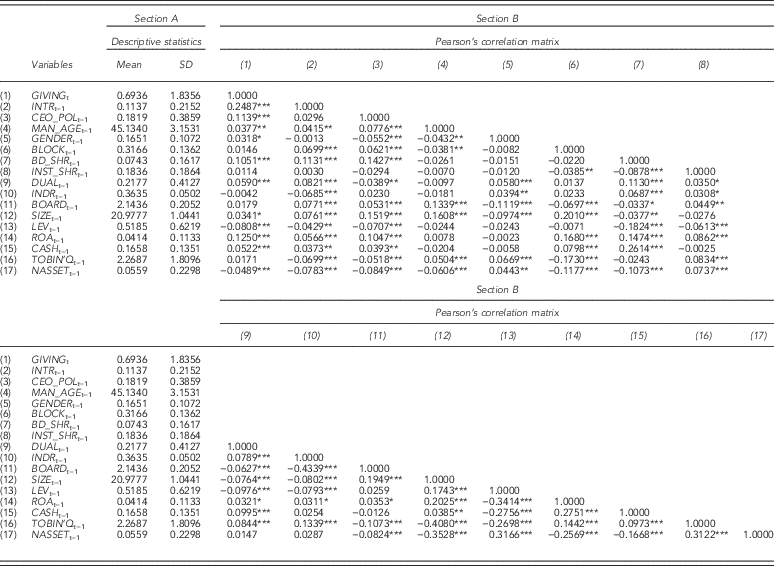
Section A of Table 1 reports descriptive statistics results of variables. GIVING has a mean value of 0.6936, indicating that the amount of corporate philanthropy in Chinese family firms equals about 0.069% of sales revenue in the year. The mean value of INTR is 0.1137, suggesting that the percentage of a firm’s overseas sales to its total worldwide sales is about 11.37%. The mean value of CEO_POL is 0.1819, implying that about 18.19% of CEOs involve in political affairs by being elected as deputies to the People’s Congress or members of the Chinese People’s Political Consultative Committee.
Descriptive statistics and Pearson’s correlation matrix

Note. ***, **, and * represent the 1, 5, and 10% levels of significance, respectively.
Descriptive statistics results of control variables reveal that, on average and approximately, the age of top managers (MAN_AGE) is 45.1340, the ratio of women directors (GENDER) is 16.51%, the proportion of shares held by the largest shareholder (BLOCK) is 31.66%, the percentage of shares owned by corporate directors (BD_SHR) is 7.43%, the percentage of shares held by institutional investors (INST_SHR) is 18.36%, the same person serves as the CEO and the chairman simultaneously (DUAL) for 21.77% of Chinese family firms, the ratio of independent directors (INDR) is 36.35%, board size (BOARD) includes nine directors (e2.1436), firm size (SIZE) is 1.29 billion RMB (Renminbi, i.e. Chinese Yuan), financial leverage (LEV) is 51.85%, accounting performance (ROA) is 4.14%, cash ratio (CASH) is 16.58%, TOBIN’Q is 2.2687, and 5.59% of Chinese family firms own negative net assets (NASSET).
Section B of Table 1 reports results of Pearson’s correlation analysis. GIVING is significantly positively correlated with INTR, providing preliminary support for Hypothesis 1. This finding suggests that internationalization plays an important role in promoting corporate philanthropy. In addition, the correlation coefficient between GIVING and CEO_POL is positive and significant, suggesting that CEO’s political participation positively impacts corporate philanthropy. A positive and marginally significant correlation between INTR and CEO_POL implies that the interactive effect between internationalization and CEO’s political participation on corporate philanthropy should be addressed.
In addition, GIVING displays significantly positive correlations with MAN_AGE, GENDER, BD_SHR, DUAL, SIZE, ROA, and CASH. Furthermore, GIVING is significantly negatively correlated with LEV and NASSET. These results suggest a need to control for these variables when examining the influence of internationalization on corporate philanthropy. Finally, as expected, the coefficients of pair-wise correlation among other control variables are generally low (<0.30), suggesting no multicollinearity problem exists when these variables are included together in multivariate regressions.
Main findings
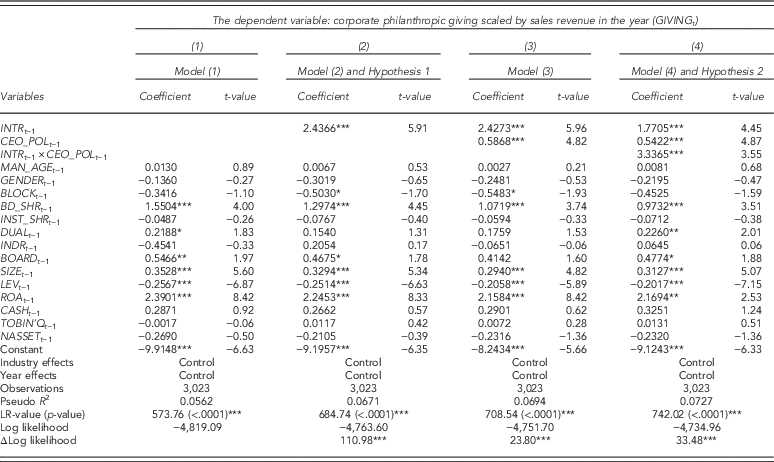
Using four step-by-step Tobit regressions, Table 2 provides results of corporate philanthropy on internationalization (INTR), political participation (CEO_POL), and other determinants. All reported t-statistics are based on standard errors adjusted for clustering at the firm level and the year level (Petersen, Reference Petersen2009). Moreover, four step-by-step Tobit regressions display gradually increasing explanatory power along with significantly higher Log likelihood values (see ‘∆Log likelihood’).
Results of corporate philanthropy on internationalization and CEO’s political participation

Notes. All reported t-statistics are based on standard errors adjusted for clustering at the firm level and the year level (Petersen, Reference Petersen2009).
***, **, and * represent the 1, 5, and 10% levels of significance, respectively, for two-tailed tests.
LR=likelihood ratio.
First, Model (1) only includes a set of control variables and examines their impacts on corporate philanthropy. Tobit regression results in Column (1) reveal the following aspects: (1) BD_SHR has a significantly positive coefficient (1.5504 with t=4.00), revealing that higher percentage of shares held by directors is linked to more corporate philanthropy. (2) The coefficient on DUAL is positive and significant (0.2188 with t=1.83), meaning that corporate philanthropy is significantly higher for firms in which the CEO and the chairman of the board are the same person than for their counterparts. (3) BOARD has a significantly positive coefficient (0.5466 with t=1.97), implying that larger board size upgrades corporate philanthropy. (4) SIZE has a significant and positive coefficient (0.3528 with t=5.60), consistent with Zhang et al. (Reference Zhang, Zhu, Yue and Zhu2010) and Du et al. (Reference Du, Jian, Du, Feng and Zeng2014). (5) The coefficient on LEV is negative and significant (−0.2567 with t=−6.87), implying the negative relation between financial leverage and corporate philanthropy. (6) ROA has a significantly positive coefficient (2.3901 with t=8.42), implying better accounting performance motivates more corporate philanthropy.
Second, Model (2) displays the influence of internationalization on corporate philanthropy after considering all control variables, and thus tests Hypothesis 1. As shown in Column (2), the coefficient on INTR is positive and highly significant at the 1% level (2.4366 with t=5.91), providing important and strong support to Hypothesis 1. Moreover, this result also suggests the following two aspects: (1) corporate philanthropy is significantly higher for firms with higher degree of internationalization than for firms with lower degree of internationalization, authenticating the positive association between internationalization and corporate philanthropy. (2) The coefficient estimate on INTR suggests that corporate philanthropy increases by about 52.44% accompanying with 1 SD increases in INTR, equaling about 75.60% of the mean value of corporate philanthropy. Obviously, this coefficient estimate is economically significant.
Third, Model (3) addresses the concerns about the influence of internationalization on corporate philanthropy after incorporating the moderating variable of CEO’s political participation (CEO_POL) and all control variables. As shown in Column (3), the coefficient on INTR is still highly significantly positive (2.4273 with t=5.96), providing additional support to Hypothesis 1. Also, CEO_POL, the moderating variable, has a significant and positive coefficient (0.5868 with t=4.82), suggesting that CEO’s political participation in Chinese family firms promotes corporate philanthropy. This finding is consistent with extant studies (Sánchez, Reference Sánchez2000; Claessens, Feijen, & Laeven, Reference Claessens, Feijen and Laeven2008; Su & He, Reference Su and He2010; Du, Reference Du2015).
Finally, Model (4) provides regression results of corporate philanthropy on internationalization (INTR), CEO’s political participation (CEO_POL), the interactive item of INTR×CEO_POL, and other determinants, and thus tests Hypothesis 2, which predicts that CEO’s political participation reinforces the positive association between internationalization and corporate philanthropy. As shown in Column (4), the coefficients on INTR and CEO_POL are both significantly positive (1.7705 with t=4.45 and 0.5422 with t=4.87), providing additional support to Hypothesis 1 and consistent with findings in Column (3), respectively. More importantly, the coefficient on INTR×CEO_POL is positive and significant at the 1% level (3.3365 with t=3.55), providing important support for Hypothesis 2. Moreover, the coefficient estimate on INTR×CEO_POL suggests that corporate philanthropy in firms with CEO’s political participation is about 88.45% (3.3365/1.7705−1) higher than their counterparts.
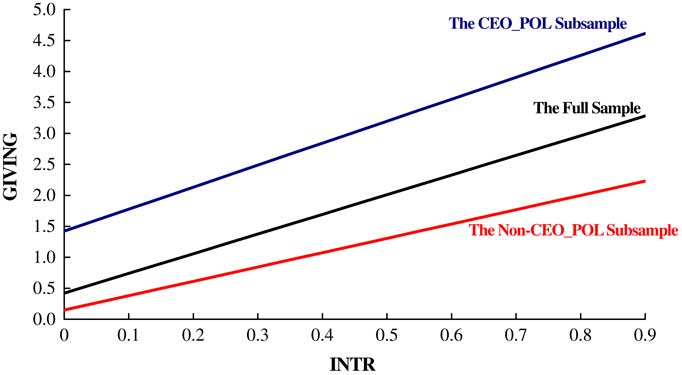
Figure 1 further displays the interactive effect between internationalization (INTR) and CEO’s political participation (CEO_POL) on corporate philanthropy (GIVING). In Figure 1, the black, deep blue, and red lines denote the effects of internationalization on corporate philanthropy for the full sample, the CEO_POL subsample (CEO_POL=1), and the non-CEO_POL subsample (CEO_POL=0), respectively. As shown in Figure 1, the positive effect of internationalization on corporate philanthropy is more pronounced for the CEO_POL subsample than the non-CEO_POL subsample, providing visual evidence and additional support to Hypothesis 2, which predicts the reinforced effect of CEO’s political participation on the positive relation between internationalization and corporate philanthropy.
The interactive effect between corporate internationalization (INTR) and CEO’s political participation (CEO_POL) on corporate philanthropy (GIVING). The black line, the deep blue line, and the red line denote the influence of INTR on GIVING for the full sample, the CEO_POL subsample (CEO_POL=1), and the non-CEO_POL subsample (CEO_POL=0), respectively

Robustness checks using corporate philanthropy scaled by total assets
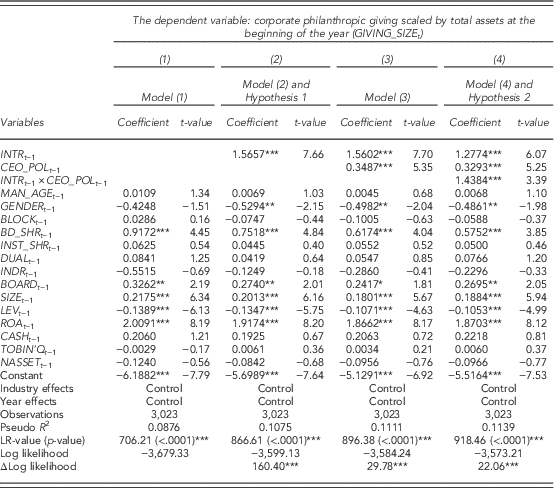
In Table 2, we adopt corporate philanthropy deflated by sales revenue as the dependent variable (Williams, Reference Williams2003; Chen, Patten, & Roberts, Reference Chen, Patten and Roberts2008) to test Hypotheses 1 and 2. To examine whether results in Table 2 are robust to other dependent variables, in Table 3, we use corporate philanthropy deflated by total assets at the beginning of the year (GIVING_SIZE) as the dependent variable (Brammer & Millington, Reference Brammer, Pavelin and Porter2006; Brown, Helland, & Smith, Reference Brϕnn2006; Amato & Amato, Reference Amato and Amato2007, Reference Amato and Amato2012; Du et al., Reference Du, Jian, Du, Feng and Zeng2014), and then conduct tests. For Model (2) and Column (2), the coefficient on INTR is positive and significant at the 1% level, supporting Hypothesis 1 again. In addition, results of Model (4) in Column (4) show significantly positive coefficient on INTR×CEO_POL, lending additional support to Hypothesis 2.
Robustness checks using corporate philanthropy scaled by total assets

Note. All reported t-statistics are based on standard errors adjusted for clustering at the firm level and the year level (Petersen, Reference Petersen2009).
***, **, and * represent the 1, 5, and 10% levels of significance, respectively, for two-tailed tests.
Robustness checks using the likelihood of internationalization
In Table 2, we use the degree of internationalization as the independent variable. To test whether results in Table 2 are robust to other independent variables, in Table 4, we adopt the dummy variable of internationalization (INTDUM), equaling 1 if a firm’s overseas sales are >0 and 0 otherwise, as the independent variable to reexamine Hypotheses 1 and 2. Results of Model (2) in Column (1) show that GIVING is significantly positively related with INTDUM, consistent with Hypothesis 1. Moreover, results of Model (4) in Column (3) show that the coefficient on INTDUM×CEO_POL is significantly positive, consistent with Hypothesis 2.
Robustness checks using the likelihood of internationalization
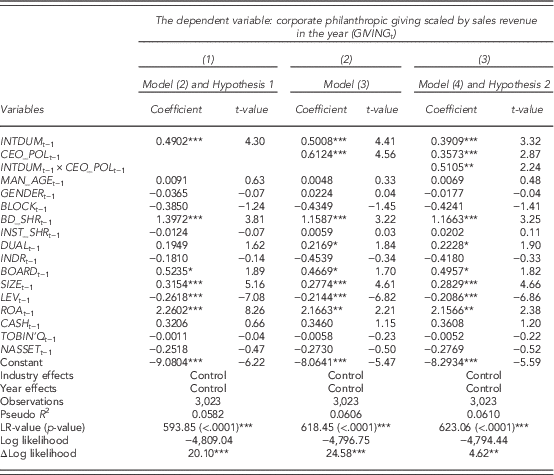
Note. All reported t-statistics are based on standard errors adjusted for clustering at the firm level and the year level (Petersen, Reference Petersen2009).
***, **, and * represent the 1, 5, and 10% levels of significance, respectively, for two-tailed tests.
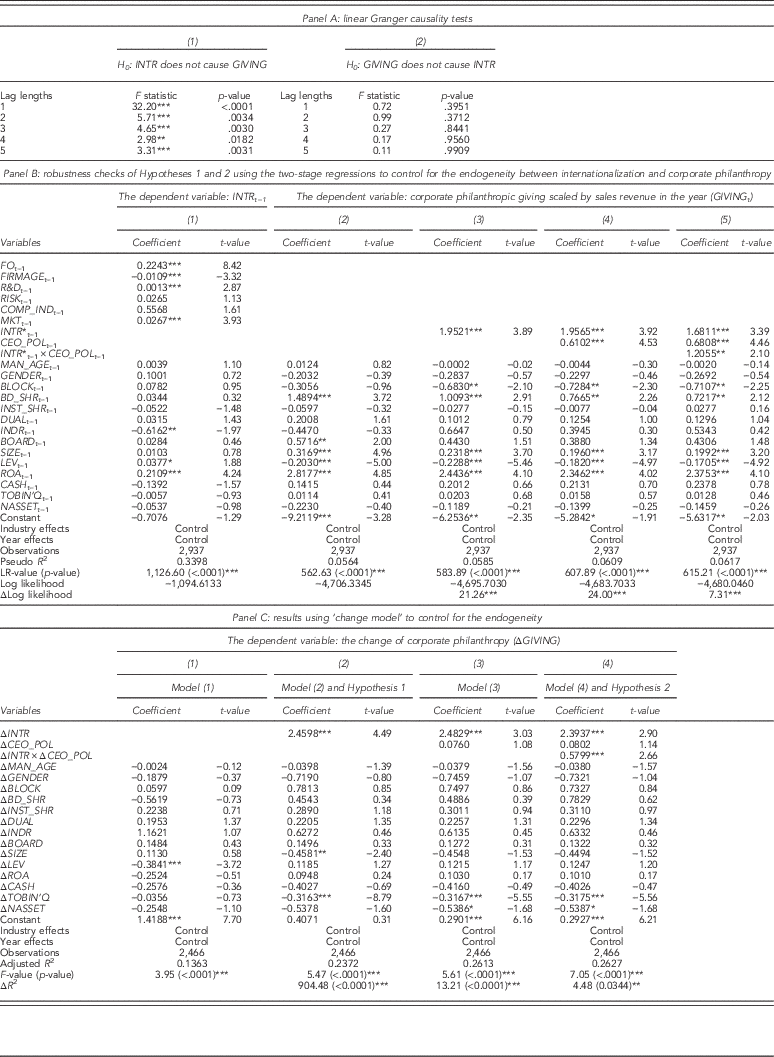
The Granger causality tests between corporate philanthropy and internationalization
Extant studies (Calof & Beamish, Reference Calof and Beamish1995; Caves, Reference Caves1996; Dunning, Reference Dunning1998; Westhead, Wright, & Ucbasaran, Reference Westhead, Wright and Ucbasaran2001) recognize that firm scale, managerial overseas experiences, unique products, manufacturing cost, and monopolistic advantage affect internationalization. Moreover, the internationalization of firms from emerging markets is a strategy as a response to the weak institutional environment at home countries (Calof & Beamish, Reference Calof and Beamish1995; Keohane & Milner, Reference Keohane and Milner1996; Child & Rodrigues, Reference Child and Rodrigues2005). Furthermore, Gardberg and Fombrun (Reference Gardberg and Fombrun2006) and Campbell, Eden, and Miller (Reference Campbell, Eden and Miller2012) argue that being a citizenship may be an important conduit for multinational firms to obtain the legitimacy and mitigate barriers from the liability of foreignness. Therefore, internationalization positively affects corporate philanthropy, but theoretically, corporate philanthropy is less likely to impact internationalization.
Nevertheless, in panel A of Table 5, we still conduct the Granger causality tests to examine whether the dual-directional causality exists between internationalization and corporate philanthropy (Granger, Reference Granger1969). As shown in Column (1), all F-statistics on joint tests of Granger causality are significant, suggesting that internationalization is the Granger causality of corporate philanthropy. But all F-statistics in Column (2) are insignificant, revealing that corporate philanthropy is not the Granger-cause of internationalization. Simply put, above results validate that the dual-directional causality is less likely to exist between corporate philanthropy and internationalization.
Results after using two-stage regression procedures to control for the endogeneity

Note. FO=foreign operation.
All reported t-statistics are based on standard errors adjusted for clustering at the firm level and the year level (Petersen, Reference Petersen2009).
***, **, and * represent the 1, 5, and 10% levels of significance, respectively, for two-tailed tests.
Using two-stage approach to control for the endogeneity
In addition to the Granger causality tests, we further employ two-stage regressions to mitigate the endogeneity between internationalization and corporate philanthropy. In doing so, we have to select instruments in the first stage, which are used to predict the fitted value of internationalization (INTR*). Referring to extant studies, we identify several instruments: (1) foreign operation, equaling 1 if a firm carries out business operations outside mainland China and 0 otherwise. (2) Firm age (FIRMAGE), measured as the number of years since a firm’s initial public offering. (3) Previous literature suggests that international strategy is affected by firm risk and innovations (Kwok & Reeb, Reference Kwok and Reeb2000; Cassiman & Golovko, Reference Cassiman and Golovko2011), and thus we incorporate R&D and RISK in the first stage. R&D denotes the amount of research and development expenditures deflated by total sales revenue. RISK represents firm risk, computed as a firm’s β coefficient on stock returns. (4) We further isolate the effect of industry competition (COMP_IND) on internationalization. COMP_IND is measured as the Herfindahl–Hirschman index of the total sales revenue for all firms within a given industry (Vahlne & Nordström, Reference Vahlne and Nordström1993). (5) Marketization (MKT), measured as the marketization index across different provinces in China (Fan, Wang, & Zhu, Reference Fan, Wang and Zhu2011). Moreover, we include all control variables in the second-stage regression as exogenous variablesFootnote 12 . Column (1) of Pane B of Table 5 shows results of the first-stage regression. The coefficients on foreign operation, R&D, and MKT (FIRMAGE) are positive (negative) and significant.
Next, we employ the predicted (fitted) value of internationalization (INTR*) from the first stage as the independent variable in the second-stage regression. In Column (3) of panel B of Table 5, the coefficient on INTR* is positive and significant at the 1% level, lending additional support to Hypothesis 1. Column (5) of panel B shows that the coefficient on INTR*×CEO_POL is also significantly positive, providing additional support to Hypothesis 2.
Using the change model to control for the endogeneity
Next, we further use the change models to mitigate the endogeneity between internationalization and corporate philanthropy (Acs & Braunerhjelm, Reference Acs and Braunerhjelm2005). Specifically, we examine the association between the change of internationalization and the change of corporate philanthropy. In doing so, we calculate ΔGIVING, ΔINTR, ΔCEO_POL, and the changes of all control variables. ΔGIVING is the change of (the level of) corporate philanthropy, measured as ‘corporate philanthropy deflated by sales revenue in year t – corporate philanthropy deflated by sales revenue in year t−1.’ ΔINTR is the change of internationalization, measured as ‘the degree of internationalization in year t – the degree of internationalization in year t−1.’ ΔCEO_POL is the change of CEO’s political participation, measured as ‘the rank of CEO’s political participation in year t – the rank of CEO’s political participation in year t−1.’ The rank of CEO’s political participation equals 5, 4, 3, 2, and 1 if the CEO is a deputy to the People’s Congress or a member of the Chinese People’s Political Consultative Committee at the national, provincial, municipal, county, and township levels, respectively, and 0 otherwise (Du, Zeng, & Du, Reference Du and Luo2014). As a result, in the change models, the number of observations decreases from 3,023 to 2,466.
Pane C of Table 5 presents results of the change models (the ordinary least squares regressions). As shown in Model (2) and Column (2), the coefficient on ΔINTR is positive and significant at the 1% level (2.4598 with t=4.49), suggesting that the increase in the degree of internationalization significantly results in higher level of corporate philanthropy. This result provides strong support to Hypothesis 1Footnote 13 . In Model (4) and Column (4), the coefficient on ΔINTR×ΔCEO_POL is positive and significant at the 1% level (0.5799 with t=2.66), supporting Hypothesis 2 again.
Above results in Table 5 suggest that our main conclusions are still valid after controlling for the endogeneity between internationalization and corporate philanthropy.
DISCUSSION
Theoretical contributions
Our study makes several theoretical contributions as below: first, to our knowledge and literature in hand, our study is one of very few studies to examine the role of internationalization itself in shaping corporate philanthropy. Specifically, our study shows that internationalization inspires and promotes corporate philanthropy, extending previous literature on the association between internationalization and CSR (Brammer, Pavelin, & Porter, Reference Brammer and Millington2009). Brammer, Pavelin, and Porter (Reference Brammer and Millington2009) find that only internationalization in particular countries with less political rights or civil liberties increases corporate charitable giving, but internationalization itself does not matter to corporate charitable givingFootnote 14 .
Second, this study is the first to examine the influence of internationalization on corporate philanthropy based on the context of developing countries (e.g., China). Extant studies (Brammer, Pavelin, & Porter, Reference Brammer and Millington2009; Campbell, Eden, & Miller, Reference Campbell, Eden and Miller2012) focus on developed countries such as United Kingdom and United States, and find that internationalization impacts corporate philanthropy. However, because of differences in economic development and cultural factors (Du, Reference Du2015), the findings based on developed countries may not be directly applied to the relation between internationalization and corporate philanthropy in developing countries. Therefore, it remains unknown that whether internationalization of enterprises from developing countries influences corporate philanthropy. In this regard, it is necessary to focus on developing countries to separately examine the effect of internationalization on corporate philanthropy.
For UK firms, Brammer, Pavelin, and Porter (Reference Brammer and Millington2009) find that only downstream internationalization from developed countries with better philanthropic consciousness and less social problems to other countries with weak philanthropic consciousness and more social problems is significantly positively associated with corporate charitable giving. Campbell, Eden, and Miller (Reference Campbell, Eden and Miller2012) show that cultural, administrative, and geographic distances reduce the likelihood of a foreign affiliate’s engaging in CSRFootnote 15 . Using a sample of family firms in China, the biggest developing country and the second largest economy where philanthropic consciousness is relatively weak and social problems are relatively prominent along with the rapid economic growth, this study complements Brammer, Pavelin, and Porter (Reference Brammer and Millington2009) and Campbell, Eden, and Miller (Reference Campbell, Eden and Miller2012).
Third, focusing on internationalization, our study adds to previous literature on the determinants of corporate philanthropy (Johnson & Greening, Reference Johnson and Greening1999; Williams, Reference Williams2003). Specifically, our study validates that the institutional environment and its change such as corporate internationalization may impact corporate philanthropy, and thus future research should not ignore this important determinant.
Finally, our findings can provide important support to previous literature in economics (North, Reference North1990; Williamson, Reference Williamson2000; Allen, Qian, & Qian, Reference Allen, Qian and Qian2005; Pistor & Xu, Reference Pistor and Xu2005) that argues that informal systems and formal institutions interact and mutually reinforce each other. Specifically, our study finds that CEO’s political participation reinforces the positive association between internationalization of Chinese family firms and corporate philanthropy, and thus echoes and validates the argument in extant literature.
Managerial implications
Our study also has several managerial implications. First, it is very important to investigate the association between internationalization and corporate philanthropy because it not only deepens the understanding of strategic motivation of corporate philanthropy, but also helps comprehend the social dimension of corporate philanthropy in an international setting. As a result, our study contributes to conceptual discussions on whether internationalization affects corporate philanthropy.
Second, our main findings suggest that internationalization as the institutional environment can positively impact corporate philanthropy and thus plays an important role in enhancing corporate philanthropy in view of the mounting interaction of corporate philanthropy consciousness along with internationalization or globalization, especially for multinational companies from developing countries like China in which the consciousness of corporate philanthropy is relatively weak.
Third, we validate that internationalization has significantly positive influence on corporate philanthropy, implying that internationalization benefits social welfare. Especially, under the context like China in which CSR consciousness is relatively weak, our findings suggest that the influence of internationalization on corporate philanthropy should be taken into account and internationalization as a market force can serve as an invisible hand to motivate a firm to be more philanthropic.
Fourth, our findings motivate managers in Chinese family firms to pay attention to the association between internationalization and corporate philanthropy. Specifically, corporate philanthropy can provide an important avenue for executives in multinational companies to offset the pressures from multiple stakeholder groups, cope with the liability of foreignness, and strengthen corporate reputation. As a result, for Chinese family firms that implement international strategy, managers should consider corporate philanthropy as a conduit to hedge operational risks to some extent.
Finally, the reinforced effect of CEO’s political participation on the positive association between internationalization and corporate philanthropy suggests that formal institutions and informal systems interact and reinforce corporate philanthropy. Focusing on the context of developing countries, this finding implies the bright side and the benefits of political connections in affecting corporate behavior.
Limitations and future research
Our study has several limitations that can be addressed in future research. First, this study only focuses on the impact of internationalization itself on corporate philanthropy, but does not differentiate between upstream and downstream internationalization because of data limitationFootnote 16 . Moreover, we cannot differentiate corporate philanthropy in home countries from that in host countries due to data limitation. Future research should further examine the impacts of upstream and downstream internationalization on corporate philanthropy, as well as internationalization’s influence on corporate philanthropy in home countries and in host countries.
Second, this study only investigates the influence of internationalization on corporate philanthropy, but does not examine whether internationalization can affect other CSR-dimensions. Zyglidopoulos et al. (Reference Zyglidopoulos, Georgiadis, Carroll and Siegel2012) and Du (Reference Du2015) find that some corporations increase CSR-strengths such as corporate philanthropy rather than reduce CSR-weaknesses. In this regard, it is an important and interesting task to investigate whether internationalization of Chinese family firms can strengthen environmental performance or mitigate environmental pollution, as well as other CSR-dimensions.
Third, our study employs a sample of family firms based on the context of China, and thus our conclusions may not fit well in with other countries, especially developed countries. In this regard, it is necessary for researchers to conduct a comparative study using the international setting to further examine whether the association between internationalization and corporate philanthropy still stands.
Finally, due to data limitation, we cannot use foreign direct investment exporting, and licensing to measure internationalization, and thus future research can further use multimeasures to address the association between internationalization and corporate philanthropy.
CONCLUSION
Drawing on the stakeholder theory, multinational companies are more likely to attract much more attention from a diversity of stakeholders due to their high visibility, and thus multinational companies always utilize corporate philanthropy to cater for the demands from different stakeholders. Moreover, according to the institutional theory, firms usually use corporate donations as an instrument to obtain the legitimacy from local communities. Therefore, multinational companies are inclined to carry out corporate philanthropy to offset various pressures from the liability of foreignness in host countries. As a result, internationalization is more likely to be positively associated with corporate philanthropy.
Using a sample of Chinese family firms, we show a positive relation between internationalization and corporate philanthropy. Moreover, we investigate the moderating role of CEO’s political participation. Our results show that internationalization is significantly positively associated with corporate philanthropy, and then CEO’s political participation reinforces the positive association between internationalization and corporate philanthropy. This study adds to the existing literature on the determinants of corporate philanthropy by validating corporate internationalization (institutional environment) and its change positively affect corporate philanthropy, implying the mounting interaction of corporate philanthropic consciousness accompanying with internationalization.
Acknowledgements
The authors appreciate constructive comments from Jinhui Luo, Hongmei Pei, and participants of our presentations at Xiamen University. Prof. Xingqiang Du acknowledges financial support from the Key Project of Key Research Institute of Humanities and Social Science in Ministry of Education (the approval number: 16JJD790032).