The use of the noun phrase accessibility hierarchy (NPAH) as an explanation for the use, interpretation, or both of relative clauses (RCs) by second language (L2) speakers is one of the earliest examples of an attempt to offer a principled hypothesis about L2 development. Its explicit claims have allowed empirical testing that has produced important counterexamples, including the results of the studies reported in this special issue, which suggest that the hierarchy is not applicable to the SLA of languages like Cantonese, Japanese, and Korean. A weak version of the hypothesis that applies only to languages in which RCs express head-complement dependencies (i.e., postnominal relatives) is just as problematic. I suggest here that the time has come to consign this hierarchy to the history of SLA research and focus on other kinds of question about L2 speakers' knowledge of RCs.
SITUATING THE NPAH IN THE DEVELOPMENT OF THEORIES OF SLA
In a number of areas of the study of language, early hypotheses that were first approximations of an explanation for interesting observations have subsequently given way to more articulated proposals with broader empirical coverage that might offer greater insight into the phenomena in question. One example of this is the early hypothesis of Manzini and Wexler (1987) with respect to anaphor binding. They observed that languages differ in what can count as an antecedent for anaphors in sentences like Kate said that Alice wished that Mary would persuade Helen to see Jane's portrait of herself. In some varieties of English, only Jane is a possible antecedent for herself, whereas in equivalent sentences in other languages, any of Kate, Alice, or Mary could be possible antecedents. To capture the observation, Manzini and Wexler hypothesized two parameters of variation: a governing category parameter and a proper antecedent parameter. The values selected for these parameters determine possible antecedents in a given language. Subsequently, it was discovered that a more insightful account of anaphor binding could be given on the basis of the morphological status of the anaphor itself: monomorphemic or polymorphemic (Pica, 1984, among others). This led to new hypotheses being proposed, such as Progovac's (1992) relativized subject hypothesis and Cole, Hermon, and Sung's (1990) movement-to-Infl hypothesis, and the eventual abandonment of Wexler and Manzini's parameters. This kind of development from early attempts at explanation to more sophisticated hypotheses is an inevitable and welcome result of ongoing investigation.
The NPAH is another example of an interesting early hypothesis—in this case, about the distribution of RC types in the world's languages. Its extension to explaining observations about how L2 learners develop knowledge of RCs met with some initial success, as observed by Ozeki and Shirai (this issue). Is the NPAH still of descriptive and explanatory value in the development of theories of SLA, given subsequent discoveries, including the work presented in this special issue?
In the 1980s, empirical problems were already beginning to emerge that suggested that the NPAH was not as parsimonious an explanation for the development of knowledge of RCs by L2 speakers as other possibilities (Hamilton, 1995). Hamilton highlighted some of the anomalies that had already appeared in empirical studies, such as the lack of an observed developmental distinction between indirect object and oblique object, which, according to the NPAH, is expected, and parallel performance by L2 speakers on genitive RCs and subject (SU) or direct object (DO) RCs in experimental studies where the NPAH predicts genitive RCs should appear later or be more difficult. Hamilton showed that in a sentence-combining task performed by 98 L2 learners of English, informants produced more targetlike RCs that involved a DO relative in argument prepositional phrases (PPs; e.g., This is the desk that I laid my pen on ___) than RCs that involved a DO in adjunct PPs (e.g., She drove the bus that I did my homework on ___). Because both cases involve a DO, this difference is not predicted by the NPAH. At the same time, subjects made no distinction between indirect object RCs (The boy that I passed the ball to ___) and oblique object RCs (The party that I took my friends to ___) in argument positions. Here, the NPAH predicts a difference, but this difference is not found.
PERSPECTIVES ON THE NPAH OFFERED BY THE STUDIES IN THIS ISSUE
The current collection of studies focuses on the acquisition of RCs in Cantonese, Japanese, and Korean and provides considerable evidence that challenges the usefulness of the NPAH for constructing theories of SLA. For example, Ozeki and Shirai (this issue) showed that L2 learners of Japanese drew little distinction between SU and DO RCs. Both Ozeki and Shirai as well as Kanno (this issue) showed that the animacy of the head of the RC is a better predictor of learners' choices than the grammatical function of the head. Yip and Matthews (this issue) found that in early Cantonese-English bilinguals, DO RCs emerged at the same time or earlier than SU RCs.
One way of rescuing the NPAH, in the face of such counterevidence, is to adopt Comrie's (1998) suggestion that RCs in languages like Cantonese, Japanese, and Korean do not involve a dependency between the noun head of the RC and a grammatical position within the clause, as they do in European languages like English, French, and German. Instead, clauses that are complements to nouns are simply attributive. This is the position that appears to be adopted by Ozeki and Shirai (this issue). Counterevidence to the NPAH from studies of the SLA of languages like Japanese are no longer considered counterevidence because the clauses in question do not involve head-complement dependencies. Adopting this strategy reduces the domain of applicability of the NPAH. Given that it faces descriptive problems even in the case of languages in which there are dependencies in RCs (as discussed previously), it is now at best something of a lame duck hypothesis. In what follows, I will consider whether one can go a step further and declare the NPAH to be a dead duck, so that the field can move on to other potentially more interesting hypotheses about the development of knowledge of RCs by L2 learners.
QUESTIONS BEYOND THE NPAH
The NPAH interpretation of the use of RCs by L2 speakers is somewhat like the view of the use of functional morphology by L2 speakers that was promoted by the early morpheme studies (e.g., Dulay, Burt, & Krashen, 1982); that is, the frequency with which a form is supplied by L2 speakers is an indicator of when it was acquired. If forms of the copula be are supplied more frequently than forms of third person singular -s (3sg -s), then copula be is acquired before 3sg -s. However, as a number of studies have since pointed out, where an individual is using forms of both copula be and 3sg -s, that individual has, in a real sense, acquired both forms, and what is involved in determining the difference in frequency of use is something other than acquisition order (see White, 2003). In a similar way, a number of existing L2 studies that assume the NPAH link the frequency of use of RC types by L2 speakers to the acquisition of those types: Because SU RCs are used more frequently, more accurately, or both than other RC types, they are acquired first. This, however, merits closer attention. I have the impression from existing studies of languages in which RCs involve a head-complement dependency that once L2 learners start to use RCs productively, they are capable of using them on a range of dependent positions, not just SU but also DO, indirect objects, and genitives. The studies in this special issue certainly suggest that this is the case for the acquisition of the Asian languages examined: When learners are aware of the possibility of RCs, they can use them in relation to several positions in the subordinate clause, whether attributive or not. If this is the case, then there is some other constraint that determines why the use of SU RCs might be favored over other types. This could be something like a structural distance principle that operates as part of a parsing routine, as suggested by Hamilton (1995) for L2 English and by O'Grady, Lee, and Choo (2003) for L2 Korean. The NPAH, based as it is on implicational relations between grammatical functions, would play no role in such an account.
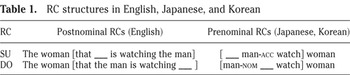
The studies reported by Kanno (this issue) for L2 Japanese and O'Grady et al. (2003) for L2 Korean suggest an intriguing possible stage of development that precedes the emergence of RCs. To illustrate, consider the structure of SU and DO RCs in prenominal languages like Japanese and Korean and with postnominal languages like English (see Table 1). The structure of the DO RC in Japanese and Korean is strikingly like the structure of SVO clauses in English, with a noun-nominative-verb-noun order. O'Grady et al., using a picture selection task that involved pictures such as a man looking at a woman and a woman looking at a man, found that in the case of DO RCs, their informants chose the picture of the man looking at the woman in nearly 30% of cases in which the stimulus Korean sentence had the RC structure the woman who the man is looking at. As O'Grady et al. observed, this looks like the English-speaking L2 learners have interpreted the Korean RC as if it is a main clause SVO structure; in other words, “they transferred the post-nominal property of English relative clauses to Korean” (p. 444). Transfer is not predicted by the NPAH, and the likelihood of such effects merits further investigation.
RC structures in English, Japanese, and Korean

Finally, both Kanno (this issue) and Ozeki and Shirai (this issue) highlighted the influence of animacy in determining L2 speakers' responses in experimental studies, suggesting that learners have a strong bias to interpret RCs as SU-based when the head is animate and DO-based when it is inanimate. Coupled with the finding discussed previously, an interesting question to ask is whether the way that L2 learners parse RCs, in either European or Asian languages, is evidence of shallow structure processing. Clahsen and Felser (2006) have proposed that in parsing filler-gap dependencies in long-distance questions and in attaching RCs to heads (where more than one attachment is possible), L2 learners, in contrast to first language (L1) learners and mature native speakers, compute syntactic representations that are “shallower and less detailed” (p. 32). Instead, they use “lexical-semantic, pragmatic, and other relevant non-linguistic information” (Clahsen & Felser, p. 31). Again, such parsing effects are not predicted by the NPAH and thus merit further investigation in the context of RCs.
CONCLUSION
The studies reported in this special issue are timely in stimulating a reevaluation of the usefulness of the NPAH in theories of SLA. The empirical problems that confront it suggest that it is no longer a tenable hypothesis. More interesting questions relate to the role played by parsing, L1 influence, and semantic factors like animacy in the acquisition and use of knowledge about RC structure by L2 speakers.