Between 1839 and 1852, three “American” magazines appeared in London, each largely composed of reprinted articles from United States periodicals. These three magazines – the American Miscellany (1839–40), Great Western Magazine (1842) and American Magazine (1851–52) – all claimed to be pioneering the transmission of American periodical literature across the Atlantic, and all presented themselves as organs of national culture, even though they were published exclusively in London and aimed at British readers.Footnote 1 All three magazines opened with confident claims of certain success, yet each met the fate most common to nineteenth-century periodicals: they failed within a year, and were forgotten. While these magazines contained works by well-known American writers, such as Nathaniel Hawthorne, Lydia Maria Child, Walt Whitman and James Russell Lowell, none had influential literary figures on their staff. Despite their short life spans and lack of cultural legacy, these failed transatlantic print experiments illustrate the importance placed on the circulation of American writing in Britain by writers, editors and publishers who sought to develop a national American culture from both sides of the Atlantic. Through reprinting American texts in Britain, and utilizing the fluidity and polyphony of the magazine form, these magazines invented the national culture that they claimed to be recirculating. Across the Atlantic, they staged a distinct and national American culture that could not be realized within the United States, where regional print cultures, and sectional tensions over slavery, inhibited the emergence of a national culture.
Beginning with the title of this article, I use the terms “stage” and “perform” to suggest that these magazines fashioned themselves as theatrical spaces, and used reprinting – the republication of articles from one periodical in another – to invent American national culture. All three magazines participated in what Peter P. Reed, in his analysis of theatre culture in the early republic, has called “print-performance culture”: a popular culture in which these two modes of transmission overlap, and printed and verbal forms “produce and record traces of performance,” but also “reshape performance through their respective aesthetic conventions and production practices.”Footnote 2 I extend Reed's theorization of print and performance by suggesting that the publication practices of these magazines, as well as their texts, created nationalizing performances. Drawing on performance studies scholarship, I argue that periodical reprinting should be understood as a form of performance. Unlike the more traditional term “circulation,” which has connotations of uninterrupted motion, performance captures how reprinted articles function both as reiterations of prior utterances, and as new creations that are shaped by their unique publication contexts. The American Miscellany, Great Western Magazine and American Magazine emphasize the performance of reprinting by fashioning themselves as theatrical spaces, in particular through their engagement with the Yankee comedy: a popular dramatic form that centered on the humorous antics of archetypal New Englander Brother Jonathan, and that had itself emerged as distinctly American through transatlantic transmission and performance.
Through combining the performance of reprinting with the theatrical space of the magazine, London's “American” magazines established Britain as a site for staging American literature as a national form. The American Miscellany, the only one of the three without a named American editor, reframed transnational and regional texts as national artefacts by reprinting them in Britain. The Great Western saw the magazine format and Britain as stages for a national polyphony might safely articulate sectional tensions over slavery. Finally, the American Magazine positioned successful transatlantic performances by Americans as means of national reunion, locating Britain as a stage on which sectional divisions could be healed. Britain and transatlantic reprinting, then, became a means of imagining not just an American culture, but a particular, racialized form of nationhood, excluding non-white bodies to produce a fantasy of unified national identity. But I also explore why all of these magazines’ performances of a white, national American culture were unsustainable. The American Miscellany moved away from the theatricality through which it had originally constructed American identity; the Great Western found it impossible to articulate both national identity and national polyphony; and the American Magazine rehearsed, and thus reinforced, the sectional divisions that it attempted to dispel.
Exploring how these magazines invented national culture, and why they could not sustain that culture, expands our understanding of the place of both reprinting and magazines in the development of American nationhood, culture and identity. Following Meredith McGill's landmark study, scholars have acknowledged that an antebellum culture of reprinting shaped, rather than inhibited, the development of a distinct American literary tradition.Footnote 3 At the same time, building on Benedict Anderson's argument for the centrality of print capitalism to the emergence of the nation as “imagined community,” scholars from literary-critical, book-historical and sociological backgrounds have examined how periodicals published in America helped to construct American national identity.Footnote 4 However, we also need to understand how reprinting outside America was a means of creating national culture, and how periodical reprinting intersects, in form and in content, with other popular cultural forms. Although the London “American” magazines that I explore ultimately failed, they demonstrate the importance of Britain, and of the labile boundary between performance and print, as sites for imagining America. The cultural work of these magazines prompts us to question how the objects and the geographic boundaries of our investigations into American culture might change if we, like these magazine editors, view reprinting and performance in Britain as a crucial part of the making of that culture in the nineteenth century.
THEATRICAL PERIODICALS AND THE PERFORMANCE OF TRANSATLANTIC REPRINTING
In Britain and America in the mid-nineteenth century, it was common for newspapers and magazines (especially cheaper magazines) to obtain a substantial amount of their content by reprinting materials from other periodicals. This reprinting was facilitated by the fact that much of the material in periodicals was in the public domain: periodicals were not covered by copyright in England until 1842, and after 1842 were not always deposited (and therefore remained unprotected), and only the largest antebellum American periodicals sought copyright protection.Footnote 5 Reprinting between periodicals was, therefore, not illegal, and there was no expectation that a periodical text would be a stable artefact in a single publication.Footnote 6 Indeed, many newspaper editors participated in exchange networks, swapping copies of their paper with other editors so that both parties might expand their contents through “scissors-and-paste” journalism. Furthermore, the lack of an international copyright treaty between Britain and American meant that texts that were subject to copyright in one country could be reprinted in periodicals in the other: British texts could not be copyrighted in America until the Chace Act of 1891, and, until 1854, American texts could only be copyrighted in Britain if first published there.Footnote 7 This situation produced the American weeklies the New World and Brother Jonathan, which traded in reprints from British magazines and serializations of British fiction, and the London “American” magazines on which this article focusses.Footnote 8
Each reprint of a text in a periodical was a re-creation as well as a reproduction; its meaning was shaped both by its individual context of publication and by its status as one of many reprints. These qualities of reprinted texts allow them to be understood as performances. The term “performance” has been various defined, especially since the rise of performance studies as a discipline from the 1960s onwards, but definitions often focus on its particular temporality. Performance is a signifying gesture that reaches back to and gains meaning through an anterior performance, but that cannot itself be reproduced. Defining performance as “representation without reproduction,” Peggy Phelan sees performance as a form of signification that is irredeemable, arguing that while a performance “can be performed again … this repetition itself marks it as ‘different’.”Footnote 9 At the same time, Richard Schechner, in his definition of performance as “twice-behaved behavior,” suggests that performance attempts to restore a communicating gesture (performance is “never for the first time”) and, in doing so, transforms the gesture, because of differences in context, performer and reception.Footnote 10 Joseph Roach agrees that performance is always both over again and anew because “no action or sequence of actions may be performed exactly the same way twice: they must be reinvented or recreated at each appearance.”Footnote 11 It is this desire to re-create, while being itself unreproducible, that gives performance its instability and its power.
These qualities of performance – its ephemerality, its situatedness and the ways in which it invites and resists reproduction – are also qualities of periodical reprints. Arguing for the usefulness of the term “fugitive verses” to describe poetry reprinted in newspapers, Ryan Cordell and Abby Mullen suggest that this nineteenth-century designation for occasional verses also reflects how those verses register the curious temporality of the newspaper as occasion – a repetition of something familiar, and an object that is embedded in a unique moment and context. Cordell and Mullen's theorization of newspaper poetry echoes performance theory in their emphasis on “occasion,” and they trace how reprints of particular poems both relied upon readers’ awareness of prior reprints and transformed the poems' meaning.Footnote 12 Moreover, Cordell's online edition of this newspaper poetry refers to each reprint of a poem as a “witness,” suggesting that reprints testify to an original cannot be reproduced absolutely, rather than being a copy of an original.Footnote 13 Conceptualizing reprinting as a form of performance reminds us that we cannot locate the meaning of a reprinted text in any single copy; instead, we have to keep in mind its immediate context and its existence as one of many reprints within an economy of reprinting, both of which would have influenced its contemporary reception and cultural work.
The London “American” magazines I consider in this essay emphasize the performative nature of reprinting by constructing themselves as theatrical spaces. Not all performance is theatrical, and the relationship between “performance” and “theatricality” is contested.Footnote 14 I follow Josette Féral, who suggests that “performativity” is an “important component” of theatricality, but that theatricality requires performers and spectators to be aware that they are producing and consuming performances.Footnote 15 Theatrical performances share the ephemerality of all performances, while also aligning with a “certain set of references and codes” that make them “recognizable and meaningful” to members of the culture in which they take place.Footnote 16 In the nineteenth century, periodicals frequently borrowed these references and codes. Theatre historian Jeffrey Richards suggests that in the early republic, periodicals were a surrogate for the stage for those removed from urban centers and functioned as “a stimulus to observe or at least imagine performance,” for example by printing real or mock playscripts.Footnote 17 In the British context, Anne Horn identifies a resemblance between Victorian stage performance and magazine form, suggesting that both were characterized by “variety and interruptions rather than by focus and continuity”; the typical Victorian theatrical evening offered several performances rather than a single play, aligning with the composite contents a magazine presented to its readers.Footnote 18 Antebellum American magazines also presented themselves as spectacles, mirroring one of the era's most popular dramatic techniques.Footnote 19 The 1830s and early 1840s witnessed a popular fad for “mammoth sheets”: cheap periodicals, whose standard dimensions were two feet by three feet, but could reach over a thousand square inches per sheet. Isabelle Lehuu remarks that such papers were “antithetical to private reading,” and were “conceived for display.”Footnote 20 While British publishers did not adopt this trend for large papers, other aspects of their periodicals evoked theatrical performance, including cover illustrations that resembled tableaux vivants, and banner headlines that resembled playbills. Together, these features alerted magazine readers that they were engaging with what Féral describes as a “framed theatrical space”; that is, a space with which one interacts as a spectator, rendering the objects within that space representations and enabling “the construction of a fiction.”Footnote 21
The American Miscellany, the Great Western and the American Magazine all employed some of these theatrical features, which is unsurprising as at least two of their editors were theatre men.Footnote 22 An obituary for Isaac Clarke Pray, the editor of the Great Western, described him as a “gentleman, well known in literary and theatrical circles,” who “won conspicuousness as a journalist, a playwright, an elocutionist and an actor.”Footnote 23 Similarly, the editor of the American Magazine, Henry Howard Paul, had a successful career in England as a theatre impresario, playwright and actor after the Magazine folded, gaining particular fame for performing in a comic duo with his first wife.Footnote 24 All three magazines augmented their formal theatricality by publishing articles and fiction about the theatre. At the start of its run, the American Miscellany reprinted reports of the earnings of star American performers like Edwin Forrest, and the American reception of British singer and actress Madame (Lucia Elizabeth) Vestris. The Great Western reviewed London performances, including those by tragedian William Charles Macready. Pray praised Macready's Drury Lane for its more subtle and sophisticated performances aimed at true “lovers of the drama,” and criticizing its ventures in populist melodrama and spectacular staging, in ways that anticipate the class-inflected positions on Macready and his US rival Edwin Forrest that prompted the Astor Place Riot.Footnote 25 The American Magazine’s monthly “Chit Chat” column included anecdotes about American actress Charlotte Cushman, who had recently toured England and was famed for her ability to play male and female roles; a note on the success of the American Edward Davenport, a young tragedian performing in Edinburgh; and a snippet about Irish singer Catherine “Katty” Hayes's tour of America.
Interplay between periodical and theatrical cultures was not uncommon in the mid-nineteenth century; as Michael Collins observes in his study of performance and the nineteenth-century short story, periodical print and theatre operated as “parallel mediums” in shaping mid-century US culture.Footnote 26 But the theatre was a particularly powerful space for magazines that marketed themselves as organs of a national American culture, as the American Miscellany, Great Western and American Magazine did. S. E. Wilmer, Jason Schaffer and others have demonstrated that the theatre was a crucial site for constructing, negotiating and testing the nature and limits of American national identity in the first half of the nineteenth century.Footnote 27 Between 1800 and 1850, a suite of theatrical traditions acted as vehicles for evaluating and disseminating different modes of national, regional, class and cultural affiliation, including melodrama, Shakespearean histories and tragedies, and “Ethiopian” or blackface entertainments.Footnote 28 In aligning themselves with the theatre, London “American” magazines explicitly framed their reprinted contents as performances, but also showed that they understood the power of theatrical performance to create and sustain national culture and affiliation.
Schechner suggests that “restored behavior offers to both individuals and groups the chance to rebecome what they once were – or even, and most often, to rebecome what they never were but wish to have been or wish to become.”Footnote 29 That is, performance brings into being the cultures, identities and affiliations that it purports to portray. Building on Schechner, Roach argues that this “rebecoming” takes place through a process of “displaced transmission,” in which practices and behaviors are transmitted to new locales through circulation and surrogation, creating cultural memory through performance's unique combination of reproduction and reinvention.Footnote 30 Roach suggests that “the key to understanding how performances worked within a culture” is to “illuminate the process of surrogation as it operated between the participating cultures”; that is, how performance constructs identity through crossing the boundaries that it simultaneously seeks to establish.Footnote 31 As well as revealing how apparently stable and fixed identities emerge through messy, disparate and ongoing processes of transmission and transformation, Roach's work suggests that performances of national culture and identity can be most vivid when they take place beyond the boundaries of the nation itself.
For the editors of London's “American” magazines, the production of national culture through “displaced transmission” would have been visible in the fashioning of the stage Yankee as a national American figure through the character's circulation on the transatlantic stage. Like the melodrama and historical tragedy, the Yankee comedy was a theatrical form that consciously negotiated the shape of American identity. Heather S. Nathans argues that the Yankee was one of a “surprising range of racial and ethnic characters” onstage in the early nineteenth century that “helped Americans think through questions of identity and belonging.”Footnote 32 Rustic birth, verbal comedy, a democratic and independent mindset, and keenness in financial dealings characterized the stage Yankee, who was usually known as Brother Jonathan and was easily identified by his distinctive costume and exaggerated New England dialect.Footnote 33 In particular, Dale Cockrell observes, Yankee plays defined white nationality and assisted in “the maintenance of racial distinction.”Footnote 34 The Yankee also embodied the essentially performative nature of culture, relationships and identity in antebellum America that Karen Halttunen and Stephen Mihm identify, especially after 1820, when the character shifted away from the rustic bumpkin and towards a shrewd dealer, who used the bumpkin persona to get the better of his social superiors.Footnote 35 While antebellum audiences on both sides of the Atlantic understood the Yankee as a quintessentially American original, Matthew Pethers has shown that transatlantic circuits of performance fashioned both the character and the forms of national identity he came to embody. Yankee comedies distilled a set of regional traits into a stock national character through staged confrontations with a British other who “served as a familiar, normative standard against which the linguistic and social peculiarities” of the Yankee were measured.Footnote 36 At the same time, British actors’ and playwrights’ Yankees influenced American renditions of the figure, and American actors sought approval for their Yankee performances in Britain.
The transatlantic career of American Yankee comedian George Handel Hill illustrates how transatlantic circuits of performance produced the Yankee as an authentic American type. Before his first London tour in 1836, critics in New York and the provinces praised Hill's Yankee as an accurate presentation of a regional type. Yet Hill knew that changes would be needed for London audiences who “don't take all the Yankeeisms as readily as my audiences in the States.”Footnote 37 Indeed, English reviewers praised Hill's premier of London playwright William Bayle Bernard's The Yankee Peddler as authentically American rather than authentically regional.Footnote 38 Moreover, they actually celebrated Hill fulfilling a British idea of the American. The London Chronicle commended Hill for “completely realiz[ing] the conceptions we had previously formed of the singular race whose representative he is,” the adjective “singular” suggesting that Americans were both unique and unified.Footnote 39 John Bull went further, applauding Hill's performance of a character that had been “rendered familiar” to London audiences by British comedian Charles Mathews, most prominently in his play A Trip to America (1824).Footnote 40 Mathews's Jonathan Doubikins was quite distinct from the American Yankee tradition; his satirical take on Americans’ love of wealth made the character a slick trickster rather than a rustic bumpkin. Yet that performance greatly influenced subsequent American Yankee comedians. Pethers notes that Mathews's trickster inspired James Henry Hackett, Hill's predecessor as America's leading Yankee comic, to add an edge of sharpness to his Yankee.Footnote 41 By the time Hill performed the Yankee in London, then, actors from both sides of the Atlantic had repeatedly reshaped this ostensibly authentic American figure in response to previous performances and audience expectations. Hill's own London version of the Yankee did not remain in England, but travelled back with him to New York. When Hill returned to the Park Theatre, arguably New York's and America's most prestigious venue, he performed a version of The Yankee Pedlar, adapted by American playwright Morris Barnett, that became his signature piece.
The American Miscellany’s first edition appeared just after Hill completed his second British tour. Likewise, the American Magazine frequently reported on Yankee comedian Joshua Silsbee, who was conducting a highly successful British tour when that magazine commenced in 1851. All three magazines reprinted Yankee sketches and “notions” that, in the context of London's popular culture, signified authentic Americanness. More importantly, these magazines’ reprinting of American texts mirrored the process of transatlantic performance through which the Yankee became nationally representative. Each used the magazine form, transatlantic reprinting and the cultural and geographic distance between Britain and the United States to perform a national American culture that was impossible to realize at home. Taking each publication in turn, I explore how texts that articulated regional and social divisions in the US became exemplary artefacts of a national culture in the theatrical space of the magazine. The American Miscellany muted the essentially regional and transatlantic character of American literature, reframing local and transnational texts as performances of nationality. The Great Western used the magazine format to offer a chorus of American voices that could offer diversity without fracturing into disharmony. Against a backdrop of increasing tensions over slavery, the American Magazine reprinted texts that staged fantasies of union when located in a national magazine, making Britain a space in which America could heal its sectional divisions. All three magazines, then, used the performance of reprinting and the theatrical space of the magazine to attempt to overcome barriers to national culture that existed in the United States. All three generated a fantasy of a stable white nation with a distinct and unifying culture, inventing the American literary tradition that they purported to reproduce.
THE AMERICAN MISCELLANY (21 SEPTEMBER 1839–AUGUST 1840)
The American Miscellany of Popular Tales, Essays, Sketches of Character, Poetry and Jeux d'Esprit was published by George Berger of Holywell Street, near the Strand, from 21 September 1839. Berger specialized in cheap print, publishing inexpensive periodicals on a variety of subjects, few of which lasted long. He was likely attracted to publishing American writing because he could reprint it for free, allowing him to sell his magazine at a low price.Footnote 42 The Miscellany was issued weekly and cost twopence for sixteen pages of double-column, closely printed prose, with a half-page illustration on the front cover. It promised readers “a selection from the literary productions of our Transatlantic brethren,” that were “quite new to the English public.”Footnote 43 As its name suggests, the Miscellany offered a range of writing, including fiction (from Western adventures to domestic romances), poetry, factual articles on history and science, and snippets of American humour. Berger achieved this generic variety with a slender selection of source materials by reprinting from American newspapers, magazines and gift books. In the Miscellany’s first four months, Berger reprinted from Nathaniel Parker Willis's New York magazine The Corsair, and the New York Mirror, for which Willis was a foreign correspondent. Both periodicals combined verse and prose selections, largely either light or sentimental, with witty commentary on the culture, theatre, and fashions of New York, and also abroad.Footnote 44 These periodicals appealed to female readers, as did some of Berger's other sources, the monthly periodical the Ladies’ Companion (1834–43), a New York rival to the Philadelphia Godey's Lady's Book that dealt similarly in sentimental literature and fashion, and the gift-books The Token and the Atlantic Souvenir.Footnote 45
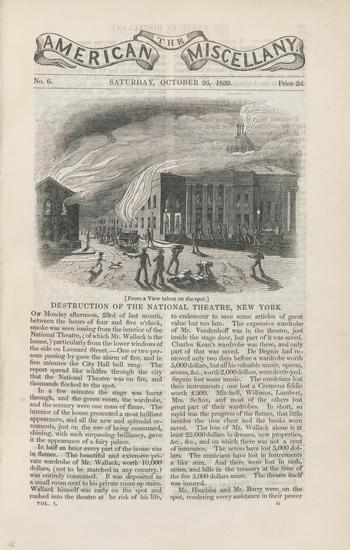
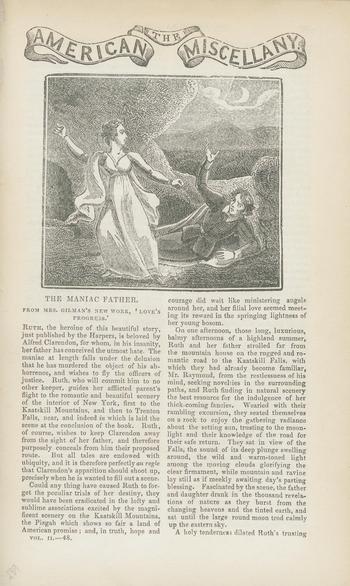
As well as reprinting American texts, Berger's periodical echoed the theatrical and carnivalesque qualities that Lehuu argues characterized antebellum American print.Footnote 46 The Miscellany traded in graphic portrayals of Western violence, as well as broad humour. The former was almost certainly an attempt piggy-back on the success of James Fenimore Cooper's Western adventures, whereas the latter echoed the popularity of Yankee stage comedy. A substantial number of articles on the theatre reinforced this interplay between stage and magazine. The Miscellany’s fourth number featured an article on “Things Theatrical, and the Star System in America,” and its eighth contained an anecdote about the manager of the Bowry Theatre. The theatre was the subject of Emma C. Embury's story “The Play and the Afterpiece,” reprinted in January 1840, in the same number as an article detailing the decline of the Park Theatre, New York. Most prominently, on 26 October 1839, the magazine reprinted a report on a large fire at New York's National Theatre as its illustrated story, transforming the theatre itself into an object of spectacle (Figure 1). The Miscellany’s cover illustrations often resembled tableaux vivants, with figures frozen in an arrangement that encouraged the reader to interpret the image as a scene in process, as in Figure 2, which accompanied Boston author Caroline Gilman's The Maniac Father. Furthermore, the arrangement of the Miscellany – a showpiece illustrated tale, supported by a selection of shorter texts – mirrored the arrangement of a mid-century entertainment, in which the main theatrical event was followed by one or more supporting dramas.
Front page of the American Miscellany, 1, 6 (1839) featuring an image of “Destruction of the National Theatre, New York”. British Library, P.P.6125, p. 81. © British Library Board.

Front page of the American Miscellany, 2, 19 (1840), featuring an illustration for the extract from Caroline Gilman's The Maniac Father. British Library, P.P.6125, p. 289. © British Library Board.

The theatrical qualities of the magazine form supported the Miscellany’s vison of an American culture characterized by orality and performance. The Miscellany featured dialect fiction, such as an extract from James Kirk Paulding's Swallow Barn (28 December 1839) and the short tale “Management: A Yankee Story” (11 April 1840). Also popular were jokes, a form that would become, Bob Nicholson argues, “America's most successful cultural export” and a “staple feature of Britain's best-selling newspapers and magazines” later in the century.Footnote 47 Writing these jokes out in a question–answer format encouraged readers to imagine them being performed, especially as they mirrored the verbal humour that was a staple of Yankee comedies. Yet this performative reprinting did not simply import an autochthonous American form into Britain. Tracing the reprinting of two jokes from The Corsair that appeared at the end the Miscellany’s second issue illustrates how transatlantic reprinting, as much as United States origins, made the Miscellany’s content American. The following jokes were labelled as being “From the American Papers”:
Why are London females unhappy at three quarters past seven? Because the mails leave at eight.
At the feast of animals, who sits at the head of the table? The cow – because she calves.Footnote 48
Although these jokes seem straightforward examples of “racy” Yankee humour – especially the first, with its sexual suggestiveness and satire of British social mores – they are not, in fact, American. In The Corsair, both jokes feature in Willis's dispatches from London, and are introduced as “conundrums” he heard when “a grave Professor gave them to the ladies for new.”Footnote 49 In The Corsair, these are British jests, but reprinted in the Miscellany they are American humour. The American Miscellany, therefore, reclothes The Corsair’s New York and transnational contents in national costume through reprinting them outside the US.
This fashioning of an American accent through transatlantic reprinting mirrors the performance circuits that made Yankee comedy into an authentic American form. The Yankee was also a frequent presence in the American Miscellany, as it attempted to capitalize on the popularity of Hill's tour and Yankee theatricals more broadly. As well as “Management: A Yankee Story,” the Yankee appeared in “Deacon Marvel” (2, 42, 4 July 1840) and “Adventure with a Bear” (2, 44, 18 July 1840). By taking regional literary productions across the Atlantic and reprinting them in Britain, the Miscellany restaged these texts as examples of a national tradition.
One of the Miscellany’s sources shows a particularly strong link between the theatrical Yankee, transatlantic reprinting and the magazine's national performance. In its first four months of publication, the Miscellany reprinted five sketches from a volume of humour, Yankee Notions: A Medley, by Timothy Titterwell (a pseudonym of Samuel Kettell, a Massachusetts magazinist and editor). Although reviews of Yankee Notions in New York, Philadelphia and Cincinnati magazines suggest that the volume found a national readership, it roots itself firmly in its local New England setting. Titterwell addresses his preface from “Merry Go-Nimble Court – No. 2, round the corner, Next door to the fat man's,” giving a street address that situates the volume in relation to a neighbourhood rather than a place that can be mapped.Footnote 50 Titterwell also distances his work from those he ironically calls “our great American authors,” whose productions are too dour and didactic for his taste, suggesting that he has no interest in joining the quest for a national literature.Footnote 51 Furthermore, much of the humour in Yankee Notions is local, in one case relying on the reader's knowledge of the social geographies of Boston. Titterwell's book, therefore, displays an expectation of the kind of regional readership that Trish Loughran argues was the defining feature of early American print culture, in spite of the nationalizing rhetoric of its texts.Footnote 52 But the Miscellany omits Titterwell's localizing preface and does not reprint the sketches that rely more strongly on local knowledge for their humour. Instead, it reprints Yankee Notion’s more general lampoons of, for example, Germanic metaphysics and Useful Knowledge Societies, removing these sketches from their localizing context by interspersing them with other materials and labelling them “American” writing.
After its first six months, the Miscellany did not maintain the theatricality that underpinned this nationalizing performance. The magazine's interest in the theatre as a location of American culture decreased, with the last article on the subject being a notice of the “Low State of Theatricals” in New York in January 1840. A month later, the Miscellany reprinted John Neal's “Traits of the New-Englanders; Otherwise, the Yankees,” which warned against believing that “the portraitures of Mathews, and Hackett, and Hill, were delineations of national character,” and instead argued for the Yankee as a regional type specific to the Northeast.Footnote 53 At the same time, the Miscellany shifted towards an emphasis on history and geography as genres for articulating American identity: Volume 1 concluded with an extract from George Washington's farewell address, and the first number of Volume 2 noted that the publisher planned “materially to increase the proportion of our Historical and Topographical Illustrations” and that “in subsequent Numbers we shall print the Constitution of the various States.”Footnote 54 Within this change in focus, pieces that emphasized regional identity, like “The Southern States,” or political divisions, like the “Log Cabin Song” in support of 1840 Whig presidential candidate William Henry Harrison, began to appear more frequently. These articles about history, politics and geography thus tended to fragment the nation, rather than coalescing American identity around an easily recognized type. It is not precisely clear why the Miscellany changed, but one reason may have been that it ran out of repertoire for its nationalizing performance. Rather than reprinting from urban New York weeklies like The Corsair and the Mirror, it instead drew upon drier nonfiction books like Grenville Mellen's A Book of the United States, in which “The Southern States” originally appeared.Footnote 55 The Miscellany seems to have been unable to sustain the theatricality and performances around which it constructed itself as “American,” and constructed American identity itself. Its second volume ended with a promise of a move to monthly publication and “an increased quantity of Letter-press,” but a third volume never appeared.Footnote 56 Tensions between regional variety and national identity would also prove problematic for the next London “American” magazine – the Great Western Magazine.
THE GREAT WESTERN MAGAZINE (APRIL 1842–OCTOBER 1842)
It remains unclear what brought the Boston-born author, theatre manager and actor Isaac Clarke Pray to London. Arriving sometime after April 1839 and staying until at least March 1843, Pray edited the Great Western Magazine and Anglo-American Journal of Literature, Science, Art, Commercial and Political Economy, Statistics &c, published by Simpkin, Marshall and Co., for seven months between April and October 1842.Footnote 57 In his opening editorial, Pray suggested that Britain was the ideal space for performing and establishing American national culture: Britain and America “though divided, in many respects are one – one in sentiment, thought and feeling,” making Britain “as open a field” for American literature as “had the colonies never been separated from the ‘Mother Country’.”Footnote 58 Although describing itself as Anglo-American, the magazine consisted entirely of what Pray described as “the best thoughts and opinions, the highest and most delicate fancies, the most pleasing and lofty sentiments in poetry, which emanate from the minds of Americans.”Footnote 59 It featured authors who would subsequently become canonical, reprinting Edgar Allan Poe's “Elenora,” two stories by Nathaniel Hawthorne, and “The Tomb Blossoms,” a short story by one “Walter Whitman.” Pray's periodical struck a more highbrow tone than the Miscellany, containing literary reviews and longer articles on politics, philosophy and the arts. Published monthly at two shillings and sixpence, its single-column layout mirrored the form of the prestigious quarterlies. But the magazine also traded in Yankee humour, joining the Miscellany in reprinting sketches from Titterwell's Yankee Notions, even as Pray promised to give authentic American voices to replace the false “stage-Yankee.”Footnote 60
Pray argued that his magazine would avoid reducing America to the “stage-Yankee” by showing the diversity of voices within American writing. A magazine was best fitted for this task because its composite form could encompass America's “characteristic” polyphony; by containing articles by a variety of authors, a magazine could capture several of the “styles of expression peculiar to some portions of the United States.”Footnote 61 Pray noted that such a polyvocal performance would generate some conflict: “a magazine which professes to give the thoughts of American writers, without partiality, must necessarily introduce in the course of its progress, ideas that will clash with one another.”Footnote 62 The most common cause of these clashes in the Great Western was sectional divisions over slavery. True to his word, Pray printed both “Moral and Political Freedom” by the staunchly unionist Henry W. Bellows (later president of the United States Sanitary Commission) and Virginia politician Abel P. Upshur's strident defense of states’ rights and the three-fifth's compromise in the same number.Footnote 63 As such, the Great Western positioned Britain as a safe space in which intra-national debates could be worked through, exposing regional divisions within the project of making a national magazine.
At other times, however, Pray seems less than comfortable with letting such divisions play out, attempting to downplay certain opinions, even as he gave them space. In the first issue, Pray published an essay called “War with America: An Examination of the Instigations and Probable Effects, by a Kentuckian.” This lengthy article combined a defense of slavery with strident claims that Britain's policing of the North Atlantic slave trade was a veiled attempt to increase the might of the British Empire. The article was so vituperative that Pray felt compelled to affix to it an editorial note, observing that “he does not enter into the spirit of some passages,” and that “there are opinions in the article which are considered by many as wholly local, or, at least confined to statesmen in the southern part of the United States.”Footnote 64 At the same time as arguing that a polyphony of voices would create a national magazine, Pray is careful to note which of these voices should not be allowed to speak for America as a whole. Indeed, studying the entire (brief) run of the Great Western suggests that rather than using the magazine to stage regional variety – a more “characteristic” picture of the United States in 1842 – reprinting in Britain subsumed regional divisions into larger, international tensions.
The Great Western located Britain as a safe space in which to rehearse intra-national divisions, while at the same time using transatlantic reprinting to sidestep such conflicts and create a fantasy of unified nationhood. The title of the Great Western avoids sectional debates by emphasizing the West over the more fraught cartography of North and South. The West is, furthermore, established as the site of an unproblematically white future nation in the periodical's first article, “North American Indians,” a review of George Catlin's book on the subject, written by Pray himself. While sympathetic to the ways in which national expansion harmed indigenous Americans, Pray, like Catlin, was convinced that “the total destruction of the original owners of the soil seems certain.”Footnote 65 Setting up the battle for the West as a conflict between the Indian and the white man, which the former would inevitably lose, Pray erases the presence of black bodies in the United States that is at the root of the divides in regional opinion. Indeed, unlike the American Miscellany and the American Magazine, the Great Western did not print dialect sketches that mocked African Americans; even caricatured black voices are absent from its pages.
The magazine's title also aligned this fantasy of white nationhood with dissemination in the Old World. Pray noted that his title both referred to his own country – “the United States of America and the Great West being in many instances synonymous” – and suggested the British railway, or “the progress of a steam-ship ploughing the waves against a head-wind.”Footnote 66 Pray's attempt to make the United States synonymous with the West may also have been an attempt to defuse Anglo-American tensions, defining American nationhood through the frontier, rather through than a break with Britain. Such gestures were politically timely, as the Great Western appeared in the same month that the British ministry dispatched Lord Ashburton to Washington to negotiate with Daniel Webster on a treaty to fix the northeastern border of the United States, and settle disputes over the British policing of the slave trade that had peaked after a slave rebellion on the American ship Creole.Footnote 67 Through references to the negotiations in his periodical, Pray implicitly connected the Anglo-American diplomacy that would define America's borders, and his own attempts to define American national culture through transatlantic performance. Indeed, magazine's announcement of the signing of the Webster-Ashburton Treaty appeared within the theatre reviews that usually concluded each issue. For the Great Western, the theatre was both a site of Anglo-American communion and a place to stage national American culture. Pray noticed an American actor performing in London, and reprinted an extract from British American author Henry William Herbert's translation of Greek choruses and reviews of British performers from the Young America periodical Arcturus, founded by Cornelius Mathew and Evert Duykinck to cultivate American letters, combining transatlantic theatre and American literary nationalism.Footnote 68
The Great Western used theatrical performance and the performance of reprinting to remap regional tensions within the United States onto transatlantic differences between Britain and America. The magazine's second number featured “The Drama at Tinnecum, or Mr. Chipp in the ‘Provinces’,” a comic story in which the visit of Mr. Chipp's theatrical troupe to a small, rural town creates joyful chaos. The story first appeared in the New York magazine The Knickerbocker, which was founded in 1833 and began to flourish a year later under the editorship of Lewis G. Clark, who drew on his friends in the New York, New England and Philadelphia literati for contributions. Published here, the stage and quotidian performances in “The Drama at Tinnecum” emphasized and made comedy from divisions between urban and rural areas, and between social classes, and between social classes. The town's aldermen have a lively discussion about the merits of the theatre before allowing the actors to perform; their meeting reads like a stage dialogue, with dialect speech, interruptions and misunderstandings, and speeches are met with “uproarious applause” or “a volley of groans and hisses.”Footnote 69 Having constructed a stage especially for the play, the townspeople are anxious to perform correctly as an audience, with the newspaper foreman giving instructions on how to “cry out brayvo or oncore.”Footnote 70 Boundaries between performance and sincerity further collapse when stage directions are introduced into Mr. Chipp's supposedly impromptu speech of thanks – “[His voice falters. Mrs. Chipp leans upon his shoulder, and weeps.]” – suggesting it is rehearsed, rather than genuine.Footnote 71 The townsfolk believe they have displayed cultural nous by applauding a troupe that fails to meet the standard of the metropolitan stage. The comic ironies of these performances would have been obvious to the story's original audience. The Knickerbocker aimed at the urban middle classes, who would have been well aware of the shortcomings of the Chipps’ performance and felt themselves distinct from the provincial inhabitants of Tinnecum.Footnote 72 In laughing at the story, those readers reassured themselves that a cultured, sophisticated, and non-performative America existed away from the “provinces.”
However, when restaged in the Great Western and for a British audience, the contrast between metropolitan readers and rural characters is replaced by a contrast between an Old World readership, implicitly positioned as superior, and a rough-and-ready New World. If the original story relied on Knickerbocker-reading New Yorkers being able to distinguish a second-class performer, in Britain the national contrast between subject and audience threatened to return the American metropole to a pre-Revolutionary past in which even the best theatres relied on “second-tier performers who played supporting roles in London and enjoyed occasional starring opportunities in the provinces.”Footnote 73 Pray promised the “distinguished writers of America,” yet printed stories that, for British readers, presented American culture as backward, and may well have reinforced a British idea of all Americans as consistently engaged in deceptive performances, even as Pray claimed to be refuting the stereotype of the slick-talking, double-dealing stage Yankee.
Transatlantic print performance, therefore, restaged regional qualities as national character, just as in Yankee dramas and the American Miscellany. For the Great Western, transforming the regional into the national had consequences for its presentation of intra-national debates over slavery. Its sixth number was entirely given over to a series of letters titled “The United States and England” that had been printed earlier in 1842 in the London Times, and that again attacked England's policing of the slave trade as a calculated effort to ensure the economic supremacy of the British Empire. Having begun by observing that “in what relates to foreign nations … the United States are one people,” while “so far as it relates to their domestic concerns, they are twenty-six distinct episodes,” the article argues that England's efforts to turn the “public opinion of the North” against the South would fail, as US citizens would defend the rights of “American” slaveholders (never referred to as southerners) against foreign interference.Footnote 74 Mapped onto a transatlantic arena and restaged for a British audience, regional divisions that threaten national unity are transformed into transatlantic differences though which national unity is formed. Although very different in origin, subject and genre, in the pages of the Great Western the “Drama at Tinnecum” and “The United States and England” perform the same cultural work, subsuming regional differences into a broader American identity that is defined in and against Britain.
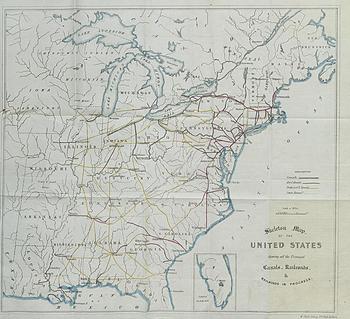
However, such performances of national identity threatened the stated aims of the Great Western and the magazine form. They required that the national polyphony that Pray promised give way to the single voice of “An American,” which Pray originally argued was a fiction. The sixth issue contained only that one article, substituting diverse regionalism for one who claims to speak for his entire country. Forming American identity transatlantically allows Pray to overcome sectional divisions over slavery, but the identity that he constructs is a falsehood, even on his own terms: the Great Western cannot be both “characteristic” and “American” because a national identity was not characteristic of the United States in 1842. The Great Western reveals this itself by printing a “Skeleton Map of the United States” (Figure 3) to accompany “The United States and England” that marked both actual and “proposed” railroads, to show how these improvements “will bind the parts of the Union together by cementing their interests.”Footnote 75 Yet the map showed how much of this work is still to be completed: proposed railroads far outnumber completed ones. A connected US nationhood, like a cohesive US character, can be projected for in and against Britain, but does not exist on the ground. The Great Western did return to its habitual form of generically diverse contents reprinted from US periodicals, but only for one more issue before the magazine folded. The editor of the final London “American” magazine would more consciously use the theatre and reprinting as performance as a way of overcoming sectional tensions over slavery, although he, like Pray, was unable to sustain his magazine's nationalizing performance.
“Skeleton Map of the United States, Showing all the Principal Canals, Railroads, & Railroads in Progess,” Great Western Magazine, September 1842. British Library, P.P.6245. © British Library Board.

THE AMERICAN MAGAZINE (OCTOBER 1851–FEBRUARY 1852)
The American Magazine by Brother Jonathan was a shilling monthly published by William Spencer Jerdan from October 1852. Its editor was Henry Howard Paul, a Philadelphian who came to Britain in 1850, initially lecturing on the Gold Rush before turning his attentions to print. Paul seems to have devoted considerable time to promoting his magazine; over forty metropolitan and provincial publications in Britain gave the Magazine favorable reviews, and at least twenty-six reprinted its articles. The New York Literary World noticed the publication, and Sartain's Union Magazine of Philadelphia reprinted a positive review from the London Daily News. The Magazine’s tone and contents were closer to the Miscellany than those of the Great Western; it reprinted humorous sketches and jokes, along with sentimental and romantic fiction. But, like Pray, Paul suggested that his magazine could create “a perfect harmony and good understanding between the two great communities of Great Britain and the United States,” and saw the magazine's composite form as a means to stage the “varied” talents of his “widely extended country”: we “shall choose from all quarters, confident that there are many great minds in the young country that only require a proper introduction at the firesides of this realm, to be read and appreciated.”Footnote 76 Indeed, the Magazine’s concern with making American national culture through publication in Britain was evident from its front cover, which featured a jaunty stars and stripes (Figure 4). However, this particular flag had seventeen stars and thirteen stripes, and was never an official flag of the United States, inadvertently signifying that the American Magazine offered a fantasy of national union at a time when sectional tensions were increasing after the Compromise of 1850 and its controversial Fugitive Slave Act. Like its predecessors, the Magazine staged this fantasy by drawing on transatlantic Yankee theatrics, fashioning itself as an extension of the theatre, and through the performance of reprinting.
Front cover of the American Magazine by Brother Jonathan, 1, 1 (October 1851). British Library, P.P.6393.a., front cover. © British Library Board.

Of all the London “American” magazines, the American Magazine located its own national performance most strongly within a transatlantic theatre culture. Its full title positioned the magazine as the creation of “Brother Jonathan,” the archetypal stage Yankee. Paul's “Chit Chat” column reported on American performers in Britain, including the Bateman Children, whom Paul described as “wonderful little specimens of ‘Young America’,” using the pun to blur the transatlantic circulation of performers with cultural nationalism.Footnote 77 The most prominent performer, however, was the Yankee comedian Joshua Silsbee, who became a friend of Paul's while the two men were in England. Silsbee's act was a key part of the magazine's contents, with Paul even writing a flattering review of Silsbee's performance in Yankee dialect: “I say ur this is my favurit resort, an’ I tell yeou wi … uncle Josh. Silsbee's down-east yarns (which remind me so much uv hum).”Footnote 78 The review collapsed the boundary between the stage performance and the printed magazine's response, so that the magazine became another stage on which Silsbee's act could be performed, and Silsbee's act became part of the nationalizing work of the magazine.
Paul's attention to Silsbee, and his use of the Brother Jonathan persona, was a good promotional tactic in autumn 1851. Silsbee was in the middle of a British tour in which he proved even more popular than Hill. In 1851–52 he gave 123 performances of Samuel Woodworth's Yankee classic The Forest Rose (1825) at the Adelphi Theatre to excellent reviews. As well as re-creating a familiar, and by now national, American type, Silsbee's Yankee plays both rehearsed and healed contemporary sectional tensions in the United States. The version of The Forest Rose licensed for performance in London in 1851 transformed the English villain Bellamy into a native of New York. The change was likely intended to appeal to London audiences, but it simultaneously relocated international tensions inside the United States at a time when sectional tensions were rising.Footnote 79 Silsbee also revived Hill's hit The Yankee Peddler, in which the villain, Colonel Bantam, is a slaveholding Virginian with an ingrained hatred of Yankees. Yankee Hiram Dodge heals this sectional conflict by orchestrating the marriage of the northern hero Moreland to Bantam's daughter Nancy, softening Bantam's attitude to northerners. In his final monologue, Dodge aligns his success with the southerners with acceptance from his British audience when he proclaims, “perhaps they won't altogether object to another visit from a Yankee Pedlar,” the pronoun encompassing Dodge's southern and Silsbee's British hosts.Footnote 80 Whether or not British audiences observed these tensions, the American Magazine associated Silsbee's performance and the sectional crisis. Reprinting “A Chunk of Fun from the New York ‘Dutchman’,” Paul included the joke “Yankee Silsbee says, the idea of dissolving the Union is one of the impossibilities. In his opinion it would be easier to lap up the Pacific with a two-pound terrier. Silsbee is right.”Footnote 81 In the pages of the American Magazine, then, Silsbee was a spokesman for the Union.
Beyond Silsbee's nationalizing Yankee, the contents of the American Magazine suggest that the magazine invested in the power of performance to overcome sectional divisions. Much of the magazine's fiction was reprinted from what Cynthia Lee Patterson has called “Philadelphia Pictorials” – magazines like Godey's Lady's Book (1840–98), Graham's Magazine (1841–58) and Sartain's Union Magazine (1849–52), which were “the first to target a national reading audience of moderate means.”Footnote 82 Several of the stories that the Magazine reprinted involve couples who misunderstand each other and become estranged, only to reconcile through performing parts which, ironically, help them see each others’ true selves more clearly. In Clara Moreton's “The Estranged Hearts,” originally published in Sartain's, Margaret's marriage to Howard crumbles when she attends a tableau vivant party against his will, but performance also helps them reconcile after Margaret dons a disguise and faithfully nurses her own children while posing as a hired nanny. In Caroline Lee Hentz's “The Mob Cap,” rich young widow Gertrude dresses up as an old woman to coax a confession of love from the poor but honest Edward Stanley. And in Moreton's “Meeta Clifton's First and Second Loves” the titular young woman turns down Clarence Grenville because she is not his first love, before Grenville apparently dies in a shipwreck. Meeta then falls in love with the exotic Signor Manfredi, only for Manfredi to reveal that he is Grenville in disguise.
Reprinted outside the domestic realm of Sartain's and Godey's, in a magazine that claimed to be American and identified so strongly with Silsbee, the reunions of divided couples resonate at a national scale. In the American Magazine, these stories imagine how America's divided regions might learn to understand one another and come together once more. “The Estranged Hearts” ends with a plea for compromise and understanding that resonates with contemporary political tensions:
for very seldom it is when pride, and jealousy, and suspicion creep in to separate two hearts, that any after reconciliation can entirely root out the weeds which have sprung up … More frequently, the breach widens with years; each grows to think the other the aggressor, and that complete isolation takes place which is so terrible to contemplate.Footnote 83
Anne Norton observes that, by the 1850s, “it had become commonplace … to liken the Union to a marriage,” but the story gives a marriage that seems like the Union.Footnote 84 “Aggressor,” in particular, suggests more martial than marital tensions, and the stakes of an isolation “so terrible to contemplate” seem particularly high.
The American Magazine’s performances of national (re)union are most visible in Paul's reprinting of Hentz's “The Pedlar,” a sequel to “The Mob Cap” that was originally published in the Philadelphia Saturday Courier in 1841, and reprinted in the American Magazine in December 1851. Edward Stanley's sister Clara strikes up a friendship with a peddler named Rover, just as her sister-in-law Gertrude's handsome, rich, southern cousin, Washington Graham, arrives in the neighbourhood. Washington courts Clara, but she grows closer to Rover, despite the class barrier separating them. Matters come to a head when Rover is wrongfully arrested and Clara breaks him out of jail using Gertrude's old-woman disguise from “The Mob Cap,” before publicly declaring her love. But on Clara and Rover's wedding day, Washington reveals that he disguised himself as Rover to be sure that Clara was not marrying him for his wealth alone, and Clara is rewarded with a man she loves as well as with riches.
Reprinting “The Pedlar” alongside notices of Silsbee's performances brings out the story's similarities to The Forest Rose: both feature confused lovers in a rural woodland, class prejudice being overcome, and a marriage at the end. That theatrical context, and the heightened tensions of the 1850s, gave Hentz's tale a deeper political hue by encouraging a reading of the disguise plot that locates theatrical performance as a spur to a national union. More than enabling Washington to test Clara, his peddler performance enables Clara to look past his southern-ness, which is a barrier to their union. Washington is described as a “southern stranger,” as exotic as an “eastern nabob,” and perpetually “attended by a negro,” and, at one point in the story, the thought of Washington looking at her “filled [Clara] with dread.”Footnote 85 But Washington's pretending allows the “unpretending” Clara to see their true compatibility beyond sectional difference.Footnote 86 As in The Yankee Peddler, the climatic marriage unites North and South, but more forcefully suggests the indivisibility of the Union by making the peddler, the traditional occupation of the stage Yankee, and the southerner be one and the same person. By reprinting Hentz's story in his nationalizing and theatrical magazine, Paul reinforced his vision of America as a union of various regional voices, and reiterated his investment in performance as a means of articulating and preserving American nationhood.
Unlike the American Miscellany, the American Magazine does not abandon theatrical performance as a sphere for the construction of national culture, and, unlike the Great Western, it does not distort the magazine form to perform national unity, or, in this case, national reunion. During its short life, the American Magazine appears to have been reasonably successful in combining theatricality and reprinting as performance to invent that national literature that it claimed to stage. Nevertheless, it closed after only five issues, giving it the briefest lifespan of the three publications. Of course, there are material reasons for a magazine to close. Positive reviews do not necessarily equal profitable circulation. Alternatively, Paul, who disappeared to continental Europe with Silsbee the month after the magazine folded, may have got bored with being an editor; as noted above, he would eventually turn to performing, playwriting and theatrical production. Yet the fact that staging American literature in transatlantic reprint magazines proved unsuccessful, even when done well, suggests that there is something inherently unstable, or destabilizing, about this form of national performance.
In the American Magazine, this instability is rooted in the fact that performances of reunion also require performances of division. As Roach observes, performing what one is or wishes to be inevitably also involves “perform[ing] what and who they thought they were not.”Footnote 87 Silsbee's joke about the impossibility of dividing the Union has to articulate the possibility of division before refuting it. Washington and Clara's national marriage has to first be conceived of in terms of their regional difference. The stories that stage reunions between North and South first have to divide them, and the frequency with which such stories appear means that the American Magazine becomes a theatre for national divisions, and well as unifying performances. Moreover, if reprinting these texts in the American Magazine suggested that they could be read as political allegories, then it also raised the possibility that national allegories would be imported into texts like “Destiny in a Rose-Bud,” by popular magazine writer Grace Greenwood, and reprinted in the Magazine’s final number. Here, the estranged couple fail to reconcile and one ends up dead and the other alone. Its appearance in the same number as extracts from an 1848 speech by the Speaker of the House of Representatives, Robert C. Winthrop, that observed that “the extension of our boundaries and multiplication of our territories are producing, directly and indirectly, among the different member of our political system, so many marked and mournful centrifugal tendencies,” encouraged such a political reading.Footnote 88 Transforming domestic fiction into nationalizing texts via a theatrical magazine and the performance of reprinting could foreground sectional divisions in, as much as the national character of, the United States.
Within the consciously theatrical and national spaces of these transatlantic magazines, performances of reprinting produced a fantasy of national identity. If conditions in the United States made these fantasies impossible to sustain within the nation, then the failure of all these magazines suggests that they were impossible to sustain in Britain, too. Or, rather, it suggests that such fantasies were too unstable to be sustained in British magazines. The magazine promised a pseudo-theatrical space in which regional texts could be made into examples of a national culture, and a composite form that would allow multiple American voices to speak. However, like performance, a magazine is perpetuated through repetitions that both sustain and transform – repetitions of each subsequent issue, but also, in the case of these antebellum periodicals, of reprinted texts. James Mussel's observations that “no issue of a serial ever exists on its own but calls up the memory of its predecessors while projecting its successors into the future” and that “a publication's editor must avoid too much difference while supplying just the right amount of same” has much in common with Schechner, Roach and Phelan's definitions of performance.Footnote 89 Magazines are powerful instruments for performing fantasies of national culture, but their need for constant renewal means that they struggle to stabilize the forms of nationhood that they imagine.
The American Miscellany, the Great Western and the American Magazine offered a fantasy of a unified and white American national identity that is familiar to scholars of antebellum culture. But what is less familiar, and what this essay has shown, is that reprinting American texts in London magazines offered a way to perform that fantasy, albeit one that was always too unstable to fully succeed. All three titles invested in the magazine as an organ of national literature, not because periodical circulation within the nation created national communities, but because magazines could fashion American literature, identity and nationhood by reprinting texts abroad. Understanding reprinting as performance illuminates how these transatlantic artefacts could claim to project American national identity, even as they invented that identity in Britain. Like the transatlantic Yankee comedies with which they engaged, the magazines made a national American repertoire by re-presenting texts in Britain, a place where American culture could “rebecome” what it never was, but wished to have been and wished to become, to paraphrase to Schechner's formulation of performance.Footnote 90 These magazines thus show how periodical print participated in the formation of national culture from beyond the boundaries of the nation itself. They therefore suggest that to fully understand the relations between print culture and nationhood, we need to map and theorize circulations across, as well as within, national boundaries.