In his 2008 book Films of Fact: A History of Science in Documentary Films and Television, Timothy Boon observes, ‘Wherever science is put together with powerful media of public communication, there is a potent conjunction, a nexus for the play of social power.’Footnote 1 That play of social power between science and a powerful public medium, in this case the BBC, is central to this article, which examines in greater depth some incidents that are only briefly touched on in Boon's book.
Between 1958 and 1963, a series of fractious interactions took place between British scientists and the BBC over the management of science broadcasts. This article tells the story of these interactions, and their eventual resolution in 1964. The story is largely unknown, being contained in unpublished archive documents.Footnote 2 At the heart of the interactions was a belief among scientists that they ought to manage the BBC's science output. BBC managers rejected this suggestion, but eventually (and grudgingly) accepted a compromise which, to their surprise, proved strategically useful.
I will examine these interactions in relation to the ideas of professionalism and authority, both the authority of British scientific institutions and the authority of the BBC. In particular, I will make use of Harry Collins's observations on the distinctively authoritarian character of ‘big science’ in the 1950s and 1960s, and on historian David Edgerton's observations on the rise of technocracy during the period covered by this article.
To some extent the article addresses a gap in scholarship pointed out by Steven Shapin, that ‘the roles of newspapers and magazines and of non-print media, notably photography, radio, television, film and museum exhibitions, in shaping (and representing) public perceptions of science, technology and medicine also remain largely unexplored’.Footnote 3 Since Shapin published his observation, more than twenty years ago, a number of scholarly works have appeared surveying, particularly, television science coverage,Footnote 4 but the organizational and historical context of science broadcasting has been little explored. I suggest that in thinking about the way broadcast science is framed, valuable insights are to be had from examining the organizational and cultural backgrounds of the actors concerned. In this respect this article follows in the wake of Timothy Boon's Films of Fact, referred to above.
Before beginning my account of the interactions, I will look at the organization of science broadcasts at the BBC, and say a little about the period in which the interactions took place – approximately 1958–1963. This period coincides closely with what historian David Edgerton refers to as the ‘technocratic moment’, a period when, in Edgerton's view, technocrats were in the ascendant in Britain.Footnote 5 The historical narrative will then follow in two parts. Between the two parts will come the major theoretical ideas for my analysis.
The BBC and science
The BBC was created in 1922 as the British Broadcasting Company, and began radio broadcasting in early 1923. It monopolized large-scale broadcasting in Britain until the arrival of commercially funded television in 1955. The company's first managing director, John Reith, espoused high ethical principles for the new medium. Programmes were to be ‘elevating as well as entertaining’.Footnote 6 An ethos of self-conscious paternalism pervaded the organization. In Reith's words, ‘It is occasionally indicated to us that we are apparently setting out to give the public what we think they need – and not what they want, but few know what they want, and very few what they need.’Footnote 7 For Reith, the BBC's ability to provide a satisfactory public service was initially compromised by its lack of formal autonomy and its commercial status. He lobbied for the BBC to be converted to a public corporation – in British parlance, a self-governing, state-owned enterprise. In 1927 the BBC became the British Broadcasting Corporation, with Reith still at the helm but now as its first director general. He remained in post until his resignation in 1938.
By the late 1950s, when the scientific interventions discussed in this article occurred, notions of public service had become more problematic for broadcasters than in Reith's day. According to Tom Burns, by the 1950s the BBC's public-service aspect had become ‘a set of conventions’, by which Burns meant that, rather than being enshrined in a code of practice, they were ‘diffusely embodied in everyday codes of social, cultural, economic and political practice’.Footnote 8 Public-service broadcasting, then, was largely what broadcasting professionals believed it to be, or did. Broadcasters, though, were not unreflective about public service. In an internal memorandum in 1956, a senior BBC manager advocated
the rejection of an attitude that many of us have grown up with, of having a mission to educate, to up-lift, to lead people on to better things, to give them what we think they ought to want rather than what they do want.Footnote 9
This memorandum resulted not in a wholesale rejection of public-service ideals, but in a juggling of existing radio networks to provide space for more popular programmes.Footnote 10 My point is that the public-service concept, because formally undefined, was open to reinterpretation within the BBC as circumstances changed.
In one respect at least, the BBC of the 1950s still had much in common with the BBC of Reith's era in being coveted by outsiders with a cause to promote. Such outsiders often sought to coopt the BBC for the furtherance of their cause. According to Burns, again referring to the 1950s, the BBC saw itself as ‘perpetually beleaguered, under pressure, being lobbied, or being compelled to lobby’.Footnote 11 His observation is highly relevant to the following story.
In the period covered by this article, no department in the BBC specialized in science. With a couple of exceptions (Music and Religion), subject-specific departments of the kind found in universities did not exist in the BBC. What distinguished BBC production departments from each other was mode of presentation rather than content. Thus among radio departments there were Talks, Features, Schools, Overseas Broadcasts and News, and among television departments there were Television Talks and Outside Broadcasts. These non-specialist departments produced many types of broadcast, science included. The radio Talks department, however, was a prominent producer of talks directed at the general radio listener. It is central to this narrative.
Although BBC departments were not subject-specific, some producers within them were specialists. A leading radio producer of science talks throughout the 1950s was Archibald Clow, a chemist and science historian. Clow was the only scientist among the staff of thirty producers in the radio Talks department for much of the 1950s. However, science programmes could also emerge from unlikely sources. Producer T.S. Gregory, whose background was in theology, supervised several pioneering radio broadcasts in the early 1950s on computers and artificial intelligence (as we would now term it).Footnote 12 On BBC television, the leading science producer in the second half of the 1950s and during the 1960s was Aubrey Singer, who was not a scientist,Footnote 13 and whose department, when he embarked on scientific production, Outside Broadcasts, had no particular remit to cover science.Footnote 14 In 1960 one BBC manager judged that six departments were active in science production – almost certainly an underestimate.Footnote 15 This dispersed production of the BBC's science programmes was typical of the way many broadcasts were produced, but was to become part of the package of complaints made by scientists about the BBC's science production.
Within the BBC's dispersed production system, producers enjoyed a good deal of autonomy, at least in planning programme content. Science producer Aubrey Singer said, in a 1966 lecture, that ‘most ideas [for science programmes] come from producers’,Footnote 16 and producer Stuart Hood, who figures later in this story but not as a science producer, confirmed Singer's description in 1967: ‘A producer is given full powers in making a programme or a series of programmes. On him rests the final judgement of what is right and seemly to present to his audience.’Footnote 17 On these accounts, BBC producers enjoyed a high degree of autonomy. In this respect the BBC's managerial style could not be described as (to anticipate a term introduced later) ‘top-down’, at least as far as programme production was concerned.
The broadcasting profession
Burns comments that broadcasting ‘seems to demand a kind of commitment which is deeper and more binding and more complete than anything one encounters outside the life and death professions’.Footnote 18 This suggests that within its short history, broadcasting had developed a strong professional ethos which deeply infused its practitioners. Professions have received a good deal of attention from sociologists,Footnote 19 and certain aspects of professions can be seen to have been at play in the following narrative, not just in respect of the BBC but also in respect of the British Association for the Advancement of Science and the Royal Society, which, though not officially professional organizations in the way that, say, the British Medical Association is, had many attributes of professions.
One of the most important assets of a profession is its jurisdiction. This is the area of activity over which it holds a monopoly, or aspires to hold a monopoly. To have professional jurisdiction over a particular field is to deny it to others: ‘one profession's jurisdiction preempts another's’.Footnote 20 To some extent, professions compete for jurisdictions. As Andrew Abbott says, ‘jurisdictional boundaries are perpetually in dispute’.Footnote 21 In the following narrative we see broadcasters and scientists disagreeing about whose jurisdictional boundary should encompass science broadcasting.
Terrence Johnson observes that a characteristic of professions is their ability to impose their own definition of the producer–client relationship,Footnote 22 an instance of which can be seen in the way professions retain the right to arbitrate on the performance of their own work. This right is justified by the claim that only the profession is competent to evaluate itself.Footnote 23 When professions argue for more resources, they justify the argument by reference to the public good, rather than to the benefits that accrue to the profession. Again, in the following narrative we see this played out as each side claims to serve the public interest, and as the BBC comes to resolve the dispute on its own terms.Footnote 24
The technocratic moment, 1959–1964
The period when the interventions happened, 1958–1963, corresponds closely to the period which historian David Edgerton has referred to as the ‘technocratic moment’ (1959–1964). It was a period of increasing prominence for science and technology in public life. Annual government spending on scientific research had grown from under £10m in 1939 to £220m in 1955–6, and subsequently to £425m in 1964–1965. Much of this spending was defence-related, and associated with Cold War politics.Footnote 25 During the late 1940s, the number of scientists and engineers in higher education doubled.Footnote 26 Aside from government-funded scientific research, large research programmes were maintained by commercial companies in science-based industries, such as ICI (chemicals); BP and Shell (oil); GEC, EMI and Plessey (electrical/electronics); and Unilever (foods).Footnote 27 ‘Big science’ was very much associated with the technocratic moment.
Nevertheless, for many scientists and commentators, Britain was underperforming, and this sense of inferiority was underlined by the launch of the Sputnik 1 artificial satellite by the USSR on 4 October 1957 (followed a month later by the dog-carrying Sputnik 2). These satellites were part of the USSR's contribution to the International Geophysical Year (IGY), which, unlike most years, lasted for eighteen months, from 1 July 1957 to 31 December 1958. Both of the main political parties in Britain pledged to create a Ministry for Science in their 1959 election campaigns.Footnote 28 Britain was not alone in being chastened by the success of the sputniks. In the USA the launch of Sputnik 2 was described as ‘a second Pearl Harbour’.Footnote 29 In Britain, though, evidence of conspicuous scientific and technological achievement abroad tended to play into notions of ‘declinism’ at home. Jim Tomlinson observes that in Britain in ‘the late 1950s and early 1960s a new and quite specific notion of economic decline was born’, related to ‘the perceived implications of poor economic performance for the welfare of the mass of the populace’.Footnote 30 The origin of British decline was widely seen to lie in idiosyncrasies of British society, particularly in the alleged prominence in public administration (for example, in the BBC) of privileged elites, and the absence of rational, analytical minds and expertise.Footnote 31 This frequently heard criticism has been termed the ‘technocratic critique’ by David Edgerton.Footnote 32 A celebrated example is C.P. Snow's ‘Two cultures’ lecture, delivered at Cambridge University in 1959, in which Snow, in a long list of grievances, lamented the dominance of humanities-trained personnel in public life, and the dearth of scientists.Footnote 33 However, according to Edgerton, the ‘technocratic moment’ was actually a period of technocratic ascendancy in Britain, when scientists' pronouncements on issues of public policy were taken seriously.
To summarize, then, by the late 1950s, scientific research had expanded enormously compared with even a decade before. ‘Big science’ had become dominant, and yet despite science's apparently thriving health, there was a widespread anxiety that Britain was not scientific enough, especially compared to certain other countries. Many scientists blamed Britain's decline on the disdain in which science was alleged to be held by public administrators and policy makers.
Opening salvo
In August 1958, at the British Association for the Advancement of Science's annual meeting, the association's president, industrial chemist Sir Alexander Fleck, mentioned in his Presidential Address a number of contemporary scientific developments that he considered indicative of the special importance of science and technology in contemporary life: artificial satellites, thermonuclear fusion experiments at Harwell and Aldermaston, rocketry, and the International Geophysical Year. He pointed out society's dependence on science, and, in particular, Britain's economic dependence on science and technology:
We must concentrate for our own survival on the development of new products and new processes. We are obliged to rely either on selling things which no one else has yet learnt to make, or make as cheaply, or on marketing our skill and know-how.Footnote 34
Yet, he observed, where science and technology were concerned, ‘it is sad to think how few people clearly understand what it is all about’.Footnote 35
A few weeks after delivering this address, in September 1958, Fleck, together with two other chemists, Sir Cyril Hinshelwood (president of the Royal Society and Nobel laureate for Chemistry in 1956) and Sir Alexander Todd (chairman of the government's Advisory Council on Scientific Policy and Nobel laureate for Chemistry in 1957Footnote 36), visited the director general of the BBC, Ian Jacob.
During the delegation's visit to the BBC, it made what amounted to a technocratic critique of BBC programming: there should be more science programmes, and they should be more closely coordinated; that is, brought under some form of central management ‘preferably at top policy-making level’, and organized systematically to inculcate scientific understanding in the public. This was necessary because of the public's inadequate understanding of science's importance:Footnote 37 ‘They made it clear that they were particularly concerned with the need to educate the mass of the public to an understanding of scientific developments and of the vital role of science in the contemporary world.’Footnote 38
Fleck, Hinshelwood and Todd's visit to the BBC had no immediate effect. However, it was the opening salvo of a five-year-long campaign by the elite scientific world (principally the British Association for the Advancement of Science and the Royal Society) to influence the BBC's handling of science. Seven months after the Fleck–Hinshelwood–Todd visit, in April 1959, Sir Hugh Linstead, a member of BBC's General Advisory Council (a body with no executive power, and comprising BBC staff and distinguished outsiders), asked for a paper on science broadcasting to be presented at the next General Advisory Council meeting.Footnote 39 What particularly exercised Linstead were (in his own words):
Scientific education
How to get over to the public the truth (apart from sensationalism) of recent scientific discoveries and claims. Making the public conscious of the great scientific problems of our times – Population and food; water and soil conservation; nuclear energy; inter-stellar penetration and so on.Footnote 40
The result of these interventions was the preparation by BBC staff of a seventeen-page report, entitled ‘Science broadcasting’, presented to a meeting of the General Advisory Council on 29 April 1959.Footnote 41 The report largely defended the BBC's existing arrangements for science broadcasting. It set out the BBC's aims regarding science programming:
broadly, to demonstrate as clearly and arrestingly as possible what science is doing, how it works – the application of scientific method to the solution of problems and the advancement of knowledge – and the relevance of its work to people's daily life and well-being.Footnote 42
The BBC implicitly had no project to make the public more scientifically minded – if by this we mean the instilling of scientific facts in the public's mind. Rather, the purpose of science broadcasts was to make the public better informed about science and scientists. Satisfying this aim, according to the report, was constrained by practical limitations. The range of science was vast in relation to the time that the BBC could devote to it. Consequently, comprehensive coverage was impossible. Furthermore, some areas of science were ‘too abstruse’ to be rendered intelligible to the layman, or were ‘so specialised and remote from ordinary life as to be incapable of interesting him’. We see in the above two very different conceptions of the role of science broadcasting held by scientists and broadcasters. This difference was a recurring theme in the interactions, and I shall say more about it later.
The BBC paper commented that science found its way into many kinds of programme, such as topical and magazine programmes and general talks, discussions and features. This distribution of science across many types of programme, the paper implied, was better served by the non-centralized production of science. The remainder of the ‘Science broadcasting’ paper was given over to a lengthy survey of the many types of science programming on the BBC.
Sir Solly Zuckerman pointed out at the General Advisory Council's discussion that the national effort in education was focusing increasingly on science, and wondered whether broadcasting was playing its part. Several speakers mentioned the possibility of a science ‘curriculum’ for talks. For example, one speaker wanted to see a ‘planned curriculum of broadcasts covering the fields of physiology, biology and physics’.Footnote 43
Responding, the director general reiterated the BBC's non-didactic conception of public-service broadcasting. The task in relation to science broadcasting (outside Schools and Educational Broadcasting) was ‘to interest the broad mass of the people constantly in science and scientific development, so that they came to regard it as a natural part of life’.Footnote 44 He did not favour a curriculum for science output in general broadcasting:
Was it not better to avoid the suggestion, which a planned syllabus might tend to convey, that you were trying to educate people? And would not such a syllabus demand an inordinate amount of broadcasting time if it was to be covered properly?Footnote 45
Regarding the suggestion that a senior BBC official should review the whole of the corporation's science broadcasting, the director general thought it impractical for one person to undertake this.Footnote 46 The meeting ended inconclusively.
This was not the end of the matter, and I shall resume the story later. Nor was 1958 the beginning, as the BBC had been lobbied by other scientists making similar points in 1943–1944 and in 1949, although the scientists in 1958–1959 appear to have been unaware of these earlier episodes.Footnote 47 The interventions of the 1940s will not be discussed here, except to record that the 1949 intervention led to the experimental appointment of physiologist Sir Henry Dale as a BBC science coordinator from 1950 to 1952. The experiment was judged unsuccessful by BBC managers, but Dale's report shows that it was jeopardized from the start by the BBC's inadequate administrative arrangements.Footnote 48
I have now reached a natural pause in the story of the interventions of the late 1950s and early 1960s. The story resumes a few months later, as I will discuss shortly. However, this is a convenient point to take stock of the broad lines of the argument presented by each side, and to introduce some theoretical concepts.
In the scientists' view, the public was deficient in scientific knowledge. Public-service broadcasters had a responsibility to remedy this through a number of policy changes. The BBC needed to highlight and promote science as part of a mission to make the public more scientifically minded, and broadcasts needed to be more didactic. The ultimate justification for these policy changes lay in science's economic and political importance in the modern world, and in the public's dependence on science. This is very much the standard ‘public-understanding-of-science’ agenda, albeit with a strong technocratic flavour in tune with the times. This agenda has a long history and has received much scholarly attention.Footnote 49 It has been seen as in some degree self-serving, and as buttressing the authority of science in public life. I will expand on this point shortly.
As far as the BBC's management was concerned, the best interests of the public were served not by treating science specially, but by treating it like almost all other subjects. The BBC did what it could for science, consistent with its need to be even-handed. Deciding what was appropriate in the amount of science and its treatment was a matter of professional broadcasting expertise rather than scientific expertise, although broadcasters occasionally consulted scientists for advice.
These two attitudes represent the principal poles around which the debate revolved in subsequent developments.
Scientific authority
In the foregoing narrative, scientists can be seen to have questioned the BBC's authority in the matter of science broadcasting, and the BBC managers can be seen to have asserted their exclusive authority to serve public interest as they construed it. I wish therefore to make a fairly long detour into the question of authority, in particular drawing on Harry Collins's coinage of the ‘top-down authority of 1950s science’, and on notions of scientific authority expounded by chemist and philosopher of science Michael Polanyi.
A dictionary definition of authority is ‘power to enforce obedience’.Footnote 50 In relation to scientific authority, however, scientists, in the exercise of their profession, seek not so much obedience as recognition that their account of the natural world is correct, or the best available. The ultimate currency of scientific authority is the orthodox scientific account of the natural world. However, as Barry Barnes and David Edge have pointed out,
Scientific knowledge does not carry a revelation of its own correctness along with itself; rather its standing is inevitably bound up with such contingent factors as the degree of trust and authority possessed by its bearer, or by the institutions which sustain him and assert his competence and legitimacy.Footnote 51
That is to say, scientists' accounts of the world are accepted not because of their self-evident truth, but because scientists appear trustworthy and authoritative in cognitive matters. This applies equally whether the consumers of scientific accounts are non-scientists or scientists outside their own specialism. The maintenance of the scientific jurisdiction, therefore, is achieved not through statute, as in the paradigmatic professions of law and medicine (and indeed public-service broadcasting), but through continual manifestation of scientific expertise in public. This observation takes us to a sociological view of knowledge, in which what counts as knowledge becomes a matter of social interaction, negotiation and agreement. As David Bloor says, ‘Knowledge has to be gathered, organised, sustained, transmitted and distributed. These are all processes visibly connected with established institutions … The mind will thus have registered on some level a connection between knowledge and authority and power.’Footnote 52 Popularization is one way of manifesting expertise in public. Sergio Sismondo observes that without popularization, science would be ‘a much more marginal intellectual activity than it is’.Footnote 53 The presentation of science in popular media is therefore of great concern to scientists for reasons that include its intimate connection with the maintenance of authority.Footnote 54 Bruce Lewenstein notes that, in the USA, campaigns to increase the public understanding of science in the post-war period have actually sought to increase the public appreciation of, and support for, science, rather than public enlightenment,Footnote 55 and Felicity Mellor has observed that the ‘rhetoric of accessibility, and of the PUS [public-understanding-of-science] movement more generally, serves to cover over the ways in which popular science texts promote the interests of scientists by reinforcing their epistemic authority’.Footnote 56
Pierre Bourdieu argues that authority, like currency, is convertible: ‘Scientific authority is thus a particular kind of capital, which can be accumulated, transmitted, and even reconverted to other kinds of capital under certain conditions.’Footnote 57
Scientists' cognitive authority about the natural world therefore can be cashed as authority about matters tangential to science, for example science policy, or indeed, I suggest, science broadcasting. In connection with this extension of scientific authority into social matters, Steve Fuller has written of ‘the pretension of certain élite scientists who would like science to do more political work than is strictly warranted’.Footnote 58 Here the dictionary definition of authority as the power to enforce obedience becomes relevant, as scientists' deploy their epistemic authority outside the strictly scientific world in political and policy interventions.
In a 2007 publication, Harry Collins commented on the distinctive character of scientific policy interventions in the era of ‘big’ science. He referred to ‘the top-down authority of 1950s science’.Footnote 59 Although Collins offered little elaboration of the phrase, inferences can reasonably be drawn about its meaning. Collins contrasted the top-down authority of 1950s science with a more a recent development in which the public is consulted on relevant scientific and technological issues. The consultative view has displaced (in some quarters) a prior ‘deficit model’ in which the public's knowledge of science was seen as inadequate, making the public ill-equipped to pass judgement on scientific or technological policy matters.Footnote 60 According to Collins, consultation with the public (or other affected groups) amounts to a levelling down of the authority of scientists, and lends political legitimacy to large-scale scientific and technological projects. In an earlier publication, Collins and Evans comment that ‘in the 1950s scientists were often attributed with authority to speak on subjects outside their narrow area of specialization’.Footnote 61 The ‘top-down authority of science’ therefore suggests a strongly directive, even authoritarian, style of interaction by scientists in matters of public policy in the 1950s.
Collins associated the ‘top-down’ approach with the scientific autonomy advocated by Michael Polanyi in his 1962 paper ‘The republic of science’.Footnote 62 In this paper, Polanyi argued that ‘the pursuit of science by independent, self-coordinated initiatives assured the most efficient possible organization of scientific progress’.Footnote 63 According to Polanyi, scientists should be free to pursue their own lines of enquiry, with no ulterior purpose, such as remedying social or economic problems.Footnote 64 Such a ‘scientific republic’, according to Polanyi, had an efficient and self-organizing character, analogous to the operation of commercial markets.Footnote 65 The scientific republic also exemplified the most desirable form of social organization: ‘For in the free cooperation of independent scientists we shall find a highly simplified model of a free society’.Footnote 66
Mary Jo Nye sees in Polanyi's advocacy of untrammelled scientific enquiry an idealization of the research environment he enjoyed in Berlin from 1920 to 1933 among ‘a tightly networked community of world-class colleagues within the tree-lined precincts of Dahlem’.Footnote 67 Polanyi's thirteen-year Berlin idyll was rudely interrupted by the rise of Nazism and his departure for the UK. For Polanyi, the subsequent state manipulation of science in Germany was symptomatic of the Nazi regime's illiberality and its politically expedient notion of truth, through which science was coopted to political ends. Polanyi held similar views about the USSR.Footnote 68 Following his move Manchester University's chemistry department in the 1930s, Polanyi opposed the social-relations-of-science movement, a growing force in British science at the time, which held that scientific research should be oriented towards socially beneficial ends.
In Polanyi's scientific republic, the success or failure of scientists was assessed only by other scientists. Mary Jo Nye summarizes this: ‘only wise scientists can interpret the difference between good science and bad science or pseudoscience’.Footnote 69 Polanyi acknowledged that this was different from the position of, for example, judges, generals and business people, whose merit could be assessed by non-specialists.Footnote 70 In the scientific republic, the criteria that scientists were expected to use when verifying their accounts of the world were not stated explicitly – unlike, for example, in Popperian falsification – but were acquired within the profession through acculturation. The public, though excluded from the republic of science, was, according to Polanyi, subject to its statutes: ‘the body of scientists, as a whole, [upholds] the authority of science over the lay public’. Indeed, ‘the whole outlook of man on the universe is conditioned by an implicit recognition of the authority of scientific opinion’.Footnote 71 Polanyi thus saw the autonomy of science as underwriting its authority, and its authority as extending from the community of scientists into the wider population. Lakatos characterizes this view as ‘elitist authoritarianism’Footnote 72 and describes it as ‘the standard view institutionalized today in scientific organizations such as the Royal Society’.Footnote 73 His use of the term ‘institutionalized’ is especially significant in view of the role of scientific institutions, including the Royal Society, in the events narrated here.
Steve Fuller suggests that autonomy and elitist authoritarianism have characterized much scientific policy making in the post-war period:
Western national science policy makers … since the end of World War II, have presumed that self-organising bodies of scientists, roughly corresponding to academic disciplines, can determine the best researchers and research, and need change course only when they see fit.Footnote 74
Lengwiler makes much the same point, referring to the period between 1945 and the early 1970s as one in which science was granted ‘wide autonomies of self-regulation in terms of the division and use of funding as well as the instruments of quality assessment’.Footnote 75
Polanyi, and later commentators on him such as Lakatos and Collins, give us a striking image of an autonomous scientific republic which is largely self-regulating, at least in epistemic matters, and to which the public is subject. It would, however, be wrong to make too much of Polanyi as an actor in the present context. He did not take part in the interactions between scientists and the BBC, and his name was not cited by any of the participants. However, Cyril Hinshelwood and Alexander Todd, two members of the trio that called on the BBC's director general in September 1958 (as described above), knew him and shared some of his views on science and society. Hinshelwood and Polanyi met at a meeting of the American Chemical Society in 1926 in Minnesota, though whether this was their first meeting is not clear.Footnote 76 Subsequently, in 1941, Hinshelwood supported Polanyi in taking exception to an article by Richard Gregory, the editor of Nature, which advised against attaching ‘particular holiness to scientific truth’.Footnote 77 Alexander Todd came into close contact with Polanyi in 1938 on accepting a chair in organic chemistry at Manchester University, where Polanyi lectured. The two men bonded, and Todd agreed with Polanyi's ‘anti-socialist views on the freedom of science from state interference’.Footnote 78
Pilkington
I now resume the story of the scientific interventions at the BBC. The next wave of interventions came in 1960–1961, and was associated with the Pilkington Committee. This was one of numerous review committees that have punctuated the history of British broadcasting. The charters of the BBC and of the ‘independent’ (that is, commercially funded) terrestrial broadcasters do not grant them perpetual existence. Instead, charters have a fixed term of, generally, ten to fifteen years, and renewal of the charter beyond that term is subject to review by a specially constituted committee. The Pilkington Committee, created in July 1960, was such a committee.
The context of the Pilkington Committee's creation was one of moral panic over the state of commercial television.Footnote 79 Advertisement-funded television had begun in Britain in 1955, and had become highly profitable through popular quiz shows such as Double Your Money, Take Your Pick and Beat the Clock. These shows had attracted much opprobrium because the extravagance of their prizes was considered disproportionate to the intellect needed to win them. Critics could be found in all parts of the political spectrum, not least in the Conservative administration, which had inaugurated commercial television.Footnote 80 The Pilkington Committee, which the Conservative government set up, was, through the choice of members, skewed strongly towards a retrenchment of public-service values, and away from a rampantly commercial and unregulated model.Footnote 81
One issue that the Pilkington committee was expected to advise on was the allocation of a third national television channel.Footnote 82 At the time of the committee's formation, British viewers had a choice of only a single national BBC channel and an ITV channel serving the viewer's region. ITV, or Independent Television, was an affiliation of regionally based commercial channels which sometimes broadcast regional content, and sometimes a single national programme. It was administered by the ITA, or Independent Television Authority.
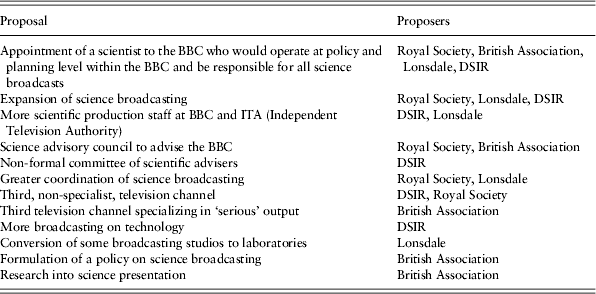
The Pilkington Committee was the first charter review committee to receive submissions on science broadcasting. Four were received, from the Royal Society, the British Association for the Advancement of Science, the Department of Scientific and Industrial Research (DSIR) and crystallographer Kathleen Lonsdale (vice president of the Royal Society and general secretary of the British Association for the Advancement of Science). Elite science was therefore the majority voice in the submissions. All the submissions overlapped considerably. In addition, the Royal Society's submission reiterated the points made by the Fleck–Hinshelwood–Todd deputation to the BBC in 1958, and indeed Fleck was one of the four authors of the Royal Society's submission.Footnote 83Table 1 summarizes the proposals made in the submissions and who made them. The proposal at the top of Table 1, the appointment of a scientist to a high managerial position at the BBC to take responsibility for all science broadcasts, was the only one to appear in all four submissions.
Proposals in scientific submissions to the Pilkington Committee

The Pilkington Committee's report was published towards the end of June 1962.Footnote 84 In addition to recommending the renewal of the BBC charter and the BBC's licence-fee funding, the report recommended awarding an additional television channel to the BBC rather than ITV, and a wholesale restructuring of commercial television (which subsequently was only partly implemented). The new television channel, BBC2, was launched in April 1964. Concerning science broadcasting, two paragraphs of the report mentioned the scientific submissions, and asked the broadcasters to reconsider them.Footnote 85
Referring the science submissions back to the BBC was a crucial move. The Pilkington Committee's major recommendations (summarized above) were directed at Parliament, where they entered the arena of national policy making. Asking the broadcasters to reconsider the scientific submissions framed the issue of science broadcasting as a matter of professional judgement, a move consistent with the pro-public-service orientation of the committee.
The task of reconsidering the scientific submissions fell to R.d'A. Marriott, assistant director of sound broadcasting, and Stuart Hood, controller of programmes, television. The director general acknowledged that resolving the issue might require a concession: ‘one of the prices we might have to pay for a satisfactory settlement would be to arrange for some kind of a meeting of a committee of scientists, preferably of an informal and irregular nature’.Footnote 86
In acknowledging the possibility of a concession, the director general indicated a solution that would be acceptable to the BBC. What the scientists actually sought – that the BBC take as a mission the reorientation of society towards science, with a scientist in charge – was implicitly excluded. The director general's preference for the committee to be ‘informal’ and to meet ‘irregularly’ suggests a wish to circumscribe its influence. The BBC's already existing advisory councils were both formal and regular.
Marriott and Hood met representatives of the Royal Society, the British Association for the Advancement of Science and the BBC on 12 December 1962.Footnote 87 The scientists stressed that they were not critical of the content of science programmes produced by the BBC. The problem was managerial: an insufficiency of science broadcasts, given the importance of science, and a lack of overall policy in science programming.Footnote 88 In response, BBC representatives cited their own professional competence in programme planning as bases for the existing arrangements, explaining that the ‘total balance of programmes was based on the process of long experience’.
Sir Eric Ashby (president of the British Association for the Advancement of Science) compared unfavourably the range of topics dealt with in Science Survey (a weekly radio magazine programme) with the systematic planned and ‘articulated’ teaching given in language lessons.Footnote 89 The BBC representatives pointed out that there was a distinction between programmes intended for the general public and educational series, which were presented by Schools and Further Education for a different type of audience. This distinction was one the scientists were reluctant to accept.Footnote 90
Sir Harrie Massey (a mathematical physicist, and one of the four authors of the Royal Society's submission) objected to the Third Programme's presentation of scientific controversy: ‘Third Programme science broadcasts dealt only with those speculative areas where scientists themselves were in dispute or where the validity of certain scientific concepts could be challenged, instead of informing people about the more important practical scientific achievements.’Footnote 91 Massey here did not take account of the probing, critical function of the Third Programme, which was a more intellectually oriented service than the other BBC radio networks, and implied that the BBC had a duty to promote orthodox science, and not to reveal internal scientific disputes.
The scientific representatives reiterated their Pilkington recommendations for a scientist at senior managerial level within the BBC, and a scientific advisory committee.Footnote 92 BBC representatives pointed out that any such scientific manager would be ineffective unless invested with powers held by BBC staff. This, they said, was not practical.Footnote 93 BBC representatives left optimistic that citing their professional experience had swayed the meeting:
Although we could not give the BBC's final answer, we left them in no doubt that in the opinion of the four of us, from our practical knowledge of broadcasting, their proposition was not a viable one. At the end of the discussion, Lord Fleck insisted that they would not yield on their claim but this was said in a partly jocular tone and it seems likely that we have made a considerable dent in their confidence.Footnote 94
Regarding the proposal for a scientific advisory committee, there was a possibility for compromise:
We made it clear that we regarded this proposal [a scientific advisory committee] as being of a different order from the proposal for a senior science post in that it was certainly not impracticable. We had no objection in principle to the formation of a Committee; our only concern was that if it were to exist it should be useful and should help in the making of good science programmes, and we thought that the BBC would prefer to avoid creating another formally constituted advisory committee.Footnote 95
The favoured solution, then, was one which was most consonant with existing BBC professional practice. Marriott and Hood's report for BBC management did not accept that science was special, or owed special consideration – the scientists ‘are specialists arguing for their own subject, and most specialists believe that their own subject is under represented’.Footnote 96 Regarding lack of coordination of science broadcasts, again there was no reason to treat science differently from any other subject:
Nor is there [coordination] for literature, history, art, drama, sport or any other subject. It seems to us that to demand that there should be is to ignore the nature of a general broadcasting service, to treat it as if it were an educational institution, and to seek to apply to the whole of such a service criteria which are relevant only to sections of it, such as Schools Broadcasts or Further Education.Footnote 97
The appointment of a high-level scientist, or of scientists, to coordinate broadcasts was asserted to be unacceptable. It would infringe existing managerial arrangements, which were taken as given:
[The creation of these posts is] wholly impracticable and should be firmly resisted. Even if the criticisms were accepted and our aim were to increase the time allotted to sound [sic: science?] and to formulate a science policy the existence of such posts would do nothing to help towards this end, and they could only really function by taking over responsibilities from those who must necessarily be senior to them.Footnote 98
The idea of an advisory committee, however, was at least workable: ‘The suggestion of an advisory committee is … not impracticable. We doubt whether it will greatly assist in the planning and production of better programmes but we think it not unreasonable to give it a fair trial.’Footnote 99 The director general accepted the implications of Hood and Marriott's report, and an advisory committee, under the name of the Science Consultative Group, was established, initially for an experimental period of two years.Footnote 100 Its first meeting was held on 29 May 1964.
The Science Consultative Group
The first chairman of the Science Consultative Group was Professor Alex Haddow, a leading cancer researcher, and the first cohort of members included Sir Lawrence Bragg, Professor Herman Bondi, Professor D.V. Glass, Dr J.C. Kendrew, Sir Patrick Linstead (brother of Hugh Linstead, mentioned earlier), Professor M.M. Swann, and Mr Hugh Tett.Footnote 101 The British Association, Royal Society and DSIR were invited to nominate members.Footnote 102 This differed from normal practice with BBC advisory councils, where members were selected by the BBC.Footnote 103 None of the scientists directly connected with the Pilkington submissions was among the membership of the group.
After the group had been operating for two years, a report was produced by BBC staff for BBC management. Its findings were surprising. Whereas managers had expected the group to infringe the BBC's autonomy and to lower professional standards,Footnote 104 the reality was quite different: the group ‘has caused us no difficulties (except for a little extra work for our science staff)’;Footnote 105 ‘Such criticisms as [the scientists] have made have been reasonable’;Footnote 106 ‘they have been friendly and individually helpful’;Footnote 107 ‘Hugh Tett was kind enough to read and comment upon Leon Bagrit's Reith Lectures in a personal capacity. Michael Swann has been helpful in advice, consultation and as a contributor.’Footnote 108
Far from resenting the group's existence, BBC managers urged its continuation: ‘To dissolve the group at this stage might well create ill will and harm the much improved official relations – as distinct from the private ones, which have always been good.’Footnote 109
Among its other benefits, the Science Consultative Group insured against a repetition of recent events: ‘its existence will almost certainly prevent the Pilkington criticisms being repeated’.Footnote 110
The Science Consultative Group thus became established. The term of membership was fixed at four years. Although the name of the group remained ‘Science Consultative Group’, it embraced both science and technology, and this hybrid remit was represented in its membership.Footnote 111 It continued to meet for three decades. During 1994 it was disbanded, possibly by John Birt, the director general from 1992 to 2000, known for his reforming zeal.Footnote 112
Discussion and conclusion
I have proposed that the interactions between scientists and the BBC be seen as competitions for jurisdiction over science broadcasting, in which each side sought to assert its authority over the other. I have also drawn on the notion of the ‘top-down authority’ of 1950s science, from the work of Harry Collins and other thinkers, which refers to an authoritarian style of interaction by scientists towards non-scientists on matters of policy in a technocratic era of ‘big science’. In the story told here scientists attempted to exercise ‘top-down’ authority in three distinct domains: the inter-institutional domain, the intra-institutional domain and the public domain. I will briefly expand on this observation.
By the inter-institutional domain I mean the domain in which one institution interacts with another over matters of institutional jurisdiction. In the present example, high-level members of elite scientific institutions interacted with high-level managers of the BBC in order to change its policy in science broadcasting, and indeed to transfer responsibility for these broadcasts to scientists.
In contrast with the inter-institutional domain, the intra-institutional domain relates to the inner workings of (in this case) the BBC. The scientists intended that a scientist-manager be installed in the BBC to plan broadcasts, supervise producers and raise the status of science within the corporation. This person would have assumed some of the responsibilities of BBC staff in what would have amounted to an intra-institutional exercise of authority by a scientist over BBC staff.
The ‘public domain’, the third domain referred to above, is where the media interact with the general public in order to inform and influence. This domain is associated with creation and maintenance of scientific authority outside the ‘republic of science’. Within this domain, the scientist-manager at the BBC was expected not only to expand the production of science broadcasts, but also to make them more didactic. This change of style was designed to impress on the public the importance of science in their lives.
I drew attention during the narrative to the fundamentally differing conceptions of the role of science broadcasting held by scientists and broadcasters. These differing conceptions posed a threat to each party. They undermined the authority of the scientists and the professional autonomy of the broadcasters. I wish to explore this idea further, drawing on the work of Richard Whitley.
In relation to the scientific world, Whitley has identified a ‘traditional view’ of science popularization favoured by scientists, and has listed some of its underlying assumptions as follows. The audience is assumed to be passive and undifferentiated, rather than, for example, heterogeneous, and possibly numbering scientists of various specialisms.Footnote 113 Scientific knowledge is seen as produced by cohesive, autonomous communities of scientists rather than by factions within a heterodox and sometimes rivalrous profession.Footnote 114 (Harrie Massey's objection to the Third Programme's covering topics where scientists were in dispute comes to mind here.) Also, the assimilation of scientific ideas by the public is construed as ‘a technical problem which can be surmounted by increasing the general level of scientific training in the population’.Footnote 115 These assumptions are consistent with the arguments advanced by scientists during the interventions, and also with the elitist authoritarian culture of Polanyi's ‘republic of science’, where, for example, internal divisions within science were not advertised externally and from which scientific authority was exercised over the lay public.
Broadcasters' beliefs about science broadcasting, however, cut across the scientific assumptions identified by Whitley. From the earliest days of broadcasting, BBC staff conceived the audience as heterogeneous, and ideally as discriminating and not passive. Listeners were expected to select their fare to suit their own recreational and educational needs, and, in the first couple of decades of the BBC, group listening followed by discussions was encouraged, for which supplementary print material was sometimes available. And although in the early years of the BBC general-interest talks were often also instructional, by the 1950s and 1960s there was a clear distinction between general-interest programmes and educational broadcasts. In his 1966 public lecture, BBC producer Aubrey Singer underlined the non-didactic nature of general broadcasting: ‘scientific programmes designed for a general audience are in no way directly educational, still less instructive, in any formal sense. Rather they are designed to be entertainingly informative at an intellectual level’.Footnote 116
Indeed, the function of science popularization as generally understood by scientists – the dissemination of scientific findings and the increase of general scientific knowledge – was not at all the primary purpose of general-interest science broadcasts as far as BBC staff were concerned. Singer summarizes the broadcasters' view: ‘Understanding of a scientific point is not essentially the most important thing for the audience to grasp’.Footnote 117
Furthermore, for the broadcaster the primary focus was the audience, not science; the purpose of science broadcasting ‘is not necessarily the propagation of science, rather its aim is common with all broadcasting, an enrichment of the audience experience’.Footnote 118
This broadcasting professional's view of science had a long history in the BBC. For instance Mary Adams, a science producer of the 1930s (and herself a scientist), doubted the value of talks designed to dispense scientific knowledge to the public.Footnote 119
The BBC's jealous guardianship of its professional jurisdiction was framed by Singer – in the manner usual to professionals – as serving the audience's interests rather than the broadcasters':
We [broadcasters] place ourselves so that the inbuilt vested interests [of participants in programmes] can be viewed as objectively as our own unconscious leanings of background and upbringing will allow. To this end, as a foundation to our policy, we have firmly decided that the broadcasting of science shall be in the hands of broadcasters.Footnote 120
The broadcasters' view of the nature of science broadcasting was consistent with the culture it emanated from, just as the scientists' view was consistent with the elitist authoritarianism of institutional science. The BBC was not merely a public-service broadcaster; it was also a culturally dominant institution. It had a monopoly on access to the medium during a formative part of its history, a tradition of paternalism, an almost universal reach within the UK, and a conviction that its own activities embodied ‘public service’. But, as Burns says, the BBC was also ‘perpetually tensed against the pressures, or the threat of pressures, from outside the Corporation’, and these external threats partly accounted for a professional culture in which broadcasters created ‘an autistic world out of their activities and beliefs’.Footnote 121
Given the strength of the scientists' grievances against the BBC, it is surprising that the BBC's imposed solution of a Science Consultative Group so effectively muted scientific criticism. (However, the lack of archival evidence of scientific dissatisfaction with the group should not be interpreted as evidence of satisfaction.) The Consultative Group, though, by bringing scientists closer to BBC production staff, revealed two salient truths: that the BBC's science output was much greater than had been apparent from casual listening and viewing, and that the BBC was not institutionally opposed to science, whatever its reservations about elite scientific institutions. These points are well illustrated by statistics from Aubrey's Singer's 1966 public lecture: there were 140 hours of science per year on radio and television, exclusive of the BBC's School broadcasting, Overseas broadcasting and Further Education output. In the latter categories, television science output alone was 178 hours each year.Footnote 122 Perhaps, though, one BBC staff member had the shrewdest insight in suggesting that the effectiveness of the Consultative Group lay in its moving the domain of interaction from the inter-institutional to the interpersonal: Consultative Group members ‘have brought out into the open the reality of the basically excellent relations that have always existed between the producers of our science unit and the [scientific] operative, as distinct from the hierarchical, scientific world’.Footnote 123