The fifteenth century in Mamluk history, while often associated by medieval as well as modern historians with decline, was also a period of social change, allowing much greater mobility between classes than had been the case under the preceding reign of the Bahri Mamluks. In the eyes of most Mamluk historians, upstarts were evidence of this decline. This article documents the dramatic career of a coppersmith who ascended the social ladder to become the second most powerful man in the Mamluk state after Sultan Jaqmaq.Footnote 1 This case, most vividly and colourfully documented by Ibn Taghrībirdī because of his pronounced antipathy towards this man, was not unique at that time. Numerous men of humble origin became powerful because, thanks to the education the Mamluk system provided, they were able to fill gaps in the administrative establishment. This article deals with the craftsmen of the late Mamluk period whose careers did not remain confined to manual work, but who instead managed to become acknowledged scholars and members of the elite with a documented biography, or even succeeded in occupying important bureaucratic and administrative positions in the Mamluk State, hence the phenomenon of the craftsman as a social upstart, to the dislike of contemporary historians. In tandem with the ascendance of the craftsmen, Sufi shaykhs, also men of common origin, emerged as patrons of religious foundations including Friday mosques built with the attributes of princely monuments. During the fifteenth century, a remarkable multiplication in the number of Friday mosques with Sufi service, sponsored by patrons of different social groups, gradually replaced the traditional princely madrasas and khanqāhs. These parallel developments appear to be connected in that they contributed to the creation of the “upstart”, that haunted late Mamluk historians. It will be shown that this phenomenon also had implications for some aspects of the visual arts of this period.
It is well known that Mamluk literature provides very little information about craftsmen and artisans, although the ruling establishment relied strongly on their works to fulfil its patronage and express its political intent. The considerable biographical literature of this period does not name sufficient artists to match the tremendous artistic output of this period, not even in the field of architecture, the most prestigious of the visual arts and the closest to political power. No Mamluk historians associated the names of any builders or craftsmen with the construction of the mosque of Sultan Ḥasan although even in its own time it was acknowledged as one of the most stunning monuments of the Muslim world. In his description of Cairo's monuments, the Khiṭaṭ, Maqrīzī mentions only two architects: the muʿallim Ibn al-Suyūfī, master-builder of Sultan al-Nāṣir Muḥammad; and another Syrian architect called Ḥujayj, who built a palace in the Citadel of Cairo.Footnote 2 An exception in Mamluk historiography is Ibn al-Himṣī's account of the restoration of the Umayyad mosque of Damascus by Qāytbāy following the fire of 1479, which mentions the names of the chief craftsmen involved in the works. This unusual occurrence is part of a dramatic and moving description of the catastrophic fire that shook the entire population of Damascus and inspired Ibn al-Ḥimsī, an eyewitness, to his unusual account which describes in lively terms how the population stood up spontaneously to help rescue their great monument. Here, the contribution of the craftsmen who restored the devastated mosque had a special and unique significance.Footnote 3 Interestingly however, musicians and singers received more attention from historians than did builders; they feature in obituaries as celebrities of their time who enjoyed the patronage of the Mamluk aristocracy.Footnote 4 This goes back to the early tradition of Umayyad and ʿAbbāsid patronage and to Isbahānī's Kitāb al-Aghānī, which continued to have an impact in later literature. This lack of regard for craftsmen and manual artists is not just symptomatic of Mamluk literature, neither is it an exclusively Islamic phenomenon. Rather it is an aspect of a premodern distinction between manual and intellectual activities. However, fifteenth-century biographies regularly refer to scholars who earned their living as craftsmen. Although many of them began their lives as craftsmen, or were born into craftsmen's families, before acquiring a higher education, it was their connections with learned circles or their eventual recruitment to religious or bureaucratic positions that earned them mention.Footnote 5
The Circassian period
The first Sultan of the Circassian period, al-Ẓāhir Barqūq (r. 784–91/1382–89), may have inaugurated a new era in the status of the Mamluk craftsman when he married, twice, into a family of builders, something unheard of under the rule of the preceding Bahri Mamluk sultans. There are many features of the reign of this sultan, besides the replacement of Turkish with Circassian mamlūks which, although not explicitly propagated, point to Barqūq's intention to reform the political culture he inherited from the Bahri Qalāwūnid dynasty, and which still need to be investigated. Barqūq married the daughter and the sister (or niece) of al-muʿallim Aḥmad al-Ṭūlūnī, his master-builder, who began his career as stone-cutter, mason and carpenter.Footnote 6 We can assume that Aḥmad was already an important contractor when he was appointed chief architect or master builder to the Sultan. Aḥmad is described as muhandis and as kabīr al-ṣunnāʿ, or kabīr al-muhandisīn, which seems to correspond to the post of shād al-ʿamā’ir or Supervisor of the Royal Constructions, a position traditionally held by a Mamluk Emir of Ten, the lowest in the princely hierarchy. Although Aḥmad was not given this title, his professional and private connections with the Sultan opened the door to the Mamluk establishment for him. He was appointed Emir of Ten and began to dress like a mamlūk. Furthermore, his extraordinary career brought him considerable fame.Footnote 7 Aḥmad is associated with the construction of the funerary complex of Sultan Barqūq in Cairo and with civil engineering projects in the holy cities and along the pilgrimage road.Footnote 8 These tasks alone might not have earned him an obituary in the chronicles or an entry in biographical literature, but his family connection with the sultan and his status as emir did.
Although Aḥmad al-Ṭūlūnī's descendants turned to the white-collar career of scholars and bureaucrats, they continued to play a leading role in the administration of royal constructions until the end of the Mamluk period, bearing the title muʿallim al-muʿallimīn, which was at that time equivalent to the Sultan's master builder. In Syria, the title muʿallim al-sulṭān was carried by the sultan's master builder operating in Damascus. In premodern Egypt and Syria the title muʿallim was used by all kinds of craftsmen, who in the Mamluk period were mostly local non-Mamluks. Signatures on artifacts by Egyptian and Syrian craftsmen often include this title. In the Mamluk establishment only the instructor in equestrian and military training in the barracks of the mamlūks was called muʿallim (literally teacher), and thus belonged here to a different context. Sultan Qāytbāy in his earlier career had been a muʿallim al-rammāḥa or teacher of the lancers.Footnote 9
Aḥmad al-Ṭūlūnī was not the only person to ascend the social ladder at that time. Ibn Ḥajar al-ʿAsqalānī mentions in the events of 808/1405–06 ʿAbd al-Wahhāb Ibn al-Jabbās, whose name indicates that his father was involved in the production of gypsum. He himself owned a spice or drug shop (ʿaṭṭār); although he did not succeed in becoming a broker he managed to occupy the post of market inspector (muḥtasib) of Fustat and later Cairo, a position traditionally held by an emir or a high-ranking bureaucrat. Ibn Ḥajar describes him as being extremely ignorant and with a miserable appearance (fī ghāyat al-jahl, althagh zari’ al-hay'a.Footnote 10 Muḥammad Ibn Mūsā Ibn ʿIsā al-Damīrī (d. 808/1405) began his career as a tailor (khayyāṭ) before he became a prominent scholar, mystic and author of important books including the famous bestiary ḥayāt al-ḥayawān.Footnote 11 Aḥmad Ibn al-Shahīd (d. 813/1410) was in the fur trade before he became vizier and Inspector of the Army (nāẓir al-jaysh).Footnote 12
Ibn Taghrībirdī, the son of a prominent Mamluk emir, emphasized and deplored the fact that posts that were formerly reserved for the Mamluk aristocracy were increasingly being taken over by bureaucrats and tradesmen.Footnote 13 He sharply criticized what appeared to him to be increasing social mobility, which enabled craftsmen and other commoners to occupy high positions in the administrative–political establishment, and attributed the general decline of the period to this development.Footnote 14 Ibn Taghrībirdī justified his discontent with examples of careers that represented the rise of riffraff and upstarts (awbāsh wa aḥdāth). Among the upstarts of this period was the muʿallim Muḥammad al-Bibāwī (d. 868/1463), an Upper Egyptian from a poor family, who came to Cairo to work as a butcher's apprentice.Footnote 15 He then set out to sell cooked food, then traded in meat and eventually became the chief meat supplier of the Mamluk barracks, which made him a rich man and opened the way for the muʿallim to become vizier, “the highest position in Islam after the caliphate”. Another contemporary upstart was Ibn Āqbars, the owner of a shop in the Amber Market, who became the supervisor of the awqāf in 853/1449.Footnote 16 However, it is the coppersmith Abū ’l-Khayr al-Naḥḥās (d. 863/1459) who occupies pride of place in Ibn Taghrībirdī's account of contemporary upstarts. The historian and aristocrat dedicates a substantial part of Volume 15 of the Nujūm, and several passages in the Ḥawādith, alongside a long entry in the Manhal, which reads like a thriller, to the extraordinary career of this person. In these texts, the historian vents his strong repugnance and fury towards the coppersmith.Footnote 17
The tragedy of Abū 'l-Khayr al-Naḥḥās
Muḥammad Ibn Aḥmad Abū 'l-Khayr, also known as Ibn al-Naḥḥās and Ibn al-Faqīh, learned the coppersmith's craft from his father, and excelled at it. He owned a shop in the Coppersmiths' Market along the street of Taḥt al-Rabʿ; according to Ibn Ḥajar, he made inlaid bronze lamps.Footnote 18 His great opportunity arose after he accumulated debts that he was unable to pay so that his creditor brought his case before the Sultan. Abū ’l-Khayr managed to turn the situation to his advantage by accusing his adversary of having usurped funds belonging to one of the emirs. This denunciation earned him the attention, and eventually the confidence, of Sultan Jaqmaq (r. 1438–53). Abū 'l-Khayr became a regular visitor at the court and became increasingly involved in the Sultan's administration. In 851/1447 Jaqmaq entrusted him with a number of authoritative functions, as Supervisor of the Royal Constructions, Market Inspector, Secretary of the Public Treasury (wakīl bayt al-māl), adding new tasks to his portfolio including the supervision of the endowments of Mecca and Medina (awqāf al-ḥaramayn), the hospital of Qalāwūn, the khanqāh of Saʿīd al-Suʿadā’ founded by Ṣalāḥ al-Dīn and the Sultan's Treasury. Abū 'l-Khayr's power was second only to that of the Sultan. He began to dress like a gentleman and to ride a horse, a privilege exclusive to the Mamluk aristocracy, and he continued to climb the social ladder until he became the supreme political authority (ṣāra huwa al-ḥall wa 'l-ʿaqd), so that even the emirs feared him.
Ibn Taghrībirdī's accusations against Abū ’l-Khayr remain vague, however, referring to the abuses, intrigues and arrogance often associated with the upstarts. It seems that the former coppersmith was caught in the midst of an opposition movement of the Sultan's new mamlūks (julbān) against their master and his staff. The julbān were an element for unrest in the fifteenth century, often rebelling for lack of funds. The royal majordomo Zayn al-Dīn Yaḥyā had likewise been a victim of their attacks. However, the unpopularity of Abū 'l-Khayr was such that it provoked an unlikely alliance between mamlūks and the populace, who one day rallied in the streets between Bāb Zuwayla and the Citadel Square waiting for him to arrive. At the moment he appeared they assaulted him, forcing him to escape through the first door he could find, which turned out to belong to the residence of one of the victims of his denunciation to the Sultan, the emir Yashbak al-Khāṣṣakī! The chase continued and Abū 'l-Khayr, after being beaten almost to death, was stripped of his clothes and mounted on a donkey, accompanied by curses and insults from the raging mob, and forced to seek another refuge until he could finally reach his house in the dark.
However, Abū 'l-Khayr continued for some time to enjoy the favour of the Sultan who, following this incident, bestowed on him a robe of honour. But the mamlūks did not give in; they plundered and burnt down his house, and demanded from the Sultan his exile. Finally, Jaqmaq ordered an inventory of Abū 'l-Khayr's estate and an investigation by the Shāfiʿī judge. While the confiscation of his considerable possessions was taking place, the mamlūks, alongside the mob, found another opportunity to catch him on the street and beat him up. Eventually, he was stripped of all the positions he held and thrown into prison. Jaqmaq transferred his case to the Mālikī judge to prosecute him for apostasy, which would have entailed a death sentence. Upon the Shāfiʿī judge's objection, however, he was acquitted of apostasy but sentenced on other charges. After a period in jail, in 854/1450, Abū ’l-Khayr was exiled to Tarsus. There, however, he seems to have been soon released and allowed to enjoy a good life so that the Sultan had to issue new orders to beat him and confiscate his slaves and mamlūks. A year later, he was back in Cairo and went to see the Sultan, who again sentenced him to be beaten and jailed. Ibn Taghrībirdī comments that the Sultan's role in this matter was ambiguous, making it difficult to see through the confusing reports. Abū 'l-Khayr was once again sent into exile, this time to the fort of Ṣubayba in Tripoli; after some time he was released and allowed to settle in the city. In the meantime Jaqmaq died and was succeeded by Sultan Īnāl, who in 863/1459 invited Abū 'l-Khayr al-Naḥḥās to return to Cairo to be reinstated as Supervisor of the Royal Treasury and Secretary of the Public Treasury (nāẓir al-dhakhīra ’l-sulṭāniyya and wakīl bayt al-māl). He continued to enjoy great authority under Īnāl; Sakhāwī reports that he was instrumental in the promotion of the emir Khuhqadam, the future sultan (r. 1461–67), the post Great Chamberlain.Footnote 19 Again, the mamlūks of the julbān royal corps opposed this appointment and chased and beat him. By then Abū 'l-Khayr's health was severely damaged, and he died shortly afterwards in 864/1460.
Ibn Taghrībirdī describes with disgust Abū 'l–Khayr's plebeian looks and behaviour: he was typical of his class, never ceased to behave like a shopkeeper, looked like his craft, kānat ṣifātuhu mushbiha li-ṣanʿatihi; he was devoid of knowledge, recited the Quran like a popular performer rather than a professional reader; his ostentatious behaviour and his lavish dress were not in keeping with his speech, which was that of the rabble. Ibn Iyās’ account of Abū 'l-Khayr corresponds to that of Ibn Taghrībirdī, with the difference that not being contemporary to the events, it is less emotional and lacks the virulent polemic of his predecessor. Ibn Iyās adds, however, that Abū 'l-Khayr was a very unpopular person. He refers to him by the title qāḍī Zayn al-Dīn Abū 'l-Khayr and describes him with the words takhallaqa bi akhlāq al-fuqahā', meaning that he adopted the demeanour of a scholar. He adds that Abū 'l-Khayr was among those Quran readers who performed musical recitations.Footnote 20 In fact the qurrā' al-jawq (choir readers) who performed melodic recitations of the Quran are regularly mentioned in biographical literature in connection with Sufi rituals.Footnote 21
Abū ’l-Khayr could not have been illiterate or ignorant as Ibn Taghrībirdi's account suggests. His relatively long biographical entry by al-Sakhāwī, which fills gaps in Ibn Tagrhībirdī's account, rather conforms to that of many other members of the Mamluk civilian elite of this period. His patronym Ibn al-Faqīh suggests that his father, also a coppersmith, had some academic education. Sakhāwī further reports that he studied with a number of eminent scholars and even travelled to Aleppo to take a course and acquire an ijāza in a specific subject.Footnote 22 He also learned calligraphy from the famous Ibn al-Ṣāyigh,Footnote 23 and Quran chanting, which he performed in a choir (qurrā' al-jawq) in Sufi shrines. Sakhāwī comments that in spite of his studies his standard was mediocre and he remained a commoner (wa lakinnahu lam yatamayyaz wa lā kāda bal istamarra ʿalā ʿāmmiatihi). He also confirms Ibn Taghrībirdī's report that Abū ’l-Khayr gained Sultan Jaqmaq's confidence and inclination by denouncing dignitaries, such as the emir Jawhar al-Qunuqbā'ī and the Sufi shaykh Abū 'l-ʿAbbās al-Wafā’ī for embezzling funds. Sakhāwī also confirms that the coppersmith became extremely powerful and wealthy, being courted by all, to the extent that nothing happened without his involvement, and that his arrogance and tyranny became so extreme that he turned everyone against him so that finally the sultan had to give in and order his arrest.
Abū ’l-Khayr was a Sufi. Before he fell into disgrace, he built in the cemetery a domed mausoleum for himself, where his name in the foundation inscription was followed by the titles al-Sufi, al-Shāfiʿī and the “sultan's deputy”: Abū ’l-Khayr Muḥammad al-Ṣūfī al-Shāfiʿī wakīl mawalānā al-maqām al-sharīf. The mausoleum, which is no longer extant, was dated 853/1449.Footnote 24 However, at his death no funds were available to his heirs to buy a shroud for Abu ’l-Khayr; this was eventually provided through a donation.
Other upstarts
In spite of some extraordinary, almost fabulous and yet tragic features, the career of Abū 'l-Khayr as a craftsman, a Sufi, and a high dignitary is symptomatic of its time. The coppersmith's son had enjoyed an academic education that qualified him to occupy an administrative office; he could not have been illiterate. However, his disastrous end was not a characteristic of this kind of social ascendance but was due rather to his obviously faulty character, which made him unpopular even among his likes with the great power he was given. He was particularly hated as a market inspector and was held responsible for the exorbitant rise in prices during his tenure.Footnote 25
Although not as virulent as Ibn Taghrībirdī, Ibn Iyās was likewise displeased by the appointment of craftsmen to important administrative posts,Footnote 26 as in the case of Abū 'l-Jawd. The son of a carpenter called al-muʿallim Ḥasan, and owner of a sweetmeat shop, he entered first into the service of Taghrībirdī the Majordomo, then Ṭūmānbāy and Qanṣuh al-Ghawrī, when both were still Great Secretaries prior to their ascendance to the throne. These connections led him to the office of Supervisor of the Endowments or awqāf, a post that allowed him to extort money from merchants and tradesmen.Footnote 27 Another nāẓir al-awqāf was Muḥammad Ibn al-ʿAẓama, a fur-tailor, who was appointed by Qāytbāy to this office in Safar 887/April 1482, but dismissed in Shaʿbān 889/September 1484, after being beaten and imprisoned. Qāytbāy's son al-Nāṣir Muḥammad reinstated him to his position, but new complaints led to his final dismissal and exile to the city of Qūṣ, not before he was thoroughly beaten up.Footnote 28 The position of the nāẓir al-awqāf had become so problematic that eventually, in 1496, al-Nāṣir abolished it altogether, to general satisfaction.Footnote 29 Ibn Iyās also reports a baker, Qāsim Shughayta, who became vizier during the reign of Qāytbāy,Footnote 30 and a villager named Ibn ʿAwaḍ, who dressed and spoke like a fellah, even after he rose to a high position in the bureaucracy, which placed him close to Sultan al-Ghawrī.Footnote 31
Sultan Qāytbāy appointed merchants to be supervisors of his construction works: Muṣṭafā Ibn Maḥmūd Ibn Rustam, an Anatolian merchant, was in charge of his restoration of the Azhar mosque;Footnote 32 and Ibn al-Zaman was in charge of his constructions in Mecca, Medina, Jerusalem and also Cairo. Ibn al-Zaman, who had an academic education before moving to trade, also founded a madrasa in his own name in the Būlāq quarter of Cairo and another in Jerusalem.Footnote 33 The emergence of merchants occupying positions initially held by emirs in higher-level administration and bureaucracy indicates that these individuals were sufficiently affluent to adopt the established practice of buying their way into such offices or offering the Sultan special services. Ibn Iyās credits Ibn Rustam with having come up with the costs of Qāytbāy's restoration of al-Azhar. The wealth and high connections which traders could acquire also enabled the sweetmeat-maker at Bayn al-Qasrayn, al-muʿallim al-Ḥalawānī al-ʿAjamī, to make himself indispensable to the Ottoman conquerors; he managed to become a member of governor Muṣṭafā Pasha's entourage in 1522.Footnote 34
Craftsmen and shopkeepers such as Abū ’l-Khayr appear to have had easy access to the kind of academic education that enabled their employment in higher administrative functions. Considering Mamluk patronage of charitable educational institutions on the primary and academic levels, literacy and higher education must have been sufficiently widespread to allow men from lower social strata, such as craftsmen and villagers, to advance and gain prominence as men of the pen. The sheer number of Mamluk religious monuments and primary schools still standing today in Cairo and Syrian cities attests to the unparalleled magnitude of this academic and educational patronage. Although as early as the fourteenth century, some figures such as the poet Ibrāhīm al-Miʿmār, a builder also active in other manual crafts,Footnote 35 could become a man of the pen, it was in the fifteenth century that craftsmen could reach high positions in the religious and administrative establishment. The historian ʿAlī Ibn Dāwūd al-Jawharī al-Ṣayrafī (d. 900/1495), as his name indicates, was a jeweller; Sakhāwī and Ibn Iyās had little esteem for his scholarship.Footnote 36 Other scholars, such as Muhammad ʿAbd al-Munʿim al-Jawjarī (d. 889/1484), to whose career Sakhāwī dedicates three-and-a-half pages, continued to work all his life as a shopkeeper.Footnote 37 Muḥammad Ibn ʿAlī Ibn Musharraf (died during the fifteenth century), who worked as a doorman at the mausoleum of Sultan Barqūq and was at the same time a carpenter, was qualified with ijāzahs or certificates from several teachers.Footnote 38 Another carpenter in Damascus, Shams al-Dīn Muḥammad Ibn al-Najjār, abandoned his profession, at which he excelled, to become a scholar.Footnote 39 ʿUmar Ibn ʿAlī Ibn Fāris (d. 829/1425–6) had been a cap-maker before he studied at the madrasa of Sultan Barqūq and eventually became an authority on the Ḥanafī rite, and the rector of the khanqāh of Shaykhū, being highly respected by the Sultan. Ibn Ḥajar praised him for having maintained a humble life style.Footnote 40 These men were mostly also Sufis and associated with Sufi institutions.Footnote 41 The Sufi shaykh Muḥammad al-Maltūtī (d. 873/1468), who had studied at the khanqāh of Baybars al-Jashnakīr and was the head of the dhakkārīn (performers of Sufi ritual of dhikr) at the mosque of al-Ḥākim and a teacher, continued to earn his living with manual crafts, as inlayer in metalwork (takfīt), decorator (naqqāsh) and as haberdasher.Footnote 42 Ibn Ḥajar also praised the faqīh Muḥammad Ibn Aḥmad Fakhr al-Dīn for his multiple talents and activities in tailoring, carpentry, building, music and poetry while being at the same time good looking!Footnote 43
Whereas historians adopted a hostile attitude towards the upstarts who gained authority in the state bureaucracy, they tended to look more sympathetically at those who became scholars and Sufis but confined themselves to academic careers, in particular when they kept a low profile and humble attitudes.
One may describe some of these men as scholars and Sufis who practised manual crafts to earn their living or, conversely, as craftsmen and traders with Sufi and academic affiliations. It also seems that some religious foundations were dedicated to a community of craftsmen, as suggested by the entry in Sakhāwī's encyclopaedia on the emir Kāfūr al-Sarghitmishī al-Rūmī (d. 830/1427). The emir is reported to have built a madrasa and Friday mosque “for the craftsmen and their followers (or their likes), although he was aware of their shortcoming”, li 'l-ṣunnāʿ wa atbāʿihim maʿ ʿilmihi bi-taqṣīrihim.Footnote 44 Sakhāwī's mention of a madrasa founded for craftsmen is astonishing and almost revolutionary. Unfortunately, this phenomenon cannot be substantiated by any further information on the matter. However, one can well imagine that Abū 'l-Khayr had access to such a madrasa. An anonymous document of the late sixteenth century on Egyptian guilds, which contains a polemic against Ottoman rule, praised the rule of the late Mamluks as a golden age for craftsmen, enabling them to enjoy substantial privileges.Footnote 45
The cultural environment
The phenomenon of social ascendance demonstrated through the case of Abū 'l-Khayr, and others, is connected to the well-documented cultural development in the late Mamluk period, which gave the populace wide access to madrasa circles, eventually undermining their elitist status, as deplored by Tāj al-Dīn al-Subkī.Footnote 46 The phenomenon of holy men of humble origin rising to influential and affluent figures, thanks to the lavish patronage of Sufi foundations by the sultans and emirs, ran in tandem with this development, which may have its roots in the Bahri Mamluk period, but which later acquired a new dimension. The authority and power of these Sufis was further consolidated by the authorization they acquired from the early fifteenth century to found not just zāwiyas, but Friday mosques with the functions and physical attributes of princely foundations.
The foundation of a Friday mosque, which in principle required the sultan's authorization,Footnote 47 was reserved in the Bahri Mamluk period for members of the ruling Mamluk establishment and their clientele of high-ranking bureaucrats and other notables. Even in the last quarter of the fourteenth century the authorities showed some reluctance to turn madrasas into Friday mosques. When the commander of the army (atābak) Emir Uljāy in 774/1372–73 held a meeting with scholars regarding the addition of the khuṭba to the madrasa of Sultan Qalāwūn, it was agreed not to authorize it.Footnote 48 In the early fifteenth century, the regulations concerning authorization of the khuṭba became more flexible.Footnote 49 Individuals of various backgrounds were allowed to found Friday mosques and at the same time a large number of madrasas, khanqāhs and zāwiyas were upgraded to include the khuṭba. Foundations traditionally described as zāwiyas associated with Sufi shaykhs became Friday mosques, such as those of the ascetic mystic Shaykh Ahmad al-Zāhid (d. 819/1416),Footnote 50 and Shaykh Muḥammad al-Ḥanafī (d. 847/1443), who owned a bookshop before he turned to Sufism.Footnote 51
Tradesmen, who did not have the status of holy men, also feature as patrons of Friday mosques. In 1400 the Kīmakhtī mosque was founded by a master (muʿallim) of the craft of kīmakht-makers.Footnote 52 Maqrīzī mentioned a Friday mosque built by Shākir al-Banna', who may have been a builder (unless al-Banna' was only a nickname), and a madrasa built by a grain broker; he also attributes a Friday mosque to the muqaddim al-saqqāyīn, whose title suggests that he was the head of the water-carriers.Footnote 53 It cannot be ruled out that the domed mausoleum Abū 'l-Khayr built for himself was attached to a mosque with Sufi service, as was usual. At the end of the Mamluk period a considerable number of Friday mosques in Cairo were named after shaykhs and commoners. This evolution, which decentralized the khuṭba, thus further delegating its political authority, must have had socio-political consequences that still need to be explored. While upgrading the foundations of Sufis and commoners, the Mamluk aristocracy modified their own patronage of religious foundations. Stipulation regarding Sufi service applied to all forms of religious foundations regardless of whether they were called jāmiʿ, madrasa or khanqāh. The use of the term khanqāh became rare in epigraphy and waqf documents. The complex of Sultan Īnāl (r. 1453–61) is the latest known traditional khanqāh with a large complex of dwellings for its Sufi community.Footnote 54 The funerary mosque of Sultan Qāytbāy in the cemetery is not called khanqāh in its inscriptions nor in its waqfiyya, although it employed a Sufi shaykh as the head of forty Sufis to assemble in the mosque on a daily basis to perform a Sufi service (mīʿād). Its waqf deed describes it as a Friday mosque and its inscriptions call it a madrasa. This mashyakhat ṣufiyya is clearly defined in the stipulations of the waqf deed.Footnote 55
Similarly, the qubba or domed mosque of Qaytbay's Grand Secretary Yashbak min Mahdī was a Friday mosque with Sufi service, as were all other Friday mosques of the period. The funerary complex of Sultan al-Ghawrī (r. 1501–16) is described in the waqfiyya as including a khanqāh: this was a dedicated hall for Sufi gatherings, with no boarding facilities, as was the case in the traditional khanqāh.Footnote 56Waqf documents indicate that the integration of the Sufi curriculum in all forms of religious foundations took place simultaneously with the provision of academic education for students who were Sufis, thus confirming what is revealed in the intellectual discourse of the time. At the same time, monumental epigraphy uses the word madrasa to describe not a teaching institution but the type of building formerly associated with the madrasa, while the waqf document of the same foundation clearly states that it was a Friday mosque with no teaching curriculum.Footnote 57 As is already well documented, the fusion between the scholar and the Sufi (the faqīh and the faqīr ) had been a gradual and complex process that led Sufism in the fifteenth century to penetrate religious life across all groups of Mamluk society,Footnote 58 thus integrating a mixed community of dignitaries, bureaucrats, scholars and craftsmen under its wing.Footnote 59 Abū ’l-Khayr al-Naḥḥās, a coppersmith and a Sufi with some academic education was one among many. The power of the Sufi shaykhs and their mediatory role between the ruling establishment and the urban populace must have facilitated the ascendance of members of their communities in the state apparatus.
The statement of the visual arts
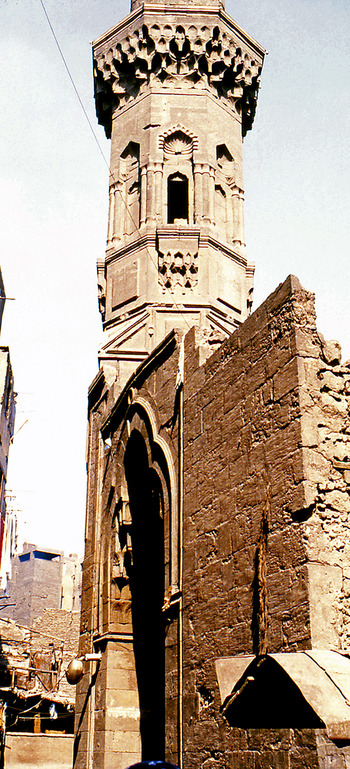
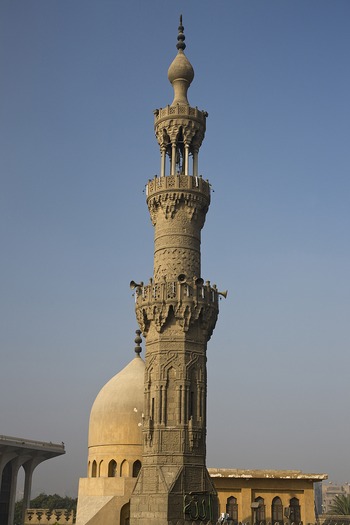
The evidence of the visual arts corroborates the social development revealed in literary and archive sources. Mosques founded by Sufi shaykhs in the late Mamluk period bear the attributes of princely monuments. Although most of the mosques attributed by Mamluk historians to commoners did not survive, either due to the disintegration or expropriation of their endowments, more likely here than in the case of princely foundations, or because the foundations associated with mystics tended to develop as venerated shrines being continuously refurbished and transformed, some exceptional cases reveal the status Sufi shaykhs could attain in terms of monumental patronage. The mosque of Shaykh Madyan (d. 862/1457–58) is a noteworthy case (Figure 1). Madyan, born into a North African family settled in the Egyptian Delta, moved to Cairo, where he built a mosque, said to have been generously endowed by the wife of Sultan Jaqmaq, who highly revered him.Footnote 60 The mosque, built in the style of contemporary princely monuments, was lavishly decorated, as is still apparent in spite of advanced degradation. Its minaret, which was destroyed recently, was made of stone and was not just a common brick construction.Footnote 61 According to Sakhāwī, few scholars and shaykhs erected buildings of such beauty and distinction. Following the foundation of this zāwiya-Friday mosque, Madyan became very influential, his disciples grew in number, some were high dignitaries, and donations increased.
The Minaret of the mosque of Shaykh Madyan (Doris Behrens-Abouseif)

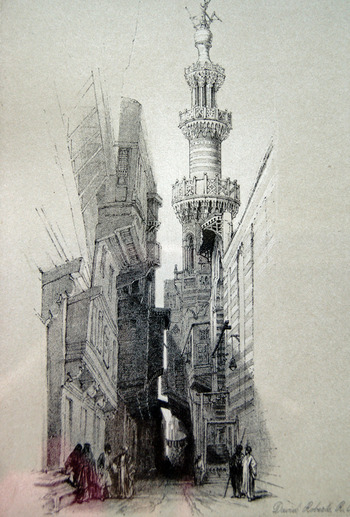
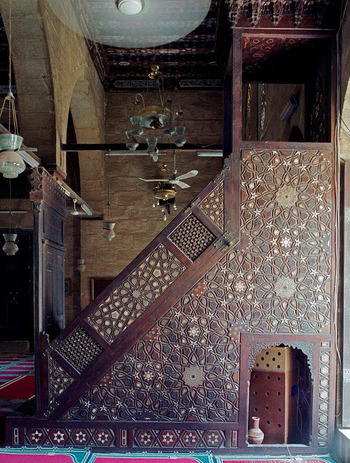
Shaykh Muḥammad al-Ghamrī (d. 849/1445) built a mosque with a magnificent minaret in the Marjūsh street in the north-west part of the medieval city of Cairo, depicted by David Roberts before it had to be pulled down owing to structural problems (Figure 2).Footnote 62 The founder, who was a very humble man, originated in the town of Miniat Ghamr (Mīt Ghamr) in the Delta and led an ascetic life, earning his living as a craftsman. However, the significance and prestige he acquired during his career as a mystic shaykh, gathering a large number of disciples around him, allowed him to found several mosques in the province and in the capital, including this one. The Friday mosque is reported to have been founded in 843/1440 in response to an urgent need for a sanctuary in this quarter of Cairo. Sakhāwī reports that some scholars, himself included, criticized the shaykh for founding a Friday mosque, and advised him to do without the khuṭba, which the shaykh rejected. The minaret of this mosque was sponsored by a merchant from the neighbourhood. Its minbar, which stands today at the funerary mosque of Sultan Barsbāy in the cemetery, is a masterpiece of woodwork (Figure 3).Footnote 63 The carpenter who made it, Aḥmad Ibn ʿĪsā, worked for the emir Jamāl al-Dīn, the private secretary of Sultan Jaqmaq; he also produced the minbars of the shrine of Mecca, the mosque of Qijmas al-Isḥāqī in Cairo. His prominence earned him a biographical entry in Sakhāwī's Ḍaw’; this is in itself an extraordinary occurrence considering that he was only a craftsman, not a scholar, who remained all his life a carpenter.Footnote 64 The sponsor of the minbar of al-Ghamrī, alongside a kursī for the Quran reader, was a scholar and merchant known as Ibn al-Radādī.Footnote 65
The Minaret of the mosque of Shaykh Muḥammad al-Ghamrī, lithograph by David Roberts

The minbar of the mosque of Muḥammad al-Ghamrī today in the funerary khanqāh of Sultan Barsbay (Bernard O'Kane)

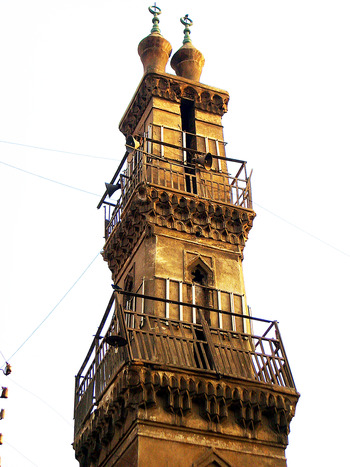
The son of Muḥammad al-Ghamrī, Abū 'l-ʿAbbās al-Ghamrī, was an even more remarkable patron; he founded the Mosque of Repentance, jāmiʿ al-thawba, in the town of Maḥalla in the 1490s. Its minaret is the only provincial minaret of this period to be built in stone; all known minarets outside of Cairo were brick constructions. Only its octagonal first storey survived; it is in the Cairene style, which is also exceptional, indicating that it was built by a craftsman from the capital, perhaps a disciple of the shakyh. Abū ’l-ʿAbbās also founded the mosque with the remarkable rectangular minaret in the town of Mīt Ghamr (Figure 4). The double-headed minaret predates all known minarets in Cairo with an upper double-bulb. This shaykh is reported to have built as many as fifty mosques for which he was able to transport building materials from ancient monuments more efficiently than a sultan could!Footnote 66
The Minaret of Shaykh Abū ’l-ʿAbbās al Ghamrī at Mīt Ghamr (Ḥusām Ismāʿīl)

The mosque with the mausoleum of Shaykh Abū ’l-ʿIlā on the shore of the Nile near Būlāq (before 1486), sponsored by a merchant and a disciple of the shaykh (Figure 5), could compete in all its architectural and decorative features with any aristocratic foundation of this period. Its elaborately carved stone minaret bears the most dense inscription programme in Cairo, and its pulpit is a masterpiece of woodwork signed by its maker.Footnote 67 The inscription on the mausoleum dome is remarkable in the history of Mamluk epigraphy: it mentions the patron with his title khawāja dedicated to great merchants.
The mosque of Shaykh Abū ’l-ʿIlā at Būlāq

Shaykh ʿAbd al-Qādir al-Dasthṭūṭī (d. 924/1518) was credited with the foundation of several Friday mosques, notably that in the north-west suburb of Ṭabbāla in Cairo near a pond called Birkat al-Qarʿ (Pumpkin Pond).Footnote 68 He was an ascetic mystic, of no permanent abode, was not married and had no children, kept a frugal diet, wore a coarse gown and walked barefoot. He was highly venerated among the Mamluk aristocracy and especially by Sultan Qāytbāy, who demonstrated deep humility towards the shaykh and assigned him the administrative task of supervising the construction of his wife's mosque in the town of Fayyum, as is also attested in an inscription.Footnote 69 However, when he founded his mosque in Cairo,Footnote 70 Dashṭūṭī followed the example of contemporary emirs, and enlarged the canal connected to the Birkat al-Qarʿ to allow the navigation of boats therein during the Nile flood season, as was the case at the greater ponds Birkat al-Raṭlī and Azbakiyya.Footnote 71 His mosque included a mausoleum for himself, which has lost its stately dome in recent years. It also had a remarkable minbar, considered worthy of restoration by the Comité de Conservation des Monuments de l'Art Arabe early in the last century.Footnote 72 This kind of patronage was not common prior to the fifteenth century.
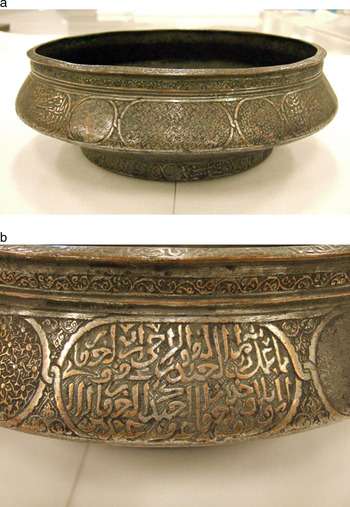
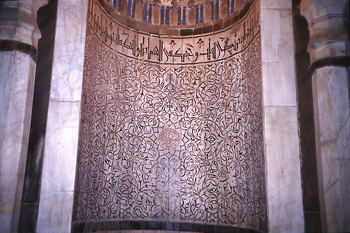
The decorative arts of the late Mamluk period also reveal social change, by expressing a craftsman's pride. While Mamluk titles and blazons on metalwork became far less frequent than during the Bahri period, names of commoners appear on art objects preceded by the formula mimmā ʿumila bi-rasm, previously associated only with high-ranking patrons. A fifteenth-century bowl in the Museum of Islamic Art in Doha bears such an inscription with the name of a certain ʿAbd al-Ghaffār with no title, and includes, further, a poem authored by the prominent poet Taqiyy al-Dīn Ibn Ḥijja al-Ḥamawī (d. 837/1433–34),Footnote 73 praising the beauty of the bowl (Figure 6). There are other interesting inscriptions like the one on a late Mamluk pen-box in which the owner swears in the first person by God that he never harmed anyone while practising his craft and goes on praising the craft of the ṭirāz (embroidered ceremonial textiles).Footnote 74 An elaborate late Mamluk brass salver bears the name of a sweetmeat-maker, al-ḥājj Aḥmad al-Ṭūkhī al-Ḥalawānī, preceded by the formula mimmā ʿumila bi-rasm, which indicates that it was made for him.Footnote 75 Perhaps the strongest evidence for the pride of a craftsman of this period is the signature of ʿAbd al-Qādir al-Naqqāsh in the mihrab of the mosque of Qijmas al-Isḥāqī (1480–81) (Figure 7), placed in the centre of the remarkable and innovatively decorated niche. This signature is extraordinary, as almost all Mamluk mihrabs include only Quranic texts. It was not common even for patrons, including sultans, to inscribe their names on mihrabs.Footnote 76
(a) Bowl inscribed with a poem in the name of ʿAbd al-Ghaffār (b) detail of the inscription (courtesy of the Museum of Islamic Art, Doha)

The signature of ʿAbd al-Qādir al-Naqqāsh inside the miḥrāb of the mosque of Qijmas al-Isḥāqī (Doris Behrens-Abouseif)

The late Mamluk period was viewed by its own chroniclers as an era of decline, where corruption reached such proportions that unqualified persons were allowed to occupy high administrative posts, which they exploited to the detriment of others.Footnote 77 Like the converts, the upstarts were accused of abusing their position to gain profit and harm their fellows. However, one may also see in the rise of upstarts unprecedented opportunities for lower social groups, who for economic and political reasons, had become indispensable for filling gaps the Mamluk aristocracy were no longer able to fill. The phenomenon of the upstart was a natural consequence of the intensive and continuous Mamluk patronage of charitable educational and Sufi institutions, which schooled individuals of modest, mostly indigenous, background and qualified them to join the bureaucracy and fulfil functions in the state, thus climbing the social ladder, making fortunes and gaining power. Although the tragic end of Abū ’l-Khayr al-Naḥḥās reveals the uneasy reaction to this development in the Mamluk establishment, it remains an extreme and individual case.
As a final point, it is interesting to note that the ascendance of the craftsman to the status of scholar and intellectual did not have a noticeable impact on the status of the arts and artists, as happened in Renaissance Italy in the fifteenth century, when artists began to acquire a humanistic education that raised them above the craftsman's status and earned them acknowledgement and respectability among the intellectual elite.Footnote 78 The acknowledgement earned by educated Mamluk craftsmen was confined to their scholarship rather than to any manual works of art they may have created. This is, however, another subject that requires a study of its own.