INTRODUCTION
Though it is a long way from Appalachia, this discussion begins with a study conducted in Sweden, where, in the late 1980s, a team of anthropologists interviewed eighty Swedes about their craft artifact collections. Though the Swedish study was designed to gather information about cultural artifacts in private collections, the investigators realized that they were not simply cataloguing folk objects, they were also collecting the stories attached to them. Ljungstrom (Reference Ljungstrom, Anttonen and Kvideland1993) describes their interviews, which entailed measuring and taking pictures of each item, as well as documenting provenance. Ljungstrom writes:
Some of the interviewees became inspired by their association with the objects and started to recall people and events in the past. They took over the interview and, by telling a story, they would elucidate something important in their lives, released by the artifact. (Reference Ljungstrom, Anttonen and Kvideland1993:131)
Ljungstrom's description portrays the object as a potential conduit for identity making, something through which aspects of self can be released. Ljungstrom further describes his own discussion of artifact narratives as standing at the crossroads of ‘material culture, personal experience narratives and themes indicating values, roles and norms related to worldview’ (Reference Ljungstrom, Anttonen and Kvideland1993:131–32). In addition to being statements about values, roles, and norms, Ljungstrom surmises that the collectors had other personal reasons for sharing their artifact narratives.
As the interviewees didn't want to reveal too much of themselves by being too intimate, their stories to elicit meaningful themes about themselves, other people and events, took place at some distance of time, concerning grand-parents or parents long ago. They identified or contrasted themselves somehow, so the stories were actually about themselves placed in the same and yet totally different landscape. (Reference Ljungstrom, Anttonen and Kvideland1993:142, emphasis added)
Through conversational narratives about people or events connected to objects in their collections, these speakers were able to talk about themselves by talking about people and events of the past. The narrator and the narrated are thus the same and not the same; the narrator's identity is created through both comparison and distinction, and all of this is possible because the personal narratives are bound to objects as concretized reflections.
As we know, speakers have lots of ways to express themselves, overtly and covertly, and in previous writings (Burkette Reference Burkette2007, Reference Burkette2013, Reference Burkette2014), I have discussed specific linguistic features being used to indicate community membership, attitude, affiliation (or disaffiliation), and stance. What I want to suggest here is that it is not just language that does these things; objects can be used to accomplish identity-making tasks as well. Much like Ljungstrom's study, the present study sits at a crossroads, as it represents an intersection of sociolinguistics, linguistic anthropology, and material culture studies.
Looking at examples from interviews conducted in western North Carolina, we can see the subtle interplay between the use of grammatical features associated with Appalachian English (such as a-prefixing and nonstandard past tense) and the use or mention of physical artifacts in the enactment of an Appalachian stance. What this analysis suggests is that it is not just linguistic choices that comprise stance enactment, but physical objects as well. This article focuses on two speakers from western North Carolina and their use of physical artifacts—a placemat, a Civil War era sword, a lock of hair, and a piece of wood with a bullet hole in it—to enact stances that construct their individual versions of an Appalachian identity.
STANCE
The concept of stance rounds out a panoply of terms that can be used to describe identity-making measures in discourse, including positioning, footing, indexicality, and enregisterment. Positioning, as described by Holloway (Reference Holloway, Henriques, Holloway, Urwin, Venn and Walkerdine1984), gives the discourse analyst a way to talk about how speakers locate themselves within an interaction. Footing (Goffman Reference Goffman1981) is used to describe the roles being played by a speaker in conversation, along with the micro-shifts that signal changes in or adjustments to a speaker's positioning (Ribeiro Reference Ribeiro, Fina, Schiffrin and Bamberg2006:74). Both positioning and footing are used from the perspective of the language analyst to describe things that speakers do within an interaction. Indexicality (Ochs Reference Ochs, Stigler, Schweder and Herdt1990) is the connection between language and local identity; using a term associated with a particular group is a way that speakers can use language to signal group membership (Schiffrin Reference Schiffrin, De Fina, Schiffrin and Bamberg2006:15). Building on this idea, Johnstone, Andrus, & Danielson (Reference Johnstone, Andrus and Danielson2006) address how linguistic features can move through three orders of indexicality (Silverstein Reference Silverstein2003), a progression from viewing linguistic features as the object of sociolinguistic observation to viewing them in terms of their potential use in social performance.
Johnstone and colleagues (Reference Johnstone, Andrus and Danielson2006:82) assign first-order indexicality to situations in which there are statistical correlations between specific linguistic features and speaker variables such as region or social class, yet use of those features go unnoticed by the speakers themselves. Second-order indexicality refers to situations in which speakers begin to notice the features they use and ascribe to them some kind of local currency (Reference Johnstone, Andrus and Danielson2006:82). Finally, third-order indexicality refers to situations in which speakers, who are aware of second-order currency, use regional features in order to ‘perform local identity’ (Reference Johnstone, Andrus and Danielson2006:83). It is through this process that the speech of a particular place or group becomes enregistered (Agha Reference Agha2003), a process pushed along by factors such as repetition (Kiesling Reference Kiesling2009) and commodification (Johnstone Reference Johnstone2009b). Once there exists a cultural story that ties together language features with a group or place, those specific aspects of language can become enregistered as ‘local’ (or ‘group-associated’). Through this process, repeated use of linguistic features allows speakers to identify themselves with the use of specific features, and then use those features to perform regional or group identities. In other words, enregistered features can be used to enact stance. Basically, stance is the way that speakers signal who they are in relation to interlocutors, their environment, and the topic(s) of conversation.
There are (at least) three different general stance types: authoritative, evaluative, and interpersonal (Jaffe Reference Jaffe2009; Keisling Reference Kiesling2009; Anderson Reference Anderson2014). Authoritative stances claim knowledge or authority, while evaluative and interpersonal stances express relationships to and attitudes toward conversation partner(s), contexts, and topics. Evaluative stances express opinions, assessments, and (possibly) comparisons. Interpersonal stances can be either affiliative or distancing, as speakers align themselves with (or locate themselves at a distance from) their interlocutors, contexts, and topics. Much in the way that micro-shifts in footing can be seen as contributing to speaker positioning, these stance types can additively enact regional and local identity.
What we think of as a dialect, then, can be defined as a ‘set of stance-taking choices associated with places and/or associated social identities' (Johnstone Reference Johnstone2009a:32). So intrinsic to speech is this kind of identity work that Kiesling (Reference Kiesling2009:179) argues for stance-taking as the primitive of language variation, suggesting that ‘stance provides an explanation of variation that … goes beyond a mere restatement of correlational patterns’ (Reference Kiesling2009:190). In fact, a stance-based analysis can be used to discuss intra-group variation that otherwise escapes explanation.
Johnstone states that ‘stance is generally understood to have to do with the methods, linguistic and other, by which interactants create and signal relationships with the propositions they utter and the people they interact with’ (Reference Johnstone2009a:30–31), which means that stance-taking is not restricted to the use of enregistered linguistic features. Elsewhere, I have argued that, in an interview conversation, narrative content can work in tandem with grammatical features as speakers express their opinions, construct their identities, and enact stances (Burkette Reference Burkette2013). Take, for example, the case of an adult daughter who characterizes her mother as ‘old-fashioned’ by telling a story about trying to get home before the curfew her mother has put in place, concluding with the general statement that, “if we was five minutes late, she's a-standing at the door waiting on us”. In this narrative excerpt, the prefixed form a-standing (one of only six appearing in the daughter's hour-long interview) serves as an implicit editorial comment. The construction of the mother's old-fashioned-ness is accomplished both by association with a traditional Appalachian English feature and by the story she tells about how strict her mother was about what time she had to be home after a date (Burkette Reference Burkette2013). Stance-taking is thus not limited to the use of specific linguistic features; stance can be enacted through narrative content and through the interaction of content with specific features.
The enactment of any particular stance is not achieved in isolation. Stance is situated between past and future utterances, in a specific environment, and with specific interlocutors; it is a co-creation of all of these factors. Stance is achieved dialogically, a means by which speakers signal and/or effect evaluation, positioning, and alignment with interlocutors and with conversation content (Du Bois Reference Du Bois and Englebretson2007:163). It is not a simple reflection of a relationship between an identity and a linguistic feature; stance-taking can be reflective of ‘multiple voices, sometimes even seemingly contrastive or contradictory, coming together as speakers position themselves in an interaction’ (A. Williams Reference Williams2008:40). The multi-voiced aspect of stance reflects the fact that, as we see here, the identities enacted through stance-taking are multi-layered and complex, as are the types of expression available to speakers, which include both linguistic expression and expression via physical objects.
APPALACHIAN ENGLISHES, APPALACHIAN IDENTITIES
In his history of the Appalachian region, John Williams observes that ‘Appalachia is both a real place and a territory of imagination, and social reality there lends credence to both aspects' (Reference Williams2002:398). The same is true of Appalachian English (AE), which exists as both a ‘real’ language variety and as a ‘territory of imagination’. Since the beginning of formal study of AE (i.e. Wolfram & Christian Reference Wolfram and Christian1976), approximately thirty grammatical features and twenty phonological features have been identified as characteristic of this variety and, since that seminal publication, a number of studies of Appalachian speakers have contributed to our understanding of the variety. For example, as a result of data collected from Appalachian speakers in West Virginia, Hazen, Flesher, & Simmons (Reference Hazen, Flesher and Simmons2013) describe AE-associated features as ‘fading’ or ‘enduring’, terms that help us recognize that whatever it is that we are calling Appalachian English is not a static structure; it is instead fluid and ever-changing.
Among the phonological features associated with AE are the following canonical examples: /aɪ/ monopthonization in words such as fire and night, the so-called ‘intrusive’ /r/ in words such as wash (pronounced as [wɔrʃ]), and the substitution of [n] for [ŋ] in words ending in -ing (e.g. huntin’, somethin’). Not one of these phonological features is the sole property of Appalachian English; /aɪ / monophthongization, for example, is found throughout the greater American South, while intrusive /r/ can also be heard in the speech of New Englanders (the Linguistic atlas of New England contains several instances of [wɔrsp] for wasp), and [n] for [ŋ] is common throughout informal Englishes everywhere. These features are not constant across generations either. Though /aɪ/ monophthongization and use of [n] for [ŋ] are found throughout the speech of Appalachian and Southern speakers regardless of age, intrusive /r/ is used predominantly by older speakers, which suggests, to use the terms of Hazen and colleagues (Reference Hazen, Flesher and Simmons2013), that while the /aɪ/ monopthong and [n] for [ŋ] are enduring features, the Appalachian intrusive /r/ is a fading feature, likely to be found only in the speech of the older generations. Grammatical features commonly associated with Appalachian English are given below in (1).
(1) Grammatical features commonly associated with Appalachian English
a. a-prefixing: e.g. I'm a-going to give you that and you can take it home with you.
b. nonstandard past tense—three main categories:Footnote 1
(i) same form for present and past tense: e.g. I can't remember who give me that.
(ii) regularized: e.g. We knowed you wouldn't care
(iii) same form for past participle and past tense: e.g. If I done something wrong, she'd tell me; They've tore that down.
c. leveled was: e.g. They was all crying.
d. multiple negation: e.g. Ain't nothing in that.
e. perfective done: e.g. I done fixed it already.
f. pleonastic pronouns, i.e. double subject: e.g. My mother, she told me that story.
g. demonstrative them: e.g. That'd be a good time for me to go through them pictures.
h. nonstandard intensifiers:
right e.g. He used to drink right much.
awful e.g. He was awful sad that his team lost.
plumb e.g. She was plumb worn out after the dance.
All of these features are found in Appalachian Englishes, general Southern American English, and beyond (cf. Wolfram & Christian Reference Wolfram and Christian1976; Feagin Reference Feagin1979; Wolfram, Christian, & Dube Reference Wolfram, Christian and Dube1988; Montgomery & Hall Reference Montgomery and Hall2004; Hazen, Butcher, & King Reference Hazen, Butcher and King2010; Montgomery Reference Montgomery2013; Hazen et al. Reference Hazen, Flesher and Simmons2013). Though a-prefixing is strongly associated with Appalcahian and Southern American speech, the features of nonstandard past tense forms, was-leveling, and multiple negation are found throughout vernacular varieties of English frequently enough that these three are counted among the English vernacular universals as described by Chambers (Reference Chambers, Fontana, McNally, Turell and Vallduví2001).
Appalachian English is not only fluid and changing, it is also heterogenous. Due to the amount of variation in the scope and use of AE-associated features throughout Appalachia (c.f. Wolfram Reference Wolfram1988; Frazer Reference Frazer1990; Mallinson & Wolfram Reference Mallinson and Wolfram2002; Hazen & Fluharty Reference Hazen, Fluharty and Bender2004; Montgomery Reference Montgomery, Kortmann and Schneider2004, Reference Montgomery2013; Montgomery & Hall Reference Montgomery and Hall2004; Wolfram & Schilling-Estes Reference Wolfram and Schilling-Estes2006), scholars such as Hazen & Fluharty (Reference Hazen, Fluharty and Bender2004) have suggested that it would be wise to refer to this variety as a collective: Appalachian Englishes (AEs), a term intended to express the same sort of pluricentricity as found in studies of World Englishes (Bhatt Reference Bhatt2001). The concept of pluricentricity applies not only to our understanding of what Appalachian English(es) might entail linguistically, but also to our understanding of what an Appalachian identity might entail in terms of its linguistic expression.
The understanding of language as an act of identity has its foundation in the work of Le Page & Tabouret-Keller (Reference Le Page and Tabouret-Keller1985) and, since their seminal study, much sociolinguistic effort has been invested into discussions of identity as fluid, multifaceted, and continuously emergent (Bucholtz & Hall Reference Bucholtz, Hall and Duranti2004, Reference Bucholtz2005; Haviland Reference Haviland2005). The idea that identity is an action is crucial to the understanding of stance as a purposeful enactment, something speakers do in order to both create and express the relationships, connections, evaluations, and attitudes that they have toward their interlocutor(s), conversation topics, and their physical surroundings.
Part of the idea of enregisterment is that speakers do, implicitly or explicitly, connect aspects of their speech—whether lexical (e.g. yinz in Pittsburghese or y'all in the American south), phonological (e.g. [hoɪ toɪd] for high tide in Ocracoke, NC), or grammatical (e.g. multiple negation as ‘working class’)—to a sense of place or community. Johnstone (Reference Johnstone2013) discusses in detail the enregisterment of Pittsburghese, including the metapragmatics that reinforce the link between language and place, such as explicit statements made during discussions of language use on a radio program, as well as the use of Pittsburghese on t-shirts, coffee mugs, billboards, and the like. Enregistered features of Southern American English fill the pages of books such as How to speak Southern (Mitchell Reference Mitchell1976) and the dialogue of supposedly Southern characters on television and in movies. Features that have reached a level of recognition as being part of Southern Appalachian speech are bound up in a schema that includes a lot of stereotypes and erroneous cultural information about the people that live in the Appalachian mountains. The stereotype of Appalachian mountaineers as poor, white isolationists is exemplified by comic strip characters such as Lil’ Abner, Barney Google, and Snuffy Smith—characters that contributed to the creation of a schema that visually and linguistically populates Appalachia with people that are tough and self-sufficient, but also frequently appear to lack both shoes and good sense (see Hazen & Fluharty Reference Hazen, Fluharty and Bender2004 for a concise discussion of these kinds of ‘hillbilly’ characters). In whatever way current Appalachian residents orient themselves as standing with (or standing apart from) these stereotypes, a cultural ‘Appalachian’ schema is present and contains elements of language use that can be used in stance-taking.
As an example, take the ‘Mountain talk’ placemat given to me by one of my Appalachian informants (an examination of this action as stance-taking is included below). The paper placemat contains a series of words and phrases and their definitions, framed by drawings of men in overalls and women in aprons carrying out various mountain-associated activities, such as playing a fiddle, holding a long rifle, and feeding farm animals, set against a background of rough-hewn clapboard houses and tree-covered mountains. The list of mountain vocabulary words is introduced by a short descriptive passage:
The charm of the Appalachian mountain folk, living deep in the mountain coves and hollows, lies in their isolation from outside influences. Their manner of speech and way of life dates back to earlier more relaxed times and brings forth a bit of nostalgia to all of us. Here are a few typical expressions of mountain folk…
Many of the examples of ‘typical’ mountain talk are lexical (e.g. vittles for ‘food’, gully-washer for ‘a hard rain’, poke for ‘paper bag’), though some reflect AE-associated pronunciations (whupped for ‘whipped’, pizen for ‘poison’, kivver for ‘cover’, holler for ‘hollow’). Several more items reflect AE-associated grammatical features, including three listed above in (1): nonstandard past tense (et for ‘eaten’, het for ‘heated’, and clum for ‘climbed’), a-prefixing (a-fixing Footnote 2 in the example We're a-fixing to go to the store), and nonstandard adverbs (awful poorly and plumb upset). Taken together, the combination of vocabulary items, definitions, example sentences (e.g. Them young-uns is kivvered with the pox and Them mules git kinda skittish when his dogs howl), and illustrations (re)create an Appalachain schema on paper, a schema that includes information about language, lifestyle, and Appalachian material culture. The placemat is a microcosm of the larger cultural schema that creates the connection between language and place that allows for the use of region-associated linguistic features to enact a stance that reflects a speaker's sense of belonging to a place (Johnstone Reference Johnstone2013:120).
In terms of Appalachia, the idea of ‘place’ is itself multi-faceted. Appalachians variously describe themselves as ‘Appalachian’ (pronounced APP-ah-LATCH-un), ‘Southern’, or ‘mountain’. Therefore, it is likely wise to conceptualize Appalachian speakers (and their language use) as comprised of a constellation of features and ideas as opposed to monolithic, static entities. Trying to separate out which linguistic features are (more or less) ‘Southern’ or ‘Appalachian’ or ‘Appalachia sub-regional’ is difficult and potentially unproductive when discussing identity-making within a specific interaction, as what it means to be or sound ‘Southern’ or ‘Appalachian’ or ‘mountain’ differs from place to place, even within the region itself. In the case studies that follow, speakers enact authoritative, evaluative, and interpersonal stances that reflect multi-layered identities that are simultaneously Southern, Appalachian, and mountain. To accomplish this identity work, the speakers use a number of strategies, linguistic and otherwise, in order to do and be who they are within an interview conversation.
ARTIFACT
The disciplines of anthropology and archaeology have a long history of studying physical artifacts—a history that, like the history of the study of language, has moved through a number of theoretical phases and positionings. Two important theoretical ‘turns’ characterize the more recent study of material artifacts: the textual turn of the 1980s and the discursive turn of the early twenty-first century. The textual turn (cf. Hodder Reference Hodder1982a, Reference Hodder1982b, Reference Hodder1986; Miller Reference Miller1982, Reference Miller1987) posited that material artifacts could be read as texts that reflect specific (though potentially changing) contexts. While the textual perspective held that material objects, like language, are a way of encoding culture, the discursive turn that followed in the late 1990s (cf. Buchli Reference Buchli, Hodder, Shanks, Alessandri, Buchli, Carman, Last and Lucas2000; Thomas Reference Thomas2004; Ingold Reference Ingold2007, Reference Ingold2008) argued that the meaning of any object is co-constructed, created, and recreated reflexively through the interactions of people, objects, and the greater environment. The discursive turn taken in the study of material objects (now more often referred to as the study of materiality) mirrors the discursive turn taken in linguistic anthropology at about the same time period.
Materiality, according to Ingold (Reference Ingold2007), blurs a great many distinctions, such as the distinction between past and present, and between what is and what is becoming. Objects are the ‘world-in-formation’; they are ‘specific confluences of materials that, for a moment at least, have mixed and melded together into recognizable forms’ (Reference Ingold2007:314–15). Ingold (Reference Ingold2008) uses the term meshwork to describe the continual inter-layering of the human and nonhuman, in which everything is bound together in an unending reflexivity, each element working to (re)create the other (Reference Ingold2008:211). Humans and material culture, then, are mutually constitutive, each created discursively by the other.
As Knappet states, ‘no such “pure” entity as human or non-human exists, as the two co-construct one another’ (Reference Knappet2011:33). Using the example of the plough, Knappet explains how objects can draw together places and agents that are otherwise separated by space and time; the plough is more than an object—it is the locus of its physical being, the blacksmith that shaped it, and the ploughman that uses it (Reference Knappet2011:33; cf. also Callon & Law Reference Callon and Law2004:6). Through this discursive relationship, objects perform many of the same identity-making tasks as language does, including the recognition work that goes in to ‘authentic-ness’ (Gee Reference Gee2005). Material objects can act as authenticators, providing links between the past and present, the tangible and intangible. Weiner (Reference Weiner1992:6), in her discussion of a cloak worn by a Maori chief, notes that when the chief ‘brandishes a sacred cloak, she is showing that she is more than herself—that she is her ancestors’. Weiner adds that it is not only the Maori who feel that objects confer power and authority; members of capitalist societies also long for possessions that mark who they are (Reference Weiner1992:154). Highly valued (or old or rare) objects can bestow status on the person that possesses them. These possessions can, in turn, be offered up for public appraisal (e.g. on television shows such as The Antiques Roadshow) or formal evaluation, such as that provided by auction houses such as Sotheby's or Christie's. The appraisal process adds a layer to what is now a reflexive authentication. Important people own important objects; important objects are so deemed because of the important people that own(ed) them, and so on. Because of this co-constructive relationship between people and objects, current anthropological theories of materiality highlight the agentive and enactive properties of physical artifacts, a way of approaching the material that is grounded in the idea that physical objects and people each bring the other into being (Knappet Reference Knappet2011:97). Both the study of language and the study of materiality have alighted upon the concept of discursivity, and the present study aims to marry the two in its discussion of two case studies that demonstrate how the linguistic and material are similarly involved in stance-taking.
DATA AND METHODS
The data for the present study are the result of sociolinguistic interviews conducted in the late 1990s and early 2000s in Jefferson, a small rural town located in western North Carolina. Eleven life-long residents of Jefferson were interviewed—all of them members of the same close-knit social network and, in fact, members of the same extended family (my family). Interviews took place in the homes of each informant, often in the presence of other family members. The interviews ranged in duration from fifty to seventy-eight minutes and discussion centered around family and community stories.
The data I collected from the eleven Jefferson speakers contained occurrences of a great number of AE-associated features. Some features appear within the data only sparsely (e.g. intensifying right, pleonastic pronouns), while the four most commonly used grammatical features—a-prefixing, nonstandard past tense, multiple negation, and was-leveling—were present in the speech of nearly every informant. Both a-prefixing and nonstandard past tense forms (especially regularized forms) are often considered features of ‘traditional’ Appalachian speech (Montgomery Reference Montgomery2013). The most common place for an a-prefix is as part of a progressive construction introduced by the verbs BE or GO (e.g. We were a-running through the house, We were a-going to tell you a tale), though the a-prefix does sometimes occur with a complement (e.g. She was a-scared of storms; Wolfram & Christian Reference Wolfram and Christian1976). Though the a-prefix has been described as on the decline in West Virginia for quite some time (Wolfram & Christian Reference Wolfram and Christian1976; Hazen et al. Reference Hazen, Flesher and Simmons2013), it appears in the speech of nine of the eleven Jefferson speakers and not infrequently in the speech of the youngest Jeffersonians interviewed, though for these younger speakers, the use of the a-prefix (and of nonstandard past tense forms) appears to be part of a performance of community voice and identity (Burkette Reference Burkette2007). In terms of nonstandard past tense, the most frequently found forms in the Jefferson data are come, done, seen, run, give, and knowed, which jibes with previous studies’ findings (cf. Wolfram & Christian Reference Wolfram and Christian1976; Feagin Reference Feagin1979), though in their Dictionary of Smoky Mountain English, Montgomery & Hall (Reference Montgomery and Hall2004) list almost one hundred verbs that appear in nonstandard past tense forms in the Smoky Mountain subregion of the Southern Appalachias, noting also that the use of these forms is highly variable. Among the Jefferson data, nonstandard past tense was the most common AE-associated feature, evidencing a range of forms, including the doubly inflected stoled and borned. Though both was-leveling and multiple negation are deemed fading features in West Virginia AE (Hazen et al. Reference Hazen, Flesher and Simmons2013), they do appear within the Jefferson data. Leveled was was the second most common AE-associated grammatical feature, used by all but one Jefferson speaker.
In a case where a handful of features seems ubiquitous within a data set, I find it enlightening to look more closely at the speakers who stand apart from their linguistic crowd. Thus, the present study focuses on two speakers whose use of the four most common grammatical features is among the lowest of the speakers interviewed. One of them, JD, is a sixty-five-year-old white male that I have discussed elsewhere in terms of his use of formal (if not hypercorrect) grammar (Burkette Reference Burkette2014). The second speaker is Betty, a seventy-five-year-old white female. JD was a distant cousin to me and Betty was my great aunt (both are now deceased). Though I had met both informants before, I did not know either of them well and was reintroduced to each by another family member who helped set up the interviews. In fact, my familial relationship with each speaker was the topic of much discussion and was frequently referenced in conversations that touched on common ancestors.
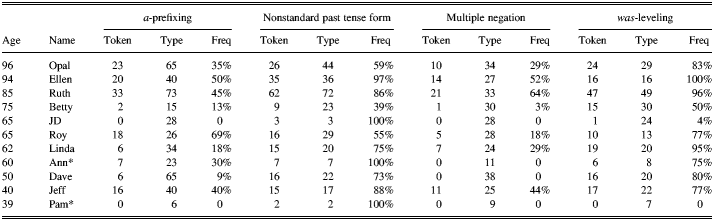
Table 1 contains a summary of each speaker's use of a-prefixing, nonstandard past tense, multiple negation, and was-leveling. Speakers are ordered by age, with the oldest speaker at the top, and with both Betty and JD falling almost in the middle, age-wise. Impressionistically, JD and Betty sound like the other members of their community; their speech evidences AE-associated phonological features such as monopthongized /aɪ/, dipthongs in words such as bed (as [bεəd]) and small (as [smaʊl]) and the raising of /æ/ to /ε/ (gather as [gεθɚ]). Grammatically, however, both of these speakers appear out-of-step with their chronological contemporaries. JD's interview evidences only four total tokens of AE-associated grammatical features, and, while Betty does use each of the four features, she does so at rates much lower than the other speakers of her generation. The discussions that follow look at Betty and JD in turn in order to examine the use of these four AE-associated grammatical features in their speech as part of larger stance-taking strategies that extend to narrative content and material artifacts.
Individual speakers' use of Appalachian English forms.

*Auxiliary informant that was in-and-out of interview conversation.
Betty
Betty uses a number of stance-taking strategies to enact a locally oriented stance—strategies that change as our interview conversation continues. The first few minutes of the interview contain interpersonal stance-taking, as Betty establishes herself as having a ‘local’ identity. This identity is reinforced by a set of statements that show a positive evaluation of Jefferson customs and affiliation with long-time Jefferson residents, followed by distancing moves that create a subtle contrast between long-time Jefferson residents who live in their community year round and a recent wave of part-time residents who ‘summer’ in Jefferson, but spend winters elsewhere.
Betty makes a series of positive statements about Jefferson at the outset of our conversation, when she explains that in Jefferson, as in other southern towns, “you holler hello” when you pass someone and that the people are “caring” and will “speak to you when you go out”. These explicit statements are indicative of both a positive evaluative stance and an affiliative interpersonal stance, as she aligns herself with her community and its expectations in terms of polite (or friendly) behavior. Betty's positive evaluation and strong affiliation with her community are underscored by another set of stance-taking moves, also occurring at the outset of the interview, in which Betty distances herself from newer residents of Jefferson, many of whom are wealthy newcomers who build large houses on prime pieces of real estate, so that they can spend summers in Jefferson. Betty describes these part-time Jefferson residents as being “from different places, you know, out of state, most of them”. Betty continues to enact this distancing stance, adding that the newcomers “from Florida and different places” sometimes volunteer with her at the local hospital and that “some of them are harder to get to know”. Though this statement may seem subtle, the idea that is being communicated is a negative evaluation of any community resident (part-time or otherwise) that appears unforthcoming and/or unfriendly. Betty goes on to elaborate as she explains that “some ladies from Florida that would come and uh volunteer in summertime, go back to Florida in winter, come back next summer, and they were, most of them were really nice”. This is faint praise indeed, as repetition suggests that the true emphasis here is on the cycle of ‘come’, ‘go back’, and ‘come back’. These explicit statements demonstrate a positive evaluation of her town and a strong affiliation with long-time Jefferson residents that roll together to create an identity that is locally grounded.
As the interview continues, Betty uses two indirect strategies to achieve a similar end: the referencing of material artifacts and the use of AE-associated grammatical features. About halfway through our interview, Betty leaves the room and brings back the paper ‘Mountain Talk’ placemat, taken from a nearby restaurant. She hands me the paper and makes a general comment about the words and phrases on the paper, stating that “some things I've said but some of them is just really way out you know”. The placemat acts as authoritative stance-taking, as proof that ‘mountain talk’ exists, as well as confirmation that, for Betty, part of her identity as local has to do with language. After handing me the piece of paper, Betty mentions in particular that her oldest grandson, who lives on the North Carolina coast, has commented on her accent. Betty says that this grandson “thinks I say some, like, uh, the house caught on fire ([fa:r]) and it tickles him so good. I don't say fire ([faɪr]), I say fire ([fa:r])”. Again, Betty uses a distancing strategy by indirectly contrasting her ‘mountain talk’ with speech associated with the ‘coast’, along with identifying the enregistered AE-associated feature /aɪ/ monopthongization, which is then positively evaluated as being humorously pleasing to her grandson (“it tickles him so good”). These stance-taking moves continue her push to local affiliation and identification.
The placemat discussion seems to set up the mention of additional physical artifacts considered to be family heirlooms—a lock of hair and a piece of wood with a bullet hole in it—a few minutes later. Although these later objects are not physically present, it is their materiality—their physical presence in the world—that is the means of Betty's further enactment of a local identity. The items that Betty mentions serve as authoritative stance-taking tools in that they are proof that the events Betty describes did happen. Betty's stance-taking strategy shifts from explicit statements to more subtle means as the stories she tells contain clusters of AE-associated features as well as references to physical artifacts.
As seen in Table 1, Betty uses all of the AE-associated features under discussion, though perhaps sparingly as compared to her contemporaries. The feature that appears most often in her speech is was-leveling, though her use of this feature is markedly less prominent than in the speech of most of the other Jefferson speakers. Both instances of a-prefixing occur within the telling of one story, the story of Tom Dooley, who was hanged for killing Laura Foster (an ancestor of Betty and myself). The story of Tom Dooley gained some fame in the 1960s as the subject of a song by The Kingston Trio, entitled ‘Hang Down Your Head, Tom Dooley’. Family lore has it that Dooley was innocent of the crime, though perhaps not innocent of two-timing Laura Foster (legend also suggests it may have been the ‘other woman’ that killed Foster in order to keep Dooley for herself). In (2) below, Betty explains a little about the relationship between Dooley and Foster as well as some information about how the search party found her body.
(2) Well, he was a, I don't know if I can tell it straight or not. Uh, she was a-dating Tom Dooley and they always thought it was another woman that really killed her and he took it, you know, because him and her been a-going together, now I don't know now whether that's right or not, but anyhow, I don't know exactly how it was. [But somebody killed her] Right, and they buried her and they said that they was searching with, on horses and this horse come to the place and wouldn't cross. He went to sniffing, you know.
Not only do both instances of a-prefixing occur within this narrative, so does an instance of was-leveling and an instance of nonstandard past tense. Betty is obviously not enacting an authoritative stance based on her personal knowledge of events, given her repetition of “I don't know” (which we see is certainly different from the way that JD enacts an objective, authoritative stance as a local historian throughout his interview). As we see below, her authoritative stance-taking is instead achieved through references to physical objects. At the same time, we find stance-taking reflective of evaluative and affiliative moves in both the content of Betty's stories and the AE-associated features that appear in their telling.
The story about Tom Dooley and Laura Foster leads immediately to another story, given in (3), also about a common ancestor. (P. and W. are both family surnames.)
(3) I'll tell you another thing. My daddy's mother, she was a P., from Wilkes County, and she married my grandfather who was a W. and back during the Civil War, have you ever heard them tell that? And uh, the renegades came. She done the plowing and everything of course. They said she wasn't afraid of nothing.
In this, the orientation of a longer narrative, we find two AE-associated features being used in quick succession: one instance of nonstandard past tense along with the only instance of multiple negation in Betty's interview. Perhaps these features occur in close proximity precisely because enregistered AE-associated features are available to speakers for the enactment of an Appalachian (or Southern or mountain) identity. Enregistered features could thus be seen as being tied to a larger cultural schema of ‘Appalachia’, which would include material artifacts, linguistic features, and ideas about language use. Having language and artifact entwined in the discursive creation of an Appalachian schema would explain why both Betty's stories in (2) and (3) follow immediately from her statement that “My brother up here has a lock of Laura Foster's hair”.
Likewise, the mention of one physical artifact (a lock of hair) leads to mention of another artifact—this time, a board with a bullet hole in it—along with the associated story. Below in (4) is the conclusion of her narrative in (3), which began with the Union army “renegades” in Wilkes County and the great-grandmother who “wasn't afraid of nothing” and ends with the invocation of both artifacts.
(4) And uh, they came to the barn one day and started to steal her horse and she told them, called to them and told them if they started, she'd kill them and she shot and killed one. Then they had to hide her out up in Wilkes County, afraid they'd come back and try to kill her. But now my brother up here, he has the, when they tore down the barn in Wilkes, my grandma's brother cut the chip out where the bullet went through and sent it to my daddy and my daddy give it to John up here. And he has the lock of Laura Foster's hair too.
The theme of the strong woman is found throughout several narratives told by a number of the Jefferson speakers, male and female, and these stories are always related with a sense of pride. In addition to evaluating her female ancestor positively, Betty is able to claim affiliation as she is a direct descendant of the ‘strong woman’ in the story, which then extends to me as her interlocutor, as it appears as though Betty offers this story so that she and I can take joint pride in a common ancestor, perhaps as a way for us as women who are related to each other to bond. And rather than this bond being grounded in hearsay, it can be grounded in the physical objects being used as proof. Having physical proof and being able to tell the story are both ways of enacting an authoritative stance, which is then layered with these ideas of ‘local’ and ‘mountain’ and ‘strong’ in order to create a nuanced social identity.
JD
Various stance-taking strategies also allow JD to create a layered identity for himself. Formal language and hypercorrect grammar perform a distancing stance that sets him up as an objective observer that stands, in some respects, apart from the community in which he lives (Burkette Reference Burkette2014), while the use of iconic artifacts allow him to simultaneously enact an authoritative stance as a local historian. These two stances are interwoven throughout conversational narratives to create a multilayered identity.
As seen in Table 1, JD's use of AE grammatical features is almost nonexistent. JD had not one use of an a-prefix or of multiple negation over the course of our hour-long interview conversation and, even though it appears as though JD uses nonstandard past tense consistently, there are only three instances of this feature: set, digged, and hanged. Though the latter is arguably not even nonstandard (even Neilson 1985 notes that the prescriptively correct past tense of the verb to hang is difficult to determine), it would not be considered ‘standard’ as JD uses it: “Granddaddy had brought the sword home with him and had hanged it in the springhouse to keep the children away from it for fear they'd be hurt with it”. JD's use of digged is reflective of his use of what I call ‘Biblese‘Footnote 3 as it appears in the statement “Where were you when Father Abraham digged this well?”. Though these two examples are nonstandard (or, in the case of digged, simply unconventional), JD's use of set should not be considered nonstandard at all. As the Dictionary of American Regional English (DARE) indicates, set is distinct from sit; the verb to set, a term DARE associates with the South Midland, refers to the custom of visiting and talking with friends and neighbors and should be considered a different verb than to sit. Although it may appear nonstandard at first glance, JD's use of set to refer to the custom of visiting reflects the use, perhaps, of a regional lexical verb, not a nonstandard past tense form, and this use very much aligns him with his peers, as all of the older Ashe County speakers used this term.
JD's only use of was-leveling was while he was talking about how most of the Jefferson residents of his father's generation lived their entire lives in the community, although at one point his father traveled to West Virginia for work, which JD explains in (5).
(5) There was some people who were going to West Virginia to work … in coal mines when the coal industry came to the fore during the, during the latter part of the [IA], almost a demise of the, of the thrust of the industrial revolution.
As mentioned before, JD uses grammar that verges on hypercorrect (such as asking me, “about what were we talking?”), which I have discussed as contributing to his enactment of an affiliative stance, perhaps as a way to express alignment with me as a graduate student who studies language (Burkette Reference Burkette2014). Because of his attention to prescriptively correct grammar, this singular use of was-leveling, coupled with the fact that he uses were in the other six instances of existential there with a plural postverb subject over the course of his interview, could potentially be important as a quick expression of affiliation with his father, perhaps even a respectful evaluation for his having worked in a coal mine.
JD does not enact a local identity through his use of AE-associated features, then; he does so through the interweaving of narrative and physical artifact. JD tells a story about his great-grandfather (my own great-great-great-grandfather), a Confederate soldier in the American Civil War who, as JD describes him, had a ‘fanatical’ dislike of dark blue. Says JD, “Great-granddaddy was so fanatical that if he bought a new pair of overalls, great-grandmother Amanda would have to bleach those with lye soap because he couldn't stand the color blue; it had to be gray”. This explicit mention of the Civil War and our common ancestor's participation in the Confederate Army is clearly a stance-taking strategy, one that JD uses to align himself with the South in general and his (our) family's historical Ashe County connections more specifically as well as establish his authority on matters pertaining to family history and genealogy.
Shortly after his mention of his great-grandfather's behavior, JD stands up and walks into another room, returning promptly with something in his hands, which he presents to me with a solemn two-word statement: “His sword”. The audio recording of the interview contains a bit of background noise at this point, as I try to unsheathe the sword and JD says to me, “you see the scabbard has been, been bent a little bit, makes it difficult to pull out but you can get it”. As I am doing just that, JD tells narrative (6), the story associated with the object in question.
(6) Now there are two stories about the killing of the Yankee soldier who was coming back North and it supposedly, supposedly occurred, one of the stories is that the, that the killing occurred in the springhouse over there where my grandfather and my grandmother lived, where I was born, and that granddad, great-granddaddy Chris had brought this sword home with him and had hanged it in the springhouse to keep the children away from it for fear they'd be hurt with it, and that he was drinking water when he saw they guy coming at him from behind and he grabbed that sword and he killed him with it. As I grew up this sword was always painted silver, just had silver paint on it and the reason they said was to hide the bloodstains that went into the metal.
Placing the sword in my hands ties JD's narrative to a physical object, anchoring a hypothetical story to something tangible. Within the joint presentation of narrative and object, a concretized reflection emerges. JD is thus able to enact a dual stance that it both authoritative and affiliative; his possession of the sword affirms both his ties to his ancestor and the community, as well as his authority to tell that ancestor's story.
I inspect the sword as JD talks, and he assures me that, a number of years ago, he had “decided to remove all the paint” and that he had “cleaned it”. (Note that this is the same sword being described in the utterance containing his nonstandard use of hanged.) JD goes on to say that the other version of the story is that his great- grandmother “shot the guy”, after which I mention having heard that version from other relatives, including Betty. I also mention that Betty told me about the chunk of wood, at which point JD interrupts and states simply, “the bullet”. Much like his staccato introduction of “his sword”, the short statement of “the bullet” is pronouncement-like in its authority, even though this second object is not physically present. Like the sword, the bullet-riddled wood gives JD a physical touchstone for the enactment of an authoritative stance. Mention of the wood piece leads directly to the summoning of another nonpresent artifact, the lock of Laura Foster's hair, which is announced in a particularly self-conscious manner as an aside.
(7) Tell you what one member of the family also has, parentheses here, is a lock of Laura Foster's hair. I've seen that many times. It was in the law book of uncle Ed's. [Really?] Yeah and it stained the law book. Several pages. The oil from the hair.
A little later, JD explains that the lock of hair was presented as evidence at some point during the trial of Tom Dooley, saying “it was evidentiary”. These objects are evidentiary indeed. But of what? Certainly they are evidence of a connection to an historical event (e.g. the Civil War, the trial of Tom Dooley). But the physical artifacts that JD presents do more; they offer him nonlinguistic tools for the enactment of authoritative stance. JD offers several versions of the same story and multiple interpretations of several other community legends, and in doing so, creates an identity for himself of objective outsider and historian. In tandem, JD also offers a sword that, though it has been cleaned of blood and paint, suggests the truth of blood and paint. Neither the bullet nor the lock of hair is present, but they are still evidentiary.
DISCUSSION
Coupland notes that ‘social meaning doesn't exclusively reside in linguistic forms, or in so-called speech communities or in speakers' sociolinguistic histories and experiences. It is partly a situated achievement in acts of speaking’ (Reference Coupland2007:24). Meaning is thus accomplished through speakers' use of linguistic features within individual interactions, and its investigation calls for a close look at individual speakers' use of specific linguistic variables and a close look at the physical elements employed in conjunction with them.
Betty and JD use physical artifacts to validate linguistic choices and to act as proof of historical events that are ubiquitous in family lore, as well as to create nuanced, layered identities. Betty enacts affiliative and evaluative stances that identify her as ‘local’, while JD enacts an authoritative stance to create an identity of objective local historian. Just like the AE-associated grammatical features that these speakers do use, objects work in tandem with narrative to create these layered identities. In this manner, objects function in much the same way that language does, as stance-taking moves, as support for narrative, and as means to forge individual identity. Physical artifacts are incorporated into each of these interviews as part of layered stance-taking strategies. For Betty, the placemat acts as support for her own ‘mountain talk’. For JD, the Civil War sword serves to anchor his (and our joint) heritage. For both speakers, material artifacts that are not physically present also act to illustrate the family connection to a historical event (a lock of hair connects a discussion in the present to the trial and hanging of Tom Dooley for the murder of Laura Foster) and the veracity of the story of the Yankee killing (a chunk of wood with a bullet in it as the tangible result of that event).
Physical artifacts are used as stance-taking measures alongside explicit statements about the positive aspects of life in Jefferson, and this combination serves to offset Betty's (relatively) sparse use of AE-associated grammatical features. For JD, the use of physical artifacts to enact an authoritative stance underscores his identity as an objective evaluator, both of his Ashe County community and of depictions of historical events. For both speakers, the tie-in to physical objects starts with the materially present object and then moves to objects not present. With items that are present, it is not just the talking about them, it is handing them over.Footnote 4 Once the physical link between the speaker, object, and interlocutor is established, proof of something has been established and then the conversation can move to objects not present. Whether immediately present or merely invoked, physical objects can be powerful tools for stance-taking.
CONCLUSION
During our interview conversation, JD talks about the fact that there are different interpretations of family stories, commenting that, “if you take [the stories], if you are to any extent the, uh, the product of a compilation of the stories and the story is as diverse as it is, then you have to question, who am I?”. The answer to this (albeit rhetorical) question is that every identity is the product of compilation, constructed discursively by a diverse range of variety-associated linguistic features, narratives, conversations, interlocutors, and contexts. Material artifacts can act as concretized reflections of that multivalent identity. It is not just narrative and specific linguistic features that can be used to enact stance; material culture can also be used as a means of stance-taking. The immaterial and material are wrought together as these two speakers construct their identities as local (and other things), a construction accomplished discursively with a semi-outsider interviewer.
Anthropologist Victor Buchli (Reference Buchli, Hodder, Shanks, Alessandri, Buchli, Carman, Last and Lucas2000) points out that the demarcation between the material and immaterial is the result of a conscious process that does not necessarily reflect the way we actually live in the world. We do not hear the grinding of metal on metal; we hear a train. We do not sense the color red unless it is attached to an object. In day-to-day life, we do not separate the sounds or colors (i.e. the immaterial) from the thing (the material). The fact that speakers can use linguistic and physical objects in much the same way—as focal points for stance-taking and as pivot points for discursive meaning-making—suggests that, while we consider the fuzziness of the line that we draw between material and nonmaterial, we might consider blurring the line between linguistic and nonlinguistic as well.