INTRODUCTION
Colonial hydrozoans are models for studies of morphological plasticity. The sessile habit of many colonial forms selects for adaptive plasticity of phenotypes as the environment changes during an organism's lifetime (Blackstone, Reference Blackstone1999), and the extent of phenotypic plasticity can be quite broad in long-lived, sessile colonies (Crowell, Reference Crowell1974; Jackson, Reference Jackson, Larwood and Rosen1979; Harvell, Reference Harvell1991; Cheetham et al., Reference Cheetham, Jackson and Hayek1995; Cheplick, Reference Cheplick1995; Dudgeon & Buss, Reference Dudgeon and Buss1996; Bruno & Edmunds, Reference Bruno and Edmunds1997). Hydrozoans are also easy to culture affixed to glass microscope slides. They can be propagated sexually or asexually, and eat commercially available and easily cultured brine shrimp nauplii (Artemia salina Linnaeus, 1758). Such characteristics make hydrozoans amenable to a variety of physiological experiments.
In colonial hydrozoans, feeding behaviour and morphological plasticity are linked. Ingestion of prey initiates regular and frequent polyp contractions, which dampen in frequency and amplitude when digestion is completed (Wagner et al., Reference Wagner, Dudgeon, Vaisnys and Buss1998; Dudgeon et al., Reference Dudgeon, Wagner, Vaisnys and Buss1999). Oscillations by the polyps are associated with contractions of mitochondrion-rich epitheliomuscular cells near the polyp base, driving the flow of gastrovascular fluid through stolons that connect polyps in a colony (Dudgeon et al., Reference Dudgeon, Wagner, Vaisnys and Buss1999; Dudgeon, Reference Dudgeon, Kaandorp and Kübler2001; Blackstone, Reference Blackstone2003). Physiological conditions generated by the patterns of fluid transport in the gastrovascular system of hydractiniid hydrozoan colonies regulate their morphological development (Blackstone & Buss, Reference Blackstone and Buss1992, Reference Blackstone and Buss1993; Dudgeon & Buss, Reference Dudgeon and Buss1996; Blackstone Reference Blackstone1998, Reference Blackstone1999, Reference Blackstone2001).
The link between colony form and gastrovascular transport means that colony form can be altered by manipulating vascular transport directly (Dudgeon & Buss, Reference Dudgeon and Buss1996), or indirectly by manipulating energetic metabolism that fuels transport (Blackstone, Reference Blackstone1998, Reference Blackstone1999, Reference Blackstone2001, Reference Blackstone2003). Chemical cues that elicit feeding behaviour may also influence colony form by virtue of initiating oscillations by polyps associated with digestion and, thereby, serve as a means to experimentally manipulate the state of the gastrovascular system. For example, the feeding reflex in the unitary hydrozoan, Hydra, and the colonial hydrozoan, Podocoryna carnea (Sars, 1846), is elicited by glutathione in the medium (Loomis, Reference Loomis1955; Lenhoff, 1961; Doolen et al., Reference Doolen, Geddes and Blackstone2007). Lenhoff (Reference Lenhoff1961) reported ‘in the presence of added glutathione, Hydra can be made to manipulate and ingest non-living material devoid of endogenous glutathione’.
We were interested in systematically manipulating the composition and quality of hydractiniid diets to examine the physiological regulation of morphological plasticity. Our objective was to develop a controlled diet delivery system that could be manipulated to test the effect(s) of specific molecules on hydrozoan colony morphogenesis. This objective was addressed by three questions:
(1) are artificial food items ingested at similar frequencies as brine shrimp nauplii?
(2) Do experimental diets consisting of similar quantity and quality of food result in similar rates of colony growth (i.e. do experimental diets cause artefacts in growth rate)?
(3) Do experimental diets consisting of similar quantity and quality of food result in similar rates of gastrovascular transport (i.e. do experimental diets cause artefacts with respect to gastrovascular transport)?
In our preliminary trials, as well as trials by others, glutathione did not elicit the feeding reflex in the colonial hydrozoan, Podocoryna carnea at concentrations similar to those used previously for Hydra (L. Buss, personal communication; S. Dudgeon, personal observation), but, a recent study by Doolen et al. (Reference Doolen, Geddes and Blackstone2007) suggests that P. carnea does exhibit a feeding response to glutathione at higher concentrations. Podocoryna carnea may exhibit a feeding response to multiple substances. A previous study observed that deoxycytidine diphosphate (dCDP) did elicit a feeding reflex in P. carnea (D. Lambert, personal communication of unpublished data). From this observation, we hypothesized that nucleotides, in general, and their precursors in the water column may serve as a cue to the presence of prey items and elicit feeding behaviour. Thus, our development of a controlled diet delivery system included a test of the ability of a mixture of deoxynucleotide triphosphates (dNTPs) to increase the frequency of ingestion of experimental diets.
Experimental diets may be useful to study the morphogenetic potential of specific compounds in hydrozoan colonies, and perhaps other invertebrates, and provide insight into the metabolic regulation of morphological plasticity of colonies.
MATERIALS AND METHODS
Animal culture and maintenance
Podocoryna carnea (Sars, 1846) used in experiments were randomly selected from replicate stock colonies growing on microscope slides from four different genetic strains. Colonies were propagated asexually by surgically explanting 2–4 polyps onto the surface of a glass slide (stock colonies) or coverslip (for use in experiments). Explanted polyps were held in place by a loop of thread until the growth of stolons attached them to the surface. Colonies were grown in 40-l aquaria in artificial seawater (REEF CRYSTALS, Aquarium Systems, Mentor, Ohio) at 20 ± 1°C. Animals were fed to repletion three times per week on a diet of 3–5 day old brine shrimp nauplii.
Method to generate experimental foods
An important goal of generating an experimental diet was to develop a standard and repeatable base diet from which subsequent modifications could be made. This diet consisted of a homogenate of brine shrimp, free of skeletal material, and solidified in an agar block (~330 × 500 µm) cut to the size of a 2-day old brine shrimp nauplius.
The procedure for making brine shrimp homogenates in agar blocks was as follows. First, the number of 2-day old brine shrimp nauplii (Artemia salina) in a culture vessel, was estimated by counting two, replicate 0.5 ml samples and multiplying by the seawater volume. Brine shrimp in the culture vessel were harvested on Whatman GF/C filter paper by vacuum filtration. The ‘cake’ of brine shrimp were scraped into a 50 ml Falcon tube using a razor blade and diluted with seawater to an estimated final concentration (assuming ~15% loss during transfer) of 2000 brine shrimp per ml. Brine shrimp were homogenized in seawater (Tissue-Tearor, United Laboratory Plastics, St Louis, MO) for 3–5 min to a uniform orange-coloured slurry. The homogenate was then transferred to a 15 ml Falcon tube and spun in a centrifuge at 1000 rpm for 1 min to pellet skeletal debris. The supernatant was transferred to a new 15 ml Falcon tube and stored at −20°C. Homogenates were used within one week of preparation.
For experiments, brine shrimp homogenates were mixed with an equal volume of 2% agar in seawater solution (prepared by heating seawater to 90°C to dissolve agar and cooling) and vortexed slowly until mixed (brine shrimp concentration = 1000/ml, agar concentration = 1%). This solution was allowed to gel for 6–10 s in a micropipette and extruded. The inner diameter and height of the micropipette were 0.50 and 0.75 mm, respectively, giving a total volume of 14.72 µl, or 0.2 µl per mm of the cylinder (equivalent to ~2.95 shrimp concentrate per mm). The gel cylinder was cut into blocks ~330 µm in length yielding approximately the equivalent of one brine shrimp nauplius per block. Shrimp/agar blocks were fed individually to polyps in experimental treatments.
Experimental assay system
A single polyp of Podocoryna carnea centrally placed along a 2.5 cm length of unbranched stolon was used as the standardized sampling unit in experiments. Experimental units were established by severing stolon tissue as necessary and by allowing 12 h recovery before initiating experiments. Agar blocks were fed to polyps to compare with a control set of polyps fed a single, live, brine shrimp nauplius. Comparisons between treatments included frequency of ingestion, colony growth rate and rate of gastrovascular transport.
(I) INGESTION FREQUENCY
The frequency of ingestion of brine shrimp homogenate agar cubes was assayed using five different feeding treatments. Feeding treatments included: a single, live brine shrimp control, a single brine shrimp homogenate in an agar block comparable in size to a nauplius, a homogenate block fed to polyps immersed in Artemia culture seawater from which the shrimp were removed within the prior 30 min (preliminary trials of longer duration proved ineffective), a homogenate block fed to polyps in seawater containing 5 µM of a mixture of the four dinucleotide triphosphates (dNTPs), and a homogenate block fed to polyps in Artemia culture seawater and containing 5 µM dNTPs. Replicate polyps in their respective treatments were hand-fed using forceps or the tip of a scalpel to deliver food to the polyp's tentacles. Polyps were scored as having accepted the food if it was ingested completely within the gastric cavity of the polyp within 5 minutes. Those that did not were scored as rejecting the food. Polyps were used in a single trial. Data were analysed using a G-test of proportions to compare frequencies of ingestion of food among treatments.
(II) RATES OF GASTROVASCULAR TRANSPORT
Gastrovascular transport was observed by placing the manipulated experimental unit in 0.22 µm filtered seawater at 20°C (±0.1°C) in a temperature-controlled chamber (20/20 Technologies, Wilmington, NC) on the stage of a Zeiss Axiovert 100 inverted microscope and viewing at 400× magnification using differential interference contrast (Nomarsky) optics. Gastrovascular transport was videotaped in both tips of the single, linear stolon for 10 min each using a Hamamatsu C-5985 video camera attached to the microscope and a JVC HR-S9600U VCR. Flow was recorded at 6 and 12 hours after feeding at a location approximately 250 µm in from each stolon tip for 10 minutes. Images from the videotape were acquired using a Flashpoint 3-D framegrabber board at the maximum and minimum lumen diameters of each expansion/contraction cycle of the stolon lumen and the period between these data points recorded. Computer image files from the video record were analysed using OPTIMAS (v. 6.5) Image Analysis Software (Media Cybernetics, Silver Spring, MD). The amplitude of stolon lumen width is a relative estimate of flow rate (Blackstone, Reference Blackstone1996) that was compared between treatments. Estimates of lumen amplitude were normalized by expressing each as a proportion of the external diameter (periderm to periderm) of the stolon.
Normalized amplitude measures, as a proxy for gastrovascular transport rates, were analysed using a Repeated Measures Analysis of Variance on arc sine transformed data. Only polyps that consumed food items (i.e. shrimp or homogenate in agar block) were used in the analysis. This analysis enabled comparison of whether maximum gastrovascular transport rates differed between live brine shrimp and homogenized brine shrimp diets and if the treatments varied differently over time.
(III) STOLON GROWTH RATE
Stolon growth of each replicate was measured by analysis of images taken immediately before, and 24 h after, feeding. Images were stored as computer files using a CCD camera attached to a macro lens and interfaced with a computer. Stolon growth was estimated from lengths of stolons measured from before and after images calibrated using OPTIMAS 6.5 Image Analysis Software (Media Cybernetics, Silver Spring, MD) and expressed as µm/mm stolon/h. Stolon growth rates were compared between live nauplius and homogenate treatments using only replicates that consumed food items with a two-tailed t-test.
For both continuous response variables, we estimated the a priori power of our experimental designs (using preliminary data on variability for both transport and growth rates) to resolve 25% differences in their rates, which we inferred to represent biologically meaningful effects. The powers estimated to detect significant differences between treatments of ≥25% were 0.70 and 0.90 for transport and growth, respectively.
RESULTS
(i) Ingestion frequency
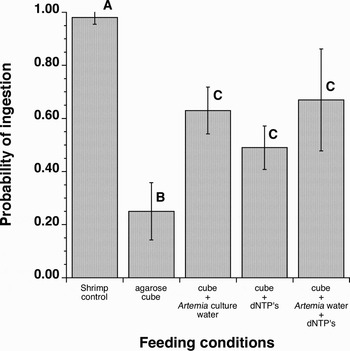
Polyps fed a live brine shrimp nauplius ingested it within 5 min in all but one trial, giving an ingestion frequency >95% (Figure 1). In contrast, the frequency of ingestion of an equivalent quantity of brine shrimp nauplii as a homogenate in a similarly-sized 1% agar block was only 20%. In the feeding treatments in which polyps were incubated in seawater with 5 µM dNTPs, seawater from Artemia salina culture, or both, the frequencies of ingestion were similar and approached 60%. Manipulation of seawater conditions significantly enhanced the frequency of ingestion of the artificial diet by polyps, but control treatment polyps ingested live brine shrimp at a significantly greater frequency.
Probability of ingestion of brine shrimp nauplius (control) or an agar (1%) cube impregnated with the homogenate of a single brine shrimp nauplius offered under different treatments. Columns sharing the same letters are not significantly different. Error bars represent standard errors of proportions for binomial data calculated as the square root of the quantity calculated from the product of the two probabilities, p and q, divided by the number of trials.

(ii) Gastrovascular transport
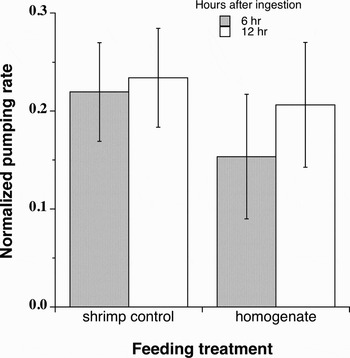
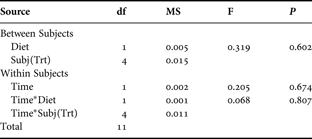
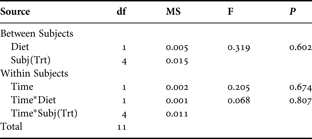
No significant difference was observed in normalized amplitudes of stolon oscillations between experimental and control feeding treatments (Table 1). Patterns of gastrovascular transport were similar between polyp–stolon systems in the two treatments at both 6 and 12 h following ingestion (Figure 2). Moreover, these normalized rates were similar between the two sampling times (Table 1).
Rates of gastrovascular transport (rate per minute normalized for variation in stolon size) of single polyp/stolon systems of Podocoryna carnea fed either a single newly hatched brine shrimp or an agar cube (1%) impregnated with a homogenate of an equivalent quantity of brine shrimp. Values represent average ±SE of N = 6.

Repeated measures analysis of variance summary of rates of vascular transport between colonies fed either a single newly hatched brine shrimp nauplius, or the equivalent homogenized and delivered in an agar cube.
(iii) Growth rates of stolons
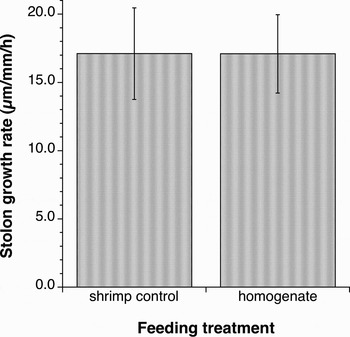
No significant difference was observed in the rates of stolon growth between control (brine shrimp nauplius) and experimental (brine shrimp homogenate) treatments (t = 0.003, df = 32, P = 0.49), all averaging 17 µm/mm/h in the day following ingestion (Figure 3).
Rates of stolon growth of single polyp/stolon systems of Podocoryna carnea fed either a single newly hatched brine shrimp or an agar cube (1%) impregnated with a homogenate of an equivalent quantity of brine shrimp. Values represent average ±SE of N = 6.

DISCUSSION
The results of this study indicate that an artificial diet of homogenized, de–shelled and gelled brine shrimp nauplii yields similar patterns of gastrovascular transport and stolon growth as a diet of live brine shrimp nauplii. However, the hydractiniids were significantly less likely to ingest the artificial diet blocks than live nauplii. These results bear on the potential use of experimental diets for physiological studies of hydrozoans.
The similar rates of growth and gastrovascular transport indicated no morphogenetic, nor physiological artefacts were associated with consumption of an experimentally generated diet during the first 24 hours. Experimental diets, therefore, may be useful to test the effects of specific compounds on morphogenesis and growth of hydrozoans. It would be possible to generate a dose-response curve for any signal chemical or metabolite that could be included in agar formulation. For instance, it has been suggested that glucose has an important role in colony development (Blackstone, Reference Blackstone2003). Optimizing the protocol for an artificial diet that could systematically vary concentrations of glucose and other metabolites suspected of influencing development could provide direct tests of these hypotheses. Moreover, effects of two compounds could be tested simultaneously by systematically varying their concentration in a factorial combination. Such experiments may provide insight into the physiological regulation of morphological plasticity of hydrozoan colonies.
The analysis to test for the presence of artefacts associated with experimental diets is complicated because it relies on negative evidence (i.e. expectation of similar outcomes in different experimental treatments). However, tests of no effect are not a problem when the power of the experiment to detect the alternative hypothesis is specified a priori. Treatments that reduced rates of gastrovascular transport and growth by 25% in 24 hours were taken to constitute significant experimental artefacts. The power of our experiment to detect significant artefacts associated with the brine shrimp-agar blocks was 0.70 and 0.90 for transport and growth rates, respectively. The power of the experiment dropped to 0.45 and 0.55 for transport and growth rates, respectively, at a resolution of 20% difference in effect between treatments. We inferred that the experimental power was sufficient to reject the null hypothesis. In other words, the experimental treatments did not cause artefacts with respect to growth and vascular transport at a resolution of ≥20% change). Nevertheless, there appears to be a trend towards lower rates of transport in the brine shrimp–agar (BSA) block treatment (Figure 2), suggesting that we may not be able to detect small differences (<20%), should such differences be biologically meaningful. It is important to point out in this context that future experiments using this protocol to test effects of specific compounds would likely be comparing two treatments using brine shrimp–agar blocks (e.g. a nutrient added to agar blocks in one treatment, but absent in the other). Thus, any (small) effect(s) of the BSA diet would cancel themselves out allowing the effects of the nutrient to be accurately determined.
The low frequency of ingestion of experimental diets in agar cubes is problematic for routine and efficient use in experiments. However, differences in ingestion frequency between different experimental feeding conditions suggest that ingestion frequency could be improved. Our data suggest that dissolved substances, exuded by actively swimming brine shrimp may serve as a cue to polyps for the presence of food. The frequency of ingestion of brine shrimp homogenate in agar cubes was ~60–70% when the polyps were immersed in seawater in which brine shrimp nauplii were recently (within 30 min) cultured, compared to 20% ingestion in unmanipulated seawater. The frequency of ingestion of brine shrimp homogenate agar cubes was similar whether they were served in seawater from brine shrimp culture or in seawater plus a mixture of dNTP (5 µM). Moreover, there was no added effect on ingestion of serving agar cubes impregnated with 5 µM dNTPs in seawater from brine shrimp cultures, suggesting that polyps may cue on the presence of dNTPs released from actively swimming brine shrimp nauplii. Our results are similar to previous work that showed low concentrations of dCDP elicited a feeding response in Podocoryna carnea (D. Lambert, unpublished data).
Our results using P. carnea differ from those obtained using Hydra littoralis (Lenhoff, Reference Lenhoff1961) and another study using P. carnea (Doolen et al., Reference Doolen, Geddes and Blackstone2007). First, glutathione, which is known to elicit the feeding reflex in Hydra (up to 5 µM; Lenhoff, Reference Lenhoff1961), did not elicit such a response in our trials using P. carnea using similar concentrations, but Doolen et al. (Reference Doolen, Geddes and Blackstone2007) observed the feeding response at concentrations exceeding 65 µM. The end of the glutathione response in Hydra is endogenously controlled rather than oxidation, disappearance or alteration of the glutathione molecule (Lenhoff, Reference Lenhoff1961), and evidence suggests a role for arachidonic acid as an endogenous signal (Pierobon et al., 2003). In P. carnea, 5 µM dNTPs increased the frequency of ingestion of artificial foods compared to treatments lacking them, but the 60% ingestion frequency was lower than one would expect from an effective elicitor of a feeding reflex. The ingestion response of P. carnea also was sensitive to whether the seawater in which they were fed contained brine shrimp within the previous 30 minutes. Further experiments systematically comparing seawater ages after brine shrimp removal are required to establish whether the molecules in seawater that elicit feeding reflexes are short-lived, and if other factors (exo- or endogenous) control the feeding reflex of P. carnea.
In summary, the use of experimental diets that manipulate the concentrations of one or more molecules show potential as a means to manipulate physiological state and assay the effects on the growth and morphology of hydrozoan colonies. The frequency of ingestion of experimental foods is too low for reliable use in experiments at present, requiring many additional replicates for a sufficient sample size. The technique would benefit from future studies aimed at increasing the frequency of ingestion of experimental foods and streamlining the production of experimental foods. Although experimental foods are ingested too infrequently at present, there are no apparent artefacts associated with such products and rates of growth and vascular transport in experimental colonies are equivalent to that of controls fed an equivalent quantity of live brine shrimp.
ACKNOWLEDGEMENTS
We thank Neil Blackstone, Diane Bridge, Hans Bode, Leo Buss, Paulyn Cartwright, Daniel Martinez, and Rob Steele for discussions over the years about the role of metabolism in hydroid morphogenesis. This manuscript was improved by comments provided by Neil Blackstone and an anonymous referee for which we are grateful. This research was supported by a grant from the National Institute of Health GMS-MBRS-SCORE programme (NIH –5SO6GM48680) to S.R. Dudgeon. This is contribution no. 125 from the CSUN Marine Biology Group.