I THE ‘CURRENCY INSCRIPTION’ FROM APHRODISIAS
The 1970 excavations at Aphrodisias brought to light a number of inscribed fragments that were identified as belonging to regulations issued by the emperor Diocletian in a.d. 301 concerning currency revaluation. This inscription — more accurately, a dossier of documents — is usually referred to as the ‘Currency Inscription’ or the ‘Currency Edict’. It is assumed that these regulations were issued on or shortly before 1 September 301, probably before the Price Edict, but this is not certain.Footnote 1 It is also assumed that the regulations fixed the value of coins, doubling the face value of the argenteus in silver and the nummus in bronze, although their relationship to the Price Edict and their impact on imperial finances and the economy still remain unclear.Footnote 2
Kenan Erim, Joyce Reynolds and Michael Crawford published the newly discovered fragments in 1971.Footnote 3 They also recognized that two already known fragments, wrongly attributed to the Price Edict, were in fact part of this dossier.Footnote 4 In 1989, Joyce Reynolds revised this edition and added further fragments, offering the so far most complete text of the Currency Regulations.Footnote 5 Her edition (abbreviated as ALA 230) is based on twenty-four fragments; some of them join, producing sixteen passages (numbered a–q). Only two of them are of a substantial length (a: 24 lines; e: 10 lines). The fragments apparently belong to two blocks that stood one above the other. Reynolds mentions the existence of an undetermined number of other fragments containing a few letters only.Footnote 6 During a symposium held at the British Museum on 7 June 1991, further fragments were presented and discussed but they remain unpublished.Footnote 7
II THE NEW FRAGMENT
On 9 August 2014 Benjamin Russell, a member of the Aphrodisias excavation team working in the area of the so-called ‘South Agora’, noticed an inscribed fragment of a marble block in a pile of stones north of the west portico of the South Agora. It immediately became clear that this fragment belongs to the dossier concerning the currency revaluation. We studied the fragment in August 2014, and decided to proceed with its publication without any delay, in order to make it known to other scholars working on this subject. The aim of this article is to present the edition of this isolated but quite important fragment, not to discuss any of the problems related to Diocletian's currency revaluation.
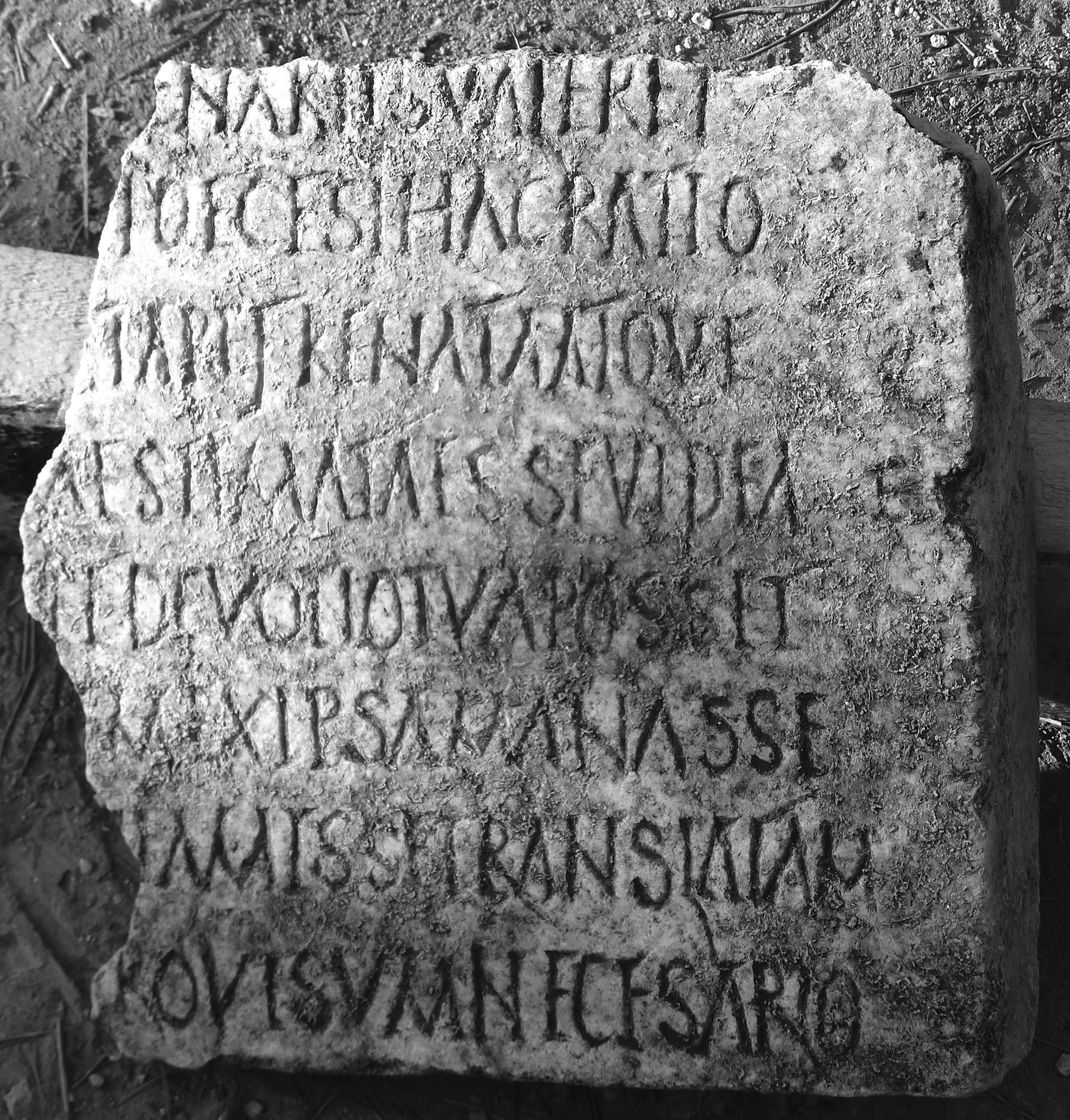
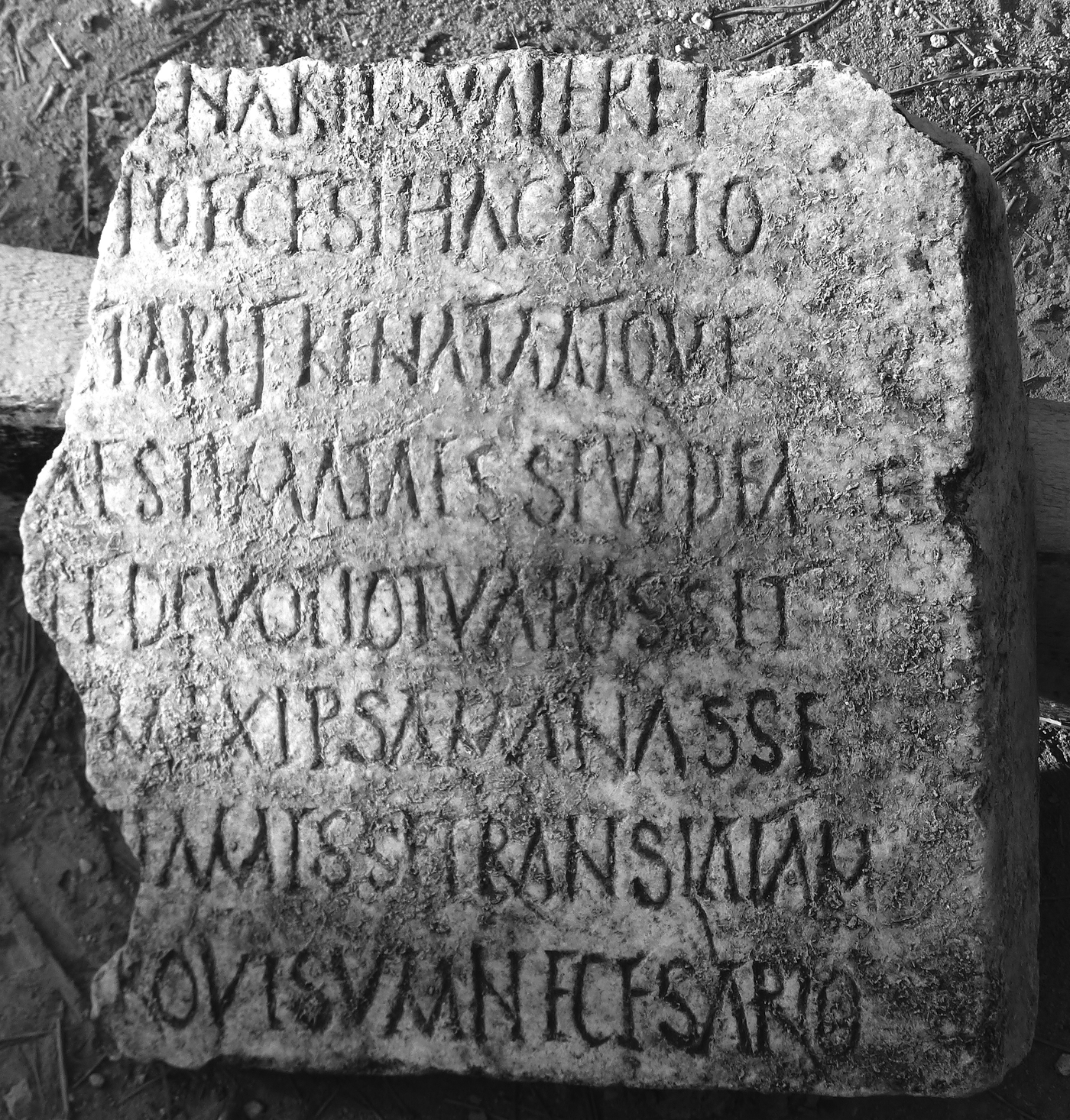
Description: Fragment of a marble block broken on top, left and back. Height 26.5 cm, width 25.5 cm, depth (preserved) 7.5 cm, size of letters 2–3 cm (Fig. 1).
Photo of the new inscription fragment from Aphrodisias.
3. initio, probably the lower edge of a C.
4. in fine, a small E, presumably a mason's mark indicating the position of the block on the wall.
7. initio, the upper end of a vertical line (H, I, or N, without excluding another letter).
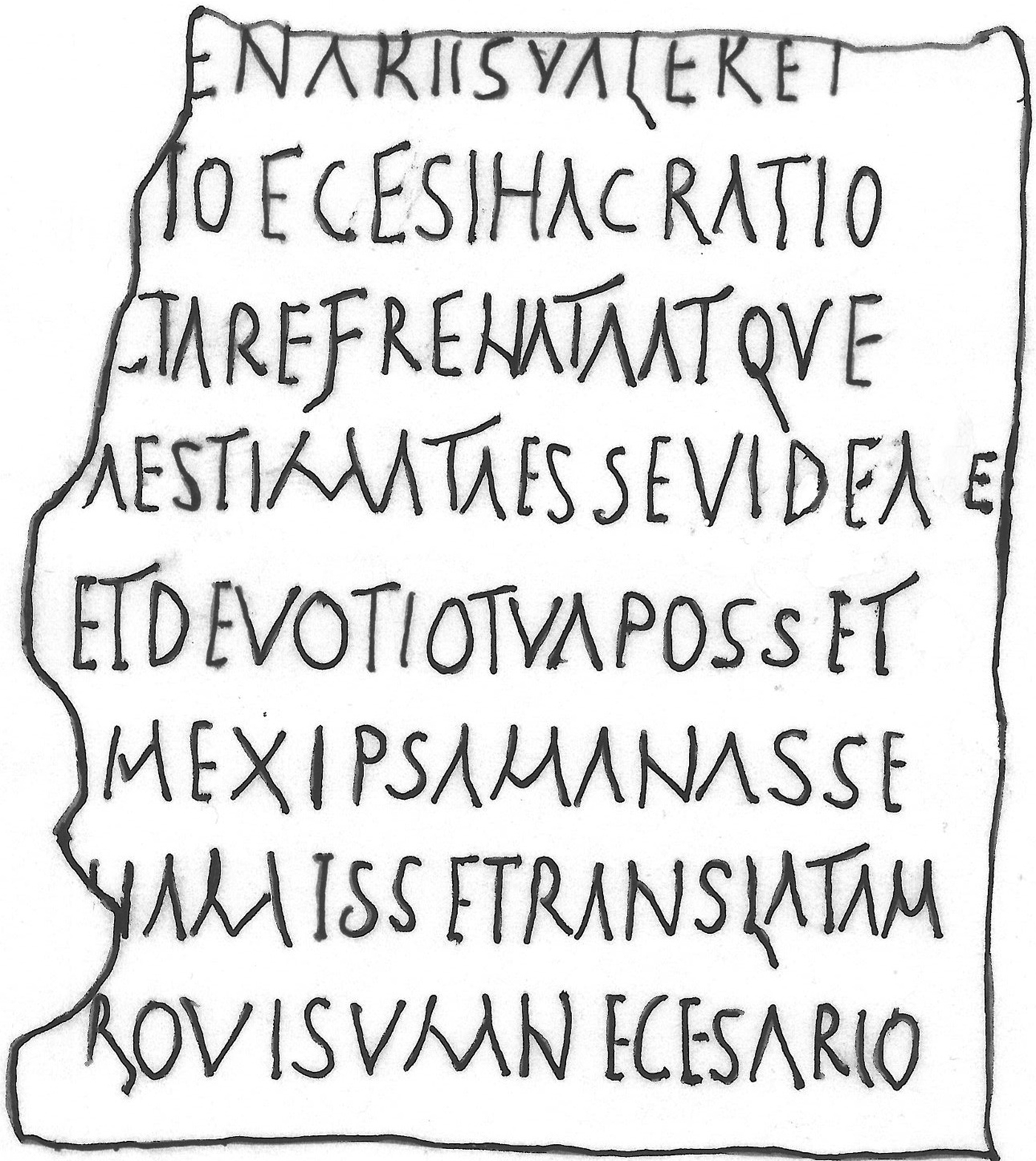
Both content and palaeography leave no doubt that this fragment is part of the dossier concerning the currency revaluation. The preserved letters share the features described by Reynolds in ALA 230: A is without a cross-bar; F has an upwards-slanting top horizontal and a backwards-trailing line at the base of its vertical; L descends sharply below the base line (Fig. 2).Footnote 8 One also notices a correspondence between the vocabulary used in this fragment and that in ALA 230: l. 1: denariis (cf. ALA 230 a.9, e.1–2); l. 1 valeret (cf. ALA 230 e.7); l. 4: aestimata (cf. ALA 230 b.4, c.4); l. 8: provisum (cf. ALA 230 e.8: provisionem).
Drawing of the new inscription fragment from Aphrodisias.

Although the new fragment does not join any of the published fragments, its position within the dossier can be determined. The dossier was inscribed, together with the Price Edict, on blocks of the north wall of the civic basilica, at the top of the left-hand pilaster of its façade.Footnote 9 It is plausibly assumed that the documents were inscribed on two blocks placed one above the other.Footnote 10 Fortunately, we already had both the beginning and the end of the dossier.
III THE UPPER BLOCK OF THE ‘CURRENCY INSCRIPTION’
The beginning of the dossier is preserved in a fragment from the upper left corner of the upper block; this fragment in part joins and in part can be associated with further fragments (ALA 230 a), which contain the titulature of the tetrarchs, followed by a very fragmentary imperial edict (ALA 230 a.1–19). The edict fixed a new tariff concerning the enigmatic bicharacta (‘twice-stamped’; l. 8).Footnote 11 Fragment a also contains a phrase which implies that a letter was addressed to a rationalis (l. 15: aḍ [r]ationạ[lem]; see below).Footnote 12
Imperial titulature reappears in l. 20 of this block (Idem Im[p]p. Augg., followed after a gap with sua benevolentia),Footnote 13 and this has plausibly been taken as an indication that the edict ended in l. 19 and that a second document, either a second edict or a letter started in l. 20.Footnote 14 Several of the published fragments preserve an edge at the bottom (ALA 230 b–d), and they must therefore belong to the lower part of this upper block, though none of them preserves a corner.
IV THE LOWER BLOCK OF THE ‘CURRENCY INSCRIPTION’
The lower block is almost completely preserved (ALA 230 e). Uninscribed space at the bottom suggests that this was the end of the dossier. The phrase scire te coṃ[ven]ịṭ (ALA 230 e.3) shows that the lower block contained a letter,Footnote 15 which must have started in the lower part of the upper block. The letter prescribed that the debts incurred after 1 September 301 could be paid in the pre-existing currency with a doubled face-value, while those incurred before this date with currency still at the old face-value.Footnote 16 This certainly relates to the doubling of the value of the argenteus and the nummus.
V THE POSITION OF THE NEW FRAGMENT
The new fragment preserves the bottom right corner of a block. It must therefore be the bottom right corner of the upper block — there is no reason to assume that the dossier required three blocks.Footnote 17 At least part of the document written in the new fragment is a letter, as we can infer from the reference to a recipient of the text (l. 5: devotio tua). As Michael Crawford has suggested (per litt.), it seems that the letter begins in l. 2, where a reference to the diocese is preserved. Consequently, the second edict must have ended somewhere early in l. 2. If this reconstruction is correct, the new fragment preserves the last lines of the upper block; its text must have continued directly into the lower block.
This raises a problem. The first, badly preserved line of the lower block (ALA 230 e) begins with the letters COṢ[- - c. 17 - -]. As Reynolds observed,Footnote 18COS probably does not stand for consul, which in this document is abbreviated as CONS. Reynolds assumed that COS is the end of a word that began in the last line of the upper block (e.g. [fis]coṣ [- -], [fis]co Ṣ[- -], [publi]|co ṣ[- -], [publi]|coṣ [- -]). Since we have the last word of the upper block (necesario), this assumption must be rejected. There are various possibilities: (a) the third letter, which is very badly preserved, is not an S (we could not confirm this through autopsy); (b) in this passage, COS is the abbreviation for consulibus; (c) we have a word starting with cos- for cons-.
VI A RECONSTRUCTION OF THE UPPER BLOCK
Since the new fragment preserves part of the bottom edge of the upper block, it can be associated with fragments ALA 230 b–d, which also preserve parts of the same bottom edge. In that case, Fragment b contains the two last lines of the edict (b.1–2) and the first lines of the letter (b.3–9). The recognizable fragments of words (b.3: placu[it], placu[erunt], or placui[sse]; b.5: [f]orma or [n]orma; b.6: possibly a form of origo or [di]rigi n[- -]; b.7: a form of praecipio, praeceptor or praeceptrix)Footnote 19 can be reconciled with this assumption:
The five lines in Fragment c correspond to lines 4–8 of the new fragment, and the four lines of Fragment d correspond to lines 5–8. The sequence of these fragments, which do not join, cannot be determined. We do not attempt a reconstruction, without knowledge of the unpublished fragments, but simply mention the possibility that fragment ALA 230 c may be from the left side of the block, missing only a few letters at the beginning. If this is the case, Fragment c and the new fragment would give the following text, with c. 35–40 letters missing between the two fragments:
7. credị[tum was suggested by an anonymous reader.
VII CONCLUSIONS
With regard to the content of the dossier the new fragment cannot contribute to questions concerning the currency regulations and their relation to the Price Edict. Only the reference to the dioecesis in line 2 of the new fragment provides a hint as to the recipient of the letter. The addressee must have been a high official in the dioecesis of Asia, probably the rationalis who represented the public treasury in the diocese.Footnote 20 However, the fact that the position of the new fragment can be determined, providing the right bottom edge of the upper block, may contribute to the reconstruction of the upper block.