Introduction
Depression is a common disorder in late life. Distribution of gender and age in the occurrence of depression varies among studies depending on the sample studied, measurement and methods used. Symptom scale-based studies of depression show an increasing rate of depression with age, and significantly higher prevalence in the oldest old (Stordal et al., Reference Stordal, Bjartveit Krüger, Dahl, Krüger, Mykletun and Dahl2001; Bergdahl et al., Reference Bergdahl2005). The Hospital Anxiety and Depression Scale (HADS) and Center for Epidemiologic Studies Depression Scale (CES-D) are symptom scales that are often used (Stordal et al., Reference Stordal, Bjartveit Krüger, Dahl, Krüger, Mykletun and Dahl2001; Heikkinen and Kauppinen, Reference Heikkinen and Kauppinen2004; van't Veer-Tazelaar et al., Reference van't Veer-Tazelaar2008). At the same time, epidemiological studies based on structured interviews with standard diagnostic criteria show a continuously decreasing prevalence of major depressive disorder (MDD) with age (Scott et al., Reference Scott2008; Kessler et al., Reference Kessler, Birnbaum, Bromet, Hwang, Sampson and Shahly2010). Different manifestation of depression with age has been suggested as a possible explanation for this contrast between symptom scale-based studies and studies using diagnostic interviews (Newmann et al., Reference Newmann, Klein, Jensen and Essex1996; Jorm, Reference Jorm2000).
Studies focusing on temporal trends of depression have shown cohort effects in prevalence of depression. The results vary, but the main conclusion is an increasing incidence and prevalence of depression in more recent birth cohorts (Wickramaratne et al., Reference Wickramaratne, Weissmann, Leaf and Holford1989; Klerman and Weissmann, Reference Klerman and Weissmann1989; Lewinsohn et al., Reference Lewinsohn, Rohde, Seeley and Fischer1993). Specifically, there appears to be an increase in risk of depression among birth cohorts who came to maturity after World War II (Wickramaratne et al., Reference Wickramaratne, Weissmann, Leaf and Holford1989). Most of these studies have used diagnostic interviews (Wickramaratne et al., Reference Wickramaratne, Weissmann, Leaf and Holford1989; Lewinson et al., Reference Lewinsohn, Rohde, Seeley and Fischer1993).
Depression has consequences for well-being, daily function, onset and prognosis of physical illnesses such as cardiovascular disease, and mortality, and is associated with high economic burden (Wells et al., Reference Wells1989; Penninx et al., Reference Penninx, Geerlings, Deeg, van Eijk, van Tilburg and Beekman1999; Bremmer et al., Reference Bremmer, Hoogendijk, Deeg, Schoevers, Schalk and Beekman2006; Luppa et al., Reference Luppa, Heinrich, Angermeyer, König and Riedel-Heller2007). This makes diagnosing and treatment of depression important, particularly since the treatment of depression in late life has shown good results (Schulberg et al., Reference Schulberg, Katon, Simon, Rush and 1998). Despite this, depression often goes undiagnosed (Birrer and Vemuri, Reference Birrer and Vemuri2004) and untreated (Cole et al., Reference Cole, Bellavance and Mansour1999).
With the elderly population growing worldwide, depression is becoming an increasing health problem. Knowledge about the developmental trends of depressive symptomatology is important to increase the detection and thereby the treatment of this illness. The Nord-Trøndelag Health Survey (HUNT) is a general health survey conducted in the Norwegian county of Nord-Trøndelag. The survey has been administered three times with an 11-year interval, and the last two surveys included the Hospital Anxiety and Depression Scale (HADS), which makes it possible to study depressive symptomatology in a longitudinal perspective, and to investigate the cohort-effect – i.e. the development trends of depressive symptomatology in age cohorts during an 11-year period.
The central aim of this study was to examine the development of depression in five-year age-cohorts of elderly in the general population in a longitudinal perspective. Specifically, we sought to study, over an 11-year period:
(1) the development of prevalence of depression in age cohorts;
(2) new cases of depression;
(3) the chronicity of depression; and
(4) recovery from depression.
Methods
Study population
The Nord-Trøndelag Health Survey (HUNT) is a general health survey conducted in Nord-Trøndelag County. The survey has been administrated three times: 1984–86 (HUNT 1), 1995–97 (HUNT 2) and 2006–08 (HUNT 3) (HUNT Research Centre, 2008). Nord-Trøndelag is one of 19 counties in Norway and it is located in the middle of the country at a latitude of 64 degrees north. The county contains about 3% of Norway's population, a population which is stable with a net migration of 0.3% per year, and is mostly living rurally or in small towns (Holmen et al., Reference Holmen2003). Between 1995 and 1997 everyone aged 20 years and over in Nord-Trøndelag was sent a mailed invitation to participate in this general health survey, which also included an appointment for a health examination (HUNT 2). With the invitation they also received the first questionnaire to fill out and bring to the examination. The first questionnaire included the questions from HADS. When attending the health examination they received a second questionnaire to fill out and return by mail. The same procedure was repeated in 2006–08 (HUNT 3), but this time the questions from HADS were included in the second questionnaire. A total of 94,187 individuals were eligible for HUNT 2 and 94,123 individuals for HUNT 3 (Norwegian University of Science and Technology (NTNU), HUNT Research Centre; see www.hunt.ntnu.no).
As this study focuses on development of depression in elderly people, we selected the individuals aged between 45 and 80 years at HUNT 2. To examine the development of depression we wanted to include individuals who had been re-tested for depression, and therefore included the participants with a valid rating on the depression subscale of HADS (HADS-D) at both HUNT 2 (baseline) and HUNT 3 (follow-up). Individuals missing a valid HADS-D rating at either HUNT 2 or HUNT 3 were excluded. The included individuals had an estimated age between 56 and 90 years at follow-up, and were divided into 5-year age-cohorts based on their age at HUNT 2. A valid rating of HADS-D was defined as five of more completed items on HADS-D. For those who had filled in five or six items, the completed sum was multiplied with 7/5 or 7/6 respectively.
Measures
The Hospital Anxiety and Depression Scale (HADS) is a self-rating instrument for anxiety and depression. It has been extensively tested and has well-established psychometric properties among the elderly (Mykletun et al., Reference Mykletun, Stordal and Dahl2001). HADS consists of 14 items, seven for anxiety (HADS-A) and seven for depression (HADS-D). HADS-D focuses mainly on the feelings of reduced pleasure (anhedonia) in depression. The questions concerning depression are “still enjoy the things I used to enjoy,” “can laugh and see the funny side of things,” “feel cheerful,” “feel as if I am slowed down,” “lost interest in my appearance,” “look forward with enjoyment to things” and “can enjoy a good book or radio or TV program.” Somatic symptoms common in anxiety and depression disorder are excluded from HADS to avoid false positive in somatic contexts (Herrmann, Reference Herrmann1997). The questions are formulated in a readily understandable language, and in this study were placed in the questionnaire with other questions concerning social aspects and physical health. At HUNT 2 the HADS items were in the first questionnaire, while at HUNT 3 they were placed in the second questionnaire. HADS-depression is defined by a cut-off score of >8 on HADS-D. This cut-off score has shown a sensitivity and specificity of 0.80 in relation to DSM-IV diagnoses based on structured interviews (Bjelland et al., Reference Bjelland, Dahl, Haug and Neckelmann2002).
Statistics
SPSS version 18 was used throughout. Prevalence of depression was estimated in the different age cohorts at HUNT 2 and HUNT 3, and 95% confidence intervals were calculated for the changes from HUNT 2 to HUNT 3. New cases were calculated for the different age cohorts, i.e. the proportion of participants in each age cohort who went from not depressed at HUNT 2 to depressed at HUNT 3. The proportion of participants in each age cohort who were depressed at both measure points (chronicity of depression) were also calculated, and the same with the proportion who converted from depressed to not depressed from HUNT 2 to HUNT 3 (recovery from depression). Recovery and chronicity were also calculated for the group of participants depressed at baseline in each age cohort. The 95% confidence intervals were calculated for new cases, recovery from depression and chronicity of depression.
Ethics
Both the HUNT study and this study were approved by the Board of Research Ethics in Health Region IV in Norway. All participants in the HUNT study gave informed consent.
Results
Sample characteristics
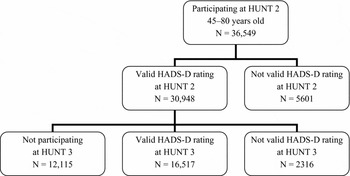
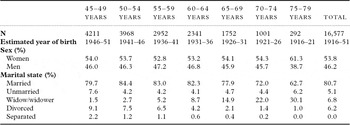
Overall, HUNT 2 and HUNT 3 had a participation rate of 69% and 54% respectively (HUNT Research Centre, see www.hunt.ntnu.no). There were 36,459 participants aged between 45 and 80 years who participated in HUNT 2, and 30,948 with a valid rating on the HADS-D subscale. Of these, 16,517 (53%) participants also had a valid HADS-D rating at HUNT 3 and were included in our study (Figure 1). The number of individuals in each age cohort decreases with age, with 4211 individuals in the youngest age cohort and 292 in the oldest age cohort. Overall, there was a small majority of female participants (53.8%), and this difference is more marked in the oldest age cohort with 61.3% females. Most of the participants were married (total 80.7%), with the smallest proportion of married participants being in the oldest age cohort (63.7%). Table 1 summarizes the sample characteristics.
Selection of individuals.

Sample characteristics by age cohort

Prevalence of depression
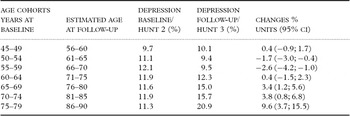
Table 2 shows the prevalence of depression at both measure points. The greatest increase in prevalence was found in the oldest age cohort with an increase from 11.3% at HUNT 2 to 20.9% at HUNT 3. The age cohorts 65–69 years and 70–74 years (estimated age 76–80 and 81–85 years at HUNT 3) also show a significant increase in prevalence of depression from HUNT 2 to HUNT 3, from 11.6% to 15.0% and from 11.9% to 15.7% respectively.
Prevalence and changes in prevalence of depression

In two of the younger age cohorts there is a small, but significant decrease in prevalence of depression from HUNT 2 to HUNT 3. The age cohort 50–54 years (estimated age 61–65 years at HUNT 3) decreased from 11.1% to 9.4%, and the age cohort 55–59 years (estimated age 66–70 years at HUNT 3) from 12.1% to 9.5%. The youngest age cohort and the age cohort 60–64 years (estimated age 71–75 years at HUNT 3) have no significant changes in prevalence of depression.
New cases of depression
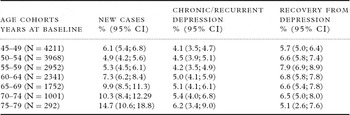
New cases are shown in Table 3. Generally there is an increase in new cases of depression with increasing age. In the oldest age cohort, 14.7% of the participants developed depression from HUNT 2 to HUNT 3, while in the age cohorts 65–69 years and 70–74 years (estimated age 76–80 and 81–85 years at HUNT 3) there were respectively 9.9% and 10.3% new cases. In the four youngest age cohorts, the proportion of participants who developed depression ranged from 4.9% to 7.3%.
Development of depression

New cases: the proportion of the participants developing a depression from baseline to follow-up.
Chronic/recurrent depression: the proportion of the participants who reported depression at both baseline and follow-up.
Remission: the proportion of the participant who reported depression at baseline and not at follow-up.
Chronic/recurrent depression
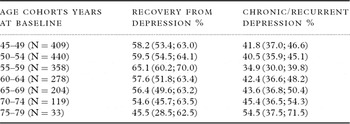
About 5% (4.1% to 6.2%) of the participants in each age cohort reported depression at both measure points, and there were small differences between the different age cohorts (Table 3). Looking at those depressed at baseline (HUNT 2) more than 40% in all age cohorts except one (55–59 years) reported depression at follow-up (Table 4). In the oldest age cohort, 54.4% of the depressed individuals at baseline reported depression at follow-up.
Remission and chronicity among the depressed individuals at baseline

Remission: the proportion of the depressed individuals at baseline who was not depressed at follow-up.
Chronic/recurrent depression: the proportion of the depressed individuals at baseline who also reported depression at follow-up.
Recovery from depression
The greatest proportion of participants who converted from depressed at HUNT 2 to not depressed at HUNT 3 (7.9%) was in the age cohort 55–59 years (estimated age at HUNT 3 was 66–70 years) (Table 3). For the other age cohorts there seems to be a decrease in recovery from depression with increasing age. In the oldest age cohort, 5.1% of the participants reported recovery. In the group of participants reporting depression at baseline, 50% to 60% showed recovery at follow-up, except the oldest age cohort where 45.5% recovered and the age cohort 55–59 years where 65.1% recovered (Table 4).
Discussion
Development of depression
One of the main findings in this study is an increasing prevalence of depression with age, and, when comparing different age-cohorts, we found a significant increase in prevalence at follow-up in all age cohorts aged 76 years or above. There are multiple cross-sectional studies showing an increase of depressive symptoms in late life (Stordal et al., Reference Stordal, Bjartveit Krüger, Dahl, Krüger, Mykletun and Dahl2001; Bergdahl et al., Reference Bergdahl2005; van't Veer-Tazelaar et al., Reference van't Veer-Tazelaar2008). There are, however, few studies looking at the prevalence of depression in a longitudinal perspective in multiple cohorts of the elderly, although there are some studies following one birth cohort over time. The Göteborg study, for instance, followed one birth cohort over 15 years, and yielded an increase in prevalence from 5.6% at the age of 70 to 13.0% at the age of 85 (Pálsson et al., Reference Pálsson, Östling and Skoog2001). This study confirmed an increasing prevalence of depression with age, but found lower prevalence rates than our study, which could be explained by more conservative inclusion criteria with only depression fulfilling the criteria of DSM-III, whereas this study used HADS-defined depression. A study from Finland also showed an increasing prevalence of depression with age when studying one birth cohort over a 10-year period (Heikkinen et al., Reference Heikkinen and Kauppinen2004).
The greatest increase of depression was found in the oldest age cohort, which included individuals aged 75–79 years at baseline, and an estimated age of 86–90 years at follow-up, indicating a clear increase in depressive symptoms around the age of 80–90 years. This phenomenon of an increase in depressive symptoms in the oldest old is also shown in the Finnish study (Heikkinen et al., Reference Heikkinen and Kauppinen2004). However, our results could represent a cohort effect, meaning a higher risk of depression in this oldest birth cohort. The oldest age cohort included individuals who were born in the early 1920s and came to maturity during the 1930s.
Another interesting finding is the decrease in depressive symptoms in the age cohorts of 50–54 years and 55–59 years (estimated age 61–65 years and 66–70 years at follow-up). The individuals in these age cohorts were born in the late 1930s and early 1940s, and came to maturity after World War II. This finding differs from earlier cohort studies showing a high incidence of depression in recent birth cohorts, specifically birth cohorts born and maturing after World War II (Klerman et al., Reference Klerman and Weissmann1989; Wickramaratne et al., Reference Wickramaratne, Weissmann, Leaf and Holford1989; Lewinsohn et al., Reference Lewinsohn, Rohde, Seeley and Fischer1993). These studies are not directly comparable with our study, because the individuals in these studies were studied at a younger age; furthermore, different measurements and instruments were used. An alternative explanation to a cohort effect could be that the decrease in depressive symptoms in these age cohorts represent an age effect, with a decrease in depressive symptoms around the age 55–65 years.
New cases
Another aim of this study was to investigate new cases of depression in a longitudinal perspective in different age cohorts. It appears that new cases of depression increase with age, with more than 10% of new cases occurring in the two oldest age cohorts. These results are in line with the Göteborg study, which showed an increasing incidence of depression with increasing age, more specifically an increase from 17 to 44 per 1000 person-years between the ages of 70–79 and 79–85 (Pálsson et al., Reference Pálsson, Östling and Skoog2001).
Chronic/recurrent depression
Our study showed that about 5% of the individuals in each age cohort reported depression at both measure points, and that more than 40% of the depressed individuals at baseline in all age cohorts except one (55–59 years) also reported depression at follow-up. As there are 11 years between the measure points, it is not known if this is due to a chronic or recurrent depression, but nevertheless it represents some kind of chronicity and a poor prognosis. Previous studies of outcome of depression in late life have also shown a poor prognosis with a long duration of depressive episodes (median 18 months) (Licht-Strunk et al., Reference Licht-Strunk, van Marwijk, Hoekstra, Twisk, de Haan and Beekman2009), a chronic course in about one of three depressed elderly patients, and a recurrence of depression in about one third of the depressed elderly (Beekman et al., Reference Beekman2002; Licht-Strunk et al., Reference Licht-Strunk, van der Windt, van Marwijk, Haan and Beekman2007). These studies show a poorer prognosis than our results, but the results are not directly compatible because of different study designs. Our study was carried out in a general population, and most likely in a relatively healthy part of the population, whereas most other studies of outcomes have been carried out among depressed individuals (Beekman et al., Reference Beekman2002, Licht-Strunk et al., Reference Licht-Strunk, van der Windt, van Marwijk, Haan and Beekman2007). That means that more than 40% chronic or recurrent depression, and 54.4% chronic or recurrent depression in the oldest age cohort represents a poor prognosis. This emphasizes the importance of good treatment of depression to yield remission, and close monitoring after remission to prevent and identify recurrent depressive episodes.
Recovery from depression
Our study showed that the age cohort 55–59 years (66–70 years at follow-up) had the greatest proportion of individuals who converted from depressed to not depressed. However, there was a decrease in recovery from depression with increasing age. This confirms earlier findings of older patients having a higher risk of recurrent depressive episodes (Licht-Strunk et al., Reference Licht-Strunk, van der Windt, van Marwijk, Haan and Beekman2007).
Strength and limitations
This study has several strengths. First, the study design ensured that the same instrument was used for the same individuals on two occasions 11 years apart, making it possible to study the development of depression in a longitudinal design. The study also included a great number of elderly participants (N = 16,507). This allowed division of participants into five-year age cohorts, which allows us to study and analyze the different cohorts with great statistical power. The study covered seven age cohorts with participants aged from 66 to 90 years at follow-up, allowing us to compare the different cohorts. Previous cohort studies have mostly studied one or just a few cohorts (Pálsson et al., Reference Pálsson, Östling and Skoog2001; Heikkinen et al., Reference Heikkinen and Kauppinen2004).
The data in this study were collected in a general health survey, with the whole population in a county being invited. The questions concerning psychiatry were set among other health questions. The attitude in the population to the health survey was positive, and the survey has a great participant rate compared to other general health surveys in Europe (NTNU, HUNT Research Centre; see www.hunt.ntnu.no).
Finally, the instrument used to measure depression, HADS-D, is extensively validated among the elderly and has shown good psychometric properties.
One of the limitations of the study is the possible selection bias. Our study includes only individuals who were willing to be retested with HADS-D, who had valid HADS-D ratings at both HUNT 2 and HUNT 3. Some 53% of the participants with a valid HADS-D rating at HUNT 2 also had a valid rating at HUNT 3. Most of those who were missing valid HADS-D ratings at HUNT 3 did not participate at HUNT 3, which could be explained by the lower participation rate at HUNT 3 compared to HUNT 2. No non-participation study for HUNT 3 has been performed so there is no information about why some were unwilling to participate. There is, however, a non-participating study for HUNT 2, which had a lower participation rate than HUNT 1. One third of the elderly reported that they had regular follow-up with a doctor or at hospital, and therefore did not need to attend the health survey, and about 20% were immobilized by disease. A further 2.3% of the individuals aged 50 years and older did not participate because they had moved or died (Holmen et al., Reference Holmen2003).
Of the participants with valid HADS-D ratings at HUNT 2, 7.5% participated at HUNT 3, but did not have a valid HADS-D rating. At HUNT 2 the HADS items were placed in the first questionnaire which the participants received together with the invitation and returned at attendance to the screening site. By contrast, at HUNT 3 the HADS items were placed in the second questionnaire which was handed out at the screening site to be returned by mail, leading presumably to a lower response rate at the second questionnaire compared to the first, and fewer participants at HUNT 3 with valid HADS ratings compared to HUNT 2.
The included individuals are possibly a stable, healthy part of the general population. We do not know the depressive status of those who did not participate, but from another population study in Norway we know that those who do not participate in such general health studies have more mental problems than those who participate (Hansen et al., Reference Hansen, Jacobsen and Arnesen2001). If this is the case in our study, the prevalence estimates are too low, and this could explain some of the differences in prevalence rates compared to other studies which measure depressive symptoms among the oldest old (Bergdahl et al., Reference Bergdahl2005, van't Veer Tazelaar et al., Reference van't Veer-Tazelaar2008). As possible selection bias would be the same in all age cohorts, however, this should not influence the main results of our study as we compare the different cohorts.
Another limitation is the possible information bias. HADS covers some elements of depression, but not all. It focuses mainly on anhedonia – the loss of ability to experience pleasure. Anhedonia is considered by many researchers to be a core feature of depression (Snaith, Reference Snaith1993). Somatic symptoms are excluded, and false positives in somatic contexts are therefore avoided. But this also excludes an important aspect of depression. HADS is also a symptom-scale, and as our study does not include a structured interview, we do not get a categorized clinical diagnosis.
Our study shows a significant increase in the prevalence of depression in the age cohorts from 76 years and over, with a particular increase in depression in the cohort around 80–90 years old. The study is a description of the development of depression in the different age cohorts, and does not give a possible explanation of the findings. Further studies will examine possible explanations based on data from the HUNT study.
Conflict of interest
None.
Description of authors' roles
H. Solhaug designed the study and wrote the paper. E. Romuld assisted in writing the article. U. Romild was responsible for the statistical design of the study and for carrying out the statistical analysis. E. Stordal supervised the collection of data, the design of the study and the writing of the paper.
Acknowledgments
Nord-Trøndelag Health Study (the HUNT Study) is a collaboration between the HUNT Research Centre (Faculty of Medicine, Norwegian University of Science and Technology NTNU), Nord-Trøndelag County Council and the Norwegian Institute of Public Health. This study has received funding from Health Trust Nord-Trøndelag.