Diabetes mellitus currently ranks among the most serious health problems worldwide, affecting approximately 382 million people (IDF Diabetes Atlas, 2013). In Brazil, there are approximately 12 million people affected by diabetes mellitus (Brazilian Diabetes Society - Sociedade Brasileira de Diabetes, 2012). A study carried out in 2006 in the United States, estimated a prevalence of 1.82 cases of type 1 diabetes mellitus (T1DM) for each 1000 youths between the ages of 0 and 20 (SEARCH for Diabetes in Youth Study Group, 2006). In patients between the ages of 10 and 19 years, prevalence was found to be 2.8 for every 1000, and in children, less than one (0.79) for every 1000 children. This data indicates the paediatric age as the peak period for the start of T1DM, demonstrating the importance of studying the disease during an infancy and teenage context (Chiarelli, Giannini, & Mohn, Reference Chiarelli, Giannini and Mohn2004).
The consequences and impact of T1DM during adolescence has been subject of much research. Studies indicate that the typical age transitions interact with the requirements of the treatment for the disease. The adolescents that have to live with the limitations of their chronic condition (Oliveira & Gomes, Reference Oliveira, Gomes and Gomes1998) consider themselves different to other adolescents of the same age (Damião & Pinto, Reference Damião and Pinto2007) and generally demonstrate a greater level of risk behaviour than their healthy counterparts (Miauton, Narring, & Michaud, Reference Miauton, Narring and Michaud2003). In this adverse context, the support of the social network is indispensable to obtain compliance with the treatment and face the disease.
Research carried out in the context of adolescents with T1DM emphasize the importance of support from the family (Jaser & Grey, Reference Jaser and Grey2010; Mackey et al., Reference Mackey, Hilliard, Berger, Streisand, Chen and Holmes2011), health care staff and friends (Karloss, Arman, & Wikblad, Reference Karloss, Arman and Wikblad2008) for the adolescent's well-being and metabolic control. Social support has an impact on the treatment of the adolescent with diabetes, seeing that the more they feel support for them, the greater their level of adjustment will be, the lower the manifestation of depression will occur and they will experience a better quality of life (Elmaci, Reference Elmaci2006). Quality of life, for the most part, refers to the level of health perceived by the individual himself (García-Viniegras, Reference García-Viniegra2008). It is a multidimensional concept, which consists of four main aspects: physical, psychological, social and environmental. Studies that assume this overall definition generally include healthy persons in their sample universe and do not take into account the quality of life for people who have specific health problems (Seidl & Zannon, Reference Seidl and Zannon2004). To this end, the term quality of life relating to health was defined, referring to the aspects of a person’s life that are affected by the changes brought on by illness (Cleary, Wilson, & Fowler, Reference Cleary, Wilson, Fowler, Dimsdale and Baum1995).
With regards to health related quality of life in adolescents with T1DM, recent studies have shown that the degree of perceived health tends to decrease, as does metabolic control, with an increase in age (Gaspar & Matos, Reference Gaspar and Matos2008; Guedes, Astudillo, Morales, Vecino, & Júnior, Reference Guedes, Astudillo, Morales, Vecino and Júnior2010; Seiffge-Krenke, Laursen, Dickson, & Harlt, Reference Seiffge-Krenke, Laursen, Dickson and Harlt2013). As with age, gender is also referred as a determining factor for the quality of life of adolescents with diabetes, and usually boys perceive their state of health in a more positive way to girls (Grey, Boland, Yu, Sullivan-Bolyai, & Tamborlane, Reference Grey, Boland, Yu, Sullivan-Bolyai and Tamborlane1998). Variables such as the time since diagnosis and the number of hospitalizations, which are considered risk factors, may also influence the health-related quality of life (Heleno, Vizzotto, Mazzotti, Cressoni-Gomes, & Modesto, Reference Heleno, Vizzotto, Mazzotti, Cressoni-Gomes and Modesto2009; Liss et al., Reference Liss, Waller, Kennard, McIntire, Capra and Stephens1998).
During a review study, Novato and Grossi (Reference Novato and Grossi2011) identified six main factors that played a role in health related quality of life in adolescents with T1DM: socio-demographic factors, psychosocial aspects, T1DM treatment, family relationships, metabolic control and hyperglycemia. The author's findings also showed that health related quality of life is not controlled by biological factors alone and that patient treatment should encompass social, psychological and assistance aspects, among others. Understanding which aspects contribute towards the improvement of health related quality of life in adolescents with T1DM allows for the elaboration of support strategies for managing the disease. As such, the overall objective of this study was to test the hypothesis that the social support perception by adolescents with T1DM, largely explains health-related quality of life perception. Specific objectives were: (a) map health-related quality of life perception in adolescents with T1DM; (b) identify correlations between the different dimensions that make up health-related quality of life, including the gender and age-group variables; (c) map social support perception by adolescents with T1DM; (d) identify correlations between the dimensions that make up health-related quality of life and social support perception; and (e) investigate the relation between health-related quality of life and social support through linear regression analysis.
Method
Participants
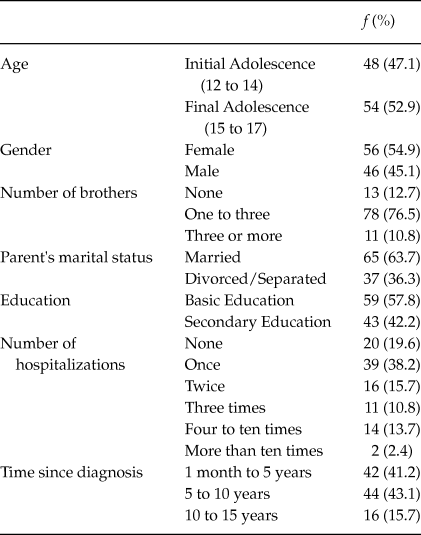
One hundred and two (102) adolescents with T1DM between the ages of 12 and 17 took part in this study (M = 14.44; SD = 1.63), of which 46 were boys (45.1%) and 56 were girls (54.9%). The participants were all patients at a specialized attending centre for children and adolescents with diabetes in Porto Alegre, in the south Brazil. To take part, an adolescent needed to be undergoing treatment for more than six months and not have any cognitive difficulties that could interfere with understanding the instruments. The sociodemographic characteristics of the participants can be seen in Table 1.
Sociodemographic Characteristics of the Participants

Procedures
The research project was approved by the Research Ethics Committee of the Federal University of Rio Grande do Sul. Guardians were requested to sign a free and informed consent form and adolescents were requested to sign a term of agreement. Instruments were applied individually in the waiting room used for routine appointments and took on average 20 minutes to conclude.
Instruments
Sociodemographic data form
To register data regarding family household, living arrangements, time since diagnosis, number of hospital admittances, education, among other things.
KIDSCREEN-52
A questionnaire developed in Europe (The KIDSCREEN Group Europe, 2006, validated for use in Brazil by Guedes & Guedes, Reference Guedes and Guedes2011) to evaluate health-related quality of life in children and adolescents. It consists of 10 dimensions (physical well-being, psychological well-being, moods and emotions, self-perception, autonomy, parent relations and home life, financial resources, peers and social support, school environment, bullying), which contain questions that should be answered on a Likert scale varying between 1 (no/never) and 5 (always/frequently). The instrument generates scores that vary between 0 and 100 for each dimension and as such, the higher the score, the better the assessment made by the adolescent regarding that aspect, except for the dimension “bullying”, in which the relationship is the opposite and the lower the scores, the higher the health-related quality of life. Studies have used the shorter version of the instrument, KIDSCREEN-10, to obtain total scores for health-related quality of life, which consists of 0 to 50 points. The shorter Portuguese version showed a good internal consistency reliability of .78.
Social Support Appraisals (SSA; Vaux et al., Reference Vaux, Philips, Holly, Thompson, Williams and Stewart1986)
The participant should rate statements relating to his/hers social support network ranging between “completely agree” and “completely disagree”. The scale divides social support into four factors: friends; family; teachers and others. The total score may vary between 30 and 180 in which the higher the score, the better the assessment made by the adolescent regarding his/hers support network. It is also possible to add points according to sub-scales. We used the Brazilian version of this instrument, which has shown a good internal consistency with a Cronbach’s Alpha of .74 (Squassoni & Matsukura, Reference Squassoni and Matsukura2014).
Data analysis
Initially, a descriptive analysis of the data was carried out to obtain a general profile of the sample. T-tests were carried out to compare health-related quality of life averages between groups and measure interaction according to gender, age and social support. To evaluate the correlation between the scores of the KIDSCREEN-52 and the Brazilian Version of Social Support Appraisals, Pearson's correlation coefficient (r) was used. Finally, a linear regression analysis was carried out to study the association between health-related quality of life and social support, taking into account gender and age in the regression model.
Results
Health related quality of life – KIDSCREEN
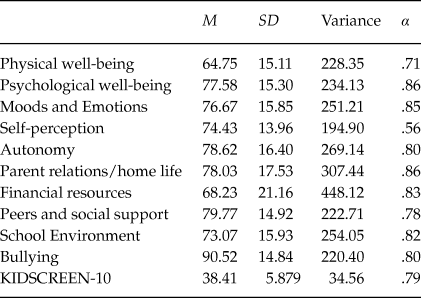
The instrument presented desirable psychometric characteristics for most of the KIDSCREEN-52 and KIDSCREEN-10 dimensions, as can be seen in Table 2, except for the self-perception dimension, which was not used in later analyses due to its unacceptable alpha value. The score obtained by adolescents with T1DM in each of the dimensions varied between M = 65.06 (SD = 11.98) and M = 90.52 (SD = 14.84), in which the lowest score obtained was for the physical well-being dimension and the highest was for bullying.
KIDSCREEN-52 Psychometric Data for each dimension and KIDSCREEN-10

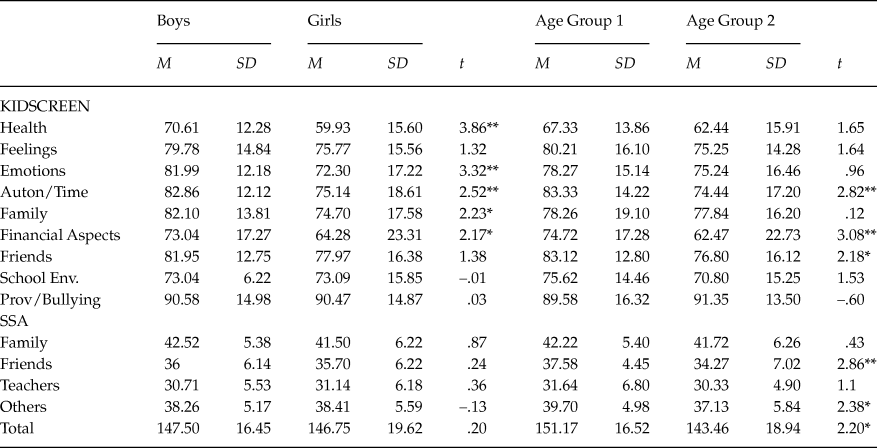
In gender and age group analyses (Table 3), significant differences between genders were observed for five of the KIDSCREEN dimensions, with lower averages for girls, although the highest scores for the physical well-being dimension were attributed to the boys. With regards to the age group, a significant difference was observed in the dimensions of autonomy, financial resources and peers and social support, with lower averages occurring in the 15 to 17 years age group. Analyses (t-tests) were also carried out taking time of diagnosis and the number of hospitalizations into account but no significant differences were verified.
Results of the Instruments by Gender and Age

Note: *p < .05; **p < .01.
Social Support Appraisals
The instrument presented a satisfactory internal consistency (α = .90), in which internal consistency for the sub-scales was .78 for family, .89 for friends, .73 for teachers and .70 for others. The general average for SSA was 148.05 (SD = 17.01), which varied between 108 and 180 points. For the sub-scales, the average scores were 41.96 (SD = 5.85) for family, 35.83 (SD = 6.16) for friends, 29.16 (SD = 4.15) for teachers and 38.34 (SD = 5.9) for others.
Table 3 also shows the total score and sub-scale score averages of the SSA (family, friends, teachers and others) according to gender and age group. The only significant difference observed was in age group, for the dimensions friends and others, and at the end of the SSA, in which younger adolescents obtained higher scores.
Correlations between variables
Within the sociodemographic characteristics studied, age and the number of hospitalizations showed significant negative correlations, although weak, with health-related quality of life dimensions. The age variable showed a negative correlation between the autonomy (r = –.20; p < .05); financial resources (r = –.19; p < .05) and peers and social support (r = –.23; p < .05) dimensions. The dimensions moods and emotions (r = –.26; p < .05); financial resources (r = –.28; p < .01) and school environment (r = –.22; p < .05) correlated with the number of hospitalizations.
Significant negative correlations were observed between age and the total SSA score (r = –.22; p < .05), the friends sub-scale (r = –.29; p < .01) and the others sub-scale (r = –.21; p < .05). Furthermore, a significant positive correlation was found to exist between the SSA results and KIDSCREEN-10 (r = .68; p < .01), which showed that the higher the perception of social support, the better the health-related quality of life; and between the social support and all KIDSCREEN-52 dimensions. The strongest correlations were verified between social support and the dimensions psychological well-being (r = .63; p < .01); peers and social support (r = .67; p < .01) and school environment (r = .64; p < .01).
Association between health-related quality of life and social support
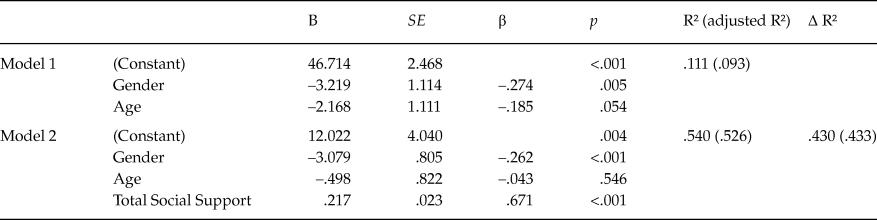
A linear regression analysis was carried out with health-related quality of life perception as the outcome variable. The first model tested included gender and age as independent variables (Table 4). Both independent variables of this model showed significant relationships with the outcome variable, which explained 9.3% of its variance (adjusted R²), with boys and younger adolescents having a better perception of health-related quality of life. In the second model tested, social support perception was added (Table 4). This model explained 52.6% of the variance (adjusted R²), therefore resulting in an increase (Δ R²) of 0.430 in relation to the previous model. In model 2, social support (β = 0.671) and gender (β = –0.262) showed significant associations to the outcome variable, indicating that boys and those with a greater perception of social support were associated with a greater perception of health-related quality of life.
Results of Linear Regression for Health-related Quality of Life

Discussion
This study allowed health-related quality of life and social support perception aspects of adolescents with T1DM to be studied, as well as the associations between these variables. With regards to health-related quality of life, the use of the KIDSCREEN-52 instrument, allows for an analysis of very specific aspects of how adolescents perceive themselves. The average score of the participants for the dimension physical well-being, which had the lowest average of all sub-scales, shows that these adolescents do not feel physically capable. The result may be related to the fact that these adolescents suffer from an endocrine disease, which involves a series of limitations, as has also been observed in overweight adolescents evaluated with the same instrument (Ottova, Erhart, Rajmil, Dettenborn-Betz, & Ravens-Sieberer, Reference Ottova, Erhart, Rajmil, Dettenborn-Betz and Ravens-Sieberer2012).
In the bullying dimension, participants obtained an average score of 90.52 (SD = 14.84), which shows that they do not feel provoked or rejected by their peers, contrary to what would be expected with adolescents that are different to their peers. The average score was higher than those of other studies (Guedes et al., Reference Guedes, Astudillo, Morales, Vecino and Júnior2010; Ottova et al., Reference Ottova, Erhart, Rajmil, Dettenborn-Betz and Ravens-Sieberer2012). Although provocative behaviour is related to the context and peculiarity of a group, characteristics such as satisfaction with life and the perception of school as a safe environment may be protective factors against bullying (Matos & Gonçalves, Reference Matos and Gonçalves2009).
The significant differences between genders, observed in the health-related quality of life dimension, were also observed in studies carried out with the same instrument on healthy Brazilian adolescents. Guedes et al. (Reference Guedes, Astudillo, Morales, Vecino and Júnior2010) studied a sample population of 588 adolescents between the ages of 12 and 17, and found that the averages in girls are lower in most of the dimensions. A study carried out with KIDSCREEN-52 in seven European countries also observed that adolescents of the female gender showed greater decrease in health-related quality of life than male gender adolescents (Bisegger, Cloetta, von Bisengger, Abel, & Ravens-Sieberer, Reference Bisegger, Cloetta, von Bisengger, Abel and Ravens-Sieberer2005).
Studies of health-related quality of life in adolescents that have analyzed the gender differences, in general, found that health-related quality of life perception in boys is greater than in girls, with this difference increasing considerably with age (Michel, Bisegger, Fuhr, & Abel, Reference Michel, Bisegger, Fuhr and Abel2009). One of the possibilities for explaining this difference is that, for girls, adolescence is marked by menarche, which carries with it important hormonal changes and the greater occurrence of stressing events (Patton & Viner, Reference Patton and Viner2007; Petersen, Sarigiani, & Kennedy, Reference Petersen, Sarigiani and Kennedy1991). Studies have also pointed to a greater preoccupation with well-being and a greater vulnerability to psychological suffering among women and female adolescents (Patton & Viner, Reference Patton and Viner2007).
With regards to age, it was observed that the scores for all KIDSCREEN-52 dimensions were lower among older adolescents, with the exception of bullying. Other KIDSCREEN-52 studies also identified a decrease in health-related quality of life as age increased. Gaspar and Matos (Reference Gaspar and Matos2008) and Guedes et al. (Reference Guedes, Astudillo, Morales, Vecino and Júnior2010) found significant differences when comparing age-group averages, in which younger adolescents presented higher averages for health-related quality of life in all dimensions, except for bullying.
The decrease in health-related quality of life, when observed in older adolescents, may be explained by various aspects of their development. Hormonal changes, which are characteristic of puberty, interfere with the effect of insulin and produce metabolic changes that can lead to acute complications, which imply being hospitalized, routine changes, not being able to practice sports, among other restrictions (Amiel, Sherwin, Simonson, Lauritano, & Tamborlane, Reference Amiel, Sherwin, Simonson, Lauritano and Tamborlane1986). Further to the typical transitions and changes during adolescence, patients with T1DM will also be required to take care of their disease, which was taken care of by their guardians during infancy. This new role may lead a decrease in health-related quality of life, in the measure that the patient becomes more autonomous and moves on from the care provided by others to self-care. The conquest of autonomy is an important developing task through which the adolescent remains linked to his/hers support network at the same time he/she reaches a certain degree of independence. Becoming independent is fundamental for the management of the disease (Spear & Kulbok, Reference Spear and Kulbok2004).
Although autonomy increases as the adolescent grows, for adolescents with T1DM there is a negative correlation between the autonomy dimension and the age variable. This shows that, even though autonomy is slowly being conquered, an adolescent with T1DM still regards him/herself as not very independent. This feeling may arise from overprotective factors (Fragoso, Araújo, Lima, Freitas, & Damasceno, Reference Fragoso, Araújo, Lima, Freitas and Damasceno2010), as parents and guardians are reluctant to allow greater independence and autonomy for fear of losing control over the treatment of their children (Oliveira & Gomes, Reference Oliveira, Gomes and Gomes1998). In a study with North American diabetic adolescents, it was noted that they perceive themselves as more capable and competent than their parents consider them to be, and this discrepancy is linked to the parent's reluctance in favouring their independence (Butner et al., Reference Butner, Berg, Osborn, Butler, Godri, Fortenberry and Wiebe2009).
The average scores obtained through the social support instrument are similar to those observed by Squassoni and Matsukura (Reference Squassoni and Matsukura2014), in a scale validation for the Brazilian population. The family remains the main source of support for adolescents, where they can feel safe and have experience regular human contact (Squassoni, Reference Squassoni2012). In the case of adolescents with T1DM, the family is still the main source of support, acting as a protective factor with regards to staying on track with the treatment, metabolic control and management of the disease (Grey, Boland, Yu, Sullivan-Bolyai, & Tamborlane, Reference Grey, Boland, Yu, Sullivan-Bolyai and Tamborlane1998; Mackey et al., Reference Mackey, Hilliard, Berger, Streisand, Chen and Holmes2011; Pereira, Berg-Cross, Almeida, & Machado, Reference Pereira, Berg-Cross, Almeida and Machado2008). Peers are also recognized as being an important source of support. In the case of adolescents with chronic disease, these may be friends with the same diagnosis, making it possible to share experiences (Willians, Gannon, & Soon, Reference Williams, Gannon and Soon2011), or healthy peers that make it possible for them to belong to groups with other characteristics (Kyngas, Reference Kyngas2004).
Support from teachers obtained the lowest averages from adolescents with T1DM, as well as in studies carried out with healthy Brazilian adolescents (Squassoni, Reference Squassoni2012; Squassoni & Matsukura, Reference Squassoni and Matsukura2014). Nonetheless, studies have revealed the direct influence of teachers on daily life and the treatment of adolescents, which shows to the importance of reinforced that particular network (Peters, Storch, Geffken, Heidgerken, & Silverstein, Reference Peters, Storch, Geffken, Heidgerken and Silverstein2008; Sato et al., Reference Sato, Berlin, Hains, Davies, Smothers, Clifford and Alemzadeh2008). Other significant correlations, although weaker, showed that the greater the number of hospitalizations, the less score was attributed by the adolescents to the dimensions of physical well-being, psychological well-being and financial resources. These results may indicate that, although not directly related to the perception of health-related quality of life in general, hospitalizations may be characterized as a risk factor in particular areas of these adolescents lives.
The need to overcome more adversities than those usually faced by healthy peers becomes apparent by the lower averages attributed by the adolescents with T1DM to the dimensions of psychological well-being and mood and emotions, relatively to the averages of healthy adolescents in a study carried out by Guedes et al. (Reference Guedes, Astudillo, Morales, Vecino and Júnior2010). During an evaluation of Swiss adolescents with and without chronic conditions, researchers found that those with chronic diseases usually have less good moods and experienced feelings of depression and despair more frequently (Miauton et al., Reference Miauton, Narring and Michaud2003). A Brazilian study of adolescents with T1DM showed that the requirements for treating the disease cause dissatisfaction, and lead to a lifestyle that is riddled with feelings of insecurity, fear, helplessness and anxiety (Almino, Queiroz, & Jorge, Reference Almino, Queiroz and Jorge2009).
The total scores for perceived social support showed moderate positive correlations with all health-related quality of life dimensions, thus confirming the results of previous studies that social support contributes toward emotional balance (Almino et al., Reference Almino, Queiroz and Jorge2009), increasing self-esteem (Kyngas, Reference Kyngas2004), well-being (Olsson, Boyce, Toumbourou, & Sawyer, Reference Olsson, Boyce, Tounbourou and Sawyer2005), social adaptation (Elmaci, Reference Elmaci2006), among other aspects that make up health perception.
With regards to the support provided by peers, the highest correlations were with school environment and autonomy. The importance of friendships and socializing with peers for social adaptation, acceptance and for the good of the adolescent's own health, has already been highlighted by other studies (Helgeson, Lopez, & Kamarck, Reference Helgeson, Lopez and Kamarck2009; Kingas, Reference Kyngas2004). The correlations found strengthen the notion that friends (who may be carriers, or not, of the disease) can provide empathy and support, promoting positive behaviour at or away from school (Olsson et al., Reference Olsson, Boyce, Tounbourou and Sawyer2005).
Support provided by family correlated in a positive way with the psychological well-being dimension, indicating the importance of this source of support has on positive perceptions and emotions experienced individually. The role of the family appears fundamentally linked to the satisfaction with life of the adolescent and reflects the way in which they experience positive feelings, such as joy and happiness.
The support of others was more closely linked to de dimension psychological well-being and with the rest of the dimensions in a less intense manner. It should be noted that the participants in this study count on the support of the multidisciplinary team at the institution where they are receiving treatment. Together with family and friends, the healthcare team contributes towards the psychological well-being, self-perception, the conquest of autonomy, perception of cognitive faculties, among other aspects (Kyngas, Reference Kyngas2007).
The moderate positive correlation between KIDSCREEN-10 and the total score of perceived social support, aside from other positive correlations observed, suggest that social support influences health-related quality of life perception. This influence became even more obvious after carrying out the linear regression analysis, whose results confirm the supposition that the support of the social network largely explains (43.3%) the variation in health-related quality of life perception.
The results obtained confirm the hypothesis that social support perceived by adolescents with T1DM that participated in this study, largely explains the health-related quality of life of these adolescents. The good health-related quality of life scores obtained for the sample are partly explained by the support network as a protective factor, thus minimizing the negative aspects of the disease. These results highlight the importance of strengthening the sources of social support (family, healthcare team, friends, school, etc.) as part of these patients' treatment.
With regards to the various sources of support, it was observed that family support was closely related to psychological well-being, the support of friends to school environment and the support of teachers to the perception of learning capabilities, autonomy, emotional state and psychological well-being. The importance of research and interventions directed at the strengthening of the different sources of support should be highlighted, seeing that each one seems to contribute in its own special way to the aspects that make up health-related quality of life. Of the four support sources studied, the role of the school deserves to be mentioned for future studies, because, although badly evaluated by the adolescents with T1DM, it was demonstrated that it has influence over various aspects of health-related quality of life.
This study may contribute towards a type of treatment of the diabetic patient that counts on a multidisciplinary team of healthcare professionals who are more attentive, not only to the health needs of the patients but also to various other aspects that promote health-related quality of life, such as psychological well-being, the promotion of autonomy and the strengthening of the support network. At the same time, the size of the sample used and the selection of participants due to convenience is highlighted as being an important limitation. Future studies with patients from other Brazilian contexts may provide a more accurate study of whether health-related quality of life in adolescents with T1DM is influenced by the care given by a specific healthcare team, or if the indices are in line with those of other Brazilian adolescents with T1DM.
As a follow up to this initial study on the influence of social support on aspects that make up health-related quality of life of Brazilian adolescents with T1DM, we suggest that the subject be further studied longitudinally. The influence of the age variable in the perception of social support and health-related quality of life shows a need to study the influence that time has on the two variables studied here, more thoroughly. Understanding how the variables behave during the development of the same individual will allow teams to develop strategies that cater to the specific needs of the patients during the different vital stages.