INTRODUCTION
Family caregivers are often crucial in caring for palliative care patients with life-threatening, incurable illnesses, whether the patients are cared for at home or in a formal healthcare setting (Candy et al., Reference Candy, Jones and Drake2011). Family caregivers can be defined as any relatives, friends, or partners involved in patient care (Hudson & Payne, Reference Hudson and Payne2009). They are often the primary source of social and emotional support and generally provide unpaid physical and practical care (Milberg et al., Reference Milberg, Strang and Jakobsson2004; Smith, Reference Smith and Payne2004). Life for family palliative caregivers is affected by substantial challenges associated with loss and approaching death (Carlander et al., Reference Carlander, Sahlberg-Blom and Hellstrom2011a ). These caregivers are subjected to stressful conditions (Hudson et al., Reference Hudson, Aranda and Kristjanson2004; Eggenberger & Nelms, Reference Eggenberger and Nelms2007; Grande et al., Reference Grande, Stajduhar and Aoun2009), with obvious and often overwhelming negative consequences affecting their physical and mental well-being (Wennman-Larsen & Tishelman, Reference Wennman-Larsen and Tishelman2002; Brazil et al., Reference Brazil, Bedard and Willison2003; Proot et al., Reference Proot, Abu-Saad and Crebolder2003; Hudson et al., Reference Hudson, Thomas and Trauer2011).
Many family palliative caregivers express mixed emotions about their caregiving role (Smith, Reference Smith and Payne2004), but they also appear to have positive experiences along with the burdens and negative feelings (Kang et al., Reference Kang, Shin and Choi2013). Existing research, which mostly emphasizes the burdens, does not do justice to the full experience of caring for someone with severe incurable illness. For some family caregivers, the new role and responsibilities positively affect their well-being, and they feel rewarded by being able to care for a family member (Whittingham et al., Reference Whittingham, Barnes and Gardiner2013). The rewards of caregiving include feelings of satisfaction, thankfulness, and pleasure (Stajduhar & Davies, Reference Stajduhar and Davies2005; Andershed, Reference Andershed2006) as well as personal enrichment, a sense of meaning, and increased insight and self-knowledge (Stajduhar, Reference Stajduhar2003; Oldham & Kristjanson, Reference Oldham and Kristjanson2004; Wolff et al., Reference Wolff, Dy and Frick2007).
Few studies have examined feelings of reward in family palliative caregiving, and most that do are retrospective studies of the experiences of bereaved family caregivers (Koop & Strang, Reference Koop and Strang2003; Mok et al., Reference Mok, Chan and Chan2003; Stajduhar, Reference Stajduhar2003; Hudson, Reference Hudson2004; Reference Hudson2006; Wong & Ussher, Reference Wong and Ussher2009; Wong et al., Reference Wong, Ussher and Perz2009). In contrast, a recent study found that family caregivers generally reported high levels of reward during ongoing palliative care. More specifically, their richest sources of reward were the feelings of being helpful and of giving the patient some happiness (Henriksson et al., Reference Henriksson, Årestedt and Benzein2013a ).
The feelings of being rewarded have been proposed as a resource that might influence and facilitate the way family caregivers handle the caregiving situation (Hudson, Reference Hudson2003). More greatly rewarded family caregivers may even experience fewer difficulties and negative consequences during and after caregiving (Stajduhar et al., Reference Stajduhar, Funk and Toye2010). It is therefore important to examine what might influence feelings of reward in family palliative caregivers and improve our understanding of what makes them feel rewarded.
In searching the relevant literature, we found one recent survey of bereaved family caregivers reporting that being older, being female, and having religious faith were associated with higher rewards, while being a spouse was associated with lower rewards, while caregiver depression or burden did not affect feelings of reward (Kang et al., Reference Kang, Shin and Choi2013). To the best of our knowledge, no study has sought to identify the factors associated with family palliative caregivers' feelings of reward while providing care. We therefore designed the present study to identify the factors influencing feelings of reward in family palliative caregivers.
METHODS
Design and Settings
The study had a correlational, cross-sectional design and was carried out in four settings. Three settings were specialist palliative care units providing advanced home and inpatient care for severely ill patients. Most patients in these settings had an advanced cancer diagnosis with a life expectancy of approximately three months. The fourth setting was a hematology unit providing home care and inpatient care for patients with malignant hematological diseases and brain tumors at different stages. All four settings were staffed by multi-professional teams comprising physicians, nurses, physiotherapists, occupational therapists, and social workers that delivered 24-hour services.
Participants and Procedure
The data analyzed in the present study were acquired from a quasi-experimental study of an intervention for family caregivers of patients in the four study settings (Henriksson et al., Reference Henriksson, Carlander and Årestedt2013b ). The intervention was a psycho-educational group program aimed at increasing caregiver preparedness and to support the well-being of family caregivers. Healthcare staff approached potential participants consecutively. The inclusion criteria were: being less than 18 years old, ability to understand Swedish, and being identified as a family caregiver by a patient receiving specialized palliative care. Participants received written and verbal information about the study, and 125 family caregivers gave their written informed consent to participate. The staff distributed a questionnaire, including baseline assessments, to participants, who returned it by post to the first author after completion. Data were collected from January to December of 2009, and baseline data from an intervention group and a comparison group were employed for the present study. Ethics approval was obtained from the regional ethical review board in Stockholm (2008/341).
Measurements
The questionnaire included demographic background questions and self-rated instruments. The Rewards of Caregiving Scale (RCS) consists of three subscales and measures caregiver rewards in terms of learning, “being there,” and enhanced sense of meaning (Archbold & Stewart, Reference Archbold and Stewart1996). The present study utilized an abbreviated version of the scale, comprising 10 items, in which the learning subscale was excluded due to its focus on caregivers for the elderly (Hudson & Hayman-White, Reference Hudson and Hayman-White2006). A total score was calculated by summing the responses to all items, with a higher score indicating a greater feeling of reward. The abbreviated RCS has shown good validity and reliability among caregivers of patients in palliative care. We used a validated Swedish version of the scale (Henriksson et al., Reference Henriksson, Andershed and Benzein2012).
The Preparedness for Caregiving Scale (PCS), which assesses caregivers' perceived readiness to provide care (Archbold et al., Reference Archbold, Stewart and Greenlick1990), consists of eight items, and a total score is calculated by summing the responses to all items, with a higher score indicating a greater feeling of preparedness. The scale has shown good validity and reliability among caregivers of patients in palliative care (Hudson & Hayman-White, Reference Hudson and Hayman-White2006). Once again, a validated Swedish version of the scale was employed for the present study (see Henriksson et al., Reference Henriksson, Andershed and Benzein2012).
The Herth Hope Index (HHI) (Herth, Reference Herth1992) measures hope using 12 items. A total score is calculated by summing the responses to all items, with a higher score indicating higher hope. We utilized a validated Swedish version of the instrument (Benzein & Berg, Reference Benzein and Berg2003).
The Health Index (HI) (Nordstrom et al., Reference Nordstrom, Nyman and Theorell1992; Forsberg & Bjorvell, Reference Forsberg and Bjorvell1993; Langius et al., Reference Langius, Bjorvell and Lind1993) consists of 10 items related to energy, temper, fatigue, loneliness, vertigo, sleep, pain, bowel function, mobility, and general health. A total score is calculated by summing the responses to all items, with a higher score indicating better perceived health. Again, we used a validated Swedish version of this instrument (Forsberg & Bjorvell, Reference Forsberg and Bjorvell1993).
The Hospital Anxiety and Depression Scale (HADS) (Zigmond & Snaith, Reference Zigmond and Snaith1983) is intended to detect the presence and severity of symptoms of anxiety and depression. It includes two subscales, one for anxiety (HADS–A) and another for depression (HADS–D), each comprising seven items. A total score can be calculated for each subscale, with higher scores indicating more severe symptoms of anxiety or depression. The original scale and a Swedish version (Lisspers et al., Reference Lisspers, Nygren and Soderman1997) have shown good validity and reliability, both in a general population sample and in samples of family members of patients in palliative care (Gough & Hudson, Reference Gough and Hudson2009).
DATA ANALYSIS
Descriptive statistics were employed to describe the study variables and participants' characteristics. Bivariate correlation analyses were conducted in step 1 to identify factors associated with rewards. These variables were: feelings of preparedness, hope, health, anxiety and depression symptoms, social support, age, sex, spousal relationship (with the patient), and cohabitation with the patient, all with reference to the caregiver, as well as illness duration and place of care. In step 2, all independent variables were entered in a multiple regression model (forced entry) to reveal the complexity of associations. Because of anxiety and depression symptoms, spousal relationship, and cohabiting were strongly correlated, and depression and cohabiting were omitted. The sample size was somewhat limited for a model including 10 independent variables, so a final regression model (step 3) was employed that included significant independent variables from the correlation (step 1) and regression analyses (step 2). A post-hoc analysis showed that the statistical power of the final regression model was 0.88. The level of statistical significance was set at p < 0.05. All analyses were conducted using Stata 13.0 (StataCorp, College Station, Texas).
RESULTS
Participant Characteristics
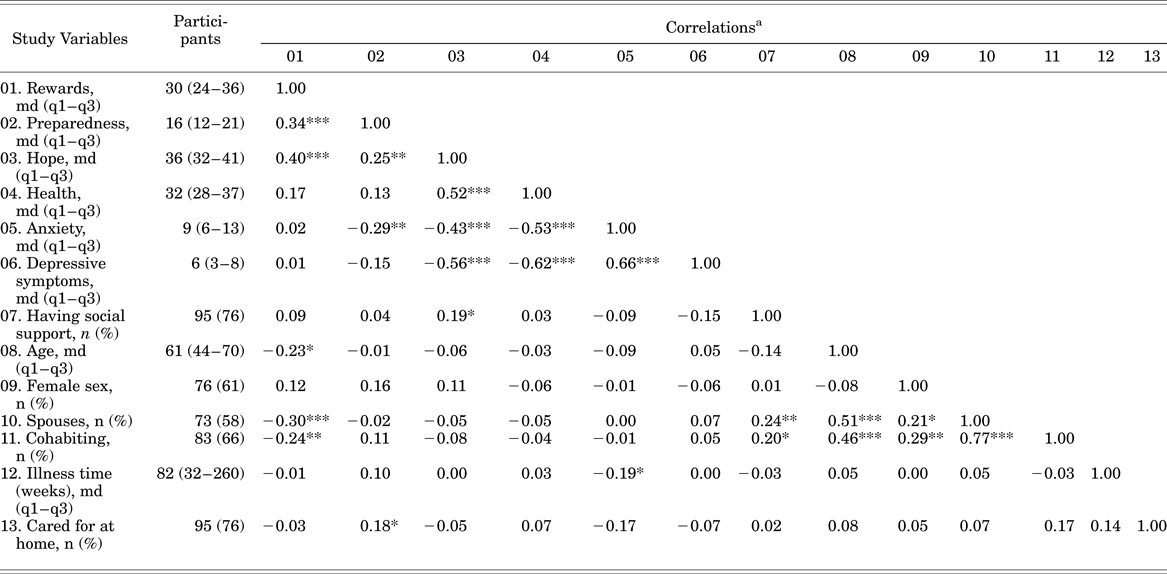
The characteristics of the sample are presented in Table 1. The final sample consisted of 125 participants, and complete data on all variables were available for 92 of them. The median age of family caregivers was 61 years. Most family caregivers were women (60%), had sufficient perceived social support (76%), were in a spousal relationship (58%) and/or cohabited with the patient (66%), and cared for the patient in her or his own home (76%) (Table 1).
Characteristics of the participants and correlations between study variables

aThe correlations (pairwise selection) are based on Spearman's rho or phi coefficients when appropriate.
*p < 0.05; **p < 0.01; ***p < 0.001.
Factors Associated with Rewards of Caregiving
The bivariate associations (step 1) between the independent variables and the rewards of caregiving during ongoing palliative care are presented in Table 1. Caregivers with higher levels of preparedness for caregiving and more hope also experienced significantly higher levels of reward. Being older, being in a spousal relationship, and/or cohabiting with the patient were associated with significantly less reward.
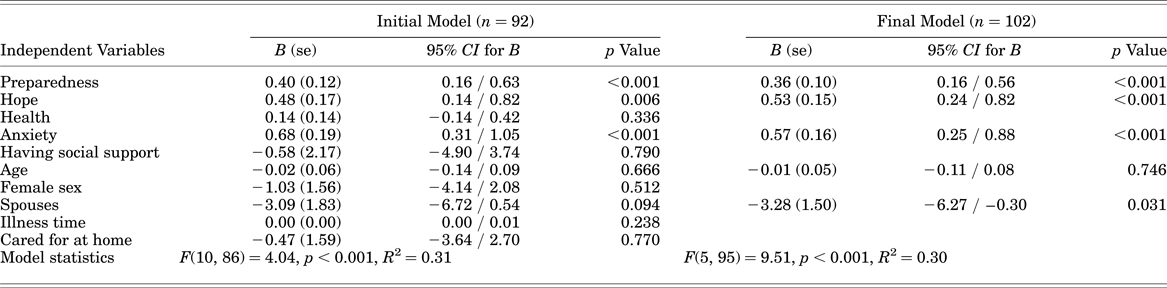
In the initial multivariate regression model (step 2), higher levels of preparedness for caregiving and hope were associated with higher levels of the reward of caregiving. Contrary to the bivariate correlation analysis, anxiety was significantly associated with lower levels of reward among family caregivers. Neither age nor being in a spousal relationship with the patient was significantly associated with feeling rewarded. The initial model explained 31% of the total variance in perceived rewards of caregiving (Table 2).
Factors associated with rewards of caregiving

The regression analyses were based on robust variance estimates.
In the final multivariate regression model (step 3), higher levels of preparedness for caregiving and hope were associated with the rewards of caregiving. Anxiety was associated with lower levels of reward, as was being in a spousal relationship with the patient. No relationship between age and reward was identified in the multivariate analysis. The final model explained 30% of the total variance in rewards of caregiving (see Table 2).
Anxiety as a Suppressor Variable
The contradictory relationship between reward and anxiety in the bivariate and multivariate analyses raised the question of whether anxiety might suppress the other independent variables (Pandey & Elliot, Reference Pandey and Elliot2010). Therefore, we conducted a nested analysis based on the final regression model. In the first block, reward was the dependent variable and preparedness, hope, age, and spousal relationship the independent variables. In the second block, anxiety was added to the model. The findings showed that adding anxiety improved the model significantly (F[1] = 12.78, p < 0.001), increased the R 2 value from 0.22 to 0.30 (ΔR 2 = 0.08), and increased all regression coefficients of the independent variables (preparedness ΔB = 0.07, hope ΔB = 0.22, age ΔB = 0.05, and spousal relationship ΔB = 0.25).
DISCUSSION
To the best of our knowledge, this is the first study to assess factors associated with caregiving rewards among family caregivers during ongoing palliative care. We found that the more prepared caregivers with higher levels of hope felt more rewarded, while caregivers with higher levels of anxiety and those in a spousal relationship with the patient felt less rewarded by caregiving. It should be recognized, however, that no strong conclusions can be drawn about the causal direction between the identified factors and the rewards of caregiving. Nonetheless, the results contribute to an understanding of feelings of reward in family palliative caregiving.
Preparedness for caregiving was significantly associated with rewards both in the bivariate correlation analysis (step 1) and in the initial (step 2) and final (step 3) regression analyses. Importantly, preparedness seemed to play an essential role in how family caregivers experienced their situation. Comprehensive methodological work has confirmed that preparedness is a powerful factor in protecting caregiver well-being (Archbold et al., Reference Archbold, Stewart and Greenlick1990; Schumacher et al., Reference Schumacher, Stewart and Archbold1998). Higher preparedness has been found to be associated with greater feelings of hope, less anxiety (Henriksson & Årestedt, Reference Henriksson and Årestedt2013), lower levels of caregiver strain (Archbold et al., Reference Archbold, Stewart and Greenlick1990), and other negative caregiver outcomes (Schumacher et al., Reference Schumacher, Stewart and Archbold2008). Associations between preparedness and rewards have also been identified in previous studies (Shyu et al., Reference Shyu, Yang and Huang2010; Henriksson & Årestedt, Reference Henriksson and Årestedt2013). Better prepared family caregivers may have a greater sense of being in control, of knowing what to expect, and of doing things properly and in the best way, and therefore also feel more rewarded (Henriksson & Årestedt, Reference Henriksson and Årestedt2013). This is supported by a previous conceptual model of caregiver support (Hudson, Reference Hudson2003) in which feelings of preparedness and reward are described as resources that could influence how family caregivers handle the caregiving situation.
According to the results of the multivariate analysis (steps 1 and 2), family caregivers with higher levels of anxiety felt less rewarded by their caregiving situation. Considering that anxiety may diminish the ability to appreciate potential positive aspects, this finding seems reasonable. Family caregivers often experience anxiety (Hudson et al., Reference Hudson, Thomas and Trauer2011), and our results suggest that this is a factor that significantly influences the palliative caregiver's experiences of reward. In the bivariate correlation analysis (step 1), however, anxiety was not associated with rewards. This contradictory relationship raised the question of whether anxiety affected the associations among the other independent variables and rewards (Pandey & Elliot, Reference Pandey and Elliot2010). Experiences of anxiety apparently have the potential to increase the associations between preparedness, hope, age, and spousal relationship, and feelings of reward. However, this finding cannot explain why anxiety was not associated with rewards in the bivariate analyses. Further research is needed to explore this complex relationship.
We found that hope was associated with feelings of reward. This was somewhat expected, since hope can be an effective coping strategy that may be associated with better caregiver outcomes (Mechanic, Reference Mechanic and Coelho1974). Hope may also be linked to optimism (Rand, Reference Rand2009), which could partially explain some caregivers' feelings of reward, that is, family caregivers who remain optimistic may interpret their caregiving experience less negatively (Given et al., Reference Given, Stommel and Given1993). The importance of hope in palliative care has been described elsewhere (Benzein et al., Reference Benzein, Norberg and Saveman2001), and it is said to help caregivers find meaning in their task (Milberg et al., Reference Milberg, Strang and Carlsson2003). Perhaps hope helps to balance the varied experiences of caregiving and allows family caregivers to hold conflicting expectations simultaneously: preparing for the worst while maintaining hope that the patient will recover (Folkman, Reference Folkman2010).
Our finding that hope is associated with family caregivers' feelings of reward could both complement and be understood in light of previous findings that hope is associated with a sense of burden (Utne et al., Reference Utne, Miaskowski and Paul2013) and with physical and psychosocial well-being (Duggleby et al., Reference Duggleby, Holtslander and Kylma2010).
Some evidence regarding family caregivers of patients with Alzheimer's disease suggests that feelings of reward can buffer the negative consequences of caregiving. Caregivers who feel rewarded are less likely to report depression, burden, and poor health (Cohen et al., Reference Cohen, Colantonio and Vernich2002). Positive and negative consequences can likely exist independent of each other (Caserta et al., Reference Caserta, Lund and Utz2009; Carlander et al., Reference Carlander, Ternestedt and Sahlberg-Blom2011b ; Kang et al., Reference Kang, Shin and Choi2013), and family caregivers can find both meaning and emotional reward in the context of the physical and emotional burdens of caregiving (Hebert et al., Reference Hebert, Dang and Schulz2006).
We found contradictory results regarding an association between being in a spousal relationship with the patient and rewards. This association was not identified in the initial regression model, which indicates that the association might be moderated or mediated by other factors. Such factors might include caregiving intensity, time spent caregiving, and experienced caregiver burden. Usually, one person, most often a spouse cohabiting with the patient, assumes the predominant caregiving role and is supported in this by an extended family network (Hudson et al., Reference Hudson, Remedios and Thomas2010). The overall responsibility of caregiving in a stressful situation might well influence feelings of reward.
METHODOLOGICAL CONSIDERATIONS
This study had a cross-sectional design, which limits the ability to determine causal relationships between the variables and the rewards of caregiving. Prospective studies are therefore needed in order to achieve a better understanding of this complex situation. Another limitation is the somewhat small sample size, particularly for the initial regression model (step 2). We had only 92 participants for 10 independent variables, whereas the general rule of thumb for such a model suggests an appropriate sample size of 10 individuals for each independent variable (Wilson van Voorhis & Morgan, Reference Wilson van Voorhis and Morgan2007). However, limited sample size is a minor consideration for the final regression model (step 3), which included five independent variables in a sample of 102 individuals. In addition, the post-hoc analysis showed that our final model had a statistical power greater than 0.80. The total amount of missing data was low, indicating accuracy in the scores.
CONCLUSION AND IMPLICATIONS
Feeling rewarded may be an important aspect of the ongoing experience of being a family palliative caregiver in a multifaceted and complex situation. Such covariate factors as preparedness, anxiety, hope, and being in a spousal relationship with the patient influence the experience and feelings of reward. Considering the significance of feeling rewarded in caregiving, support in clinical practice should aim to facilitate the positive aspects of caregiving, focusing on caregiver strengths and resources.