Background
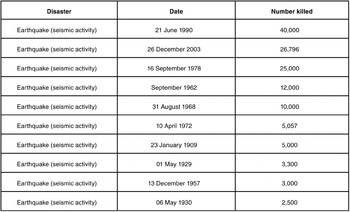
Asia accounts for >90% of the world's affected population and 50% of both the world's death toll and economic losses that are related to natural hazards.Reference Tschoegl, Below and Guha-Sapir1 Iran is located in an area that is exposed to a wide range of natural and human-made hazards. According to EM-DAT, 181 disasters were recorded in Iran from 1900–2007, which caused 155,811 deaths and 68,217 injuries, and affected 44,037,516 people.Reference Cred2 In terms of mortality, earthquakes, droughts, and floods are the most serious events in terms of economic damage, and people “affected”.Reference Ardalan, Khankeh and Masoumi3 Being exposed to more than 34 out of 41 types of known disasters caused by natural hazards, Iran has one of the longest histories in dealing with the challenges such hazards pose (Appendix).Reference Ghanefar4
On 26 December 2003, an earthquake registering approximately 6.5 on the Richter scale hit the city of Bam in the Kerman Province of Iran, destroying approximately 90% of the houses and 60% of the public buildings, including two hospitals. More than 50,000 were injured, including more than 27,000 persons that were killed.5 Communities and governments have a responsibility to the citizens to prepare for and effectively respond to disasters.Reference Darcy6 The human-related consequences of disasters and their impact on health service delivery bring health to the top of the agenda in disaster management.7
The efficiency of the health disaster management responses during disasters depends on the degree to which the problems are anticipated and recognized, and also on the extent to which the necessary resources are readily available.7 The findings of previous studies indicate that lack of resources is the most important obstacle to the delivery of effective healthcare services during disasters.Reference Akbari, Farshad and Asadi-Lari8–Reference Phillips14 These conflicting results may be due to methodological inadequacies and caution should be exercised when drawing conclusions.
Despite a growing body of literature about disasters caused by natural hazards in Iran, inadequate attention has been paid to the experiences and perceptions of healthcare workers and affected citizens. Consequently, the phenomenon of health disaster management in Iran has not been adequately studied, and it was decided to explore the capabilities of Iranian health disaster management more in-depth.Reference Ghanefar4,Reference Akbari, Farshad and Asadi-Lari8–Reference Nateghi-Alahi and Izadkhah10 It is understood that stakeholders' perceptions are important for quality improvement of healthcare services. Accordingly, the purpose of this study was to explore the experiences and perceptions of healthcare providers and affected citizens regarding how successful the management of healthcare services was at the time of the 2003 Bam earthquake.
Methods
This study utilized grounded theory, a qualitative research method for examining the social processes at work in human interaction. Grounded theory method is useful when a new area is to be discovered or if one desires to explore a known area from a fresh perspective.Reference Strauss and Corbin15,Reference Streubert and Carpenter16
Study Participants
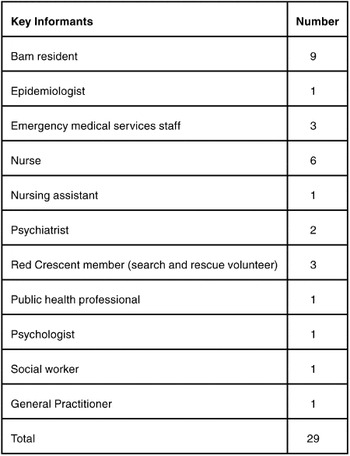
The most important eligibility criteria for participating in this study were: (1) experiences of providing or receiving health services during disasters; (2) having professional knowledge about the area; or (3) being affected from the earthquake as a Bam resident and wanting to share one's experiences. All study participants were involved in the Bam earthquake as a healthcare provider, healthcare manager, expert, and/or Bam resident affected by disaster. The senior author of this study, who is experienced in the field of health services and disaster management in Iran, contacted eligible key persons to inquire into their willingness to participate as a study subject. Study participants first selected were experienced persons who were involved in healthcare services in Bam (primary sample). A secondary sample of Bam residents was selected, followed by theoretical sampling of key persons whose experience was considered typical. Sampling was performed according to the instructions suggested by Strauss and Corbin.Reference Strauss and Corbin15 Study participants consisted of 29 individuals with multidisciplinary backgrounds from different organizations. Ages of the participants ranged from 30 to 65 years, with an average age of 38 years, and education range from three-year intermediate school to higher education in the field of medicine (Table 1). Sampling continued until theoretical saturation, and further data collection and analysis failed to contribute new information. Data saturation supported the sample size.
Participants involved in the Bam earthquake and included in the study

Data Generation Techniques
Data collection included: semi-structured interviews, narrative (letters written by Bam residents), and observational field notes regarding the process of providing health care in the affected area made during the first 15 days after the Bam earthquake and eight months later. Data were collected over a period of three years between December 2003 and September 2007.
The interviewer invited participants to tell their stories based on their personal experiences. The main themes in the interview guide for study participants included: (1) major barriers to providing effective health care; (2) role of management and organization; and (3) interactions and communication within and between healthcare provider groups, local authorities, disaster victims, and involved organizations. Interviews began with simple, general questions, gradually progressing to more specific and directed questions. Probing was performed according to the reflections offered by each respondent, but sought to cover themes such as, “How was the relationship between and within the different health care provider groups?” Interviews required 45 to 60 minutes.
Data Processing
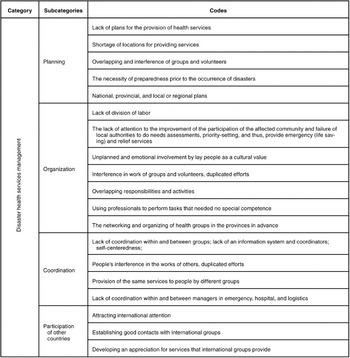
All interviews were recorded, transcribed verbatim, and approved by the participants before being analyzed according to recommendations by Strauss and Corbin.Reference Strauss and Corbin15 In order to ensure accuracy, participants checked their transcripts (member check) and comments were made. These primary results (concepts) were checked by the participants in order to improve validity. Data collection and data processing occurred simultaneously in order to constantly compare, identify, and pursue emerging phenomena. Accordingly, every interview was preliminarily analyzed in order to identify ideas that guided the next interview. During the phase of open coding, the principal investigator read all interviews thoroughly several times and selected incidents, facts, keywords, or phrases in the text as invivo codes. As the analysis progressed, the researcher grouped conceptually related codes into categories and elaborated the properties and dimensions for each category. The codes and data were compared for points of similarity and differences. Categories and sub-categories were developed based on these results. The subcategories and important codes for the disaster health services management are in Table 1.
During the axial-coding process, the relationships between all previous codes and categories were explored, and the connections between all data were considered further and collapsed to reach a data synthesis that revealed a narrative of key concepts. After axial coding at the end of the selective coding phase, a core variable was identified, which was observed in all data. Researchers recorded all activities, and trustworthiness was demonstrated when the study participants and experts in the field of qualitative research agreed with the interpretation of the findings. Thus, member check, peer check, and expert check were used. Moreover, data validation was performed through constant comparison analysis, which means returning to the data in order to verify and develop the categories further. These techniques enhanced the rigor of the study by decreasing threats to validity.Reference Streubert and Carpenter16
Ethical Considerations
The study was approved by the Ethics and Review Board at the Iran University of Medical Sciences—Nursing and Midwifery Faculty. Study participants were assured that their participation would be confidential. Information about the study was provided orally and in writing to the participants, which included coverage of the aims of the study. Study participants signed informed consent to participate in the study, including permission to be interviewed and recorded. Study participants also were informed that they could refuse participation or withdraw from the interview at any time they wished.
Results
This study indicates that: (1) lack of planning; (2) inadequate organizational management of resources; (3) insufficient coordination in the provision of health services during disasters; and (4) international relief efforts were important barriers to the provision of adequate disaster healthcare services during the 2003 Bam Iranian earthquake (Table 2).
Disaster health services management

The code is a meaning unit, used to retrieve and organize the data. Codes are key phrases and terms, and coding is a process to select incidents, facts, key words or phrases in the text. Codes are compared for points of similarity and difference and assigned to clusters. Based on this clustering, categories and subcategories are developed.
Lack of Planning
The major planning issues identified were: (1) the lack of planning for the provision of health services; (2) the shortage of locations providing services; and (3) the overlapping and interference of groups and volunteers. Study participants believed that disaster response planning is a necessary, but complicated process and that the onset of disaster is not the ideal time to begin planning.
“…If another earthquake occurs, I am greatly afraid that a lack of preparedness planning will prevail again, unless there is a directive as to where my place is. And what should I do? When do I get ready? The aftermath of a disaster is not a good time for planning…”
Preparedness is an ongoing process, and this may be achieved by planning. On the other hand, the necessity of preparedness prior to the impact of disasters and indicated importance of national, provincial, and local or regional plans implies that health service managers must be made aware of the importance of planning for the provision of health services during disasters.
“…Most people think that plans are not needed because everyone else thinks that everybody already knows what to do. However, without a plan, everything will be managed badly; cooperation is not coordinated beforehand. Chaos ensues during a disaster resulting in more loss of lives and property…”
If planning occurs, executive managers will be more likely able to perform actions such as information gathering, priority setting, and decision-making. All of these actions ought to be based on information regarding the extent of the calamity. The responsibilities and duties of individuals and groups, management structures, strategies, and resources should be determined in advance, resulting in improved efficiency and ensuring that groups are sufficiently equipped to provide coordinated, comprehensive and continuous field health services.
“… We should prepare our staff and train them in advance…facilities and the rate of destruction should be estimated…management must be in place in advance, a training class, a plan for the transfer of the injured to safer places…the persons who help must have official authority. Accordingly, not everybody should be allowed to help …”
Inadequate Organizational Management
The challenge in organization of the response effort was reflected on by a number of participants who commented on the lack of division of labor, the interference in healthcare services by lay people and volunteers, duplicated efforts, overlapping responsibilities and activities, and using professionals to perform tasks that needed no special competence. Other organizational issues included: (1) the spontaneous, emotion-based involvement of lay people as a cultural value; (2) lack of effective participation by local authorities; (3) geographical division of affected areas; (4) need to establish networks and organize health groups in the provinces in advance; (5) rapid organization and division of assistance groups and resources based on need assessments; (6) organizing health service teams into prehospital, hospital, public health, social and psychological teams; and (7) the selection of qualified persons. A simple and clear organization should be able to be mobilized at short notice.
“…If our work is managed properly and a division of labor is established, then surely our people and specialized groups will be equipped to help the injured very well. But unfortunately, everything is badly organized and everyone is confused, so that no one knows what to do. Although everyone wants to help the injured, they don't know how or what they should do. For example, we, as health experts, were dispatching food and other required materials. Those professional duties which belonged to our groups were being performed by another group with no relevant skills, because there was no organizer…”
Insufficient Coordination
Problems with coordination were common. Successful coordination and cooperation often leads to lives saved, much suffering alleviated, and the safe and efficient use of response resources. Inefficient use or duplication of resources can lead to poor consequences. Examples of inadequate coordination included: (1) unneeded and misallocated personnel, equipment, and/or supplies; (2) a mismatch of skills with jobs, including lay people's interference in the work of health care providers; and (3) duplicated efforts.
“…Unfortunately nobody was there to coordinate. From the very beginning, we had some problems. Some places were visited several times, while others received no visits. There was no correlation between people and tasks. In some places we visited, there were no visiting groups or any special services …there was much that should have been done and a lot of people, volunteers, resources and equipment were available to do it…”
Other factors mentioned included: (1) lack of coordination within groups and between managers in emergency, hospital, and logistic settings; (2) lack of an information system and of coordinators; (3) self-centeredness; (4) waste of resources; and (5) delays in establishing an effective management system. All of these issues indicate a lack of coordination in the provision of health services.
“…It is the duty of a manager to inform all groups about their duties. Management was fragmented; groups intervened in each others' activities… The big problem was the lack of coordination because nobody was in overall command of the operations… it is apparent that health delivery services need to be better coordinated … Information is essential for coordination. Coordination is not something that can be commanded, but it is needed to facilitate all efforts.”
International Relief Efforts
Based on the participants' points of view, health disaster managers must be prepared to assume responsibility for the coordination of health-related humanitarian assistance. It is common in larger disasters that in addition to the local and national government response agencies there are several local and international non-governmental organizations responding with each offering a particular skill or service. This massive conglomeration of resources presents a challenge for disaster management. During a disaster event, it is appropriate to attract international attention and establish good contacts with relief organizations and develop an appreciation for the services provided. Health-related requests should be formulated as soon as possible after the event and directed through proper communication channels to the appropriate organization. One way that responding countries could assist is by quickly establishing and operating fully equipped and staffed field hospitals in proximity to the disaster area, thereby compensating for the shortages and problems of the affected country's health sector.
“…The level of international assistance was enormous…I saw foreign medical groups in Bam. Our medical groups got there too late, our facilities were sent here after the international groups had already arrived. These groups had their equipment in place…and even if they had ten patients, they would complete the operations. The patients were recovering; they were cared for, fed and kept clean for a week…we should communicate with the related agencies properly…they come here with different objectives and resources, if they aren't properly communicated with and coordinated the result is confusion…”
Discussion
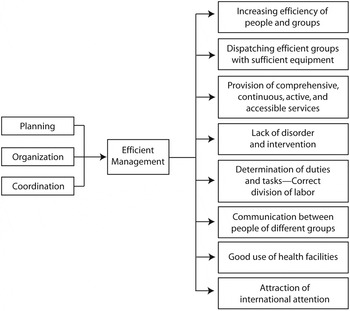
Results from this study, which is the first in its kind in Iran, indicated that proper pre-event planning, organization, and mechanisms for resource coordination are critical factors in a successful response. This is in contrast to other studies, which suggest inadequate resources as one major problem in the provision of health services.Reference Akbari, Farshad and Asadi-Lari8–Reference Phillips14 The key elements of effective disaster health services management are summarized in Figure 1.
The management of health care services at the time of disasters

Based on the findings of this study, it is clear that providing coordinated, integrated, continuous, and accessible health services during disaster is important. These findings, to some extent, are consistent with a study by Manley et al, which emphasizes the importance of management and local, regional, and national disaster preparedness.Reference Manley, Furbee and Coben17 According to Hersche and Wenker, “There is a delusive belief that one will be able to manage disasters without systematic planning by simply concentrating on existing resources. Major accidents and disasters can only be mastered and controlled by intelligent planning”.Reference Hershe and Wenker18 This is confirmed by Hick et al, who noted that proper pre-event planning and mechanisms for resource coordination are critical for a successful response.Reference Hick, Hanfling and Burstein11 Regarding these essential issues, Akhbari et al emphasize the importance of establishing a disaster management plan and of coordinating international aid.Reference Akbari, Farshad and Asadi-Lari8
Participants in this study indicated that there were many problems with coordination, which is consistent with previous studies in Iran.Reference Khorasani-Zavreh, Mohammadi and Khankeh19–Reference Haghparast-Bidgoli, Hasselberg, Khankeh, Khorasani-Zavareh and Johansson21 This corroborates Markenson et al, who mentioned that a major barrier to healthcare preparedness is a lack of coordination across the spectrum of public health and healthcare communities and disciplines.Reference Markenson, DiMaggio and Redlener22 The lack of coordination among organizations and the emotional behavior of lay people at the scene were core problems mentioned in the case of post-crash management of road traffic injuries in Iran.Reference Khorasani-Zavareh, Khankeh and Mohammadi20 Public education campaigns, as expressed by participants, are a key factor in solving this major problem. The World Health Organization (WHO) maintains that the use of coordination mechanisms, regular sharing of information, and joint planning have been crucial to the avoidance of overlapping services and to ensuring the provision of health assistance to those in need.23 From the participants' perspective, in order to develop safer communities with fewer deaths, physical injuries, and psychosocial trauma, health systems must be capable of providing a coordinated response, and of delivering effective preparedness programs before disasters occur. The health sector has a vested interest and a key role in this process.
Another important challenge in this study was the manner of the responses of international organizations during the disaster and to look at how to establish good contacts and show appreciation for the contribution of international humanitarian and relief groups. To obtain international humanitarian assistance, the health services of disaster-affected countries should consider appropriate communication strategies with related agencies. It is important to note that, according to the WHO, proper communication channels are important because some agencies only may accept requests for assistance from one specific source within the affected country.5 According to a study conducted by Zoraster, the humanitarian response to the December 2004 earthquake and tsunami in Asia was one of the largest ever.Reference Zoraster24 Nevertheless, coordination problems were apparent, leading to wasted efforts and funds. The findings of the current study show that it is of the utmost importance that efforts and actions being put into disaster management should be coordinated in order to limit the effects of disasters and to achieve recovery as early as possible.5
Strengths and Limitations
This qualitative study focused on the individual opinions of the participants. However, a triangulation approach by means of individual interviews, observational field notes, and the narrative of the Bam residents, as well as constant comparative analysis support the findings. In this study, data were collected from a few cases or individuals by using purposeful sampling, which means that findings cannot be generalized to other locations that do not have similar environmental, cultural, and economic characteristics. However, generalization is not within the scope of this kind of study. In fact, the representativeness in qualitative research concerns the data and not the sampling units; even if the number of participants may be small.Reference Strauss and Corbin15,Reference Streubert and Carpenter16,Reference Nieswiadomy25 Finally, the results of this study, like other grounded theory and qualitative research, is descriptive and presents findings other researchers could interpret in different ways.
Conclusions
This study supports health service managers coordinating the appropriate use of foreign aid. It is suggested that this can be done by better communication with local and foreign constituents. The findings of this study indicate that health disaster managers must develop a constructive relationship between healthcare providers, local authorities, and the affected community in advance of and at the time of a disaster event. Data from this study indicates that public education and proper pre-event planning support an effective response in providing healthcare services during a disaster. The present study marks a starting point for clarifying and describing the process of health disaster management. Further study on this process is needed. Studies including the perspectives of more affected people, policy-makers, and local authorities could yield increased understanding of the process of health disaster management and the interaction and relationships between all of those involved in the process.
Acknowledgements
The authors thank their colleagues, both current and former, for their kind and much needed collaboration in the preparation of this paper. They express deep appreciation to the people of Bam and the Iranian Secretariat of Natural Disasters at the Ministry of Health and Medical Education of Iran for their contributions to this study.
Ten most fatality-related natural disasters in Iran for the period 1900 to 2008

Adapted from: “EM-DAT: The OFDA/CRED International Disaster Database, http://www.em-dat.net”
The authors declare that they have no competing interests.