Lactococcus lactis is a lactic acid bacterium commonly dominant in natural niches such as spontaneous milk fermentations, on cattle, and on plant material (Mundt, Reference Mundt, Sneath, Mair, Sharpe and Holt1986). Recently, it has also been reported as a dominant microorganism in the intestinal tract of freshwater fish (Hagi et al. Reference Hagi, Tanaka, Iwamura and Hoshimo2004; Ringo, Reference Ringo, Salminen, von Wright and Ouwehand2004). Strains of this species are also the main component of starters used in the economically important fermentation of milk into cheese (Fox et al. Reference Fox, Guinee, Cogan and McSweeney2000). Lactococci are also responsible for flavour formation through their proteolytic and amino acid conversion pathways (Smit et al. Reference Smit, Smit and Engels2005). In addition, these bacteria have recently found a use in other biotechnological applications, such as the expression of heterologous proteins, the synthesis of food-grade additives and nutraceuticals, and in vaccine delivery (Hols et al. Reference Hols, Kleerebezem, Schanck, Ferain, Hugenholtz, Delcour and de Vos1999; Nouaille et al. Reference Nouaille, Ribeiro, Myoshi, Pontes, Le Loir, Oliveira, Langella and Azevedo2003).
Food and certain food supplements can introduce large numbers of live Lc. lactis into the human and animal gastrointestinal tract (GIT), a complex ecosystem containing hundreds of different types of resident and transient microorganisms including opportunistic and pathogenic bacteria (Guarner & Malagelada, Reference Guarner and Malagelada2003). There is therefore concern about the possibility of commensal bacteria acquiring antibiotic resistance genes from their environment and acting as a reservoir of such determinants (Teuber et al. Reference Teuber, Meile and Schwarz1999; European Commission, 2005). Resistance could ultimately be transferred to pathogenic species, which would hamper the treatment of infections (Hamilton-Miller, Reference Hamilton-Miller2004). Indeed, the transfer of resistance into food matrices and the GIT of mammals has been shown possible in a number of experiments (Netherwood et al. Reference Netherwood, Bowden, Harrosin, O'Donnel, Parker and Gilbert1999).
Antibiotic resistant lactococci may be selected for in environments where they come into contact with antibiotics, such as the udder of antibiotic-treated cows and, therefore, the products derived from their raw milk (Bennish, Reference Bennish1999), or in the ponds for fish culturing (Chopra & Roberts, Reference Chopra and Roberts2001). The need for new lactococcal strains to complement those currently used as starters (Klijn et al. Reference Klijn, Weerkamp and de Vos1995; Salama et al. Reference Salama, Musafa-Jeknic, Sandine and Giovannioni1995) demands that, as well technological characterization studies, antibiotic surveys be performed to avoid selecting those harbouring acquired, transferable resistance determinants (Teuber et al. Reference Teuber, Meile and Schwarz1999). This need is all the more evident since several antibiotic resistance genes have been successfully transferred to Lc. lactis from related bacteria under laboratory conditions (Gasson & Fitzgerald, Reference Gasson, Fitzgerald, Gasson and de Vos1994; Clewell et al. Reference Clewell, Flannagan and Jaworsky1995), and since a multiple resistance plasmid has been discovered in an isolate from a raw-milk cheese (Perreten et al. Reference Perreten, Schwarz, Cresta, Boeglin, Dasen and Teuber1997) Antibiotic resistance cut-off values for Lc. lactis have only been defined for strains used in animal feed (European Commission, 2005). These have been based on antibiotic surveys using different methodologies (microdilution, plate dilution, Etest), media and culture conditions, and sometimes a small number of related strains (Cogan, Reference Cogan1972; Orberg & Sandine, Reference Orberg and Sandine1985; Elliot & Facklam, Reference Elliot and Facklam1996; Teuber et al. Reference Teuber, Meile and Schwarz1999).
This paper reports the determination of the MICs of six antibiotics with activity against Gram positive bacteria, inhibiting either the synthesis of proteins (tetracycline, erythromycin, clindamycin, streptomycin, and chloramphenicol) or the synthesis of the cell wall (vancomycin) in a large collection of lactococcal strains. These strains were isolated from different geographical locations over many years (from 1950 to the present), and from different dairy products and animal environments.
Material and Methods
The following analyses were performed at the different laboratories involved in this research: CSIC, Instituto de Productos Lácteos de Asturias (CSIC), Villaviciosa, Spain; CH, Christian Hansen A/S, Hørsholm, Denmark; IBB, Institute of Biochemistry and Biophysics, Warsaw, Poland; and UKU, University of Kuopio, Kuopio, Finland.
Bacterial strains, growth media and culture conditions
Ninety three Lc. lactis isolates from industrial starter cultures (28), cows' milk (12), artisanal starter-free cheeses (41), cat (4) and fish (5) intestines, and culture collections (3) were surveyed for antimicrobial resistance. The isolates were geographically well separated, as they were collected in Spain (31), Denmark (15), Belgium (18), Poland (7), Finland (5) and other European countries (17). Most were isolated in the 1980s and 1990s (73), but several were collected before the generalized use of antibiotics (20), the so-called pre-antibiotic era (Teuber et al. Reference Teuber, Meile and Schwarz1999).
Enterococcus faecalis LMG 8222 (=ATTC 29212), Lc. lactis LMG 8520, and two well-known laboratory strains (Lc. lactis MG 1363; Lc. lactis IL 1403), all from the LMG collection of the Belgian Co-ordinated Collections of Microorganisms, BCCMTM, University of Ghent, Belgium, were used as controls throughout the study.
Cryopreserved cultures of Lc. lactis strains in glycerol were first recovered on Mueller-Hinton agar (Oxoid, Basingstoke, UK). Isolated colonies were then streaked onto Mueller-Hinton plates and incubated for 16–18 h at 28°C. The isolates from fish intestines, however, did not grow well at 28°C; these incubations were therefore performed at 25°C.
Classification and characterisation of isolates
The isolates were phenotypically grouped by their carbohydrate fermentation profiles using the API50 CHL system (bioMérieux, Marcy l'Etoile, France) and later identified by PCR using either universal primers (Young et al. Reference Young, Downer and Eardly1991) or species-specific primers (Pu et al. Reference Pu, Dobos, Liwsowtin and Pobell2002), all based on conserved sequences of 16S rRNA genes. Amplicons were then sequenced and the sequences compared to those in public databases. Genetic fingerprinting was performed by RAPD-PCR and/or by PFGE as previously described (Delgado & Mayo, Reference Delgado and Mayo2004). Clustering calculations were performed using GelCompar II v. 2.5 software (Applied Maths BVBA, Sint-Martens-Latem, Belgium).
Minimum inhibitory concentrations determined by the Etest method
Individual colonies from the Mueller-Hinton plates were suspended in a sterile glass or plastic tube containing 2–5 ml of sterile saline (Oxoid) until a density corresponding to McFarland standard 1 or its spectrophotometric equivalent (corresponding to around 3×10⁸ cfu/ml) was obtained.
A sterile cotton swab was dipped into the above McFarland suspension and used to inoculate the Mueller-Hinton agar plates. The agar surface was then allowed to dry for approximately 15 min before applying the Etest strips (AB Biodisk, Solna, Sweden). Readings were recorded after 48 h of incubation at 28°C (or 25°C for fish isolates). The MICs for the bacteriocidal antibiotics (streptomycin, chloramphenicol and vancomycin) studied were taken as the first value on the Etest strips at which growth did not occur, as per the manufacturer's recommendations. For the bacteriostatic antibiotics (tetracycline, erythromycin and clindamycin), the MIC was taken as the point where growth was significantly inhibited (around 80%, as estimated by visual inspection).
Measurement of MICs by the standard NCCLS agar dilution method
To check the performance of the Etest compared with the standard plate agar dilution technique (CLSI, 2004), the MICs of these antibiotics for 25 selected strains were also determined by this last procedure using Mueller-Hinton agar.
PCR amplification of tetracycline resistance genes
Total DNA was isolated from tetracycline resistant strains by using a commercial kit (GenElute bacterial genomic DNA kit; Sigma-Altdrich Co., St. Louis, Mo., USA). DNA dilutions were used as template in PRC reactions with universal primers of ribosomal protection genes (DI, 5′-GA(T/C)ACICCIGGICA(T/C)(A/G)TIGA(T/C)TT-3′, and DII, 5′-GCCCA(A/G)(T/A)IGG(A/G)TTIGGIGGIAC(T/C)TC-3′) (Clermont et al. Reference Clermont, Chesneau, De Cespédès and Horaud1997). Following PCR conditions as described by Gevers et al. (Reference Gevers, Danielsen, Huys and Swings2003), specific primers for tet(K) (TetK-FW1 5′-TTATGGTGGTTGTAGCTAGAAA-3′ and TetK-RV1 5′-AAAGGGTTAGAAACTCTTGAAA-3′), tet(L) (TetL-FW3 5′-GYMHYYHVHVHVYSYSYYVV-3′ and TetL-RV3 5′-GTGAAMGRWAGCCCACCTAA-3′), and tet(M) (DI and tetMR, 5′-CACCGAGCAGGGATTTCTCCAC-3′) were also used. Amplicons obtained were purified using Microcon PCR filters (Millipore, Bedford, Ma., USA) and double-stranded sequenced in an ABI 370 Genetic Analyzer (Applied Biosystems, Warrington, UK). Sequences were then compared with others in the EMBL data library by using the online BLASTN resource (http://www.ncbi.nlm.nih.gov/blast/).
Results and Discussion
All strains grew well on plain Mueller-Hinton without the need for frequent additions of glucose and yeast extract (Katla et al. Reference Katla, Kruse, Johnsen and Herikstad2001) or lysed horse blood (Green et al. Reference Green, Wadowsky and Barbadora1990; Elliot & Facklam, Reference Elliot and Facklam1996), thus allowing the determination of MICs by the Etest method. Etest modal MIC values of the analysis performed in the different laboratories (in μg/ml) for the internal control strain Ec. faecalis ATCC 29212 of tetracycline (8), streptomycin (256), erythromycin (3), clindamycin (16), chloramphenicol (8), and vancomycin (2) compared well with the Etest manufacturer' guidelines.
MICs of the different antibiotics assayed
In this study, MICs of six antibiotics with action on Gram-positive bacteria were evaluated by the Etest method in 93 Lc. lactis isolates from different environments, locations and periods of time. Table 1 shows the range of MICs to the antibiotics analysed plus the MICs that inhibited the growth of 50 and 90% of the strains. Differences in ranges converged when the MIC50% and MIC90% values recorded at the different laboratories were compared. Moreover, differences were always within one or two dilutions of the range, the normal variation in inter-laboratory assays. Similar differences were observed for MICs obtained in the same strains by either Etest or the standard CLSI agar dilution method. Grouping the strains by their year of isolation, their geographical origin or their environment of origin appeared to have no influence on the distribution of the MICs.
Minimum inhibitory concentrations (MICs) of the different antibiotics assayed against Lactococcus lactis isolates

§ Abbreviation key of collections and laboratories: CSIC, Instituto de Productos Lácteos de Asturias (CSIC), Villaviciosa, Spain; CH, Christian Hansen A/S, Hørsholm, Denmark; IBB, Institute of Biochemistry and Biophysics, Warsaw, Poland; and UKU, University of Kuopio, Kuopio, Finland
¶ 50% and 90%, MIC50 and MIC90, respectively
† Too few isolates for percentual MIC determinations
‡ Excluding the six tetracycline resistant strains from IBB
Early antibiotic surveys involving Lc. lactis showed this species to have little in the way of antibiotic resistance (Cogan, Reference Cogan1972; Reinbold & Reddy, Reference Reinbold and Reddy1974; Orberg & Sandine, Reference Orberg and Sandine1985). The present results agree well with those of other authors who found lactococcal species to be susceptible to broad and Gram positive spectrum antibiotics and β-lactams (Elliot & Facklam, Reference Elliot and Facklam1996; Katla et al. Reference Katla, Kruse, Johnsen and Herikstad2001; Delgado et al. Reference Delgado, Delgado and Mayo2002; Flórez et al. Reference Flórez, Delgado and Mayo2005). Variations in the MIC for streptomycin similar to those obtained in the present work have been reported by other authors (Orberg & Sandine, Reference Orberg and Sandine1985; Katla et al. Reference Katla, Kruse, Johnsen and Herikstad2001). In the present work, the standardised protocol probably reduced the differences that might arise in microdilution and the Etest assays through the use of different culture media (Huys et al. Reference Huys, D'Haene and Swings2002) or inoculum sizes (M Egervärn & S Lindgren, unpublished). In addition to antibiotic resistance genes, differences in the activity of general detoxification systems such as those of multi-drug resistance (MDR) transporters might contribute towards enhancing the MICs of otherwise susceptible lactococcal strains (Perreten et al. Reference Perreten, Schwarz, Teuber and Levy2001; Putman et al. Reference Putman, van Veen, Degener and Konings2001). The MICs for 79 lactococci strains showed them to be susceptible to all six antibiotics.
Distribution of MICs among the Lc. lactis strains
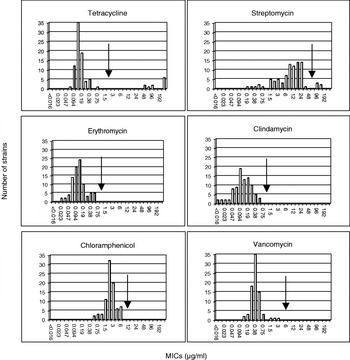
Figure 1 shows the distributions of the MIC values frequencies for the antibiotics over the range of strains. Most frequency distributions followed a rather normal curve; only tetracycline and streptomycin differed, which showed bimodal curves. The curves for tetracycline, chloramphenicol and vancomycin were very narrow, while those for erythromycin, clindamycin and streptomycin were wider. The distribution of some tetracycline and streptomycin MICs strongly suggests that certain isolates possess active resistance mechanisms.
Distribution of Minimum inhibitory concentrations (MICs) frequency of the Lactococcus lactis strains analysed for the six antibiotics. Arrows point to the new cut-off MIC values proposed in this study.

Proposition of new microbiological susceptibility-resistance cut-off values
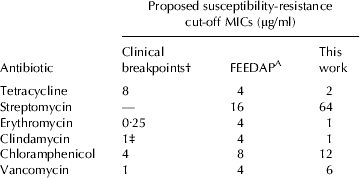
The term microbiological breakpoint was introduced to replace the concept of the clinical breakpoint for the purpose of identifying bacterial strains with acquired and potentially transferable resistance determinants (Olsson-Liljequist et al. Reference Olsson-Liljequist, Larsson, Walder and Miorner1997). In the present work, however, a microbiological term more related to risk assessment is used: the resistance-susceptibility cut-off value. The cut-off for each antibiotic was considered as the second MIC above the apparently normal range of the MICs (Fig. 1). The large number of strains examined allows the proposition of the resistance-susceptibility cut-offs shown in Table 2, which are based on both the MIC ranges and their unimodal or bimodal distribution. In the experimental conditions of this study, some of the cut-offs were quite different from previously published breakpoints, such us those of the European Commission Scientific Panel Committee on additives and products or substances used in animal feed (FEEDAP) (European Commission, 2005), and others, which are also summarized in the table for comparison. To validate the new cut-offs, analysis of resistant strains to all antibiotics will be necessary. Especially, a careful inspection of the strains contributing to the higher MIC levels of the curves will be needed to exclude the presence of dedicated (acquired) mechanisms of resistance.
Microbiological susceptibility-resistance cut-off values proposed for Lactococcus lactis to the six antibiotics under assay

† Breakpoints by the Clinical and Laboratory Standards Institute (CLSI, 2004), former NCCLS, as defined for Streptococcus spp. other than Streptococcus pneumoniae
A FEEDAP, Scientific Panel on additives and products or substances used in animal feed. Breakpoints as related on a recent report (European Commission, 2005)
‡ Breakpoint as defined by the Société Française de Microbiologie (http://sfm.asso.fr)
Strains with a MIC equal to or higher than the cut-off values were considered resistant. In this sense, 11 strains were found resistant to tetracycline (six of which had been selected by their tetracycline resistance phenotype after screening of a large collection of dairy lactococci for resistance to this antibiotic) (J Zycka, JB Lampkowska & J Bardowski, unpublished). Tetracyclines continue to be important as therapeutic antibiotics, and are still employed in stockbreeding and aquaculture in many countries (Chopra & Roberts, Reference Chopra and Roberts2001), which may favour the selection of tetracycline resistant bacteria. Furthermore, five strains resistant to streptomycin were also encountered among the fish intestinal tract isolates; of these, two proved to be resistance to both tetracycline and streptomycin.
Antimicrobial resistance genes in Lc. lactis
Few antimicrobial resistance determinants have been found in strains of Lc. lactis, although plasmid-encoded genes have been described for tetracycline [tet(S)], macrolides [mdt(A) and erm(T)], chloramphenicol (cat) and streptomycin (str) (Perreten et al. Reference Perreten, Schwarz, Cresta, Boeglin, Dasen and Teuber1997; Raha et al. Reference Raha, Ross, Yusoff, Manap and Ideris2002). The tetracycline resistant strains were screened for tetracycline resistance determinants by using universal primers for ribosome protection genes and primers specific for tet(K), tet(L), and tetM. An amplification product of around 1·5-kbp was obtained by using specific primers for tet(M) when DNA from two resistant strains from a farmhouse cheese (Spain) and a resistant strain from a cat tonsil (BCCMTM, Belgium) was used as a template. The same gene was also amplified from the two tetracycline resistant fish isolates. The partial sequences of all these genes proved to be 100% identical to each other and also to the tet(M) gene from Tn916 of Ec. faecalis (Su et al. Reference Su, He and Clewell1992). Further, two different tetracycline resistance genes were detected among the Polish resistant strains, a mosaic tet(L/S) gene along with tet(M). This demonstrated the usefulness of the tetracycline resistance cut-offs and the presence of acquired tetracycline resistance determinants among the isolates of this work. The analysis of genes involved in streptomycin resistance is currently underway.
In conclusion the Etest is a convenient method that accurately determines MICs and suggests the presence of atypical resistances which may be encoded by acquired determinants. These added genes are considered to have the greatest risk for horizontal dissemination (European Commission, 2005). The analysis of strains from different ecotypes may be useful for precisely defining the cut-off values separating acquired resistances from all other types, while at the same time revealing acquired resistance that has already spread among the Lc. lactis populations. Owing to the current low incidence of resistance in Lc. lactis, in which multi-resistance is practically absent, this species could be useful for studying the acquisition and spread of antibiotic determinants among commensal organisms. In this work, a few strains harbouring tetracycline resistance genes identical to those present in other bacteria have been identified.
This work was supported by an EU project within the VI Frame Programme (ACE-ART, Reference CT-2003-506214). BCCMTM, University of Gent, Gent, Belgium, and EFFCA, Paris, France, are acknowledged for providing some of the strains in this work.