


INTRODUCTION
Visceral leishmaniasis (VL) is a common protozoan infection transmitted by female sandfly bites. It is endemic in many areas of the world including Central and South America, Africa, Asia and the Mediterranean Basin. In Spain, during the last 10 years, 101 cases a year were declared (0·4/100 000 inhabitants). In our area, Madrid, during the last 5 years 122 diagnoses of VL were declared of whom 34 cases (27·8%) were patients infected with the human immunodeficiency virus (HIV) (López Vélez et al. Reference López Vélez, Pérez Molina, Guerrero, Baquero, Villarrubia, Escribano, Bellas, Pérez-Corral and Alvar1998; WHO/PANAFTOSA, 2006). Children and immunocompromised subjects are more susceptible to have full-blown disease. VL in HIV patients is characterized by having a protracted course and frequent relapses despite adequate anti-leishmanial therapy (Alvar et al. Reference Alvar, Cañavate, Gutiérrez-Solar Jiménez, Laguna, López-Vélez, Molina and Moreno1997). Endemic areas where both infections occur are a great concern (Górgolas and Miles, Reference Górgolas and Miles1994; WHO, 2000). In southern Europe, for example, about 25–70% of VL cases in adults are associated with HIV co-infection (Desjeux and Alvar, Reference Desjeux and Alvar2003; Rosenthal et al. Reference Rosenthal, Marty, Poizot Martin, Reynes, Pratlong, Lafeuillade, Jaubert, Boulat, Dereure and Gambarelli1995). Experimentally, HIV drives leishmanial infection, and vice-versa. Co-infected patients have higher parasite burdens and weaker or absent immune responses. They also respond poorly to anti-leishmanial therapy including antimonials, amphotericin B and others (Berman, Reference Berman2003). Relapse rates are estimated to occur in 60% of cases within 1 year, regardless of the anti-leishmanial drug used. In addition, secondary resistance has emerged to all of the drugs used (Croft, Reference Croft2001). Since 1996, when highly active antiretroviral therapy (HAART) was instituted, co-infected patients tended to improve their immunity, limiting the number of relapses and even controlling the infection (Russo et al. Reference Russo, Nigro and Panarello2003). However, a small subset of patients has persistent and symptomatic infection. For this particular subgroup of patients secondary prophylaxis or even repeated therapeutic cycles with antimonials, amphotericin B deoxicholate or in liposomes, paromomycin, allopurinol or miltefosine had not been effective (Berman, Reference Berman2003; Jha et al. Reference Jha, Sundar, Thakur, Bachmann, Karbwang, Fischer, Voss and Berman1999; Sundar et al. Reference Sundar, Jha, Thakur, Engel, Sindermann, Fischer, Junge, Bryceson and Berman2002).
The role of splenectomy in patients with visceral leishmaniasis is not known. It has been used in the past for the treatment of resistant kala-azar with some success (Das and Sen Gupta, Reference Das and Sen Gupta1950; Lyngdoh et al. Reference Lyngdoh, Jain and Barua1971). The risks of severe infections caused by encapsulated bacteria or even malaria parasites in splenectomized patients, particularly those with visceral leishmaniasis and severe HIV infection, should be taken into account before the surgical procedure is indicated. We present herein the result of 3 patients with AIDS and persistent visceral leishmaniasis, who required elective splenectomy due to severe cytopaenias.
MATERIALS AND METHODS
Retrospective study of 3 HIV+patients with relapsing VL seen at a tertiary-care hospital in Spain, during the last 6 years, in whom splenectomy was performed due to severe cytopaenia that required periodic blood transfusions. All patients were informed of the risks associated with splenectomy and signed an informed consent. Two weeks before the procedure patients received pneumococcal, Haemophylus influenzae b and meningococcal vaccines as recommended by the American Society of Haematology (George et al. Reference George, Woolf, Raskob, Wasser, Aledort, Ballen, Blanchette, Bussel, Cines, Kelton, Lichtin, McMillan, Okerbloom, Regan and Warrier1996).
The diagnosis of VL was confirmed by demonstration of amastigotes in bone-marrow smears. AIDS was diagnosed according to accepted criteria (Centers for Disease Control and Prevention, 1992).
Relapse was defined as a new episode of VL occurring after a successful response to treatment of a previous episode.
RESULTS
There were 2 men and 1 woman, with a mean age of 35·3 years (range 32–42 years). Two of them were Spanish and one was Portuguese but resident in Spain for the last 10 years. When VL was diagnosed all patients had full-blown AIDS with a medium CD4 lymphocyte count of 75 cells/μl, undetectable HIV-1 RNA viral load and were in the CDC classification stage C. Two of them were prior intravenous drug users and were also co-infected with hepatitis C virus (Table 1).
Main features of patients
(M, Male; F, Female; CDC (Center for Disease Control); U, Undetectable; TR, Transfusional requirements.)

In 2 of 3 patients additional biopsies, performed for different diagnostic purposes during the course of VL (i.e. samples from skin, gums, gastric and small intestine wall, condilomata), disclosed leishmania invasion out of the reticuloendothelial system (liver, spleen or lymphatic nodules). The mean duration of VL from the time of diagnosis was 6·3 years (range 5–8 years). Clinical manifestations at diagnosis were fever (3p), hepatomegaly (2p), splenomegaly (2p) and enlarged lymph nodes (3p). Severe anaemia with periodic transfusion requirements was present in 2 patients. All of them were treated with at least 2 anti-leishmanial drugs regimens including amphotericin B and antimonials prior to splenectomy. The mean number of different anti-leishmanial drugs received for each patient was 3 drugs (Table 2). All had at least 3 relapses before the use of splenectomy with a medium number of 4 relapses (range 3–5). One patient was treated before splenectomy with miltefosine (Impavido®), at a standard dose of 50 mg/bid for 28 days (Jha et al. Reference Jha, Sundar, Thakur, Bachmann, Karbwang, Fischer, Voss and Berman1999; Russo et al. Reference Russo, Nigro and Panarello2003), having an initial response with symptomatic improvement. However, after discontinuation, relapse did occur.
Main features of treatment
(AB, Amphotericin B; ABL, Amphotericin B liposomal; GLU, Glucantime; Pro, Secondary prophylaxis.)
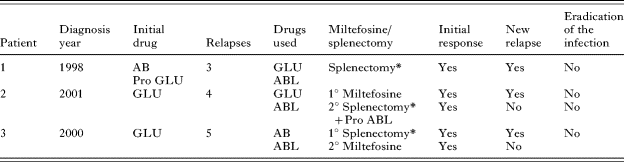
* Prior patient informed consent was obtained and inmunizations against encapsulated bacteria was performed.
Splenectomy was indicated in 2 cases due to severe cytopaenia and the need of periodic blood transfusions and in the third case because of refractory kala-azar infection. The evolution of haematological and virological parameters before and after splenomegaly is shown in Table 3. The haemoglobin, leukocyte and platelet counts increased, the absolute number of CD4 cells increased and the RNA-HIV-1 viral load remained undetectable in all cases.
Main laboratory values before and after splenectomy
(Hb, Haemoglobin; VL, RNA-HIV-1 viral load (cop/ml).)

After the surgery, one of the patients, who had complained of severe abdominal discomfort and had persistent pancytopaenia, was asymptomatic and without anaemia during several months of follow-up. Another remained free of clinical and analytical abnormalities during the following 5 years. The third patient had a new VL relapse 1 year after the procedure, then miltefosine in a 28-day regimen was tried, but it also failed to prevent recurrences. Finally, combined anti-leishmanial therapy including amphotericin B and fluconazole maintained this patient in clinical remission for 1 year of follow-up.
Discussion
The spleen is the largest single reservoir of parasitized reticuloendothelial cells in VL. Subjects with massively enlarged spleens have severe pancytopaenias due to blood cell sequestration in the splenic tissue. Previous studies demonstrated that an effective concentration of the specific drug does not easily reach the parasites in situ, in that leishmania amastigotes in the bone-marrow are more readily destroyed by the drugs than parasites in the spleen (Lyngdoh et al. Reference Lyngdoh, Jain and Barua1971).
Removal of the spleen is thus a way to eliminate large amounts of parasites not amenable to specific drugs. In that sense, splenectomy may be used as a ‘parasite debulking’ strategy and also for avoiding severe cytopaenias due to hypersplenism. However, to the best of our knowledge, the use of splenectomy in co-infected HIV/VL patients has not been described before.
On the other hand, it has been proposed that the increase in absolute CD4 and CD8 counts and temporary reduction of plasma viraemia after splenectomy in HIV-infected patients is associated with improved survival, and prolongs the time to AIDS development. These observations, although not definitely established, may have importance in the understanding of T-cell dynamics and the potential for splenectomy as an HIV reservoir-debulking procedure (Bernard et al. Reference Bernard, Chernoff and Tsoukas1998). We have seen that splenectomy does not alter the efficacy of the antiretroviral therapy measured as RNA-HIV-1 viral load suppression.
Our data show that the use of splenectomy is not sufficient to control VL in HIV-1 infected patients. In addition, the surgical procedure might put the patient at risk of other common bacterial and parasitic infections. However, those patients with severe cytopaenias might benefit from the surgical spleen removal. Splenic artery embolization might be another less invasive, relatively safe and effective method to treat this particular situation as it has been demonstrated in other situations with massive hypersplenism (Corti et al. Reference Corti, Villafane, Suarez Anzorena, Daruich, Perez Bianco, Candela, Ferraina and Tezanos Pinto2003).
In conclusion, refractory visceral leishmaniasis in HIV-positive patients on successful HAART is still a therapeutic challenge. Continuous long-term use of miltefosine alone or in combination with other anti-leishmanial drug might be a strategy but clinical trials to confirm this approach are needed. Splenectomy might be a therapeutic approach to avoid severe cytopaenias, but should only be considered as a very last option.


