




No CrossRef data available.
Article contents
Priming for novel between-word associations in patients with organic amnesia
Published online by Cambridge University Press: 26 August 2005
Abstract
Ten amnesic patients of various etiologies and 10 matched normal controls participated in this study. On 2 consecutive days, subjects studied 30 novel word–word associations 6 times. Using a cued recall task, we assessed episodic learning and delayed retention of the study material immediately after each study phase and again 24 hr after the final study phase. Further, we evaluated implicit memory for new between-word associations by means of an automatic relational priming paradigm immediately after the delayed cued recall trial. Amnesic patients performed poorly on the cued recall task. Moreover, in the overall group of amnesics the priming effect failed to reach statistical significance. When the overall group of amnesics was split according to mean performance on the cued recall task, those in the low performer subgroup—comprised of 6 patients with direct or indirect involvement of the hippocampi—were particularly poor at episodically remembering the associations and did not reveal any relational priming. These data support the hypothesis of similar impairment of new episodic and implicit learning in amnesic patients and suggest that the hippocampus is crucial for both kinds of new learning. (JINS, 2005, 11, 566–573.)
Information
- Type
- Research Article
- Information
- Journal of the International Neuropsychological Society , Volume 11 , Issue 5 , September 2005 , pp. 566 - 573
- Copyright
- © 2005 The International Neuropsychological Society
INTRODUCTION
Patients with organic amnesia due to cerebral damage affecting medial temporal lobe structures and related neural circuitry show impaired performance on direct tests of memory (e.g., free recall, recognition). Memory for recent information can also be investigated by means of indirect measures of memory such as repetition priming. A large body of literature documents that patients with organic amnesia show intact repetition priming when the experimental paradigm involves facilitated reprocessing of single items (e.g., words or pictures of real objects) or between-item associations (e.g., related word pairs) with pre-existing representation in memory (see for reviews Gooding et al., 2000; Schacter & Buckner, 1998). Instead, mixed results have been obtained regarding the capacity of amnesic patients to be primed by individual items (e.g., nonwords or abstract pictures) or between-item associations (e.g., unrelated word pairs) that lack pre-existing memory representations. In particular, some studies reported comparable priming for novel between-word associations in amnesics and normal controls (Gabrieli et al., 1997; Goshen-Gottstein et al., 2000; Graf and Schacter, 1985) and others revealed reduced priming in patients with amnesia (Cermak et al., 1988; Mayes & Gooding, 1989; Paller and Mayes, 1994; Schacter & Graf, 1986; Shimamura & Squire, 1989).
In their meta-analysis of available experimental evidence, Gooding et al. (2000) noted a number of variables that can affect amnesics' performance on repetition priming procedures for novel material. The most relevant one is the tendency of healthy controls to contaminate performance on the priming test for novel information by using explicit stimulus retrieval strategies (e.g., Gooding et al., 1999; McKone & Slee, 1997). Depending on how susceptible the performance index in the particular experimental paradigm is to explicit memory contamination (e.g., because it is based on accuracy rather than on speed of stimulus processing or because experimental subjects engage in strategic expectancy to respond faster), amnesic patients are likely to show a reduced priming effect. A second experimental variable that may affect amnesic patients' performances is the number of stimulus presentations during the study phase. It has been suggested that novel information may be acquired via neural circuits that do not include medial temporal lobes; however, in this case, the learning process is slower and requires multiple exposures to material (Holdstock et al., 2002a). Accordingly, amnesic patients with medial temporal lobe damage should be particularly disadvantaged by experimental procedures with one stimulus presentation during the study phase and should perform better if there are more study presentations. Finally, amnesic patients' performances on priming tests for novel material should be particularly poor if the experimental task is based on the generation of the response cued by a fragment (as, for example, in word-stem completion). Indeed, if these patients have some degree of frontal lobe damage, then their ability to generate responses should be particularly impaired (Brokate et al., 2003).
Here we report the results of a study further investigating priming for newly formed associations in patients with organic amnesia. The priming procedure we used consisted of adapting the widely used semantic priming paradigm so that newly formed between-word associations replaced the traditionally used semantic associates as prime–target pairs (Dagenbach et al., 1990; Pecher & Raaijmakers, 1999; Schrijnemakers & Raaijmakers, 1997). To our knowledge, the semantic priming paradigm has never been utilized to assess whether patients with organic memory disorders can be primed by recently established novel associations. To prevent the possible reliance of healthy subjects on an episodic retrieval strategy to perform the task, we established experimental parameters in the priming experiment (both SOA and proportion of prime–target related pairs) needed to obtain automatic priming (see Neely, 1977, 1991). Moreover, to maximize our chances of obtaining a significant priming effect and to circumvent amnesic patients' supposed difficulty in establishing new memory representations following single stimulus exposure, we administered the priming experiment following six study trials with the word pairs. Finally, the priming effect was revealed by speeded lexical decision for previously processed words, thus circumventing the amnesic patients' possible disadvantage with priming procedures requiring item generation.
METHODS
Research Participants
Twenty subjects participated in this study. The first group consisted of 10 patients with organic amnesia. All patients were referred to our laboratory because of an impairment in recalling day-to-day events. The neuropsychological evaluation (see Table 1) showed a severe long-term episodic memory deficit in the context of substantially preserved general cognition. In particular, these patients had high range WAIS verbal IQs (M = 112.0; SD = 9.2) but their performance scores on tests of verbal and visuo-spatial episodic memory fell on average from 1.9 to 2.7 standard deviations below the normal controls' mean.
Personal and clinical data, neuroradiological findings and performance scores on some neuropsychological tests of the amnesic patients who participated in the present study

The patients in the amnesic group could be classified according to the locus of the neuropathological damage likely responsible for their memory disorder. Five patients had bilateral atrophy of the hippocampus. Three of them developed amnesia following cerebral hypoxia. Histopathological and neuroimaging data have been reported indicating that temporary loss of oxygen leads to severe hippocampal atrophy (Gadian et al., 2000; Hopkins et al., 1995; Rempel-Clower et al., 1996). The 4th patient, an insulin-dependent diabetic, became amnesic after a period of coma due to iatrogenically caused hypoglycemia. Animal models demonstrate that prolonged reduction of blood glucose concentration leads to relatively selective damage of hippocampal cell sub-populations (Tekkok et al., 2002). The amnesic syndrome in the 5th patient arose during chemotherapy for the treatment of leukemia. However, no direct relationship could be established between the basic disease or the chemotherapy and the hippocampal atrophy. Visual inspection and morpho–volumetric analysis of high quality cerebral MRI images, according to Pruessner et al. (2000), revealed bilateral atrophy of the hippocampus in these 5 patients. In particular, left and right hippocampal volumes ranged from −5.27 to −1.97 SDs below the mean of a normative group of healthy controls (Pruessner et al., 2000). There was no indication of significant volume reduction in other brain regions, including the medial temporal lobe cortices (perirhinal, parahippocampal and entorhinal cortices). However, as we do not have a morphovolumetric analysis of these brain regions at our disposal, the claim of completely spared parahippocampal cortices should be regarded with caution.
One patient had memory problems as a result of surgical section of the right column of the fornix (see Bonanni et al., 2004). One patient became amnesic following the removal of a hypophysary tumor. In this patient, the cerebral MRI showed the presence of an ischemic area in the anterior region of the left thalamus. Two patients had amnesia as a chronic sequela of subarachnoidal hemorrhage for rupture of an anterior communicating artery aneurysm. In these patients, the amnesic syndrome was thought to be the result of damage to septal nuclei (Gade, 1982; Gade & Mortensen, 1990). Morphovolumetric analysis of medial temporal lobe structures in these 4 patients revealed hippocampal volumes ranging from −0.3 to +1.0 standard deviations from normal controls' mean, according to Pruessner et al. (2000). In fact, there was no overlap between hippocampal volumes in the hippocampal and non-hippocampal patients and the difference between the average volumes of the two groups was significant for both the right hippocampus (t = 3.32, p = .01) and the left hippocampus (t = 3.15, p = .02). The last patient, a chronic survivor of severe closed-head trauma, wears a vertebral metallic support and is ineligible for MRI investigation. In such patients, the memory impairment is generally due to contusional and diffuse axonal changes at many levels of cortical and subcortical cerebral structures.
Biographical, clinical and neuroradiological characteristics of the amnesic patients as well as performance scores on some tests of the neuropsychological screening battery are summarized in Table 1.
The normal controls (NCs) for the patients in the amnesia group were 10 healthy volunteers matched for age, sex, and literacy with the patients. Exclusion criteria for this group were the following: a history of brain trauma, brain or psychiatric disease, diagnosed internal diseases or taking drugs or medications potentially able to interfere with cognitive efficiency. Average ages of amnesics and normal controls were 44.7 (SD = 16.1) and 39.7 (SD = 15.2) respectively [F(1,18) = 0.5, p > .10]. Average years of schooling were 12.9 (SD = 2.1) and 14.1 (SD = 3.3) [F(1,18) = 0.9, p > .10].
Experimental Task
Material
The overall experimental material consisted of 180 word–word pairs and 180 word–non-word pairs. Thirty critical word–word pairs were chosen so as not to present any pre-experimental association or semantic relation. In each pair, the first word represented the prime and the second was the target in the priming experiment. The words in the pairs were four to eight letters in length and had an average frequency of occurrence in the Italian lexicon of 30.7:1,000,000 (range 4–233) according to Bortolini et al. (1971). The 30 word–word pairs were divided into three subsets, each formed by 10 pairs. Thirty recombined word–word pairs were obtained by re-pairing the primes and the targets in each 10-pair subset. Thirty neutral word–word pairs were obtained by combining the word NULLA (BLANK in Italian) as prime and the same targets as the critical word–word pairs. Thirty, 4-to-8-letter legal nonwords were obtained by substituting one or two consonants in real words; these nonwords were paired with the primes of the word pair list to form 30 word–nonword pairs. Thirty neutral word/nonword pairs were obtained by combining the word NULLA as prime and the same nonwords as the previous word/nonword pairs as targets. In order to surreptitiously increase the number of trials in the priming experiment, 90 word–word and 120 word–non-word pairs were also selected to be used as fillers. Words and nonwords for the filler and practice pairs were selected with the same criteria as those used for the critical pairs.
Procedure
The overall experiment consisted of three sessions, each given on 1 of 3 consecutive days. The first two sessions were aimed at learning the 30 word–word pairs. For this purpose, in each session the subject underwent three consecutive study-test trials. In order to make the associative link between the words in the pair as rich and varied as possible, in each session the encoding instructions in the study phase changed from one trial to the next. Instead, the memory test always consisted of an episodic cued-recall task. On the 3rd day (about 24 hr after the last study–test session), the subject underwent the final cued recall task immediately followed by the priming experiment.
Study phase
In the first study phase of the first-day session, the examiner presented the two words in the pair auditorily (e.g., envelope–hair) and the subject was requested to say a sentence aloud that included both words (e.g., a hair was stuck to the envelope). In the second study phase, the subject was requested to generate a similarity between the two words in the pair which, also in this case, were presented auditorily by the examiner (e.g., both of them are very thin). In the third study phase, the subject read 30 sentences, each containing the first word and a fragment (i.e., two or three letters) of the second word of a pair (e.g., In the envelope there was a brown h_i_). The subject was asked to complete the word fragment by writing down the missing letters. The same three study phases were also given in the experimental session on the 2nd day. In the first two phases, the subject was allowed to repeat the same sentences or to generate the same similarities. Instead, in the third study phase the sentences were varied from the first to the 2nd day. The pair presentation order was randomized across trials.
Cued recall task
For each item of the cued recall task, the examiner said the first word of a pair aloud and the subject was requested to recall the second word. With the exception of the delayed trial on the third day, the examiner provided the correct answer if the subject made an error.
Priming for new associations
The overall priming experiment consisted of three blocks of 120 trials, each containing an equal number (10) of intact, recombined and neutral word–word pairs, 10 word–nonword pairs, 10 neutral word–nonword pairs, 30 filler word–word pairs, and 40 filler word–nonword pairs. The probability of encountering a word rather than a non-word in the target position was 50% and the intact (i.e., studied) pairs represented 16.6% of the total number of word–word pairs. To avoid presenting the same prime or target words after too short an interstimulus lag, stimuli pertaining to each of the three 10-pair subsets contributed differently to each experimental block. In particular, for each block the 10 critical word–word pairs came from the first subset, the 10 recombined word–word pairs from the second subset and, finally, the 10 neutral word–word pairs from the third subset. In this way, each prime or target word appeared only once in each block. The presentation order of each block varied among subjects in a pseudo-random fashion.
The experiments were run individually and controlled by a 386 PC. The stimuli were presented in white capital letters in the center of a black computer screen; they occupied about 5.7° of visual angle. Each trial started with the appearance of a small central cross for 2 s, indicating the fixation point. The cross was followed by the prime word, which remained for 300 ms. This was followed immediately by the target, which remained until the subject responded or, if there was no response, for 5 s, after which it was replaced by a blank screen. The experimenter controlled the beginning of each trial by pressing a key on the computer keyboard. The subjects were placed approximately 50 cm from the computer screen and were instructed to read the prime silently and to perform a lexical decision task on the target. They had to press a green button for words and a red button for nonwords using their dominant hand. If the subjects pressed the wrong button, the mistake was indicated by an auditory signal. The PC recorded response reaction times and accuracy.
RESULTS
Cued Recall Task
Results of the word pair recall (Figure 1) were analyzed by means of a two-way mixed ANOVA with group (amnesics vs. normal controls) as the between-subject factor and trial (from 1 to 6) as the within-subjects factor. Overall, average accuracy of recall was much higher in the normal (M = 24.8) than in the amnesic (M = 7.1) group [F(1,18) = 75.2, p < .001]. The trial effect was also highly significant [F(5,90) = 44.1, p < .001], reflecting the progressive increase of recall accuracy across successive study–test trials. LSD post-hoc tests revealed significant differences among adjacent trials in each case, p < .05, except for the difference between the fourth and fifth trial, p > .10. The Group × Trial interaction was also significant [F(5,90) = 2.6, p < .05]. The interaction did not imply a different learning rate in the two groups. Indeed, the average performance improvement passing from the first to the sixth trial was comparable in the two groups [M = +9.2 and +10.6 in the amnesic and control groups, respectively; F(1,18) = 0.4, p = n.s.]. Rather, the significant interaction was the expression of differently shaped learning curves in the two groups. As a matter of fact, the polynomial contrasts revealed that while the amnesic patients' learning curve was only fitted by a linear slope [F(1,18) = 31.0, p < .001], in the normal controls both the linear and the quadratic components of the slope contributed to significant prediction of the learning curve [F(1,18) = 40.2 and 29.5, respectively, p < .001 in both cases]. The significance of this latter component likely reflects the precocious reaching of a ceiling effect in the normal control group's performance accuracy across successive study–test trials (as also revealed by artificially small variances in this group's performance; see Figure 1).

Performance accuracy of amnesic patients and normal controls on the six immediate and the delayed trials of the cued recall task.
A further two-way mixed ANOVA comparing performance on the sixth and on the seventh cued recall trial revealed significant main effects of group [F(1,18) = 95.8, p < .001] and trial [F(1,18) = 9.7, p < .05]. The significant Group × Trial interaction [F(1,18) = 9.8, p = .02], documented discrepant performance changes in the two groups as a function of test trial. Indeed, while the performance decrement in the normal control group was very limited and actually not significant [M = −0.6; F(1,18) = .02], it was substantial and highly significant in the amnesic patients' group [M = −5.8; F(1,18) = 16.0, p < .001].
Priming for New Associations
The average number of lexical decision errors made by amnesic patients and normal controls on the target words of the intact, recombined and neutral word–word pairs of the priming experiment was very low (M = 1.6 and 0.7, respectively). For this reason, accuracy data on this task will not be further analyzed.
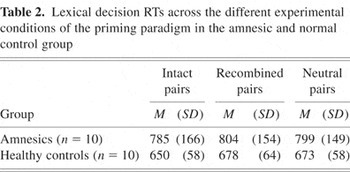
As for reaction times (RTs), only those on correct lexical decisions were considered for the statistical analysis. In addition, trials with RTs outside a range represented by the individual's mean RT of more or less than 2 standard deviations were considered outliers and excluded from all the statistics. The average RTs obtained by amnesics and normal subjects as a function of priming condition are reported in Table 2. These data were analyzed by means of a two-way mixed ANOVA with group as the between-subjects factor and priming condition (intact vs. recombined vs. neutral word–word pairs) as the within-subjects factor. The group effect was significant [F(1,18) = 6.1, p < .02], due to average longer RTs in the amnesic group (M = 796 ms) than in the normal control group (M = 668 ms). The priming condition effect was also significant [F(2,36) = 4.4, p < .02]. Planned comparisons between the three conditions revealed that average RTs on the intact word–word pairs (M = 718 ms) were significantly faster than on the recombined pairs (M = 741 ms) [F(1,18) = 7.9, p = .01], while the difference with respect to the neutral condition (M = 736 ms) approached significance [F(1,18) = 3.7, p = .07]. RTs on the recombined and neutral word–word pairs did not differ [F(1,18) = 0.6]. The Group × Priming condition interaction did not approach significance [F(2,36) = 0.3], thus suggesting comparable priming effects in the two groups.
Lexical decision RTs across the different experimental conditions of the priming paradigm in the amnesic and normal control group

Relationship Between Performance on Cued Recall Task and Priming for New Associations
In order to investigate the relationship between episodic and implicit learning in the amnesic patients, we split the group according to the performance mean on the delayed cued recall task (M = 6.2). The low performer group included 6 patients (performance range in the delayed cued recall test from zero to 5), while the remaining 4 patients constituted the high performer group (performing from 10–16 in the delayed recall test). Interestingly, 5 of the 6 patients in the low performer group (designated with asterisk in Table 1) were affected by bilateral hippocampal atrophy. The 6th patient had undergone surgical section of the right column of the fornix.
As shown in Table 3, the performance patterns of these two groups of amnesics in the semantic priming paradigm differed. In fact, while the high performer group revealed a 47 ms facilitation in the intact compared to the recombined word-word pairs, no evidence of facilitation was detectable in the low performer group. A two-way mixed ANOVA provided partial statistical support for this claim. Indeed, while the group effect was not significant [average RTs in the high and low performer groups were 851.5 and 757.8, respectively; F(1,8) = 0.8], both the priming condition effect [F(1,8) = 4.7, p = .06], and the Group × Priming condition interaction [F(1,8) = 4.8, p = .06] were close to significance. As a matter of fact, separate post-hoc analysis of the priming effect in the two subgroups by means of the Newman-Keuls test showed no sign of priming in the low performer group, p = .99, while the effect in the high performer group reached significance, p = .01, despite the extremely small sample size.
Lexical decision RTs in the intact and recombined pair conditions of the priming paradigm in the amnesic patients' subgroups that scored below (low performers) or above (high performers) the group mean on the delayed cued recall task

DISCUSSION
As expected, the healthy subjects' episodic memory for the word pair list (as measured by the cued recall test) was much better than that of the amnesic patients. Moreover, a qualitative analysis of performance showed that the two groups had comparable learning rates passing from the first to the sixth study–test trial but that the amnesic patients exhibited much greater forgetting than the normal control group passing from the sixth to the delayed recall trial. However, due to a ceiling effect in the healthy subjects' cued recall performance, the interpretation of both of these findings is somewhat uncertain. In fact, the precocious reaching of a quasi-perfect performance level could have led to an underestimation of both the learning and the forgetting rates in this group of subjects, thus giving rise to spurious results in the between groups comparisons.
In the lexical decision task, the healthy subjects revealed a significant priming effect. Indeed, their lexical decision was 28 ms faster following intact than recombined pairs. In the amnesic group, making a lexical decision was also faster in the intact than in the recombined pair condition, but the facilitation effect was smaller (19 ms) than in the normal control group. Moreover, in the amnesic group the emergence of a relational priming effect was related to performance accuracy on the cued recall task. Indeed, only the amnesic patients who correctly recalled 10 or more word pairs in the delayed cued recall test displayed a significant facilitation in the priming procedure. No sign of a priming effect was shown by amnesics who scored 5 or less on the recall task. It should be noted that the strength of our conclusions about a direct relationship between performance on direct and indirect associative memory tests in patients with amnesia is somewhat undermined by the low patient sample size. As a matter of fact, despite a robust priming effect in the high performer amnesic group (47 ms) and the lack of any priming in the low performer group, the critical Group × Priming condition interaction only approached significance. It is a fact, however, that difficulty in recruiting adequately sized samples of patients with selective memory disorders underlain by well defined cerebral lesions is a constant in the neuropsychological literature on organic amnesia, so that firm conclusions can only be reached by converging evidence from different group studies.
To summarize, in a group of patients with organic amnesia we found evidence of a relationship between deficient ability to episodically remember novel between-word associations and impaired ability to rely on these previously studied associations to facilitate lexical decision. How can these results be reconciled with the contradictory data emerging from the existing literature on priming for novel between-word associations in amnesic patients? First of all, it seems very unlikely that poor priming in patients with severe amnesia is just an epi-phenomenon of the reliance of healthy controls on explicit recollection of verbal associations during the lexical decision task. As previously noted, experimental parameters of the priming experiment (both SOA and proportion of intact pairs) were established to obtain an automatic form of priming. Experimental results supported this prediction. Indeed, the amnesics and healthy controls took about the same time to make the lexical decision in the recombined and neutral pair conditions. This suggests that following presentation of the first word of a pair, the subjects did not generate the conscious expectancy of the paired word (Neely, 1977). Since preparatory strategies did not contribute to performance, the subjects could not rely on memory for the study episode, and the priming phenomenon reflected the unconscious influence exerted by the recently stored verbal associations in facilitating the lexical decision.
The hypothesis that poor priming in amnesic patients results from insufficient exposure to the study material also seems untenable (Gooding et al., 2000). In the present study, the verbal associations were given six times before the priming experiment. In most previous investigations (e.g., Goshen-Gottstein et al., 2000; Paller & Mayes, 1994), who reported variable results, subjects studied novel verbal associations only once or twice before performing the priming experiment.
Finally, it is unlikely that the observation of reduced relational priming in the severe amnesics' subgroup was biased by the kind of experimental paradigm used. Subtle frontal damage could have been responsible for the amnesics' reduced ability to generate a word as a completion of a stem, or to guess a word following degraded stimulus presentation (e.g., in conditions of masked and tachistoscopic exposure). In the present study, patients were only requested to make a lexical decision about a letter string. This is likely the least demanding condition in a word processing task and, as such, the least likely to present a problem for the possibly reduced generation abilities of brain lesioned patients.
Based on previously available evidence and on the presently reported data, we hypothesise that two factors are crucial for determining whether normal or deficient priming for novel associations will be observed in amnesics. The first factor concerns the characteristics of the amnesic sample investigated. In keeping with previous investigations (Schacter & Graf, 1986; Shimamura & Squire, 1989), our data show that the severity of the anterograde memory impairment predicts the probability that the individual amnesic will reveal a significant priming effect for recently established verbal associations. Moreover, in our sample of patients the emergence of a relational priming was also predicted by the putative locus of cerebral damage responsible for amnesia. In fact, all but 1 patient in the low performer subgroup suffered from hippocampal atrophy. Visual inspection of the parahippocampal gyrus in these patients did not show any sign of atrophy in the cortical areas surrounding the hippocampus. Unfortunately, since we have no disposable morphovolumetric analysis, we could not quantitatively support the argument of a complete sparing of these areas. The 6th patient had undergone sectioning of the right fornix column. Since the fornix is the main pathway connecting the hippocampus with other subcortical structures critical for memory, this patient's amnesic syndrome can also be considered as resulting from functional deafferentation of the hippocampus proper (Aggleton et al., 1992). Instead, patients in the high performer group had cerebral lesions outside the medial temporal lobes and their hippocampal volumes were in the range of normal controls.
The second factor likely able to influence the quality of relational priming in patients with organic amnesia is the nature of the stored representation underlying the priming effect. In particular, it seems that when the procedure stresses the perceptual aspects of the stored representation, then the amnesics' priming is normal. Instead, when the reprocessing facilitation is based on more conceptual features of the memory representation, then it is more likely that the priming effect will be deficient. In particular, in studies of word identification, patients with amnesia revealed normal priming in all experiments in which the words forming the pairs (which appeared side by side during the priming paradigm) actually reproduced the same perceptual format as in the study phase (Gabrieli et al., 1997; Goshen-Gottstein et al., 2000). Instead, in Paller and Mayes's (1994) study and in the present research in which the words were presented sequentially (thus not reproducing the perceptual condition of the study phase), relational priming in severely amnesic patients was poor. This is not to say that perceptual factors had no role in the reprocessing facilitation of word pairs in our study (and possibly in Paller & Mayes's). However, the emphasis in the study phase on establishing multiple and meaningful relationships between words in the pairs, together with the change in the perceptual format from study to test, likely stressed the role of more conceptual levels of memory representation at the origin of the priming effect. If this hypothesis is true, then it can be supposed that patients with organic amnesia, especially those with lesions affecting the hippocampal formation, are impaired in storing novel conceptual associations between previously unrelated word pairs.
In this perspective, the presently reported data might also be relevant for the debate over the possible role of the hippocampus in episodic and semantic learning. Indeed, while its emergence from repeated study–cued recall trials suggests that relational priming originates in the episodic memory system, the nature of the priming paradigm (a lexical decision task facilitated by the creation of meaningful relationships between words in the pair) might suggest the alternative view that the priming effect originates in the knowledge system; that is, in semantic memory. Espousing one or the other of the two above-mentioned hypotheses regarding the origin of the priming effect clearly constrains our interpretation of the presently reported data. Indeed, if we advocate the first hypothesis (relational priming as rising from the episodic memory), then poor cued recall and lack of a priming effect would be two expressions of the same difficulty of hippocampal amnesics in storing new associative memories in the episodic memory system (Henke et al., 1997; Holdstock et al., 2002b; Turriziani et al., 2004). However, if one takes performance on the cued recall task as indicative of the ability to store new episodic memories and, in contrast, level of relational priming as indicative of the ability to store new representations in the semantic memory system, then patients with hippocampal damage would be equally impaired in both kinds of learning. Following this assumption, the presently reported data are incompatible with the neurobiological implementation of Tulving's dualist model (Tulving & Markowitsch, 1998), which assumes that the parahippocampal regions are responsible for establishing new memory representations in the semantic system and that the hippocampus (which receives its major cortical input from the parahippocampus) is the critical structure for episodic memory. Rather, the results of the present study are entirely consistent with a theory that posits a single system for the storage of new episodic and semantic memory traces (Anderson & Ross, 1980; Cohen et al., 1997; Squire & Knowlton, 1995; Squire & Zola, 1998). In this unitary view of human memory, the episodic–semantic distinction describes either two different portions of the stored memory representation (the semantic one possibly deriving from the primitive episodic trace after being set free from the record of the temporo–spatial context in which the information was initially acquired) or two different retrieval modes for the same memory representation (inserted in an autobiographical context in one case, free from any reference to personal events in the second case) and the amnesic syndrome consists of an impairment in storing new memory representations in this unitary system.
ACKNOWLEDGMENTS
This research was financially supported by funds received from the Italian Ministry of Health RC 02.A. No portion of this paper has been previously presented elsewhere.
References
REFERENCES
Aggleton, J.P.,
Keith, A.B.,
Rawlins, J.N.,
Hunt, P.R., &
Sahgal, A.
(1992).
Removal of the hippocampus and transection of the fornix produce
comparable deficits on delayed non-matching to position by rats.
Behavioural Brain Research,
52,
61–71.Google Scholar
Anderson, J.R. &
Ross, B.H.
(1980).
Evidence against a semantic–episodic distinction.
Journal of Experimental Psychology: Human Learning and
Memory,
6,
441–465.Google Scholar
Bonanni, R.,
Carlesimo, G.A.,
Tomaiuolo, F., &
Caltagirone, C.
(2004).
Amnesia following endoscopic third ventriculostomy: A single case
study.
European Neurology,
51,
118–120.Google Scholar
Bortolini, V.,
Tagliavini, C., &
Zampulli, A.
(1971).
Lessico di frequenze della lingua italiana contemporanea
[Frequency of words in the contemporary Italian
language].
Milan, Italy:
Garzanti.
Brokate, B.,
Hildebrandt, H.,
Eling, P.,
Fichtner, H.,
Runge, K., &
Timm, C.
(2003).
Frontal lobe dysfunctions in Korsakoff's syndrome and chronic
alcoholism: Continuity or discontinuity?
Neuropsychology,
17,
420–428.Google Scholar
Cermak, L.S.,
Bleich, R.P., &
Blackford, S.P.
(1988).
Deficits in the implicit retention of new associations by alcoholic
Korsakoff patients.
Brain and Cognition,
7,
312–323.Google Scholar
Cohen, N.J.,
Poldrack, R.A., &
Eichenbaum, H.
(1997).
Memory for items and memory for relations in the
procedural/declarative memory framework.
Memory,
5,
131–178.Google Scholar
Dagenbach, D.,
Horst, S., &
Carr, T.H.
(1990).
Adding new information to semantic memory: How much learning is
enough to produce automatic priming?
Journal of Experimental Psychology: Learning, Memory and
Cognition,
16,
581–591.Google Scholar
Gabrieli, J.D.E.,
Keane, M.M.,
Zarella, M.M., &
Poldrack, R.A.
(1997).
Preservation of implicit memory for new associations in global
amnesia.
Psychological Science,
8,
326–329.Google Scholar
Gade, A.
(1982).
Amnesia after operations on aneurysms of the anterior communicating
artery.
Surgical Neurology,
18,
46–49.Google Scholar
Gade, A. &
Mortensen, E.L.
(1990).
Temporal gradient in the remote memory impairment of amnesic
patients with lesions in the basal forebrain.
Neuropsychologia,
28,
985–1001.Google Scholar
Gadian, D.G.,
Aicardi, J.,
Watkins, K.E.,
Porter, D.A.,
Mishkin, M., &
Vargha-Khadem, F.
(2000).
Developmental amnesia associated with early hypoxic-ischaemic
injury.
Brain,
123,
499–507.Google Scholar
Gooding, P.A.,
Mayes, A.R., &
van Eijk, R.
(2000).
A meta-analysis of indirect memory tests for novel material in
organic amnesics.
Neuropsychologia,
38,
666–676.Google Scholar
Gooding, P.A.,
Mayes, A.R.,
van Eijk, R.,
Meudell, P.R., &
McDonald, F.L.
(1999).
Do novel associative word stem completion and cued recall share the
same memory retrieval processes?
Memory,
7,
323–343.Google Scholar
Goshen-Gottstein, Y.,
Moscovitch, M., &
Melo, B.
(2000).
Intact implicit memory for newly formed verbal associations in
amnesic patients following single study trials.
Neuropsychology,
14,
570–578.Google Scholar
Graf, P. &
Schacter, D.L.
(1985).
Implicit and explicit memory for new associations in normal and
amnesic subjects.
Journal of Experimental Psychology: Learning, Memory and
Cognition,
11,
501–518.Google Scholar
Henke, K.,
Buck, A.,
Weber, B., &
Wieser, H.G.
(1997).
Human hippocampus establishes associations in memory.
Hippocampus,
7,
249–256.Google Scholar
Holdstock, J.S.,
Mayes, A.R.,
Isaac, C.L.,
Gong, Q., &
Roberts, N.
(2002a).
Differential involvement of the hippocampus and tem-poral lobe
cortices in rapid and slow learning of new semantic information.
Neuropsychologia,
40,
748–768.Google Scholar
Holdstock, J.S.,
Mayes, A.R.,
Roberts, N.,
Cezayirli, E.,
Isaac, C.L.,
O'Reilly, R.C., &
Norman, K.A.
(2002b).
Under what conditions is recognition spared relative to recall after
hippocampus damage in humans?
Hippocampus,
12,
341–351.Google Scholar
Hopkins, R.O.,
Kesner, R.P., &
Goldstein, M.
(1995).
Item and order recognition memory in subjects with hypoxic brain
injury.
Brain and Cognition,
27,
180–201.Google Scholar
Mayes, A.R. &
Gooding, P.
(1989).
Enhancement of word completion priming in amnesics by cueing with
previously novel associates.
Neuropsychologia,
271,
1057–1072.Google Scholar
McKone, E. &
Slee, J.A.
(1997).
Explicit contamination in ‘implicit’ memory for new
associations.
Memory and Cognition,
25,
352–366.Google Scholar
Neely, J.H.
(1977).
Semantic priming and retrieval from lexical memory: Roles of
inhibitionless spreading activation and limited-capacity attention.
Journal of Experimental Psychology: General,
106,
226–254.Google Scholar
Neely, J.H.
(1991).
Semantic priming effects in visual word recognition: A selective
review of current findings and theories. In
D. Besner &
G.W. Humphreys (Eds.),
Basic processing in reading (pp.
264–236).
Hillsdale, NJ:
Erlbaum.
Paller, K.A. &
Mayes, A.R.
(1994).
New-association priming of word identification in normal and amnesic
subjects.
Cortex,
30,
53–73.Google Scholar
Pecher, D. &
Raaijmakers, J.G.
(1999).
Automatic priming effects for new associations in lexical decision
and perceptual identification.
Quarterly Journal of Experimental Psychology,
52A,
593–614.Google Scholar
Pruessner, J.C.,
Li, L.M.,
Serles, W.,
Pruessner, M.,
Collins, D.L.,
Kabani, N.,
Lupien, S., &
Evans, A.C.
(2000).
Volumetry of hippocampus and amygdala with high-resolution MRI and
three-dimensional analysis software: Minimizing the discrepancies between
laboratories.
Cerebral Cortex,
10,
433–442.Google Scholar
Rempel-Clower, N.L.,
Zola, S.M.,
Squire, L.R., &
Amaral, D.G.
(1996).
Three cases of enduring memory impairment after bilateral damage
limited to the hippocampal formation.
Journal of Neuroscience,
16,
5233–5255.Google Scholar
Schacter, D.L. &
Graf, P.
(1986).
Preserved learning in amnesic patients: Perspectives from research
on direct priming.
Journal of Clinical and Experimental Neuropsychology,
8,
727–743.Google Scholar
Schrijnemakers, J.M. &
Raaijmakers, J.G.
(1997).
Adding new word associations to semantic memory: Evidence for two
interactive learning components.
Acta Psychologica,
96,
103–132.Google Scholar
Shimamura, A.P. &
Squire, L.R.
(1989).
Impaired priming of new associations in amnesia.
Journal of Experimental Psychology: Learning, Memory and
Cognition,
15,
721–728.Google Scholar
Squire, L.R. &
Knowlton, B.
(1995).
Memory, hippocampus, and brain systems. In
M.S. Gazzaniga (Ed.),
The cognitive neurosciences (pp.
825–837).
Cambridge, MA:
MIT Press.
Squire, L.R. &
Zola, S.M.
(1998).
Episodic memory, semantic memory, and amnesia.
Hippocampus,
8,
205–211.Google Scholar
Tekkok, S.B.,
Godfraind, J.M., &
Krnjevic, K.
(2002).
Moderate hypoglycemia aggravates effects of hypoxia in hippocampal
slices from diabetic rats.
Neuroscience,
113,
11–21.Google Scholar
Tulving, E. &
Markowitsch, H.J.
(1998).
Episodic and declarative memory: Role of the hippocampus.
Hippocampus,
8,
198–204.Google Scholar
Turriziani, P.,
Fadda, L.,
Caltagirone, C., &
Carlesimo, G.A.
(2004).
Recognition memory for single items and associations in amnesic
patients.
Neuropsychologia,
42,
426–433.Google Scholar

Personal and clinical data, neuroradiological findings and performance scores on some neuropsychological tests of the amnesic patients who participated in the present study

Performance accuracy of amnesic patients and normal controls on the six immediate and the delayed trials of the cued recall task.
Lexical decision RTs across the different experimental conditions of the priming paradigm in the amnesic and normal control group

Lexical decision RTs in the intact and recombined pair conditions of the priming paradigm in the amnesic patients' subgroups that scored below (low performers) or above (high performers) the group mean on the delayed cued recall task
 You have
Access
- 12
- Cited by