Introduction
It is widely noted that world politics suffers from a democratic deficit.Footnote 1 In a post-Cold War era characterised by globalisation and deep interdependence, this deficit arises from two sources. First, the actions of national governments increasingly have an effect beyond their own territorial borders creating transnational spillovers.Footnote 2 Second, key agents of global governance – international organisations (IOs) and their bureaucracies, non-state actors and private agents – exercise pervasive forms of authority. In both instances, individuals and collectives are oftentimes divorced from the decision-making processes that determine their lives.Footnote 3 If the notion of collective self-governance – in which affected parties exercise popular sovereignty – is to make sense in a global age, democracy must go beyond the nation state.Footnote 4 Over the past two decades in particular, the cause and consequence of the global democratic deficit have been recognised, conceptualised, and problematised by International Relations (IR) scholars, political theorists, lawyers, and activists.
This article contributes to work on global democracy by looking at the role of international courts (ICs). Although courts are typically understood as essential to national democratisation, their presence in transnational governance has not been adequately appreciated by global democrats. This is somewhat ironic because early work on global democracy, especially that by David Held and Daniele Archibugi, suggested that ICs specifically – and the legalisation of world politics in general – would be essential for global democracy.Footnote 5 Yet today, there exists 23 permanent, operational international judicial bodies that have issued tens of thousands of binding rulings.Footnote 6 Against this background, we examine the relationship(s) between ICs and the ongoing process of global democratisation.
The core question of this article is if, how, and in which ways ICs bolster or undermine democratic values beyond the state. We contend that ICs are indeed able to advance global democratic values and shape democratic practices. They can do so by fostering equal participation, accountability, and public justification that link individuals directly with sites of authority beyond their own nation-state. We maintain that the ability of ICs to promote these values is conditioned by institutional design choices concerning access rules, review powers, and provisions regarding judicial reason-giving. We canvass these design features of different ICs and assess the promises and pitfalls for global democratisation. Doing so enables us to discuss how design choices condition the practice and behaviour of ICs. Although the internal democratic legitimacy of ICs is important, this article is concerned with how ICs promote the democratisation of world politics at large.Footnote 7
Methodologically, we draw upon an original dataset covering the 24 ICs in existence during the post-Second World War period. This dataset contains data on ICs’ formal rules governing access for private, non-state actors, review powers, and judicial reason-giving. The numerical increase in ICs enables us to talk about global democratisation over time while our data on design features in all 24 courts across different world regions speaks to democratisation across space. The article is thus particularly novel in bridging normative theory with substantive and systematic empirical data.Footnote 8
The article proceeds in four sections. First we discuss literature on global democracy emphasising the recent turn toward striving for democratic values under pluralist conditions. Drawing on the current state of the literature, we outline three values that together allow us to examine the advancement or recession of global democratisation. Second we underline the prevalence and importance of ICs and suggest that ICs may have a pivotal role to play in global democratisation. Third we look at how equal participation, accountability, and justification are secured by different ICs and note which institutional design features are critical for each value. We discuss both the promise and pitfalls of realising these values by looking at how these values are realised or inhibited in practice. The Conclusion discusses future directions of research by linking global democratisation with debates about the legitimation of global governance at large.
Global democratisation
Work in the field of international normative political theory has flourished in recent years.Footnote 9 Roughly speaking, three separate strands can be discerned. First, global justice scholars have examined the appropriate allocation of burdens and benefits to be distributed across national borders and scrutinised how various institutional (pre)conditions trigger different moral duties.Footnote 10 Second, theorists and philosophers working in the just war tradition have examined the historical and ethical rules governing inter-state warfare and conflict.Footnote 11 Finally, global democrats have probed how the legitimacy of world politics relates to the notion of collective self-governance that stands at the heart of democratic governance within national polities.Footnote 12
This article is concerned with global democratisation. The notion of a democratic deficit – in which decisions taken beyond the state pierce national sovereignty and expose individuals to rules they have not helped formulate – is now extensively recognised.Footnote 13 The global democratic deficit, tethered as it is to globalisation, increased national interdependence, and the prominence of international law, has forced attention toward the normative legitimacy and sources of authority that underpin transnational social, economic, and political decision-making. While it is possible to assess the sociological legitimacy of global authority,Footnote 14 it is also clear that authoritative relationships can be legitimated through democratic practice in which the ‘governed’ or ‘affected’ parties participate in the formation of those authoritative rules that bind them.Footnote 15
In order to dampen the global democratic deficit, numerous proposals, models, blueprints, and schemes have been touted to give individuals more direct say in how their lives are governed. Although a full exposition is neither possible nor necessary here, early work was often formulated in terms of idealised ‘models’ or ‘terminal blueprints’ that could be strived toward.Footnote 16 For instance, the model of cosmopolitan democracy came with a variety of short- and long-term institutional prescriptions including international courts, transnational parliaments, and multi-level governance architecture that would enable individuals to participate in global decision-making.Footnote 17 World government scholars went beyond the cosmopolitan model and outlined a hierarchical and encompassing system of state-like institutions that could be replicated at the global level. This would include a world parliament, global constitution, and federal government with coercive power.Footnote 18 In a different vein, global civil society advocates have often promoted a deliberative model that puts democratising faith in non-state actors who can employ different discourses to oppose, contest, and shape more formal international politics.Footnote 19 Intergovernmental models, radical proposals, pragmatist suggestions, and postmodern models are just several of the other prescriptions for giving individuals a greater say in the transnational forces that afflict their lives.Footnote 20
However, literature on global democracy has shifted away from this strategy of proposing idealised models to be realised as closely as possible.Footnote 21 Instead, scholars and practitioners are now searching for how different democratic values and practices emerge under existing conditions and devising ways to advance their attainment. This method, broadly speaking, mirrors a turn in global justice debates toward non-ideal and (so-called) realist theory.Footnote 22 Instead of stipulating a fully-democratic institutional scheme that serves as a target or benchmark, we should work from within current arrangements to make productive steps forward seeking to understand which values and principles should regulate different institutional arrangements for global democratisation.Footnote 23
This article joins this general reorientation of the literature. The question then becomes: which democratic values should be sought in world politics generally, and through ICs specifically? We seek to establish if, how, and under which conditions ICs enable practices of equal participation, accountability, and public justification beyond the state. We have two methodological rationales for selecting these values. First, these values reflect three prominent strands of democratic thinking: participatory, liberal, and deliberative. Participatory democrats emphasise the importance of individual involvement in forming rules and laws. Liberal democrats highlight the centrality of holding decision-makers to account and the role of a balance-of-power in that relationship. Finally deliberative scholars iterate the formation of preferences through public reasoning that stands at the core of democratisation efforts.
Second, these values represent a synthesis of recent work on global democratisation from IR, political theory, and international law. Magdelena Bexell, Jonas Tallberg, and Anders Uhlin put forward participation and accountability as the core values civil society actors can promote in global democratic governance.Footnote 24 These authors also advocate the importance of deliberative conceptions of global democratisation. Similarly, Klaus Dingwerth, in a recent article, emphasises ‘the benefits of disaggregating the concept of (global) democratic governance’ into inclusiveness, transparency, accountability, and deliberation.Footnote 25 In political theory, Kate Macdonald and Terry Macdonald highlight public disempowerment, accountability, and transparency as the relevant criteria for global democratisation.Footnote 26 Public disempowerment requires giving affected parties the ability to signal (dis)approval and sanction authoritative rule-makers, and transparency provides public justification for how authority is wielded.Footnote 27 Within international law – especially the field of global administrative law – Nico Krisch advocates the importance of accountability and contestation (participation and deliberation) for democratising the postnational order.Footnote 28
Values of democratisation
From this brief interdisciplinary review of global democratic scholarship, convergence can be noted. There is rough agreement on both the ways to pursue global democratisation – as a set of values derived from democratic theory – and on what those values might be. We identify equal participation, accountability, and public justification as central. While there are certainly other candidates, less consensus exists on these values. For instance, some might question why we have not included human rights in our list of relevant democratic values. While we think that protecting human rights is an important function for ICs to consider, the values of accountability and public justification go a long way towards safeguarding individual rights. Moreover, there are significant debates in political theory about whether human rights are a necessary condition for democracy – a debate without consensus.Footnote 29 As such, we have not made ‘human rights’ a separate democratic value, but nor do we preclude its importance or potential as a value for future research.
The goal of this article thus remains to determine if ICs can embody these values, through which modes and mechanisms this can occur, and whether this provides a springboard for global democratisation. From our analysis, it becomes clear that ICs can be designed to engender these values to greater or lesser degrees, variation which is conditioned by institutional design features. There are also substantive limitations (beyond issues of institutional design) that inhibit the realisation of different values in practice, such as unequal distribution of resources, geographical remoteness, and epistemic hindrances.Footnote 30 As such, we are interested in both the internal design features of ICs that enable or hamper these democratic values, as well as the effect on the wider system of world politics. Indeed, it is the ways in which ICs enable affected individuals to be connected democratically with other sites of authoritative rule-making beyond the state that is key to their democratising potential. Before moving on to this analysis, we flesh out each value in more substantive terms.
Equal participation means that citizens affected by the authoritative exercise of public power should have the opportunity and ability to be involved in how that authority is wielded. This entails equal capacity to set the agenda as well as shape the rules, laws, and regulations that will affect their lives. We recognise that equality of participation may often rest upon forms of representation as individuals cannot always be directly involved in all decision-making processes. National representatives or other self-appointed representatives (interest groups, non-governmental organisations, etc.) can all help connect individuals with sites of public power.Footnote 31 Precisely how equal participation is secured will and should vary depending upon the institutional scheme in need of democratic regulation.
Accountability, in a democratic sense, means that those affected by decision-making should have the right to hold power wielders ‘to a set of standards, to judge whether they have fulfilled their responsibilities in light of these standards, and to impose sanctions if they determine that these responsibilities have not been met’.Footnote 32 This criterion gives affected individuals the opportunity to hold decision-makers at different levels of governance accountable for their actions and stop the arbitrary exercise of power that can undercut individual autonomy. Operative accountability mechanisms provide an ex ante incentive for decision-makers to take consideration of how affected parties will react to decisions being made in their name.
Finally, public justification provides those affected by decisions with a rationale for how rules are being formulated and applied in various contexts.Footnote 33 This value derives largely from work in the field of deliberative democracy that understands the importance of providing reciprocal and generalisable arguments for how public power is exercised and how it is connected to the public use of reasoning.Footnote 34 Reciprocity means that justification is mutually-acceptable to parties in a deliberation, whereas generalisability connotes a set of reasons that could be shared by affected parties due to shared institutional or moral structures. Public justification thus rests upon the offering of reasoned argument and, in turn, the acceptance of those reasons by affected individuals.
These values provide the basis for our analysis of how democratic practice may be instantiated and deepened beyond the nation-state. The criteria do not presuppose any specific institutional structure, indeed quite the opposite: it recognises that the specific way different values are constructed depends on the type of institutional scheme being regulated and the diverse means available to individuals seeking democratic control over authority.Footnote 35 It is worth noting that the methodological move toward ‘values of democratisation’ has been criticised on the grounds that democracy cannot be conceptually disaggregated so simply.Footnote 36 While we recognise this issue, we maintain that looking at these values helps make clear the trade-offs and conflicts between values as well as the way values can be mutually-supportive. In our analysis, therefore, we identify the institutional design features of ICs that are crucial to these democratic values as well as potential pitfalls for global democratisation.
It is also worth discussing briefly three additional caveats. First, it is important to be clear about the composition of the relevant demos, which is owed democratic standing of equal participation, accountability, and public justification. We have suggested that those individuals affected by the exercise of authority across and beyond the state are entitled to democratic rights. This fits well with the recent work on global democratisation as it tracks current scholarship on how multiple demoi of affected agents can emerge beyond the state.Footnote 37 ICs, on this view, may provide one pathway for the coalescence of demoi, and we bring out these formations in our analysis. Understanding how ICs can contribute to the formation of relevant demoi by connecting individuals to sites of public power requires sustained empirical analysis focusing on design and institutional relationships between ICs and other actors in world politics.
Second, it might also be contended that ICs are important for the legalisation of world politics, but are not the appropriate institutional structures through which democratisation should be promoted. It is a key point of this article that the global democratising potential of ICs should be judged by looking at their role in the wider system. ICs can themselves be sites of authority that citizens are able or unable to participate in, but they can also curtail the authority of other national and international bodies. Given that global democratisation is embryonic, it remains important to have an open conception concerning what role ICs may play.Footnote 38 By focusing on ICs both as sites of authority and institutions embedded in a wider system, we are able to understand how ICs operate within a broader division of labour that either promotes or impedes global democratisation.
Finally, there are obvious connections between the increasing prominence of ICs and debates over the constitutionalisation (or lack thereof) of international law.Footnote 39 While some scholars see emergent legal constitutionalism taking place in world politics, others see increasing fragmentation and pluralism of legal orders and values.Footnote 40 Although we are certainly witnessing an upsurge in the number and authority of ICs and other IOs, the literature is divided on the democratic potential of each pathway. Some authors suggest that global democracy is predicated on a strong rule of law safeguarded by constitutionalism, while others suggest that democratic values can emerge (or even thrive) under pluralism.Footnote 41 Although this article does not directly engage these debates, we are interested in whether or not different design features of ICs can promote or impede democratic values beyond the state. Looking at our three different values, mapping the design of ICs, and unpacking the effects in practice we provide instructive evidence for both constitutionalists and pluralists as they seek to determine which pathway is unfolding and the related normative (that is, democratic) potential.
The role of international courts
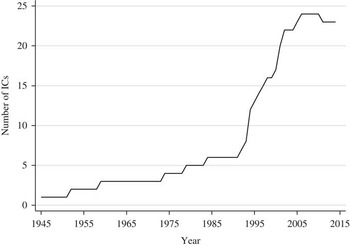
Today ICs are a prominent and influential element of governance across and beyond the state. International courts are defined here as permanent international judicial bodies that meet the following criteria: (1) decide the question(s) brought before them on the basis of international law; (2) follow predetermined rules of procedure; (3) issue legally binding outcomes; (4) are composed of independent members; and (5) require at least one party to a dispute is a state or an international organisation.Footnote 42 In recent years, the number of international courts has grown significantly. Figure 1 illustrates the expansion of ICs over time. Only one IC, the International Court of Justice (ICJ), existed in 1950.Footnote 43 By 1990, there were a total of six ICs.Footnote 44 The number of ICs peaked in 2006, when there were 24. After the disbanding of the Tribunal of the Southern African Development Community (SADC) Tribunal in 2010, there were 23 international courts at the end of 2014. In addition to the numerical increase, ICs merit attention when examining world politics because they often play active and important roles in different issue areas, including the environment, trade, human rights, and armed conflict.
Number of ICs over time, 1945–2014.

Given that global democratisation involves giving affected individuals and collectives a say in the rules that govern their lives, there are several specific reasons for looking at ICs. First and foremost, ICs are central to dispute settlement in international relations. While ICs were traditionally designed only to settle disputes between state parties, today their role often extends to include disputes between private parties and states (for example, human rights courts tend to have jurisdiction over disputes between private actors and a state). Even when disputes do not include non-state parties, the outcomes of the judicial proceedings can have a profound effect on individuals and collectives.Footnote 45 In this vein, ICs have been called upon to adjudicate an unprecedented number of disputes. Karen Alter concludes that through 2011, there have been a total of 37,236 binding rulings issued by ICs in contentious cases.Footnote 46
Second, beyond settling disputes, ICs fulfill several other roles that affect international and national authority. Laurence Helfer identifies several, including ‘exercising constitutional, enforcement, and administrative review; stabilising normative expectations and legitimating the exercise of public authority; improving state compliance with primary legal norms; engaging in judicial lawmaking to clarify or expand substantive obligations; and enhancing the legitimacy of international norms and institutions, including of ICs themselves.’Footnote 47 As such, ICs may promote the goals of an IO or regime. The Court of Justice of the European Union (CJEU) has been central to the institutionalisation of regional integration in Europe.Footnote 48 Similarly, the World Trade Organization (WTO)’s Dispute Settlement Mechanism (DSM) has facilitated trade relations globally and is often viewed as one of the most successful elements of the WTO.Footnote 49 Research on international criminal tribunals also suggests they can deter violence and contribute to the building of domestic democratic processes.Footnote 50
Third, in conjunction with interlocutors, ICs can improve state compliance with international commitments and thus help to address global problems. We can see that the European Court of Human Rights (ECtHR) and Inter-American Court of Human Rights (IACtHR) have contributed to reforms in law and policy governing the rights of individuals.Footnote 51 For example, Laurence Helfer and Erik Voeten have shown the transformative effects of the ECtHR on LGBT rights across Europe.Footnote 52 These issues bear directly on the rules governing individuals.
Fourth, ICs contribute to world politics by clarifying and developing international legal obligations. Through the process of legal interpretation and adjudication, ICs can transform international law through sometimes incremental, minor forms of legal clarification and at other times through more active lawmaking. For example, the ICJ and the International Criminal Tribunal for the former Yugoslavia (ICTY) have asserted that laws of war apply to internal conflicts.Footnote 53 Likewise, the CJEU extended the scope of EU law to include human rights.
Finally, ICs – especially those with compulsory jurisdiction and access for private litigants – have strengthened an international rule of law and contributed to the judicialisation of world politics.Footnote 54 These are only a few of the ways we can observe the effects of international courts on transnational authority. Against this backdrop, we consider if ICs can promote global democratisation by focusing on how ICs are designed to integrate the principles of equal participation, accountability, and public justification in world politics.
International courts, institutional design, and global democratisation
Equal participation
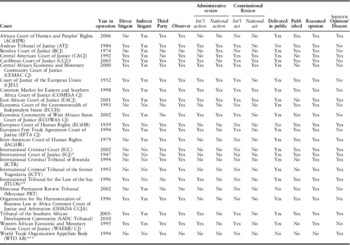
ICs can bolster global democratisation by engendering possibilities for individuals to participate in how transnational authority is exercised. To assess how ICs foster or impede equality of participation, we analyse the institutional design features that condition access to the courts. As Rachel Cichowski argues, an ‘important factor in understanding how courts can change participatory politics is the degree of access the public has to legal institutions’.Footnote 55 Formal rules governing access for stakeholders, in other words, are the institutional condition to participation. Recent research has noted that access correlates strongly with participation and has been an essential activity of international courts.Footnote 56 Moreover ICs with non-state actors’ access tend to have the majority of their cases filed at the request of non-state actors, and many of these ICs also have larger caseloads than their counterparts with less access.Footnote 57 We draw from our original dataset on formal rules of ICs to examine how international courts enable opportunities for participation. We look at the data on formal rules that regulate private, non-state actors’ access to international judicial proceedings. All ICs that have been in operation between 1945 and 2015 are included (N=24).Footnote 58 The coding of access rules is based on the treaties and protocols establishing international courts, the rules of procedures of ICs, as well as some case law that established new access measures (which applies only in a few instances). Informal access options are excluded from the dataset because they are not dimensions of institutional design. Nevertheless, informal access may provide important modes of participation (discussed below).
There are four general types of formal rules that regulate access to international courts.Footnote 59 These rules govern who can participate in judicial proceedings and in what capacity. The first type of rule addresses whether private, non-state actors can act as a direct litigant. Rules that allow stakeholders to become direct litigants are those that grant them opportunity to directly file a petition to a court to have a complaint heard by the court. Several courts are designed to grant stakeholders privileges to participate as a direct litigant, including the ECtHR, the Andean Tribunal of Justice (ATJ), the Central American Court of Justice (CACJ), among others.
Second, there are rules governing indirect litigants, which specify whether private, non-state actors can become a litigating party through referral of their case to an IC by a public authority. These rules differ from direct litigant access, where a stakeholder can directly petition an IC, because the stakeholder has access indirectly through a referral mechanism. Such rules include instances where a stakeholder can become an indirect litigant through a referral by a national court. Rules granting access as an indirect litigant through a national court referral are common to many regional trade courts, and are best exemplified by the CJEU’s preliminary ruling procedure. Similarly, indirect litigant access can be defined by rules that require an intergovernmental commission, in combination with the acceptance of the court’s jurisdiction by the relevant member state, to refer a case to the court. This form of indirect litigant access is common to international human rights courts. For example, six states have accepted the jurisdiction of the African Court of Human and Peoples’ Rights (ACtHPR) to review an individual petition. A similar procedure exists for the IACtHR, as well as for the ECtHR prior to 1998.
The third type of rule to govern access, and thus act as an institutional condition to participation, are those that regulate whether private, non-state actors can act as a third party in a case before an IC. Third parties can either be interveners or amicus curiae. While the privileges of an intervener are different from amicus, these are similar in that they offer a non-litigant the opportunity to voice their position on a case to the court. Many ICs provide third party privileges to stakeholders, including the IACtHR, the CJEU, and the ECtHR.
A fourth type of rule governing access to ICs regulates whether stakeholders can observe court hearings. This type of rule is specified by provisions that determine if an IC’s oral hearings are to be held in public, thus allowing stakeholders to observe the proceedings of that IC.Footnote 60 Many ICs allow for the public to observe hearings as a general rule. Yet, where the general rule is for public hearings, there are most often exceptions for closed proceedings. For example, the Statute of the International Court of Justice states that ‘[T]he hearing in Court shall be public, unless the Court shall decide otherwise, or unless the parties demand that the public be not admitted’ (Article 46). Conversely, some ICs, such as the WTO panels and Appellate Body (AB), operate with the general rule that proceedings are closed, and thus restrict private, non-state actors’ access to judicial proceedings.Footnote 61
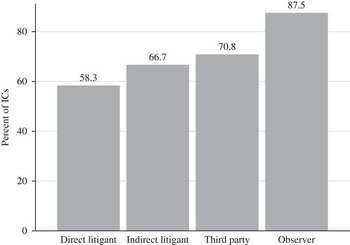
Figure 2 illustrates the percentage of international courts that feature each of the four types of access as of 2015.Footnote 62 As the figure shows, most ICs (87.5 per cent) operate with the general rule that hearings are held in public, and thus allow private non-state actors to participate as observers. In fact, only three ICs do not have a general rule that oral proceedings of the court are to be held in public – the WTO panels and Appellate Body (AB), the Benelux Court of Justice (BCJ), and the Mercosur Permanent Review Tribunal (PRT). On the other hand, direct litigant privileges are the least common form of access to ICs. Today, more than half (58.3 per cent) of international courts are designed with access for stakeholders to participate as direct litigants. Direct litigant access is usually featured by regional trade courts. The ECtHR also features this form of access. Our data also reveal that all 24 ICs feature at least one type of access, six ICs feature three types, and nine feature all types of access (not shown).
Percentage of international courts with stakeholders access (by type, 2015) (N=24).

These various access provisions provide affected parties with opportunities for participation. First, direct, and indirect litigant access can enable stakeholders to participate in shaping public agendas in world politics. The ability to shape public agenda can be viewed as a form of democratic participation.Footnote 63 Direct and indirect litigants shape the agenda of ICs because petitioning a court contributes to what issues are on its docket. Individuals’ and societal groups’ petitions to ICs, either directly or indirectly, have transformed the agendas of ICs in several instances. For example, direct and indirect litigants have put human rights issues on the dockets of regional trade courts. This has occurred for the East African Court of Justice (EACJ).Footnote 64 Recent petitions brought before the Caribbean Court of Justice (CCJ) have brought human rights issues to the original jurisdiction of the court.Footnote 65 Similarly, referrals to the CJEU led to women’s rights entering into the policy domain of the European Union and the CJEU.Footnote 66
In other words, the participation of individuals and groups in international judicial proceedings, especially as litigants, contributes to an IC’s agenda in ways that states could not, or would not. Private litigants have incentives to bring claims against non-compliant states, whereas states can have disincentives to do so. This opens up the possibly to mitigate the democratic deficit exacerbated by cross-national spillovers. Concerns for retaliation can prevent states from filing claims against fellow member states. Citizens, however, have incentives to do so, especially when they have seen only blockage through other channels of mobilisation.Footnote 67 Indeed, it is questionable whether many issues would have come to international courts if it were not for the opportunities presented by access.
While participation as direct and indirect litigants contributes to shaping an IC’s agenda, the democratising effects on world politics are much broader. This occurs in several ways. First, litigation before ICs can serve as a catalyst for mobilisation and participation in other domestic settings. Second, it can also lead to changes in international rules. For example, the CJEU’s early rulings on women’s rights contributed to mobilisation of civil society organisations and secondary legislation by the European Union governing gender equality rights and environmental protection.Footnote 68 Similarly, we have seen how the early referrals to the IACtHR on enforced disappearances preceded and contributed to later international efforts to establish binding law on the prohibition of enforced disappearances. Thus, direct and indirect litigant privileges enable citizens to participate in defining what lies on the agenda of international courts, and thus on broader public agendas in world politics.
Direct and indirect litigant access, as well as third party privileges, also allow for democratic participation by presenting stakeholders with the opportunity to present a voice in decision-making. These three forms of access give affected persons opportunities to present both factual information and legal arguments as well as introduce valuable perspectives that can contribute to decision-making by ICs. Stakeholders are often well-equipped to contribute to the information that judges have to make their decisions for two reasons. On one hand, non-state stakeholders have valuable resources that judges or state parties do not. In particular, these resources include scientific expertise, local knowledge, and sector-specific information. On the other, stakeholders contribute to the representation of a diverse set of societal perspectives that are otherwise missing from judicial proceedings. As Armin von Bogdandy argues, courts are not representative institutions because of the requirements of independence and impartiality.Footnote 69 Nevertheless, judges should consider societal convictions and interests when adjudicating. Third party access, especially, can serve as a vehicle for these convictions and interests to enter into the judicial process. Sarah Williams and Hannah Woolaver find that ‘[A]micus can be very useful in ensuring that the perspective of these groups [victims and groups within society] is heard’ during international criminal tribunals’ proceedings.Footnote 70 Thus, third party access may compensate for an IC’s inability to be a representative institution and help to integrate societal perspectives into judicial decision-making.
Access to observe the hearings of international courts can also bolster participation. While seemingly minor, open proceedings enable international judicial proceedings to become salient to the broader public. Public observers are likely to include media, bringing an international decision-making process into the public sphere. Similarly, third party access can improve democratic participation by also building a public sphere around international court proceedings.Footnote 71
While IC access rules can foster participation beyond the state, participation may be impeded by various issues that inhibit the realisation of global democratisation in practice. Access to ICs, especially as a litigant, requires that some personal interest in a dispute be demonstrated and that the dispute meets specific admissibility or standing requirements. This is distinct from other forms of democratic participation, which generally only hinge on citizenship, rather than interest.Footnote 72 While access rules treat individuals equally based on citizenship, it is then restricted to those individuals who can demonstrate an interest while fulfilling admissibility criteria. This clearly restricts the scope of litigants to those capable of articulating how their interests are affected. While this is problematic in some ways, it also speaks to the potentiality of ICs in helping delineate demoi beyond state boundaries.
Equal participation through ICs is also impeded in practice by factors such as monetary and epistemic resources, or even physical proximity to an IC that structurally disadvantages some individuals and groups more than others. At the domestic level, litigation is costly and demands knowledge of the law as well as expertise in how to navigate the legal system. International litigation is also demanding of resources, in addition to being extremely remote from the average person. These factors – funding, knowledge, and geography – can all substantively undermine the potential of democratic participation by affected parties. Some additional design features, such as a travelling court (for example, a feature of the Caribbean Court of Justice) or legal aid, can however compensate for such structural disadvantages and be used to improve the opportunities and equality of participation featured by ICs. Similarly, some may argue that those societal actors who participate through courts lack democratic credentials. While this may be the case, judges usually have the discretion to determine whether such actors’ views should be disregarded.
Despite possible shortcomings, access to ICs provide an important means of participation in world politics. There is also previous scholarship suggesting that private non-state actors are in practice accessing ICs to challenge the exercise of transnational authority.Footnote 73 It remains clear, however, that the design of access rules affect the terms of participation. Direct and indirect litigation enable deeper participation that can extend to agenda-setting. Alternately, third-party and observer status is a more limited form of participation, perhaps enhancing representation. When these various access designs are featured in conjunction, participation is heightened even further. As such, the design rules of ICs on access effects the equality of participation offered to individuals. Thus ICs can improve equal participation in a shift toward global democratisation, but the mechanisms of access condition the depth and equality.Footnote 74 Moreover, while design rules condition the attainment of democratic participation through ICs, additional epistemic, geographic, and resource-based factors enable and constrain the practice of global democratisation.
Accountability
ICs can also bolster the practice of accountability in global governance by safeguarding and ensuring that transnational authority is exercised according to established standards vis-à-vis affected agents. Ruth Grant and Robert Keohane suggest that courts, including international courts, are a type of accountability mechanism.Footnote 75 We agree with this assessment and identify more specifically how they can be used to hold states and international actors and institutions to account, thus facilitating global democratisation.
ICs have two types of powers that enable them to serve as an accountability mechanism in world politics and grant democratic control to affected parties. First, some ICs have been designed with the power of administrative review. These ICs ‘have jurisdiction to assess the validity of administrative decisions and a corresponding authority to annul illegal administrate actions’.Footnote 76 International administrative review is one way in which state and IO authority can be checked and protected against arbitrary decisions. Specifically, ICs with administrative review assess whether administrative decisions abide by procedural rules and correctly apply the law. In practice, international administrative review by an IC is exercised when a court declares an administrative decision to be illegal and, in some instances, requires compensation for the wronged. We are interested in both reviews of international and national administrative decisions as both cross-national spillovers and the authority of IOs can contribute to the global democratic deficit. However, the degree to which ICs have the power of administrative review varies. While some ICs have authority to annul both international and national administrative decisions, others have only one form of administrative review and some have no delegated administrative review.
Second, some international courts have been designed to have the power of constitutional review, or the jurisdiction to assess the validity of legislative acts.Footnote 77 As many IOs are able to produce legislative output (for example, resolutions, directives, and regulations), constitutional review can play an important role in safeguarding that international legislative output does not conflict with higher order legal principles such as an IO’s constitutive treaty, general principles of law, or human rights norms. ICs can also have the power to review and annul national law. The extent to which ICs have these constitutional review powers differs; some are designed with these powers while others are not. Those with the authority of constitutional review have been known to exercise this authority, albeit infrequently.Footnote 78 Constitutional review by ICs allows stakeholders to challenge international and national legislation and when an IC finds in their favour the act is nullified.
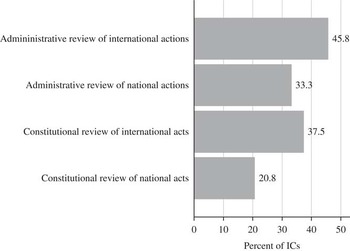
Figure 3 illustrates the distribution of ICs designed with administrative and constitutional review powers, and thus the potential to operate as an accountability mechanism where domestic and international decisions are evaluated.Footnote 79 As Figure 3 shows several ICs (46 per cent) have the authority to review international administrative actions, and roughly 38 per cent can review international legislative acts. Fewer ICs have the power to declare void the actions or acts of states. One-third of ICs can review the actions of national authorities, while 21 per cent can review national legislative output. Regional courts embedded within regional economic and trade organisations are especially central to understanding how accountability is practiced through international courts. On the face of it, issues such as human rights are often outside of the accountability mechanisms provided by ICs because administrative and constitutional review tends to be provided by regional trade courts. However, several regional trade courts have either been granted or expanded their jurisdiction to include human rights issues, including the EACJ, SADC Tribunal, CJEU, and others.
International courts with administrative and constitutional review (N=24). Source: Coding is based on Alter, The New Terrain of International Law.

Where ICs do not have the authority of constitutional and administrative review, their ability to hold other sites of transnational authority accountable are formally limited. Nonetheless, despite not having explicit powers to nullify national administrative decisions, several courts exercise a form of administrative review in practice when declaring national authority has contravened international legal obligations. For example, the WTO DSM and international human rights courts hold states to account for laws, policies, and actions that may violate international trade law and international human rights law.Footnote 80 ICs that can declare national administrative actions contravene international obligations, according to either substantive or procedural standards, act as a check on national authority.Footnote 81 Also, while international criminal tribunals do not directly hold transnational authority to account (as they are mandated to hold individuals accountable), they indirectly ensure some kind of accountability for national authority (both as it is exercised within state borders and across), through the prosecution of heads of state and other actors who act as agents of the state.
When ICs can review the actions of domestic or international administrators or the validity of international legislative output, they have the potential to advance global democratisation through practices of accountability. Many courts do have these powers, indicating that ICs can hold other IOs or states to account based on predetermined standards. When these powers are held in combination with access for private non-state actors, ICs are able to serve as an accountability mechanism that is available to individuals and societal groups. In fact, the powers of administrative and constitutional review most often coincide with access provisions. All ICs with administrative review have compulsory jurisdiction and access for direct and indirect litigants, meaning that individual stakeholders can use litigation before these international courts to challenge administrative decisions.Footnote 82 Similarly, constitutional review is also common to ICs with compulsory jurisdiction and access for direct and indirect litigants. In most instances, constitutional review can be initiated by individual stakeholders.
As with equality of participation, though, the ability to hold international actors to account and curb arbitrary power through ICs does suffer from some pitfalls. First, as previously mentioned, non-state actors’ use of ICs may be limited by factors such as monetary and epistemic resources. These limitations provide a substantive critique of global democratisation by suggesting, as Dingwerth does, that issues of education and subsistence are required to make use of democratic procedures. While we agree with this, improvements in health, education, resource distribution, and so on can also be promoted by formal rules of accountability.Footnote 83 In other words, there is likely a mutually beneficial relationship between giving individuals formal rights of participation and accountability in ICs and the substantive improvement in life prospects for affected individuals that deserve consideration by designers.
Second, even when ICs are designed to have the power of administrative and constitutional review, they face many political constraints that limit the extent to which they utilise this power in practice. This can include the ability of other IOs to exercise informal forms of power over the judicial process of different ICs and intransigence on behalf of states to follow IC decisions. This is not a problem inherent to ICs, but rather an issue that afflicts the decision-making of all IOs. However, problems surrounding how informal power politics might contribute to the global democratic deficit certainly warrant more attention. This speaks to the role of ICs as part of a broader division of labour for global democratisation. If IOs and states exercise informal power over the decision-making procedures or outputs of Ics, then their role as accountability wielder – through both administrative and constitutional review – is severely dampened. At the least we suggest that informal power between states, along with limitations to individuals, will be factors that determine how well the design rule of administrative and constitutional review play out in practice.
Third, not all international organisations fall within the purview of international courts, as defined here. This means that many sources of authority in global governance do not have corresponding accountability mechanisms similar to that of ICs. On the other hand, several international organisations have quasi-judicial processes or bodies that can in some ways hold international authority to account. For example, in the area of development, the World Bank has the Inspection Panel and the Asian Development Bank the Compliance Review Mechanism.
Despite these pitfalls, accountability in world politics is, we argue, greater with international courts than without, and thus ICs are critical for global democratisation. Administrative and constitutional review powers are the core design features that enable international courts to offer a series of checks-and-balances on the use of arbitrary power by Ios and other state actors. Moreover, when these review powers can be initiated by individual stakeholders, as opposed to only states, the ability of an IC to serve as a democratic accountability mechanism is heightened by giving affected parties avenues to shape decision-making (and the interpretation of existing rules) beyond the state. This again indicates that institutional design is critical in bolstering accountability, strengthening the links between individual participation and accountability, and ensuring robust democratic practice beyond the state.
Public justification
International courts may also contribute to global democratisation through practices of public justification. As Jürgen Habermas has consistently suggested, it is the public use and justification of reasoning which sits at the core of democracy.Footnote 84 A characteristic of judicial decision-making is that judges explain the reasoning of their decisions and deliver their decisions publically. Even when judicial decisions are not elaborate in their reasoning, they nonetheless specify the legal basis for their decisions. ICs are no exception. In fact, ICs are often (though interestingly not always) required by a matter of their constitutive treaties or rules of procedure to make decisions public and identify the reasons of their decisions. As a consequence of these two requirements, ICs are uniquely positioned to bring public justification to the decisions that govern international politics.
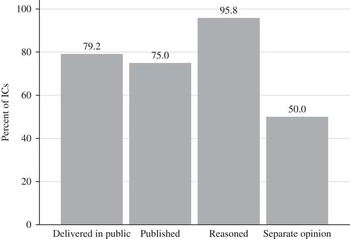
To assess the extent to which ICs are designed to provide public justification, we draw again on our original dataset looking at ICs’ formal rules on the publicity and reasoning of court judgments. Specifically, the dataset codes formal rules on: (1) whether decisions are to be delivered in a publically open session of the court; (2) if decisions are formally required to be published, at least in part; (3) whether decisions are to be reasoned; and (4) if separate (concurring or dissenting) opinions can be issued by judges.Footnote 85 Figure 4 shows what percentage of ICs feature each of these various rules.
Percentage of ICs with formal rules on publicity and reasoning of decisions (N=24).

As Figure 4 highlights, most ICs are formally required to make their decisions public in some manner. Seventy-nine per cent of ICs are required to issue their decisions in a public session, while seventy-five per cent must publish their decisions. In many instances, where one of the requirements of publicity is missing, it is compensated by a requirement to make their decisions public according to the other means. For example, the most recent version of the ECtHR’s rules of procedure does not require that decisions be delivered in open court, yet decisions are required to be published. In fact, the only IC that does not have formal rules to issue decisions in public or to publish them is the WTO Appellate Body (AB). Yet, the WTO AB’s reports are all publically available. Many courts also make their decisions public in practice through publication on their websites, despite the formal rules. This suggests that some informal practices can develop along democratic lines even if formal measures are not codified.
Having decisions made public is only one aspect of how ICs practice public justification. ICs, in conjunction with publically-issued decisions, give reasoned decisions. As Figure 3 shows, roughly 96 per cent of ICs are required by formal rules to provide reasoning to their judgments. The one instance where this is not the case is the WTO AB (though the ad hoc panels are required to do so). Even without the formal requirement, however, the AB in practice does provide reasoned judgments. Reason-giving by ICs however varies in terms of quality as well as their mode and logic. In addition, ICs vary in whether separate opinions can be issued; Figure 4 illustrates that half of ICs are allowed to issue separate (or dissenting) opinions.
We argue that the combination of making decisions public and explicating the reasoning of a decision advances the value of public justification in democratic ways. First, giving reasons for a decision is a device for informing the public of what the decision-maker is doing and why, while also controlling the use of discretion. When giving reasons decision-makers are ‘likely to make more reasonable decisions than he or she otherwise might and is more subject to public general surveillance’.Footnote 86 This is similar to the notion that open deliberation generates a ‘civilising force’ to avoid being hypocritical or exercising arbitrary power.
Second, the virtues of reciprocity and generalisability stand at the core of justified reason-giving, especially in the deliberative democratic tradition.Footnote 87 Providing reasons that take consideration of dissenting opinions is clearly an institutional embodiment of both reciprocity and generalisability by framing decisions and arguments in terms acceptable to other parties (reciprocity) and linked with precedent or other institutional laws (generalisability). In other words, reason-giving by courts resembles collective deliberation because it presents the public with a considered decision incorporating opposing positions.Footnote 88 While a court considers opposing positions in deliberations, their expression in a court’s official judgment may not be explicit. When a separate or dissenting opinion can be issued, there is greater guarantee that opposing or alternative viewpoints will be expressed. While there is some argument to whether separate and dissenting opinions can destabilise international adjudication, scholars have argued that separate or dissenting opinions improve reason-giving.Footnote 89
Third, the reasoning offered – and the scope of judicial decisions – may also catalyse public discussion. Cass Sunstein argues that, ‘case-specific judgments operate as a kind of “remand” to the public for further proceedings, at least in the sense that they do not foreclose those proceedings and may even spur them through the visibility of court decisions’.Footnote 90 ICs are often limited to case-specific judgments, especially when their judgments are not binding on parties other than the litigants. That said, the reasoned judgments provided by courts might frame future public debates, if not public decisions.
Again, there are limitations to this value. A pitfall of court-based public justification is that reason-giving is often embedded in an inaccessible legal discourse, and thus may not always be directly intelligible for the broader public. Affected individuals are often unable to access or decipher complex legal decisions. This makes it more difficult for affected parties to understand the ramifications of IC decisions. As such, the broader effects of reason-giving are conditioned by the public dissemination and translation of court judgments. Publically-issued decisions and publication are thus crucial to the ability of ICs to incorporate the value of public justification.
Second, the actual deliberative quality of public decisions is typically not scrutinised closely. Consequently, judicial reasoning may be shaped by strategic negotiation among judges and their own policy preferences. The requirement of reason-giving and publicity can compensate for these pitfalls, and fosters decisions that are generalisable and reciprocal. In other words, the separate elements of public justification – publicity and reasoning – offer the most democratising leverage when taken together because publicity helps to moderate overt strategic and particularistic decision-making. Moreover, the incorporation of dissenting opinions is also critical for ensuring that arguments are subjected to the give-and-take of deliberative democratic reasoning. Given that only 50 per cent of ICs ensure that separate opinions can be issued, though, suggests that there is much more scope and leverage for ICs to enhance global democratisation.
Public justification, as we have shown here, can be a feature of institutional design. Moreover, it is one that is commonly embedded in the designs of ICs, enabling them to advance global democratisation. The greater the provisions for publicity of decisions and reasoning, especially how dissenting views can and should be incorporated into judicial decision-making, the stronger the practice of public justification becomes and thus the greater the contribution ICs have for global democratisation. As a result, the connections between public justification and the other democratic values – equal participation and accountability – run deep. This speaks to the need to think about ICs as part of a broader process of global democratisation. Institutional rules can and should be designed in symbiotic ways. Public justification provides equal respect for individuals who participate as well as audiences who view the decision-making. Providing individual direct or indirect litigants with public reasons for decisions provides depth to the quality of equal participation. Public decisions on matters of administrative and constitutional review offer international actors a fair and transparent platform to understand the rationale of decision-making. Again this highlights the importance of ICs in a division of labour for global democratisation. While given powers of constitutional and administrative review over other IOs and states, it is important to check this power of ICs (and not through the informal power of states and IOs that they are supposed to regulate). Providing avenues of access and reasoned justification goes a long way to safeguarding the emergence of global democratisation.
Conclusion
In conclusion, we make three points. First, this article has explored if, how, and under what conditions ICs contribute to the emergence of democratic values beyond the state. Drawing from three prominent strands of democratic theory and a synthesis of recent literature, we found evidence that ICs help promote global democratisation by: enhancing equality of participation for affected actors; holding other international actors to account thus dampening arbitrary power; and offering public reasoning. Our analysis did not presume that these three values were the correct values to regulate ICs or link ICs with global democratisation.Footnote 91 But drawing from our dataset and supplemented with case-specific evidence, we have found strong evidence that ICs do embody these values beyond the state. That said, the relationship between all three values and ICs were contingent upon the canvassed features of institutional design and issues of implementation. We identified procedural and substantive limitations to the attainment of each value, thus suggesting that further conditions need to be met for global democratisation to progress fruitfully. Ultimately, though, we suggest that global democratisation is far from a chimera, but rather a tangible set of values that can be actively strived toward.
Second, the article speaks directly to literature in international law on the democratic legitimacy of ICs themselves. Although space constrains a full exploration, authors such as Armin von Bogdandy, Ingo Venzke, Nienke Grossman, and many others have probed how the authority exercised by ICs can be democratically legitimated in the absence of an encompassing national framework.Footnote 92 These authors often highlight the same features we have, especially access and public justification, as key to the internal democratic legitimacy of ICs. Our arguments here all speak to the fact that the authority of ICs can be democratically legitimated through equal participation of stakeholders, curbing arbitrary power, and providing public reasoning for decisions. But more importantly our article also speaks to the role of ICs in the broader landscape of global democratisation, the potential role they could play in a division of labour, and the factors inhibiting realisation in practice.
Finally, the article has several limitations that provide future avenues for research. Democratically speaking, equal participation should be offered to those affected by decisions. Although we have touched upon the issue, future work should delve into more detail about who precisely is given rights of access to ensure that those most in need of participation and representation have their interests considered. This will speak to recent literature concerned with how multiple demoi emerge across and beyond the confines of the nation state.Footnote 93 Likewise, accountability mechanisms should themselves be justified to those affected by decisions. Moreover the deliberative quality of public reasoning by ICs should be subject to greater scrutiny. Content analysis and other quantitative measures (such as the Discourse Quality Index) offer ways forward on this front.Footnote 94 It is through this type of indepth analysis that the normative foundations of global democratisation can be assessed with more rigour.
Acknowledgements
The authors are grateful to the editors and two reviewers for this journal. Excellent comments were also offered by Andreas Føllesdal, Daniel Archibugi, Johan Karlsson Schaffer, and Silje Aambø Langvatn along with the PluriCourts seminar participants. This research was made possible by: the Research Council of Norway through its Centres of Excellence Funding Scheme for a project entitled ‘PluriCourts: The Legitimacy of the International Judiciary’ (Project No. 223274); the Swedish Research Council (Project No. 421-2011-1862) and Formas (Project No. 2011-779) for the research project ‘Non-State Actors in the New Landscape of International Climate Cooperation’, and finally; the Marianne and Marcus Wallenberg Foundation for the grant ‘The Democratization of International Organizations through the Involvement of Transnational Actors: Which? How? Why?’. The authors acknowledge equal contribution to this article and, as always, any remaining errors are ours.
Supplementary Material
To view supplementary material for this article, please visit http://dx.doi.org/10.1017/S0260210516000218
Appendix