Implications
Climate change and adapting to climate change (via heat stress management) will have a profound impact on household income and food security. Relief strategies that required low capital investment were least effective at preventing losses in milk yield. However, due to their low cost of implementation such strategies provided farmers with more income. Feed cost was a significant determinant of profitability. This study questions national breeding policy as advocating high producing exotic breeds will limit the long-term sustainability of the dairy sector.
Introduction
Since the commencement of Operation Flood in the 1970s, India’s bovine milk production has increased by 84% (111.2 million tonnes) (Government of India, 2014). Between 1999 and 2013 the average yield of exotic crossbreeds and indigenous breeds has increased by 9.18% (0.59 kg) and 24.87% (0.47 kg), respectively (Government of India, 2006 and 2014). Exotic crossbreeds yield 7.02 kg/cow per day whilst indigenous breeds yield 2.36 kg/cow per day (Government of India, 2014).
Operation Flood focussed on smallholders (owning <2 ha) who are responsible for 70% of India’s bovine population (Datta et al., Reference Datta, Shrestha and Chokkalingam2015) and produce 80% of the milk (Cunningham, Reference Cunningham2009). A feature of Operation Flood was the advocacy and introduction of exotic breeds for crossbreeding with indigenous breeds. The crossbreeding of indigenous breeds with higher-yielding exotic breeds became national breeding policy. By 2012–13, crossbred cattle represented 28.4% of the milking cow population (Government of India, 2014). However, as climate change become more severe, the pro-production (see Heffernan et al., Reference Heffernan, Salman and York2012) policies of Operation Flood may have placed dairy producers in a precarious position.
The temperatures expected under climate change will precipitate heat stress and cause declines in productivity. By 2020, heat stress will decrease milk production from India’s dairy cows by 0.73 million litres (Upadhyay et al., Reference Upadhyay, Mohini, Kansal, Singh, Ashutosh, Sirohi and Kumar2007). Heat stress is measured against a temperature–humidity index (THI), a combined measure of temperature and humidity to denote thermal comfort (Berman, Reference Berman2011). The THI threshold above which decreased milk yield is observed in Holstein Friesian cows is accepted to be 72 (Igono et al., Reference Igono, Bjotvedt and Sanford-Crane1992; Ravagnolo et al., Reference Ravagnolo, Misztal and Hoogenboom2000). No widely accepted THI threshold values exist for other dairy cattle types. However, the Jersey (Bryant et al., Reference Bryant, Lopez-Villalobos, Pryce, Holmes and Johnson2007; Smith et al., Reference Smith, Smith, Rude and Ward2013) and dairying Bos indicus breeds (such as Sahiwal and Gir) are considered less susceptible to heat stress (Sirohi and Michaelowa, Reference Sirohi and Michaelowa2007; Upadhyay et al., Reference Upadhyay, Mohini, Kansal, Singh, Ashutosh, Sirohi and Kumar2007).
The heat tolerance of B. indicus breeds is derived from a raft of physiological adaptations (such as propensity to sweat, size of sweat glands and coat type) that help the animal dissipate metabolic heat (Thornton et al., Reference Thornton, van de Steeg, Notenbaert and Herrero2009). Some commentators argue that the heat tolerance of B. indicus breeds is a function of productivity; the lower the level of milk production, the lower the quantity of metabolic heat produced (Berman, Reference Berman2011). The low productivity of Indian cows would afford some level of heat tolerance. However, heat tolerance as a function of productivity does not adequately explain the role of physiological adaptations associated with B. indicus breeds.
Indeed, selection of Gir cows for increased milk yield reduces heat tolerance (Santana et al., Reference Santana, Pereira, Bignardi, Filho, Menéndez-Buxadera and El Faro2015). Over 30 years, the Brazilian Gir breed improvement programme increased population productivity by 0.22 kg/year, whereas heat-stress-induced yield declines of 0.019 kg/year (Santana et al., Reference Santana, Pereira, Bignardi, Filho, Menéndez-Buxadera and El Faro2015). Thus, as productivity improves metabolic heat appears to overwhelm physiological adaptations. However, the literature is not clear as to whether B. indicus breeds are more (or less) heat tolerant than Bos taurus breeds at similar production levels. Despite this gap in knowledge, yield improvement via exotic genetics poses a significant challenge to maintaining heat tolerance characteristics within India’s cattle.
The Indian state of Odisha is characterized by a high incidence of poverty (35.69% of rural households) (Government of India, 2014) and heavy investment in livestock production (Datta et al., Reference Datta, Shrestha and Chokkalingam2015). Odisha is ranked amongst those states considered most susceptible to the effects of climate change (Upadhyay et al., Reference Upadhyay, Mohini, Kansal, Singh, Ashutosh, Sirohi and Kumar2007). For example, O’Brien et al. (Reference O’Brien, Leichenko, Kelkar, Venema, Aandahl, Tompkins, Javed, Bhadwal, Barg, Nygaard and West2004) found significant portions of Odisha’s agricultural lands to be vulnerable. Annual heat stress in Odisha is expected to cost crossbreed producers Rs. 1775.56/head, whereas producers reliant on indigenous cows will experience declines of Rs. 33.91/head (in 2007 prices) (Upadhyay et al., Reference Upadhyay, Mohini, Kansal, Singh, Ashutosh, Sirohi and Kumar2007).
Climate change is also expected to indirectly affect livestock production via complex effects on plant growth. However, within India the situation is simplified by chronic feed shortages (Government of India, 2013). Deficiencies of green fodder, dry fodder and concentrates are in the realm of 62%, 23% and 63%, respectively (Sharma et al., Reference Sharma, Tyagi, Singh and Mandal2011). Indeed, climate change (via CO2 fertilization and altered precipitation patterns) coupled with technological advances and improved plant breeding may increase feed availability. However, it is unlikely that improvements will be significant enough to reduce deficits and keep pace with demand. As such, the feed deficit is expected to increase (Pathak and Devakumar, Reference Pathak and Devakumar2011).
A simple deterministic model was developed to evaluate the influence of breed and heat stress relief options on smallholder dairy farmers in Odisha, India. A feed price scenario was modelled to illustrate the importance of feed in climate change impact estimation.
Material and methods
Model framework
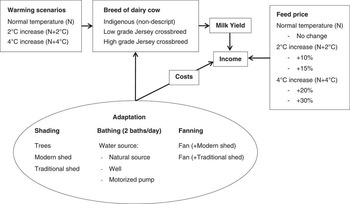
A deterministic model was constructed to examine the impact of heat stress on milk yield and household income at critical climate change temperature thresholds (+2°C and +4°C). The influence of breed (indigenous, low-grade Jersey crossbreed and high-grade Jersey crossbreed) and the effectiveness of microclimate heat stress management strategies (shading, bathing and fanning) in protecting household income were also examined. Feed availability was considered via a pricing scenario assuming that climate change will increase the price of feeds. The model framework is shown in Figure 1.
The simple deterministic model design outlining the various adaptations and feed availability scenarios under investigation for smallholder dairy producers in Odisha, India.

Household-level sampling and data collection
Villages were randomly selected within the high potential dairying zone surrounding the state capital Bhubaneswar. Participating villages were within a 40-km area crossing two districts (Puri and Khurda) and characterized by sufficient water, market access and relatively reliable animal health infrastructure. In all, 115 cattle-owning households were purposively sampled from Puri (n=31) and Khurda (n=84) districts. Cattle ownership was the only selection criterion. Cattle-owning households were identified during key informant interviews with local community leaders. Sampling was not stratified. Households were smallholders maintaining a herd of less than five. Average herd size was 1.95 cattle aged 1 year or older. The survey was conducted in November 2012 in the local language (Oriya). All prices were in 2012 values. Responses were translated into English at the time of the interview. A voice recorder ensured all interviews were recorded verbatim. Interviews were transcribed into Microsoft Access 2010.
The interview
Farmers were asked a range of questions regarding the scope and impact of their dairying operation. Breed definitions (Jersey, 1/4 Jersey and Local) were farmer derived based on the phenotypic appearance of the animals. Farmers categorized cows based on phenotypic appearance. The Jersey crossbreed cows were categorized at two levels: a low-grade Jersey crossbreed and a high-grade Jersey crossbreed. The Jersey was considered as the high-grade Jersey crossbreed, the 1/4 Jersey as the low-grade Jersey crossbreed and the Local as the indigenous (non-descript) breed. B. indicus traits were required for a crossbred cow to be categorized by farmers as 1/4 Jersey. The genetic background of each breed could not be determined due to breeding practices. No attempt was made to determine breed beyond farmer definitions. The local indigenous breed is not a breed per se. Rather, it is convention to group B. indicus cattle not belonging to a described Indian breed together as non-descript. Buffalo were not considered as they only form 6.76% of Odisha’s dairy population (Government of India, 2014).
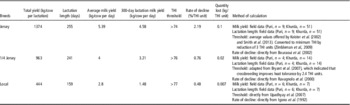
Farmers were also asked milk price and the average daily milk yield for each month of lactation. Responses were corroborated where possible with individual farm-level records supplied by local milk collection agents. However, as records contained sales information, the amount of milk kept for household consumption required farmer recall. Each value was multiplied by the number of days in the month to determine total milk production per lactation (Table 1). The resulting figure was divided by 300 (Moran, Reference Moran2005) to determine the average daily production over a standardized lactation length. Average lactation length could also be used to indicate daily milk production (Table 1). However, as a 300-day lactation is the international standard it was selected as the unit of analysis. Milk yields and price were converted into kg/day via a milk density factor of 1.033 (International Farm Comparison Network, 2015). The THI load and quantity of milk lost to heat stress using actual lactation length is provided in Supplementary Table S1.
The model parameter values for milk yield, the temperature–humidity index (THI) thresholds and rate of decline in milk yield

Jersey=high-grade Jersey crossbreed; 1/4 Jersey=low-grade Jersey crossbreed; Local=indigenous (non-descript) breed.
The THI threshold is the point at which declines in milk yield would be expected during periods of heat stress.
Temperature and temperature–humidity index
District-level meteorological data were procured for the period 2011–12 (Government of Odisha, 2013). Data included the mean daily minimum and maximum temperatures and relative humidity (RH%) at 0830 and 1730 h for each month. Although temperature and RH% for the district of Khurda was not specifically included in the data set, temperature and RH% data for Bhubaneswar were utilized instead. Data from Bhubaneswar and Puri district were used to create an average THI estimate. Daily or weekly meteorological data were desired. However, no such data could be located. Similarly, no long term (i.e. >10 years) district-level data inclusive of temperature and RH% could be identified to allow Climate Normal calculation.
A standard THI formula (Bryant et al., Reference Bryant, Lopez-Villalobos, Pryce, Holmes and Johnson2007) was used to combine temperature and RH%. Minimum temperature was used as it is the greatest determinant of heat stress in cattle (Igono et al., Reference Igono, Bjotvedt and Sanford-Crane1992; Keister et al., Reference Keister, Moss, Zhang, Teegerstrom, Edling, Collier and Ax2002; Bryant et al., Reference Bryant, Lopez-Villalobos, Pryce, Holmes and Johnson2007). Humidity recorded at 0830 h was matched with minimum temperature (Mohapatra et al., Reference Mohapatra, Swain, Dash and Behera2015). The mean minimum temperature for each month (N) was increased by 2°C (N+2) and 4°C (N+4) to simulate climate change.
Model parameters
Temperature–humidity index threshold and milk loss
The THI thresholds and rate of milk yield loss assumed are shown in Table 1. A total of 30 relevant documents were reviewed to determine values. Although a focus on the global south (India in particular) was desired, poorly described methodologies limited the usefulness of such documents. Thus, the sample was primarily composed (n=15) of peer-reviewed literature from the southern United States. Values that had relevance to the breeds under investigation were selected (i.e. a focus on Jersey cows (Keister et al., Reference Keister, Moss, Zhang, Teegerstrom, Edling, Collier and Ax2002; Smith et al., Reference Smith, Smith, Rude and Ward2013) and/or Indian B. indicus cows (Upadhyay et al., Reference Upadhyay, Mohini, Kansal, Singh, Ashutosh, Sirohi and Kumar2007)). However, limited robust research required additional inclusion criteria. Studies investigating lower-yielding cattle (e.g. Bouraoui et al., Reference Bouraoui, Lahmar, Abdessalem, Djemali and Belyea2002) or containing similar breeding themes such as crossbreeding (e.g. Bryant et al., Reference Bryant, Lopez-Villalobos, Pryce, Holmes and Johnson2007) were included. Milk price was Rs. 18.14/kg. The severity of heat stress was not expected to result in differing rates of decline (Key and Sneeringer, Reference Key and Sneeringer2014).
The transposal of values from higher-yielding cows risked inaccuracy. However, there is an absence of high-quality local data. Furthermore, the investigation is speculative, assuming the dairy sector will continue to implement northern production methods and breeds. Indian cows will become increasingly comparable with higher-yielding northern cows.
Calculating the temperature–humidity index load and heat stress impact on milk yield
The THI load refers to the total number of units above the threshold THI experienced throughout the year. In months which exceed the threshold, each day of that month was assumed above the threshold. An annual estimate of THI load was calculated for each breed by adding together the THI units above the threshold in each month. The THI load was multiplied by milk yield and rate of loss to determine total quantity of milk lost to heat stress.
Calving commonly occurs in the late winter to pre-monsoon (February to May) and post-monsoon (October to November) period. Cows calving in the October to November period avoid lactation during highest temperature periods. As breeding is not organized to avoid lactation during this time it was assumed cows would be lactating throughout the hottest period (i.e. May to September). Relief strategy cost was also considered in terms of productivity (Supplementary Table S2).
Heat stress relief strategy: shading
Two types of shade were considered: trees and a man-made structure (shed). To ensure maximum cooling capacity and animal welfare, each cow was provided with 4.65 m2 of shade. The model assumed tree shade increased the THI threshold by 1 unit, the modern shed increased the threshold by 2 units and the traditional shed increased the threshold by 3 units. Assumptions were derived from the studies by Reena et al. (Reference Reena, Triveni, Patel, Amitava, Chandran, Barari, Asit and Bharat2014) and Mohapatra et al. (Reference Mohapatra, Swain, Dash and Behera2015). The traditional shed is more effective at moderating microclimate temperature due to the rice straw thatched roof (Reena et al., Reference Reena, Triveni, Patel, Amitava, Chandran, Barari, Asit and Bharat2014; Mohapatra et al., Reference Mohapatra, Swain, Dash and Behera2015).
Trees
Field data were used to determine the purchase price of trees. As the trees will not reach maturity for a number of years, only trees planted more than 10 years ago were included. On average, households spent Rs. 9.75 to 58.52/tree (depending on species). The model assumed trees have now reached maturity. There was no labour cost as seedlings were planted.
The number of trees required to create 4.65 m2 of shade differed between species. The most expensive was papaya (Carica papaya) as nine trees were required (Rs. 490.68). Mango (Mangifera indica) was the cheapest as only one tree was required (Rs. 19.51).
Shed
The modern shed was made from modern materials such as concrete, bricks, iron roofing, whereas the traditional shed was made from locally available items such as bamboo, rice straw thatch.
Modern material sheds were found to cost Rs. 8700/cow, including all materials and land rental. The modern shed depreciated over 10 years, which is the length of time households had leased the land. Land rentals for the 10-year period were paid before construction. Construction labour costs were estimated from interviews. On average, 3-day labour was required. The total cost of labour for construction was Rs. 529.20 (Rs. 176.40/day).
The traditional shed construction cost was Rs. 3563.16 (including all materials). Land rentals were not included as traditional sheds were constructed on the households’ land. Construction took 1.5 days at a total labour cost of Rs. 264.60. The expected lifetime was 5 years due to the poor durability of construction materials. To improve comparability it was necessary to build a second traditional shed after 5 years. Field data indicated that the rice straw thatch would be replaced yearly at a cost of Rs. 730.63 for 365 bundles of straw (Rs. 2/bundle) requiring 1 day of labour (Rs. 176.40).
Heat stress relief strategy: bathing
The model considered the effects of altering current bathing practices by increasing wetting events from 1/day to 2/day. There is no data available to indicate the effectiveness of traditional bathing practices as a heat stress management strategy.
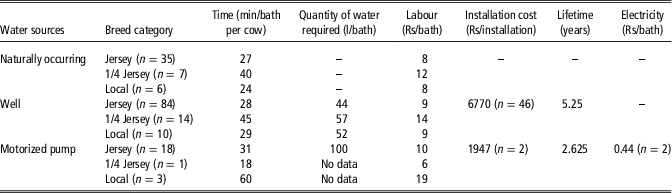
Three water sources were used: naturally occurring sources (such as ponds, rivers), wells and motorized pumps. Currently, 63% (n=47) of sampled cows are bathed in the morning. A second bath can be undertaken at 1400 h to prevent the peak in cow temperature at 1600 h (Kendall et al., Reference Kendall, Verkerk, Webster and Tucker2007). A second bath will keep THI thresholds 2.5 units higher until 1800 h, as wetting will maintain body temperature within a thermoneutral zone for 4 h (Kendall et al., Reference Kendall, Verkerk, Webster and Tucker2007). Cows will be bathed twice daily during those months in which their THI threshold exceeded. Bathing water requirements (Table 2) were informed by field data. The entire body (except the face, head and ears) was wet to the skin. However, cows bathed in natural sources are immersed in water up to the stomach. This additional cooling was not considered. Water temperature was assumed to be 22°C (Kendall et al., Reference Kendall, Verkerk, Webster and Tucker2007).
The cost components associated with bathing different breeds of dairy cows (Jersey, 1/4 Jersey and Local) using different water sources (naturally occurring, wells and motorized pumps) in sampled locations of Odisha, India

Jersey=high-grade Jersey crossbreed; 1/4 Jersey=low-grade Jersey crossbreed; Local=indigenous (non-descript) breed.
Women are primarily responsible for bathing the cows. Bathing is currently conducted for hygiene reasons. Those cows considered more valuable (i.e. Jersey) are bathed daily (data not shown). As such, they are less dirty than those bathed at longer intervals (i.e. Local). Therefore, the variation in bath duration is likely a function of time since bathing. Indeed, the motorized pump would be expected to be a labour-saving device. However, as bathing is conducted for hygiene purposes, farmers are likely to be more thorough when using the pump as the drudgery of taking water to the animal (or vice versa) is removed. The time required to bath (including time required to take the cow to water or vice versa) and installation costs are shown in Table 2. Time required did not vary by herd size and was considered additive. The price of women’s labour was Rs. 18.56/h assuming 8 h work/day (Government of Odisha, 2012).
Naturally occurring water sources could be freely accessed. Labour was the only operating cost associated with naturally occurring sources. Installation costs of the well and motorized pumps (installed 2006–11) were adjusted (against a base of 2004–05) to account for inflation (Reserve Bank of India, 2013). A marginal installation cost was not included as costing considers the total relief strategy (i.e. 2 baths/day). Indeed, a marginal cost could account for baths conducted at other times of the year. However, such bathing is not related to heat stress management. A marginal installation cost risked underestimating the cost of the strategy. Field data indicated the lifetime of the pump to be half of that of the well.
Heat stress relief strategy: fanning
The average cost of ceiling fan installation was Rs. 1838.68. Households estimated fan electricity requirement (Rs. 55.5/month). Households fanning cows (n=17) used fan for an average of 19.82 h/day for 6.72 months. The model assumed households would continue to use fan for an additional 2 months before thresholds are reached. Hourly usage was assumed to remain as currently practiced. Fan lifetime was assumed to be 5 years. Two fans are required to match the lifetime of the shed.
Fan wind speed was assumed to be >2 m/s (Little and Campbell, Reference Little and Campbell2010). No studies could be identified investigating fanning as a single treatment against a THI. However, fanning will reduce the rate of rectal temperature increase by half compared with a shade-only group (Berman et al., Reference Berman, Folman, Kaim, Mamen, Herz, Wolfenson, Arieli and Graber1985). Thus, it was assumed that fanning would increase THI threshold by 0.5 units. The shading effect from the shed was assumed additive.
State-level impact
A state-level THI index was created (as outlined above) with the use of district-level data (Government of Odisha, 2013). Each district was weighted equally and the THI load experienced by different breeds was determined. Breed definitions (exotic v. indigenous) and productivity levels were derived from census data (Government of India, 2014). Milk production was 6.15 and 1.47 kg/cow per day for exotic and indigenous cows, respectively (Government of India, 2014). The 1/4 Jersey was not included.
The threshold values and rates of decline used for the Jersey and indigenous breed (Table 1) were used at a state level. Milk loss was calculated at the cow level (assuming 300-day lactation) and extrapolated across the lactating population composed of 325 000 exotic and 1 397 000 indigenous cows (Government of India, 2014). Adaptation was not considered.
Feed analysis
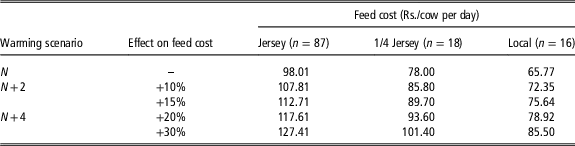
Feed cost was determined from field data. Farmers provided the quantities and price of each ingredient throughout the year. The average daily cost of feeding during lactation informed the model (Table 3). Milk incomes (without adaptation) were reduced by feed cost. Expected price increases were based on estimates of future feed deficits (Indian Grassland and Fodder Research Institute, 2013).
The cost of feeding a lactating dairy cow in Odisha, India under normal conditions (N) and warming scenarios of +2°C (N+2) and +4°C (N+4) as expected during climate change

Jersey=high-grade Jersey crossbreed; 1/4 Jersey=low-grade Jersey crossbreed; Local=indigenous (non-descript) breed.
Results
Temperature–humidity index load and lost milk production
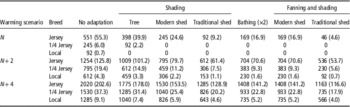
The THI load and quantity of milk lost to heat stress is provided in Table 4. The combined treatment of traditional shed and fan is most effective at preventing milk losses. None of the relief strategies completely prevent heat stress negatively affecting milk yields.
The number of temperature–humidity index units above the heat stress threshold during a 300-day lactation under normal conditions (N) and warming scenarios of +2°C (N+2) and +4°C (N+4) as expected during climate change under no adaptation and the adaptations of shading, bathing and fanning in Odisha, India

Jersey=high-grade Jersey crossbreed; 1/4 Jersey=low-grade Jersey crossbreed; Local=indigenous (non-descript) breed.
The quantity of milk lost to heat stress (kg/cow per 300-day lactation) is provided in brackets.
By modelling actual lactation length, the THI load experienced by the 1/4 Jersey and Local breeds was reduced due to their shorter lactation period (Supplementary Table S1). However, the quantity of milk lost is 15%, 20% and 47% larger for the Jersey, 1/4 Jersey and Local breeds, respectively (compared with the 300-day lactation) (Supplementary Table S3). This is due to the higher daily yields being susceptible to greater loss (albeit for a protracted period).
Heat stress relief strategy costings
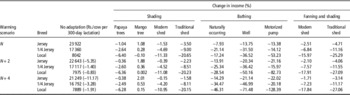
Table 5 provides milk income under conditions of heat stress without adaptation. The percentage change in income after accounting for the cost of the relief strategies is also provided. The table indicates that bathing reduces income levels the most across all breeds. Even with relief the income received will decline under climate change.
The amount of income (per 300-day lactation) the households received from milk sales without adaptation under normal conditions (N) and warming scenarios of +2°C (N+2) and +4°C (N+4) as expected during climate change in Odisha, India

Jersey=high-grade Jersey crossbreed; 1/4 Jersey=low-grade Jersey crossbreed; Local=indigenous (non-descript) breed.
The percentage change in income following implementation of relief strategies compared with no adaptation is also provided.
Brackets indicate the percentage of income lost without adaptation under warming scenarios N+2 and N+4 compared with income received under N conditions from milk sales.
State-level impact
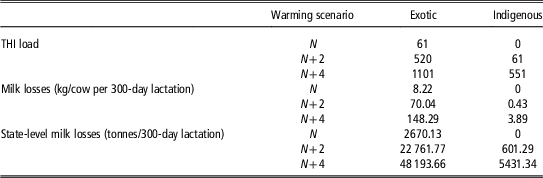
Table 6 indicates that as climate change intensifies the indigenous cow population will lose significantly less milk than the exotic population. Heat stress will cost a total of Rs. 972.76 million. The majority of loss incurred is from the exotic cow population (89.87% or Rs. 874.23 million).
The temperature–humidity index (THI) load experienced by dairy cows under normal conditions (N) and warming scenarios of +2°C (N+2) and +4°C (N+4) as expected during climate change in Odisha, India

Exotic=Bos taurus crossbreed; Indigenous=Bos indicus (non-descript) breed.
The quantity of milk lost at cow and state level is also provided.
Feed analysis
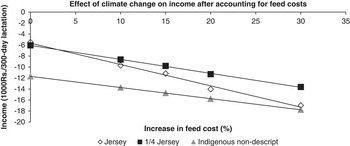
Currently, the Jersey provides only marginal additional income compared with the 1/4 Jersey (Rs. 559 or 10.20%) (Figure 2). However, as climate change intensifies the 1/4 Jersey provides Rs. 33 347 (19.71%) more income than the Jersey. The profitability of the Jersey declines to such an extent that it only provides Rs. 787 (4.64%) more income than the indigenous breed.
Income remaining after accounting for the effects of heat stress and increased feed costs under conditions of climate change.

Discussion
The temperature–humidity index and temperature–humidity index load
Heat stress is a serious constraint as relief will be required for even the most tolerant breeds. The relief strategies demonstrate varying levels of effectiveness. At present, fanning and/or an additional bath is largely unnecessary for the less-susceptible breeds as no additional cooling benefit is provided that could not be achieved with shading. The indigenous (non-descript) cow is an extreme example as its apparent heat tolerance ensures that tree shade is currently sufficient to prevent heat stress. Thus, it is necessary to match relief strategies to the breed’s heat stress susceptibility. Susceptible breeds require more drastic strategies to protect productivity.
Lost milk production
The coupled treatment of fanning and the traditional shed appear most effective at reducing losses in milk production. However, even with relief the quantity of milk lost never returns to zero. Although the quantities of milk lost appear relatively minor, the total yields are themselves small. Lost production represents a serious concern for households reliant on milk for income and food security. For example, without relief under the warming scenario N+4, Jersey cows will lose 14.8% of total yield. The most effective relief strategy (fanning and traditional shed) examined was able to reduce this loss to 8.5%.
This investigation is limited by the assumption that heat stress has a linear effect on milk yield. Indeed, the literature indicates a linear relationship (see Igono et al., Reference Igono, Bjotvedt and Sanford-Crane1992; Ravagnolo et al., Reference Ravagnolo, Misztal and Hoogenboom2000; Bouraoui et al., Reference Bouraoui, Lahmar, Abdessalem, Djemali and Belyea2002). However, care must be taken in interpreting the results as it is unlikely that the rate of decline experienced by cows under different warming scenarios will remain constant. Yet, yawning gaps in knowledge regarding the susceptibility of low producing cows to heat stress and the effectiveness of heat stress relief strategies in a smallholder context limit the extent to which this aspect can be assessed. This study is also underpinned by very small sample sizes which are taken as representative. Thus, this investigation is a proof of concept, indicative of an urgent need for further robust locally relevant field-based experimentation.
Relief strategy costings
The usefulness of relief strategies in supporting income varies based on the overall income derived from milk sales. For example, mango tree shade can increase total income beyond no relief simulations for the Jersey cow. Yet, for the lower-yielding breeds the cost of relief often reduces income below what could be achieved if the farmer was to do nothing. The poor response to relief makes the capital-intensive strategies unprofitable. However, this model does not consider the effects of heat stress over time. Heat-stressed cows may be less productive in future lactations, exhibit poor reproductive performance and risk mortality (Thornton et al., Reference Thornton, van de Steeg, Notenbaert and Herrero2009).
In mitigating heat stress, households will face trade-offs. The primary trade-off is the additional labour to implement strategies (particularly bathing). Although this has been accounted for by the labour cost, additional trade-offs may affect uptake that need further investigation. For example, bathing may use water required by agriculture. Furthermore, the water footprint of milk is already greater than that of cereals with equivalent nutritional value (Hoekstra, Reference Hoekstra2012). Questions must be asked as to whether the use of water for heat stress relief will ensure the greatest benefit in terms of food security.
State-level impact
Heat stress is a very serious constraint for the development of Odisha’s dairy sector if it is to be based on exotic breeds. The financial losses associated with the more numerous non-descript cows is relatively minor compared with the losses associated with the smaller crossbred population.
Feed analysis
The coupling of impact pathways (i.e. heat stress and increased feed price) suggests that a holistic, production system-wide approach to climate change adaptation will be required. Thus, it is not appropriate to draw conclusions regarding the comparative importance of heat stress v. feed availability, particularly as intake is reduced during heat stress (Bouraoui et al., Reference Bouraoui, Lahmar, Abdessalem, Djemali and Belyea2002).
The heat-stress-induced yield declines identified are less severe than other Indian dairy sector heat stress models (namely, Upadhyay et al., Reference Upadhyay, Mohini, Kansal, Singh, Ashutosh, Sirohi and Kumar2007) due to differences in the use of climate data. Upadhyay et al. (Reference Upadhyay, Mohini, Kansal, Singh, Ashutosh, Sirohi and Kumar2007) calculated a THI based on weekly average temperature. Thus, the thresholds will be exceeded more often than was noted in the current investigation. Furthermore, the author assumed that indigenous and crossbred cows will experience the same rate of decline (0.77 l/cow per THI unit).
Heat stress modelling has also been conducted on dairy herds in the United States. St-Pierre et al. (Reference St-Pierre, Cobanov and Schnitkey2003) found high levels of abatement effective at limiting the cost of heat stress (St-Pierre et al., Reference St-Pierre, Cobanov and Schnitkey2003). However, the author does not consider any aspects of Animal Genetic Resources (AnGR). Furthermore, the yields examined were significantly higher than yields considered by this investigation. Thus, the response to abatement is much more pronounced. Key and Sneeringer (Reference Key and Sneeringer2014) modelled climate change impacts on US dairy farm efficiency. However, the author does not consider adaptation. Therefore, the current investigation is the first to illustrate the importance of AnGR in the selection of heat stress relief strategy.
This study illustrates the complexities of design and implementation of climate change adaptation. Although it is unlikely that the production levels of local breeds will be acceptable to farmers, the model shows that cows with high levels of exotic genetics will experience heat stress for the majority of the year. From an economic perspective, only those relief strategies that can be implemented at a low capital cost (e.g. tree shade) were found to be financially viable as other options reduced income to below what could be achieved without relief. However, to do nothing would compromise animal welfare and future productive capacity.
Therefore, the model questions the usefulness of national breeding policy in conditions of climate change. Heat stress will make milk production more challenging. However, to advocate the use of heat-stress-susceptible higher-yielding exotic breeds will limit sector sustainability as farmers will be required to invest in heat stress relief for little economic benefit. Yet, failure to do so will limit long-term productive capacity. Thus, hot-climate dairying projects and programmes need to take a more holistic approach to adaptation and consider AnGR as a means of improving dairy sector sustainability under conditions of climate change.
Acknowledgements
The authors thank Dr Soumya Pani from the Orissa University of Agriculture and Technology, the secretary of the Women’s Federation Sabita Sethy and the farmers.
Supplementary material
To view supplementary material for this article, please visit https://doi.org/10.1017/S1751731116002706