

%20--%3e%3c!DOCTYPE%20svg%20PUBLIC%20'-//W3C//DTD%20SVG%201.0//EN'%20'http://www.w3.org/TR/2001/REC-SVG-20010904/DTD/svg10.dtd'%3e%3csvg%20version='1.0'%20id='Layer_1'%20xmlns='http://www.w3.org/2000/svg'%20xmlns:xlink='http://www.w3.org/1999/xlink'%20x='0px'%20y='0px'%20width='64px'%20height='64px'%20viewBox='5.5%20-3.5%2064%2064'%20enable-background='new%205.5%20-3.5%2064%2064'%20xml:space='preserve'%3e%3cg%3e%3ccircle%20fill='%23FFFFFF'%20fill-opacity='0'%20cx='37.785'%20cy='28.501'%20r='28.836'/%3e%3cpath%20fill='%23595959'%20d='M37.441-3.5c8.951,0,16.572,3.125,22.857,9.372c3.008,3.009,5.295,6.448,6.857,10.314%20c1.561,3.867,2.344,7.971,2.344,12.314c0,4.381-0.773,8.486-2.314,12.313c-1.543,3.828-3.82,7.21-6.828,10.143%20c-3.123,3.085-6.666,5.448-10.629,7.086c-3.961,1.638-8.057,2.457-12.285,2.457s-8.276-0.808-12.143-2.429%20c-3.866-1.618-7.333-3.961-10.4-7.027c-3.067-3.066-5.4-6.524-7-10.372S5.5,32.767,5.5,28.5c0-4.229,0.809-8.295,2.428-12.2%20c1.619-3.905,3.972-7.4,7.057-10.486C21.08-0.394,28.565-3.5,37.441-3.5z%20M37.557,2.272c-7.314,0-13.467,2.553-18.458,7.657%20c-2.515,2.553-4.448,5.419-5.8,8.6c-1.354,3.181-2.029,6.505-2.029,9.972c0,3.429,0.675,6.734,2.029,9.913%20c1.353,3.183,3.285,6.021,5.8,8.516c2.514,2.496,5.351,4.399,8.515,5.715c3.161,1.314,6.476,1.971,9.943,1.971%20c3.428,0,6.75-0.665,9.973-1.999c3.219-1.335,6.121-3.257,8.713-5.771c4.99-4.876,7.484-10.99,7.484-18.344%20c0-3.543-0.648-6.895-1.943-10.057c-1.293-3.162-3.18-5.98-5.654-8.458C50.984,4.844,44.795,2.272,37.557,2.272z%20M37.156,23.187%20l-4.287,2.229c-0.458-0.951-1.019-1.619-1.685-2c-0.667-0.38-1.286-0.571-1.858-0.571c-2.856,0-4.286,1.885-4.286,5.657%20c0,1.714,0.362,3.084,1.085,4.113c0.724,1.029,1.791,1.544,3.201,1.544c1.867,0,3.181-0.915,3.944-2.743l3.942,2%20c-0.838,1.563-2,2.791-3.486,3.686c-1.484,0.896-3.123,1.343-4.914,1.343c-2.857,0-5.163-0.875-6.915-2.629%20c-1.752-1.752-2.628-4.19-2.628-7.313c0-3.048,0.886-5.466,2.657-7.257c1.771-1.79,4.009-2.686,6.715-2.686%20C32.604,18.558,35.441,20.101,37.156,23.187z%20M55.613,23.187l-4.229,2.229c-0.457-0.951-1.02-1.619-1.686-2%20c-0.668-0.38-1.307-0.571-1.914-0.571c-2.857,0-4.287,1.885-4.287,5.657c0,1.714,0.363,3.084,1.086,4.113%20c0.723,1.029,1.789,1.544,3.201,1.544c1.865,0,3.18-0.915,3.941-2.743l4,2c-0.875,1.563-2.057,2.791-3.541,3.686%20c-1.486,0.896-3.105,1.343-4.857,1.343c-2.896,0-5.209-0.875-6.941-2.629c-1.736-1.752-2.602-4.19-2.602-7.313%20c0-3.048,0.885-5.466,2.658-7.257c1.77-1.79,4.008-2.686,6.713-2.686C51.117,18.558,53.938,20.101,55.613,23.187z'/%3e%3c/g%3e%3c/svg%3e)
%20--%3e%3c!DOCTYPE%20svg%20PUBLIC%20'-//W3C//DTD%20SVG%201.0//EN'%20'http://www.w3.org/TR/2001/REC-SVG-20010904/DTD/svg10.dtd'%3e%3csvg%20version='1.0'%20id='Layer_1'%20xmlns='http://www.w3.org/2000/svg'%20xmlns:xlink='http://www.w3.org/1999/xlink'%20x='0px'%20y='0px'%20width='64px'%20height='64px'%20viewBox='5.5%20-3.5%2064%2064'%20enable-background='new%205.5%20-3.5%2064%2064'%20xml:space='preserve'%3e%3cg%3e%3ccircle%20fill='%23FFFFFF'%20fill-opacity='0'%20cx='37.637'%20cy='28.806'%20r='28.276'/%3e%3cg%3e%3cpath%20fill='%23595959'%20d='M37.443-3.5c8.988,0,16.57,3.085,22.742,9.257C66.393,11.967,69.5,19.548,69.5,28.5c0,8.991-3.049,16.476-9.145,22.456%20C53.879,57.319,46.242,60.5,37.443,60.5c-8.649,0-16.153-3.144-22.514-9.43C8.644,44.784,5.5,37.262,5.5,28.5%20c0-8.761,3.144-16.342,9.429-22.742C21.101-0.415,28.604-3.5,37.443-3.5z%20M37.557,2.272c-7.276,0-13.428,2.553-18.457,7.657%20c-5.22,5.334-7.829,11.525-7.829,18.572c0,7.086,2.59,13.22,7.77,18.398c5.181,5.182,11.352,7.771,18.514,7.771%20c7.123,0,13.334-2.607,18.629-7.828c5.029-4.838,7.543-10.952,7.543-18.343c0-7.276-2.553-13.465-7.656-18.571%20C50.967,4.824,44.795,2.272,37.557,2.272z%20M46.129,20.557v13.085h-3.656v15.542h-9.944V33.643h-3.656V20.557%20c0-0.572,0.2-1.057,0.599-1.457c0.401-0.399,0.887-0.6,1.457-0.6h13.144c0.533,0,1.01,0.2,1.428,0.6%20C45.918,19.5,46.129,19.986,46.129,20.557z%20M33.042,12.329c0-3.008,1.485-4.514,4.458-4.514s4.457,1.504,4.457,4.514%20c0,2.971-1.486,4.457-4.457,4.457S33.042,15.3,33.042,12.329z'/%3e%3c/g%3e%3c/g%3e%3c/svg%3e)
%20--%3e%3c!DOCTYPE%20svg%20PUBLIC%20'-//W3C//DTD%20SVG%201.0//EN'%20'http://www.w3.org/TR/2001/REC-SVG-20010904/DTD/svg10.dtd'%3e%3csvg%20version='1.0'%20id='Layer_1'%20xmlns='http://www.w3.org/2000/svg'%20xmlns:xlink='http://www.w3.org/1999/xlink'%20x='0px'%20y='0px'%20width='64px'%20height='64px'%20viewBox='5.5%20-3.5%2064%2064'%20enable-background='new%205.5%20-3.5%2064%2064'%20xml:space='preserve'%3e%3cg%3e%3ccircle%20fill='%23FFFFFF'%20fill-opacity='0'%20cx='36.924'%20cy='28.403'%20r='28.895'/%3e%3cpath%20fill='%23595959'%20d='M37.442-3.5c8.99,0,16.571,3.085,22.743,9.256C66.393,11.928,69.5,19.509,69.5,28.5c0,8.992-3.048,16.476-9.145,22.458%20C53.88,57.32,46.241,60.5,37.442,60.5c-8.686,0-16.19-3.162-22.513-9.485C8.644,44.728,5.5,37.225,5.5,28.5%20c0-8.762,3.144-16.343,9.429-22.743C21.1-0.414,28.604-3.5,37.442-3.5z%20M12.7,19.872c-0.952,2.628-1.429,5.505-1.429,8.629%20c0,7.086,2.59,13.22,7.77,18.4c5.219,5.144,11.391,7.715,18.514,7.715c7.201,0,13.409-2.608,18.63-7.829%20c1.867-1.79,3.332-3.657,4.398-5.602l-12.056-5.371c-0.421,2.02-1.439,3.667-3.057,4.942c-1.622,1.276-3.535,2.011-5.744,2.2%20v4.915h-3.714v-4.915c-3.543-0.036-6.782-1.312-9.714-3.827l4.4-4.457c2.094,1.942,4.476,2.913,7.143,2.913%20c1.104,0,2.048-0.246,2.83-0.743c0.78-0.494,1.172-1.312,1.172-2.457c0-0.801-0.287-1.448-0.858-1.943l-3.085-1.315l-3.771-1.715%20l-5.086-2.229L12.7,19.872z%20M37.557,2.214c-7.276,0-13.428,2.571-18.457,7.714c-1.258,1.258-2.439,2.686-3.543,4.287L27.786,19.7%20c0.533-1.676,1.542-3.019,3.029-4.028c1.484-1.009,3.218-1.571,5.2-1.686V9.071h3.715v4.915c2.934,0.153,5.6,1.143,8,2.971%20l-4.172,4.286c-1.793-1.257-3.619-1.885-5.486-1.885c-0.991,0-1.876,0.191-2.656,0.571c-0.781,0.381-1.172,1.029-1.172,1.943%20c0,0.267,0.095,0.533,0.285,0.8l4.057,1.83l2.8,1.257l5.144,2.285l16.397,7.314c0.535-2.248,0.801-4.533,0.801-6.857%20c0-7.353-2.552-13.543-7.656-18.573C51.005,4.785,44.831,2.214,37.557,2.214z'/%3e%3c/g%3e%3c/svg%3e)
The first five chapters of this book have sketched out the sociological, intellectual and institutional dimensions of secularism as a dissenting culture and examined how secularist knowledge correlated to confidence among working-class autodidacts, whether men, women or youth. This chapter takes up the political implications of secularism in the period of national parliamentary upheaval, which began in 1906 and deepened into a systemic crisis after the Reichstag elections of 1912 returned the largest ever number of socialist deputies. Since the “Fischer controversy” of the early 1960s, historians have been debating the relationship between this crisis and the decision of the monarchic state and military to go to war in August 1914. According to Thomas Nipperdey, the fluid, unstable situation in parliament left all sides feeling immobilized, making “the alternative of war or revolution” into a construction that served the “either-or polarization by ultras.” Similarly, Hans-Ulrich Wehler concluded that imperial adventurism represented a “flight forward” for a monarchy facing intractable problems presented by democratic politics.Footnote 1 Helmut Walser Smith has drawn attention to the religious dimension of this period, which he likened to the Kulturkampf of the 1870s due to the heightened confessional antagonisms between Catholics and Protestants.Footnote 2 Yet, to date, the influence of secularism on this political crisis has remained unexplored, despite an upsurge of anticlerical demonstrations, utopian manifestoes and the founding of a host of new secularist organizations.
To make sense of the complex interplay of secularist agitation and partisan politics we need to draw rough distinctions between five political groups, who were strongly represented amongst Germany’s secularist movement. To begin with there was the fundamental divide between the “bourgeois” (or liberal) and the “proletarian” (or socialist) camps. Yet important divisions existed within each of these camps. On the socialist side, there were radicals, pushing towards revolution, and revisionists, arguing for evolution. On the bourgeois side, amongst those for whom I often use the shorthand “liberal,” there were left liberals, who backed the Progressive parties, and democrats, who stood in the tradition of radical republicans. Finally, rounding off the bourgeois-liberal camp were the antipolitical advocates of a rule by cultural elites. This chapter locates these groups on the national level at the outset of the period, and then turns to two German states, Prussia and Bavaria, to explore interactions in different regional confessional and political contexts.
National Politics 1905–1908
In 1905 socialist radicals in Germany looked with great hope at the revolutionary events unfolding in Russia. The collapse of that revolution at the end of the year fed into long-standing frustrations at home. Despite the tremendous growth of their party and the full coffers of the trade unions, many German socialists felt that they had reached the limit of parliamentary action. Their inability to challenge the Prussian election law, which minimized worker voting power and ensured a continuation of “bourgeois” rule, placed in question the long-term socialist strategy of “revolutionary waiting,” which assumed that continual party growth would eventually deliver socialist transformation, either through the ballot box or through a political crisis, which August Bebel called the “big Kladderadatsch [hullabaloo].” Radicals increasingly favored the idea that rather than waiting, the party should provoke confrontation with the system, for example by calling for a general or mass strike to oppose the Prussian electoral law. Many reformists and revisionists, who were strongest in the labor unions, rejected the mass strike as illegal, costly and a threat to the existence of the labor movement. They continued to place their hopes for a transformation of Germany’s political system on the ongoing growth of labor union membership and on the increasing share of socialist seats in the Reichstag.Footnote 3
The radicals enjoyed significant support from the party rank-and-file in Berlin, where between 1906 and 1912 political street violence reached a prewar peak.Footnote 4 Unable to gain control of the party, radicals looked for alternative sites of action, and anticlericalism fit into this strategy.Footnote 5 It appealed to working-class revolutionaries, but also to many left liberals. Karl Liebknecht believed the SPD could tap middle-class opposition to the Bülow government in the 1908 Landtag elections with a campaign based on electoral reform, antimilitarism and what Liebknecht called “ethical arguments.”Footnote 6 Seven socialists were elected to the Landtag, a first in the history of that institution. Of these, six were from Berlin districts and three were radicals: Liebknecht, Heinrich Ströbel and Adolph Hoffmann.
The other minority movement in the SPD that concerns us in this chapter is revisionism. The central bone of contention between the revisionists and the “orthodox” Marxists was the latter’s assumption that the “iron law” of wages and the concentration of capital necessarily led to social polarization and eventually to social revolution. Citing evidence of the economic health of the middle classes, revisionists proposed an “evolutionary” theory, which held pure socialism to be an ethical ideal, which would guide the party, as it negotiated with other democratically inclined political parties. According to Eduard Bernstein’s dictum “the movement means everything to me, … the final goal nothing,” they sought reform within capitalism.Footnote 7 Monist and Free Religionist Heinrich Peus, a powerful figure in the SPD in Dessau, gave a good summary of the revisionist credo:
Let us promote practical socialism! Let us transform the world in which we live today in the spirit of socialism! Today, I insist, not tomorrow! The hope for a future event is misguided. The day of the ‘liberating Kladderadatsch’ will never come. In that Bebel and with him many others were prisoners of his misleading conceptual system.Footnote 8
Revisionism had a strong secularist signature but was weak among party officials. Two of the minority of only eleven delegates to vote against the condemnation of Bernstein and his revisionist theory at the Dresden Party Congress of 1903 were Free Religionists, Peus and Paul Löbe. Both men cultivated ties to democratic-liberal circles.Footnote 9
If the Russian Revolution acted as a goad to radical socialists, another world-historical event of 1905, the French law separating church and state, was a provocation to German liberals, who worried that they were falling behind France in the struggle against the Vatican. Confessional tensions in Germany had been rising since the late 1890s. Some German Protestants avidly supported the “Los von Rom” (Away from Rome) movement, founded in 1898 to convert Austrian Catholics to Protestantism. The Vatican enflamed Protestant passions with harsh condemnations of the Lutheran “heresy” and dogged attacks on liberal theological currents, culminating in the “anti-modernist oath” for all Catholic priests.Footnote 10 Liberals were alarmed when the German state proffered the Catholic Center Party a deal in 1903, whereby the key elements of the anti-Catholic legislation of the 1870s, in particular the “Jesuit Laws,” would be repealed in exchange for parliamentary backing of naval building and colonization.Footnote 11 Raising the specter of resurgent ultramontanism, Friedrich Naumann published an influential tract Democracy and Monarchy, in which he argued that only a social liberalism tied to a strong monarchist state could prevent “Roman domination.” Although his National Social Association failed to attract support in the 1903 Reichstag election, Naumann’s strategy inspired many.Footnote 12
The Center Party reacted in a divided fashion to the liberal onslaught. Julius Bachem, editor of the influential Kölnische Volkszeitung, called on Catholics to “come out of the tower,” i.e. abandon their confessional isolation and incorporate conservative Protestants into the Center Party. In this spirit, the clergy, politicians and lay leaders attending the national Catholic conference (Katholikentag) in Essen in 1906 called for ecumenical cooperation in “an alliance of all confessions faithful to God and Jesus Christ against the forces of atheism and revolution.” This tactic was opposed by younger party leaders, who criticized nationalism and did not shy away from defending confessional prerogatives. In December 1906, Center Party deputies objected to the government’s colonial policy, in particular the recent military suppressions of revolts in South West Africa. In response, Chancellor Bernhard von Bülow dissolved parliament and called a snap election in which he appealed to nationalists to form an alliance to “struggle against ultramontanes, Guelfs [Hanoverian separatists, T. W.], socialists and Poles.”Footnote 13 In the so-called Hottentot elections of January 1907, the “Bülow-Bloc” of Conservatives and National Liberals whipped up nationalist emotions and delivered a defeat to the SPD, which lost half of its seats.
The atmosphere of Kulturkampf and the parliamentary realignment contributed to a burst of activity among “bourgeois” secularists, who sought to fill their sails with the new energy of German liberalism. Already in 1904, a secularist journal had argued that the “union of liberals” could only succeed if it challenged the confessional system.Footnote 14 New organizations were founded, including the League for Mothers’ Protection in 1904–05, the German Monist League in 1906, and in 1907 the German League for Secular Schools and Moral Instruction, which pioneered ethics as an alternative to religious instruction in schools.Footnote 15 Naumann’s call for a “gathering” of liberals in the political realm was echoed in the secularist scene. In 1906, the Frankfurt industrialist, Buddhist and freethinker Arthur Pfungst called for a “union of free spirits,” and the Congress of Freethinkers in Stettin issued a similar declaration. In 1907 the formation of a first umbrella organization for all secularist organizations was announced and in 1909 formally constituted as the Weimar Cartel.Footnote 16 Following calls for a “centralization” of freigeistig organizations in Berlin to counteract the “fragmentation of spiritual life,” a “Cultural Cartel of Greater Berlin” was launched in 1910.Footnote 17 Local cartels also formed in Munich and Frankfurt am Main.
Prior to 1909, the leading secularist organizations foregrounded their anti-Catholicism and sought to build common ground with liberal Protestants. The Monist League focused some of its initial public attacks at Catholicism; one of the largest events held by the newly founded Berlin chapter of the DMB was a series of public debates with the Jesuit biologist Erich Wasmann in 1907.Footnote 18 Ernst Haeckel and Wilhelm Ostwald participated in the Anti-Ultramontane National Association (Antiultramontane Reichsverband) of the former Jesuit Count Paul von Hoensbroech.Footnote 19 The heated confessional climate enhanced the appeal of secularism among German liberals, such as Max Weber’s brother Alfred, a young professor of sociology in Prague, who issued a welcoming statement for the organizing committee for the 1907 International Congress of Freethought. Weber dismissed conservative worries that Freethought was being used by socialists and teetotaling anarchists – whom he called the “biggest consumers of lemonade on earth” – to prepare a future without “masters or gods.” The real enemy were the state “masters” who were forcing “gods” on the people through clerical control of schools and thereby retarding cultural development.Footnote 20
The hope for liberation through culture and education was the core tenet of a liberal approach to national renewal that Thomas Mann later famously described as “unpolitical” and which others have since called “antipolitical,” because it denied the efficacy of parliamentary democracy.Footnote 21 Unpolitical liberals were not so naïve as to think that the power of their “personalities” alone would lead to national rebirth. In good Kantian fashion, they envisaged a period of national tutelage, in which the “educators” would have to rely on political authority. Ludwig Büchner, who was both Germany’s most famous Freethinker and a leading Democrat, referred in the 1890s to the negative effects of universal suffrage as “the Democratic Disease,” which afflicted society when “those uneducated … voters, who are dependent on the church, Social Democratic leadership or personal influences, are given the same rights as the educated.” Büchner advocated instead a “reform of universal voting rights in favor of a greater participation of those portions of the nation that are intelligent and independent in their opinions or civic positions.”Footnote 22 Similarly, some secularists supported electoral reform with more votes for the “bearers of culture” (Kulturträger).Footnote 23 In October 1906, leading Munich monist Johannes Unold held a lecture, in which he opposed democracy as the rule of the majority over the cultural elite. Because the majority of Prussian citizens would vote for “clerical” (Center) or “class” rule (SPD), Unold proposed instead a corporatist model in which one voted according to profession.Footnote 24
Although borders in the liberal-bourgeois camp were fluid, the antidemocratic stance of antipolitical intellectuals can be distinguished from the direction taken by some of Naumann’s followers, who came to embrace the radical republican tradition of the 1848 revolution. They formed the Democratic Union (Demokratische Vereinigung) and split off from the Progressive Party (Freisinn) in April 1908 over its participation in the Bülow government.Footnote 25 Rudolf Breitscheid had earlier issued a call for a “bloc of leftists,” by which he meant a “cooperation with Social Democracy in all questions related to defense against conservative-clerical attacks.” However, he also wanted a Social Democracy free of “unfruitful” Marxism that would look to liberalism as its “mentor” (Lehrmeister). His collaborator Hellmuth von Gerlach, also a former Christian Social, demanded from the SPD a “radical program, interpreted revisionistically and applied practically.”Footnote 26
Debates over democracy also contributed to divisions within secularist organizations. Some organizations defected from the national Freethought League (DFB) because of the unwillingness of “bourgeois” members to abandon an electoral modus that provided extra votes for wealthier members and functionaries and thus bore resemblance to the “three-class” voting system. At the 1904 annual meeting, “bourgeois” Berliners Rudolf Penzig, Otto Lehmann-Rüßbult and Bruno Wille all voted to defend this system and rejected the reform proposal put forward by the board of the Berlin Free Religious Congregation that would have redistributed votes to reflect the relative size of each congregation and thus given the enormous “socialist” Berlin Free Religious Congregation a dominant position. When the proposal was rejected, the Berlin Free Religious Congregation withdrew from active participation in the DFB (it had exited the national organization of Free Religion for similar reasons the year before).Footnote 27 Following renewed debate over vote distribution at the 1908 DFB Congress in Frankfurt, a number of socialist chapters formed a separate umbrella organization to represent “the proletarian element within the Freethought movement.” The Zentralverband deutscher Freidenkervereine (ZdF) was formed and shifted into an opposition movement to the DFB.Footnote 28 The division between “bourgeois” and “proletarian” Freethought would not be overcome until 1930. Proletarian freethinkers were strongest in regions where cooperation between liberals and socialists was weak, such as Munich, the Rhineland and Hamburg. They pilloried the idealism of the bourgeois “Sport-Freidenker,” who “want to replace the sermon of the priest with the lecture of the professor, transform church ceremonies into secular ‘hours of edification’ in which one gets intoxicated on the platitudinous chatter of vulgar monism, this vogue of bourgeois enlightenment.”Footnote 29 For socialist freethinkers, true monism had to include the overcoming of the dualism of class, i.e. it meant the incorporation of Marxian social theory and class struggle.
The Church-leaving Movement in Berlin and Prussia until 1908
Having examined partisan politics and the secularist scene on the national level between 1905 and 1909, we now turn to investigations of how the two interacted in political action. We start in Berlin with the socialist campaign for church-leaving, and then move to socialist, anarchist and liberal secularist agitation in Munich.
As discussed in the introduction, secularists continually tested the SPD declaration that “religion is a private matter” by insisting on the right to undertake anticlerical agitation to defend the (private) freedom of conscience of their own associations. The most politically potent weapon at their disposal was official exit from the churches (Kirchenaustritt). Unlike blasphemy, which was a fleeting symbolic act, registering one’s exit was considered a body blow to the state churches and not just because it potentially deprived them of state-collected taxes. The size of the church flock was measured by membership rather than attendance. The right to leave the church and become “confessionless” was first formalized in Prussia in 1847 to allow rationalist dissidents to leave the state churches without forming new ones. Its political potential was realized during the late 1870s, and it played a significant role during the Weimar Republic and again during the National Socialist “Church Struggle.” However, the first time it was used in a sustained fashion as a form of mass political protest was in Berlin between 1905 and 1914.
Police statistics (see Table 6.1) reveal two waves of church-leaving in this period, one cresting in 1908, the second in 1913. In each wave, the church-leavers were largely working-class, but in the first wave the percentage of SPD members among church-leavers was much higher. The peak of church-leaving came in 1913 and the beginning of 1914 and corresponded to a joint campaign of socialists and liberals.Footnote 30 Overall, the net reduction of church membership was moderate. With 2 million residents in Berlin, only 0.5 percent of the population left the churches in 1913. Yet, church exits completely outstripped conversions between religions. In 1907, for example, there were 5,868 exits from the churches, but only 162 conversions to Protestantism, 46 to Catholicism and 15 to Judaism.Footnote 31
| Year | Total exits | Male | Female | Registered as Social Democrats | Protestant | Catholic | Jewish | Worker / craftsmen | Higher classes (“bessere Stände”) |
|---|---|---|---|---|---|---|---|---|---|
| 1898 | 245 | 170 | 74 | 50 (20%) | 174 | 25 | 46 | 185 (76%) | 60 |
| 1899 | 232 | 170 | 62 | 42 (16%) | 156 | 34 | 42 | 198 (85%) | 34 |
| 1900 | 262 | 172 | 90 | 49 (19%) | 202 | 23 | 37 | 202 (77%) | 60 |
| 1901 | 271 | 185 | 86 | 82 (30%) | 188 | 35 | 48 | 216 (80%) | 55 |
| 1902 | 291 | 223 | 68 | 100 (34%) | 233 | 35 | 23 | 235 (81%) | 56 |
| 1903 | 376 | 268 | 108 | 124 (33%) | 298 | 40 | 38 | 298 (79%) | 78 |
| 1904 | 413 | 292 | 106 | 115 (28%) | 324 | 59 | 30 | 344 (83%) | 69 |
| 1905 | 1060 | 872 | 153 | 471 (44%) | 890 | 118 | 52 | 997 (94%) | 63 |
| 1906 | 4408 | 3601 | 612 | 1989 (45%) | 2745 | 594 | 69 | 4313 (98%) | 95 |
| 1907 | 5868 | 3718 | 1855 | 2655 (45%) | 4660 | 1170 | 38 | 5538 (94%) | 330 |
| 1908 | 11063 | 6506 | 4001 | 4225 (38%) | 9484 | 1493 | 86 | 10551 (95%) | 512 |
| 1909 | 9769 | 5881 | 3568 | 2467 (25%) | 8102 | 1542 | 125 | ||
| 1910 | 4375 | 2532 | 1618 | 1454 (33%) | 3388 | 920 | 67 | 3889 (89%) | 486 |
| 1912 | 7719 | 4711 | 2864 | 1359 (18%) | 6467 | 1165 | 87 | ||
| 1913 | 12572 | 7811 | 4597 | 1454 (12%) | 11048 | 1476 | 48 | ||
| 1914 | 6438 | 3980 | 2340 | 1349 (21%) | 5667 | 748 | 21 | ||
| 1915 | 672 | 291 | 369 | 189 (28%) | 459 | 175 | 38 |
a LAB A Pr. Br. Rep. 030, 15799, 15800, 15801.
When compared to church-leaving for the rest of Prussia and, indeed, the entire Reich, the fact that annually between 10 and 25 percent of all German church exits prior to 1914 took place in Berlin, makes that city an anomaly.Footnote 32 Only in the final twelve months before the war, did church-leaving pick up elsewhere. This raises the questions: why Berlin, and what constellation of forces led to these two waves? The best starting point for answering these questions is the investigation of church-leaving by Jochen-Christoph Kaiser for the period 1905 to 1914. Kaiser sought to poke holes in the inflated sense that secularists had of their own impact on what appeared to be anticlerical acts by German workers. Whereas secularist organizers told workers that they were leaving the churches for political-ideological motives, Kaiser emphasized the material interests of the workers. To explain the uptick around 1905, he pointed to changes in the financing of the state churches introduced by the Prussian government beginning in 1905, which reduced fees charged for specific church services (Stolgebühren) and raised church taxes based on income. The effect of this new revenue structure was to increase the financial burden on the religiously indifferent members of the churches, who did not use its services.Footnote 33 Resentment towards church taxes grew further in 1907, when the government adopted new instruments that improved its ability to gather the taxes, and again in 1908, when clergy salaries were increased.Footnote 34
Changes in church taxes are an important but not sufficient cause to explain church exit. Other local factors must be considered, beginning with the relationship of the Prussian state to dissidents in Berlin. Berlin had the greatest concentration of dissidents in Germany, yet they were subject to more intense discrimination than in some other German states. Whereas Saxony and Bavaria allowed Free Religious instruction to dissident schoolchildren, most of Prussia required confessionless children to attend Christian religious instruction against the will of their parents. Agitation for church-leaving had begun in the Berlin Free Religious Congregation (FRC) after its religious instruction was prohibited by the Royal Provincial School Collegium in 1894, an injunction that was not lifted until the last days of the First World War. This meant that a continual casus belli was present for secularist agitation in Berlin. At the height of the church-leaving campaign in November 1913, the President of the Monist League Wilhelm Ostwald insisted that his anticlerical actions were motivated purely by the practical question of finding the “the shortest path to removing the intolerable compunction to confessional instruction of dissident children,” which proved the “intimately immoral idea of a state church, i.e., the combination of religion and state administration.”Footnote 35
Police files reveal that the church-leaving movement in Berlin between 1890 and 1910 was led by the most prominent socialists in the Free Religious Congregation, who often sought to link the defense of the dissidents to wider political goals, and thereby overcome the party injunction on anticlerical activity. This was particularly obvious when they sought to establish church-leaving as the norm for party officials. At an 1894 meeting on “state religion and Social Democracy,” the Free Religious organizers invited prominent socialists who had not left the church to appear at their next meeting to explain their position. In response, Vorwärts urged socialists to reject this intolerance as an “inquisition” (Ketzergericht).Footnote 36 On another occasion, the editors commented sarcastically on “the well-known propensity of certain Free Religionists to demand freedom of conscience for themselves, but not to grant others this freedom.”Footnote 37
Church-leaving meetings of the 1890s became places where rank and file members and party officials debated the party line. Some spoke in favor of the “Marxist” perspective that worker belief in religion was withering of its own accord and that anticlerical agitation only hindered socialist appeals to Christian and especially Catholic workers.Footnote 38 Yet, as the left-liberal Vossische Zeitung reported in March 1897, the “fierce confrontations” at mass rallies for church-leaving often ended in victory for the secularists. At the end of the debate of one such meeting, the audience sided with the demand of Waldeck Manasse that socialist officials should “also show their true colors regarding the religious question” and passed an anticlerical resolution by an overwhelming majority.Footnote 39
Manasse and Hoffmann complained thatVorwärts and the party were “lukewarm” (lau) towards Freethought,Footnote 40 and this is correct, insofar as reporting on the campaign for dissident rights was generally ambivalent. For example, in a lead article promoting the passage of a “dissidents’ law” in the Prussian Landtag in July 1897, Vorwärts described dissidents as those people “who have turned their backs on the state recognized and sponsored faith communities, because they cannot reconcile ‘salvific truths’ with their healthy reason.” Having thus implicitly identified dissidence with common sense, the article then distanced the party from enforcing this norm, calling it “[a] bald maneuver … when our opponents try to identify dissidence and social democracy. … Our party leaves religious questions entirely to the independent decision of each individual member.”Footnote 41
The most important person in the Berlin church-leaving campaign was Adolph Hoffmann. He is a prime example of a secularist activist who sought to work within the party rather than directly challenging the party plank. Hoffmann cast church-leaving as the mere exercise of the individual’s right to private freedom of conscience. On January 6, 1896, Hoffmann co-founded the socialist-dominated Free Religious Commission for Exit from the State Church that printed and distributed forms for church-leaving and organized rallies on an ongoing basis.Footnote 42 The Commission explicitly called on Berliners to use church-leaving to lodge their protest against the obligatory confessional instruction of dissident children against the will of their parents. Without the pioneering efforts of the Berlin FRC in this field, it is unlikely that it would have come to the more spectacular church-leaving events of 1905 to 1914. As police noted in 1906, most of the requests for church-leaving were filled out on forms printed by the FRC.Footnote 43
Two political factors contributed to the sudden jump in church-leaving in 1905.Footnote 44 First was the pending passage of a new school law for Prussia, which, when it was finally approved by the Landtag in summer 1906, strengthened church control over religious instruction and codified confessional segregation. The second was agitation against the three-class electoral system that effectively disenfranchised the Prussian working classes. Paul Göhre, who as a former Protestant minister played a singular role in SPD religious politics, proposed that the party respond to both of these challenges through church-leaving:
The onslaught which the Prussian and German proletariat has launched against the three-class voting system will likely be held in narrow bounds. Petitions no longer help; leaflets and mass demonstrations likewise produce no miracles; peaceful demonstrations are to be choked in blood; we cannot and may not consider a political mass strike: in this situation, given the pending school law, a mass church-leaving movement of great proportions may, in fact, be a revolutionary tool of struggle.Footnote 45
Historian Marjorie Lamberti found that the SPD as a whole was cool to Göhre’s proposal,Footnote 46 but the press at the time noted that the public linked both the Russian Revolution and agitation for electoral reform to the ongoing Free Religious church-leaving campaign.Footnote 47 In April 1906 socialist freethinkers dominated protest demonstrations against the school law in the Rhenish towns of Duisburg and Ruhrort and passed resolutions demanding reform of the Prussian franchise and separation of church and state.Footnote 48 In the same month the agitation committee led by Hoffmann placed a large ad in Vorwärts offering free copies of a May Day handbill (with a claimed run of 1 million copies) calling for “Mass exodus out of the church” as a “Protest against the School-Clericalisation-Law [Schulverpfaffungs-Gesetz].”Footnote 49
The popularity of Hoffmann’s anticlericalism likely helps explain his election to the Prussian parliament in 1908 despite the unfair franchise. He would clearly have been a poor choice if there had been any possibility of cooperative work with other parties, such as had existed in Bavaria prior to 1905. However, as Fritz Kunert had explained upon his own election to another body with a restrictive franchise, the Berlin City Council, the chief purpose of their taking elected seats was “to exercise criticism … and thus achieve propaganda.”Footnote 50 The socialist deputies elected to the Prussian Landtag in 1908 assumed a similar tactic and quickly became known as the “angry seven” or the “bad conscience of this parliament.”Footnote 51 None of the seven took greater pleasure in the role of firebrand than Hoffmann, who used his bully pulpit to criticize the state churches and advertise the church-leaving movement. During debate on the salaries of church ministers in October 1908, Hoffmann was called to order three times for inappropriate criticism of church and state officials. Barred from speaking further in the halls of parliament, he went to the streets. He promptly organized a public rally in a large rented hall, where in front of a crowd of several thousand he passed from a criticism of the “violation of [his] freedom of speech” to an attack on the church oversight of public schooling: “As long as the school is ruled by the church, our children will be raised in clericalism [Muckerei] and slavish obedience to heavenly and worldly authorities.” Following his call for the liberation of the schools, some 1,500 persons marched from the Tiergarten through the city center singing the “Workers’ Marseillaise,” cheering international Social Democracy and yelling “Away from the church!” (Los von der Kirche). A scuffle broke out when police stopped them at the edge of the Prenzlauer Berg district, which was finally ended when police reinforcements arrived on horseback.Footnote 52
The slogan “Away from the church!” became the battle cry of the intensified church-leaving campaign in 1908. Even if Hoffmann did not invent it, the slogan certainly fit his ironic style, as it manipulated the name of the anti-Catholic “Away from Rome” movement popular among the Protestant, nationalist and liberal circles that backed the Bülow government. Although many liberals may have been sympathetic to Hoffmann, there is little evidence that the liberal secularist organizations contributed in any meaningful way to the first wave of the Berlin church-leaving campaign of 1905 to 1909, which had modest success in terms of numbers of completed exits. Police and church officials were regularly able to disqualify applications for church-leaving after they had been submitted. Many applicants failed to appear at the church parish or police station for a mandatory meeting to conclude the procedure.Footnote 53 Despite this, the movement rattled the authorities, for, as the conservative Tägliche Rundschau warned in 1908, “it is obvious that a church with which the masses can play must lose respect.”Footnote 54
Religious Politics in Bavaria 1905–1909
Upon joining the new federal German state in 1870/71, Bavaria gained a Prussian emperor, but retained its own king. Because the royal house was Catholic, represented between 1886 and 1912 by the Prince Regent Luitpold, the Catholic Church retained a privileged place in Bavarian life. Bavaria had its own papal nuncio and was governed by its own episcopal conference. The Kulturkampf of the 1870s had been fought out principally in Protestant-dominated Prussia. Having been largely spared this trauma, Bavaria had a less developed network of confessional defense organizations than the Catholic regions of Prussia. Religious practices in the capitals of the two states also varied greatly. Bavaria’s capital Munich was some 80 percent Catholic and church attendance remained higher than the national average, whereas much of Berlin’s overwhelmingly Protestant population was Protestant in name only. In 1863 less than 20 percent of Berlin’s Protestants took communion (as compared to nearly 80 percent in Bavaria or 70 percent in Saxony) and the rates dropped continually thereafter.Footnote 55 Importantly, the constitutional position of dissidents varied greatly in the two kingdoms. Unlike Prussia, Bavaria allowed the Free Religious Congregations to provide religious instruction to dissident schoolchildren and its courts upheld this right when challenged.Footnote 56
Bavaria was the stronghold of the Reformist wing of the SPD. Again and again, Bavarian party chairman Georg von Vollmar stressed the need for religious tolerance and insisted that the SPD was “a purely economic and political party, outside of any confessional partisanship.”Footnote 57 The success of Vollmar’s strategy of religious neutrality can be seen in the ability of the Munich SPD to buck the national trend, which generally held that the more Catholic the region, the weaker the socialist movement. Although the city was overwhelmingly Catholic, more than 50 percent of Munich votes routinely went to the socialists in local and national elections. Among the Bavarian party leadership itself, some 60 percent remained members of the Catholic Church, including Vollmar and his chief lieutenant, Erhard Auer; Auer even allowed himself to be voted into the leadership of a local church council so he could oppose an expensive building project.Footnote 58 When a vote was held in Munich in 1894, asking whether the assembled Social Democrats wanted to leave the church, the proposal was rejected by 500–600 votes against 8. Vollmar noted during the Munich Party Congress in 1902 that a significant portion of the local public would consider any tampering with the privileged position of the churches to be an insult. Such tacit defense of Catholic interests, alongside shared opposition to the liberal parties, was crucial to the cooperation of the SPD with the Center Party, which culminated in a local electoral alliance in 1905.Footnote 59
The policy forged by Catholic socialists in a majority Catholic state was a source of irritation for socialists in traditionally Protestant regions of Bavaria with strong secularist traditions. Nuremberg, the largest city of the largely Protestant region of Middle Franconia, was a hotbed of radical secularism and home to Der Atheist, the mouthpiece of the Proletarian Freethought movement. Mannheim in the Palatinate had been a center of early rationalist dissent, and socialists dominated the Free Religious Congregation of the growing industrial center of nearby Ludwigshafen.Footnote 60
Given the relatively good relations between the Center Party and the SPD in the Bavarian core, it is not surprising that opponents of the SPD made frequent use of anticlerical rhetoric. Upon moving from Mannheim to Munich in 1899, Philipp August Rüdt took the helm of the local Freethought Association. Despite having been expelled from the party in 1895, he was invited to speak and agitate among local party organizations and discussion clubs, which were resisting Vollmar’s efforts to dissolve them and integrate the members into a centrally administered party organization. Around 1903 the leadership of the Freethought Association passed to Joseph Sontheimer, who was known to police as one of Munich’s most notorious anarchists and maintained ties to writer Erich Mühsam and other figures of the radical cultural scene in the district of Schwabing. A gadfly in the socialist milieu, Sontheimer occasionally succeeded in rallying rank-and-file socialists against the party leadership. In large meetings held in 1905 regarding the mass strike and unemployment, anarchist resolutions were pushed through and Sontheimer’s speech applauded.Footnote 61
The combination of Catholic monarchy, reformist Social Democracy and flourishing cultural bohème, allowed Munich to develop into a great center of liberal secularism prior to the war, in which professors and cultural prophets attracted attention with their public stances against the Catholic Church. The sight of these elites kicking against the pricks was tremendously appealing to a generation of idealistic university students, such as Hermann Heimerich, a law student, who in December 1906 aided the private scholar Dr. Max Rieß in forming a local chapter of the secularist student association, the Young German Culture League (Jungdeutscher Kulturbund). Rieß’s philosophy combined monism with advocacy of a Fichtean cultural nationalism that drew inspiration from Paul de Lagarde and Julius Langbehn. Echoing Langbehn’s title Rembrandt as Educator, the stated aim of this Culture League was to raise a “cohort of future ‘educators’”Footnote 62 by gathering the “freethinking and spiritually and morally self-enlightening young people, distilling the quintessence of what is truly valuable … [and] bridging all divisions – social and religious – that currently stand in the way of inner German cultural unity.”Footnote 63
Rieß argued that religious division would be overcome through the separation of church and state and the removal of clerical influence over universities and schools, while social division would be overcome through cultural enlightenment via the self-appointed “educators.” Following a speech given by Rieß to 180 listeners in Munich in May 1907, a young worker requested that the “Kulturarbeiter” should bring knowledge to the proletarian, who had been subjected to nine years of fairy tales about god and loving one’s neighbor in primary school. Rieß replied paternalistically that the representatives of science would be willing to share the results of their research, but only if workers brought understanding and interest to the table.Footnote 64 In July 1907, Rieß and Heimerich formed a Cartel of the Free Associations of Munich (Kartell der freiheitlichen Vereine Münchens) which included the German Society for Ethical Culture, the Monist League, Free Religious Congregation and the Jungdeutscher Kulturbund. Similar to the secularist cartels in Frankfurt and Berlin, this one excluded socialist or anarchist secularist associations, such as the Munich Freethought Association. Plans for the Cartel to house the national Weimar Cartel were halted following Rieß’s suicide in September 1908. Replacing Rieß at the head of the Munich Cartel was Ernst Horneffer.
Horneffer was a public philosopher, who upon his arrival in Munich quickly became the leading figure in the secularist scene there. In their reports, police officers acknowledged his tremendous charisma in public demonstrations and remarked that even Catholic hecklers in the audience became silent in his presence.Footnote 65 Through Die Tat, a journal that he founded in 1909, Horneffer tried to push German liberals to adopt a politics of social respiritualization through Kultur: “Overall it was a dangerous mistake to separate culture from the great organizations of the people. One believed that one was keeping [culture] ‘pure’, but one weakened it. Culture cannot do without a sustaining organization.” The ultimate aim was to reintegrate culture into the state, as society’s largest organization. However, this could not be achieved through party politics, which Horneffer found had been stripped of culture and excellence. “Salvation,” Horneffer concluded, “can only come through the ‘unpolitical’ [person], who can bring a common cultural ideal into political life, who alone can bridge the tensions that have grown intolerable.”Footnote 66 Such sentiments were widespread among prewar Monists, including Heinrich Peus, who concluded that the “formation of that culture bloc of the Left … which is so hotly desired by many … must remain a work of total spiritual freedom; it must absolutely not wish to be a new party, and thus any narrowly drafted positive program based on resolutions is to be rejected.”Footnote 67
Horneffer’s “unpolitical” stance was not without political consequences. The liberal focus on party politics had led to a secularization that had cost it inner strength and weakened it against the confessional parties. The solution, Horneffer believed, was for liberalism to become a religious movement, whose path to inner rejuvenation would be blazed by remorseless culture war against all authorities that hemmed individual spiritual freedom. This “spirit of Rome” extended beyond the Center Party to Protestantism, because the Reformation had only shifted external forms and not overcome Catholicism. Horneffer identified an analogous crisis brewing in the socialist camp, which was also threatened by secularization. Utopian aspirations provided Social Democracy with a religious spirit, but it was in danger of sliding into the lukewarm waters of liberal politics when it came to combatting religion. Horneffer noted that the religious neutrality promoted by the party leadership was in opposition to the anticlerical energy at the base, and concluded that if the leadership succeeded in making it a purely economic “material class party,” the decline of Social Democracy was unavoidable.Footnote 68 In short, Horneffer proposed a völkisch version of secularism as the sole hope for renewal of socialism and for the German nation. When he failed to attract followers to a proposed “Kulturpartei,” Horneffer was not dissuaded and proposed instead a religious leadership for liberalism in the form of a “religion of neo-paganism.”Footnote 69
National Politics 1909–1914
Just how sensitive royal officials were to the religious interests of the liberal members of the “Bülow Bloc” is shown by an internal communiqué from the Prussian Minister of Culture in September 1908. At issue was a sizable inheritance that had been bequeathed to a number of secularist organizations in Wiesbaden, a city in the western province of Hesse-Nassau that had been incorporated into Prussia in 1866. In a prior report the minister had recommended blocking the execution of this will on political grounds, but he was now reversing his position, arguing that the likely outcome of such an action would be “sharp attacks on the Royal government from the liberal side, both in the press and probably in the state diet,” which “would be very undesirable in the current political climate, because they could shift the position of the government in relation to the parties united in the political bloc.”Footnote 70 Such concessions to the liberals were no longer necessary after July 1909, when the Conservatives backed the Center Party and voted against the Chancellor’s tax reform. Having lost the confidence of the Kaiser and unable to maintain his coalition majority, Bülow was forced to resign. The collapse of the “Bülow Bloc” led to a political polarization that stimulated the growth and radicalization of extraparliamentary pressure groups on the right and left.Footnote 71 Shared opposition to the new ruling “black-blue bloc” of the Center and Conservative parties meant new alliances became possible on the left. Friedrich Naumann proposed a political alliance “from Bebel to Bassermann,” i.e. including the Socialists, Progressives, and National Liberals. Although this failed to emerge on the national stage, Socialists and Progressives made local agreements not to compete against one another in run-off elections for the Reichstag. This loosened the taboo long held by both parties against cooperation.Footnote 72
If anti-Catholicism had been the glue holding together the “Bülow Bloc,” anticlericalism in the name of “cultural freedom” became a central component of any socialist-liberal rapprochement, and one that helped compensate for the incommensurability of their economic interests. This meant a shift from a principal focus on the Catholic Church to attacks on conservative Protestantism and even religion as a whole. Thus, whereas the Berlin chapter of the Monist League had targeted a Jesuit biologist at its major event in 1907, in 1910 it questioned the foundation of the Christian faith itself with a public debate of the question “Did Jesus exist?”Footnote 73
From 1909, Germany’s chief revisionist, Eduard Bernstein, was courted by liberals and democrats, who saw him as their gatekeeper to the socialist movement.Footnote 74 Secularist-völkisch publisher Eugen Diederichs wrote to Bernstein in 1910 that he had decided “to go along with the whole pull to the left in the political realm, and get somewhat strongly involved in political currents, in order to bring sympathy for the individual personality to bear against the state.” He requested Bernstein’s advice on foreign writers that he might publish to promote “the line of [Democrat Theodor] Barth, i.e., the future union of revisionism and the bourgeois left.” In his response, Bernstein mentioned the work of several French Radicals and Liberals, but recommended only two for publication in German, Aristide Briand’s La Séparation and Pierre Waldeck-Rousseau’s Associations et Congrégations. These texts, he felt, could be applied against the Center Party in addressing the “church question.”Footnote 75
For Diederichs, the magic formula, often repeated in his correspondence after 1909, was “Fabianism.”Footnote 76 He published a work by the leading English Fabians, Sidney and Beatrice Webb, who fused sociology with monism and evolution. However, unlike the Webbs, Diederichs did not think in a socialist idiom. Socialism and Fabianism were really just rhetorical phrases that indicated how he sought to harness the energy and followers of the SPD to his reform program. In a revealing letter to Friedrich Naumann in December 1912, Diederichs intimated that he was abstaining from liberal party politics to foster a “German Fabian movement,” but that ultimately, he and Naumann were “marching separately but fighting together.” In a paradoxical inversion of Marxist terminology, Diederichs declared in early 1913 that the mission of his publishing house was to deliver “a new spiritual superstructure, a neo-idealism, to our economic development” and that the greatest task still incomplete was the “deproletarianization of socialism.” In essence, Diederichs sought to draw socialism into his biologically and religiously grounded integral nationalism. In 1912 he wrote to the president of the Austrian Monist League Rudolf Goldscheid that he wanted to promote a “national conception of socialism, i.e., a biological conception of socialism” in which “democracy is not the antithesis of aristocracy.”Footnote 77 In the same year he purchased Die Tat from Horneffer and built it over the years into an influential mouthpiece for his reform efforts.
The “biological conception of socialism” was nothing other than a variation of the key term in Diederichs’s philosophy: “life.” In a letter to Julius Hart in 1900, he had defined “life” as “desire, a striving for a distant goal, a flowing,” which encompassed both the physical and the ideal. He excitedly described his realization that this category “contains everything” and hence could not be divided. In 1913, he informed the French writer Jules Romains that Die Tat “knows no other program than to serve life.”Footnote 78 Given the long list of spiritual guides published by Diederichs, which ran from neo-romanticism, to naturalistic monism, to Asian religion, to dissenting Protestantism, Max Weber likened the press to a “department store of worldviews.” Diederichs was not bothered by the contradictions between the works he published. Like Nietzsche, the criteria by which he judged a philosophical worldview, a work of art, or a religious creed was whether it strengthened and gave expression to life. He wrote to dissident Protestant minister Carl Jatho in July 1911 that “I feel myself not only to be a publisher, but to a certain extent also an organizer of the extra-church religious movement.”Footnote 79
One of Diederichs’s authors was Max Maurenbrecher, who was a politically erratic socialist-secularist intellectual. From the moment the Protestant clergyman joined the SPD in 1903, he presented himself as an autonomous intellectual with little respect for anything but his own convictions. His conversion to socialism was ultimately part of a strategy to convert socialism to nationalism, which became apparent in Maurenbrecher’s effort to get the SPD to support the German military in an era of mounting imperialist competition.Footnote 80 Once August Bebel nixed Maurenbrecher’s appointment to the new Party School in Berlin in 1906, Maurenbrecher became ever more antagonistic to the party leadership. In October 1908, the revisionist Kurt Eisner helped Maurenbrecher gain employment as the full-time “party instructor” in Nuremberg. The following year he also became the teacher of the local Free Religious Congregation.Footnote 81 Maurenbrecher now mobilized his anticlerical rhetoric against the party orthodoxy, those “epigones of Marxism, who muck up the heads of the workers and make them incapable of real politics through their dogmatically grounded theories.”Footnote 82 Following the collapse of Bülow’s government, Maurenbrecher began to style himself as a designated leader of a future revisionist-liberal coalition. Maurenbrecher, like Diederichs, ultimately saw socialism as an identification of the individual with the biological body of the people. After leaving the SPD in 1913, he expressed his hope to fellow Protestant minister Gottfried Traub that the monist movement could break into the socialist milieu and offer them a “truly organic socialism that avoids all narrowness of Marxism and stands in true harmony with today’s science.” He and Traub would go on to become leading intellectuals of the national-liberal völkisch right.Footnote 83
The cooperation with revisionists sought by “unpolitical” cultural prophets like Horneffer and Diederichs did not bear much fruit. Democrats, by contrast, were somewhat more successful. Heinrich Peus urged the socialist voters in Anhalt to attend the meetings of both the SPD and the Democratic Alliance (Demokratische Vereinigung) in 1910,Footnote 84 and Paul Löbe cultivated ties to DemocratsFootnote 85 and backed the Free Religious preacher in Breslau, Gustav Tschirn, in the Reichstag elections of 1912. Yet, Tschirn was defeated along with all other Democratic candidates.Footnote 86 Thus, as with earlier failed efforts to establish a radical party in Germany, the Democratic Alliance mobilized a group of “brave officers” but no army (Rosa Luxemburg).Footnote 87
The desire of democrats and left liberals to engage with the SPD heated up debate over the question of electoral reform. On April 10, 1910 leading Democrats joined with Social Democrats to give speeches at mass protests against the three-class electoral law in Prussia that drew 250,000 demonstrators in Berlin.Footnote 88 Yet, the Democrats still had trouble with democracy. In the same year an organization appeared in Berlin with the programmatic name of Kultur-Parlament, which attempted to amalgamate democracy and Kultur under a left-liberal/revisionist leadership.Footnote 89 What this might entail was revealed in a forum on “Equal Franchise” in the organization’s journal Diskussion. Some contributors continued to argue against “the brutal power of the head count.” One liberal argued that democracy might actually provide new opportunities for cultured elites to educate and thus elevate the working class: “The equal franchise forces [a person] of a higher cultural or social standing not to utilize his superiority egoistically for himself, but rather to apply it to the enlightenment of his national comrades [Volksgenossen] living in less ideal conditions.” Full democracy would, in other words, force liberals to descend into the masses to educate them, not in the narrow interest of a party or class, but of the social whole.Footnote 90
Not surprisingly, such efforts to use “Kultur” to mediate between liberalism and Social Democracy angered some socialist secularists. In June 1910, the Hamburg chapter of the ZdF condemned the national Freethought League (DFB) for its evasive talk of harmonizing class differences and called on socialist freethinkers to leave the DFB. Later that year, Adolph Hoffmann indeed walked out of the 1910 DFB congress over its unwillingness to address electoral reform.Footnote 91 Yet, he did not burn his bridges to liberal secularism. Rather, he used secularism to goad liberals into supporting Social Democracy. In a 1910 speech to Freethinkers in the left-liberal bastion Frankfurt am Main, Hoffmann appealed to their nationalism, when he warned that armed with the Separation Law of 1905 the French had prepared an “intellectual Jena” for Germany (an allusion to Napoleon’s 1806 defeat of the Prussian army): “Because only the nation, which has the most intellectually developed and capable population on its side, marches forward in the world. One can ask the question, whether the atheists and socialists are not the better patriots than the pious and the papists.”Footnote 92 He also pushed the question of socialism at the 1912 Munich congress of the International of Freethinkers – the first to be held in Germany. Whereas most of the delegates proposed rather evasive formulations of the solidarity of Freethought with the left, Hoffmann declared that such discussion was useless: to be a freethinker implied adherence to socialism.Footnote 93
The collapse of the Bülow Bloc set the stage for a radicalization of liberal secularism, but this took two directions. Berlin featured greater cooperation between Social Democrats and left liberals, while in Munich educated secularists followed Horneffer, who set the tone with his Nietzschean elitism and calls for cultural revolution.
Church-Leaving in Berlin 1909–1914
The birth of the “black-blue bloc” in July 1909 created the conditions under which the church-leaving campaign could form the basis for an anticlerical coalition of left liberals, socialist radicals and revisionists.Footnote 94 In contrast to 1905, the initiative for the second wave came from liberal monists. In the month of Bülow’s demission, Otto Lehmann-Rußbüldt, former publisher of the Giordano Bruno League and indefatigable secularist organizer, argued that such a campaign offered the best practical means to force through the separation of church and state. Two months later, the conservative Protestant Kreuzzeitung reported that the monists had joined the “systematic agitation” for church-leaving and had proposed that the money saved on church taxes be voluntarily donated to the Monist League.Footnote 95 Late in 1910 Lehmann-Rußbüldt arranged a meeting between his Berlin benefactor, the former cavalry officer Kurt von Tepper-Laski, and Ernst Haeckel to discuss creating an organization. Other notables were brought on board, including the youth movement leader Prof. Ludwig Gurlitt, and the “Komitee Konfessionslos” (Committee Confessionless) was born.Footnote 96 The new organization’s correspondence was published in Der Demokrat (renamed Der Weg in September 1911), the journal of the Charlottenburg physician and later leader of the League of the Atheists (Bund der Atheisten) Georg Zepler. Following endorsement by the Monist League, the church-leaving movement gained support from the German Freethough League and the Weimar Cartel.Footnote 97 A humorous cartoon from the time shows Germany’s leading monists, Haeckel and Ostwald, chiseling out the door of a church to ease exit (Figure 6.1). 800 persons declared their church exit at one of the first large demonstrations, which was held on October 28, 1912 in the Neue Welt concert hall in Berlin and featured Wille and Tschirn as speakers.
“Mass Exit from the State Church.” Gendarme: What are you doing there? The masons: We are simply making the exit a little wider!

In keeping with its origins in the monist movement, the Komitee Konfessionslos cultivated an educated, bourgeois image, and distanced itself from the socialist church-leaving movement. The lists printed of recent church-leavers always began with those with university titles and prominent positions, and the choice of Frederick the Great to adorn the postcards of the Komitee was an advertisement of its nationalist orientation. At a church-leaving meeting co-hosted with the Monist League in December 1911, Ludwig Gurlitt revealed the insensitivity of the elitist monists to working-class audiences, when he took unclear statements made by “simple people” at the meeting as proof of the “inferiority of public primary schooling” and of the need for church-leaving in order to secularize schools.Footnote 98 When Lehmann-Rußbüldt argued that the working classes and Social Democracy “stood well behind the upright and modern-thinking segment of the middle classes [Bürgertum],” this was more a reflection of the social gulf between socialist and monist efforts than an accurate portrayal of the reality of the church-leaving movement.Footnote 99
In fact, it was only in late 1912, after the socialists in the Berlin Free Religious Congregation joined forces with the liberals in the Komitee Konfessionslos, that a tremendous growth in agitation took place. This convergence found symbolic expression in the headline of the New Year’s edition of Der Freidenker – “Away from Rome and away from the churches” (Los von Rom und Los von den Kirchen) which merged Hoffmann’s slogan with that of the liberal anti-Catholic movement.Footnote 100 Agitation became more combative. Der Freidenker reported on “storm scenes in a church-leaving meeting” that occurred after three Protestant ministers arrived with their parishioners at a brewery-hall meeting in the district of Moabit called by the Komitee Konfessionslos. The keynote speaker, freshly minted SPD-Reichstag delegate Ewald Vogtherr, responded to the presence of these visitors by stating that he was not addressing true Christians, but those who had “broken inside with the church,” whom he urged to leave the churches to prevent the “clericalization” (Verpfaffung) of the schools. After a break during which church-leaving declarations were gathered, Rev. Henselmann was given a chance to speak and “The disquiet of the assembly increased during his remarks to a din. Partisans of the church defended their minister through yelling, stomping, and whistling with their house keys.” The mood became tumultuous after Henselmann verbally attacked Vogtherr and was barred from speaking further. At this point his supporters left singing the Lutheran hymn “A Mighty Fortress is our God” to the jeers of those who remained.Footnote 101
In February 1913, the Culture Cartel of Greater Berlin held a public meeting against the “moral coercion” of dissident children at which Penzig (DGEK, DFB), Anschütz, Eckold (DMB) and Hoffmann (FRC) spoke.Footnote 102 In May, socialist secularists dominated a meeting held to celebrate the visit of the Portuguese freethinker, Sebastião Magalhães Lima, whom Adolph Hoffmann introduced as a hero for having helped liberate his people “from the chains of a despotic church” through the recent Portuguese law of separation. Following Magalhães Lima’s speech, which was translated from the French by Vorwärts editor Ernst Däumig, Hoffmann again took the stage and “castigated the Prussian domination by Junkers and priests,” a reference to the ruling coalition of Center Party and Conservatives. According to the Vorwärts report he was greeted with stormy applause and shouts of “Away from the church! Separation of church and state!”Footnote 103
In the fall of 1913, the tone of the church-leaving meetings became even more radical. At a meeting of the Komitee Konfessionslos in the Berlin Viktoriabrauerei, the socialist journalist Walter Oehme called church liberals the “most dangerous enemies” of the movement, comments deemed so hefty that Georg Zepler and other members of the Komitee had to distance themselves from him.Footnote 104 On October 28, the Komitee Konfessionslos held four simultaneous mass meetings around Berlin under the slogan “Mass strike against the state church!” At each, at least one “bourgeois” and one socialist secularist spoke. Peus and Tschirn spoke to ca. 3,000 at the Friedrichshain Brewery; Wille, Vogtherr and the monist pacifist Lilli Jannasch spoke at in the Viktoriagarten in the bourgeois district of Wilmersdorf; Hoffmann spoke with the liberal Free Religious preacher Wilhelm Klautke in working-class Moabit. At the day’s largest meeting, DMB President Ostwald spoke at the Hasenheide together with Karl Liebknecht, who was the only speaker without obvious secularist affiliation. A total of 1,328 church-leaving declarations were filled out, 600 alone at the meeting held by Ostwald and Liebknecht.Footnote 105
After the success of these demonstrations, the Komitee announced an even larger effort at twelve different locations around the city to take place in November on the Protestant Day of Repentance and Prayer (Buss- und Bettag) under the satirical slogan “Repent!” (Tut Buße!).Footnote 106 These were banned by the police and had to be held a week later. Despite police closure of seven of the twelve meetings because of “overcrowding,” organizers reported receiving 4,209 Austritt declarations, mostly in the working-class district Wedding.Footnote 107 The fact that thousands of Berliners could leave the Protestant Church in the Prussian capital in a single day caused widespread alarm in church and government circles.Footnote 108 The Kaiserin weighed in, telling the Minister of Culture that she regretted that the state had little legal recourse to prevent church-leaving. She reportedly approved plans to raise the administrative fees for Austritt, which would countermand the financial incentive of those hoping to avoid church taxes.Footnote 109 However, when rumors circulated in the Berlin press that exit fees would increase to 100 marks in 1914, it had the unintended effect of leading to a surge of Berliners wanting to leave the church before the year’s end. The press reported that the police had to hire five new employees to meet the demand for church-leaving at the civil registry.Footnote 110
On November 31, three more mass meetings were held and 1,247 Kirchenaustritte declared. Karl Liebknecht and six secularist activists squared off against four Christian ministers and the theology student Paul Tillich, who later achieved international fame as a religious socialist and liberal theologian.Footnote 111 The guests were shocked at the rude insults to church and monarchy expressed by the audience. When one pastor tried to speak, he was silenced with the cry, “liar, liar, priest, shut up!”Footnote 112 Increasingly, meetings ended in tumults.Footnote 113 The press reported on Christmas day that a new announcement of church-leaving meetings had appeared, signed also by Bernhard Menke, the Dresden-based leader of the national Central Association of Proletarian Freethinkers (ZpF).Footnote 114 In January the ZpF, Berlin Free Religious Congregation and Komitee Konfessionslos created a new alliance, the United Committee for Church-Leaving (Vereinigte Komitee für Kirchenaustritt) directed by Menke, Hoffmann and Lehmann-Rußbüldt. This United Committee signified two new developments: the institutionalization of cooperation between the radical socialist and “bourgeois” secularists, as well as the expansion of the movement beyond Berlin into the Rhineland, Hamburg, Saxony and Bavaria.Footnote 115 The ZpF organized its first widespread meetings at its chapters across Germany in February 1914. When the guest agitators Hoffmann, Alfred Bernstein, Peus, Lily Jannasch and Tschirn spoke, clashes often broke out with church supporters, as in Bochum and Düsseldorf in March and April 1914.Footnote 116
These developments were in marked contrast to Berlin, where the last official action of the church-leaving movement appears to have been a demonstration held in January 1914 under the motto “The people are rising!” It grew increasingly quiet in the capital in the months prior to the outbreak of war. The only anticlerical event of note was the “May Festival of the Godless” organized by the Free Religious Congregation on Ascension Day without the apparent participation of the Komitee Konfessionslos.Footnote 117 Between choral pieces and recitations of Goethe, the estimated 6,000 attendees in the Friedrichshain Brewery listened to the keynote speech “Why we are godless” by Adolph Hoffmann, who had recently been elected to chairman of the Congregation.Footnote 118
Why did the church-leaving movement shrink back to its original base in the Berlin Free Religious Congregation in the six months before the war?Footnote 119 The most likely explanation is that the local success of the church-leaving movement and its radicalization into rude anticlericalism had produced too much negative press and made further support politically costly for liberal parties and for the mainstream SPD. On December 20, 1913 the SPD party leadership distanced itself from the church-leaving movement, and in January 1914 Paul Göhre reversed his earlier support of the church-leaving movement in an opinion piece.Footnote 120 According to a report from the Prussian police, “this water blast from above has noticeably cooled down the excited temperaments. Even Adolf Hoffmann has acted less provocatively since then.”Footnote 121
Judging from the newspaper clippings found in the files of the Berlin police, the Prussian Ministry of the Interior and the Protestant Church, the bulk of publicity generated by the church-leaving movement in 1913 was in the conservative and Protestant press. Unlike the church liberals, who were harmed by church-leaving because of their affinity with elements of its rhetoric, the conservative “positive” Christians were willing to pick up the gauntlet thrown down by the Komitee Konfessionslos and engage in similar tactics. In December 1913, the Reichsbote argued that “in our public age” big meetings were necessary and announced approvingly that the general superintendents for Greater Berlin had called for a “general church Sunday” on January 11, 1914 to resist church-leaving. The Positive Church Association of Berlin held its own public protest meeting in the tent of the Busch Circus on January 25, 1914.Footnote 122
In accordance with the logic of the modern public sphere, conservative Christian publicists sought to disqualify the church-leaving campaign by arguing that behind its universal claims lay particularistic interests.Footnote 123 They sought to puncture Lehmann-Rußbüldt’s depiction of his movement as the summation of Prussia’s enlightened national and liberal traditions by applying the combination of antisemitism and red-baiting perfected by Court Preacher Adolf Stoecker in the late 1870s. The Reichsbote, Die Post, Deutsche Tages-Zeitung, Staatsbürgerzeitung and Kreuzzeitung all referred to the “Jewish” interests supposedly served by the movement. In November 1913, for instance, the Reichsbote reported on a public meeting on blasphemy laws at which the socialist deputy Cohn and “his race-comrade Waldeck Manasse” spoke. The article concluded that it is no surprise that with such agitation thousands of members of the church “are dragged off by Reform Jews, who should instead agitate against kosher slaughter if they want to raise their national comrades [Volksgenossen] to the level of Christian culture.” A writer for the Staatsbürgerzeitung noted that the Jewish atheist and editor Georg Zepler published articles opposing antisemitism yet favoring church-leaving in a recent issue of Der Weg and concluded that “behind this whole affair stands Jewish-national organized Judaism.”Footnote 124
The other line of argument pursued by the conservative and confessional press was that the liberal Kulturkämpfer in the Komitee Konfessionslos had entered into a “brotherhood of arms with Social Democracy” in order to reach the masses. But rather than leading the socialists, they had become the junior partners in a movement that “sails … under a red flag.”Footnote 125 A postcard printed by the Center Party showed the Monist League, the “professors” and the secularist journals all swept up in a red mob ready to set fire to the church and the confessional public school (see Figure 6.2). This analysis was not completely unjustified. Police statistics show that most of those who left the churches were workers and a large portion of these was organized in the SPD.Footnote 126 And most if not all elected politicians in the movement were socialists; the “bourgeois” leaders were, with the exception of the Democrats, representatives of an unpolitical, cultural liberalism.
“The New Kulturkampf”: postcard published by the Center Party.

Confessionless Moral Instruction in Bavaria 1910–1914
The relatively good relations between the SPD and the Center Party in Bavaria began to sour between 1908 and 1909. Public condemnations by the Center Party backfooted the socialist party leadership and created an opening for anticlerical agitation within the socialist camp. This set the stage for the return of Philipp August Rüdt, the black sheep of the Bavarian SPD, who began to speak again in local socialist associations. Because the Freethought Association he once chaired was now dominated by the anarchist Joseph Sontheimer, Rüdt founded a new Freethought Association “Darwin” around 1909.Footnote 127 Following the execution of the Spanish anarchist and social pedagogue Francesco Ferrer in October 1909, which liberals, socialists and secularists immediately blamed on the Catholic Church, the Darwin Association convened a protest demonstration, at which Rüdt demanded that the just response to the “judicial lynching” in Spain was for the peoples of Europe to topple “the domination of clericals and tyrants” and erect a “new state, a new society, which is filled with the principles of the modern age, modern science, modern humanity.”Footnote 128 True to its oppositional orientation, “Darwin” joined the ZdF and repeatedly invited Adolph Hoffmann to Munich. In January 1910, Hoffmann questioned the party policy of “religion as a private matter” and handed out church-leaving forms, and in October Hoffmann treated a crowd of 3,500 in the Kindl beer hall to his brand of anticlerical humor.Footnote 129
Such demonstrations were a thorn in the side of the Bavarian SPD party leadership. Although some leading Munich functionaries were members of “Darwin,” in 1910 Erhard Auer reinforced the Bavarian party line at the regional party congress in Erlangen. He argued that the Center Party was using the actions of a few Freethinkers to circulate the propaganda claim that “Social Democracy is the sharpest enemy of religion.” A resolution was passed that relegated Freethought agitation to a private affair to be strictly divided from party work. Auer was reportedly able to block a further visit by Hoffmann in 1911.Footnote 130
It is a testament to the drawing power of liberal secularism in Munich that when the Kartell der freiheitlichen Vereine held its own protest over Ferrer’s execution it exceeded the 5,000 person capacity in one beer hall and had to set up a second demonstration for 2,000 in another. The chairman of the meeting struck inflammatory tones by warning that “the black powers” were going to try something in Germany like they had in Spain. As the first speaker, Horneffer called Ferrer’s anarchism “a necessary consequence of clericalism,” but then argued that Germans did not require revolution because they could marshal the weapons of philosophy and personal education against the church. The demonstration showed that even in this “old Jesuit city of Munich the free spirit lives and is becoming wild and is lashing out in order to protect its right … to free education. The dilemma facing Europe today is: either Rome or the free spirit.” The second speaker was the Progressive leader Ludwig Quidde, who argued that clericalism was sustained by the “passive membership in the churches of millions of Germans who no longer believed but didn’t have the courage to leave the churches and outwardly drag the old chains along with them.” The audience passed a resolution protesting both the church-backed killing of Ferrer and the Center Party for preventing the introduction of the “enlightened national school” under pretext of freedom of confession. It demanded the “complete freedom of the state school from clerical tutelage and the separation of church and state” and urged freethinking men and women to publicly express their convictions, an indirect call for church-leaving.Footnote 131
Although police files noted the presence of socialists in the audiences of liberal and anarchist anticlerical demonstrations, the socialist Freethought Association “Darwin” showed relatively little action after 1911, most likely as a result of the SPD resolution against their agitation passed in Erlangen. With few exceptions, the significant anticlerical protests in 1909, 1910 and 1911 in Munich did not include calls for mass church-exiting.Footnote 132 Why did the Bavarians not seize on this weapon that was clearly very effective in Prussia? Three factors stand out. First, Bavaria allowed Free Religious instruction for confessionless schoolchildren, second, the church tax regulations were different, and third, the regional SPD leadership throttled radical anticlericalism. When two of these factors changed, however, a Bavarian church-leaving campaign did begin to form in 1912.
A dramatic shake-up of Bavarian politics occurred in November 1911, when the Center Party used its Landtag majority to withhold approval of the budget, thus forcing snap elections. Fierce attacks on the SPD by the Center Party in the run-up to the 1912 elections were given episcopal sanction. Liberals and socialists formed an electoral alliance – “the Red Bloc” – which got 47 percent of votes against the Center’s 40 percent. However, due to districting and electoral laws favorable to the Center Party, the Red Bloc received only sixty-eight seats to the Center’s eighty-seven. The cabinet resigned and Prince Regent Luitpold chose Count Georg von Hertling, a sitting member of the Center Party in the Reichstag, as the new Minister President. This appointment represented a significant break with the tradition of choosing for this post a nonpartisan representative of the higher civil service, who could ensure the autonomy of monarchic government from parliament and church. Hertling’s appointment gave the Center Party hope for greater power than it had enjoyed previously.
Born in Hessen, Hertling had experienced the Prussian Kulturkampf in the Rhineland prior to his call to a chair in philosophy in Munich. As a member of the Center Party’s right wing, who had long opposed cooperation with Social Democracy, Hertling set out his government’s priorities in a bellicose speech in the Landtag in March 1912 that took aim at socialism and liberalism. Conservative government meant two things, he announced. First, it meant the conservation of state authority: any party that rejected the monarchy did not belong in “our political life.” Second, it meant the conservation of society’s spiritual foundations that formed “the healthy core of our national life [Volkslebens].” He characterized the present moment as a culture war. “We live in an unusually agitated time,” in which “intellectual movements of the most diverse variety run alongside and against one another.” As a deeply pious Catholic philosopher, Hertling had long been doing battle with the Darwinian “hypothesis” and monism. He condemned the belief in “evolution” as a “magic formula” and rejected the idea that Christianity might evolve into an improved “religion of the future.” In religious matters, Hertling found that truths did not evolve, but were eternal and contained in the Christian teachings affirmed by the vast majority of Bavarians. Thus, the maxim of his government was “Christian religion should be protected, it should be maintained and it should form, as it always has, the foundation of the entire education system.”Footnote 133
In the June session of the Bavarian Landtag, the Social Democrats responded to this declaration with two programmatic speeches of their own. In a humorous address, the ailing Vollmar decried the amount of time wasted in parliament debating the right of the state to appoint bishops or the right of the church to require the oath against modernism from priests. He would willingly grant these all to the Center Party as a gift in exchange for separation of church and state. Two weeks later, the party’s education expert, former schoolteacher Johannes Hoffmann, demanded the secularization of the schools and said that the anticlerical agitators were not to blame for the willingness of Germans to leave the churches, rather it was the priests, who entered parliament to make politics.Footnote 134
Given that the Red Bloc had no hope of passing such legislation, these speeches were merely statements of principle. It was for the Center Party to choose the time and place of next battle and it did so in November 1913 with an interpellation to the Minister of Culture by one of the principal figures in the Bavarian Center Party, Franz von Pichler, a prelate and cathedral provost in Passau. After noting the recent church-leaving demonstrations in Berlin by Wilhelm Ostwald and leading socialists, Pichler turned to the situation in Bavaria, where the provision of Free Religious ethical instruction in the schools presented the “most dangerous” problem, also because it formed the basis for “systematic agitation” for church-leaving. Pichler asked the Minister of Culture to examine whether this did not violate those principles set out by Hertling, namely defense of the authority of the state and its spiritual foundations. “According to our convictions … the entire education must take place on the basis of the religion revealed by God for our Christian people, therefore on the basis of positive Christianity.”Footnote 135 In his initial reply, the Minister of Culture Eugen von Knilling explained that seven Bavarian municipalities had permitted Free Religious instruction in schools starting in 1871. Four of these municipalities had provided subsidies and one, Nuremberg, had even mandated ethical instruction of dissident children. This practice had taken place outside the field of vision of the central government until 1910, when his predecessor in office had decided to investigate it and determine whether it was in keeping with a 1905 ordinance regarding the public instruction of religion. Von Knilling stated that the matter had now become politicized and indicated that past steps taken to regulate the phenomenon had only led to further public interest.Footnote 136
The government scrutiny of Free Religious education had initially gone well for the secularists, and even opened up new horizons for action. With Max Maurenbrecher in Nuremberg and Ernst Horneffer in Munich, Free Religious instruction was being given by two of the most controversial secularists in Germany, who nonetheless enjoyed a certain cache among educated liberal circles that may have extended into the Bavarian civil service. Horneffer submitted a memorandum to the Ministry of Culture in 1910, and for the public he published The Confessionless Moral Instruction of the Free Religious Congregation in Munich.Footnote 137 This expensively printed booklet treated ethical questions in a modest and learned fashion and withheld the anticlerical barbs he used to pepper his public speeches. Its aim was to make Free Religious instruction palatable to the authorities. Approval had been granted in 1911, and financial support (300 marks from the city council) led Horneffer to seek to turn the exceptional case of this single congregation into a normal alternative and potential competitor to confessional religious instruction in schools across Bavaria. He promoted this idea in talks around the city and in 1913 announced plans to expand his moral instruction to three new neighborhoods in Munich.Footnote 138
The notion of “confessionless” ethical instruction was being championed across Germany at this time.Footnote 139 It points to the transformation of a specifically Free Religious training in preparation for the Jugendweihe into a state-approved ethical instruction that could be provided for all children whose parents left the churches. School reformers used the right granted by various German states to dissidents to provide religious instruction as a legal lever to pry open the confessional school system. And the successes of the church-leaving movement in Berlin, where over 10,000 left the church in a single year, opened the prospect of a huge potential market for ethics instruction.Footnote 140 An analogous development in another confessionalized segment of society, health care, was announced in 1913 with the launch in Munich of the Association for Confessionless Medical Care.Footnote 141
One indication of Horneffer’s success in reframing the debate around confessionlessness is found in the manner in which the SPD worded a policy reversal in the Munich City Council. In December 1911, the SPD had opposed granting 300 marks of support for Free Religious school instruction because of its policy of opposing spending for “confessional purposes.” Yet in January 1912, the SPD leader released his colleagues from fractional discipline and allowed them to vote for the support if they considered it “non-confessional” moral instruction.Footnote 142
Church officials in Bavaria realized that the stakes were very high in Horneffer’s initiative. One Bavarian church leader who had studied Horneffer’s writings closely and recognized the threat posed by his initiative was Bishop Michael Faulhaber, future Cardinal of Munich. From his episcopal see in Speyer, Faulhaber had registered the alarming growth of Free Religious instruction in nearby Ludwigshafen. In a speech in July 1911, he admonished the participants of a meeting of the Catholic Teachers’ Association that there was no contradiction between faith and education and that they could not avoid taking a position in the “religious question of worldview.” In 1913 he joined a petition effort aimed at revoking the right to Free Religious instruction in the schools.Footnote 143
In the midst of the rising tensions in the Landtag in 1912, a “Komitee Konfessionslos” was formed in Nuremberg. A key role was played by the former leader of the Jungdeutsche Kulturbund Hermann Heimerich, who had concluded his law studies with a dissertation on the legal status of the Free Religious Congregations in Prussia and moved to Nuremberg in 1911, where he joined the local Free Religious Congregation as well as the SPD. In the name of the Komitee Konfessionslos, he penned a flyer promoting church-leaving, of which 40,000 copies were distributed around the city by members of the Free Religious Congregation. The following year, Heimerich pilloried the “shameless slandering by the clericals” of Free Religious school instruction and threatened that if legal means did not suffice, the congregation would launch a church-leaving campaign that would show that “even in Bavaria it is possible to inflict wounds on the church.”Footnote 144 Heimerich was confident of the outcome of this struggle and wrote that “at present the existence of Free Religious instruction in Bavaria does not appear threatened.”Footnote 145 However, events soon proved him wrong.
When debate in the Landtag heated up at the beginning of December 1913, it followed the pattern in the streets. The Social Democrats gave principled support to the rights of dissident families, but refrained from anti-Catholic or antireligious polemics. Instead, SPD vice chairman Martin Segitz attacked the Center’s social policies for being un-Christian. It was the left-liberal deputies instead who offered the fiercest resistance to the Center Party’s advance. Professor Siegmund Günther compared the threatened ban on Free Religious instruction to the Kulturkampf of the 1870s, while fellow Progressive deputy Ludwig Quidde accused Hertling of applying to the Bavarian state the policies of ultramontanism, i.e. “the use of state power for the coercive suppression of opinions that challenge the ruling views.” Both Günther and Quidde characterized the state intervention against confessionless religious instruction as a line in the sand. For Quidde there could be no mediation on this point, which marked “the true opposition between that which we consider spiritually and politically reactionary and that which we hold up as the ideal of freedom.” Günther warned Hertling to expect stiff resistance: “We will not shy away from even the harshest forms of opposition, if restrictions of the freedom of conscience take place specifically in this area.”Footnote 146
In his address to the Landtag, Center Party leader Heinrich Held, who would go on to become the most influential Bavarian politician of the Weimar Republic, agreed with the liberals that “here the spirits divide. Here there is only struggle, constant struggle.” Echoing Günther’s phrase, he continued, “we do not shy away from the struggle, we take it up. The struggle is about the Christian educational ideal in the form of the confessional school.” Destroying this ideal was the aim of the freethinkers, hence their confessionless moral instruction was a danger for the state. He discounted Segitz’s restatement of the SPD maxim “religion is a private matter.” “How often have we heard this lovely phrase and how long has it been that we no longer believe it!”Footnote 147
Held then engaged in an extended discussion of Horneffer’s teachings, in which he connected incendiary statements made by Horneffer in other publications to the philosophical and religious arguments of Confessionless Moral Instruction. With its combination of Darwinism, monism and Nietzscheanism, Horneffer’s program was not confessionless but religionless and anti-Christian. Held argued that Horneffer’s teaching stood in no relation to the Deutschkatholiken, who had originally been granted the right to give religious instruction. They had still believed in positive Christianity, whereas Horneffer wrote that “faith in God is the greatest calamity that has befallen humanity.” Held blasted the Bavarian state for granting approval to Horneffer’s instruction, which placed Christian children in danger of having their faith called into question by fellow pupils.
Minister of Culture von Knilling told the Landtag that he would investigate the matter. He recognized that two principles were valid but in conflict: freedom of conscience prohibited forcing children to attend confessional religious instruction, but the state had to uphold its commitment to forms of religious education compatible with state interests. His negative comments about Free Religious instruction and his rejection of Horneffer’s application to extend teaching in new districts of Munich portended ill for the secularists.Footnote 148 However, as long as Knilling reviewed the policy, Munich secularists refrained from anticlerical agitation with the exception of anarchist Joseph Sontheimer, who played cat and mouse games with the police in the first half of 1914. In April Sontheimer eluded a ban by announcing a meeting with the harmless title “limiting births,” but when the police arrived to observe, they found a sign proclaiming a “birth strike.” In his speech, Sontheimer urged the 500 listeners to cease procreating to protest church mendacity and the conditions of proletarian life as well as to withhold future recruits from the military.Footnote 149
On May 9, the matter of Free Religious instruction returned to the Landtag, when the Center Party again interpellated the Ministry of Culture and demanded to know why no action had been taken.Footnote 150 At this point, secularists saw the writing on the wall. On the occasion of a celebration marking the centenary of Russian anarchist Mikhail Bakunin’s birth on May 20, Sontheimer bemoaned the impunity with which the Center Party was now able to beat down the left and impose more restrictive laws on church-leaving. He laid principal blame on “the royal Bavarian Social Democracy,” which was now suffering the consequence of its earlier “perverse union with the ultramontanes.” The SPD had supported the Center Party’s electoral reform bill in 1905 and now, having “made the ultramontanes the strongest party, … is being tossed out. This is what you get, if you enter a relationship with whores and priests, [it is] as though a steer mated with a nanny goat.” Revolution was the only hope, and it was his association’s duty to “throw spiritual bombs into the masses.”Footnote 151
Three days later, Horneffer addressed a boisterous crowd of 3,300 at the Kindl beer hall, where he excoriated the Bavarian government for looking to reactionary Prussia for direction. But whereas Prussia was merely defending the status quo when it refused to allow confessionless religious instruction, Bavaria was about to violate its own legal tradition and retract rights already granted. Horneffer described the fate of Free Religious instruction as the test case that would decide the fate of the liberal order, for “once the rule of law has been violated, there is no end in sight. Then comes the university, then Protestantism, because the whole is at stake. We are but the first victim!” He foresaw two possible and undesirable outcomes, a night of clerical reaction or revolution: “all revolutions have begun with a small violation of right, but once released, the currents can sweep away the surest and largest dams of rights and laws.”Footnote 152
On July 17, the Minister of Culture announced his decision to ban confessionless moral instruction. Because the instruction was atheistic and its ethical system not based on the ten commandments, Knilling deemed it hostile to Christianity and a danger to the faith of Catholic, Protestant and Jewish children: “It has now been determined that this instruction stands in clear opposition to and in incompatible competition with the religious-ethical educational principles and goals maintained by the state for our public primary schools.”Footnote 153 The Social Democrats lodged a formal complaint, asking for a clarification of how the government would ensure the “freedom of conscience of the confessionless children and parents.” However, with the growing likelihood of war at the end of July, the SPD fraction shelved this interpellation.Footnote 154
Conclusion
This chapter has investigated the relationship of secularist agitation and the national parliamentary turmoil of the period 1905–14. The anti-Catholic spirit of the Bülow Bloc provided a positive atmosphere for secularist agitation, but party-political rivalry polarized the secularist culture. Following the collapse of the Bülow government in 1909, Social Democrats and liberals found themselves together in the camp of the opposition and secularism formed a point of potential cooperation between them. Yet, the balance of competition and cooperation varied regionally. The comparative examinations of Bavaria and Prussia revealed how the different confessional frameworks and political contexts led to diverse political outcomes. The conditions in Bavaria were particularly well suited to sustaining liberal domination of secularist agitation. The “royal Bavarian SPD” did not seek leadership in the new culture war. Its milieu overlapped with that of the Catholic Church and it had not forgotten the benefits it had enjoyed from its long accommodation with government and the Center Party, even if this had become increasingly strained after 1907. This drove secularism to the margins of Munich socialism, and largely left the field to anarchists and liberals. The contrast to Berlin is significant, where steps were taken towards a fusion of the liberal and socialist church-leaving movements in 1912. Democrats and liberals entered into this cooperation with an overinflated sense of their importance as “bearers of culture.” Ostwald told a friend in 1913 that his aim was to deliver to the socialists “the theoretical underpinnings for the new content … that they will desperately need for their organization after the exhaustion of their Marxism.”Footnote 155 Yet, in his memoirs, Ostwald provided a more negative judgment of his encounters with radical Social Democrats: “The more intimate acquaintance did not invite a continuation and so I soon gave the thing up.”Footnote 156 In the court of public opinion, the partnership appeared to serve radical socialists and not the liberals or the moderate socialists.
This raises the question of whether the revolutionary Liebknecht was left the victor on the stage? Jochen-Christoph Kaiser concluded that the ultimate beneficiaries of the surge of popular church-leaving in 1913 were the radicals within the SPD, whom Paul Göhre called the “Liebknecht group.” According to Kaiser, their support of church-leaving was largely instrumental and sought to reignite the “debate over the political mass strike via a detour.”Footnote 157 It is true that Liebknecht was the one speaker at the mass rallies in October 1913 to offer purely political reasons for Kirchenaustritt, and his speech received the most press, precisely because it appeared to represent a new and dangerous direction in the movement. However, several reasons speak against this political reading of the church-leaving movement. First, with the exception of Liebknecht himself, all of the regular socialist speakers at the church-leaving meetings were also secularists. Second, Göhre’s interpretation, which has been followed by some historians, was made to discredit the movement.Footnote 158 Third, Liebknecht himself had an abiding interest in secularist culture, as attested to by his reading and speculative writing on worldview. We might apply in this case Liebknecht’s own claim that “Nothing is more wrongheaded than deducing the level of scientific understanding of the relationship of things from the propagandistic argumentation made by a person.”Footnote 159
Both in Munich and Berlin there was a dampening down of anticlericalism in the winter of 1913/14. One cause of this was the counteroffensive of conservatives, churches and state, whose propaganda raised the political costs of being affiliated with church-leaving. If the accusation of being antinational had proven an effective cudgel for beating the SPD in the 1907 elections, being portrayed as anti-Christian might prove equally damaging. In 1910 the leadership of the Bavarian SPD restated its long-standing opposition to any association with anticlericalism and the Berlin leadership issued similar injunctions in late 1913. The articles in the conservative press also targeted liberal secularists as traitors to the national cause. When Peus floated the expectation that Ostwald might convert to the socialist cause in late 1913, it excited little attention in the socialist press, but the story was picked up by at least eleven Christian and conservative papers.Footnote 160 The radicalization of secularism and the right-wing response created shearing forces within the liberal camp, particularly for liberal Protestants, that were reminiscent of the Kulturkampf of the 1870s. In both episodes, religious animus against the Catholic Church generated initial liberal optimism, but as anti-Catholicism gave way to general anticlerical and even antireligious agitation, tensions increased with liberal Protestants and produced a backlash. The proliferation of chauvinist organizations after 1912 echoed the swing by some national liberals, such as Heinrich von Treitschke, to nationalist antisemitism after 1877.Footnote 161 The drift to the right also occurred in the secularist camp, where figures such as Maurenbrecher and Horneffer began to lay the groundwork for the völkisch direction they would take during the coming war.Footnote 162
In his standard work on Bavarian politics under Hertling’s government, Willy Albrecht found that unlike Prussia, where the antagonisms between the “ruling aristocracy and the mass of the people” grew starker in the years immediately before the war, Bavaria had less polarization due to its liberal traditions and more equitable franchise. The exception to this was cultural politics, where Albrecht concluded that the ban on confessionless religious instruction poisoned the relations between the parties.Footnote 163 The Landtag debates in Bavaria reveal an impasse that could not be bridged by compromise, but only shelved. On the eve of the banning of the Free Religious instruction, a Protestant minister from Nuremberg described the “hefty spiritual struggles lately fought out here in Bavaria” as the confrontation between “two diametrically opposed worldviews” in which there was only an “either-or.” In his view, it should be made clear to anyone who confabulated about “freedom of conscience” that the state could not tolerate the emergence of a “religionless and antireligious generation in its schools that would later be a great danger to the state itself. The right to freedom of religion and conscience in no way involves the right to authorized religionlessness and public blasphemy.”Footnote 164 Thus, we can conclude that both in Prussia and Bavaria, secularist agitation rattled the foundations of Germany’s confessional system and with it the undemocratic political order. The campaigns for church-leaving and confessionless religious instruction called out the churches and their respective milieus and presented the state with an impasse that could not be breached without further exacerbating the hostile camps or calling into question its own legitimacy.
The course and outcome of the secularist campaigns in Prussia and Bavaria also caused tensions within German secularism and pointed towards future divisions. Public agitation demonstrated to liberal secularists that they could excite wide sections of the urban population through anticlericalism, in particular anti-Catholicism, but the coalition with Social Democracy that made this possible led to suspicions – fostered by the nationalist and clerical press – that they had become marionettes instead of prophets. Some liberals, such as Wilhelm Ostwald, backed out of the cooperation with Social Democracy, while others, such as Otto Lehmann-Rußbüldt, continued. Social Democracy too was split over church-leaving. Paul Göhre sounded cautious tones, while Adolph Hoffmann pressed forward. These responses prefigured the positions taken during the war. The strongest anticlericals, Lehmann-Rußbüldt and Hoffmann, became two of Germany’s leading antiwar organizers, while Ostwald and Göhre became prowar activists in their respective milieus.
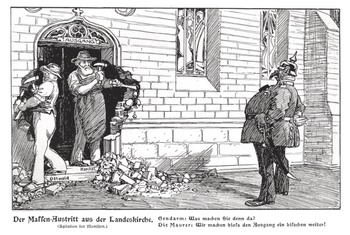
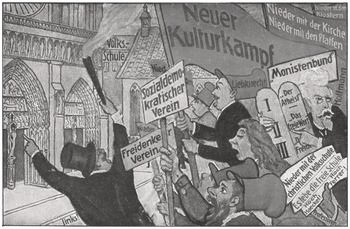

 Open access