

Wherever humans have lived, occupying the most inhospitable regions of the ecumene, they have brought with them depictions of the hand as a symbol of their identity (Oktaviana et al. Reference Oktaviana, Bulbeck, O’Connor, Hakim, Suryatman, Prasetyo Wibowo, St Pierre and Fakhri2016). One of the extreme limits of human migration is in the southern part of the Americas, where we can find splendid friezes featuring negative hand stencils, or hand silhouettes, along with other paintings, in the great Río Pinturas gorge (Argentina). It is quite some way from El Castillo in Spain to Patagonia, all the more so when one bears in mind that humans entered the American continent via the Bering strait. Furthermore, it is a long way in terms of chronology: 30,000/25,000 bp for El Castillo, Maltravieso, Gargas, Fuente del Salín, and other caves in South-west Europe and 10,600–10,400 cal bp for Río Pinturas.
In Palaeolithic rock art, hands are one of the most reliable and realistic known human depictions, as compared to those considered anthropomorphic. A number of researchers have studied these figures in articles with titles such as ‘All the Palaeolithic hands were made by women’ (Snow Reference Snow2006), ‘New views on old hands’ (Pettitt et al. Reference Pettitt, Castillejo, Arias, Ontañón and Harrison2014), and ‘Women leave their handprints on the cave wall’ (Snow Reference Snow2013), but the majority of these texts are based on observations of previously-published images, often not to scale or with a different perspective from that of the person who left the handprint. The use of cutting-edge technology lets us affirm that the majority are male left hands, although there are some female hands (Llaurens et al. Reference Llaurens, Raymond and Faurie2009).
To date then, the dominant paradigm established in studies of rock art for Palaeolithic hand stencils held that they were largely done by women and children, based entirely on their size. None of the previous studies has made use of new technologies, statistical measurements, the medical proposals of John T. Manning (see below), physical location within the cave space, the colouring materials used to make them, and chronological evidence.
On the Iberian Peninsula various cave complexes exist with these types of depictions. The Laboratory of Palaeolithic Studies Research Group has undertaken studies of some of them, but the approach we are proposing here is completely new.
To date, data collection technologies, from 3D Scanner techniques to giga-images in high-resolution photography, have proved extremely efficient in the cave complexes where we have used them, like in the famous cave of Altamira (Bayarri-Cayón et al. Reference Bayarri-Cayón, Latova, Castillo, Lasheras, De Las Heras and Prada2015b). But the challenge for the concept, or the test of it, is their overall application on all the hand stencils (Ripoll López et al. Reference Ripoll López, Bayarri-Cayón, Muñoz, Latova, Gutiérrez and Pecci2014).
Our group has carried out a project compiling modern hand stencils belonging to both men and women, with ages ranging from 8 months to 90 years. A form was created with all the parameters we considered essential for the study, and through social media, the centres associated with the Universidad Nacional de Educación a Distancia (UNED, Open University), and personal collecting from all the workers at the UNED’s central headquarters, over the course of 2 years we put together an extensive corpus that included all ages and both sexes. We have amassed almost 24,000 files with which to check the effectiveness of what is called the Manning or Digit Ratio (see below). In a preliminary study prior to organising all of these items, we found a match of up to 97.7% of the overall total, allowing us to infer that the 2D:4D ratio (see below) is statistically valid (work in progress). Based on the study of the El Castillo cave, we created an interdisciplinary team to study both hand depictions and zoomorphic figures. For the former, we brought together a team of prehistorians along with forensic examiners, doctors, orthopaedists, experts in biomechanics, I.T. engineers, technicians specialised in new technologies and the digital treatment of images, and photographers. Footnote 1 For the second, we worked with zoologists specialised in each of the animal depictions identified.
It is clear that any attempt to extrapolate these measurements to prehistoric hands should be undertaken with due care, acknowledging the variability of these imprints on a rock surface, sometimes sloping, with deficient lighting. But the data we have obtained in the study of the hands in the El Castillo cave is both extremely encouraging and conclusive.
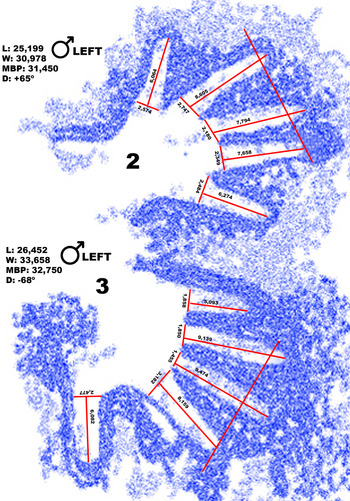
New technologies and the digital treatment of high-resolution images have been extremely important in opening up the possibility of making very precise measurements (up to three decimal places), enabling us to differentiate sex, stature, and even to infer intangible phenomena such as whether the subjects were right- or left-handed (Fig. 1).
Example of measurements carried out on two hands in El Castillo cave, according to S. Ripoll

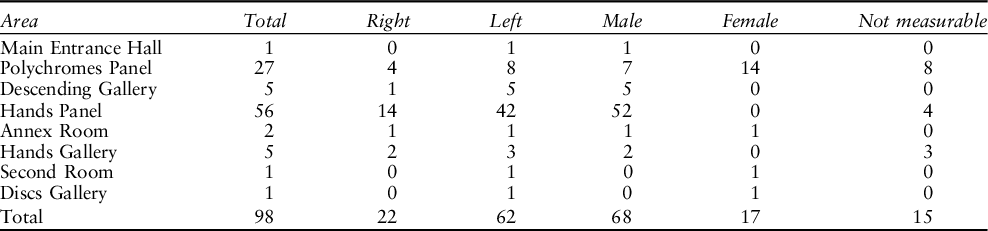
This is not the first attempt to apply the Manning Index to the study of Palaeolithic hands (Rabazo-Rodriguez et al. Reference Rabazo-Rodríguez, Modesto-Mata, Bermejo and García-Díez2017) but it is indeed the first time that analysis of all type of representations is addressed and supported by an enormous database of a very large population. Twenty-nine hands of El Castillo are analysed in the study by Rabazo-Rodriguez et al. while we dealt with all the hand images identified to date in El Castillo, which reach 98 prehistoric representations. As to distinction by sex, in the previous study nine male and 12 female hands are represented, while our study of the Cantabrian cave shows that 68 are male, 17 female, and 15 non-measurable (see below). When dealing with a study of this type, it is necessary to make an attempt to take all the figures into account.
THE CASTILLO CAVE
Monte del Castillo in Puente Viesgo, Cantabria, has one of the largest groupings of caves from European prehistory, which includes El Castillo cave, La Pasiega A, La Pasiega B, Las Chimeneas, and Las Monedas. In this 354 m high limestone cone there are also 64 other caves where, to date, no archaeological evidence has been found, except for in La Flecha.
The well-known El Castillo cave in Puente Viesgo was discovered as a prehistoric site and cave with paintings by Hermilio Alcalde del Río in 1903. Later, the parietal artwork in the cave was studied by Abbé Henri Breuil with the collaboration of Alcalde del Río and Lorenzo Sierra, from which come the chapters that make up the most important part of the great work Les Cavernes de la Región Cantabrique (Breuil Reference Breuil1952; Breuil & Cartailhac Reference Breuil and Cartailhac1906). From 1910 to 1914 excavation of the entrance hall was undertaken by the Institut de Paléontologie Humaine in Paris. The work was overseen by Hugo Obermaier with collaboration from Paul Wernert and a number of other foreign prehistorians. From 1952 to 1964 Eduardo Ripoll, along with his wife Amparo Luisa López and other collaborators, studied Las Monedas cave in the same complex and thoroughly reviewed the descriptions of El Castillo cave (Ripoll Perelló Reference Ripoll Perelló1956; Reference Ripoll Perelló1971–1972; Reference Ripoll Perelló1973).
Later, in 1954, Jesús Carballo with Joaquín González Echegaray carried out an excavation inside the cave which showed that the great hall (see Fig. 14 below: Gran Sala) also contains an important Upper Solutrean site that is missing in the stratigraphy of the entrance hall (González Echegaray & Moure Romanillo Reference González Echegaray and Moure Romanillo1970).
Between 1980 and 1992, the late Victoria Cabrera decided to clean the site’s stratigraphic section to confirm whether, as was believed, there remained no unexcavated desposits. She discovered that an important lower part of the infilling was intact. (Cabrera Valdés Reference Cabrera Valdés1984). A new excavation campaign continued until the 1990s and, after her death, they were directed by F. Bernaldo de Quiros (Bernaldo de Quirós et al. Reference Bernaldo de Quirós, Maíllo and Neira2010). Recently, in 2020, J.M. Maillo has again taken up the archaeological work, but there are no published results as yet.
This very important site has one of the most extensive stratigraphic sequences in world prehistory, given that it encompasses around 120,000 years, from the late Lower Palaeolithic to the Bronze Age.
The hand
To understand the significance of Paleolithic representations, it is necessary to know the importance of this limb and its versatility when it comes to being placed in any position on a rocky surface. Hands, with their 27 bones, form the most precise appendage in nature, but opposable thumbs are really their most important element, representing one of the great milestones of evolution. This series of bones, with their 29 joints and 123 ligaments, enable the hand to carry out its many movements around the wrist which can be flexed, rotated, and extended, with the fingers able move both individually and in unison. A total of 35 movements make the hand an essential tool (Bezodis et al. Reference Bezodis, Willwacher and Tapio Salo2019).
THE J.T. MANNING RATIO
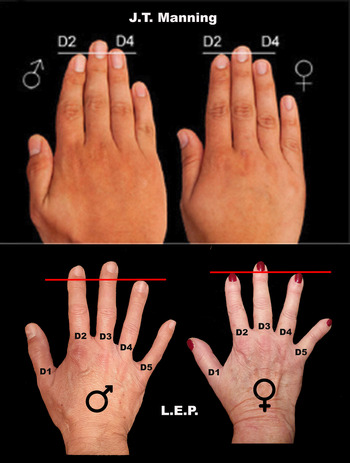
The John T. Manning Ratio, also referred to as the 2D:4D Digit Ratio, is used to identify differences in men’s and women’s hands, based on the dimorphism that exists in the length of Finger 2 (the index finger) and Finger 4 (the ring finger) (Manning et al. Reference Manning, Morris and Caswell2007; Manning & Fink Reference Manning and Fink2008; Reference Manning and Fink2014; Reference Manning, Fink, Shackelford and Weekes-Shackelford2018). In women, as a general rule, both fingers are more-or-less the same length, whereas in men the ring finger tends to be longer than the index finger. In humans, each hand is unique. In addition to fingerprints, a person may also be identified by finger and palm measurements. Some researchers believe that there is no evidence of biomechanical activity that correlates to these differences in lengths and, that being the case, it would not be possible to verify it biomechanically (Brůžek et al. Reference Brůžek, Lázničková-Galetová, Galeta and Maestracci2012).
This difference can be seen on an ontogenic level from the 9th week of gestation onwards and is based on the difference between androgens and oestrogens during the development of the foetus. From a mathematical point of view, the ratio difference between the two sexes is minimal: 0.984 for men, and 0.994 for women. However, if you look at the open hand (fingers separated), the difference is clear and obvious (Voracek Reference Voracek2011). Normally, if the mathematical formula is applied with the fingers together, very clear results are obtained. The ratio is calculated by dividing the length of the index finger (2D) by the length of the ring finger (4D) on the same hand. A long index finger would translate into a ratio greater than 1, while a longer ring finger would give a result of less than 1. When the observation is made with the fingers separated, the differences between these fingers are much more evident. The 2D:4D relationship is sexually dimorphic, although the result obtained is less in women than in men, the difference between the lengths of the two fingers is greater in men than in women (Fig. 2). It is oestrogen that causes the growth of Finger 2 (index finger), whereas testosterone is responsible for the growth of Finger 4 (ring finger) (Romo-García et al. Reference Romo-García, Zapata-Zuñiga, Enciso-Moreno and Castañeda-Delgado2020).
Differences between a male hand and a female hand according to the J.T. Manning ratio index (top) and according to our study with the L.E.P. index shown below

Clear differences also exist between ethnic groups (Caucasian, Asian, black), but our interest is focused on an apparently homogeneous group from a racial point of view, with our sample centring exclusively on Caucasians.
Physical anthropology plays an important role, given that a statistical application of the length of Finger 3 (3D), the middle finger, enables us to establish the height of each of the individuals who left their handprints in the caves, and thereby gives us an indication of the height of the group. Determining the height of an individual is found within the different human identification systems used in physical and forensic anthropology, with one of the techniques being the correlation between the lengths of different parts of the body to total height, essentially based on measurements of long bones (Kocmur et al. Reference Kocmur, Velušček, Mihevc and Ortega Ruiz2017).
Hands are no exception, and on them there is a relationship between length of the fingers and the person’s height. The length of the 1st phalange of the Finger 3 multiplied by 29 gives almost exactly the real height of the individual (±10 mm). However, it is not the most widely used technique and studies have scarcely been developed in this respect. In fact, it is used as a last resort, mainly in cases where other large bones are not available or are not found in a good state of conservation, such as in cases of mutilations, people who have been cremated, or, as in the case presented here, pictorial representations of hands.
The brain’s right–left asymmetry leads to the use of one hand or the other. The right hemisphere of the brain controls the movement of the left-hand side of the body, while the left hemisphere controls the right-hand side. Genetics has established that 40 weak genes contribute to determining whether people are right-handed or left-handed. The gene known as LRRTM1 has been associated with a greater likelihood of being left-handed, whereas the PCSK6 gene has been associated with the likelihood of being right-handed (Darvik et al. Reference Darvik, Lorås and Vorland Pedersen2018). But genetics is not the only factor contributing to the preference for one hand over the other. Prenatal environments and cultural influences are also important. It is probable that, in the evolutionary process, there was also a natural selection involving the ability to throw objects (stones, branches, and so on). The first hominids, when they started walking upright, freed their upper extremities for carrying out other actions not simply linked to walking. They learnt to throw.
Naturally left-handed people can be found in every human population across every continent. Approximately 8–13% of the global population is left-handed. Studies indicate that this phenotype is more common among men than among women. There are more left-handed males (13%) than there are females (9%), without the cause for this difference being known. The child of a left-handed father and mother has more than a 50% chance of also being left-handed (Darvik et al. Reference Darvik, Lorås and Vorland Pedersen2018).
In a society of hunter-gatherer-fishers and opportunists during the Upper Palaeolithic, with extremely tight family units and a certain level of consanguinity, it is highly likely that children inherited being left-handed from their parents.
THE LIVING SAMPLE
Contrary to the general observation made above, our living sample shows that, in a very high percentage of men, the index finger is significantly longer than the ring finger. In looking at the 2D:4D ratios we have prioritised family groups to confirm whether similarities or differences exist within these closed units. The male hands are similar between fathers and sons and at an adult age are practically identical, with the occasional difference. In the sons, all the fingers have the same measurements other than Finger 1 (the thumb), which differs from those of the fathers both in length and width. Meanwhile, when it comes to mothers and daughters (again, at an adult age), this difference is focused on Finger 5 (the little finger).
Among isolated individuals (the majority), the differences between 2D and 4D are all extremely clear, other than in three pairs of female hands that present markedly male characteristics. Looking into these cases in greater depth, we discovered that the three women were triplets, daughters of parents who both had twin siblings. It is highly significant that no differences are observed between the sexes in the varying regions of the Iberian Peninsula.
In terms of determining height, the results of some of the specific measurements already undertaken (1.85 m) could come as a surprise since, in our imagination, we thought that these people were much shorter than us. In this respect it is also extremely interesting to find the presence of children and even infants in the depths of the caves (see below and Pastoors & Lenssen-Erz Reference Pastoors and Lenssen-Erz2021).
In our survey, we asked our living subjects to indicate whether they were right- or left-handed and at the end, in order not to condition their answers, we asked them which was the first hand they had drawn. We also asked them to draw an animal in one of the corners of the sheet. Those who were right-handed always (100%) drew their left hands first, as they held their pencils in their right hands, and the zoomorphic figure was oriented towards the right. Left-handed respondents, meanwhile, always (100%) depicted their right hands first, and the drawn figure was oriented towards the left. Our database shows that 17.8% of the sample were left-handed whereas 82.2% were right-handed.
IMPLICATIONS FOR HAND DEPICTIONS IN THE CAVES
Having established our database from a living sample we can turn our attention to the hand depictions in the El Castillo cave system. We should bear in mind that these caves were not reconditioned like the majority of caves that can be visited today. In general, a virgin cave contains a chaos of blocks full of passageways, hidden corners, a lot of mud and, in the Palaeolithic, also the possibility of running into a hibernating cave bear (Ursus spelaeus). All this difficulty and danger was on top of a fairly precarious lighting system: small grease or marrow lamps or torches with their faint and flickering light.
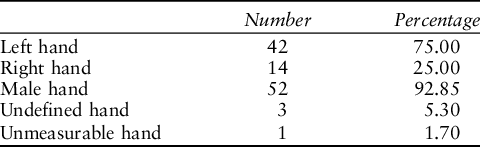
In the El Castillo cave, with a present total of 98 depictions of hands clustered around the central part of the cave, 62 (63.26%) are left hands, compared to 22 (22.44%) right hands. Due to their state of preservation, it is impossible to tell whether 15 of them (15.30%), are right or left hands.
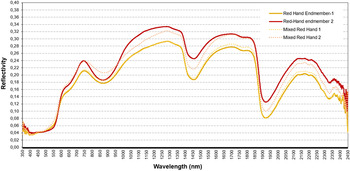
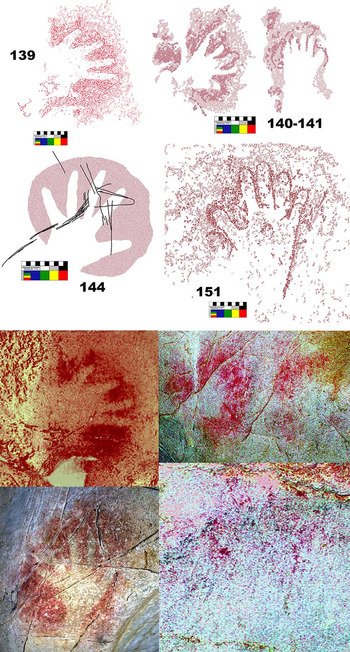
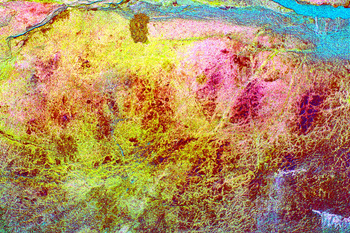
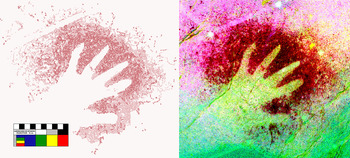
Of the hands that have been identified to date (98, 100%), all are negative hand stencils, or silhouettes and all are painted in different tones of red ochre. Although many of them appear to be the same colour, their spectral signatures (Fig. 3) have demonstrated that there are varying hues, responding to different colorimetric curves, as can be seen in the hand images that follow (hand images are shown in colour in the online version of this paper and indicated by greyscale tones in the printed text). It is possible to differentiate between varying types of pigment that are identical to the naked eye. Their spectral signatures make it possible to analyse the separability between classes, and to discover how many types of pigment it is possible to distinguish (Bayarri-Cayón et al. Reference Bayarri-Cayón, Sebastián and Ripoll2019).
What we have termed the Spectral Signature allows us to differentiate between a panel’s varying pigments

The possibility also exists that our predecessors chose not to place the palms of their hands, but their backs onto the rock. In this case the outline would be reversed, turning a right hand into a left hand. Given that, in our live sample database, nobody depicted their hands backwards, it would seem unlikely (though not impossible of course) for that to be the case for prehistoric hands. The modern participants in our study were told to ‘draw a hand’, without any symbolic or cultural background; however, this could have existed for the Palaeolithic individuals, and drawing them ‘backwards’ might have been part of that symbolism.
METHODOLOGY FOR THE VISUALISATION AND GEOMETRIC CHARACTERISATION OF THE HANDS
A geomatics method that combines several types of photogrammetry and remote sensing has been used in the current work, as described by V. Bayarri-Cayón (Reference Bayarri-Cayón2020). This technique permits the accuracy of the Ground Control Points (GCP) to be increased to 2 mm by taking them from a 3D Terrestrial Laser Scanner (3DTLS), compared to 5–7 mm from the prism measuring systems of Topographic Total Stations (TTS), and to avoid the use of pointing elements such as targets. It also allows control points to be had throughout the whole panel to assess deviations (Ontañon et al. Reference Ontañón, Bayarri, Castillo, Montes, Morlote, Muñoz and Palacio2019).
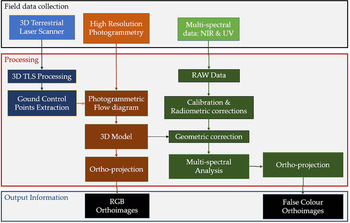
The overall workflow of the proposed method is shown in Figure 4. It basically consists of three parts. The first deals with field data collection; the second with processing the collected data to generate the third part, that is, the output information used to make the measurements.
Detailed workflow of the proposed method

First, data was collected in El Castillo by 3DTLS FARO X-330. Once the data was adjusted, a sub-sampling method was used to obtain a homogeneous point cloud, which constituted the basis of the ground control points later used in photogrammetry, as described in Bayarri-Cayón and Castillo (Reference Bayarri-Cayón and Castillo2009). The photogrammetric data was recorded with a resolution of over 200 microns and a colour management process by using a Sony A7R Mark II camera with a 90 mm focal length. The GCPs were taken from the point cloud, and a standard photogrammetric process as described in Bayarri-Cayón et al. (Reference Bayarri-Cayón, Latova, Castillo, Lasheras, De Las Heras and Prada2015b) was carried out.
Multispectral data that integrates information from ultraviolet (UV) and near-IR (NIR) spectroscopy provides much information. The resulting 3D model was used to reproject multispectral data to it by removing the conical perspective of the data and being able to project data and results orthogonally, as described in Bayarri-Cayón et al. (Reference Bayarri-Cayón, Sebastián and Ripoll2019), and create false colour orthoimages based on colour transformations, such as Principal Components Analysis, Minimum Noise Fraction, and Independent Component Analysis, as described in Bayarri-Cayón et al. (Reference Bayarri-Cayón, Latova, Castillo, Lasheras, De Las Heras and Prada2015a). The goal of these techniques is to enhance paintings that can barely be seen or even perceived with the naked eye.
The innovative hyperspectral technique (Bayarri-Cayón et al. Reference Bayarri-Cayón, Sebastián and Ripoll2019; Reference Bayarri-Cayón, Castillo, Ripoll and Sebastián2021) consists in that, when we take a photograph with a conventional camera we get data from three channels – red, green, and blue. But when we use hyperspectral remote sensing, such as Specim ImSpector V10E, up to 214 channels of 2.8 nm spectral resolution are generated in the spectral range 400–1000 nm. The ability to detect colorimetric differences is surprising given that, while the ultraviolet beam stays on the surface, the infrared measurement penetrates the rocky surface and can detect what may lie beneath or behind a paint stain, soot, or the calcite flow itself that has been deposited throughout millennium on any of the panels studied in a cave. What is novel about this methodology lies not only in how more-or- less advanced the apparatus taking the images is – posing no risk to the figures – but in the way of processing the images, using various algorithmic mathematical calculations that today constitute the main differential value provided by GIM Geomatics, a company we have been actively collaborating with for many years.
DESCRIPTION OF THE HANDS IN EL CASTILLO CAVE
Main Entrance Hall
Quite a number of zoomorphic and idiomorphic figures have been identified in the entrance to the cave complex, distributed throughout the space. In the area on the right and almost in the corner, connecting to what is known as Slide and the Descending Gallery, we have identified a negative hand stencil corresponding to a left hand which, judging by the difference between Fingers 2 and 4, is clearly male.
Polychromes Panel (Fig. 14: Panel de los Policromos)
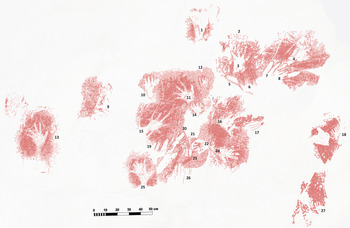
Although this area forms part of the Descending Gallery, given the complexity of its rock art, we decided to look at it individually. We were able to distinguish a total of 27 hand stencils, compared to supposedly six (which in fact are four, as two are not represented on the rocky surface) published by Alcalde del Río et al. (Reference Alcalde del Rio, Breuil and Sierra1911) (Fig. 5). In other words, we have multiplied the number of hands sevenfold. These are the four complete examples from Les Cavernes de la Région Cantabrique (González-Pumariega Reference González-Pumariega1911), to which we have added a further five, more-or-less complete, hands. The other 18 are partial hands where the halos of subsequent hands have covered the previous ones. Thus, we have some outlines where up to four fingers can be observed (four examples) and others with 1–3 fingers (four examples).
Tracing of all depictions of hands identified on the Polychromes Panel, according to S. Ripoll and Equipo Norte

Although it is not possible to prove beyond doubt, contrary to the case with the Hands Panel, we can verify that on this rocky surface at least one (No. 24) differs from the rest in terms of spectral signature, in spite of numerous superimpositions of hands. As such, we can state that there are also two stages or phases of hand impressions, where in many cases the latter are superimposed over the former.
Furthermore, for the nine more or less complete hands, we can categorically confirm that these are male hands according to the L.E.P. ratio Footnote 2 (see Fig. 3), When measurements are taken with the palm open, unlike with the Manning system, the differences in the length of Fingers 2 and 4 are much more evident, given that in all cases 4D is shorter than 2D. Additionally, in the nine hands including the thumb (1D), eight are left hands while only one is a male right hand.
Descending Gallery (Fig. 14: Galería Descendente)
Across the right-hand wall alongside the stairs going down towards the Hands Panel and Tectiforms Alcove, we have differentiated a total of four groups that include nine hand stencils. Starting with the highest one, on the left of the Polychromes Panel, we can make out a left hand with markedly male characteristics.
Nearby, just a few centimetres from the previous hand, heading downstairs, we find two more hands (Fig. 6). One of them, on the left, can be clearly observed, while that on the right is rather faded and deteriorated. Both are left hands, and both belong to men.
Hands of the Descending Gallery from the inventory of E. Ripoll–S. Ripoll, and Equipo Norte

Just before we reach the end of the stairs, next to an extremely clear anthropomorphic figure, we find another hand, which had been perfectly documented previously, and which has a depiction of a deer engraved on top of it. This is, once again, a male left hand.
In a small chamber at the end of the stairs we can clearly make out the front half of a great bison, painted in black and with almost its entire outline engraved, being completed with other black paint strokes. On its right we can clearly observe a new hand, in this case a right hand, once again belonging to a man.
The Hands Panel (Fig. 14: Panel de las Manos)
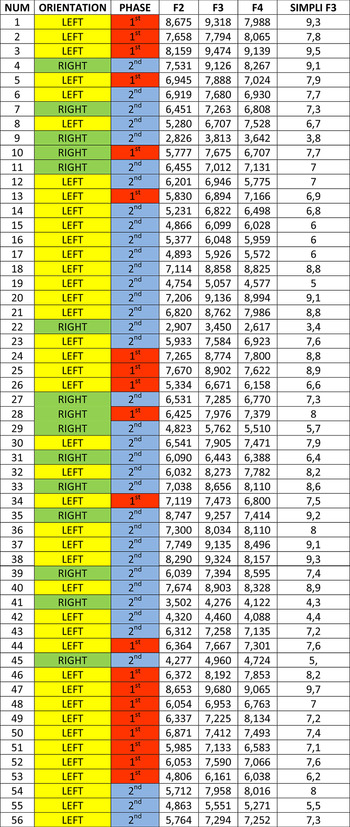
In the study by Alcalde del Río et al., and in Les Cavernes de la Region Cantabrique (González-Pumariega Reference González-Pumariega1911), we find descriptions of a total of 33 painted hands, which we have increased to 56 (Table 1). It is not only the increased number that is significant, but also their relationship to the rest of the iconographic figures on this rocky surface.
The hands described in the hands panel

The individualised hand outlines in their original position have been subject to a series of measurements, including the length and width of each of the fingers, the width of the palm from the bottom of Finger 1 to the base of Finger 5, and the total length of the hand from the end of Finger 3 to the start of the wrist, when the palm closes to start the arm (Fig. 7). All of these measurements were done using the Adobe Photoshop measuring tool, taken to three decimal points (for example, 7.634 cm) to attain exact measurements for the purpose of comparing the series of painted hands both individually and as an ensemble.
Measurements of all hands found on the Hands Panel

It is highly likely, given the data we have collected from the exhaustive process of measuring all the hands on the Hands Panel, that there are stencils from 17 different people, all male, other than four where it is impossible to determine the sex due to the state of preservation or because the halo of another hand has obscured one of the fingers.
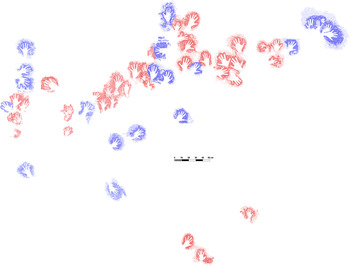
We have been able to differentiate two decorative phases on the Hands Panel (Fig. 8). In some cases, their infraposition relative to the well-known bison was quite clear, just as others were superimposed on top of zoomorphic figures. This fact led us to look into the digital response of varying colouring agents, applying the Spectral Signatures described above. Even by applying specific algorithms, some hands become extremely clear while others almost completely disappear, depending on the configuration of the filter used. What is surprising is that when this is undertaken in situ, it becomes quite evident that some lie beneath the zoomorphic figures while others are on top of them.
Series of hands from both phases identified on the Hands Panel, the first phase in dark grey/blue and the second in light grey/red, according to the inventory of S. Ripoll and Equipo Norte

In certain cases, there is a striking similarity in hand measurements between the two phases. This means that the man who painted the first one was already an adult when he did so, and after the faded black figures we discovered some years ago and the series of yellow bison were painted, this same man came back to paint his hand on another part of the panel (Ripoll et al. Reference Ripoll López, Bayarri-Cayón, Muñoz, Latova, Gutiérrez and Pecci2014; Reference Ripoll López, Bayarri-Cayón, Castillo, Latova and Muñoz2021). This is the case with three other hands that are present in both phases, although the measurements of some fingers differ slightly, suggesting the possibility that these were the children of those from the first phase.
Annex Room (Fig. 14: Sala Anexa)
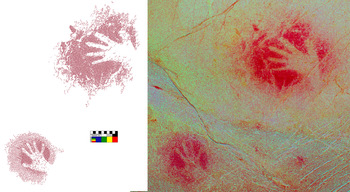
This small room connects the Tectiforms Alcove with what is known as the Hands Gallery. Close to the start of this passageway we find one of the figures which, according to Les Cavernes de la Région Cantabrique, is located on the upper part of the Polychromes Panel. In this work the figure is described as the hindquarters of a quadruped. In E. Ripoll’s documentation, the outline of a bison can be distinguished, but what stands out most is the presence of the supposed head of a leporid that really is not even there, since he mistook an engraved bison head for the rabbit. A few years ago, G. Tosello et al. (Reference Tosello, Ceballos del Moral, Sauvet and Fritz2007) published the bison outline, specifying that it belonged to the hindquarters. We have completed that figure, adding some details and incorporating the hand stencils into the ensemble. The two hands (Nos 270–1) are starkly contrasting (Fig. 9). The upper one is a big and clearly male left hand, whereas the lower one is a smaller, female right hand. Judging by its size, the latter probably belonged to a young girl.
Hand Nos 270–1 from the inventory of E. Ripoll–S. Ripoll and Equipo Norte

The Hands Gallery (Fig. 14: Galería de las Manos)
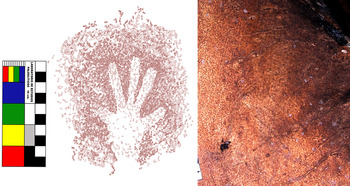
This passageway connecting the lowest section of the cave complex with the Fourth Room is often flooded, and this may be the reason for the poor state of preservation of its art. Despite this, we have identified a total of five negative hands, of which three belonged to left-handed people and two to right-handed individuals (Fig. 10). In two of them the fingers are clearly visible, and we believe them to belong to male hands, while three of them are not measurable, though one is also probably male.
Hands from the Hands Gallery. Photo: V. Bayarri

Second Room (Fig. 14: Sala Segunda)
Near the Hands Panel and the column with what is known as the Shaman-Bison, we find an extremely clear silhouette of a left hand (No. 362; Fig. 11), whose measurements lead us to conclude it belonged to a woman.
Hand No. 362 from the inventory of E. Ripoll–S. Ripoll and Equipo Norte

The Discs Gallery (Fig. 14: Galería de los Discos)
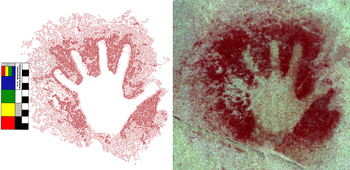
Known as the Discs Gallery or the Dots Gallery, this is the last gallery that can be visited in El Castillo cave. Here it is worth highlighting the lines of large-scale discs, whose possible significance is, of course, unknown. The gallery ends with the ‘lithophone’. Among these discs or dots of varying sizes, the eye is drawn to a negative hand stencil (No. 431; Fig. 12) next to an idiomorph painted in red. This is a clearly female left hand, given the 2D and 4D fingers are practically the same length.
Hand No. 431 from the inventory of E. Ripoll–S. Ripoll and Equipo Norte

Reaching this area of the cave complex must have involved an enormous effort, given the cavity was not managed for tourism as it is now. In addition, there was the problem of lighting. Carrying a sufficiently durable source of light, or a spare, constituted a real feat of organisation and foresight. At least one woman who left her handprint had made this arduous and dangerous feat of spelunking (potholing) to the very end of El Castillo.
SPATIAL DISTRIBUTION
Of the 98 hands recorded in our inventory (summarised in Table 2), 95 (96.93%) are clustered in an extremely limited area of the cave complex, in one of the lower sections. The other three hands (3.06%), meanwhile, are much more randomly distributed and isolated, not being part of any groups.
Summary of all hand stencils in el castillo cave

Two of them are relatively close to the rest (Nos 74 and 362; Fig. 13), but the last (No. 431) is in the very deepest part of the cave. At one time we thought it might be the same hand as is found in the Second Room, given that 5D (the little finger) is bent in a particularly odd way, but the measurements between the two hands do not match for any of the fingers.
Hand No. 74 from the inventory of E. Ripoll–S. Ripoll and Equipo Norte

Floor plan of El Castillo cave including the spatial distribution of the different hand stencils mentioned in the text

CONCLUSION
On the Cantabrian coast there are various caves with depictions of negative hands: Fuente del Salín (14) (González Morales & Moure Romanillo Reference González Morales and Moure Romanillo2000; Moure Romanillo & González Morales Reference Moure Romanillo and González Morales1992); Altamira (6) (Alcalde Del Río et al. Reference Alcalde del Rio, Breuil and Sierra1911); La Garma (32) (González Sainz et al. Reference González Sainz, Arias Cabal and Moure Romanillo1996; Ontañón Peredo et al. Reference Ontañón Peredo, Arias Cabal, González Sainz and Moure Romanillo1999); La Pasiega (1) (Ripoll Perelló Reference Ripoll Perelló1986; Balbin Behrmann et al. Reference Balbin Behrmann, González-Sainz and Alcolea-González2014); and El Cudón (1) (San Miguel & Muñoz Reference San Miguel and Muñoz1986). These caves are all in Cantabria. In Asturias are a supposed positive hand in the cave of El Pindal (1) (Jordá Cerda & Berenguer Alonso Reference Jordá Cerda and Berenguer Alonso1954; González-Pumariega Reference González-Pumariega1911) and two hand stencils in the eastern part of Tito Bustillo (Balbin Behrmann & Moure Romanillo Reference Balbin Behrmann and Moure Romanillo1980; Reference Balbin Behrmann and Moure Romanillo1981; Reference Balbin Behrmann and Moure Romanillo1982). But there is no doubt that El Castillo stands apart in numerical terms, with 98 negative hand stencils. Without a doubt, when we apply our hyperspectral methodology and treatment of images by means of specific algorithms to other caves, the number of hand figures will increase considerably and the possibility will open up to differentiate the figures between the sexes.
Beyond the Cantabrian Coast we find the cave of Maltravieso (Cáceres) (71) (Jordá Cerdá & Sanchidrián Torti Reference Jordá Cerdá and Sanchidrián Torti1992; Ripoll López et al. Reference Ripoll López, Collado Giraldo and Ripoll Perelló1999), La Fuente del Trucho (Huesca) (42) (Ripoll López et al. Reference Ripoll López, Baldellou, Muñoz Ibañez and Ayuso2001; Utrilla & Bea Reference Utrilla and Bea2006), Ardales (Málaga) (1) (Pitarch Martí et al. Reference Pitarch Martí, Zilhão, Ramos Muñoz, Weniger, Cantalejo Duarte, Domínguez Bella and Errico2019), and a recent addition to the list, the cave of Las Estrellas (Cadiz), with five negative hand stencils (Collado Giraldo et al. Reference Collado Giraldo, Bea, Ramos-Muñoz, Cantalejo, Domínguez-Bella, Ramón Bello, Angás, Miranda, Gracia Prieto, Fernández-Sánchez, Aranda, Luque, García Arranz and Aguilar2018).
The three cave complexes that bring together the greatest number of hands (Castillo, Maltravieso and Fuente del Trucho) have been studied by the Laboratory of Palaeolithic Studies Research Group, which means that, in future, we will be able to undertake a comparison of them all. At present it is clear, in contrast to what has occasionally been published, that the hands at El Castillo cave are, in the majority, male left hands.
As stated at the beginning, in recent years there has been an exaggerated tendency to ‘feminise’ prehistory (Lupo & Schmitt. Reference Lupo and Schmitt2002; Hass et al. Reference Haas, Watson, Buonasera, Southon, Chen, Noe, Smith, Viviano Llave, Eerkens and Parker2020; Lombard & Kyriacou Reference Lombard and Kyriacou2020). This is not to say that women were not of vital importance in our predecessors’ society but attempting to extrapolate current concepts to societies with a subsistence economy is, in our opinion, not very accurate.
The existence or co-existence of representations of masculine and feminine hands within El Castillo cave shows the active participation of both sexes in the religious or decorative rituals carried out in the dimly lit caves, including the participation of infants from both sexes. Not all the hands are feminine, nor are all masculine, but in our study there is a clear predominance of the latter over the former.
Acknowledgements
I (S.R.) would like to express my thanks for the suggestions and contributions regarding hands provided by my friend and Orthopaedic surgeon Dra. Lourdes Gutiérrez Francés and to Lori Gerson and Julie Gardiner for revision of the translation and suggestions. This research project was carried out with the permission of the Regional Governmental Department of Culture of Cantabria, which granted us authorisation in 2016.