Introduction
Weather conditions are thought to play an important role in the transmission of many infectious diseases that cause significant mortalities in humans, wild and domestic animals in both temperate and tropical countries. For instance, the outbreaks of diseases such as trypanosomiasis are correlated with rainfall that provides favourable conditions for survival and reproduction of trypanosomes (Rogers and Randolph, Reference Rogers and Randolph2006). Also, avian influenza is positively influenced by rainfall (Brown et al., Reference Brown, Mulatti, Smietanka, Staubach, Willeberg, Adlhoch, Candiani, Fabris, Zancanaro and Morgado2017). Temperature, relative humidity and precipitation have been shown to play a vital role in the incidences of dengue fever (Gubler et al., Reference Gubler, Reiter, Ebi, Yap, Nasci and Patz2001), Rift Valley fever (Maloo, Reference Maloo1993; Anyamba et al., Reference Anyamba, Chretien, Small, Tucker, Formenty, Richardson, Britch, Schnabel, Erickson and Linthicum2009; Lwande et al., Reference Lwande, Paul, Chiyo, Ng'ang’a, Otieno, Obanda and Evander2015) and malaria (Wangdi et al., Reference Wangdi, Singhasivanon, Silawan, Lawpoolsri, White and Kaewkungwal2010).
Tick-borne diseases (TBDs), such as tick-borne encephalitis (Subak, Reference Subak2003), boutonneuse fever (de Sousa et al., Reference de Sousa, Luz, Parreira, Santos-Silva and Bacellar2006) and lyme disease (Rogers and Randolph, Reference Rogers and Randolph2006), are known to be also positively correlated to rainfall. In dry tropical areas, rainfall patterns are often highly variable. Ticks reproduce massively at the onset of any rainfall episode and slowly develop into nymphs in 3 weeks to 1 month. The nymphal and adult stages have been shown to be the stages where pathogens are transmitted from the tick to the mammalian host, resulting in diseases and probably mortalities (Jongejan & Uilenberg, Reference Jongejan and Uilenberg2004; Hechemy et al., Reference Hechemy, Oteo, Raoult, Silverman and Blanco2006; Rogers and Randolph, Reference Rogers and Randolph2006; Dantas-Torres, Reference Dantas-Torres2015). Variations in tick densities over time depend on three factors: fecundity, length of time between the stages (conditioned partly by the waiting time of successive hosts and environmental conditions) and mortality rate of the ticks. These three processes lead to tick densities that follow a certain seasonality and which result in a more or less predictable annual pattern. Moreover, the growth of the vegetation during these periods attracts reservoir mammalian hosts facilitating transmission of pathogens (Norval et al., Reference Norval, Sutherst, Kurki, Gibson and Kerr1988; Cumming, Reference Cumming2002; Awa et al., Reference Awa, Adakal, Luogbou, Wachong, Leinyuy and Achukwi2015). On the other hand, as more forage is available during periods of rainfall for mammalian hosts that may be negatively affected by TBDs, their body condition (and immunity levels) also improve, which reduces their susceptibility.
TBDs cause severe economic losses and are associated with 60–80% of the livestock mortalities affecting livelihoods (Chepkwony et al., Reference Chepkwony, Van Bommel and Van Langevelde2018). To date, few studies on the effects of TBDs on livestock mortality have been conducted in dry tropical areas. Identification of the environmental determinants of TBDs and their associated mortalities is of great importance to understand the incidences of TBDs, especially in dry tropical areas with highly variable rainfall patterns. Rainfall may affect ticks directly and indirectly by its effect on relative humidity and vegetation. Whether variation in rainfall affects disease-induced mortalities is, however, poorly understood. In the absence of tick monitoring in many regions in the tropics, livestock mortalities, which are indications of effective pathogen transmission, may provide understanding about the associations between within-year variation in rainfall and the incidences of TBDs (Gachohi et al., Reference Gachohi, Skilton, Hansen, Ngumi and Kitala2012; Fouque and Reeder, Reference Fouque and Reeder2019).
Although there is a need to determine if there are any associations between rainfall and TBDs-induced mortalities, long-term data are generally lacking (Heuer et al., Reference Heuer, Boehle, Rutagwenda, Jongejan, Unger, Kivaria and Okello-Onen2004; Keeling and Rohani, Reference Keeling and Rohani2008; Kołodziej-Sobocińska, Reference Kołodziej-Sobocińska2019). Here, we use long-term data on Boran cattle mortality to determine associations between monthly rainfall and three TBDs, namely East Coast fever (ECF), anaplasmosis and babesiosis, to further improve our understanding about the extent weather conditions play in the dynamics of pathogen transmission and for use in disease control. We expect that high monthly rainfall would lead to an increase in mortalities induced by these TBDs. ECF causes most mortalities (65%; Kanyari and Kagira, Reference Kanyari and Kagira2000) in cattle of all TBDs, as the vector, the tick Rhipicephalus appendiculatus, is one of the most abundant tick species in East Africa, infesting both wild and domestic animals (Zieger et al., Reference Zieger, Cauldwell and Horak1998; Wesonga et al., Reference Wesonga, Orinda, Ngae and Grootenhuis2006; Swai et al., Reference Swai, Karimuribo, Kambarage and Moshy2009; Keesing et al., Reference Keesing, Allan, Young and Ostfeld2013; Mwamuye et al., Reference Mwamuye, Kariuki, Omondi, Kabii, Odongo, Masiga and Villinger2016). Babesiosis accounts for 5.1% and anaplasmosis for 4.5% of the mortalities in cattle due to TBDs (Kanyari and Kagira, Reference Kanyari and Kagira2000), and these two TBDs share the same main vector, the tick R. decoloratus.
Methods
Study area
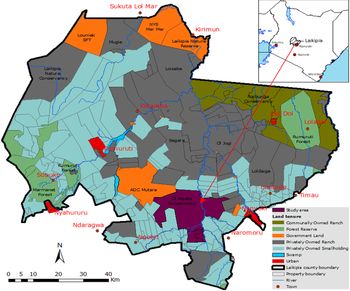
The data on cattle mortality were collected in Olpejeta Conservancy (OPC), a facility for commercial livestock production and wildlife management in Laikipia County, Kenya. Laikipia county is located between 0°04′60.00″N and 36°39′59.99″E (Fig. 1). The county covers ~ 10 000 km2 and the rainfall is typically bimodal and unpredictable throughout the year. Laikipia county has an estimated human population of ~ 400 000 living in either urban or rural areas and relies on wildlife conservation, livestock production and crop farming for their livelihoods (Government of Kenya, 2016). The interfaces between human, wildlife and domestic animals coupled with the local environmental conditions in the area may provide all-year-round conditions for tick survival, the spread of TBDs with resulting mortalities with major ramifications on livestock production and wildlife conservation (Odadi et al., Reference Odadi, Karachi, Abdulrazak and Young2011; Keesing et al., Reference Keesing, Allan, Young and Ostfeld2013; Allan et al., Reference Allan, Tallis, Chaplin-Kramer, Huckett, Kowal, Musengezi, Okanga, Ostfeld, Schieltz and Warui2017; VanderWaal et al., Reference VanderWaal, Gilbertson, Okanga, Allan and Craft2017). OPC is an intensively managed protected area in Laikipia County and covers 364 km2 (Fischhoff et al., Reference Fischhoff, Sundaresan, Cordingley and Rubenstein2007). In OPC, ticks are managed in domestic animals through weekly acaricide applied via high-pressure spraying nozzles (Chepkwony et al., Reference Chepkwony, Van Bommel and Van Langevelde2018).
Map of Kenya and the location study site Olpejeta Conservancy (OPC), in Laikipia, Kenya. OPC is located to the south of Laikipia county and borders Mutara ranch to the West and Naro-Moru township to the South East.

Data collection
We obtained monthly data on domestic cattle mortalities from OPC for a period of 19 years beginning from October 1998 to October 2017. The data are used at OPC to monitor performances of commercial cattle ranching, one of the key land use activities in the property. Cattle diseases in OPC were monitored through surveillance for signs and symptoms to enable early detection, prevention, control and management. Diagnosis of a disease is done at several levels: (i) clinical signs or symptoms of the disease enabling to make a tentative diagnosis are based on signs that are pathognomonic for a particular disease. For example, for ECF, symptoms may include reduced foraging, dullness, and swollen lymph nodes of an affected animal. (ii) Aided diagnosis (laboratory, histology, culture and sensitivity, polymerase chain reaction (PCR), serology). Here, samples collected from an animal were subjected to a series of tests for confirmatory diagnosis, with more than 95% accuracy. (iii) Post-mortem analysis to ascertain the cause of death. Additionally, the employees monitored tick loads and body condition to infer other causes of death such as injuries, poisoning, snake bites and predation.
To control ticks in cattle, acaricides are applied weekly using high-pressure nozzle spray-races. Besides ECF, anaplasmosis and babesiosis, other causes of cattle mortalities, namely anthrax, brucellosis, dysentery and stillbirths, among others, were recorded. When the disease was not confirmed via laboratory diagnostics, it was generally classified in the data as non-specified. Other forms of mortalities recorded included depredation from wild carnivores, poisoning by plants or chemicals, bloat, debility, accidents occasioned through falling-off cliffs while grazing in the wild, snares and trampling by other members while aggregated in places such as in chemical spraying-race or supplemental feeding areas.
We also have monthly data on herd size of cattle. We linearly interpolated missing datasets for the herd sizes for the years 2015 and 2016 using the data-sets of herd sizes of the previous and next year. Cattle mortality per TBD was calculated as the percentage of animals diagnosed with ECF, anaplasmosis or babesiosis per month from the corresponding herd size. We obtained monthly rainfall (mm) data from OPC's Kamok meteorological station spanning over five decades since 1965. We used the monthly rainfall over the period that coincided with the mortality data.
Testing for associations between monthly rainfall and cattle mortalities
As our data contained the time series of mortalities and rainfall, we used Autoregressive Integrated Moving Average (ARIMA) models (Huang and Shih, Reference Huang and Shih2003; Gaur and Gaur, Reference Gaur and Gaur2006). In these models, the percentage of cattle mortalities per month per TBD (ECF, anaplasmosis and babesiosis) was used as the response variable and monthly rainfall as the predictor variable. Time series analysis allows us to understand whether the underlying structure of monthly rainfall can explain the observed mortality observations and it tests whether there is a seasonal pattern in mortality that can be related to monthly rainfall with or without a lag effect.
We excluded all outliers due to known causes from the analysis since they significantly affected the model performance (Wangdi et al., Reference Wangdi, Singhasivanon, Silawan, Lawpoolsri, White and Kaewkungwal2010). Our sample size was 228 observations of monthly cattle mortalities per TBD. ARIMA uses the parameters p, d and q, where p represents the autoregressive (AR) order, d stands for the differencing order and q for the moving average (MA) order. AR orders specify which previous values from the time series are used to predict current values. Our ARIMAX model using the predictor variable rainfall can be specified as:

where Z t is the mortality due to the TBD at month t, Z t−p is the mortality in the previous month with a lag of p (i.e. AR), μ is the intercept, X i,t−n is the independent variable i (here rainfall) with a lag of n months, and ɛt−q is the error at lag q (i.e. MA). ϕ p, β i and θ q are the model parameters for the AR term, the independent variable and the MA term, respectively (Monamele et al., Reference Monamele, Vernet, Nsaibirni, Bigna, Kenmoe, Njankouo and Njouom2017). MA orders specify the deviations from the series mean for previous values and are used to predict current values. With monthly rainfall as an exogenous variable (X) to make predictions in the ARIMA models, the models are then referred to as ARIMAX. Following the procedures described by Huang and Shih (Reference Huang and Shih2003), we developed the ARIMAX models for the TBDs using the Forecasting Expert Modeler in SPSS 25 IBM statistics (Huang and Shih, Reference Huang and Shih2003; Gaur and Gaur, Reference Gaur and Gaur2006). The Expert Modeller was used to fit the best model for the time series data using the maximum likelihood. The Expert Modeller identified and estimated the best-fitting Autoregressive Integrated Moving Average (ARIMA) or exponential smoothing model for the dependent variable with one or more AR terms and/or one or more MA terms. The ARIMAX model assumed that all other conditions, such as control and preventive measures including vaccination of infected animals, do not vary systematically over time. We did not distinguish a training and test set in the data as monthly rainfall in a semi-arid region such as Laikipia is highly variable. For training the model, we used a long period of data, but short-term predictions of the mortalities for say 1 year are not reliable due to the highly variable monthly rainfall.
As a general rule in time series analysis, stationarity or non-stationarity of the series is indicated by the existence of a sigmoidal pattern with sharp points at the peak of the sequence plots indicating seasonality. If an increasing trend is observed, then the pattern is deemed as exhibiting a non-stationary trend (Geweke & Porter-Hudak Reference Geweke and Porter-Hudak1983). When the data are non-stationary, differencing will be necessary to ‘stationary’ it through either log-transformation, deflating or raising-to-some-power to convert the data to a form where its local random variations over time vary around zero (Huang and Shih, Reference Huang and Shih2003). The stationarity of the data was checked by the autocorrelation function (ACF) and the partial autocorrelation function (PACF). We then used the seasonally adjusted factor (SAF) to determine the peaks of seasonal variations of the three TBDs. We used the Ljung-Box (modified Box-Pierce) test to evaluate if the model was correctly specified (Huang and Shih, Reference Huang and Shih2003; Clement, Reference Clement2014). Besides, we used the mean absolute percentage error (MAPE) to characterize the model, which is a test of the smoothness of the time series. The lower the MAPE, the more reliable is the model as MAPE is a measure of error (Huang and Shih, Reference Huang and Shih2003; Clement, Reference Clement2014).
Results
Livestock mortalities
Depredation by wild carnivores was responsible for 23% of the cattle mortalities over the entire period, while the three TBDs, namely ECF, anaplasmosis and babesiosis, accounted for 20.4% of the mortalities, which made them the second most common cause of mortalities for the Boran cattle at OPC (ECF: 13.2%, anaplasmosis: 4.0%, babesiosis: 3.2%). The population of Boran cattle varied from 4591 to 8368 cattle over the years we studied. The time-series of the mortalities due to ECF, anaplasmosis and babesiosis are shown in Fig. 2. The unusual observations in May and June 2005 were attributed to the OPC management's decision to change the chemical acaricides used for tick control from ‘Triatix©’ to ‘Delete EC©’, causing a spike in cattle mortality. In August 2005, there were some reported cases of resistance by blue ticks (vector for anaplasmosis and babesiosis) to the applied acaricide leading to increases in anaplasmosis and babesiosis-induced mortalities. Because this affected the models as a confounding factor not related to monthly rainfall, we treated them as outliers and they were removed from the analysis.
Associations between rainfall intensity and cattle mortalities
The ARIMAX models show that ECF and Anaplasmosis followed rainfall with a lag of 2 months and 6 months for ECF and anaplasmosis, respectively (Tables 1 and 2; Figs 2 and 3). We found negative correlations between rainfall and the predicted mortalities due to ECF (rainfall with a lag of 2 months; Spearman rank correlation = −0.135, N = 224, P = 0.04) and anaplasmosis (rainfall with a lag of 6 months; Spearman rank correlation = −0.461, N = 222, P < 0.001). The lag of 2 months refers to the amount of rainfall 2 months earlier (the same for the lag of 6 months). Given the negative correlation between rainfall and ECF or anaplasmosis, our results suggest that the occurrence of these diseases is low during a dry period when the earlier amount of rainfall (2 or 6 months earlier) was relatively high, and the occurrence was high during a rainy period when there was earlier a dry period. We can thus conclude that there were more mortalities in a rainy period after a dry period (after 2 and 6 months for ECF and anaplasmosis, respectively). Babesiosis could not be correlated to rainfall. In the Discussion, we will mainly deal with the association with monthly rainfall. For both ECF and anaplasmosis, the number of AR orders in the model is 2, whereas this number is 1 for babesiosis (Table 1). For example, an AR order of 2 specifies that the mortalities of the series 2 months in the past be used to predict the current mortality. For babesiosis, the number of MA orders in the model is 1, which means that the deviations from the mean mortality of the series from each of the last months are considered when predicting current mortality. The Ljung–Box test indicated that the models for ECF and anaplasmosis were correctly specified (P > 0.05) (Table 2). For each TBD, cattle mortalities seem to be stationary with a constant variance oscillating around 0 (Fig. 4).
Monthly Boran cattle mortality as a percentage of the total herd sizes for (A) East Coast fever (ECF), (B) babesiosis, and (C) anaplasmosis in Olpejeta Conservancy, Laikipia, Kenya. The outliers were: May 2005 for ECF, May and August 2005 for both babesiosis and anaplasmosis.

Observed cattle mortalities due to East Coast fever (ECF) and Anaplasmosis at Olpejeta Conservancy, Kenya from October 1998 to October 2017. T best fit of the ARIMAX models (blue) with the upper confidence limits (UCL).

Correlograms of the residual autocorrelation function (ACF) and partial autocorrelation function (PACF) of the suggested ARIMAX models for cattle mortalities due to East Coast fever (ECF) (top panels), babesiosis (panels in the middle) and anaplasmosis (lower panels) at the Olpejeta Conservancy, Kenya from October 1998 to October 2017. The dark grey lines indicate 95% confidence bands.

Summary of the ARIMAX models with rainfall as a predictor variable for the three tick-borne diseases East Coast fever (ECF), babesiosis and anaplasmosis

Summary of ARIMAX model statistics with rainfall as a predictor variable for the three tick-borne diseases East Coast fever (ECF), babesiosis and anaplasmosis (see Table 1 for the model performance)

MAPE, Mean absolute percentage error; BIC, Bayesian information criterion.
Discussion
The aim of this study was to understand the association between monthly rainfall and mortalities in Boran cattle due to the three TBDs ECF, anaplasmosis and babesiosis. We found a clear association between monthly rainfall and the occurrence of mortalities due to ECF and anaplasmosis with a disease-specific lag after rainfall. However, this association was negative, whereas we expected that high monthly rainfall would lead to an increase in mortalities due to TBDs. The negative association between monthly rainfall and cattle mortalities associated with ECF and anaplasmosis had a 2-months and 6-months lag after a rainfall event for ECF and anaplasmosis, respectively. For babesiosis, we did not find an association with monthly rainfall.
Most studies indicate that R. appendiculatus numbers (vector tick for ECF) are higher during the rainy season (Okello-Onen et al., Reference Okello-Onen, Tukahirwa, Perry, Rowlands, Nagda, Musisi, Bode, Heinonen, Mwayi and Opuda-Asibo1999; Wesonga et al., Reference Wesonga, Orinda, Ngae and Grootenhuis2006; Laisser et al., Reference Laisser, Chenyambuga, Msalya, Kipanyula, Mdegela, Karimuribo, Mwilawa and Kusiluka2015). The nymphs of R. appendiculatus were found to be abundant from mid rainy seasons to shortly after the rainy seasons (McCulloch et al., Reference McCulloch, Kalaye, Tungaraza and Mbasha1968). Fyumagwa et al. (Reference Fyumagwa, Runyoro, Horak and Hoare2007) and Zieger et al. (Reference Zieger, Cauldwell and Horak1998) found, however, that the nymphs were more abundant during the dry season and others found no clear seasonality pattern for R. appendiculatus (Zieger et al., Reference Zieger, Cauldwell and Horak1998; Rogers and Randolph, Reference Rogers and Randolph2006; Fyumagwa et al., Reference Fyumagwa, Runyoro, Horak and Hoare2007; Walker et al., Reference Walker, Klein and Levin2014). An explanation for the negative correlation we found could be that the nymphs were indeed more frequent during the dry season and that these numbers were overall higher than the adult numbers, as Zieger et al. (Reference Zieger, Cauldwell and Horak1998) have found. For R. decoloratus (vector tick for Anaplasmosis), a higher number was found during the wet period (Wesonga et al., Reference Wesonga, Orinda, Ngae and Grootenhuis2006; Walker, Reference Walker2011). However, Okello-Onen et al. (Reference Okello-Onen, Tukahirwa, Perry, Rowlands, Nagda, Musisi, Bode, Heinonen, Mwayi and Opuda-Asibo1999) did not find a seasonal effect probably due to the high densities of this tick species, because the control interventions by farmers are still low as compared to other areas such as in Kenya. So, for both vector tick species, there is no clear relation between rainfall and their densities. In this study, we recognize that there are many environmental factors involved in tick dynamics and consequently in TBDs that may confound our findings, such as temperature, relative humidity, vegetation, host density, wildlife densities (contact between wildlife and domestic animals are expected to increase ECF cases, Allan et al., Reference Allan, Tallis, Chaplin-Kramer, Huckett, Kowal, Musengezi, Okanga, Ostfeld, Schieltz and Warui2017), the presence of tick predators and control practices (acaricide spraying). Unfortunately, we do not have these data during the same time period for which we have data on rainfall.
Different TBDs have different aetiology that influences their transmission, the incubation and subsequent infectiousness in humans and animals. ECF caused by protozoan Theilleria parva has been shown to take a period between 10 days and 3 weeks from the transmission, development into full-blown infections (Gachohi et al., Reference Gachohi, Skilton, Hansen, Ngumi and Kitala2012). Because of its short incubation period and effect on an animal, ECF is considered as a more lethal and high impact disease than other TBDs such as anaplasmosis and babesiosis. So, if ECF starts shortly after the onset of rainfall it makes the disease prevalent to be high during the dry season. Anaplasmosis also has its own aetiology with its development that may take up to 4–5 months between the period of transmission in an animal, incubation and subsequent effect and manifestation in an animal (Gachohi et al., Reference Gachohi, Skilton, Hansen, Ngumi and Kitala2012). Anaplasmosis, therefore, takes a long latency or incubation than either ECF or babesiosis. Moreover, the time between infection with a disease and the time the infected animal dies, i.e. the time of death, may vary between the TBDs. Several studies have found the time of death for ECF-infected cattle to be around 26 days, with ranges from 11 to 44 days (Brocklesby, Reference Brocklesby1962; Radley et al., Reference Radley, Brown, Burridge, Cunningham, Peirce and Purnell1974; Robson et al., Reference Robson, Pedersen, Odeke, Kamya and Brown1977). For anaplasmosis, the time of death is currently unknown. As a proxy, the incubation period varied from 7 to up to 100 days (Theiler, Reference Theiler1911; Pipano et al., Reference Pipano, Krigel, Markovics and Shkap1992; Kocan et al., Reference Kocan, De la Fuente, Guglielmone and Meléndez2003). These differences in aetiology between the TBDs may probably explain the differences in the lag period of 6 months that this study found for anaplasmosis compared to the lag period of 2 months for ECF. The absence of a correlation between babesiosis and monthly rainfall may be due to the small number of babesiosis-induced mortality cases in the Boran cattle populations (Fig. 2B). Babesiosis is mainly detected in Boran cattle from August 2004 until February 2007 as it is not associated with the changes in monthly rainfall.
The effect of the different TBDs on livestock may also be influenced by an animal's immunity levels or responses, and are often influenced by an animal's body condition (Fyumagwa et al., Reference Fyumagwa, Runyoro, Horak and Hoare2007). When an animal loses condition through parasite infestation or lack of forage and water such as during drought, the animal may easily succumb to the disease, increasing the risk of mortality (Swai et al., Reference Swai, Mtui, Mbise, Kaaya, Sanka and Loomu2006). During the high rainfall season when forage is abundant, the animal's body condition may improve considerably boosting the animal's immune response and decreasing its mortality risk. In addition to the aetiology of the TBDs, the negative relationships between the Boran cattle mortalities and monthly rainfall may be also attributed to the lower immunity levels of the animal during the dry months (Potkanski, Reference Potkanski1994; Kanyari and Kagira, Reference Kanyari and Kagira2000; Subak, Reference Subak2003; VanderWaal et al., Reference VanderWaal, Gilbertson, Okanga, Allan and Craft2017). Yet another explanation could be that during the dry season contact between herds at OPC increases near water resources, which causes more potential for pathogen spread than during the wet season (VanderWaal et al., Reference VanderWaal, Gilbertson, Okanga, Allan and Craft2017).
Furthermore, previous studies in China showed that monthly rainfall was positively correlated to monthly notification of Japanese encephalitis, spread by either ticks or mosquitoes, and their lag times varied from 1 to 2 months (Bi et al., Reference Bi, Zhang and Parton2007). Although this study did not account for the resultant mortalities, it was nevertheless consistent with our observations that tick-borne disease transmission is influenced by environmental variables (rainfall) and the pathogen infection has lagged effect due to vector biology and perhaps immunity levels in hosts.
We used mortality data of Boran cattle to determine if there is an association between the long-term mortalities due to the three TBDs and monthly rainfall. However, one shortcoming of this study is that we did not have data to compare how many animals were infected and recovered from each infection due to these TBDs. We also made the general assumption that the control interventions for TBDs were relatively uniform and were based on consistent use of acaricides over the period, which was based on the information obtained from the ranch management (Chepkwony et al., Reference Chepkwony, Van Bommel and Van Langevelde2018). Although Boran cattle are widely bred in most ranches and pastoral areas of local communities, extrapolation of our results to more extensive and less-controlled herds that are common in the Eastern Africa region may be limited due to different conditions such as control practices. Moreover, the impact of the diseases may differ between age classes. For example, ECF primarily affects calves (Latif et al., Reference Latif, Rowlands, Punyua, Hassan and Capstick1995). These differences are beyond the scope of our paper.
Our study shows a negative correlation between rainfall intensity and TBDs-induced mortalities in Boran cattle. Our findings suggest that Boran cattle mortalities are probably amplified in the rainy period after dry periods. The analysis presented in this study may have some implications for the prevention and control of TBDs. We suggest that warnings of enhanced risk should take into account knowledge of the lag times of the diseases and the measured rainfall conditions in relation to the risk of the spread of pathogens. Tick control strategies to reduce TBD-induced mortalities may be intensified, such as increasing the frequencies of the application of chemicals (acaricides), during rainy periods after the respective estimated time lags following dry periods, and perhaps by improving the body condition of cattle. This study contributes to a better understanding of the occurrence of mortalities in Boran cattle due to three TBDs, namely ECF, anaplasmosis and babesiosis, and to our ability to predict ECF- and anaplasmosis-induced mortalities based on monthly rainfall, a prerequisite for disease control in livestock.
Acknowledgements
We wish to thank the Kenya Wildlife Service for authorising the research to be conducted in Laikipia and its staff for providing security during the fieldwork. We also thank Samuel Mutisya, Alfred Kibungei and Joseph Mathenge for providing part of the data and counter-checking the data for errors and omissions. We sincerely thank the entire management of Olpejeta Conservancy Ltd, Laikipia, Kenya, for allowing fieldwork in their conservancy.
Financial support
This study was funded by the Wildlife Ecology and Conservation Group of Wageningen University, The Netherlands, and the INREF Programme ‘Environmental Virtual Observatories for Connective Action (EVOCA)’.
Conflict of interests
The authors declare that they have no conflict of interests.
Ethical standards
Not applicable.