Introduction
Flatworms of the genus Gyrodactylus (Monopisthocotyla: Gyrodactylidae) are viviparous ectoparasites, which commonly infect fish and are mostly found on skin. Some species of this genus have significant economic implications, inducing diseases in farmed and wild fish and sometimes provoking mass mortalities among the hosts (Bakke et al. Reference Bakke, Cable and Harris2007; Johnsen and Jensen Reference Johnsen and Jensen1986). In the mid-1970s, Gyrodactylus salaris Malmberg 1957 s. str. was introduced into Norwegian rivers with infected juvenile Atlantic salmon (Salmo salar Linnaeus, 1758) from Swedish hatcheries, dispersed widely, and caused massive mortalities in the parr of this fish species (Johnsen and Jensen Reference Johnsen and Jensen1991). Thus, salmonid crossovers between catchments bring about risks of alien parasites being transmitted to native fish populations.
A pressing parasitological problem of rainbow trout farming in the north of European Russia is the infection of this salmonid fish with Gyrodactylus spp. (Evseeva et al. Reference Evseeva, Barskaya, Lebedeva, Strelkov, Kuznetsova and Chernysheva2009; Hansen et al. Reference Hansen, Ieshko, Rusch, Samokhvalov, Melnik, Mugue, Sokolov and Parshukov2022; Ieshko et al. Reference Ieshko, Barskaya, Parshukov, Lumme and Khlunov2016; Kuusela et al. Reference Kuusela, Ziętara and Lumme2008; Ziętara et al. Reference Ziętara, Kuusela and Lumme2006). Cases have recently been described of a transfer of a member of this genus, which the authors classify as rainbow trout-associated haplotype of G. salaris, from hatchery-reared trout to wild juvenile resident and anadromous Atlantic salmon in Karelia and the Murmansk Region of Russia (Hansen et al. Reference Hansen, Ieshko, Rusch, Samokhvalov, Melnik, Mugue, Sokolov and Parshukov2022; Kuusela et al. Reference Kuusela, Holopainen, Meinilä, Veselov, Shchurov, Ieshko and Lumme2005; Shulman et al. Reference Shul’man, Shchurov, Shirokov and Gaĭda2007).
Gyrodactylus teuchis Lautraite, Blanc, Thiery, Daniel & Vigneulle, Reference Lautraite, Blanc, Thiery, Daniel and Vigneulle1999 is a widespread parasite in Central and Western Europe, occurring on wild and farmed salmonid fishes, namely rainbow trout (Oncorhynchus mykiss (Walbaum, 1792)), brown trout (Salmo trutta Linnaeus, 1758), Atlantic salmon, grayling (Thymallus thymallus (Linnaeus, 1758)), and brook trout (Salvelinus fontinalis (Mitchill, 1814)) (Cunningham et al. Reference Cunningham, Mo, Collins, Buchmann, Thiery, Blanc and Lautraite2001; Hahn et al. Reference Hahn, Bakke, Bachmann, Weiss and Harris2011, Reference Hahn, Weiss, Stojanovski and Bachmann2015; Harris et al. Reference Harris, Shinn, Cable and Bakke2004; Johnston et al. Reference Johnston, MacKenzie, Cunningham, Eiras and Bruno1996; Lautraite et al. Reference Lautraite, Blanc, Thiery, Daniel and Vigneulle1999; Paladini et al. Reference Paladini, Gustinelli, Fioravanti, Hansen and Shinn2009, Reference Paladini, Shinn, Taylor, Bron and Hansen2021; Rokicka et al. Reference Rokicka, Lumme and Ziętara2007). The fact that G. teuchis parasitize both wild and farmed salmonids facilitates the dispersal of these parasites via reared rainbow trout with unpredictable consequences. This parasite species has a complex taxonomic history including misidentification at first entry (Johnston et al. Reference Johnston, MacKenzie, Cunningham, Eiras and Bruno1996), the highly stylized original description by Lautraite et al. Reference Lautraite, Blanc, Thiery, Daniel and Vigneulle1999 rendering the concept of the species, and a later original description based on new material (Cunningham et al. Reference Cunningham, Mo, Collins, Buchmann, Thiery, Blanc and Lautraite2001). The original description (holotype) was from a French isolate of the specimens collected from rainbow trout. Also, G. teuchis has been reported in Scotland, Poland, Italy, and Germany for farmed rainbow trout (Dzika et al. Reference Dzika, Maciejewska, Hoffman and Oidtmann2009; Hahn et al. Reference Hahn, Bakke, Bachmann, Weiss and Harris2011). According to Hahn et al. (Reference Hahn, Weiss, Stojanovski and Bachmann2015), G. teuchis has a relatively high intraspecific sequence variation in Western Europe.
In European Russia, G. teuchis-like worms were encountered only once, in June 2013, on cage-reared brown trout (Salmo trutta lacustris Linnaeus, 1758) from a farm in Lake Jänisjärvi (Lake Ladoga catchment, Baltic Sea drainage system) (Ieshko et al. Reference Ieshko, Lebedeva and Lumme2015). Originally, these worms were identified based on the sequence of mitochondrial and nuclear DNA loci as Gyrodactylus cf. teuchis and regarded by the authors as a hybrid between G. teuchis and another, unidentified species (Ieshko et al. Reference Ieshko, Lebedeva and Lumme2015).
During parasitological studies of farmed rainbow trout from Lake Kalmozero (White Sea drainage system) in Russian Karelia, we discovered G. teuchis. Our data represent the first record of this parasite species in the White Sea drainage system and the first finding on farmed rainbow trout in Russia supported by molecular and morphological evidence.
Materials and Methods
Cage-reared trout were sampled in one of the farms situated within Lake Kalmozero (catchment of the Kem′ River, draining to the White Sea), Russian Karelia (Fig. 1).
Map showing the study area and sampling location (yellow arrow), Lake Kalmozero.

In total, 18 one-year-old (age 1) rainbow trout individuals were sampled in May 2023 and 12 one-year-old individuals (ind.) were collected in October 2023. The fish were killed, measured, fixed in 96° ethanol, and transported to the laboratory. In the laboratory, all fins of the fixed fish were cut off and examined under LOMO MSP–2 stereomicroscope with magnification ranging from ×7 to ×45. Gyrodactylus von Nordmann 1832 specimens were transferred for storage to 5 ml Eppendorf tubes with 96° ethanol. The infection rates were quantified by standard metrics: prevalence (%) and mean abundance (ind.) (Bush et al. Reference Bush, Lafferty, Lotz and Shostak1997). The abundance frequency distribution of Gyrodactylus specimens was tested for fit to the negative binomial distribution (NBD) using QP 3.0 software (Rózsa et al. Reference Rózsa, Reiczigel and Majoros2000), while the similarity/differences of seasonal parasite distribution patterns were estimated by the Kolmogorov-Smirnov test (KS-test) using PAST 5.0 (Hammer et al. Reference Hammer, Harper and Ryan2001). The parasite specimens were identified based on the morphology of the haptoral sclerites and molecular characteristics. The morphology of the haptoral sclerites is of key importance in the taxonomy of Gyrodactylus spp. (e.g., Ergens Reference Ergens1985; Shinn et al. Reference Shinn, Gibson and Sommerville2001, Reference Shinn, Hansen, Olstad, Bachmann and Bakke2004). The haptor of the worms picked out of 96% ethanol was cut off by a micro-scalpel and transferred with a mounting needle to micro-volume vessels with fresh water for 1–2 minutes, from where it was moved into a droplet of Proteinase K (60 μg/ml) on a glass slide for several minutes to digest the soft tissues (Ziętara et al. Reference Ziętara, Kuusela and Lumme2006). After that, the region of the glass slide containing the separated hard parts of the disc was rinsed with fresh water, a single drop of liquefied glycerol gelatin was added, and a coverslip was carefully placed on top. The slides were then observed through an Olympus BX-53 light microscope (Nagano, Japan) equipped with differential interference contrast at the Core Facility of the Karelian Research Centre of the Russian Academy of Sciences, Petrozavodsk, Russia. The morphometric parameters of the haptoral sclerites were measured as suggested by Shinn et al. (Reference Shinn, Hansen, Olstad, Bachmann and Bakke2004).
DNA was extracted separately from body parts (body remaining after haptor cutting off) of three newly collected G. teuchis specimens according to the methods described elsewhere (Ziętara et al. Reference Ziętara, Arndt, Geets, Hellemans and Volckaert2000, Reference Ziętara, Kuusela and Lumme2006, Reference Ziętara, Rokicka, Stojanovski and Lumme2010). The G. teuchis body parts were transferred from tubes with 96% ethanol into individual 0.2 ml tubes containing 10 μl of lysis buffer. The buffer consisted of 2.5 × PCR buffer, 0.5% Tween 20, 0.5% Igepal, and 60 μg/ml Proteinase K. The tubes were incubated for 25 min at 65°C and denatured for 10 min at 94°C. The process was stopped at 4-6°C. Aliquots of 2 μl of this lysate were used as templates for PCR amplification.
To amplify subunit I cytochrome c oxidase partial gene of the mitochondrial DNA (cox1), we designed and used primers based on sequences available in GenBank (G_teu_COIF (5′-AGTAGGTGTATGAGCCGGGT-3′) and G_teu_COIR (5′-GGATGCCCRAAGAACCAGAA-3′)). These primers were also used for sequencing. The amplification reaction contained 8 μl of 2.5 × PCR buffer (DIALAT Ltd., Russia), 0.6 mM dNTPs (Evrogen, Russia), 1 μM of each primer, 1 U of HF-fuzz DNA polymerase (DIALAT Ltd., Russia), 2 μl of template and nuclease-free water, adding up to the final volume of 20 μl. The cox1 gene was amplified as in Ziętara et al. (Reference Ziętara, Kuusela and Lumme2006). The PCR products were electrophoresed on 2% agarose gels containing 0.5 μg ml–1 ethidium bromide and visualized under UV light.
Sequencing was performed on an ABI 3500 sequencer with BigDye v3.1 kit, followed by analysis and alignment of the obtained sequences using the LaserGene 17.2.1 bioinformatics software package.
The newly obtained partial cox1 sequences were analyzed using the Mega_12.0.11 software package (Kumar et al. Reference Kumar, Stecher, Suleski, Sanderford, Sharma and Tamura2024). These sequences, which had a length of 598 to 630 bp, and sequences of different haplotypes of G. teuchis were used for alignment. Therefore, before constructing multiple sequence alignments, all sequences were trimmed to 598 bp – the shortest sequence in the dataset. The maximum likelihood method was used to construct the tree with bootstrap values calculated after 1000 iterations.
The internal transcribed spacer 2 (ITS2) of the nuclear ribosomal gene cluster was amplified and sequenced as described previously (Hahn et al. Reference Hahn, Bakke, Bachmann, Weiss and Harris2011) using published primers ITS4.5 (5′-CATCGGTCTCTCGAACG-3′) and ITS2 (5′-TCCTCCGCTTAGTGATA-3′) (Matejusova et al. Reference Matejusova, Gelnar, McBeath, Collins and Cunningham2001). Heterozygote analysis was conducted by careful inspection of sequence chromatograms for double-peaks, and ambiguity code was applied for heterozygous sites.
Results
Gyrodactylus teuchis (Fig. 2) was found when examining two cage-reared rainbow trout samples from May (n = 18; mean weight 21.1 ± 1.3 g) and October (n = 12; mean weight 240.4 ± 57.1 g) 2023. The prevalence of the parasite in the spring (May 2023) sample of the host was higher than in the fall (October 2023) – 100% vs 75%. Also, mean abundance was higher in May compared to October (20.8 vs 18.1). Abundance distributions are in all cases adequately approximated by the negative binomial model, and there were no reliable differences between the distributions (KS = 0.82, p = 0.52). The infection intensity (min–max) varied from 1 to 126 ind. in May 2023 and from 2 to 86 ind. in October 2023. All host individuals appeared healthy, without any visible clinical signs of disease.
Haptoral sclerites of Gyrodactylus teuchis from caged rainbow trout (White Sea drainage system, Russian Karelia). A. Hamuli, marginal hooks, a dorsal bar, and a ventral bar. B. Marginal hook. Scale bar = 10 μm.

The measurements (min–max (mean ± SD), μm) of marginal hooks (Fig. 2B) in the studied G. teuchis specimens (n = 20) were the following: marginal hook sickle length (MHSL) – 7.3–8.2 (7.7 ± 0.3), marginal hook sickle proximal width (MHSPW) – 4.7–5.5 (5.1 ± 0.2), marginal hook toe length (MHSTL) – 1.5–2.3 (2.0 ± 0.2), marginal hook sickle distal width (MHSDW) – 6.6–7.9 (7.3 ± 0.3), marginal hook aperture (MHAD) – 6.1–6.9 (6.5 ± 0.2), marginal hook total length (MHTL) – 33.7–37.6 (35.2 ± 1.1), and marginal hook shaft length (MHSHL) – 26.6–30.2 (28.0 ± 1.0). Pressing down of the coverslip into a strictly lateral position often deformed the hamuli and the ventral bar. As a result, their dimensions could be measured only in a single specimen (Fig. 2A, μm): hamulus total length (HTL) – 60.2, hamulus aperture distance (HAD) – 25.0, hamulus point length (HPL) – 37.7, ventral bar total width (VBTW) – 30.0, ventral bar total length (VBTL) – 27.8, and ventral bar membrane length (VBMBL) – 14.7.
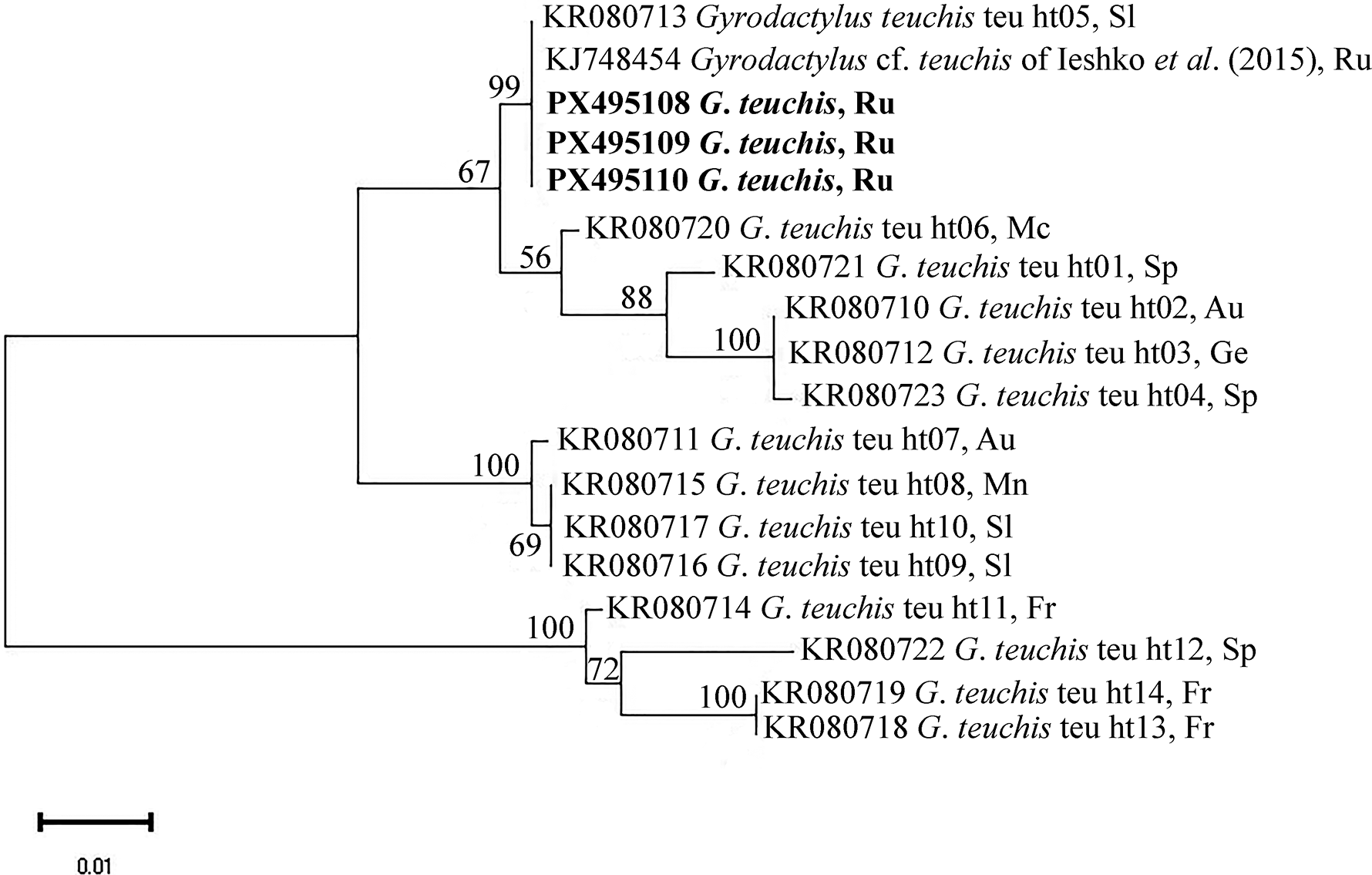
We obtained partial sequences of the cox1 gene for three specimens of G. teuchis collected in May 2023 on farmed rainbow trout from Lake Kalmozero (GenBank No. PX495108–PX495110) (Fig. 3). These sequences were identical both among themselves and to the fragment of the cox1 gene sequence that Hahn et al. (Reference Hahn, Weiss, Stojanovski and Bachmann2015) classified as haplotype teu_ht05 of G. teuchis (GenBank No. KR080713), as well as to the partial cox1 gene sequence obtained from Gyrodactylus cf. teuchis by Ieshko et al. (Reference Ieshko, Lebedeva and Lumme2015) (GenBank No. KJ748454).
Phylogenetic position of Russian isolates of G. teuchis ex Oncorhynchus mykiss based on maximum likelihood (ML) analysis of partial mitochondrial cox1 gene sequences (unrooted tree). Newly obtained sequences of G. teuchis are highlighted in bold. Abbreviations: teu ht01–teu ht14 – haplotypes of G. teuchis followed by Hahn et al. (Reference Hahn, Weiss, Stojanovski and Bachmann2015); Au – Austria, Fr – France, Ge – Germany, Mc – Macedonia, Mn – Montenegro, Ru – Russia, Sl – Slovenia, Sp – Spain.

The ITS2 region sequences in all three worms (our specimens) were identical, possessed five heterozygous sites, and were identical with the variant or ribotype “D” (KR080727) described for G. teuchis by Hahn et al. (Reference Hahn, Weiss, Stojanovski and Bachmann2015) (Table 1).
ITS2 ribotypes of G. teuchis according to classification of Hahn et al. (Reference Hahn, Weiss, Stojanovski and Bachmann2015) in worm isolates from Russian Karelia and some locations within Western and Central Europe

Host species: SF – S. fontinalis, SS – S. salar, ST – S. trutta, TT – T. thymallus, OM – O. mykiss, w – wild, f – farmed.
Discussion
This is the first report of finding G. teuchis in the White Sea drainage basin as well as in cage-reared rainbow trout in Russia. Data on the rates of farmed rainbow trout infection with this parasite is scarcely intercomparable between different European localities because the literature provides no data on G. teuchis abundance (Lautraite et al. Reference Lautraite, Blanc, Thiery, Daniel and Vigneulle1999). Such data are available only for hatchery-reared and wild brown trout sampled in the cold seasons. Compared to our results, G. teuchis in brown trout exhibited similar prevalence but lower abundance: prevalence 75%, mean intensity 5.9 ind. (Ieshko et al. Reference Ieshko, Lebedeva and Lumme2015); prevalence 100%, mean intensity 14.0 ind. (Hahn et al. Reference Hahn, Bakke, Bachmann, Weiss and Harris2011). The characteristics of G. teuchis abundance distribution on juvenile trout in our surveys suggest the fish may have similar resistance to the infection in the spring and in the fall.
The mean measurements of marginal hooks and their parts in G. teuchis specimens collected from farmed rainbow trout in Lake Kalmozero are almost identical to those of conspecific individuals on the same host from France (Cunningham et al. Reference Cunningham, Mo, Collins, Buchmann, Thiery, Blanc and Lautraite2001). At the same time, the hamulus total length in our isolate (though measured only in one specimen) was less than the minimum value recorded for this species by Cunningham et al. (Reference Cunningham, Mo, Collins, Buchmann, Thiery, Blanc and Lautraite2001). The cox1 gene sequences for our specimens are identical with the fragment of those obtained for G. teuchis (haplotype teu_ht05) specimens from wild brown trout (River Bistrica, Slovenia, Black Sea basin, GenBank No. KR080713) and from aquacultured brown trout (Lake Jänisjärvi, Russia, Baltic Sea basin GenBank No. KJ748454). However, the ITS2 region in our specimens is the same as in G. teuchis isolated from brown trout and brook trout from Schwarzenseebach and Erzbach (Austria, Black Sea basin) (Hahn et al. Reference Hahn, Weiss, Stojanovski and Bachmann2015) and in G. teuchis isolated from farmed brown trout and rainbow trout in Poland (Baltic Sea basin) (Rokicka et al. Reference Rokicka, Lumme and Ziętara2007).
Although our specimens of G. teuchis are identical to the Gyrodactylus cf. teuchis of Ieshko et al. (Reference Ieshko, Lebedeva and Lumme2015) (KM192263) collected from Lake Jänisjärvi (Russian Karelia) as regards the cox1 gene fragment, these samples differ in one heterozygous site of ITS2 sequences. Formally, the ITS2 of Gyrodactylus cf. teuchis of Ieshko et al. (Reference Ieshko, Lebedeva and Lumme2015) represents a new ribotype not found in the classification proposed by Hahn et al. (Reference Hahn, Weiss, Stojanovski and Bachmann2015). Yet, since Ieshko et al. (Reference Ieshko, Lebedeva and Lumme2015) derived the ITS2 sequence of the second parental haplotype for their isolate by subtracting from the only then available ITS region sequence of G. teuchis available in GenBank, its single missing heterozygous state may be a chromatogram interpretation error. If so, then the ITS2 ribotype of Gyrodactylus cf. teuchis of Ieshko et al. (Reference Ieshko, Lebedeva and Lumme2015) is not unique and matches ribotype D as classified by Hahn et al. (Reference Hahn, Weiss, Stojanovski and Bachmann2015). The taxonomic interpretation of G. teuchis ribotypes (B–D by Hahn et al. (Reference Hahn, Weiss, Stojanovski and Bachmann2015) and KM192263) remains debatable. The supposition of Ieshko et al. (Reference Ieshko, Lebedeva and Lumme2015) is that they may all be different hybrids between G. teuchis and undetermined Gyrodactylus species. We, however, tend to support the opposite hypothesis that the heterozygous ribotypes are a consequence of the genetic polymorphism of one species, G. teuchis. Until further evidence becomes available, we shall consider all the above-mentioned heterozygous ribotypes within the G. teuchis sensu lato concept.
This finding adds to the list of Gyrodactylus species recorded on hatchery-reared rainbow trout in Northwestern Russia. Previously, records for this host included the Gyrodactylus salaris RBT clone, the Ossetian lineage of G. salaris, Gyrodactylus lavareti Malmberg, 1957, and the Gyrodactylus pomeraniae × Gyrodactylus lavareti hybrid (e.g., Karasev et al. Reference Karasev, Mitenev and Kalinina1997; Evseeva et al. Reference Evseeva, Barskaya, Lebedeva, Strelkov, Kuznetsova and Chernysheva2009; Ieshko et al. Reference Ieshko, Barskaya, Parshukov, Lumme and Khlunov2016).
Rainbow trout are known to be widely traded and transported for farming and thus provide conditions for the spread of the associated pathogens that can be dangerous for native wild salmonids. The rainbow trout-associated haplotype of G. salaris (Gyrodactylus salaris RBT clone) is among the parasites that cross over from farmed fish to wild resident and anadromous Atlantic salmon parr in Northwest Russia (Kuusela et al. Reference Kuusela, Holopainen, Meinilä, Veselov, Shchurov, Ieshko and Lumme2005; Shulman et al. Reference Shul’man, Shchurov, Shirokov and Gaĭda2007; Hansen et al. Reference Hansen, Ieshko, Rusch, Samokhvalov, Melnik, Mugue, Sokolov and Parshukov2022). Ziętara et al. (Reference Ziętara, Kuusela and Lumme2006) suppose this haplotype has evolved in cage-reared trout and its pathogenicity for Atlantic salmon is not yet fully known. Whether the G. salaris RBT clone will continue to exist if all trout farms are closed is questionable.
The parasitism of G. teuchis, including its ribotype D, in wild European salmonids (Hahn et al. Reference Hahn, Bakke, Bachmann, Weiss and Harris2011) makes the consequences of its transfers from one water body to another with cultivated rainbow trout highly unpredictable. Data on the pathogenic impact of G. teuchis on salmon and trout populations is lacking (von Gersdorff Jørgensen et al. Reference von Gersdorff Jørgensen, Heinecke, Kania and Buchmann2008). Yet, the possibility that the expansion of the introduced rainbow trout or other salmonids to recipient water bodies may entail epizootic and ecological consequences associated with this parasite cannot be ruled out.
It is difficult to say for now whether G. teuchis is a native species in the White Sea drainage basin or, otherwise, it is an alien species introduced together with its farmed trout host. More research is needed to further our understanding of G. teuchis range and distribution. In particular, it is necessary to launch long-term parasitological monitoring of wild brown trout populations in rivers draining to large Karelian water bodies and holding no fish farms in order to determine whether the fauna contains G. teuchis. Large-scope studies of the parasite fauna of farmed trout are also needed. Long-term monitoring of the health of wild and farmed fish can provide information regarding the epizootic risks due to the spread of potential pathogens and ensure timely response to the introduction of stocking material from affected areas.
Acknowledgements
The authors thank Olga Kislova for language editing.
Financial support
The research was supported by the federal budget under State Assignment to the Karelian Research Center RAS (FMEN-2022-0005, state registration № 122032100130-3).
Competing interests
The authors declare no competing interests.
Ethical standard
The authors assert that all procedures contributing to this work comply with the ethical standards of the relevant national and institutional guides on the collecting, care, and dissection of animals.