The traditional stability assumption of personality disorders (PDs) has recently been challenged by different longitudinal studies (Livesley, Reference Livesley2005), demonstrating significant mean-level declines of PD features over time, and thus suggesting an unexpected plasticity of disorders that were previously considered as “enduring patterns of individual behavior, inflexible and stable over time” (American Psychiatric Association [APA], 1994, pp. 629–639). The longitudinal designs of the Children in the Community (CIC) study (Cohen, Crawford, Johnson, & Kasen, Reference Cohen, Crawford, Johnson and Kasen2005), the McLean Study of Adult Development (Zanarini, Frankenburg, Hennen, Reich, & Silk, Reference Zanarini, Frankenburg, Hennen, Reich and Silk2005), the Collaborative Longitudinal Personality Disorders Study (Skodol et al., Reference Skodol, Gunderson, Shea, McGlashan, Morey and Sanislow2005), and the Longitudinal Study of Personality Disorders (LSPD; Lenzenweger, Reference Lenzenweger1999) have had a major impact on the field, with each of them reporting change in prospective multiwave data of large referred or community samples, and relying on different data-analytical procedures. However, two critical issues related to these studies should be mentioned. First, the majority of studies published with these data sets have focused on the developmental pathway of personality pathology from a categorical Diagnostic and Statistical Manual of Mental Disorders (DSM) approach, resulting in findings that are inevitably confounded by the well-known diagnostic problems of the DSM itself. Second, none of the abovementioned studies adopted a longitudinal perspective from childhood onward, relying on child-specific measures for personality difficulties, because such measures did not exist at that time. Although the researchers of the CIC study should be truly honored for their pioneering effort to broaden the lifetime perspective on PD toward the age of childhood, the former absence of age-specific assessment tools that comprehensively cover early personality pathology hampers a sound interpretation of the outcome findings 30 years later.
A dimensional reconceptualization of the Axis II PDs has the unique opportunity to respond to each of these two problems. There is currently a general consensus on the basic dimensional structure of PDs (Markon, Krueger, & Watson, Reference Markon, Krueger and Watson2005; Widiger & Simonsen, Reference Widiger and Simonsen2005), and these trait dimensions appear to be consistently more reliable, comprehensive, and valid compared with the current DSM Axis II criteria (Clark, Reference Clark2005). Furthermore, such dimensional design may create fruitful avenues for expanding the life-span PD perspective toward the age of childhood within a single descriptive framework, given the recently demonstrated similarity of higher and lower order childhood maladaptive trait dimensions and the established dimensional PD structure in adulthood (De Clercq, De Fruyt, Van Leeuwen, & Mervielde, Reference De Clercq, De Fruyt, Van Leeuwen and Mervielde2006). The present paper explicitly focuses upon this childhood age period, and explores the longitudinal course of early maladaptive trait dimensions that may be relevant precursors of adult personality pathology across a 2-year time period. Given the large amount of evidence supporting comorbidity between personality pathology and common mental disorders in adulthood (for a review, see Clark, Reference Clark2007), the developmental course of more general childhood psychopathology dimensions will also be evaluated to investigate whether the longitudinal trajectories of early trait pathology and general psychopathology can be considered as parallel at childhood age.
Stability Versus Change From a Dimensional Perspective
The convergent evidence on diagnostic and criterial instability and associated remission rates of PDs (Cohen, Crawford, Johnson, & Kasen, Reference Cohen, Crawford, Johnson and Kasen2005: Durbin & Klein, Reference Durbin and Klein2006; Lenzenweger, Johnson, & Willett, Reference Lenzenweger, Johnson and Willett2004; Skodol et al., Reference Skodol, Gunderson, Shea, McGlashan, Morey and Sanislow2005, Zanarini et al., Reference Zanarini, Frankenburg, Hennen, Reich and Silk2005) was perhaps one of the most remarkable empirical findings in the PD research area of the past decade. Although the majority of these studies demonstrated a substantial rank-order stability across time (Clark, Reference Clark2007), the publication of findings supporting a mean-level waxing and waning nature of PDs was strongly conflicting the long-standing presumption of temporal stability, and became the subject of commentaries by leading personality researchers.
Krueger (Reference Krueger2005, p. 235) has countered the changeability of PDs, stating that “people may fluctuate around a general level of personality pathology over time (such that some fall below or above a specific threshold at a specific time), yet this phenomenon masks a general, rank-order stability in personality pathology over time.” From this categorical approach, it should also be noted that a decrease in specific Axis II symptoms often does not imply observable recovery, but rather a shift to a different diagnostic DSM category, presumably in many cases to PD not otherwise specified. Clark (Reference Clark2007) therefore concluded that categorical diagnoses provide less relevant information regarding temporal stability than do dimensional trait scores.
From these same longitudinal studies, it has indeed been suggested that underlying dimensions of personality pathology are far more stable, with stability coefficients that closely approach the stability estimates typically found for general personality traits (Pukrop & Krischer, Reference Pukrop and Krischer2005). These findings implicitly support the idea of the merit of a dimensional PD conceptualization, with phenotypic expressions of stable underlying traits that may vary across time and across developmental contexts. In an attempt to integrate the evidence on change and stability within a single conceptual model, it has been suggested to recast PDs along the lines of (a) stable temperamental dimensions that represent a certain vulnerability and are generally stable over time and consistent across situations and (b) acute, more fluctuating symptoms (such as represented in the Axis II criteria) that are distinct from, but related to, these temperament or personality dimensions (Clark, Reference Clark2005; Costa, Patriciu, & McCrae, Reference Costa, Patriciu and McCrae2005; Krueger & Tackett, Reference Krueger and Tackett2005; Skodol et al., Reference Skodol, Gunderson, Shea, McGlashan, Morey and Sanislow2005; Zanarini et al., Reference Zanarini, Frankenburg, Hennen, Reich and Silk2005). Within this framework, Warner and colleagues (2004) explored whether PD change can be explained from change in general five-factor model (FFM; Costa & McCrae, Reference Costa and McCrae1992) trait scores. Their results indicated that “there is a specific temporal relationship between traits and disorder whereby changes in the personality traits hypothesized to underlie PDs lead to subsequent changes in the disorder” (Warner et al., Reference Warner, Morey, Finch, Gunderson, Skodol and Sanislow2004, p. 222). Moreover, as the opposite prediction did not seem to hold, they concluded that the “clinical expression of disordered personality stems from particular constellations of general traits.” Data from the LSPD (Lenzenweger, Reference Lenzenweger1997) confirmed that changes in neurobiological dimensional trait systems are predictive of change in PD features (Lenzenweger & Willett, Reference Lenzenweger and Willett2007). Although these two studies relied on samples with different status (clinical vs. community) and used unique data-analytical procedures, they both convincingly support the idea of a set of core personality dimensions that give rise to specific personality difficulties, eventually varying across age, gender, and environmental context. Clark (Reference Clark2007) proposed from this recent evidence that the definition of PD traits as being stable over time is not fundamentally challenged, but provides a more nuanced picture on the developmental course of PDs, that consists of potential gradual change along a basic kind of dimensional stability.
Assessing Childhood Precursors of PDs
Developmental research on PDs has finally broadened its view toward childhood age, and now more systematically begins to explore the unknown realm of childhood personality difficulties. This changing view on the existence of potential PD precursors stands in sharp contrast with the traditional DSM definition of PDs that explicitly excluded developmental antecedents of PDs (for a historical overview, see Widiger, De Clercq, & De Fruyt, Reference Widiger, De Clercq and De Fruyt2009). However, the reluctance to attribute PD characteristics at young age is not tenable in light of the increasing evidence on heritability (Livesley & Jang, Reference Livesley and Jang2008; Reichborn-Kjennerud, Reference Reichborn-Kjennerud2008) of PDs, with childhood heritability coefficients that are comparable to adult estimates (Coolidge, Thede, & Jang, Reference Coolidge, Thede and Jang2001), as well as on the strong predictive validity of early childhood psychopathology syndromes within the internalizing and externalizing spectrum for later personality dysfunction (Cohen, Reference Cohen2008; De Clercq & De Fruyt, Reference De Clercq and De Fruyt2007; Shiner, Reference Shiner, Mash and Barkley2007). Findings from trait research have been evenly convincing, demonstrating a large continuity of childhood personality into adult age and a strong link between early traits and adult psychosocial functioning (Caspi, Reference Caspi2000; Shiner, Masten, & Roberts, Reference Shiner, Masten and Roberts2003; Salekin & Frick, Reference Salekin and Frick2005; Tackett, Reference Tackett2006).
The accumulating evidence supporting the childhood roots of severe adult dysfunction has inspired researchers to include a childhood or adolescent PD description in cross-sectional or longitudinal study designs on PDs and their correlates. In this respect, there have been efforts to transfer and validate the Axis II system toward younger age groups (Durrett & Westen, Reference Durrett and Westen2005), obviously resulting in a nondevelopmental and invalid childhood PD description based upon categorical criteria. PD taxonomies such as the Q-sort Shedler and Westen Assessment Procedure for Adolescents (Westen, Shedler, Durrett, Glass, & Martens, Reference Westen, Shedler, Durrett, Glass and Martens2004) or the Millon Adolescent Clinical Inventory (Millon, Millon, & Davies, Reference Millon, Millon and Davis1993) are likewise constructed from a top-down approach, generating revised adult measures that cannot guarantee an accurate description of age-specific PD symptoms in childhood or adolescence. Although the Shedler and Westen Assessment Procedure and its adolescent version have been found useful for clinical descriptive purposes (Clark, Reference Clark2007), the inconsistent dimensional factor structure across studies has repeatedly questioned the model's factorial validity (Clark, Reference Clark2007; Trull, Reference Trull2005). Similarly, the six-polarity dimensions of Millon's theory have been criticized for their weak validity in terms of the relation with PDs (Mullins-Sweatt & Widiger, Reference Mullins-Sweatt and Widiger2007).
The problem of invalidity in general, and age-inappropriate items in particular, is inherent to childhood or adolescent PD taxonomies that originate from adult (DSM Axis II) criteria. Alternatively, potential PD precursors may be more validly delineated from an explicit developmental trait approach. Childhood personality traits can be conceptually framed within the FFM (Costa & McCrae, Reference Costa and McCrae1992), and are organized in dimensions that are similar to the adult five-dimensional trait structure, including components of neuroticism, extraversion, agreeableness, conscientiousness, and openness to experience. Their stability over time was recently demonstrated to be largely parallel to adult stability findings, using different indices of development (De Fruyt et al., Reference De Fruyt, Bartels, Van Leeuwen, De Clercq, De Cuyper and Mervielde2006). These five dimensions have been convincingly shown to adequately capture variance of Axis II PDs, both in adulthood (Costa & Widiger, Reference Costa and Widiger2002) and in adolescence (De Clercq & De Fruyt, Reference De Clercq and De Fruyt2003; De Clercq, De Fruyt, & Van Leeuwen, Reference De Clercq, De Fruyt and Van Leeuwen2004), and have thus been proposed as relevant constructs for conceptualizing personality pathology at young age (Shiner, Reference Shiner2005). However, Trull and Widiger (Reference Trull and Widiger1997) have argued that altering these general personality traits into more maladaptive variants would even increase the comprehensiveness of a dimensional PD representation, given that the richness of PDs may not be sufficiently characterized by instruments that are originally designed for the description of adaptive trait variance. Corroborating this suggestion, a dimensional and age-specific maladaptive trait measure was constructed (i.e., the Dimensional Personality Symptom Item Pool [DIPSI]; De Clercq, De Fruyt, & Mervielde, Reference De Clercq, De Fruyt and Mervielde2003) using both theoretical and empirical item compilation procedures. The construction strategies and psychometric properties of the higher and lower order scales are extensively described elsewhere (see De Clercq et al., Reference De Clercq, De Fruyt, Van Leeuwen and Mervielde2006), including a description of the measure's construct validity (De Clercq, De Fruyt, & Widiger, Reference De Clercq, De Fruyt and Widiger2009). The DIPSI is the first hierarchically organized and empirically based proposal for describing early personality difficulties, and includes developmental counterparts for each of the four adult higher order dimensions of personality pathology. In terms of the two-component model of PDs (Clark, Reference Clark2007), the DIPSI may represent the underlying temperamental features of personality pathology at young age. Studying their longitudinal course may thus elucidate questions on the behavior of early trait vulnerabilities over time and, from a long-term perspective, verify how they connect with adult patterns of PDs.
The Developmental Course of Personality Pathology and General Psychopathology Dimensions in Childhood
PDs and general mental disorders have common genetic and environmental factors that mutually affect their development and course, and link their etiology and symptom expression in complex ways (Krueger, Reference Krueger2005). This shared genetic ground is further elaborated in the spectrum model of personality and psychopathology (Tackett, Reference Tackett2006), assuming that PDs and common mental disorders are each to be represented along the lines of general personality traits. This assumption directly implies that growth trajectories of specific maladaptive trait dimensions and general psychopathology may be related over time, if not parallel. A recent study on trait and psychopathology development in childhood has indeed suggested a rather similar level of stability of general personality and psychopathology dimensions, relying on different indices of development (De Bolle et al., Reference De Bolle, De Clercq, Van Leeuwen, Decuyper, Rosseel and De Fruyt2009). Shifting toward a maladaptive developmental perspective, a joint empirical study on the longitudinal behavior of early PD symptoms and general mental disorders has not, however, been studied yet at this childhood age and may thus enhance our knowledge on shared developmental aspects of childhood personality pathology and general psychopathology. The present study will therefore address different aspects of stability of each of the four DIPSI dimensions and further illustrate their longitudinal behavior from an individual growth curve framework in relation to the two childhood psychopathology dimensions of externalizing and internalizing problems across a 2-year time period. Such short-term studies provide specific information regarding the rapidity with which changes actually occur (Lenzenweger & Castro, Reference Lenzenweger and Castro2005), which is definitely relevant during an age period that is inherently characterized by rapid developmental changes at the behavioral, emotional, social, and cognitive level.
Method
Sample and procedures
Longitudinal analyses were conducted on data from the Personality and Affect Longitudinal Study (PALS). This study has a prospective multiwave longitudinal design and was approved by the ethical board of Ghent University. Participants are Flemish school-age children from the general population and their parents, who were assessed at three successive assessment points with a time interval of 1 year. Children and their parents were initially recruited by trained graduate psychology students from Ghent University, who received course credit for collecting data. Students visited the families at home and asked both parents and the child to independently complete an extensive set of questionnaires. Students provided detailed oral and written instructions on how to complete the questionnaires, but offered no further assistance to guarantee that the independent opinion of all participants was assessed. Both parents and child were assured that all information would be treated as confidential and would only serve research purposes. Voluntary written informed consent was obtained from all parents and children. Follow-up data were collected by mail at 1 and 2 years after the baseline assessment, respectively. An invitation letter, informed consent form, and questionnaires for parents and child were sent to the participants, together with a reminder for returning the completed questionnaires within 1 month in an enclosed envelope free of charge.
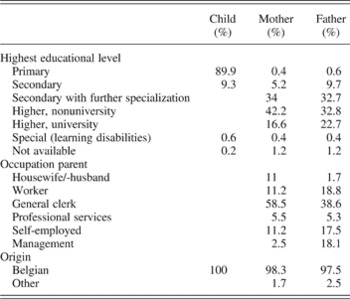
The PALS sample at baseline assessment consisted of 477 children, including 224 boys (47%) and 253 girls (53%), with a mean age of 127.99 months (range = 86–168 months, SD = 13.02). An overview of selected sample characteristics is summarized in Table 1, and shows a large diversity in sociodemographic background variables, supporting the relative representativeness of the present sample. There were no statistical differences between families who did not continue their participation (n = 163) and the continued group (n = 314) in terms of educational level of the child, educational level of both parents, and occupation of the fathers, although significant differences concerning child and maternal age, as well as occupation of the mothers, were found. Mothers of the drop-out group were significantly younger than mothers of the continued group (F = 10.19; p < .01), and had relatively younger children (F = 4.72; p < .05). The distribution of mother's occupation appeared to be significantly different (χ 2 = 14.20; p < .01) for the continued versus drop-out group, with the drop-out mothers being relatively more self-employed (17.9%) compared with mothers of the continued group (7.7%). The current research does not report on all measures that were included in the PALS study, and only focuses on the childhood maladaptive trait and general psychopathology measures, both administered to the mothers of the children.
Sociodemographic characteristics at baseline assessment

Measures
The DIPSI
The DIPSI provides an age-specific and dimensional description of maladaptive traits at young age that are the most likely precursors of adult PDs. The construction procedures of the DIPSI are reported in De Clercq et al. (Reference De Clercq, De Fruyt, Van Leeuwen and Mervielde2006), including both theoretical and empirical strategies as to obtain the most comprehensive taxonomy of early personality difficulties. The construction procedures resulted in 172 concrete trait–pathology items rated on a 5-point Likert scale by parents or primary caregivers and structured in 27 reliable and homogeneous lower level facets that are hierarchically organized in a replicable four-dimensional higher order structure. This four-dimensional higher order structure is consistent with O'Connor (Reference O'Connor2005), Saulsman and Page (Reference Saulsman and Page2004), and Widiger and Simonsen (Reference Widiger and Simonsen2005). It can be described as disagreeableness (including extreme low-end variants of benevolence such as dominance/egocentrism and irritable/aggressive traits), emotional instability (referring to both anxious and depressive traits, and also including a dependency component), introversion (describing extreme low-end variants of extraversion, such as withdrawn traits and shyness), and compulsivity (including the high extremes of conscientiousness traits such as perfectionism and extreme order). De Clercq et al. (Reference De Clercq, De Fruyt, Van Leeuwen and Mervielde2006) provide a detailed description of the construction procedures, factor loadings, coefficient alphas of the DIPSI facets across groups, and sample items.
The DIPSI's four higher order maladaptive trait factors represent unique trait constructs that are associated with, but distinct from the well-known higher order dimensions of internalizing and externalizing problem behavior (De Clercq, Van Leeuwen, De Fruyt, Van Hiel, & Mervielde, Reference De Clercq, Van Leeuwen, De Fruyt, Van Hiel and Mervielde2008), as described in the Child Behavior CheckList (CBCL; Achenbach, Reference Achenbach1991). De Clercq et al. (Reference De Clercq, Van Leeuwen, De Fruyt, Van Hiel and Mervielde2008) indicated a substantial association between the four DIPSI traits and the internalizing/externalizing CBCL dimensions, but only a small overlap in item content between both sorts of dimensions. Their nature is further reflected in the correlation with normal-range higher order personality traits (De Clercq et al., Reference De Clercq, De Fruyt, Van Leeuwen and Mervielde2006), and in their conceptual fit within the common higher order framework of the FFM (Markon et al., Reference Markon, Krueger and Watson2005). Both at the higher and lower level, the DIPSI can be theoretically linked (De Clercq et al., Reference De Clercq, De Fruyt, Van Leeuwen and Mervielde2006) to adult dimensional maladaptive trait models such as the Dimensional Assessment of Personality Pathology, Basic Questionnaire (DAPP-BQ; Livesley, Reference Livesley1990) and the Schedule for Nonadaptive and Adaptive Personality (Clark, Reference Clark1993). Both of these instruments are well-validated hierarchically organized dimensional systems (Clark & Livesley, Reference Clark, Livesley, Costa and Widiger2002), each resulting from a specific bottom-up strategy to define the personality pathology domain and to examine the underlying structure of personality pathology. The DAPP differentiates four major dimensions of personality pathology (emotional instability, dissocial behavior, inhibitedness, and compulsivity) and 18 more specific personality pathology scales, whereas the Schedule for Nonadaptive and Adaptive Personality distinguishes three higher order dimensions (positive and negative affect and disinhibition) and includes 22 lower level scales. The four-dimensional character of the DAPP-BQ measure can also be directly empirically compared with the DIPSI's higher order structure, indicating significant and meaningful associations between adolescent self-reports on the DIPSI and the DAPP-BQ (De Clercq et al., Reference De Clercq, De Fruyt and Widiger2009).
The lower order traits are to be interpreted along the extremes of general lower order trait facets (Widiger et al., Reference Widiger, De Clercq and De Fruyt2009), but they also provide a more detailed description of pathological trait features that are not fully accounted for by general trait or temperament models (De Clercq et al., Reference De Clercq, De Fruyt and Widiger2009). From a conceptual point of view, it has also been demonstrated that the DIPSI lower order traits show a notable coverage of potential PD precursors (De Clercq et al., Reference De Clercq, De Fruyt and Widiger2009) as delineated by Geiger and Crick (Reference Geiger, Crick, Ingram and Price2001).
Psychometric properties of the four maternal-rated DIPSI dimensions in the current study showed to be adequate across measurement points in terms of internal consistency, with alpha reliability coefficients ranging from .90 to .97 at Time 1 (T1), from .83 to .93 at Time 2 (T2), and from .85 to .94 at Time 3 (T3). Principal axis factoring with varimax rotation showed a clearly interpretable four-factor structure at each assessment point, explaining 61.01% (T1), 69.62% (T2), and 69.71% (T3) of the variance, representing a large Disagreeableness factor (21.12% at T1, 21.65% at T2, and 19.71% at T3), an Emotional Instability factor (16.72% at T1, 19.78% at T2, and 20.14% at T3), an Introversion factor (13.91% at T1, 11.94% at T2, and 18.85% at T3), and a Compulsivity factor (9.26% at T1, 11.24% at T2, and 11.02% at T3), with 24 of the 27 DIPSI facets loading their respective factor at T1, and 26 of the 27 versus 21 of the 27 at T2 and T3, respectively.
The CBCL
The current study administered all mothers the Dutch version (Verhulst, Van der Ende, & Koot, Reference Verhulst, Van der Ende and Koot1996) of the CBCL (Achenbach, Reference Achenbach1991), which is the most widespread measure for describing behavioral and emotional problems in childhood and adolescence. The taxonomy distinguishes eight syndrome scales (withdrawn, somatic complaints, anxious/depressed, social problems, thought problems, attention problems, delinquent behavior, and aggressive behavior), and two broadband scales (internalizing and externalizing problems), aggregated in a total problem score. Excellent psychometric properties have been reported, and there is a large body of research demonstrating its reliability and validity in both clinical and nonclinical populations (Achenbach, Reference Achenbach1991; Verhulst, et al., Reference Verhulst, Van der Ende and Koot1996).
Analyses
Structural continuity of the DIPSI dimensions
Structural continuity of childhood maladaptive traits across time implies similar correlations between the maladaptive trait dimensions across different time points. A baseline and a constrained model were therefore specified in Lisrel 8.72, with the baseline model representing a single-indicator model in which the variances of the eight latent variables (four DIPSI dimensions × two time points) are fixed to 1, and the variances of the residuals to 0. Correlations between latent variables are freely estimated. In the constrained model, correlations between all pairwise constructs across time points are forced to be equal. When a chi-square difference test does not show a significant reduction in fit, this indicates that the baseline model does not fit better than the constrained model (Robins, Fraley, Roberts, & Trzesniewski, Reference Robins, Fraley, Roberts and Trzesniewski2001).
Rank-order stability of the DIPSI dimensions
Differential or rank-order continuity describes the degree to which individuals keep their ranking in the group across time. For the current study, Pearson correlation coefficients were calculated between T1 and T2 (across 1 year) and between T1 and T3 (across 2 years).
Longitudinal data analysis
Issues on stability and change are traditionally examined using repeated measures analysis of variance, resulting in evidence for mean-level continuity or change across time. However, such analysis does not provide a comprehensive and detailed picture of longitudinal data (Lenzenweger & Castro, Reference Lenzenweger and Castro2005), that may be well accounted for by multilevel modeling (MLM). One of the major advantages of MLM compared to repeated measures analyses of variance is the possibility of using not only complete cases but all available data, even when participants are missing data for a certain assessment period (Kwok, et al., Reference Kwok, Underhill, Berry, Luo, Elliott and Yoon2008; Snijders, & Bosker, Reference Snijders and Bosker1999). MLM also offers the possibility to model individual-level trends over time, known as individual growth models (Kwok et al., Reference Kwok, Underhill, Berry, Luo, Elliott and Yoon2008), and further accommodates the existing unequal spacing of assessments across subjects (Lenzenweger & Castro, Reference Lenzenweger and Castro2005). For more detailed background information on the method, the reader is referred to Lenzenweger and Castro (Reference Lenzenweger and Castro2005).
Hierarchical linear models with a two-level structure were specified, with Level 1 reflecting the three different measurement occasions, and Level 2 referring to the individuals under whom the repeated measures are nested. Mixed statistical models with both random and fixed effects were fitted using restricted maximum likelihood estimation implemented in SAS (9.2) PROC MIXED (Littell, Milliken, Stroup, Wolfinger, & Schabenberger, Reference Littell, Milliken, Stroup, Wolfinger and Schabenberger2006; Singer, Reference Singer1998). To reduce the positive skewness in the dependent variables of internalizing and externalizing problem behavior and the DIPSI maladaptive trait variables, a square root transformation was performed. Analyses were conducted sequentially, starting with an intercept-only model, followed by unconditional and conditional growth analyses (Singer & Willett, Reference Singer and Willett2003), respectively.
Results
Structural continuity of the DIPSI dimensions
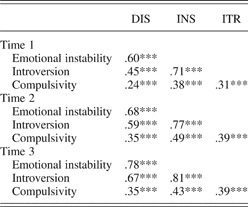
The correlations among the four DIPSI constructs were invariant across T1 and T2 with Δχ2 (6) = 9.74 (p = .136), root mean square error of approximation (RMSEA) = .045, and across T2 and T3 with Δχ2 (6) = 11.18 (p = .08), RMSEA = .053. Correlations were not fully invariant across T1 and T3 with Δχ2 (6) = 20.64 (p = .002), RMSEA = .088. Inspecting Table 2, all correlations are positively significant (p > .001); therefore, the invariance seems to be the result of only small differences in size between the DIPSI intercorrelations.
Correlations among the four DIPSI dimensions across time

Note: DIPSI, Dimensional Personality Symptom Item Pool (De Clercq et al., Reference De Clercq, De Fruyt and Mervielde2003); DIS, disagreeableness; INS, emotional instability; ITR, introversion; N = 307.
*** p ≤ .001.
Differential continuity of the DIPSI dimensions
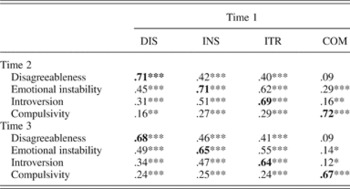
Pearson correlations across a 1-year and a 2-year time interval are reported in Table 3. They show a substantial rank-order continuity for each of the four DIPSI dimensions, indicating that children maintain their maladaptive trait ranking across time. Correlations, uncorrected for unreliability, range from .69 to .72 across a 1-year period and from .64 to .69 across a 2-year period, suggesting a similar differential continuity for varying time intervals.
Rank-order stability for the DIPSI dimensions across 1 and 2 years

Note: DIPSI, Dimensional Personality Symptom Item Pool (De Clercq et al., Reference De Clercq, De Fruyt and Mervielde2003); DIS, disagreeableness; INS, emotional instability; ITR, introversion; COM, compulsivity; N = 307.
* p ≤ .05. **p ≤ .01. ***p ≤ .001.
Stability and change of the PD and general psychopathology dimensions
Empty model
To investigate to what degree scores vary within and between persons, we fitted an intercept-only model, separately for the four PD dimensions, and the two problem behavior dimensions as the different dependent variables. Because such an intercept-only model does not include any explanatory variables, it is also called “an empty model.”
More specifically, the within-participant variation is described by means of an equation:

where Y is the response variable and e is a normally distributed random residual with zero mean. Index j = 1, … , N refers to the participant and index i to the measurement occasion (in our case, i = 1, 2, 3). The participant-specific intercept β0j refers to the expected value for the response variable for participant j, and the residual e ij is the deviation of the score of participant j on measurement i from this expected value. The first level model given in Equation 1 is extended by an additional equation at the second level, describing the variation in the coefficient over study participants:

where u 0j is a random residual, indicating the deviation of the expected value of person j from the overall intercept in this model, and γ00 is the mean score across children and across measurement times. Residuals at both levels are assumed to be normally distributed with a zero mean.
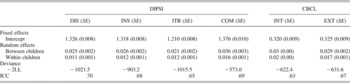
The overall intercepts for all dependent variables significantly differ from zero (see Table 4), when performing a Wald test, by comparing the parameter estimate divided by its corresponding standard error to a standard normal distribution. As a rule of thumb, a parameter is considered statistically significant at the .05 level when the estimated parameter value is at least twice as large as its corresponding standard error.
Parameter estimates for the empty models

Note: DIPSI, Dimensional Personality Symptom Item Pool (De Clercq et al., Reference De Clercq, De Fruyt and Mervielde2003); CBCL, Child Behavior Checklist (Achenbach, 1991); DIS, disagreeableness; INS, emotional instability; ITR, introversion; COM, compulsivity; INT, internalizing problems; EXT, externalizing problems; −2LL, −2 log likelihood; ICC, intraclass correlation coefficient.
For each variable, the variance of the intercept over children (σu2) and within children (σe2) was estimated. Subsequently, the intraclass correlation coefficient (ICC) was calculated, as the proportion of the between-individual variance to the sum of the between- and within-individual variances (see Table 4). For example, the ICC value of .70 (=.025/(.025 + .011)) for the DIPSI disagreeableness dimension, indicates that 70% of the variance was located between children, and 30% of the variance within children. The more the ICC approximates a value of 1, the more variance in a measure is because of between-subject differences, rather than to changes within subjects over time or to measurement error. The ICC coefficient thus represents a measure of within-person stability, indicating the extent to which the absolute symptom level of each individual in the sample remains stable over time (Lenzenweger, Reference Lenzenweger1999). Intraclass correlations ranged between .65 and .70 for the four DIPSI measures and were .63 and .67 for internalizing and externalizing problem behavior, respectively, indicating relative within-person stability for both general psychopathology dimensions and maladaptive trait dimensions in childhood when compared to the variability across children on the DIPSI and CBCL variables.
Unconditional growth model
Trajectories for children were estimated to explore whether scores across measurement times showed meaningful systematic changes. To that end, we included in the model a dummy variable indicating the first measurement occasion and a dummy variable indicating the third measurement occasion. The second measurement occasion was used as the reference category in the fixed part of the model; therefore, the intercept can be interpreted as the expected value score at this occasion, and the coefficients of the dummy variables as the deviation of the expected score at the first and third occasion, respectively, compared to the second measurement occasion. A linear time trend was also allowed to randomly vary across children. At the first level (within participants) we have the following model:

At the second level we have
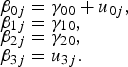
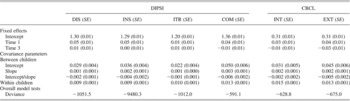
The growth rates in the fixed part of the models showed that for all the variables the expected score at T1 was significantly higher than at T2, a difference indicated by γ10, except for the DIPSI dimension Introversion, where changes were not significant (see Table 5). When subsequent changes from T2 to T3, γ20, were taken into account several patterns could be distinguished in the growth models for the different variables. The DIPSI dimensions disagreeableness, emotional instability, and compulsivity, as well as the CBCL Internalizing Problem Behavior Scale, did not continue their decrease, whereas the CBCL Externalizing Problem Behavior Scale continued to decline between T2 and T3. For example, the mean score for the DIPSI disagreeableness dimension at T2 was 1.30, whereas the mean score at T1 was 0.05 (SE = 0.01, p < .001) higher and at T3 was 0.01 higher (SE = 0.01, p = .627). Furthermore, the DIPSI introversion dimension remained stable from T2 to T3 and hence showed stability across both assessment intervals.
Parameter estimates for the unconditional growth models

Note: DIPSI, Dimensional Personality Symptom Item Pool (De Clercq et al., Reference De Clercq, De Fruyt and Mervielde2003); CBCL, Child Behavior Checklist (Achenbach, Reference Achenbach1991); DIS, disagreeableness; INS, emotional instability; ITR, introversion; COM, compulsivity; INT, internalizing problems; EXT, externalizing problems.
Level 1 and Level 2 residual (co)variances of the model were also estimated, showing significant negative covariances between random intercept (elevation) and slope (rate of change) for the maladaptive trait dimensions disagreeableness, emotional instability, and compulsivity, as well as for externalizing problem behavior, indicating that children with a higher score at measurement occasion 2 in general display a smaller decline. In addition, the estimated slope variances further provide insight into the between-person variation in the degree to which maladaptive trait dimensions and general psychopathology dimensions change with time. For DIS for instance, the estimated slope variance equals 0.001, corresponding to a standard deviation of 0.03. Remember that coefficients are assumed to be normally distributed with zero mean. This means that 95% of the residuals u 3j vary between −1.96 × 0.03 and +1.96 × 0.03; this is between −0.06 and +0.06. Summing these residuals to the overall expected change of −0.05 from T1 to T2 and of 0.01 from T2 to T3, we can expect for most (95%) of the participants a change between −0.11 and +0.01 from T1 to T2 and between −0.05 and +0.07 from T2 and T3.
Changes in the PD dimensions and general psychopathology dimensions and the relationship with age and gender
Conditional linear growth models
In these analyses, variables were examined that may predict growth curves across individuals. Given the large age range of the present sample (varying between 7 [86 months] and 14 [168 months] years at the first measurement time), it is possible that both the average score on personality pathology and problem behavior variables as well as the changes in the scores of these variables vary for children with different ages. Moreover, it is possible that the age effect depends upon the person. Age can therefore be included as a person-related predictor in the fixed part, but also in the random part of the model, which means that we will estimate not only the mean age effect but also the degree to which this age effect varies over persons. To facilitate interpretation, age was centered around the mean age at the first measurement occasion (about 140 months): the intercept in the model refers in that case to the expected outcome associated with a child of 140 months. The possible effects of gender as a time-invariant variable were investigated by including gender in the model. An Age × Gender interaction term was also included in the models to explore if the evolution over age depends on the gender.
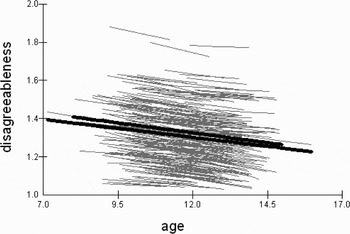
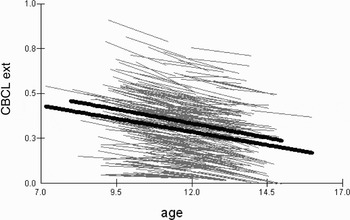
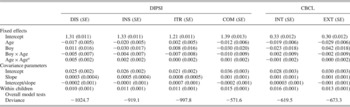
The fixed effect of age (see Table 6) showed significant negative age effects for all maladaptive trait dimensions, except for Introversion, as well as for the problem behavior constructs internalizing and externalizing behavior (see Figures 1 and 2 for a graphical illustration of disagreeableness and externalizing behavior), suggesting that scores on these variables decreased with increasing age. Only one meaningful main effect of gender was present, with boys showing significantly higher rates on externalizing behavior than girls (see Figure 2). There were no significant Age × Gender interaction effects. The random part of the model showed no significant Intercept × Slope covariation for any of the DIPSI or CBCL dimensions, suggesting that the decrease/increase of children does not depend on their expected level at the age of 140 months.
Individual growth trajectories for disagreeableness in 314 subjects across a 2-year interval, based on the results of the multilevel analysis (performed with MLwiN software), as well as the overall expected trajectory for boys (highest curve) and for girls. Age is expressed in years.

Individual growth trajectories for externalizing problem behavior in 314 subjects across a 2-year interval, based on the results of the multilevel analysis (performed with MLwiN software), as well as the overall expected trajectory for boys (highest curve) and for girls. Age is expressed in years.

Parameter estimates for the conditional linear growth models with age and gender

Note: DIPSI, Dimensional Personality Symptom Item Pool (De Clercq et al., Reference De Clercq, De Fruyt and Mervielde2003); CBCL, Child Behavior Checklist (Achenbach, Reference Achenbach1991); DIS, disagreeableness; INS, emotional instability; ITR, introversion; COM, compulsivity; INT, internalizing problems; EXT, externalizing problems.
aWe also estimated the quadratic effect of age in both the fixed and random part of the model. For only one variable, the DIPSI disagreeableness domain, the model showed a positive significant curvilinear effect in the fixed part, but not in the random part.
Discussion
The present study is the first to explore the longitudinal course of maladaptive personality traits in childhood from an age-specific dimensional approach, focusing on both structural, rank-order and within-person aspects of stability, as well as on individual growth curves within a multilevel modeling framework across a 2-year time period. Given the community-based character of the sample, with none of the children following psychological treatment or counseling, the present findings on stability/change can be considered as the result of normative maturation and socialization during childhood and early adolescence. From this normative perspective, childhood maladaptive personality traits representing disagreeableness, emotional instability, and compulsivity tend to slightly decrease over time in a similar way for boys as for girls and for younger versus older children, but with a less pronounced decline for children who demonstrate high scores. This poorer flexibility of children with elevated maladaptive trait patterns is in line with findings of the LSPD study (Lenzenweger, Reference Lenzenweger1999) as well as Johnson et al.'s (2000) results from the CIC study, who demonstrated that adolescents with PDs continue to have elevated PD trait levels during early adulthood, and hence broadens existing stability findings toward a much younger age group relying on age-specific dimensional PD descriptions. Consistent with the trends in each of these studies (Lenzenweger & Castro, Reference Lenzenweger and Castro2005), the present study showed a significant change for almost all maladaptive trait dimensions from the first to the second assessment, and a nonsignificant change for any of the maladaptive personality traits from Wave 2 to Wave 3.
The results also specify a considerable rank-order continuity across a 1- and 2-year time interval that is equivalent (and, in fact, even somewhat higher) to stability coefficients reported by this same CIC study (Johnson et al., Reference Johnson, Cohen, Kasen, Skodol, Hamagami and Brook2000) and confirm their conclusion that: “based on stable but declining symptoms, individuals maintain similar rankings in PD symptoms relative to age peers even as average levels decline over time” (Cohen et al., Reference Cohen, Crawford, Johnson and Kasen2005, p. 470). The rank-order stability coefficients of maladaptive personality dimensions are also similar to estimates for general personality dimensions in childhood (De Fruyt et al., Reference De Fruyt, Bartels, Van Leeuwen, De Clercq, De Cuyper and Mervielde2006), which underscores the conceptual spectrum view of PD traits as the extremes of general FFM traits (Costa & McCrae, Reference Costa and McCrae1992), even at this early age.
A different but related operationalization of this spectrum model entails the relation between general psychopathology and PDs, as their strong interrelation and comorbidity even at young age (Shiner, Reference Shiner, Mash and Barkley2007) may be caused by their similar relation to underlying general trait dimensions (Krueger, Reference Krueger2005). The current individual growth curve approach on childhood PD dimensions and general psychopathology dimensions sheds a new light on this issue, and suggests that although empirically and conceptually distinct (De Clercq et al., Reference De Clercq, Van Leeuwen, De Fruyt, Van Hiel and Mervielde2008), the longitudinal behavior of Axis I related psychopathology and Axis II related precursors in childhood show very similar longitudinal patterns in terms of shape and change over time. One exception to this relates to the externalizing problem behavior dimension, which continued to decrease from Wave 2 to Wave 3. Previous studies on the normative development of problem behavior have noted a similar declining pattern in the externalizing developmental trajectory (Bongers, Koot, van der Ende, & Verhulst, Reference Bongers, Koot, van der Ende and &Verhulst2003; Broidy, et al., Reference Broidy, Nagin, Tremblay, Bates, Brame and Dodge2003), perhaps resulting from a stronger proneness of CBCL-measured externalizing problems to developmental maturation processes.
From a clinical point of view, the current findings suggest that the natural plasticity of basic maladaptive trait dimensions at young age is small but significant, hence providing more specific information to clinicians who may direct their interventions toward those features that are most likely to change because they fluctuate naturally (Livesley, Reference Livesley2005). The inflexibility of the introversion dimension with no natural change across a 2-year time interval may at this point reflect the difficulty of changing childhood personality problems that are related to shyness, withdrawn traits, or paranoid traits. This hypothesis is consistent with studies on the stability of specific Axis II PDs in adulthood (McGlashan, et al., Reference McGlashan, Grilo, Sanislow, Ralevski, Morey and Gunderson2005), who demonstrated from the Collaborative Longitudinal Personality Disorders Study data that “paranoid ideation” and “feeling socially inept” are one of the least changeable personality aspects over a similar time span of 2 years.
A number of limitations should be mentioned when interpreting the current results. First, a larger number of measurement points, including the entire transition from childhood to adolescence, would have generated more reliable estimates for the growth models with more specific stability/change information on the crossroad of child and adolescent maladaptive trait development. As this research has an ongoing format, additional follow-ups may elucidate continuity aspects of PD traits during such shifting developmental periods. Second, it cannot be ruled out that memory of information about a prior assessment period created a halo effect in the present study, resulting in an artifactual elevated stability estimate (Loranger et al., Reference Loranger, Lenzenweger, Gartner, Susman, Herzig and Zammit1991). Third, another limitation concerns method overlap because of the exclusive reliance on mothers as informants of both the maladaptive trait and general psychopathology measures, potentially leading to a certain bias in the similarity of the individual growth curves of both constructs. Future research should hence verify whether current findings of similarity can be replicated from a cross-informant perspective. In addition, individual growth curve analyses in a referred sample of children with presumably higher scores on the DIPSI dimensions may reveal more specific patterns of change over time.
Conclusion
In sum, the current prospective multiwave study on the short-term developmental course of maladaptive trait dimensions in childhood underscores a similar stability for dimensional and age-specific PD precursors at young age as for adult maladaptive trait dimensions, summarized by Clark (Reference Clark2007) as “change can occur, but gradually and with effort” (p. 242). Childhood maladaptive trait stability explored with a individual growth curve analysis, as well as in terms of within-person and rank-order (differential) stability, is hence not by itself lower than the stability of PD trait dimensions in adulthood. This convergent evidence across different developmental stages questions the “under construction, and thus too unstable” assumption of childhood personality and, related to this, personality pathology, and makes exactly the case for a similar maturation principle as has been proposed for adults. That is, there is on average a gradual movement toward greater personality maturity, but children with high-scoring profiles of maladaptive traits tend to be at higher risk to continue this PD vulnerability over time. Future outcome studies that focus on the changeability of early childhood maladaptive traits as a result of psychotherapeutic interventions should take the present evidence on natural changes into consideration and, comparable to adult outcome studies, are challenged to demonstrate that when change is found it reflects the effects of therapeutic interventions beyond the natural variation of the PD trait itself (Livesley, Reference Livesley2005).