1. Introduction
Feldstein and Horioka (Reference Feldstein and Horioka1980), hereafter F–H, interpret the strong correlation found between domestic investment rates and savings rates as evidence of capital immobility among OECD countries. Using long-run data averages, they estimated a cross-section regression equation of the following form
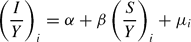
where I is investment, S is savings, and Y is GDP for country i. An estimate of β close to one indicates that most of the incremental savings in each country is used to finance domestic investment, i.e. a case of perfect capital immobility, whereas, β close to zero reflects perfect capital mobility as domestic savings leave boundaries to earn a higher marginal return in the world. In the face of financial liberalization and economic openness, the finding of a high savings–investment correlation in the F–H study for developed countries came to be known as ‘the mother of all puzzles’ (see Obstfeld and Rogoff, Reference Obstfeld and Rogoff2000).
Later research using the methodology of F–H finds high savings–investment correlation in large as well as small economies, although this correlation in smaller economies is weaker (Dooley et al., Reference Dooley, Frankel and Mathieson1987; Wong, Reference Wong1990; Mamingi, Reference Mamingi1997; Vamvakidis and Waczairg, Reference Vamvakidis and Wacziarg1998; Coakley et al., Reference Coakley, Kulasi and Smith1999; Kasuga, Reference Kasuga2004). Sinha and Sinha (Reference Sinha and Sinha2004) examine capital mobility for developed as well as developing countries and find that capital is more mobile for countries with a low per capita income. The findings of relatively higher capital mobility in developing countries have mainly been attributed to the integration of world financial markets and capital account liberalization.
F–H also argue that the correlation between domestic investment and domestic savings likely reflects the impact of some other variables. A few recent studies, employing an augmented F–H specification in a panel framework, find that inclusion of foreign aid in the savings–investment regression raises the coefficient of the savings rate, which implies lower capital mobility (Isaksson, Reference Isaksson2001; Payne and Kumazawa, Reference Payne and Kumazawa2005; Younas, Reference Younas2007). Furthermore, these studies also conclude that financial market liberalization around the world has led to an increase in capital mobility over time in developing countries. However, we are not aware of any studies examining whether the domestic institutional environment has an influence on the degree of capital mobility. Our study investigates the impact of institutional quality on the degree of capital mobility under an augmented F–H specification for 63 developing countries over the period 1982–2002.Footnote 1
The incentives to invest differ across countries depending upon the marginal returns on investment. However, the presence of poor institutions makes investment more risky in developing countries, as investors may chose an investment portfolio that guarantees security of their investments rather than higher marginal expected returns. F–H states (p. 316) that, ‘for most investors, uncertainties and risks associated with foreign investment are perceived as so great that investment is restricted to the domestic economy’. This implies that under an adverse institutional environment the movement of portfolio and direct investment encounters increasingly high barriers, discouraging both inflow and outflow of capital. Therefore, high correlation between domestic investment and domestic savings can arise from the presence of institutional constraints restricting the movement of capital across borders. On the other hand, improved institutional quality and capital account liberalization encourage the movement of capital across borders, which may weaken the savings–investment correlation.
An economy that guarantees security of property rights, maintains the rule of law, and generates private incentives to invest experiences higher investment and growth.Footnote 2 In contrast, a poor institutional environment makes investors reluctant to risk their capital due to fear of appropriation. Studying transition economies, Johnson et al. (Reference Johnson, McMillan and Woodruff2002) find that reinvestment rates are lowest in Russia and Ukraine, where bribes for government service and licenses are common, firms make payments for protection, and courts are ineffective. They further find that reinvestment rates are highest in Poland and Romania, where property rights are the most secure. Similarly, Rodrik et al. (Reference Rodrik, Subramanian and Trebbi2004) find that the presence of clear property rights positively impacts economic performance. Collier and Gunning (Reference Collier and Gunning1999) blame inept democratic accountability and bureaucratic hurdles for perpetuating poor economic performance in Africa.
We find that inclusion of different aspects of institutional quality raises the coefficient of the savings rate, which implies a lower degree of capital mobility. On the other hand, improvement in institutional quality that strengthens the legal system, reduces investment risks, and ensures democratic accountability leads to increases in capital mobility in developing countries.
The remainder of the paper proceeds as follows. The next section describes the empirical model and methodology. Section 3 describes the data, while Section 4 presents the estimation results and Section 5 concludes.
2. Empirical model and methodology
This paper uses an augmented F–H methodology to examine the impact of institutional quality on the degree of capital mobility for 63 developing countries over the period 1982–2002 in a panel framework. The empirical model employs different aspects of institutional quality to find their differential effects. Following Isaksson (Reference Isaksson2001), Payne and Kumazawa (Reference Payne and Kumazawa2005), and Younas (Reference Younas2007), we also control for foreign aid and an interactive variable of time trend and savings rate in our model.Footnote 3 The econometric models for the panel data analysis estimate the following two regression equations:
Basic F–H equation

Augmented F–H equation
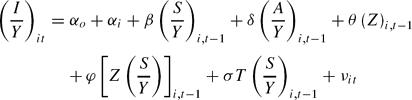
where subscripts i and t indicate country and time period, respectively. The intercept includes a component, α0(β0), that is common to all recipient countries, and a country-specific fixed effect, αi(βi), that is specific to each country but fixed over time. Ignoring for country-specific heteroscedasticity can produce biased and inconsistent estimation results. We also include a time trend T that is common to all countries but varies over time, which is interacted with the savings rate (see below for detail).
All variables, except Z (which is a vector of indices measuring different aspects of institutional quality), are defined as a ratio to GDP. I is gross fixed capital formation used to measure investment, S is gross domestic savings, and A is official development assistance used to measure foreign aid. T × (S/Y) is an interactive variable of the time trend and the savings rate that is introduced to indicate whether capital mobility increases over time due to financial liberalization around the world. Z × (S/Y) is an interactive variable of the institutional quality and the savings rate. νit and ϵit are disturbance terms that are assumed to be independent and identically distributed.
We employ different aspects of institutional quality such as investment risk, rule of law, government stability, democratic accountability, and respect for human rights (details discussed in Section 4).Footnote 4 Well-functioning institutions reduce domestic uncertainties, increase investors' confidence, and enforce contractual agreements through an efficient legal system, while poor institutions exacerbate the risks of investment, place excessive regulation on financial markets, and inhibit the movement of capital across borders.Footnote 5 Therefore, institutional rigidities are expected to decrease the degree of capital mobility in developing countries. If controlling for institutional quality is important in the savings–investment regression, but is omitted, the coefficient of the savings rate would have a downward bias and, thus, exaggerate the degree of capital mobility.
The interactive variable, Z × (S/Y), is introduced to examine the effect of improvements in institutional quality on the degree of capital mobility. Theoretically, better institutional quality should increase the degree of capital mobility in developing countries, as the movement of capital encounters increasingly lower barriers. Hence, we expect a negative and significant value for this interaction term. Similarly, if financial liberalization around the world has increased capital mobility over time, the coefficient on T × (S/Y) will also be negative.Footnote 6
Montiel (Reference Montiel1994) argues that it is worthwhile analyzing the effect of foreign aid when estimating savings–investment correlations, because domestic investment in developing countries may also depend on the amount of foreign assistance. So, if foreign aid is important, but is omitted, the coefficient of the savings rate will have a downward bias (Isakson, Reference Isaksson2001). Burnside and Dollar (Reference Burnside and Dollar2000) also argue that the outcomes of foreign aid depend on whether it is used for investment or consumption, implying that the effectiveness of aid for economic development depends on the extent to which it is used for investment.
Before proceeding to estimations, we address the possibility of potential simultaneous causation between investment rates, savings rates, and foreign aid. One may plausibly argue that savings and foreign aid may be endogenous as they not only affect, but may also be affected by investment. This may require a simultaneous estimation technique, such as two-stage least squares (2SLS). However, the problems with 2SLS are the non-availability of valid instruments and their data for developing countries. Moreover, employing weak instruments can contaminate estimation results.Footnote 7
We follow two approaches to account for this potential endogeneity problem and present the estimation results for both of them separately. First, Wooldridge (Reference Wooldridge2003: 541) explains that if the error term μit is assumed to be uncorrelated with all past endogenous and exogenous variables (a standard assumption), then lagged endogenous variables in simultaneous models are predetermined variables and they are uncorrelated with μit. Therefore, we use one-year lagged values for all independent variables in our econometric model.Footnote 8 This approach also makes more economic sense as domestic savings and foreign aid take time to transform into gross fixed capital formation, which measures investment rates in our study. Second, recent literature examining capital mobility in cross-sectional and panel data frameworks also uses past savings rates as an instrument to address the potential endogeniety of domestic savings (Kasuga, Reference Kasuga2004; Younas, Reference Younas2007).Footnote 9 We also employ this approach to check the robustness of our findings.
An econometric analysis of investment and capital mobility is likely to suffer from business cycle effects, and, given the procyclical nature of the investment−GDP ratio, the use of annual data can impart a bias upon the estimated coefficients (Bayoumi, Reference Bayoumi1990). Therefore, we follow the standard practice of taking five-year data averages for all the variables to remove such cyclical effects (Vamvakidis and Wacziarg, Reference Vamvakidis and Wacziarg1998; Isaksson, Reference Isaksson2001; Kasuga, Reference Kasuga2004; Younas, Reference Younas2007). The institutional indices are correlated with each other and they also measure the various aspects of the same thing – the quality of institutions. Therefore, we include each institutional variable separately in the individual regressions while controlling for other variables to derive unbiased and consistent estimates.Footnote 10
3. Description of data
Data for savings, investment, foreign aid, GDP, and the International Country Risk Guide (ICRG) composite risk-rating index are taken from the World Bank Development Indicators (WDI, 2004). Savings are calculated as gross domestic product minus private and government consumption. Isaksoon (Reference Isaksson2001) points out two reasons for using gross savings over net savings: first, it is gross savings that move between countries, and, second, the accounting definitions of depreciation differ across countries. Gross fixed capital formation is used as a measure of investment.Footnote 11
This study uses indices as a measure of institutional quality from two sources: 1 the ICRG (2005) database of the Political Risk Service (PRS) Group, and 2 the political rights and civil liberties from the Freedom House (2005). The ICRG country risk rating index is the most widely used database that focuses on the indicators of governance and risk vulnerabilities. The ICRG collects information on 22 components of risk and groups them into three subcategories, i.e. political, economic, and financial.Footnote 12 The composite risk-rating index ranges from 0 to 100. A rating below 49.5 indicates very high risk, while above 80 suggests very low risk. As such, higher values represent better institutional quality. Risk is described as compound factors mainly emerging from a lack of property rights, poor enforcement of law, government instability, contractual repudiations, and threats to business activities.
Besides using the ICRG composite risk rating index, we also employ four other ICRG indices to capture the effects of different aspects of institutional quality in our model. These components are:
• ‘Investment profile’ refers to the factors affecting risk to investment that are not covered by other political, economic, and financial risk components. Those factors include contract viability/expropriation, profits repatriation, and payment delays.
• ‘Rule of law’ is based on the strength and impartiality of the legal system and the extent to which people have confidence in the rules of society.
• ‘Democratic accountability’ measures how responsive a government is to its people. It weighs the governance strength of a country based on holding free and fair elections, evidence of independent judiciary, and presence of effective opposition, among others.
• ‘Government stability’ refers to a government's ability to carry out its programs and the commitment to its policies. It is based on the quality of public service provisions, legislative strength, and the popular support.
To explore another aspect of institutional quality relating to respect for human rights, we use indices for political rights and civil liberties produced by Freedom House (2005). Political rights refer to the freedom of people to participate in the political process by exercising voting right, being able to organize political parties to compete for public office, forming an effective opposition, and electing representatives (who are accountable for their actions) to devise public policy. Civil liberties entail freedom of expression and religious belief, the prevalence of rule of law, right to form unions, freedom to marry, and freedom to travel. It also signifies autonomy of the people without interference from the state. These two indicators are derived from a cross-country survey every year. Each of these indices is measured on 1 (best) to 7 (worst) points scale. Following Wall (Reference Wall1995), we have constructed a combined freedom index by adding indices of political rights and civil liberties and then reverting that index such that it ranges from 2 (worst) and 14 (best).
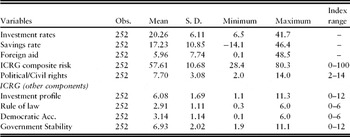
Table 1 lays out descriptive statistics for the data set. The average investment rates over the sample period are 20.3% with a maximum of 41.7% (Malaysia) and a minimum of 6.5% (Mozambique and Sierra Leone). The average savings rates are 17.23% with a maximum of 40.4% (Republic of Congo) and a minimum of –14.1% (Mozambique). Negative savings for developing countries can arise due to current account deficits and/or government budget deficits. Current account deficits imply that the consumption and investment of a country cannot be funded domestically and that a country is a net borrower in the international market. The average of ICRG country risk rating index is 57.61 points with a maximum of 80.3 (Botswana) and a minimum of 28.4 (Nicaragua).Footnote 13 The mean values of other indices measuring institutional quality (except for government stability) are below their median values, suggesting an overall poor state of institutions in developing countries.
Summary statistics

Notes: Obs. = observations; S.D. = standard deviation; Acc. = accountability. Higher value of an index corresponds to a better institutional quality, and vice versa.
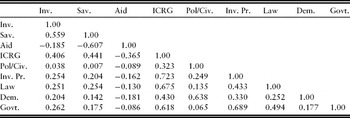
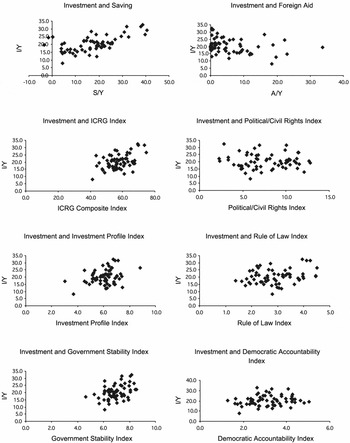
Table 2 and Figure 1 show the correlations. It appears that countries with higher investment rates also have higher savings rates. However, in general, countries in sub-Saharan Africa exhibit lower savings rates, while for a few others the rates are also negative, i.e. Mozambique and Nicaragua. The difference between investment rate and savings rate is made up of net foreign aid inflow. There is also a general positive correlation between investment rates and all institutional variables. Although these correlations provide some insight, they are inadequate for drawing a reasonable conclusion. Therefore, we need to simultaneously control for them in the regression to find their individual effects upon investment rates and, more importantly, upon the coefficient of the savings rates, which measure the degrees of capital mobility.
Correlations

Notes: Inv. = investment rates; Sav. = savings rate; Aid = foreign aid; ICRG = ICRG composite risk index; Pol/Civ. = sum of political and civil rights; Inv. Pr. = investment profile; Law = rule of law; Dem. = democratic accountability; Govt. = government stability.
Correlations between investment rates and explanatory variables (country averages)

4. Estimation results
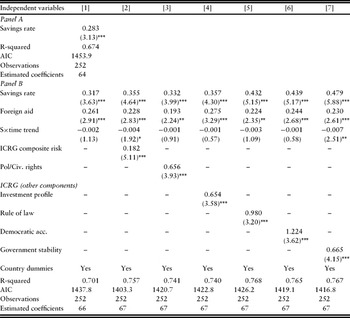
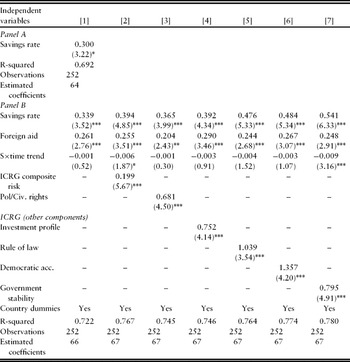
Panel A of Table 3 presents the results of a basic F–H model, as in equation (2). The coefficient of the savings rate is positive and significant at the 1% level. Its magnitude suggests that capital is more mobile in developing countries, which is also consistent with previous findings in this area (Sinha and Sinha, Reference Sinha and Sinha2004; Payne and Kumazawa, Reference Payne and Kumazawa2005; Younas, Reference Younas2007).
Dependent variable: investment rates

Notes: All regressions estimated with heteroscedasticity-robust standard errors. S = savings rate; acc. = accountability; Absolute t-values are shown in parentheses. Subscripts ***, **, and * indicate significance at 1, 5, and 10 % levels, respectively
Panel B presents regression results using an augmented F–H specification as in equation (3). Initially, we include only savings rate foreign aid and an interactive variable of time trend and savings rate in the regression. Column (1) shows that the coefficient of foreign aid is positively significant at the 1% level, suggesting that foreign assistance supports domestic investment in developing countries. Moreover, inclusion of foreign aid has a positive upward impact on the coefficient of the savings rate. This implies that exclusion of foreign aid in the savings–investment regression would exaggerate the degree of capital mobility in developing countries. The expected negative sign on the coefficient of the interactive term of time trend and savings rate suggests that capital mobility has increased over time due to financial liberalization around the world; however, it is statistically insignificant.
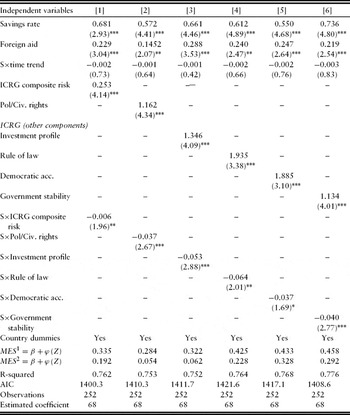
Columns 2 through 7 include variables measuring different aspects of institutional quality one by one. The coefficients of all institutional variables are positive and significant at the 1% level and their size ranges from 0.18 (ICRG composite risk) to 1.22 (democratic accountability).Footnote 14 The varied magnitudes of the coefficients of institutional variables suggest that they capture somewhat different aspects of institutional quality. These estimates imply that one standard deviation increase (decrease) in the index point measuring institutional quality is estimated to raise (drop) the investment rates up to 1.22%. Therefore, starting from a high risk environment, an increase in institutional quality appears to stimulate investment, which drives economic growth and development. The estimated coefficient of the savings rate is positive and significant at the 1% level in all the regressions.
Inclusion of the institutional quality variable raises the size of the coefficient of the savings rate, which ranges between 0.332, when political rights and civil liberties are included, to 0.479, when government stability is controlled for.Footnote 15 This result indicates that excluding the institutional measure in the regressions served to exaggerate the degree of capital mobility by reducing the estimated coefficient of the savings rate. The point to emphasize, however, is that an increase in institutional quality substantially increases investment in developing countries. This also suggests that a country with better institutions will have more access to external capital markets. Prasad et al. (Reference Prasad, Rajan and Subramanian2006) argue that, given similar technologies, a developing country that can invest more – presumably by borrowing foreign capital to supplement domestic savings – should grow faster during its development phase.
The interactive variable of time trend and savings rate has the expected negative sign, but it is significant only when the ICRG composite risk and government stability are included. However, foreign aid remains positive and significant in all the regressions and follows a similar explanation to that given above.
The regressions controlling for institutional variables explain about 74% to 77% of the variance in the investment rates as compared to 67% and 70% for the regressions without them. We also carry out the Akaike information criterion (AIC) test to ascertain the relative performance of the estimated models. A lower value of AIC is associated with the better model. According to that criterion, all models that include institutional variables perform better than those that exclude them.
Finally, in the specifications reported in Table 4, we include the interaction variables of institutional quality and the savings rate to examine whether capital mobility increases with the improved institutional quality in developing countries. As expected, the coefficient of this interactive term is negative and significant in all the regressions. This provides evidence of increased capital mobility due to improvement of institutional quality over time in developing countries. We determine the marginal effect of domestic savings (MES) on domestic investment at the mean and upper values of various indices measuring different aspects of institutional quality so as to reveal the actual size of the savings-retention coefficient, which measures the degree of capital mobility.Footnote 16Table 4 also shows the coefficient of the savings rate evaluated at the mean (MES1) as well as at the highest (MES2) values of indices measuring different aspects of institutional quality in our sample.Footnote 17
Dependent variable: investment rates

Notes: All regressions estimated with heteroscedasticity-robust standard errors. S = savings rate; MES1 evaluated at mean value Of institutional index, and MES2 at maximum value; Absolute t-value are shown in parentheses. Subscripts ***, **, and * indicate significance at 1, 5, and 10 % levels, respectively.
The saving-retention coefficient evaluated at the highest indices values measuring institutional quality is lowest, 0.054, when political/civil rights and the savings rate are interacted, followed by 0.06, when the investment profile and savings rate are interacted in the regressions. The substantial decline in the savings rate coefficient provides evidence of decreased capital mobility due to an increase in institutional quality in developing countries. It suggests that the movement of capital increasingly encounters fewer restrictions as institutional quality improves. The sign and significance for all other variables remain about the same as in Table 3.
Our findings also suggest that institutions are the driving force for increasing investment. Therefore, institutional reforms such as strengthening the legal system, ensuring private property protections, enforcing contractual agreements, and establishing an investor-friendly environment will increase investment in developing countries.
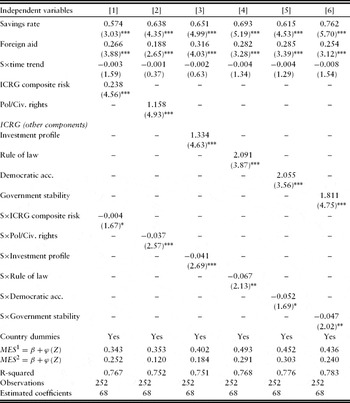
As mentioned in Section 2, we also follow Kasuaga (Reference Kasuga2004) and Younas (Reference Younas2007) by using past savings rates as an instrument to account for the potential endogeneity of domestic savings. Though our econometric model addresses this concern, the purpose of this exercise is to further test the robustness of our findings. The results in Tables 5 and 6 show that qualitatively the pattern and impact of all variables remain about the same.
IV estimation Dependent variable: investment rates

Notes: All regressions estimated with heteroscedasticity-robust standard errors. S = savings rate; acc. = accountability; Absolute t-values are shown in parentheses. Subscripts ***, **, and* indicate significance at 1, 5, and 10 % levels, respectively.
IV estimation Dependent variable: investment rates

Notes: All regressions estimated with heteroscedasticity-robust standard errors. S = savings rate; MES1 evaluated at mean value Of institutional index, and MES2 at maximum value; Absolute t-value are shown in parentheses. Subscripts ***, **, and * indicate significance at 1, 5, and 10 % levels, respectively.
5. Conclusion
This paper uses augmented F–H specification to examine the impact of institutional quality on the degree of capital mobility for 63 developing countries over the period 1982–2003. According to F–H, an economy with low capital mobility will have a slope coefficient with the savings rate close to unity, and close to zero with high capital mobility. A high savings–investment correlation can arise due to the presence of institutional rigidities inhibiting the movement of capital across borders, while improvement in institutional quality would weaken this correlation. Therefore, if institutional quality is important, but omitted, the coefficient of the savings rate will exaggerate the degree of capital mobility in developing countries.
We include different aspects of institutional quality to find their differential effects and also to check the robustness of our results. We also include interaction variables of institutions and the savings rate to find whether the degree of capital mobility increases with improvement in institutional quality. We also include foreign aid as it may complement domestic savings and, thus, support domestic investment in developing countries. Moreover, the interactive term of the time trend and savings rate is introduced to examine whether capital mobility has increased over time due to financial liberalization around the world.
Our findings reveal that the presence of institutional rigidities decreases the degree of capital mobility in developing countries. Poor institutional quality creates economic and political distortions by exacerbating investment risks, weakening the legal system and creating barriers on the movement of capital. On the other hand, we also find support for our hypothesis that improvement in institutional quality increases capital mobility, as the movement of capital increasingly encounters fewer barriers. Inclusion of foreign aid also has an important positive impact on the coefficient of the savings rate. Finally, institutional reforms for strengthening property rights, lowering corruption, and enforcing contractual agreement can substantially increase investment in developing countries. However, we need a separate and focused analysis on the determinants of investment to come to a definitive conclusion in this regard.