1. Ordovician deep water trilobite faunas
Many Ordovician deep water trilobite faunas have two major components: an abundance of taxa that lived within the water column and species that were members of the underlying benthos. The former largely belong to the Cyclopygidae and have characteristically large eyes. Cyclopygids had wide palaeogeographical distributions but their remains are almost invariably restricted to deep water deposits from ocean-facing settings (Cocks & Fortey, Reference Cocks, Fortey, McKerrow and Scotese1990). They are therefore interpreted as having been mesopelagic (Fortey, Reference Fortey1985; Fortey & Owens, Reference Fortey and Owens1987; McCormick & Fortey, Reference McCormick and Fortey1998), typically occupying levels in the water column at depths estimated to be between about 200 m and 700 m (Fortey, Reference Fortey1985; Fortey & Owens, Reference Fortey and Owens1987) or possibly a little shallower (e.g. McCormick & Fortey, Reference McCormick and Fortey1998; Zhou, Zhou & Yuan, 2001; Zhou et al. Reference Zhou, Zhou, Siveter and Yuan2003, Reference Zhou, Bergström, Zhou, Yuan and Zhang2011; Owens, Reference Owens2002). Throughout the Ordovician period they lived above the outer shelves and upper continental slopes of the margins of Gondwana and continents and terranes derived from there (Fortey & Cocks, Reference Fortey and Cocks2003). Occasionally, at times of high sea level during early and middle Ordovician times, cyclopygids extended their range onto the margin of Baltica (e.g. Nielsen, Reference Nielsen1995; Hoel, Reference Hoel1999) and terranes outboard of Laurentia (Williams et al. Reference Williams, Boyce and Colman-Sadd1992; Fortey & Cocks, Reference Fortey and Cocks2003). During late Ordovician time, however, they became increasingly frequent visitors to the Iapetus margin of Laurentia (e.g. Bartholomew & Tillman, Reference Bartholomew and Tillman1977; Lespérance et al. Reference Lespérance, Malo, Sheehan and Skidmore1987; Fortey & Owens, Reference Fortey and Owens1987, p. 107) and its outboard terranes now preserved in Scotland and Ireland (Owen & Romano, Reference Owen and Romano2011).
Cyclopygid faunas are commonly associated with benthic species that lacked eyes or had smaller eyes than their shallow water relatives (‘atheloptic’ faunas of Fortey & Owens, Reference Fortey and Owens1987; see also Zhou et al. Reference Zhou, Zhou, Siveter and Yuan2003; Fortey in Adrain et al. Reference Adrain, Edgecombe, Fortey, Laurie, McCormick, Owen, Waisfeld, Webby, Westrop, Zhou, Webby, Droser and Paris2004). Although cyclopygids are abundant in some faunas from the upper Ordovician of the Laurentian margin, the only known occurrence in North America of a cyclopygid fauna with an associated benthic trilobite fauna dominated by species lacking eyes is that from the Pyle Mountain Argillite in Maine (Owen & Bruton, Reference Owen, Bruton, Rabano, Gozalo and Garcia-Bellido2008). This fauna is described herein and assessed in terms of its likely relative bathymetric position compared to other upper Ordovician deep water trilobite faunas from a range of palaeogeographical settings.
2. Upper Ordovician cyclopygids in Laurentia
As is noted above, cyclopygids occur only rarely in upper Ordovician faunas from Laurentia and its marginal terranes within the Iapetus Ocean prior to middle Katian time (approximately latest Caradoc and earliest Ashgill in terms of Anglo-Welsh chronostratigraphy). Such recorded occurrences are from deep water deposits of Sandbian age and comprise a probable species of Degamella noted by Fortey & Owens (1987, p. 107) from the Normanskill Shale of New York State (= Niobe? huberi Roy, Reference Roy1929); a specimen of Microparia from the Craigmalloch Formation (Albany Group) in the Girvan district of Scotland (Rushton, Tunnicliff & Tripp, Reference Rushton, Tunnicliff and Tripp1996); a specimen of Microparia from the Laggan Member of the Balclatchie Formation at Girvan (Stewart & Owen, Reference Stewart and Owen2008) and six specimens, three complete, compared to Microparia (M.) brachycephala (Klouček) by Bartholomew & Tillman (1977) from the Liberty Hall Formation at Lusters Gate, Virginia.
However, at around the Caradoc–Ashgill boundary (middle Katian, see Bergström et al. Reference Bergström, Chen, Gutiérrez-Marco and Dronov2009, fig. 1), abundant and diverse cyclopygid faunas appeared both on the Laurentian margin – as evinced by the Pyle Mountain Argillite fauna documented herein – and in the outboard terranes represented in the Whitehouse Subgroup at Girvan, Scotland (Ingham in Thomas, Owens & Rushton, Reference Thomas, Owens and Rushton1984) and the Ballyvorgal Group and Oriel Brook Formation in Ireland (Weir, Reference Weir1959; Owen & Romano, Reference Owen and Romano2011). The benthic trilobite faunas associated with the last of these is most similar to the deep shelf Phillipsinella parabola–Staurocephalus clavifrons fauna seen in the upper Katian of Avalonia and Baltica, whereas the Whitehouse and Ballyvorgal Group faunas include a much more substantial component of trilobites lacking eyes.
Cyclopygids are also known from the subsequent part of the Katian of Laurentia. Species of Cyclopyge, Heterocyclopyge (now considered a subgenus of Microparia) and Symphysops occur in, and locally dominate, the ‘Stenopareia Community’ of Lespérance et al. (Reference Lespérance, Malo, Sheehan and Skidmore1987) in the Ashgill of the Percé region of Quebec but in association with ‘normal-eyed’ benthic taxa. A single cyclopygid specimen was ascribed to Heterocyclopyge by Sheehan & Lespérance (Reference Sheehan and Lespérance1978) amongst the 205 trilobite sclerites associated with a Foliomena brachiopod fauna that probably represents one of the shallower water developments of that fauna (Harper in Owen & Bruton, Reference Owen, Bruton, Rabano, Gozalo and Garcia-Bellido2008). The low diversity trilobite fauna is composed almost entirely (84%) of specimens of Tretaspis and, to a lesser extent, Lonchodomas (11%). Both of these taxa lack eyes and, as noted by Owen & Bruton (2008), constitute a development of the trinucleid–raphiophorid association known through most of the Ordovician of Avalonia, Baltica and South China (see Owen & Parkes, Reference Owen and Parkes2000, p. 227).
3. The Pyle Mountain Argillite and its fauna
3.a. The Pyle Mountain Argillite
The geological setting of the Pyle Mountain Argillite in Castle Hill Township, Aroostook County, northeastern Maine was summarized by Neuman (Reference Neuman1994), who provided a geological map showing the distribution of the formation (1994, fig. 2). The formation was originally named by Boucot et al. (Reference Boucot, Field, Fletcher, Forbes, Naylor and Pavlides1964) and although Roy (Reference Roy1987) recommended in an Open-File Report of the Maine Geological Survey that the name be amended to Pyle Mountain Formation, this has not been adopted by subsequent workers. The unit comprises fine-grained, olive-coloured mudstone, which, where calcareous, weathers to a brown ‘gingerbread’ rock that is commonly richly fossiliferous with abundant moulds of ostracods and agnostoid trilobites. Graptolites of the Climacograptus spiniferus Biozone occur in black shales near the top of the underlying Winterville Formation (Neuman, Reference Neuman1994, fig. 2) and indicate that the Pyle Mountain Argillite is probably equivalent to a level in or close to the lower part of the Pleurograptus linearis Biozone and thus approximately uppermost Caradoc in terms of the Anglo-Welsh chronostratigraphy. Pollock, Harper & Rhor (Reference Pollock, Harper and Rhor1994) discussed and provided a correlation of upper Ordovician successions in northern Maine and adjacent Canada and considered (1994, p. 930) that the Pyle Mountain Argillite was deposited in a ‘deep, cold water basin on the outboard margin of Laurentia’.
Shelly fossils were first recorded from the Pyle Mountain Argillite by Boucot et al. (Reference Boucot, Field, Fletcher, Forbes, Naylor and Pavlides1964). The original plan for the present study was for a joint publication whereby, following joint collecting at the Pyle School locality in 1989, Robert B. Neuman (formerly of the US Geological Survey) was to describe the brachiopods and one of us (DLB), the trilobites. Regrettably this did not materialize and Neuman (Reference Neuman1994) published the brachiopods separately but included a provisional list of the trilobites identified by Bruton (Neuman, Reference Neuman1994, p. 1221). This list was based on the 1989 collections, supplemented by specimens collected on numerous occasions by Neuman with W. H. Forbes and others and those collected by Harry and Dorothy Whittington in 1961, which formed the basis for Whittington's report and faunal list published in Boucot et al. (Reference Boucot, Field, Fletcher, Forbes, Naylor and Pavlides1964, p. 21). Whittington recognized that the Pyle Mountain Argillite fauna was unlike those known from elsewhere in North America and had strong affinities with the Ashgill rocks of Europe, in particular Bohemia and Poland. We provided a preliminary assessment of the trilobite fauna (Owen & Bruton, Reference Owen, Bruton, Rabano, Gozalo and Garcia-Bellido2008) prior to its detailed systematic treatment and analysis.
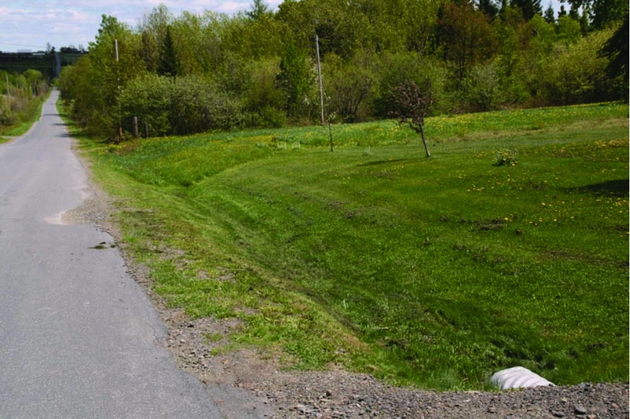
The type locality of the Pyle Mountain Argillite is a roadside ditch, now overgrown (Fig. 1), extending west across the north slope of Pyle Mountain at the intersection of the Turner Road and Dudley Road (Neuman, Reference Neuman1994, p. 1220, fig. 2) and at the site of the former Pyle School, now since gone. Collections from 1989 and later come from the spot marked PM on the map published by Neuman (Reference Neuman1994, fig. 2), which corresponds to locality D-4 of the Presque Isle Quadrangle map (Boucot et al. Reference Boucot, Field, Fletcher, Forbes, Naylor and Pavlides1964, pl. 1), whilst the 1961 collections contain additional specimens from locality E-3. In the field, the mudstone seems to lack bedding and the fossils appear widely scattered without any apparent orientation. Collections made by the Whittingtons and by Bruton have been prepared with the aid of a vibro-tool or fine needles, while those received from Neuman were those identified in rock samples that had already been treated in dilute hydrochloric acid to dissolve any remaining carbonate from the studied brachiopod shells. The majority of specimens are therefore internal moulds, or latex casts from external moulds that were first blackened with ‘Opaque’ and then whitened with ammonium chloride before photographing using Leitz Aristophot equipment with a film camera attachment. The developed films were later scanned and plates made using Adobe Photoshop™. A few specimens were photographed directly as digital images.
The type locality of the Pyle Mountain Argillite, a roadside ditch and culvert from which fossil collections were made by H. B. Whittington with D. A. Whittington in 1961 and D. L. Bruton with R. B. Neuman in 1998. The gravel road above the culvert leads to what was once the site of Pyle School. Photo courtesy of W. H. Forbes, 2008.

3.b. Trilobite fauna
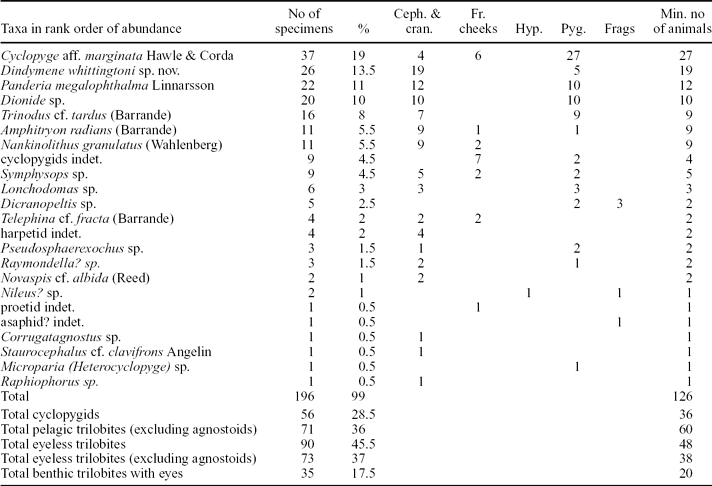
The trilobite fauna of the Pyle Mountain Argillite comprises some 22 species. All of the specimens are isolated sclerites and thus the fauna reflects a degree of post-mortem transport. They range in size from a few millimetres in the case of some pygidia of Cyclopyge to a hypostome of Nileus? 23 mm wide. This is in marked contrast to the brachiopods, which are all small (even compared to related species elsewhere; most specimens being between 2 and 4 mm, none greater than 9 mm) (Neuman, Reference Neuman1994). The number of component sclerites of each trilobite species is listed in Table 1, with the taxa shown in rank order of abundance. The same order is obtained irrespective of whether the total number of sclerites of each taxon is counted or the minimum number of individual animals these might represent is estimated. The latter is based on the maximum number of sclerites representing a single part in the exoskeleton (cranidium, pygidium or hypostome) or, if it is greater, half the number of paired sclerites (free cheeks). We recognize that this does not account for differences in the number of moult stages between species and hence the number of exuviae a single animal may leave during its life.
Composition of the trilobite fauna from the Pyle Mountain Argillite

Taxa are arranged in rank order of abundance based on both numerical abundance of specimens and the minimum number of animals indicated by the numbers of the different sclerites (cephala & cranidia, free cheeks, hypostomes, pygidia and indeterminate fragments) of each species. Cyclopygids comprise species of Cyclopyge, Symphysops and Microparia (Heterocyclopyge). Amphitryon and Telephina were also pelagic. See text for discussion of the benthic taxa.
The fauna comprises a significant proportion of trilobites, largely cyclopygids, which lived in the water column, and a benthic fauna dominated by representatives of taxa lacking eyes. None of the benthic taxa that lack eyes have normal-eyed relatives, and whereas the original use of the term ‘atheloptic association’ was for faunas that included such secondarily blind or ‘shrunken-eyed’ taxa (Fortey & Owens, Reference Fortey and Owens1987, p. 106), the Pyle Mountain Argillite fauna conforms to the slightly broader sense in which the term ‘atheloptic’ has become used (e.g. Waisfeld et al. Reference Waisfeld, Vaccari, Chatterton and Egecombe2001).
Cyclopygids constitute 28.5% of both the total number of identifiable sclerites and of the minimum number of individual trilobite animals. Cyclopyge is the most abundant but species of Symphysops and Microparia (Heterocyclopyge) are also present. The epipelagic Telephina is a rare component of the fauna and the remopleuridid Amphitryon was probably also a swimmer, and hence pelagic trilobites together constitute 36% of the sclerites (37% of the minimum number of individual animals). The agnostoids Trinodus and Corrugatagnostus constitute a further 8.5% of the sclerites in the fauna (8% of animals) and may also have had a pelagic mode of life, although this is a matter of some debate (e.g. see Fortey & Owens, Reference Fortey and Owens1999). Undoubted benthic trilobites lacking eyes (species of Dindymene, Dionide, Nankinolithus, Lonchodomas, harpetids, Raymondella?, Novaspis and Raphiophorus) constitute 37% of the sclerites (30% of the minimum number of individual animals). Including the agnostoids increased the figures for trilobites lacking eyes to 45.5% and 48%, respectively. Apart from Panderia, no benthic trilobite species with eyes represents more than 2.5% of the fauna and such trilobites together comprise only 17.5% of the sclerites and 16% of the minimum number of individual animals represented by those isolated exoskeletal parts. The presence of benthic trilobites with normal eyes suggests some light penetration to the sea bed. It is possible that at least some of these trilobites could have been transported from shallower, more illuminated, waters. However, as is noted in Section 4.b, there seems to be some systematic arrangement of benthic taxa, including ones with normal eyes, down the palaeoslope below the waters inhabited by cyclopygids, suggesting that at least some were components of the deep water benthos.
3.c. Brachiopod fauna
The Pyle Mountain Argillite contains the only known Foliomena brachiopod fauna from North America (Neuman, Reference Neuman1994; Owen & Bruton, Reference Owen, Bruton, Rabano, Gozalo and Garcia-Bellido2008), although such faunas are known from terranes in Ireland and Scotland that lay outboard of Laurentia during Ordovician time (Parkes & Harper, Reference Parkes, Harper, Copper and Jin1996; Harper & Stewart, Reference Harper and Stewart2008). Upper Ordovician cyclopygid faunas are commonly associated with such assemblages of typically small, thin-shelled brachiopods. Since its first description from Sweden (Sheehan, Reference Sheehan1973), the Foliomena fauna has been documented from most palaeocontinents and has been the subject of several reviews (e.g. Cocks & Rong, Reference Cocks and Rong1988; Rong, Zhan & Harper, Reference Rong, Zhan and Harper1999; Zhan & Jin, Reference Zhan and Jin2005). It has become clear that the fauna occupied deep water (distal shelf) environments (Benthic Assemblage (BA) Zones 5–6) during Sandbian and early Katian times (Caradoc in terms of Anglo-Welsh chronostratigraphy) and extended its range into mid-shelf settings (BA 3–4) during late Katian time (Ashgill) (Villas, Hammann & Harper, Reference Villas, Hammann and Harper2002; Zhan & Jin, Reference Zhan and Jin2005) when it also reached its widest palaeogeographical extent. Cluster and Principal Component Analysis of 29 Foliomena faunas from nine Ordovician plates or microplates by Zhan & Jin (2005) placed the Pyle Mountain Argillite fauna in a group of younger faunas, which they interpreted as having occupied sites in the deeper water part of the environmental spectrum inhabited by the brachiopod fauna. Within that group the Pyle Mountain Argillite fauna occupied the deepest parts of the spectrum along with those of the Tangtou Formation in Nanjing, South China, the Jerrestad Mudstone of Sweden (Baltica) and the Domusnovas Formation of Sardinia. Other Ashgill faunas from what were interpreted as shallower (but none the less still deep) water settings within the same group include those of the Holy Cross Mountains in Poland (Baltica), the Crugan Mudstones of the Llŷn Peninsula of North Wales, the Tangtou Formation in Ningguo, South China, the Králův Dvůr Formation in Bohemia and the Jonstorp Formation of Västergötland, Sweden.
4. Environmental setting of the trilobite fauna
4.a. Deep water trilobite faunas
Analyses of cyclopygid trilobite faunas along depth gradients inferred from regional palaeogeographical and other criteria show an increasing abundance and diversity with increasing water depth and this is inferred to indicate depth stratification of taxa within the water column (e.g. Price & Magor, Reference Price and Magor1984; Zhou et al. Reference Zhou, McNamara, Yuan and Zhang1994, Reference Zhou, Zhou, Siveter and Yuan2003, Reference Zhou, Bergström, Zhou, Yuan and Zhang2011; Zhou, Zhou & Yuan, Reference Zhou, Zhou and Yuan2001, Reference Zhou, Zhou and Yuan2007). In simple terms, those cyclopygid taxa living at higher levels in the water column extended further shoreward above the outer shelf and are more likely to occur in otherwise shallower shelf successions at times of marine transgression. They may occur in low diversity cyclopygid-bearing assemblages in relatively shallow settings but increasingly higher diversity, higher abundance, cyclopygid faunas in deeper water environments. There are three cyclopygid genera, Cyclopyge, Symphysops and Microparia, in the Pyle Mountain Argillite fauna. The question then arises as to what this might indicate in terms of the recorded spectrum of late Ordovician outer shelf to upper slope environments and whether that bathymetric ‘signal’ is also reflected in the associated benthic trilobite fauna.
4.b. Comparison of the Pyle Mountain Argillite faunas with other deep water faunas
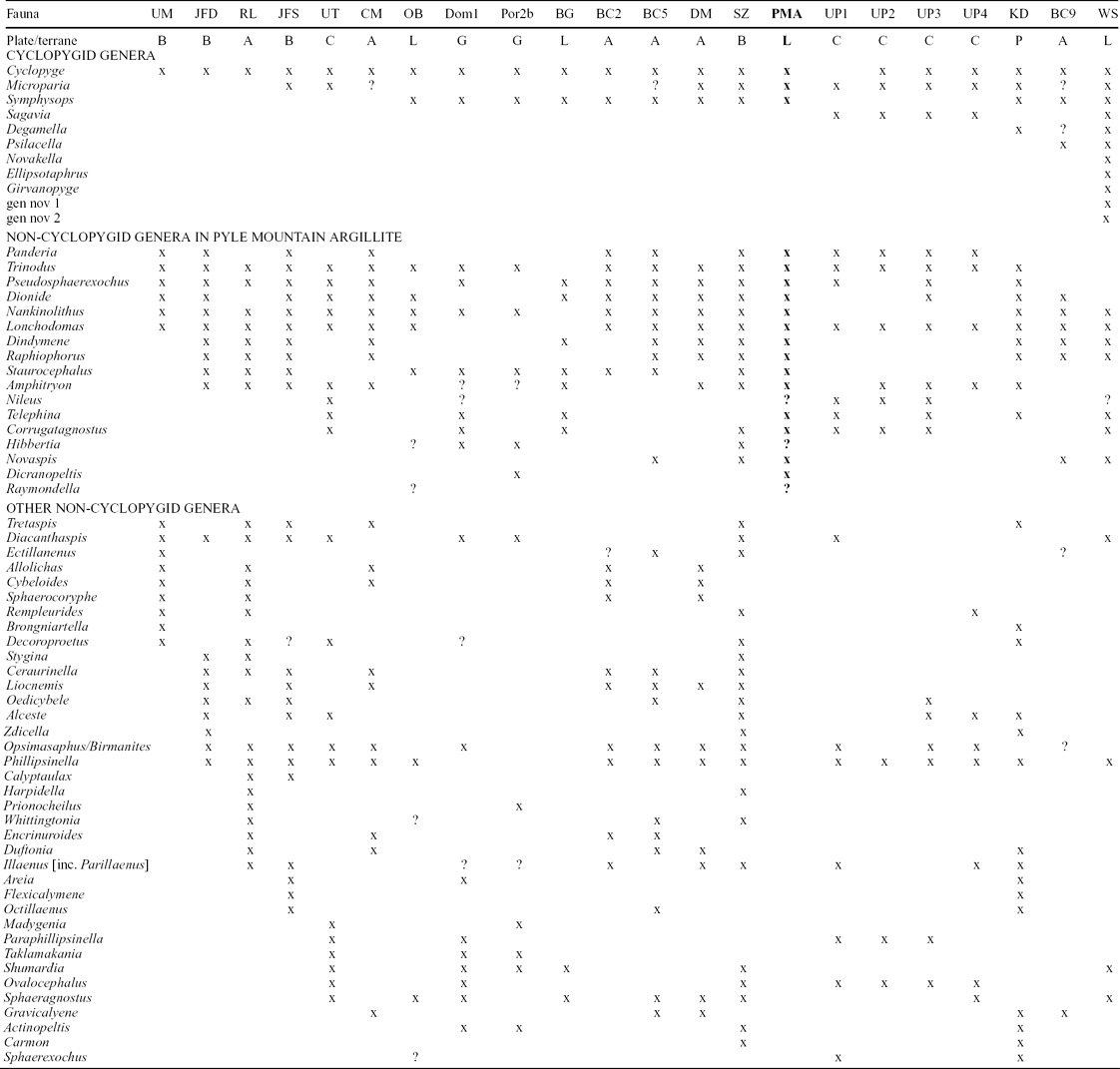
Table 2 is a compilation of the occurrences of trilobite genera in the best-documented cyclopygid-bearing faunas in the middle and upper Katian of the Iapetus region (Avalonia, Baltica, Laurentia (including the Pyle Mountain Argillite fauna) and peri-Laurentian terranes in Scotland and Ireland), the high latitude margin of Gondwana (including Perunica) and South China. Foliomena brachiopod faunas have been documented from virtually all of the units yielding the trilobites. The trilobite faunas in Table 2 are arranged from left to right in terms of the increasing number of cyclopygid genera; this also reflects basinward transects determined using regional geological criteria for the Avalonian and Chinese faunas. The relative positions of faunas reflects a general deepening from left to right in the table and the Pyle Mountain Argillite fauna clearly plots towards the deeper water end of the spectrum, which accords with the interpretation of the brachiopod fauna (Zhan & Jin, Reference Zhan and Jin2005; see Section 3.b). The co-occurrence of the cyclopygids Cyclopyge, Symphysops and Microparia is a palaeogeographically widespread phenomenon (Table 2) and has a longer history on the Gondwanan margin such as in the Sandbian trilobite fauna recently documented from the Tarbagati Range in Kazakhstan by Ghobadi Pour et al. (Reference Ghobadi Pour, McCobb, Owens and Popov2011).
Comparison of the trilobite fauna of the Pyle Mountain Argillite with that of other cyclopygid-bearing faunas from the middle and upper Katian (upper Caradoc to middle Ashgill) of Baltica (B), Avalonia (A), China (C), Gondwana (G), Perunica (P) and Laurentia and its marginal terranes (L)

The presence of a genus in a sample is marked by a cross. Cyclopygids are abundant in those faunas where more than one genus of that group is present, although quantitative data are not available in many instances. The faunas are arranged in terms of increasing water depth from left to right based on increasing cyclopygid diversity and, in the case of those from Avalonia and China, other regional geological evidence of bathymetry. The non-cyclopygid genera present in the Pyle Mountain Argillite (PMA) are arranged in stepwise order of occurrence from shallow to deep followed by a similar ordering of taxa that occur in more than one palaeogeographical region but not in the Pyle Mountain Argillite. Non-cyclopygid genera recorded from faunas restricted to a single palaeogeographical region have been excluded from this compilation. A limited amount of reassessment of taxonomic reassignment has been undertaken, but the main sources of data are: UM – Ulunda Mudstone, Västergötland, Sweden: Bergström (Reference Bergström1973 with emendations by Owen, Harper & Rong, Reference Owen, Harper, Rong, Barnes and Williams1991); JFD – Jerrestad Fm, Bornholm, Denmark: Kielan (Reference Kielan1960); RL – Rhiwlas Limestone, Wales: Whittington (Reference Whittington1968 with emendations by Owen, Harper & Rong, Reference Owen, Harper, Rong, Barnes and Williams1991); JFS – Jerrestad Fm, Skåne, Sweden: Kielan (Reference Kielan1960); UT – Upper Tangtou Fm, Jiangsu Province, China: Tripp, Zhou & Pan (Reference Tripp, Zhou and Pan1989); CM – Crugan Mudstone, North Wales: Price (Reference Price1981); OB – Oriel Brook Fm, Ireland: Owen & Romano (2011); Dom1 and Por2b – Punta S'Argiola Member of the Domusnovas Fm, Sardinia: Hammann & Leone (2007); BG – Ballyvorgal Group, Ireland: Weir (Reference Weir1959 see also Whittington, Reference Whittington1968; Owen & Romano, Reference Owen and Romano2011); BC 2, 5, 9 – upper Katian (Rawtheyan) between Bala and Corris, N Wales: Price & Magor (1984); DM – Dwyfor Mudstone, N Wales: Price (Reference Price1981); SZ – Staurocephalus clavifrons Zone, Poland: Kielan (Reference Kielan1960); UP1–4 – Upper Pagoda Limestone, northern Sichuan and southern Shaanxi provinces, China: Zhou, Zhou & Yuan (2007); KD – Králův Dvůr Formation, Czech Republic: faunas from localities yielding cyclopygids listed by Shaw (Reference Shaw2000); WS – Upper Whitehouse Subgroup, Girvan, Scotland: Ingham in Thomas, Owens & Rushton (Reference Thomas, Owens and Rushton1984) and Ingham (in press).
The benthic trilobites in the Pyle Mountain Argillite fauna include some of the most ubiquitous genera across the analysed spectrum of deep water faunas shown in Table 2. The occurrence of the trinucleid Novaspis confirms a position for the fauna in the deeper part of the spectrum within what Price & Magor (1984) termed the ‘Novaspis-cyclopygid Association’. There are some interesting absences from the fauna, notably Opsimasaphus/Birmanites (the taxonomy of these genera requires clarification) and Phillipsinella, which are otherwise very widely distributed. Both have ‘normal’ eyes and occur in faunas in other peri-Iapetus settings including the occurrence of Phillipsinella in broadly coeval cyclopygid faunas in the Grangegeeth (Oriel Brook Fm) and Midland Valley (Upper Whitehouse Subgroup) terranes that lay on the margins of Laurentia. Their absence presumably reflects either very low abundance or some subtlety of the environment in Maine.
In terms of the peri-Iapetus faunas (Baltica, Avalonia and Laurentia and its marginal terranes), only 4 of the 34 genera in Table 2 (Phillipsinella, Shumardia, Sphaeragnostus and Gravicalymene) have ranges that unequivocally bracket the position of the Pyle Mountain Argillite but are not recorded from that formation. This lends support to the relative bathymetric position of the Maine fauna established on the basis of the cyclopygids being also reflected in the benthos. Shumardia and Sphaeragnostus occur at Girvan, in what is interpreted as the deepest of the trilobite faunas, and Gravicalymene is known from more ‘normal’ shelf faunas on Laurentia (e.g. Ross, Reference Ross1967; Lespérance & Weissenberger, Reference Lespérance and Weissenberger1998) so again, a local environmental rather than a wider biogeographical explanation for their absence must be sought.
5. Palaeobiogeographical interpretation
The increasing frequency of the appearances of cyclopygids on the Iapetus margin of Laurentia and its outboard terranes from the beginning of the late Ordovician period may reflect a long-term shift to higher global sea levels (Fortey, Reference Fortey and Bruton1984). This began during the preceding Darriwilian age and persisted until well into Katian time (Haq & Schutter, Reference Haq and Schutter2008, fig. 1). On a shorter timescale, the development of diverse cyclopygid faunas on and close to the Iapetus margin of Laurentia, including ones associated with atheloptic benthic faunas such as in the Pyle Mountain Argillite, in middle Katian time may have been promoted by a major sea level rise, the ‘Linearis drowning events’ of Nielsen (Reference Nielsen, Webby, Droser and Paris2004), that led to the maximum extent of drowning of the Laurentian platform (Zhang, Reference Zhang2011). Although not fully established in the deep waters off Laurentia until late Ordovician time, it is somewhat ironic that the youngest record of a cyclopygid is from there and not from Gondwana or crustal blocks derived from it such as South China or Avalonia. Thus a species of Cyclopyge is known from the Hirnantian Tirnaskea Formation of Pomeroy, Co. Tyrone, northern Ireland (Thomas, Owens & Rushton, Reference Thomas, Owens and Rushton1984; Owen, Reference Owen1986), part of the marginal Laurentian Midland Valley terrane that includes Girvan (Woodcock in Fortey et al. Reference Fortey, Harper, Ingham, Owen, Parkes, Rushton and Woodcock2000 and reference therein). Unlike most Hirnantian units, the Tirnaskea Formation also contains deep water brachiopod associations indicative of BA 5–6 (Candela, Reference Candela2006).
6. Systematic palaeontology
The terminology and order of description of taxa follows that advocated in the Treatise on Invertebrate Paleontology Part O (Kaesler, Reference Kaesler1997). All figured and listed material is housed in the type collections of the Geological Museum, University of Oslo (hereafter abbreviated PMO); the remaining material is in the US National Museum of Natural History, Washington, DC. With the exception of the new species of Dindymene, the records of the Pyle Mountain Argillite Formation taxa in the faunal lists of Whittington (in Boucot et al. Reference Boucot, Field, Fletcher, Forbes, Naylor and Pavlides1964, p. 21), Bruton (in Neuman, Reference Neuman1994, p. 1221) and Owen & Bruton (2008, table 1) have not been compiled in synonymy lists. In most instances the generic affinity and even species comparison was the same as in the present paper. A note is made in the relevant discussion of those cases where the earlier generic determination differs from that used here.
A free cheek (Fig. 2o) of a proetid (?Ogmocnemis of Bruton in Neuman, Reference Neuman1994, p. 1221), three incomplete harpetid genal prolongations (Fig. 5s) and a fragment of harpetid brim (= Hibbertia sp. of Bruton in Neuman, Reference Neuman1994, p. 1221), and a possible asaphid fragment (Fig. 3j) do not warrant further description or discussion.
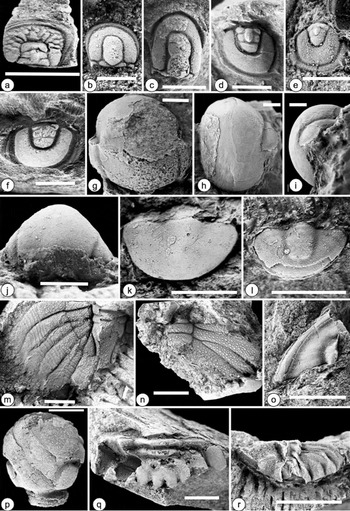
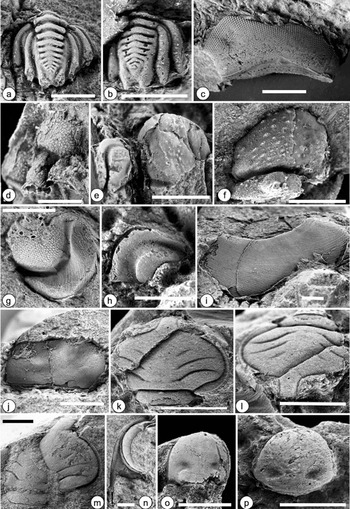
(a) Corrugatagnostus sp. incomplete cephalon, dorsal view, PMO 142.181, scale bar 2 mm. (b–f) Trinodus cf. tardus (Barrande, Reference Barrande1846) (b) cephalon, dorsal view, PMO 141.984, scale bar 1 mm; (c) elongated cephalon, dorsal view, PMO 141.986, scale bar 2 mm; (d) pygidium, dorsal view, PMO 141.985, scale bar 2 mm; (e) pygidium, dorsal view, PMO 141.982, scale bar 2 mm; (f) pygidium, dorsal view, PMO 141.986, scale bar 2 mm. (g–l) Panderia megalophthalma Linnarsson, Reference Linnarsson1869 (g) cranidium, palpebral view, PMO 142.018, scale bar 2 mm; (h, i) cranidium, anterior and left lateral views, PMO 142.176, scale bar 2 mm; (j) cranidium, dorsal view, PMO 208.308, scale bar 2 mm; (k) pygidium, dorsal view, latex cast, PMO 142.024, scale bar 4 mm; (l) pygidium, dorsal view, PMO 142.023, scale bar 4 mm. (m, n) Dicranopeltis sp. (m) pygidium, dorsal view, PMO 141.981, scale bar 4 mm; (n) pygidium, dorsal view, latex cast, PMO 141.962, scale bar 4 mm. (o) Proetid indet. free cheek, PMO 208.310, scale bar 4 mm. (p–r) Pseudosphaerexochus sp. (p) cranidium, dorsal view, PMO 142.150, scale bar 4 mm; (q) pygidium, dorsal view, PMO 142.176/1, scale bar 4 mm; (r) laterally distorted pygidium, dorsal view, PMO 142.148, scale bar 4 mm (n.b. grooves behind the pygidium are preparation marks).

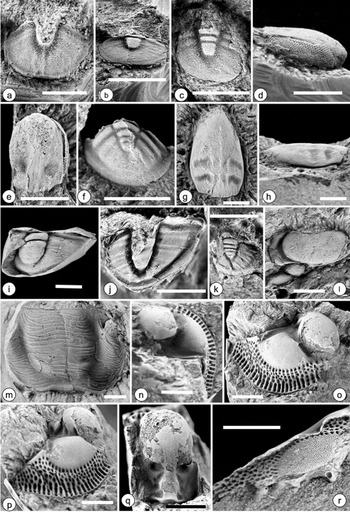
Scale bars are 4 mm unless otherwise stated. (a, b) Dindymene whittingtoni sp. nov. (a) pygidium, dorsal view, PMO 141.952, scale bar 2 mm; (b) pygidium, dorsal view, latex cast, PMO 141.947. (c) Symphysops sp. conjoined eyes with doublure below, anterior view, PMO 142,165. (d) Staurocephalus cf. clavifrons Angelin, Reference Angelin1854, cranidium, oblique lateral view, latex cast, PMO 208.309. (e–h) Telephina cf. fracta (Barrande, Reference Barrande1852) (e) incomplete cranidium, dorsal view, PMO 142.014; (f), glabella and occipital ring, dorsal view, latex cast, PMO 208.306; (g) latex cast of free cheek, PMO 142.143; (h) free cheek, PMO 142.142. (i) Nileus? sp.? ventral view of doublure, PMO 142.146. (j) Asaphid? indet. axial ring?, PMO 142.145. (k–n) Amphitryon radians (Barrande, Reference Barrande1846) (k, l) cranidium, dorsal and frontal views, PMO 142.008; (m) two cranidia, dorsal view, PMO 142.012; (n) free cheek, PMO 142.006. (o, p) Cyclopyge aff. marginata Hawle & Corda, Reference Hawle and Corda1847 (o) cranidium, dorsal view, PMO 142.156; (p) cranidium, dorsal view, PMO 142.160.

Family Metagnostidae Jaekel, Reference Jaekel1909
Genus Corrugatagnostus Kobayashi, Reference Kobaysahi1939
Type species. Agnostus morea Salter, Reference Salter1864, from the Hope Shales (Llanvirn; Darriwilian), Shropshire, England (senior subjective synonym of Agnostus perrugatus Barrande, Reference Barrande1872). Holotype (by monotypy) cephalon refigured by Shergold & Laurie (1997, p. 375, fig. 236:5b).
Corrugatagnostus sp.
Figure 2a
Material. One cephalon.
Discussion. Nielsen (Reference Nielsen1997) provided an excellent survey of Corrugatagnostus and its distribution and noted that it contains both non-scrobiculate and scrobiculate forms (see also Shergold, Laurie & Sun, Reference Shergold, Laurie and Sun.1990; Shergold & Laurie, Reference Shergold, Laurie and Kaesler1997). The Maine cephalon is of the latter type as are those of the type species and related species from Bohemia figured by Pek (Reference Pek1977, pls 5–7; Pek & Prokop, Reference Pek and Prokop1984, pl. 1, figs 1, 2). These species are older than the present specimen, which has a more pronounced and irregular pattern of small scrobicules arranged en échelon lateral to the glabella and divergent to chaotic in front. Owen & Ingham (1996, pp. 139–40, pl. 25, figs 1, 2) considered C. sol Whittard, Reference Whittard1955 from the Whitehouse Subgroup (uppermost Caradoc–lowest Ashgill) at Girvan, SW Scotland to be the most scrobiculate species of Corrugatagnostus. They considered that C. convergens Weir, Reference Weir1959 from a broadly equivalent horizon in Ireland may prove synonymous with C. sol. Although probably laterally stretched, the present cephalon shows a comparable scrobiculation anteriorly and anterolaterally to that of C. sol figured by Owen & Ingham, but this becomes less pronounced posteriorly. The scrobiculation of the present specimen is like that of the much distorted cephalon from the upper Katian of Poland figured as Geragnostus sp. by Kielan (Reference Kielan1960, pl.1, fig. 4) but the furrowing of the glabella is much more pronounced.
Genus Trinodus M'Coy, Reference M'Coy1846
Type species. Trinodus agnostiformis M'Coy, Reference M'Coy1846 from the Campanile Formation (Sandbian), Greenville, Enniscorthy, Co. Wexford, Ireland.
Discussion. Owen & Parkes (2000, pp. 229–32) discussed the complex nomenclatorial problems affecting Trinodus M'Coy, Reference M'Coy1846 and Arthrorhachis Hawle & Corda, Reference Hawle and Corda1847 (type species Battus tardus Barrande, Reference Barrande1846 from the Králův Dvůr Formation in Bohemia). Fortey (Reference Fortey1980, pp. 26–7) recommended that, in the absence of other material from its type locality, the name Trinodus should be restricted to the poorly preserved type cranidium of T. agnostiformis. This was widely followed and, although not without taxonomic problems of its own (see also Hammann & Leone Reference Hammann and Leone1997), Arthrorhachis became extensively used to accommodate material that had previously been assigned to Trinodus. In documenting topotype specimens, including pygidia, of Trinodus agnostiformis, Owen & Parkes (2000) reluctantly re-established Trinodus as a senior subjective synonym of Arthrorhachis. They noted that there may be a case for retaining Arthrorhachis as a subgenus of Trinodus for the A. tarda species group of Nielsen (Reference Nielsen1997). A detailed phylogenetic analysis would be necessary to establish this. Budil et al. (Reference Budil, Fatka, Kolár, David, Gutiérrez-Marco, Rábano and García-Bellido2011) have recently argued that there may be a case for promoting the use of Arthrorhachis and again restricting the name Trinodus to material from the type locality. Pending the resolution of these issues we follow Owen & Parkes (2000) in using Trinodus.
Trinodus cf. tardus (Barrande, Reference Barrande1846)
Figure 2b–f
Material. Seven cranidia and nine pygidia.
Discussion. Hammann & Leone (1997) discussed the widely distributed, highly variable, upper Katian Arthrorhachis [= Trinodus] tarda in great detail. Suffice it to note here that previous authors have remarked on considerable variability of the species in the relative lengths of the glabella and pygidial axis (e.g. see Zhou & Dean Reference Zhou and Dean1986, p. 747) with two end morphotypes being recognized. This is certainly the case with the cephala figured here where the ‘short’ specimen (Fig. 2b) resembles closely that of A. aff. tarda of Tripp, Zhou & Pan (Reference Tripp, Zhou and Pan1989, fig. 3d, f) from the Ashgill Tangtou Fm, Jiangsu Province, China, and the ‘long’ specimen (Fig. 2c) is like that of Trinodus aff. tardus of Owen & Bruton (1980, pl. 1, fig. 4) from the upper Caradoc of Hadeland, Norway. The ‘long’ morphs have a glabella that is laterally constricted along its length; this is especially pronounced in the figured specimen (Fig. 2c). This feature is obvious on the lectotype of A. tarda selected by Pek (Reference Pek1977, pl. 8, fig. 2; but not figs 3, 4) but it is not obvious on other Bohemian material figured by Whittington (Reference Whittington1950, pl. 68, fig. 6) and Fortey (Reference Fortey1997, pl. 1, fig. 2) and is weak even on the internal moulds of material figured by Hammann & Leone (1997, pl. 2) from Sardinia. It is, however, present, albeit weak, on the articulated specimens figured by Kielan (Reference Kielan1960, pl. 1, figs 9, 11) from Poland. The present specimens, like those from Poland, have deep marginal border furrows on both the cephalon and the pygidium. The latter is characterized by having a short axis outlined by deep furrows and three axial rings; the posterior ring furrow is complete and the first two are interrupted by a raised narrow strip terminating with an axial node. The short posterolateral spine is directed outwards rather than rearwards. In larger specimens (Fig. 2d, f), the convex pleural area narrows slightly towards the anterior and becomes steeper as in the Bohemian material figured by Whittington (Reference Whittington1950, pl. 68, figs 4, 6), but on the smaller pygidium (Fig. 2e) the area behind the axis is longer (sag.) and less convex anteriorly, much the same as in the specimen figured by Kielan (Reference Kielan1960, pl. 1, fig. 13) and the small pygidium figured by Tripp, Zhou & Pan (Reference Tripp, Zhou and Pan1989, fig. 3c). The present pygidia are very similar to those from the upper Caradoc of the Oslo-Asker area (Owen & Bruton, Reference Owen and Bruton1980, pl. 1, figs 1–3).
Family Panderiidae Bruton, Reference Bruton1968
Genus Panderia Volborth, Reference Volborth1863
Type species. Panderia triquetra Volborth, Reference Volborth1863 from the middle Ordovician (probably Kunda Stage BIII; Darriwilian), Pavlovsk, St Petersburg District, Russia
Panderia megalophthalma Linnarsson, Reference Linnarsson1869
Figure 2g–l
-
1869 Panderia megalophthalma Linnarsson, p. 78, pl. 2, fig. 45.
-
1968 Panderia megalophthalma Linnarsson; Bruton, p. 26, pl. 10, figs 5, 6, 9; pl. 11, figs 1, 5–10.
For full synonymy see Bruton (Reference Bruton1968, p. 26).
Material. Twelve cranidia and ten pygidia.
Discussion. Although widely distributed throughout the Ordovician period in Baltoscandia where 12 species were described in detail by Bruton (Reference Bruton1968), the genus has also been found in Poland (Kielan, Reference Kielan1960), the Anglo-Welsh area and southern Ireland (Morris, Reference Morris1988 and references therein), Kazakhstan (Apollonov, Reference Apollonov1974), southern Thailand (Fortey, Reference Fortey1997), the Turkistan-Altai region (Petrunina in Repina et al. Reference Repina, Yaskovich, Aksarina, Petrunina, Poniklenko, Rubanov, Bogolova, Cheirullina and Posochova1975), Iran (Karim, Reference Karim2009) and Guizhou Province, China (Yin et al. Reference Yin, Tripp, Zhou, Zhou and Yuan2000). It may also occur in Iberia. Important criteria in discriminating species are the shape of the glabella in palpebral and dorsal views (Fig. 2g, j) and convexity in frontal and lateral view (Fig. 2h, i), while for the pygidium, the overall shape and width of the axis is important. Using these features, the present material is closest to the wide-ranging middle and upper Katian (upper Caradoc–Ashgill) species P. megalophthalma Linnarsson (see Bruton, Reference Bruton1968), although in frontal and lateral view the extended glabella forward of the front edge of the palpebral lobes resembles that of the youngest known species P. edita (see Bruton, Reference Bruton1968, pl. 9, figs 5, 7; pl. 10, figs 2, 8) from the upper Katian (middle Ashgill) Boda Limestone of Sweden. Ingham (Reference Ingham1970, p. 26) assigned Ashgill material from northern England to P. hadelandica Bruton, but noted that the pygidium (Ingham, Reference Ingham1970, pl. 4, fig. 10) was rather like that of P. megalophthalma; both certainly have the axis segmented on the external surface (Ingham, Reference Ingham1970, pl. 4, fig. 10) as is also the case on the internal mould of the small pygidium figured here (Fig. 2l). The latter also shows a narrow, convex doublure with a terrace line pattern similar to that of the pygidium assigned to P. megalophthalma from the Ashgill of Sweden (Bruton, Reference Bruton1968, pl. 11, fig. 7). Fortey (Reference Fortey1997, p. 7, figs 1–6) and Yin et al. (Reference Yin, Tripp, Zhou, Zhou and Yuan2000) described P. orbiculata Ji from the upper Caradoc of Thailand and South China, respectively. We agree with Yin et al. (Reference Yin, Tripp, Zhou, Zhou and Yuan2000), that in palpebral view P. orbiculata resembles P. megalophthalma, but in lateral view it differs in having a shorter glabella in front of the palpebral lobes. To judge from the figures of Fortey (Reference Fortey1997, pl. 7, figs 1–3) the glabella of P. orbiculata is longer (sag.) in dorsal view than it is in P. magalophthala and the lateral profile shows a more convex glabella. The pygidium of P. orbiculata is semicircular in outline with a long axis defined by deep dorsal furrows anteriorly. The pygidial axis is well defined on the small specimen from Maine (Fig. 2l) but weakly defined on larger specimens (Fig. 2k) (cf. Bruton, Reference Bruton1968, pl. 11, figs 8, 10).
Family Lichidae Hawle & Corda, Reference Hawle and Corda1847
Subfamily Lichinae Hawle & Corda, Reference Hawle and Corda1847
Genus Dicranopeltis Hawle & Corda, Reference Hawle and Corda1847
Type species. Lichas scabra Beyrich, Reference Beyrich1845 from the Litěn Formation (Wenlock) of Bohemia, Czech Republic.
Dicranopeltis sp.
Figure 2m, n
Material. Two pygidia and three fragments with typical lichid sculpture but of unknown provenance on the exoskeleton.
Discussion. Whittington (in Boucot et al. Reference Boucot, Field, Fletcher, Forbes, Naylor and Pavlides1964) and Bruton (in Neuman, Reference Neuman1994) suggested that this material may belong in Platylichas but Owen & Bruton (2008) took a more cautious approach and simply ascribed it to the Lichidae. Even in the more complete of the two pygidia (Fig. 2m) the outermost parts of the pleurae are not preserved but there is enough to suggest an approximately semicircular pygidial outline. This together with the short axis with two rings, the short terminal piece in front of a long post-axial band and the presence of three pleural ribs strongly indicates that this material belongs in Dicranopeltis. The anterior band of the second segment on the incomplete right anterolateral pygidium shown in Fig. 2n does not reach the axial furrow but this may be a teratological or injury repair feature. Such disruptions of the furrows or ribs on the pleural parts of pygidia are amongst the most common trilobite abnormalities (Owen, Reference Owen1985). Apart from the area behind the tip of the axis possibly being a little narrower, the specimens could easily be accommodated in D. polytoma (Angelin, Reference Angelin1854), a widespread Ashgill species known from pure limestone units in Sweden (Warburg, Reference Warburg1939; Suzuki, Shiino & Bergström, Reference Suzuki, Shiino and Bergström2009), the British Isles (Dean, Reference Dean1974) and Spain (Hammann, Reference Hammann1992). Two cranidia, one from a cyclopygid-bearing fauna, were compared to Angelin's species by Hammann & Leone (2007) from the upper Katian of Sardinia and material considered to at least have affinity to D. polytoma has been described from the Hirnantian of Norway (Owen, Reference Owen1981) and Rawtheyan of Inner Mongolia (Zhou & Zhou, Reference Zhou and Zhou1982). D. ubaldoi Hammann & Leone, Reference Hammann and Leone2007 from the Ashgill of Sardinia (but not from any of the cyclopygid-bearing faunas) is characterized by weakly impressed pleural and interpleural furrows and thus differs from the present material.
Family Cheiruridae Hawle & Corda, Reference Hawle and Corda1847
Subfamily Eccoptochilinae Lane, Reference Lane1971
Genus Pseudosphaerexochus Schmidt, Reference Schmidt1881
Type species. Sphaerexochus hemicranium Kutorga, Reference Kutorga1854 from the Aseri Stage (Darriwilian), Estonia.
Pseudosphaerexochus sp.
Figure 2p–r
Material. A glabella and two incomplete pygidia.
Discussion. This material was assigned to Actinopeltis and Liocnemis by Bruton (in Neuman, Reference Neuman1994) but to Pseudosphaerexochus by Whittington (in Boucot et al. Reference Boucot, Field, Fletcher, Forbes, Naylor and Pavlides1964) and Owen & Bruton (2008). Although incomplete, the pygidia have four pairs of posteriorly directed pleural spines, the posterior two of which at least are short and blunt. Such pygidia are typical of the group of species centred on P. octolobatus (M'Coy). M'Coy's species was based on material from the upper Katian (middle Ashgill–Rawtheyan Stage) Rhiwlas Limestone of North Wales and was redescribed by Lane (Reference Lane1971, p. 48, pl. 8, figs 1–8) from there and from the broadly equivalent Lady Burn Starfish Beds in the upper Drummuck Subgroup at Girvan, SW Scotland. Ingham (Reference Ingham1974, p. 70, pl. 14, figs 1–5) tentatively ascribed material to M'Coy's species from Rawtheyan strata in northern England from where he also described a new, closely allied species, P. tectus from the underlying Cautleyan Stage (Ingham, Reference Ingham1974, pp. 68–70, pl. 13, figs 8–14). P. laticeps (Linnarsson) from the middle Ashgill of Västergötland and Scania in Sweden also has a broadly similar pygidium to that of P. octolobatus (see Kielan-Jaworowska, Bergström & Ahlberg, Reference Kielan-Jaworowska, Bergström and Ahlberg1991; Pålsson, Reference Pålsson1996). In marked contrast, P. conformis (Angelin, Reference Angelin1854) from the Ashgill Boda Limestone of Dalarne, Sweden has long, gently curved, more strongly radiating spines (see also Dean, Reference Dean1971 and Owen, Reference Owen1981, p. 45). The same applies to the broadly coeval P. juvenis (Salter) from Wales and northern England (see Price, Reference Price1980, pp. 858–9 and references therein) and P. wolkae Kielan, Reference Kielan1960 from the Ashgill Staurocephalus clavifrons Zone in Poland. P. seabornei Price, Reference Price1981 from the deep water Dwyfor Mudstone Formation of North Wales also has pointed pygidial spines but they are shorter and curve posteriorly to become sub-parallel.
Family Encrinuridae Angelin, Reference Angelin1854
Subfamily Dindymeninae Přibyl, Reference Přibyl1953
Genus Dindymene Hawle & Corda, Reference Hawle and Corda1847
Type species. Dindymene fridericiaugusti Hawle & Corda, Reference Hawle and Corda1847 from the Králův Dvůr Formation (middle Ashgill; upper Katian) of Bohemia, Czech Republic.
Dindymene whittingtoni sp. nov.
Figures 3a–b, 5h, k, o, p
-
1994 Eodindymene sp.; Bruton in Neuman, p. 1221.
-
1994 Dindymene ornata Linnarsson; Bruton in Neuman, p. 1221.
-
2008 Dindymene sp.; Owen & Bruton, table 1.
Holotype. External mould of a pygidium, PMO 141.947 (Fig. 3b).
Paratypes. External mould of cranidium, PMO 141.948 (Fig. 5h); internal mould of cranidium, PMO 141.954 (Fig. 5o, p); internal mould of pygidium, PMO 141.952 (Fig. 3a).
Other material. Eighteen cranidia and four pygidia.
Derivation of name. For Harry Whittington who first identified and interpreted the Pyle Mountain Argillite trilobites.
Diagnosis. Glabella narrow, especially posteriorly, bearing a median spine at about mid-glabellar length. Genal spine posterolaterally directed. Pygidium broad with 9–10 axial rings and three pairs of broad pygidial ribs that taper strongly distally.
Description. Semicircular cranidium strongly convex (tr., sag.). Glabella narrow, especially posteriorly where the ridge-like occipital ring occupies about 15% of the posterior cephalic width, narrowing slightly in front of the occipital furrow but almost doubling in width anteriorly. Thorn-like median spine developed about half way along the glabella. Axial furrows deep, curved concave outwards although this may be exaggerated by post-mortem distortion. Triangular genal lobes convex. Posterior border transversely directed, narrow but broadening a little towards the genal angle where it is confluent with the lateral border. Genal spine very short, directed slightly rearwards. Posterior border furrow broad and shallow, arched very slightly forwards. Lateral border narrows considerably in front of the genal angle and becomes ridge-like and confluent with a narrow anterior border (Fig. 5k, p). Facial suture in front of the glabella delimits the outer edge of the cranidial border. External surface of glabella and genal lobes (excluding borders and border furrows) finely pitted and bearing irregularly distributed large granules that are more pronounced on the otherwise smooth internal moulds.
Free cheek, hypostome and thorax not known. Pygidium gently convex (tr.), broad; sagittal length (excluding spines) about three quarters of maximum width. Axis tapers evenly rearwards except over the posterior 15% of its length where it tapers more strongly to a point a short distance from the posterior edge of the pygidium. Axis bears an anterior articulating half-ring, 9–10 (n = 4) rings and a short triangular terminal piece. Rings essentially transversely directed except for the posterior three or four, which are arched forward increasingly strongly. Ring furrows are very shallow mesially, deepening markedly abaxially into slot-like apodemal pits. This is especially the case on the external surface, and both here and on internal moulds, the mesial depth is greatest on the first two furrows. Axial furrow only impressed against the first two axial rings and the posterior-most part of the axis. Over the remainder, there is simply a slight break in slope between the axis and the inner pleural rib. Three pairs of ribs present, the first two originating opposite the first two axial rings; the third extending alongside the axis and weakly differentiated from it except posteriorly. First two ribs divided into a larger strongly swollen inner band and a narrower, much more subdued outer one. Anterior rib curving strongly abaxially rearwards to become parallel to the other two ribs; all three taper very markedly distally. External surface and internal mould of pygidium bear scattered small granules.
Discussion. The presence of three rather than two ribs on the pygidium allies Dindymene whittingtoni sp. nov. to D. longicaudata Kielan, Reference Kielan1960 and D. brevicaudata Kolobova, Reference Kolobova and Zanina1972 and distinguishes it from most named species of Dindymeme including several broadly coeval species. These include the type species D. fridericiaugusti Hawle & Corda from Bohemia (= D. speciosa Hawle & Corda and D. haidingeri Barrande (see Shaw, Reference Shaw2000, p. 386; but see also Kozák & Vaněk, Reference Kozák and Vaněk1997) and possibly D. cordai Nicholson & Etheridge from the Rawtheyan of Girvan (see Ingham, Reference Ingham1974, p. 85)), D. ornata Linnarsson from Sweden, Poland and Wales (see Kielan, Reference Kielan1960; Whittington, Reference Whittington1968; Price & Magor, Reference Price and Magor1984), D. hughesiae Reynolds (see Ingham, Reference Ingham1974) from the North of England and D. ovalis Weir from Ireland. Owen & Ingham (1996, p. 159) suggested that the last of these may prove to be a junior synonym of D. ornata.
D. longicaudata was described originally from the Staurocephalus clavifrons Zone of the Holy Cross Mountains in Poland and equivalent horizons in Sweden (Kielan, Reference Kielan1960, pp. 153–6, pl. 26, fig. 5; pl. 28, fig. 5; pl. 29, fig. 4; pl. 30, figs 1–3; text-fig. 43; see also Kielan-Jaworowska, Bergström & Ahlberg, Reference Kielan-Jaworowska, Bergström and Ahlberg1991, p. 240). Price (Reference Price1980) subsequently described the species from the Ashgill of Wales. The present material differs from D. longicaudata in having a more slender glabella (occipital ring occupying about 15% cf. about 25% of the posterior cephalic width), a more forwardly placed median glabella spine, cephalic axial furrows curving outwards slightly rather than simply divergent forwards, shorter genal spines directed posterolaterally rather than anterolaterally, a proportionally broader pygidium, fewer pygidial axial rings (9–10 cf. 11–12) and pygidial pleural ribs that are proportionally broader over most of their length but taper more strongly distally.
D. brevicaudata from the Sandbian Karagach Formation of the Tarbagatai Range in Kazakhstan was redescribed by Ghobadi Pour et al. (Reference Ghobadi Pour, McCobb, Owens and Popov2011, pp. 181–2, figs 5d, 12a–d, f–g). D. whittingtoni can be distinguished from it by the stronger anterior expansion of the glabella, the presence of genal spines, the pygidium having more axial rings (9–10 cf. 6–7) and the third pygidial rib being much less well differentiated from the axis. Ghobadi Pour et al. (Reference Ghobadi Pour, McCobb, Owens and Popov2011, p. 184, fig. 13a–h) described as D. aff. longicaudata Kielan specimens co-occurring with, and having a similar cephalic morphology to, D. brevicaudata but with a pygidial axis comprising 9–12 rings. The third pygidial rib in these specimens is very short and thus unlike those of Kielan's species or D. whittingtoni.
Ingham (Reference Ingham1974, p. 85) noted the presence of an undescribed species of Dindymene with three pygidial pleural ribs in the uppermost Caradoc–lower Ashgill Upper Whitehouse Subgroup at Girvan, SW Scotland. He noted the narrow posterior part of the glabella in this material; this also suggests some similarity to the present new species.
Three pygidial pleural ribs are also known in Dindymene pulchra Olin from the lower Ashgill of Sweden and Poland, which was redescribed by Kielan (Reference Kielan1960, pp. 144–6, pl. 27, figs 1–2; pl. 28, figs 3–4; pl. 29, fig. 6; text-figs 9a, 40) who based her monotypic genus Eodindymene on it. Eodindymene was separated from Dindymene on the basis of the facial suture cutting across the anterior part of the glabella and the outer parts of the genal lobes rather than being located in front of the glabella and delimiting the outer edge of the cranidial border (see Kielan, Reference Kielan1960, text-fig 9). Fortey & Owens (1987, p. 235) doubted whether this character was sufficient to warrant generic separation of Eodindymene and suggested that Kielan's taxon should be relegated to subgeneric status. Dr Simon Peers (unpub. Ph.D. thesis, Univ. Glasgow, 1997) argued that Eodindymene should simply be synonymized within Dindymene. In addition to the course of the facial suture, D. whittingtoni differs from ‘E’. pulchra in its shorter, posterolaterally directed genal spines, narrower posterior part of the glabella, curved rather than simply divergent axial furrows and in its greater number of rings on the pygidial axis of some specimens (range of 9–10 cf. 8–9 rings).
Family Staurocephalidae Prantl & Přibyl, Reference Prantl and Přibyl1947
Genus Staurocephalus Barrande, Reference Barrande1846
Type species. Staurocephalus murchisoni Barrande, Reference Barrande1846 from the Litěn Formation (Wenlock), Bohemia, Czech Republic.
Staurocephalus cf. clavifrons Angelin, Reference Angelin1854
Figure 3d
Material. An incomplete external mould of a cranidium.
Discussion. Although poorly preserved, this cranidium closely matches the redescription of S. clavifrons by Kielan (Reference Kielan1957, pp. 163–7, pl. 3, figs 2, 3; pl. 4, figs 1, 2; text-figs 2, 3) based on the type specimen from the Rawtheyan of Västergötland, Sweden, other material from Västergötland and Scania in Sweden and a large collection from the Staurocephalus clavifrons Zone in the Holy Cross Mountains in Poland. Kielan-Jaworowska, Bergström & Ahlberg (Reference Kielan-Jaworowska, Bergström and Ahlberg1991, p. 240) noted the presence of 19 topotype specimens of S. clavifrons in the collections of the Riksmuseum, Stockholm but noted that they add nothing to the description provided by Kielan (Reference Kielan1957). Hammann & Leone (2007, pp. 73–4, 76–7, pl. 46, figs 11, 12) assigned material from the Ashgill of Sardinia to S. clavifrons and reviewed the upper Ordovician species of Staurocephalus. They considered that differences in the surface sculpture of specimens described by Ingham (Reference Ingham1977) from the uppermost Rawtheyan of the Cautley district of northern England compared to Kielan's Polish material were not significant and hence they reassigned this and other Ashgill material from northern England, Wales and eastern Ireland to Angelin's species unequivocally (see also Whittington, Reference Whittington1965a ; Dean, Reference Dean1971; Price, Reference Price1980; Owen & Romano, Reference Owen and Romano2011). In addition to the European occurrences of S. clavifrons, Hammann & Leone (2007) supported the assignment of material from the Rawtheyan of Inner Mongolia by Zhou & Zhou (1982) to Angelin's species.
The present cranidium differs from that of S. aff. clavifrons from the Rawtheyan of Cross Fell in northern England described by Ingham (Reference Ingham1977, p. 89, pl. 19, figs 8, 9) in its much finer tuberculation. It also differs from that of S. pilafrons Owen & Bruton (1980, pp. 30–1, pl. 9, figs 1–7) from the uppermost Caradoc of the Oslo Region, Norway in having a proportionally narrower glabella behind the swollen frontal lobe.
Family Telephinidae Marek, Reference Marek1952
Genus Telephina Marek, Reference Marek1952
Type species. Telephus fractus Barrande, Reference Barrande1852 from the Králův Dvůr Formation (middle Ashgill; upper Katian), Bohemia, Czech Republic.
Telephina cf. fracta (Barrande, Reference Barrande1852)
Figure 3e–h
Material. An incomplete cranidium, an external mould of a glabella and two free cheeks.
Discussion. The material is not well preserved and Bruton (in Neuman, Reference Neuman1994) provisionally assigned the cranidium to Glaphurus. However, the arrangement of the tubercles and associated lirae on the glabella and the configuration of the fixed cheek of the cranidium indicate that it belongs in Telephina. The latex peel of the broader glabella (Fig. 3f) has evenly distributed tubercles with a fine granulated background and traces of lirae, but the glabella on the internal cranidial mould (Fig. 3e) has tubercles on the central part only. The incomplete occipital ring (Fig. 3f) has the broken base of a spine.
Members of the Telephinidae had a world-wide distribution during Ordovician time and are thought to have formed part of the epipelagic trilobite community (Fortey, Reference Fortey1985). Bruton & Høyberget (Reference Bruton and Høyberget2006, p. 363) considered that the occipital spine in species of Telephina is one of the features indicating a pelagic adaptation while cranidia lacking this feature may be immature and adapted to a benthic period of life. Shaw (Reference Shaw2000, p. 387, pl. 7, fig. 15) refigured the lectotype of the type species, T. fracta, from the upper part of the Králův Dvůr Formation. This is an internal mould of a cranidium and together with fragmentary material was considered to represent a poorly defined species. However, the present specimens share with it a broad glabella bearing faint tubercles, an occipital ring with spine and an arcuate facial suture. T. angulata (Yi) from the Shihtzupu Formation (Darriwilian) of SW China, has an angulate facial suture (Zhou, Yin & Tripp, Reference Zhou, Yin and Tripp1984, p. 23, fig. 5j, k, m, n) as does the Caradoc species T. cf. convexa Yin et al. (Reference Yin, Tripp, Zhou, Zhou and Yuan2000, p. 209, fig. 4a–c) from the Pagoda Formation, Guizhou Province and the Ashgill species T. jui Xiang & Ji (Reference Xiang and Ji1987, pl. 1, fig. 11) from the Linxiang Formation of South China, which also lacks an occipital spine. A seemingly widespread Caradoc–Ashgill species is T. convexa Lu (see Tripp, Zhou & Pan, Reference Tripp, Zhou and Pan1989, p. 44, fig. 9o; Fortey, Reference Fortey1997, p. 425, pl. 5, figs 16–17), but this has a narrow occipital ring and the inner portion of the fixed cheek is slim and curved convex outwards.
Family Remopleurididae Hawle & Corda, Reference Hawle and Corda1847
Genus Amphitryon Hawle & Corda, Reference Hawle and Corda1847
Type species. Caphyra radians Barrande, Reference Barrande1846 from the Králův Dvůr Formation (middle Ashgill; upper Katian) of Bohemia, Czech Republic. (Senior subjective synonym of Amphitryon murchisonii Hawle & Corda, Reference Hawle and Corda1847 (see Marek in Horný & Bastl, Reference Horný and Bastl1970).)
Discussion. Zhou & Zhou (Reference Zhou and Zhou2007) have made a convincing case that Remopleurella Dean, Reference Dean1963 (type species Remopleurides burmeisteri Bancroft, Reference Bancroft1949) is a junior subjective synonym of Amphitryon and that the supposedly diagnostic difference in the width of the glabellar tongue is an extremely variable character that is insufficient to sustain any taxonomic separation between the two.
Amphitryon cf. radians (Barrande, Reference Barrande1846)
Figure 3k–n
Material. Nine cranidia, one free cheek and one fragmentary pygidium.
Discussion. Whittington (in Boucot et al. Reference Boucot, Field, Fletcher, Forbes, Naylor and Pavlides1964) originally assigned these specimens to Remopleurides but they were listed as belonging in Amphitryon radians by Bruton (in Neuman, Reference Neuman1994) and Owen & Bruton (2008). Hammann & Leone (1997, pp. 56–8) provided an extensive discussion of material assigned to Amphitryon which need not be repeated here. The type species, A. radians, has been widely described (see Kielan, Reference Kielan1960, p. 65 and Ingham, Reference Ingham1970, p. 14 for synonymies). Whittington (Reference Whittington1966, p. 72, text-fig. 4) reviewed its history and figured Bohemian material including topotypes from the Králuv Dvůr Formation at Králuv Dvůr and material from Lejškov, a locality from which specimens show variation in the width of the glabellar tongue (compare Whittington, Reference Whittington1966, text-fig. 4b and Shaw, Reference Shaw2000, pl. 2, fig. 21). Kielan (Reference Kielan1960, pp. 65–6) discussed the length of the glabellar tongue and provided measurements of various specimens including those from Lejškov in the collections of the former Palaeontological (= Geological) Museum (PMO), in Oslo. These specimens together with those figured by Whittington (Reference Whittington1966) and Shaw (Reference Shaw2000) have longer glabella tongues than those from the upper Katian of the Holy Cross Mountains (Kielan, Reference Kielan1960, pl. 2, figs 3, 7; pl. 3, fig. 12). The present specimens closely resemble the Polish material in this respect. The former are not compressed and thus the tongue curves abruptly downwards when the cranidium is viewed in true dorsal view; if compressed, a similar view shows a flatter and seemingly straighter and longer tongue (Whittington, Reference Whittington1966, fig. 4b; Kielan, Reference Kielan1960, pl. 3, fig. 12). The material from Maine together with that from Poland and northern England (Ingham Reference Ingham1970, pl.1, figs 27, 28) shows a wider glabella and occipital ring than does material from Bohemia but it is not easy to define significant differences between these and specimens from the Ashgill of Wales (Whittington, Reference Whittington1966, pl. 22, figs 8, 10, 11). The present cranidia have the small occipital node close to the occipital furrow noted on internal moulds of A. radians by Kielan (Reference Kielan1960, p. 66; see also Whittington, Reference Whittington1966 and Ingham, Reference Ingham1970) but lack a Bertillon pattern on the glabella; a variable feature that seems very much dependent on the mode of preservation. Two juxtaposed incomplete cranidia figured here (Fig. 3m) may represent a stage in the process of moulting, but the absence of associated, articulated, exoskeletal parts indicates that this is unlikely.
A. insculptum Ji and A. asiaticum Chen from the upper part of the Pagoda Formation (upper Caradoc) of southwestern Shaanxi were redescribed and reassigned to Amphitryon from Remopleurides, respectively, by Zhou & Zhou (Reference Zhou and Zhou2007). Both species have broad glabellar tongues. Zhou & Zhou (Reference Zhou and Zhou2007, p. 175) also reassigned several earlier records of early Ashgill Chinese specimens with narrow glabellar tongues to A. zhejiangensis Ji, Reference Ji1986, within which they included A. cheni Tripp, Zhou & Pan, Reference Tripp, Zhou and Pan1989. They distinguished A. zhejiangensis from A. radians on the basis of its broader pygidium with a shorter post-axial field and less well incised interpleural furrows.
Family Cyclopygidae Raymond, Reference Raymond1925
Subfamily Cyclopyginae Raymond, Reference Raymond1925
Genus Cyclopyge Hawle & Corda, Reference Hawle and Corda1847
Type species. Egle rediviva Barrande, Reference Barrande1846 from the Vinice Formation (upper Caradoc; lower Katian) of the Czech Republic.
Discussion. The genus Phylacops Cooper & Kindle, Reference Cooper and Kindle1936 was established for species close to Cyclopyge in which the eyes are confluent frontally. Marek (Reference Marek1961) considered this to be insufficient to warrant the recognition of a separate taxon; a view that has been followed by most subsequent workers. However, Hammann & Leone (1997, p. 71) resurrected Phylacops as a subgenus of Cyclopyge and Jell & Adrain (Reference Jell and Adrain2003, p. 469) retained its generic status in their compilation of available trilobite genus names. Neither view has been widely accepted. Shaw (Reference Shaw2000, p. 389) and Karim (Reference Karim2009, p. 118) noted that anteriorly fused eyes occur in several cyclopygid lineages (see also Fortey, Reference Fortey1985, pp. 223–4). Karim (Reference Karim2009) argued that a phylogenetic analysis might resolve the relationships between taxa with such eyes and did not adopt the use of Phylacops pending such an analysis; an approach followed herein.
Cyclopyge aff. marginata Hawle & Corda, Reference Hawle and Corda1847
Figures 3o, p, 4a–e
Material. One cephalon, three cranidia, six free cheeks and 27 pygidia. A further seven indeterminate cyclopygid free cheeks (largely incomplete eyes) and two pygidia (= cyclopygids indet. of Owen & Bruton, Reference Owen, Bruton, Rabano, Gozalo and Garcia-Bellido2008, table 1) may wholly or partly belong in Cyclopyge.
Discussion. Despite being the most abundant element of the fauna, the thin exoskeleton of Cyclopyge means that it is very prone to deformation and so it is not possible to provide a detailed description. Such deformation also applies to the many named upper Ordovician species of Cyclopyge and it is now widely recognized that several such taxa will prove to be synonymous. Hammann & Leone (1997) and Zhou & Zhou (Reference Zhou and Zhou2009) have undertaken such rationalization in redescribing C. marginata Hawle & Corda, Reference Hawle and Corda1847 and C. recurva Lu, Reference Lu and Wang1962, respectively.
The glabellar proportions of the present material are very variable, but the more elongate specimens (e.g. Fig. 4e) also bear longitudinal ridges indicating lateral compression and suggesting that the proportionally broader specimens (e.g. Fig. 3o, p) are probably closer to the original shape. The glabella is invariably evenly rounded frontally which, together with the likely overall glabellar proportions, suggests an affinity to material ascribed to C. marginata Hawle & Corda, Reference Hawle and Corda1847 by Hammann & Leone (1997, pp. 76–80, pl. 8, figs 1–9; pl. 9, figs 1–16; text-figs 18–20) from the Katian of Sardinia. The original material of C. marginata is from the upper Katian Králův Dvůr Formation in the Czech Republic (see Marek, Reference Marek1961) but, as noted by Shaw (Reference Shaw2000, p. 389), it is poorly known from there. Dr J. K. Ingham of Glasgow University has kindly shown us illustrations of topotype material of Hawle & Corda's species that he will use to clarify the understanding of the species as part of his revision of the Girvan cyclopygids. Owen & Romano (2011) have recently compared material from the upper Katian of the Grangegeeth terrane in eastern Ireland to C. marginata. Hammann & Leone (1997) included Phylacops bituberculatus Weir, Reference Weir1959 from Ireland and Cyclopyge quadrangularis Kielan, Reference Kielan1960 from Poland within Hawle & Corda's species along with material from the Girvan district of Scotland ascribed to C. rediviva (Barrande) by Nicholson & Etheridge (Reference Nicholson and Etheridge1880) and Reed (Reference Reed1904) as well as specimens assigned to various taxa from Kazakhstan, Central Asia and Turkey, giving C. marginata an extremely wide distribution.
Scale bars are 4 mm unless otherwise stated. (a–e) Cyclopyge aff. marginata Hawle & Corda, Reference Hawle and Corda1847 (a) pygidium, dorsal view, PMO 142,168, scale bar 2 mm; (b) pygidium, dorsal view, PMO 142.16; (c) pygidium with two thoracic segments, dorsal view, PMO 142.155, scale bar 2 mm; (d, e) incomplete cephalon with right free cheek and eye, lateral and dorsal views, PMO 142.167. (f) Microparia (Heterocyclopyge) sp. pygidium, dorsal view, PMO 142.172. (g–l) Symphysops sp. (g–h) cranidium, dorsal and lateral views, PMO 142.151; (i) pygidium, dorsal view, latex cast, PMO 142.001; (j) pygidium, dorsal view, PMO 142,003; (k) pygidium, dorsal view, PMO 142.000; (l) cheek with eye, PMO 208.311. (m) Nileus? sp. hypostome, ventral view, PMO 141.978. (n–r) Nankinolithus granulatus (Wahlenberg, Reference Wahlenberg1818) (n–p) incomplete cephalon, dorsal, oblique frontal and lateral views, PMO 141.971; (q) glabella, dorsal view, PMO 141.972; (r) detail of pitting on cheek inside brim, latex cast, PMO 208.307.

Only one specimen from the Pyle Mountain Argillite (PMO 142.167) preserved the medial part of the conjoined free cheeks, but unfortunately this part of the cephalon was damaged following photography in dorsal and lateral orientations (Fig. 4d, e). It showed the eyes to be confluent frontally with a narrow median groove between the two sets of lenses as in material of C. marginata described by Hammann & Leone (1997). These authors considered that Phylacops vigilans Cooper & Kindle, Reference Cooper and Kindle1936 from the upper Katian Grande Coupe Beds of the Matapédia Group in the Percé area of Quebec (see Lespérance et al. Reference Lespérance, Malo, Sheehan and Skidmore1987) could be distinguished from C. marginata in having the visual surface of the eyes more completely confluent frontally where they also narrow (sag.) much less strongly. This may to some extent reflect preservational differences but perhaps more significantly, rather than a median groove, there is simply a slightly wider gap than between the rest of the lens files. Whether this is sufficient for the recognition of a separate species is debatable. Hammann & Leone also suggested that the pygidium of the Canadian species differs from that of C. marginata in having a medial widening (sag., exsag.) of its border. This is not the case in most of the specimens illustrated by Cooper & Kindle but one (Cooper & Kindle, Reference Cooper and Kindle1936, pl. 52, fig. 36) does have a very broad border posteriorly that tapers markedly laterally. This and the transversely rectangular outline of the pygidium distinguishes it from the other cyclopygids from the Matapédia Group. Hammann & Leone (1997, p. 75) considered Cyclopyge angustata Cooper & Kindle, Reference Cooper and Kindle1936 from the same unit as C. vigilans to be similar to C. marginata but with the cranidium slightly more tapered forward. It was based on a single cranidium and detailed comparison must await further material.
Genus Microparia Hawle & Corda, Reference Hawle and Corda1847
Subgenus Microparia (Heterocyclopyge) Marek, Reference Marek1961
Type species. Cyclopyge pachycephala Hawle & Corda, Reference Hawle and Corda1847, from the Vinice Formation (upper Caradoc; lower Katian) of the Czech Republic.
Microparia (Heterocyclopyge) sp.
Figure 4f
Material. One pygidium.
Discussion. The strongly ribbed axis and the presence of two distinct pleural ribs in this slightly deformed internal mould suggest an affinity to Microparia (Heterocyclopyge) abunda Zhou et al. Reference Zhou, McNamara, Yuan and Zhang1994 from the Sandbian of Tarim. Although its axis is not as strongly tapered and the overall pygidial outline less transverse, the specimen is also reminiscent of the pygidium of M. (H.) shelvensis Whittard, Reference Whittard1961 from the lower Llanvirn (middle Darriwilian) of the Shelve district, Shropshire and the upper Llanvirn (upper Darriwilian) of Builth, central Wales (Owens, Reference Owens2002). The overall outline is closer to that of M. (H.) nigra (Hörbinger & Vanĕk, Reference Hörbinger and Vanĕk1985) from the Dobrotivá Formation (uppermost Darriwilian–lower Sandbian) of Bohemia and also described by Owens (Reference Owens2002) from Builth. The axis is less tapered and the pygidial segmentation more strongly developed than in that species, however.
Cyclopyge kindlei Cooper in Schuchert & Cooper, Reference Schuchert and Cooper1930 and C. insolens Cooper in Schuchert & Cooper, Reference Schuchert and Cooper1930 from the upper Katian Grande Coupe Beds of the Matapédia Group in the Percé area of Quebec are in need of modern redescription but were reassigned to Heterocyclopyge by Lespérance (Reference Lespérance1968, pp. 813, 815). The pygidial axis of M. (C.) kindlei is short and shows subdued rings on the external surface; it is feasible that they may be more pronounced on internal moulds. The overall shape of the present pygidium is also comparable to that of Cooper's species but its preservation as an internal mound precludes detailed comparison with the named taxon.
Subfamily Pricyclopyginae Fortey & Owens, Reference Fortey and Owens1987
Genus Symphysops Raymond, Reference Raymond1925
Type species. Aeglina armata Barrande, Reference Barrande1872 from the Králův Dvůr Formation (middle Ashgill; upper Katian) of the Czech Republic.
Symphysops sp.
Figures 3c, 4g–l
Material. Five cranidia, two free cheeks and four pygidia.
Discussion. The present specimens are too poorly preserved to enable detailed comparison with the named upper Katian species of Symphysops. Moreover, as argued by several authors (e.g. Marek, Reference Marek1961; Owen & Ingham, Reference Owen, Ingham, Harper and Owen1996; Hammann & Leone, Reference Hammann and Leone1997; Shaw, Reference Shaw2000), the supposed differences between these upper Ordovician taxa are at best very limited and some or all may prove to be conspecific. As noted by Shaw (Reference Shaw2000) the paucity of well-preserved specimens makes unequivocal comparisons impossible. The supposedly diagnostic characters are based on features that are highly susceptible to distortion and other preservational effects and there may also be substantial differences in material from the same locality between external surfaces and internal moulds (cf. Fig 4i, j herein) and between specimens of different size (cf. Fig 4j, k herein).
Shaw (Reference Shaw2000, p. 390, pl. 8, figs 2–4) reillustrated the lectotype of the type species, S. armata (Barrande, Reference Barrande1872), selected by Marek (Reference Marek1961). He noted that no further specimens beyond those discussed by Marek had come to light. Hammann & Leone (1997) assigned material from the Katian of Sardinia to S. armata and provided an extensive comparison to all the other named upper Katian species and subspecies. They suggested that S. spinifera Cooper & Kindle, Reference Cooper and Kindle1936 from the Matapédia Group in Quebec may be distinguishable from the type species in having the glabella less vaulted (tr.) and more elongate frontally and in having more pronounced terrace ridges on the glabella and posterior margin for the free cheeks. None of these distinctions seem to be sustainable. Owen & Ingham (1996, p. 146) included S. spinifera and S. subarmata elongata Kielan, Reference Kielan1960 from the upper Katian of Poland in the synonymy of S. subarmata (Reed, Reference Reed1914) from the Whitehouse Subgroup (uppermost Caradoc–lowest Ashgill) at Girvan, SW Scotland. Whether or not S. subarmata can be distinguished from S. armata must await the redescription of the Girvan material.
Family Nileidae Angelin, Reference Angelin1854
Genus Nileus Dalman, Reference Dalman1827
Type species. Nileus armadillo, Dalman, Reference Dalman1827, from the uppermost Arenig–lower Llanvirn (Darriwilian) of Sweden (see Nielsen, Reference Nielsen1995).
Nileus? sp.
Figures 4m, ?3i
Material. One hypostome and possibly a large fragment of doublure.
Description. The well-preserved hypostome was assigned to Nileus by Owen & Bruton (2008, table 1) and has a maximum width of 23 mm, the largest specimen in our collection. It is quadrate with a straight anterior margin and gently concave posterior margin upturned medially. The lateral margins are gently curved from behind the wing with rounded posterolateral corners. The anterior wings are not visible on the figured specimen but a fragment of the external mould of the broken left side does show a short wing. The gently convex median body tapers slightly rearwards and is rounded posteriorly inside the upturned margin. Weak maculae occur posteriorly and are most obvious where the area is not crossed by the well-defined terrace lines. These are transverse across the median body but curve strongly rearwards posterior to the wings and straighten and bifurcate on the lateral margins behind a line drawn transversely through the maculae.
Discussion. Nielsen's (1995) detailed study of early Ordovician nileids excluded consideration of the hypostome beyond brief reference to illustrations in the literature. Brøgger (Reference Brøgger1886, pl. 3, fig. 40) and Hansen (Reference Hansen2009, pl. 17, fig. 6) have illustrated hypostomes of the type species showing a slight median projection on the posterior border. There is no projection in the present specimen and, where developed, this is a variable feature within Nileus (e.g. compare that of N. affinis Billings illustrated by Whittington, Reference Whittington1965b , pl. 31, fig. 4 from Newfoundland with that of N. porosus Fortey, Reference Fortey1975, pl. 12, fig. 6 from Spitsbergen). Schrank (Reference Schrank1972) illustrated hypostomes ascribed to N. exarmatus Tjernvik both with and without a median projection (1972, pl. 2, fig. 5 and pl. 2, fig. 9, respectively). The forward curvature of the posterior margin of the present specimen is less than that of the hypostome assigned to Nileus transversus Lu, Reference Lu and Gu1957 by Tripp, Zhou & Pan (Reference Tripp, Zhou and Pan1989, p. 37, fig. 6a, b) from the middle Katian (upper Caradoc–lower Ashgill) of South China, which also lacks a median projection.
The Pyle Mountain Argillite specimen differs from the Scandinavian, Spitsbergen, Newfoundland and Chinese hypostomes assigned to Nileus in having less pronounced, more posteriorly placed maculae. It is identical to undescribed hypostomes in the Hunterian Museum, University of Glasgow, from the upper Myoch Fm and overlying Gray Member of the Mill Fm, Upper Whitehouse Subgroup at Girvan, SW Scotland. The Girvan material may be very slightly younger than the Maine fauna and includes other sclerites including free cheeks with typical Nileus eyes but bearing genal spines. Such spines are well developed in Kodymaspis Prantl & Přibyl (see Whittington, Reference Whittington2003, p. 638), Peraspis Whittington (but see Whittington, Reference Whittington2003, p. 642 concerning familial placement) and Elongatanileus Ji (see Fortey, Reference Fortey1997, p. 412). Genal spines are generally absent in Nileus but were reported in some specimens of N. transversus Lu by Tripp, Zhou & Pan (Reference Tripp, Zhou and Pan1989, p. 37) and a minute spine was illustrated in a small cephalon of N. orbiculatoides svalbardensis Fortey (Fortey, Reference Fortey1975, pl. 11, figs 1, 2). The poorly preserved hypostome of Nileus? domusnovensis Hammann & Leone (1997, p. 84, pl. 11, fig. 2; text-fig. 22) from the upper Katian of Sardinia has the maculae far back on the median body but the posterior margin has a median projection. Turvey (Reference Turvey2007, p. 386) suggested that the Sardinian species may belong in Elongatanileus.
A large fragment of doublure (Fig. 3i) has a Bertillon pattern similar to that on the dorsal surface of the atheloptic nileid Illaenopsis Salter (see Fortey & Owens, Reference Fortey and Owens1987, pp. 197–8), the normal-eyed Kodymaspis Prantl & Přibyl (see Šnajdr, Reference Šnajdr1984, p. 147) and at least one species of Nileus, N. implexus Nielsen (Reference Nielsen1995, fig. 208B) from the lower Darriwilian of Sweden. The ventral cephalic doublure of the third of these has not been described but that of the other two bears ‘normal’ terrace ridges. The same applies to the Girvan nileid noted above, suggesting that if the Pyle Mountain Argillite hypostome is from the same species as that from Girvan, then the doublure fragment represents a different taxon.
Family Trinucleidae Hawle & Corda, Reference Hawle and Corda1847
Subfamily Trinucleinae Hawle & Corda, Reference Hawle and Corda1847
Genus Nankinolithus Lu, Reference Lu and Gu1957
Type species. Nankinolithus nankinensis Lu, Reference Lu and Gu1957 from the Tangtou Formation (lower Ashgill; upper Katian), Tangtou, Tangshan, Jiangning County, Jiangsu, China. (See Zhou & Hughes, Reference Zhou and Hughes1989, p. 68 for discussion of the date of the first formal description of the species and therefore the genus.)
Nankinolithus granulatus (Wahlenberg, Reference Wahlenberg1818)
Figure 4n–r
-
1818 Entomostracites granulatus Wahlenberg, p. 15, pl. 2, fig. 4.
-
1996 Nankinolithus granulatus (Wahlenberg); Pålsson, p. 157, fig. 5H.
-
1997 Nankinolithus granulatus (Wahlenberg); Hammann & Leone, pp. 59–62, pl. 24, figs 1–12.
-
2011 Nankinolithus granulatus (Wahlenberg); Owen & Romano, p. 423, fig. 3F.
For full synonymy see Hammann & Leone (1997, p. 59).
Material. Two cephala, seven cranidia and two lower lamellae.
Discussion. The broad fringe with a large genal prolongation bears about 30 sulci (half-fringe) containing arcs I1, E1–2. There are up to four other I arcs (including In) on the anterolateral part of the fringe and an increasing amount of pit irregularity towards the posterior of the fringe. The material falls well within the range of variation of the widely distributed upper Katian (middle Ashgill) Nankinolithus granulatus. The history of the species and its junior synonyms was summarized by Hammann & Leone (1997) who included material within it from Sweden (including the type locality), Poland, Bohemia, Sardinia, Wales and the Girvan district of Scotland. They also included records of the species from the upper Katian of Quebec (e.g. Lespérance, Reference Lespérance1968) but noted that these have yet to be supported by illustrations. Hammann & Leone described a wide range of variation in the extent of the E2 arc (which is complete or nearly so in the present material) and in the depth of the radial sulci. They attributed the latter to preservational differences, but the extremely weak development of these depressions in some of the material described from South Wales by Price (Reference Price1980, pl. 109, figs 3, 4, 10) indicates that there is at least a degree of original phenotypic variation in this feature.
In describing a large sample of topotype material of the type species of Nankinolithus, N. nankinensis Lu, Tripp, Zhou & Pan (Reference Tripp, Zhou and Pan1989, pp. 47–9, 51, figs 2M, 10b–f, j–m, 11A–J) noted that all the Chinese species are typified by the presence of a single E arc. N. yanhaoi Zhou & Hughes, Reference Zhou and Hughes1989 is an exception in having E2 pits present anteriorly and anterolaterally. N. granulatus differs from this species, however, in having a much broader fringe with more I arcs and a larger genal prolongation.
All of the Chinese species of Nankinolithus are early to middle Ashgill in age in terms of the Anglo-Welsh chronostratigraphy (see Zhou & Zhou, Reference Zhou, Zhou, Zhou and Zhen2008, table 8.1) and the material from around the Iapetus and Rheic oceans ascribed to N. granulatus is of middle Ashgill age. However, the poorly known N. portrainensis (Reed, Reference Reed1897) from the ‘Trilobite Shales’ within the upper Portrane Volcanic Formation in eastern Ireland is broadly constrained as late Caradoc–early Ashgill in age (Harper & Parkes in Fortey et al. Reference Fortey, Harper, Ingham, Owen, Parkes, Rushton and Woodcock2000, p. 56) and material from the Myoch and Mill formations at Girvan, SW Scotland currently being described by Dr J. K. Ingham of Glasgow University spans that interval. Preliminary analysis of N. portrainensis by one of us (AWO) and of the Girvan material by Ms K. Keefe (unpub. M.Sc. thesis, Univ. Glasgow, 2004) suggests strong affinities to N. granulatus. Hughes, Ingham & Addison (Reference Hughes, Ingham and Addison1975, p. 559) placed Bergamia praecedens (Klouček) from the upper Dobrotivá Formation (approximately lowest Sandbian) in Bohemia in Nankinolithus but Zhou & Hughes (1989, pp. 67–8) and Shaw (Reference Shaw1995, pp. 5–7) have since argued that Klouček's species should remain in Bergamia.
Genus Novaspis Whittington, Reference Whittington1941
Type species. Tretaspis elevata Cooper & Kindle, Reference Cooper and Kindle1936 from the Ashgill (= upper Katian) of Quebec.
Discussion. The holotype specimen is from Cooper & Kindle's locality 1 at Priest's Road in what have became known as the Grande Coupe beds within the Matapédia Group (see Lespérance et al. Reference Lespérance, Malo, Sheehan and Skidmore1987, p. 125). Whittington (Reference Whittington1941, p. 40) also collected and described a specimen from here. Cooper & Kindle also recorded the species from their locality 13 in what is now termed the Pabos Formation near Grande Rivière. Lespérance & Weissenberger (1998, p. 304) stated that this is the type locality and that the species does not occur outside that formation. No reasons were given for this contradiction of the earlier stated occurrences in the Grande Coupe beds at Priest's Road, nor was there any mention of N. elevata in that unit by Lespérance et al. (Reference Lespérance, Malo, Sheehan and Skidmore1987) or Lespérance (Reference Lespérance1968).
Novaspis cf. albida (Reed, Reference Reed1914)
Figure 5a–d
Material. One almost complete cranidium and one posterolateral part of a cephalon including genal spine.
Scale bars are 4 mm unless otherwise stated. (a–d) Novaspis cf. albida (Reed, Reference Reed1914) (a–c) cephalon, dorsal, frontal and lateral views, PMO 141.976; (d) cheek with long spine, PMO 141.974. (e–g, i–j) Dionide sp. (e) cranidium, dorsal view, latex cast, PMO 141.962/1, scale bar 2 mm; (f, g) cranidium, dorsal and anterior views, PMO 141.966; (i) pygidium, dorsal view, PMO 142.013; (j) pygidium with part thorax, PMO 142.016, scale bar 2 mm. (h, k, o, p) Dindymene whittingtoni sp. nov. (h) cephalon, lateral view showing glabellar spine, latex cast, PMO 141.948, scale bar 2 mm; (k, o, p) cephalon, anterior, oblique posterolateral and dorsal views, PMO 141.954. (l–n, v) Lonchodomas sp. (l) incomplete cranidium, latex cast from external mould showing pitted surface on fixed cheek, PMO 208.312; (m, n) pygidium, dorsal and posterior views, PMO 142.03; (v) incomplete cranidium showing glabellar muscle scars and anterior pit, PMO 142.036. (q, r) Raymondella? sp. (q) cranidium, dorsal view, PMO 142.035, scale bar 2 mm; (r) latex cast from external mould of pygidium, dorsal view, PMO 142.029. (s) Harpetid indet. PMO 142.035. (t, u) Raphiophorus sp. latex cast from external mould of cranidium dorsal and anterior views, PMO 142.040.

Discussion. The specimens show the narrow cephalic fringe with two complete arcs (In and E1) and a few pits in I1 posterolaterally typical of the genus. The more complete of the specimens shows the almost spherical pseudofrontal lobe and swollen genal lobes seen in Novaspis albida (Reed). Reed's species from the Upper Whitehouse Subgroup at Girvan, SW Scotland is being revised by Dr J. K. Ingham of Glasgow University and specimens were illustrated by Hughes, Ingham & Addison (Reference Hughes, Ingham and Addison1975, pl. 4, figs 55–8). Kielan (Reference Kielan1960, pp. 175–8, pl. 34, fig. 3; pl. 36, figs 1–5; text-fig. 50) ascribed specimens to N. albida from the upper Katian of the Holy Cross Mountains having also examined type and topotype material of Reed's species in the Natural History Museum, London. She considered similar ranges of apparent variation in the overall shape and inflation of the pseudofrontal lobe to be a result of post-mortem deformation in both the Girvan and the Polish samples. Kielan distinguished N. albida from the type species, N. elevata (Cooper & Kindle) on the basis of its less strongly inflated pseudofrontal lobe, more rounded cephalic outline and less elongated posterior parts of the fringe. In the holotype cranidium of N. elevata (Cooper & Kindle, Reference Cooper and Kindle1936, pl. 52, figs 19, 25, 28) the glabella stands well above the very weakly convex genal lobes. This is difficult to reconcile with post-mortem deformation although the rather transverse cephalic outline and posterior fringe may well reflect such distortion. The cranidium figured by Whittington (Reference Whittington1941, pl. 6, figs 7, 8) is less transverse and the glabella may not be as elevated as in the holotype, although Whittington did not illustrate his specimen in frontal view.
A single specimen from the Staurocephalus clavifrons Zone (upper Katian) in the Holy Cross Mountains was described as N. sp. by Kielan (Reference Kielan1960, p. 178, pl. 35, fig. 3) on the basis of its unusually large pit count. In modern terminology, this is reflected in there being about 21 pits in E1 between the axial furrow and posterior margin (cf. about 19 or fewer in the entire half-fringes of the illustrated material of N. elevata and N. albida). This may simply represent an extreme value in the natural range of variation in pit numbers.
Weir (Reference Weir1959, pp. 371–2) described material from the upper Katian (Ashgill) of County Clare, Ireland as N. aff albida, but as Hughes, Ingham & Addison noted (Reference Hughes, Ingham and Addison1975, p. 567), it is clear from the description and some of the illustrations that other trinucleines may be present in addition to Novaspis. The similarity of specimens from the Abercwmeiddaw Group in North Wales to N. albida suggested by Price & Magor (1984, fig. 4a, b) seems reasonable.
Novaspis abbatialis Lespérance in Lespérance & Sheehan, Reference Lespérance and Sheehan1988 was based on a single, incomplete, distorted cranidium from the upper Katian of Belgium. Only a part of the fringe is preserved and shows a few anterolateral In pits, outside of which is a distinct list beyond which the fringe is deflected steeply downwards and bears an arc of pits in radial alignment with those of In. It is not clear whether this is the outermost arc or whether it is simply the inner part of a much broader fringe extending down into the matrix. However, the genal lobe is strongly reticulate and bears a lateral eye tubercle: features unknown in Novaspis but also present in Tretaspis, which is also described from the same locality and seems the likely identification for this specimen.
Family Dionididae Gürich, Reference Gürich1907
Genus Dionide Barrande, Reference Barrande1847
Type species. Dione formosa Barrande, Reference Barrande1846 from the Zahořany Formation (upper Caradoc; lower Katian) of Bohemia, Czech Republic.
Dionide sp.
Figure 5e–g, i–j
Material. Ten cranidia and ten pygidia.
Discussion. The present specimens include pygidia previously assigned to Dalmanitina by Bruton (in Neuman Reference Neuman1994, p. 1221) and are similar in various combinations of characters to several middle and upper Katian (uppermost Caradoc and Ashgill) species of Dionide, some of which are in need of modern description and illustration. In addition, it is clear that some features such as the preservation of glabellar spines and details of genal caeca can be strongly influenced by preservation (Shaw, Reference Shaw2000, p. 390) or by ontogenetic development even within the holaspis stage (Ingham in Tripp, Zhou & Pan, Reference Tripp, Zhou and Pan1989, pp. 51–2). Original cranidial proportions are difficult to determine with certainty because of the effects of post-mortem distortion but probably lie somewhere between a semicircular outline (as in Fig. 5f which has undergone some transverse shortening) and one in which the sagittal length is equivalent to about 40% of the posterior width (as in Fig. 5e). The apparent absence of a median glabellar swelling or spines may be diagnostic but given the degree of crushing of the present specimens, the possibility of an originally weak, broad swelling cannot be excluded. Pending a more thorough investigation of the upper Ordovician species of Dionide, the present material is retained under open nomenclature but a fairly extensive review of its possible affinities is given.
In its glabellar features, the lack of differentiation of the genal lobe from the fringe and the medial extent of the fringe, the Maine specimens strongly resemble D. magnifica Owen & Bruton, Reference Owen and Bruton1980 from the uppermost Caradoc (middle Katian) of the Oslo Region and D. jemtlandica Månsson, Reference Månsson2000 from the upper Llanvirn to the middle Caradoc (approximately upper Darriwilian to lower Katian) of Jämtland, Sweden but the cranidium can be distinguished in the absence of a median glabellar swelling, the more subdued genal caeca and probably in having a less transverse outline. The pygidium of the Pyle Mountain Argillite taxon has fewer pleural ribs (12–14; n = 5) than those of D. magnifica (17–19) and D. jemtlandica (16) and, to some extent, axial rings (15–17; n = 3 cf. 17–19 and 16–18, respectively). The American material differs from another Baltic taxon, D. euglypta (Angelin) from the uppermost Katian Upper Jonstorp Formation in Västergötland Sweden (see Månsson, Reference Månsson2000, pp. 320–1, fig. 5), primarily in having the fringe extending in front of the glabella and in the essentially transverse posterior margin of the cranidium; that of D. euglypta curves strongly rearwards over its outer parts.
The present material also resembles D. speciosa (Hawle & Corda) from the Ashgill Králův Dvůr Formation in Bohemia illustrated by Shaw (Reference Shaw2000, 390–1, pl. 8, figs 10–15), differing in the more distinct glabellar constriction, prominent longitudinal glabellar furrows and probably lower glabellar convexity. One of the specimens illustrated by Shaw (Reference Shaw2000, pl. 8, fig. 15) shows a marked coarsening of the fringe pitting towards the margin. Setting aside the small, complete holaspid specimen figured by Shaw (Reference Shaw2000, pl. 8, fig. 11), the number of axial rings in the Maine pygidia fall in the middle of the range given by Shaw for D. speciosa (13–18), although judging from his illustrations, the Bohemian specimens may have slightly fewer ribs (10–13 cf. 12–14). The glabella of D. speciosa is very similar to that of D. decorata Kielan, Reference Kielan1960 from the Ashgill Staurocephalus clavifrons Zone in the Holy Cross Mountains, Poland, but that species differs from both D. speciosa and the Maine specimens in the pitting on the genal lobes being much coarser than on the fringe and in having more pygidial ribs (16). The glabella of D. semicircula Owen, Reference Owen1981 from the Rawtheyan of the Oslo Region, Norway, is to some extent intermediate between those of the specimens from Maine and D. speciosa but the genal lobe of the Norwegian species has a convexity independent of the fringe and the pitting on both lobe and fringe is extremely subdued. The glabellar spines are also more forwardly placed than in the Bohemian species.
Family Raphiophoridae Angelin, Reference Angelin1854
Genus Raphiophorus Angelin, Reference Angelin1854
Type species. Raphiophorus setirostris Angelin, Reference Angelin1854, from the Fjäcka Shale Formation (upper Katian, lower Ashgill) of the Siljan district, Sweden.
Raphiophorus sp.
Figure 5t–u
Material. The external mould of a cranidium.
Discussion. The glabella of this specimen does not extend very far in front of the fixed cheeks, a feature considered characteristic of Raphiophorus gratus (Barrande) by Shaw (Reference Shaw2000, p. 391) from the upper Katian Králův Dvůr Formation in Bohemia. R. gratus was also described by Kielan (Reference Kielan1960, pp. 166–7, pl. 32, fig 6; pl. 33, figs 4, 5; pl. 36, fig. 7; text-fig. 48) from the upper Katian of Poland and Sweden. The present specimen is distinguished from R. gratus by its more pear-shaped glabella and arched occipital ring, and in these respects it resembles R. tenellus (Barrande) from the upper Katian of Bohemia (Whittington, Reference Whittington1968; Shaw, Reference Shaw2000), Poland (Kielan, Reference Kielan1960), Sweden (Kielan, Reference Kielan1960; Pålsson, Reference Pålsson1996) and possibly Wales (Price, Reference Price1980).
Genus Lonchodomas Angelin, Reference Angelin1854
Type species. Ampyx rostratus Sars, Reference Sars1835 from the Vollen Formation (Sandbian) on Bygdøy, Oslo, Norway.
Lonchodomas sp.
Figure 5l–n, v
Material. Three cranidia and three pygidia.
Discussion. Owen (Reference Owen1981, pp. 39–40) pointed out the need for a thorough revision of the many Ashgill species assigned to Lonchodomas. The genus is long-ranging and only well-preserved material in which details of the frontal spine and hypostome together with surface sculpture are known, can be directly compared. An incomplete cranidium from Maine (Fig. 5l) shows finer pitting than is present on L. portlocki (Barrande, Reference Barrande1846) from the upper Katian of Bohemia and Poland (Kielan, Reference Kielan1960) although Shaw (Reference Shaw2000, p. 392) noted that the Bohemian material is not well preserved and it is difficult to see features of the surface sculpture. This is well preserved on the cranidium of L. aff. pennatus La Touche figured by Owen & Bruton (1980, pl. 7, fig. 1) from the upper Caradoc of the Oslo Region, Norway, and on similar material assigned to L. aff. depressus (Angelin) from the succeeding Ashgill (Owen, Reference Owen1981, pl. 9, fig. 4). The Maine pygidium (Fig. 5m, n) is very like that of L. sp. from the uppermost Katian of Norway figured by Owen (Reference Owen1981, pl. 9, fig. 10) in having an evenly rounded margin with rim and poorly defined axial rings and pleural furrows on the internal mould but with six well-defined axial muscle scars.
Genus Raymondella Reed, Reference Reed1935
Type species. Ampyx? macconochiei Etheridge & Nicholson in Nicholson & Etheridge, Reference Nicholson and Etheridge1879, from the Balclatchie Formation (upper Sandbian) of Girvan, SW Scotland.
Raymondella? sp.
Figure 5q, r
Material. Two cranidia and one pygidium.
Discussion. Whittington (Reference Whittington1959, p. 487) and Owen & Bruton (1980, p. 25) discussed the differences between the cephala of Raymondella and Ampyxina, which are remarkably similar, but the pattern of lirae with minute tubercles on the fixed cheek distinguishes Raymondella from most species of Ampyxina (but see Owen & Parkes, Reference Owen and Parkes2000, p. 261 for exceptions). Fine lirae and minute tubercles are present in the Maine specimens, which seem to be closer to R. elegans (Cooper, Reference Cooper1953) from the Lower Edinburg Formation of Virginia, USA (see Whittington, Reference Whittington1959, pp. 487–91) and R. sp of Owen & Bruton (1980, p. 25, pl. 7, figs 19–21) from the upper Caradoc–lower Ashgill (middle–upper Katian) of the Oslo Region, Norway than to the type species, R. macconochiei described by Whittington (Reference Whittington1950, p. 558, p. 74, fig. 10; pl. 75, figs 1, 2). The only other Ashgill species known to us is R. erratica Krueger (Reference Krueger1972, pp. 856–8, figs 1–4) described from Baltic erratic blocks. The present cranidia differ in having a more elongate frontal glabellar lobe, a shorter (sag.) posterior part of the glabella and much less prominent bacculae. Apart from the presence of only one well-developed axial ring, the short pygidium from Maine bears some resemblance to that of Raphiophorus.
Acknowledgements
We dedicate this paper to the memory of Harry Whittington who first recognized the significance of the fauna and who was a great inspiration to us and all other trilobite workers. We thank Jan Bergström for information on Swedish faunas and Keith Ingham and Bob Owens for helpful discussions of cyclopygid identifications. We are also grateful to Richard Fortey and an anonymous referee for their very constructive reviews of an earlier version of the manuscript. DLB acknowledges the company of Robert B. Neuman and William H. Forbes in the field and the technical help in Oslo provided by Thomas Hanson and Hans Arne Nakrem.
Note added in proof
A case for promoting the use of the genus name Arthrorhachis and restricting the name Trinodus to its type and topotype material anticipated in the discussion of the latter genus herein has now been published (Budil et al. Reference Budil, Fatka, Kolář and David2011).