BACKSTORY
In the late summer of 2006, Suzie Hanna, Sally Bayley and Tom Simmons met to discuss a project that would explore the early creative and artistic life of American poet Sylvia Plath. This conversation led to the production of an animated film, The Girl Who Would Be God (2007), a film that marked the beginning of an extended cross-disciplinary collaboration.
The young Plath is a felicitous starting point for thinking about an exchange of artistic languages, media and genres. Her background in the humanist liberal-arts tradition of mid-century America brought her into close contact with sculptors and painters, poets, essayists and dramatists, those for whom film, radio, stage and page were familiar forms of working media. This essay will offer a critical narration of three film projects, two completed and one in the process of production, which explore poetry as a starting point for cross-genre and cross-media translation through narrative, metaphor and allegory. The authors have developed a distinct methodology for detailed interpretation, not only of poetry and its cultural and historical contexts, but also of animation and sound design as tools for poetic interpretation and configuration. Through their research, Bayley, Hanna and Simmons have explored the transference and translation of ideas, material forms, techniques and critical languages, drawing on an expanded assemblage of sound and image, poetics, literary criticism, cultural and historical sources, and artefacts. The methods employed reflect the business of poetic metaphor itself – what is, in its basic definition, a process of carrying over one form of language to another; from this metaphoric transference emerges a new form of expression, hovering somewhere between the first and second body of language.Footnote 1
All three films are embedded in biographical and archival material related to the life of the poet; such careful research emerged as a determined commitment to achieving an accurate representation of the person and the material. As such, the films rely upon a high level of historical, cultural, biographical and textual detail. Consequently, the presumed audience is one familiar with the life and the work of the poets, and in this sense the films are forms of literary biography as well as works of critical interpretation. According to Hanna, the films employ strategies to configure the poet, and, in doing so, identify tropes embedded within their work. Essentially, the films employ visual and sonic metaphors to recast the poet in the light of their own words within a contemporaneous cultural and historical context, drawing attention to the poet's ideas, working methods and concerns.Footnote 2 This has meant a careful interrogation of poetic and contextual structures, in particular the structures of metaphor and allegory, in light of their transferability to the comparably compressed visual and sonic forms of the animated short.Footnote 3 Animation is peculiarly suitable for such metaphoric exchanges, producing, as Joan Ashworth has noted, particular empathetic qualities of experience:
Animation can make a unique contribution to the exploration and expression of states of mind, unconscious impulses, sexuality and sensory experience. Unrestricted by the dictates of photographic realism and traditional narrative, animation can make such experience palpable via visual imagination, metaphor, metamorphosis and highly creative use of sound.Footnote 4
Seven years on, Hanna, Simmons and Bayley are still collaborating, and in the process of producing a new film: this time in response to modernist poet Hart Crane's “To Brooklyn Bridge,” the Proem that opens his epic sequence The Bridge (1930). Between the Plath and Crane films is an animation inspired by the poet Emily Dickinson, Letter to the World (2010), which asks its viewers to think metaphorically; to participate in the sorts of covert and overt metaphorical transaction Dickinson also demands of her readers; to do what Hart Crane in his stirring Proem, “To Brooklyn Bridge,” suggests: to “forsake our eyes” and move more deeply into the longed-for world of metaphor, to explore the boundaries of representation, imagination and transcendence.
I. THE GIRL WHO WOULD BE GOD
Sometime on 13 November 1949, the young Sylvia Plath confessed to her diary that she had a burning desire to play at being God: “I want to be free, I want, I think, to be omniscient and a bit insane. I think I would like to call myself ‘The Girl who would be God’.” The statement is a startling one: the bolshie confession of a young girl's desire for autonomy and self-definition located in a particular moment in time. It is this precise location in time and space that gives the passage its resonance and power, its compelling temporal drama. As we snoop upon her diary entry, Plath asks us to consider two of her: the ebullient teenager of this November day and a rather more disappointing housewife-self. It is this future self that Plath wishes to put off in favour of a more powerful present self she is determined to preserve.
But who or what is the young Plath at the point of writing? On the one hand she is a seventeen-year-old girl sitting in her bedroom in Winthrop, Massachusetts, staring from her window, wanting the world to be the same and yet different. The passage is full of restless desire for action and movement beyond the present; the seventeen-year-old Plath, the young woman who, fifteen years later, produced perhaps the most influential collection of modern poetry, Ariel (1965), is here mentally pacing around her bedroom, tearing up the tired and disappointing material forms that hold her in place.
Or is she? Reading the passage again reveals that Plath is very happy being seventeen now. She is full of the “rapture” of the moment; she brims with excitement and pleasure: “Somehow I have to keep and hold the rapture of being seventeen. Now is the perfect time of my life. I feel free.”Footnote 5 The present tense is a happy one, but the young Plath is already looking for a way of keeping things as they are. She wants to consolidate and reinforce the ebullient present, to draw herself into an equally powerful and happy future. But it must be led elsewhere.
In the autumn of 2006 the present authors discussed making an animated film that would do justice to the burgeoning seventeen-year-old Plath. Bayley wanted to find a way of capturing the sensation of being Plath at seventeen, a celebration of a young woman and artist on the point of becoming – a tall order, not least because of a potent tradition of Plath memorialization at a particular moment in her cultural history: the seventy-fifth anniversary of her birth, 27 October 2007. The film that came out of this request, The Girl Who Would Be God, was commissioned as a celebration of Plath's young life, but, more than this, as an imaginative reformulating of the imaginative life of a young artist: one that would move definitively away from Plath, the Goddess of Death. The Girl Who Would Be God emerged alongside the publication of Eye Rhymes: Sylvia Plath's Art of the Visual, the first book to consider Plath as a practising visual artist and as a poet working with a lifelong knowledge of the visual arts. Hence the film was in dialogue with this new version of Plath: a young woman for whom thinking visually was central to her poetics.
Poetry, animation and sound
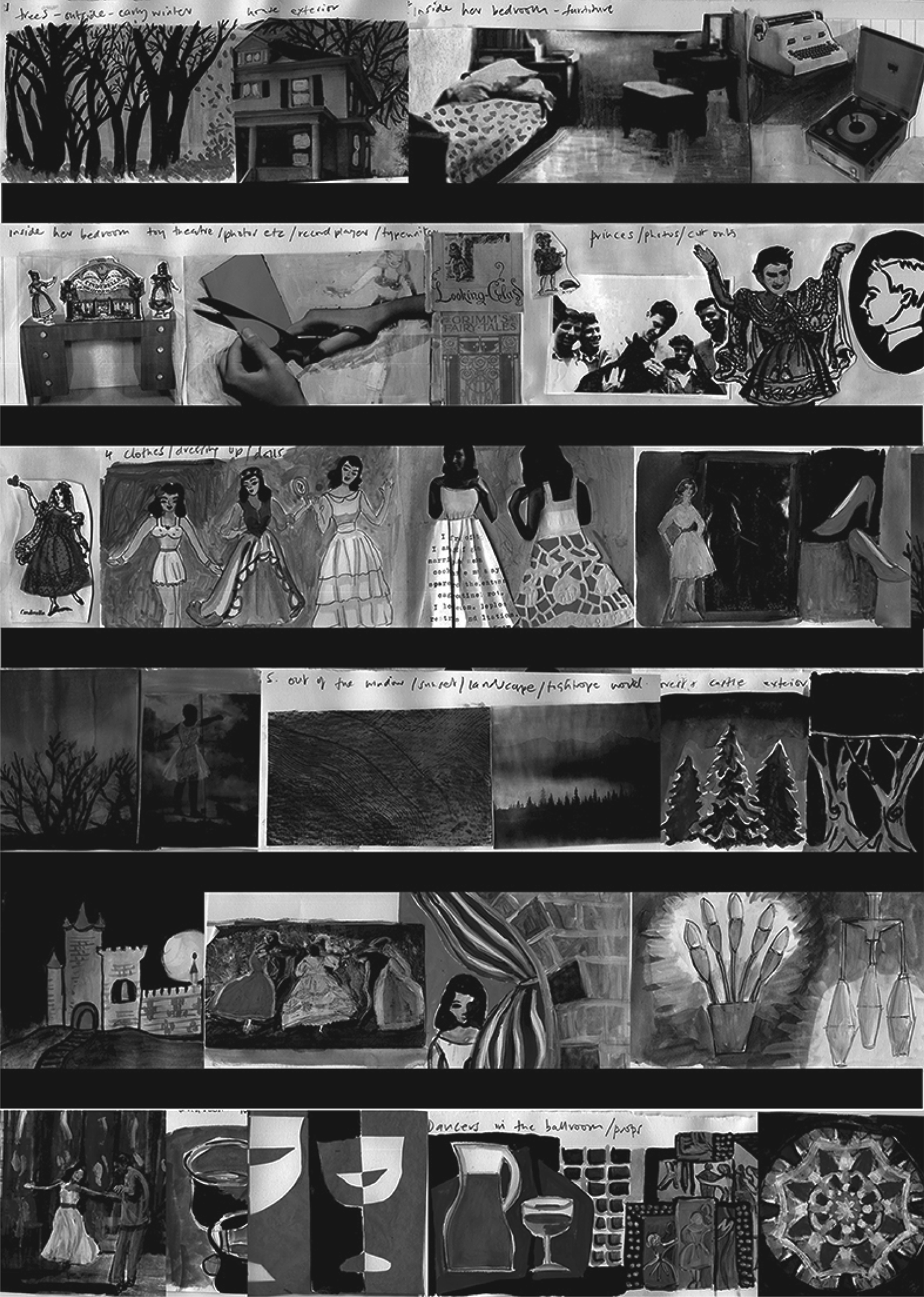
Animation and sound seemed obvious mediums for exploring Plath's intensely visual, somatic and creative world, in which, to iterate the message of her diary entry, material reality is subject to the compressions and compositions of her lived-with sightlines and visual frames. To return to that 1949 diary entry: here is a young woman acutely aware of her position in the world, her particular temporal and spatial locations; a young woman with the ability to draw fastidiously and carefully the outlines of things as they are. We might, then, read her sentences as an extended audiovisual phenomenological sequence: “At the present I am very happy sitting at my desk and looking out over the bare trees around the house across the street – the chilly gray sky like a slate of icy marble propped up against the hills.”Footnote 6 The sentences unfurl through a frame of self-conscious self-realization. Plath is annotating herself coming into view in her own mind. Her protagonist is Plath the sensing subject on the “lookout” for forms but also ways of portraying those forms in visual and auditory languages. Plath is producing her own self-consciously drawn frames, controlling the content of that mental frame, moment to moment. As an onlooker of herself, the young Sylvia Plath documents herself as a seeing, listening and perceiving subject, drawing into audiovisual consciousness her immediate relations to the material world. Animation is a medium built upon a sequence of rapidly replaced images. Hanna notes that the animated film can compress time and circumstance to a tiny fraction of indicated action and emotion, as distance, gravity and scale are reimagined and re-imaged in a sequence of rapidly passing frames and sounds. This creates a parallel experience to reading a line of poetry that can transport the reader in a few words (Figure 1).
The Girl Who Would Be God moodboard showing Suzie Hanna's initial response to creation of a visual narrative and graphic style, referencing Plath's teenaged artwork, the 1949 diary entry and her “Cinderella” poem.

Plath's early artwork is full of collage. Here we find evidence of a mind that likes to carry words, sounds and images elsewhere. In the early stages of devising the film, Hanna consulted the work of Eduardo Paolozzi, who, in 1948, the year before Plath's diary entry, was creating pop-art collages, a technique taken up very soon after by Richard Hamilton. Both artists typically locate images of young women alongside modern appliances in collaged domestic scenarios. In Plath's journal entry she lists items in her room, including books, photographs, drawings and furniture. Hanna filmed a real seventeen-year-old girl for the role of the Plath-persona, selected for her resemblance to Plath's juvenile painting of Snow White, completed in the late 1940s.Footnote 7
Built frame to frame, moment to moment, animation asks the viewer to imagine what it is that might be happening in between each frame, in the blink of an eye, in the moment of not-seeing. Filled with sound, these spaces between frames open onto the consciousness and elicit semiotic liberation, continuously forming and dissolving the figures depicted in each image. Poetry, animation and sound rely upon intense and intuited experiences of the ambiguous and the absent, a poetic of connotation that nonetheless moves towards denotation and then away again, elsewhere, back to new connotations and new associations. Poetry, sound and animation refer to the words, sounds and images apparent on the page, on the screen and in the environment; at the same time they make equally large gestures towards what is not there, but might exist in offscreen space. Taken together, these separate but overlapping processes make a richly reciprocal and productive partnership in which one medium comments upon and informs the others.
The Girl Who Would Be God was devised as a mixed-media animated film in response to the large body of Plath manuscripts, letters, journals, artwork, scrapbooks and ephemera held at the Lilly Library, Indiana University. In a deliberately self-conscious manner, the film commits to showing off the process of image and sound construction: how Plath and the filmmakers select, edit and position props in order to create their fantasy audiovisual worlds.
Mixed-media animators, like sound designers, go in search of materials that will stretch the boundaries of their own practice; in other words, the medium encourages an inherent reflection upon its own processes. Plath's diary entry is itself a form of self-critical private assemblage. Plath's own relation to mixed media, her music, drawing, painting, scrapbooking and collaging techniques, as well as the cultural and material forms of self-representation found in her poetry, letters and journals, suggest an imagination intent upon producing multiple forms of self-representation.
As her Lilly Library scrapbooks reveal, Plath hoarded page after page of popular magazines and journals. From these, she produced several political and cultural commentaries parodying American domestic life: a life, as she saw it, full of absurd gimmicks and rituals, designated costumes and props. Plath was an avid dramatizer and myth-maker of the domestic and the daily and it was from this perspective that the authors began to devise the film.
Extending methods of assemblage into the film's narrative, the authors combined Plath's diary entry with its romance story – of a young self in search of an exciting future, and her juvenile poem “Cinderella.” Perrault's original Cinderella story is an allegory for the everyday girl who makes it to the top. Plath's “Cinderella” poem, written sometime in the early 1950s, transfers this story into a radically internalized scenario. At the heart of the poem is the image of a revolving glass palace, a magical poetic kaleidoscope that stands as a conceit for poetic metamorphosis. In this glass palace material images are filtered and transformed, turned into something “like” the original but not quite:
The glass palace generates myriad associative forms, captured in the images of light and reflection that, in turn, produce other reflections. Plath's glass palace is a metaphor for imaginative association. In this associative world, several rose candles can generate the idea (the mental image) of a million flagons. This is the world of fairy tale and allegory in which one idea rapidly produces a new and different version of itself, elsewhere. But this is the business of allegory: to say something that is otherwise to the here and now.Footnote 9
The plot and the protagonist
Cinderella is a fantasy story for young girls who long to imagine themselves elsewhere; as such, it became not only a central narrative but also an informing aesthetic of the film. Hanna worked closely with the forms and palettes of Plath's juvenile paintings of Disneyesque heroines, the saccharine rose pinks, yellows and iridescent blues copied from Disney's 1940s films: Snow White (1939) Fantasia (1940) and Cinderella (1950). To these images she added photographs of a real girl: what, in aesthetic terms, was a collaged representation of Plath herself and a sort of visual allegory.
Allegory is a method of producing double meanings and double forms at once.Footnote 10 It portrays split temporalities, here and there, past and present, present and future. Allegory is always in the process of taking meaning elsewhere.Footnote 11 Plath's juvenile writing is built upon an allegorical desire for “other worlds.” Alongside the story of Cinderella sits another early poem, “Aerialist,” whose principal trope is that of a tightrope walker performing her potentially deadly nighttime routine:
The Girl Who Would Be God traces this dramatic movement from private world of bedroom to public world of spectated performance. Read more metaphorically, the film tracks the course of Plath's inner world: the choreographed and unchoreographed movements of her imperious imagination.
The film needed an allegorical protagonist to stand in for Plath herself: a figurative representative, a person. The poet Emily Dickinson, one of Plath's self-professed literary foremothers, wrote, “When I state myself, as the representative of the verse, it does not mean me, but a supposed person.”Footnote 13 Hanna was sure that the film should encourage thinking about Plath's created worlds through a figure that might stand in for her, based less upon Plath herself than upon one of her painted archetypes: Plath's 1940s rendering of Snow White. In this archetype of the female romance plot, the necessity of transformation is everything.
As a child, Plath's mother read her the Brothers Grimm tales and later in life she translated some of these tales from the German.Footnote 14Snow White was Disney's first animated feature film, released in 1937 when Plath was five years old; as such, it is the prototype of the commercial American film that Plath grew up with. The relationship between storybook and film is a potent but also crucial elision. In between the storybook and the film there exist many young readers, viewers and lives, several generations of young girls imagining themselves as Snow White and then, perhaps later in life, as Sylvia Plath.
Hanna's selection of a seventeen-year-old girl who resembled Plath's Disneyesque Snow White allows viewers to identify with the idea of Sylvia Plath as a lived person. The “supposed person” of Sylvia Plath reaches across the film as a literary and cultural objective correlative (to use T. S. Eliot's term) of her imaginative work. The chosen actress was brunette, not blonde, and this visual contrast to the historical Sylvia Plath introduces an interesting tension into the film. In the animated character-person of Plath you don't get what you expect. The historical Sylvia Plath remains backstage, in the offscreen world of the film, signalled and suggested but not represented. Animation and sound design revel in offscreen worlds, the invisible exits and entrances between the world represented and the world that is intimated in the senses and the imagination. Poetry likewise suggests uncompleted metaphors, thoughts still ongoing at the end of the line, an invisible threshold between one line and the next where all the business of private individual interpretation goes on.Footnote 15
Consequently, thresholds and lines became one of the film's shaping internal conceits. The line between inside and outside world, between the imagined Plath's domestic space and the grander allegorical world of the Cinderella plot, gave the film its structure. The narrative content is forged from a combination of the 13 November diary entry and the early “Cinderella” and “Aerialist” poems. A young girl sits in her bedroom imagining her future. She climbs out of her window, along a tightrope to a castle where she meets a dashing stranger. They dance. As with the original Cinderella story, time interrupts her, and she leaves the dance hall. But in the authors' version of the Cinderella story, the young woman leaves no slipper behind. Instead, she takes a pair of scissors from her reticule, cuts around her two-dimensional paper prince and rolls him up like a piece of canvas. Suddenly, her prince is portable. She escapes into a starry night through the hole left by the cutout prince. The next moment we see her back in her bedroom with her tiny trophy, placing him inside her toy theatre next to a cutout version of herself.
The world of the toy theatre brings to the film its internal narrative and one that comments on the process of animation itself. The young Plath-persona sits at her desk cutting images of boys' faces from magazines and pasting them onto faceless dolls. Here is Plath the young creator and animator of her own tale, moving small cutout images of her fantasy world and placing them inside a three-dimensional doll theatre. From inside the theatre we hear a miniature piano playing a composition based on Debussy music that Plath herself practised as a young pianist. She types in time to the music, as piano and typewriter merge into a metaphor of her musical self. The object world of the film comments on the hours of laborious work with paper (cutting, gluing, measuring, drawing, colouring in) from which the film itself emerges. Paper, in a sense, is the creative base of much animation, which begins with storyboarding, drawn gestures of shape and movement filling the oblong shapes of the imagined screen.
Something little known about Plath is her intense interaction with cutout paper dolls. As archives held at the Lilly Library, Indiana University evidence, young Sylvia Plath inhabited a kingdom of paper dolls. Within that realm she nominated a leading doll, Stella, her doll-prototype and starry version of herself. Plath created dozens of costumes for Stella, all individually designed, a plethora of possible selves.Footnote 16 Plath did not make animation films but her creative instincts are similar to those of an animator: she created small, malleable, portable images, simulating a sense of real world meets fantasy, moving through space and time. But how is time counted in animation except by a series of small stop–start movements, micro-units of counted movement and stasis, the alignment of action and sound?
A few technical facts are needed to understand this. The Girl Who Would Be God was ultimately created through a series of live-action film frames in which five out of twenty-five frames were selected for each second of film time. These images of actors were imposed into three-dimensional composited environments made from two-dimensional objects collaging the paper world of Stella with a live actress; in turn, it produces a mutable line of interpretation built upon composited characters acting in a metamorphic space.
Dance and music are a central part of the film's action, creating a carefully choreographed relationship with space. Sound and music open up the process of interpretation, generating a sonic world that simultaneously enhances and diminishes the relationship between the viewer and the hypervisual world of animation, whilst consolidating historical and cultural references. Plath's poetry is full of auditory and choreographic information. Take these two sets of lines from “Cinderella”:
Simmons worked directly with these musical and choreographic descriptions, and the auditory “ticking” heard by Cinderella, not to isolate the sound of a ticking clock, but to identify the manipulation of timing in this moment in Plath's life. Metric ticking sounds start as soon as the young girl appears onscreen: her hands play the typewriter keys, percussively, to music. The “caustic ticking of the clock” develops into a larger sonic sensation: in the metallic sound of Plath's cutting scissors and in the paper Foley that produces a repetitive brittle noise as it is cut and crumpled – lending tactility to the film's surface. Through these procedures the film substitutes musical time for clock time, poetically choreographing past, present and future.
Music and sound embody both political and emotional responses; they heighten particular moments of consciousness and elevate sensations; they can enhance, explain and configure visual information onscreen. Simmons devised the soundscape to reflect his documentary research into Plath's own teenaged “soundtrack.” Reflecting the phases of youth described in Plath's diary entry and poem, the soundtrack encompasses the tunes she played at the piano as a teenager; the popular forms of music she would have heard in the Massachusetts of the late 1940s; and her auditory and material descriptions of people, objects and environments. In the film, music underpins and constructs movement: the movement of the girl, the dancers, and the timing of camera moves through landscapes and interiors. The film's music and sound design are reflective and subversive, embodying differentially Plath's power to extend childhood happiness and her burgeoning desire to control adolescent experience. As Jacques Attali writes in his influential treatise, “with noise is born disorder and its opposite: the world. With music is born power and its opposite: subversion.”Footnote 18
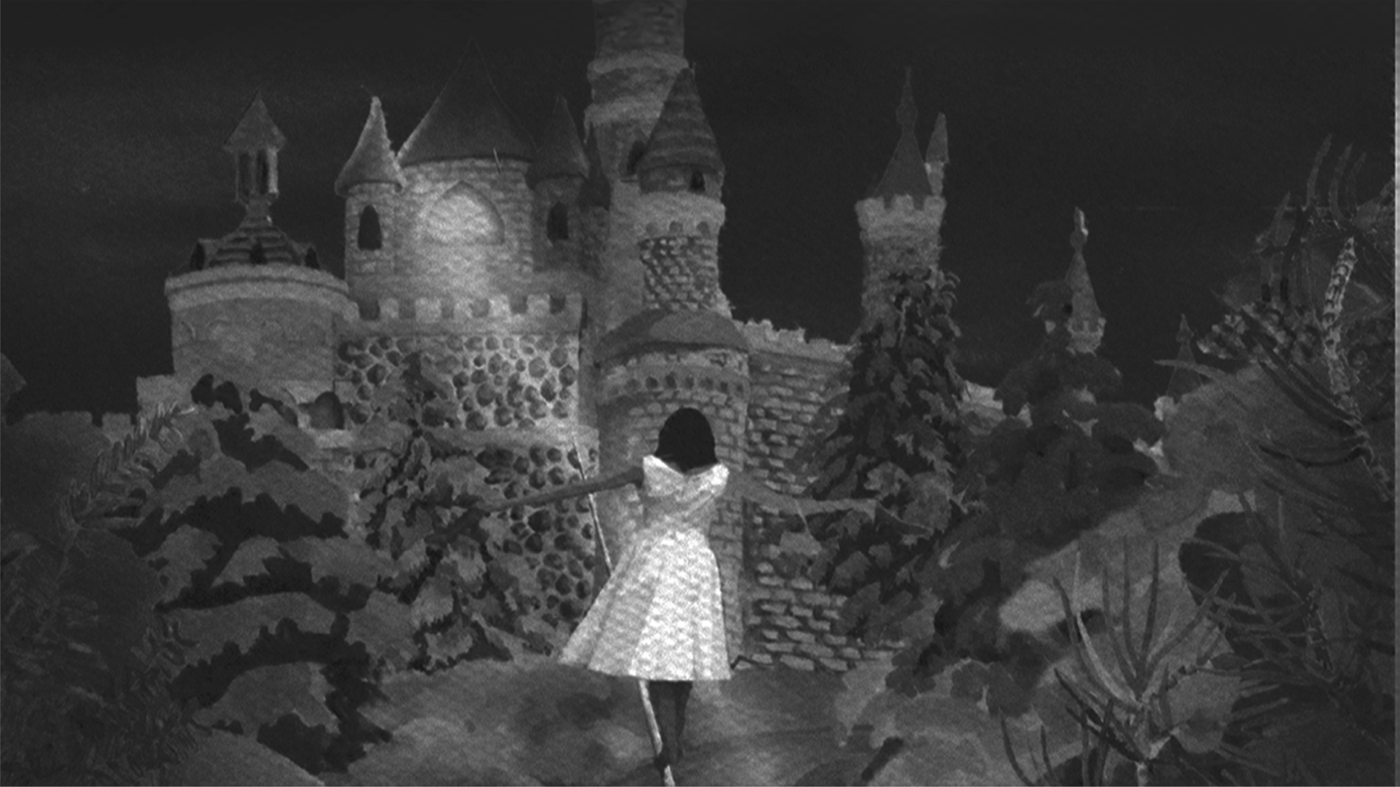
And so the high-drama moment of the film: when the Plath-persona crosses from her window ledge along an imaginary high wire to a fairy-tale forest and distant castle (images from Plath's juvenile painting-world). It is a series of quiet noises, sounds not music, that identify tentatively with this moment, as Plath's persona hovers between childhood comfort and adolescent experimentation. A harp string under pressure, a finger (Hanna's), pressing the catgut into the wooden body of the harp, creates a distorted sound noisily resonating through wood. Sounds that magnify the environment, drawing attention to the threshold over which Plath's persona moves, include pine fibres creaking as the forest sways in the breeze. Travelling back to the film's musical introduction, these sounds extend the bowed cello that accompanies the camera's path through autumn trees encircling Plath's childhood house. In such a way, sound and music produce a nexus of sensory ideas, in which the sound of a resonating wood instrument is also a metaphor for the body as a vessel for sound, thought and transformation: all of which brings us back, through a sonic circuit, to the young Plath nervously crossing her suburban high wire, over a landscape of fairy-tale pine trees on her way to the castle (Figure 2).
The Girl Who Would Be God. Animation frame of the girl crossing her high wire to the castle.
At the moment of the high-wire crossing, silence is also the sound of fear, suggestive of the moment when object consciousness meets a heightened consciousness of sound. The red shoes provide a synecdochic representation of the young girl moving out of her familiar space into the world of adult engagement, the social world of dates and debutante balls, the cultural formulae of heterosexual romance. As she moves towards the dance hall, she hears a noisy Irish reel, popular in Massachusetts of the late 1940s: “Speed the Plow,” a contra dance whose counted rhythm is four beats by four. This tidy and symmetrical rhythm sits at the intersection of Plath's threshold between childhood and adolescence, reflecting a young and rather hygienic culture of provincial dating. Momentarily, Plath's persona revels in late childhood, though this soon disintegrates as her Cinderella dances tango in a power game with her prince.
Moving shoes and counted time through sound are metaphors for constituents of poetry and dance. Poetry is built upon a carefully counted metric pattern of which the basic unit is the foot. Likewise, dance is built upon temporal rhythms of feet moving through space. The film's red shoes are a metaphoric representation of the rhythms of poetry, dance and music tracked across space and time. The red shoes that pass from inside to outside world offer a useful metaphoric summary of the passageway between lived experience – the seventeen-year-old Plath in her Winthrop bedroom – and the Cinderella who climbs out of her window in search of a larger reading of herself. What makes this film unlike the Cinderella story is that Hanna's Plath-protagonist returns, at the end of the film, not to marriage and the romance plot but to her own creative play: her toy theatre and paper cutouts, the prince and Cinderella figures she moves and animates. We leave Plath as content as we see her in her diary entry, playing with the possibilities of romance, but still safely outside it. By the end of the film, the teenage Plath is enacting romance in her tiny doll-play; only her red shoes, left out on the windowsill, hint at her willingness to take up more unforeseen and untold adult adventures.
II. “LETTER TO THE WORLD”: EMILY DICKINSON'S SUBLIME ANIMATIONS
The Romantic artist has always sought representation, as Plato's Phaedrus put it, “beyond the heavens”; it is in this pure, transcendent place that knowledge of true being lies.Footnote 19 To access this place beyond the heavens is certainly the ambition of poet Emily Dickinson. “Bring me the sunset in a cup,” demands her speaker; bring me something back from the Heavens that I can measure and see.Footnote 20 Bring me proof of transcendence in material form.
Like the young poet Plath, Dickinson is searching for ways of representing what is not there, what can only be imagined.Footnote 21 In Dickinson's poetic world this produces a series of restless and unanswered metaphysical questions and equations. In early 2010 Bayley asked Hanna and Simmons if they would consider making a film that explored the dynamic conceits of Dickinson's metaphysical world. This time the film would be less about narrative and more about poetic conceits; it would focus on Dickinson's figurative language, but particularly her metaphors, as a way of structuring poetic thought.
One of the most charismatic and enigmatic images of Dickinson's poetry is the figure of the bumblebee. Despite the often flippant and juvenile position of the bee in her poetic mythos, Dickinson's bee is more than something childish and silly and pertains to her understanding of self-in-the-world. It was the figure of the bee that first drew our attention in the early stages of devising. “Bring me the sunset in a cup,” with its array of “natural” characters, supplied a useful storyboard beginning. The poem is built around a series of semi-nonsensical rhetorical questions to the natural world. Dickinson's speaker asks the Robin, the Tortoise and the Bee to audit their activities:
The speaker's relationship with nature is erotic and intimate, inquisitive but also acquisitive. She wants to gather up and record all of the myriad invisible actions of the minute natural world. Dickinson's speaker, like the young Plath, wants to play at God, she wants to see everything, but her particular conceit is the telescope – the missing and magical lens that would allow her to watch all of nature at work. In her research into Dickinson's own sources of inspiration, Hanna discovered the work of seventeenth-century writer, naturalist and philosopher Thomas Browne, whose Religio Medicio (1642) Dickinson, reputedly, kept by her bed. In the language of the Medicio, Hanna met with a version of Dickinson's microscopic entomological universe:
What reason may not go to Schoole to the wisdome of Bees, Ants, and Spiders? What wise hand teacheth them to doe what reason cannot teach us?
… in these narrow Engines there is more curious Mathematicks, and the civilitie of these little Citizens more neatly sets forth the wisdome of their Maker.Footnote 22
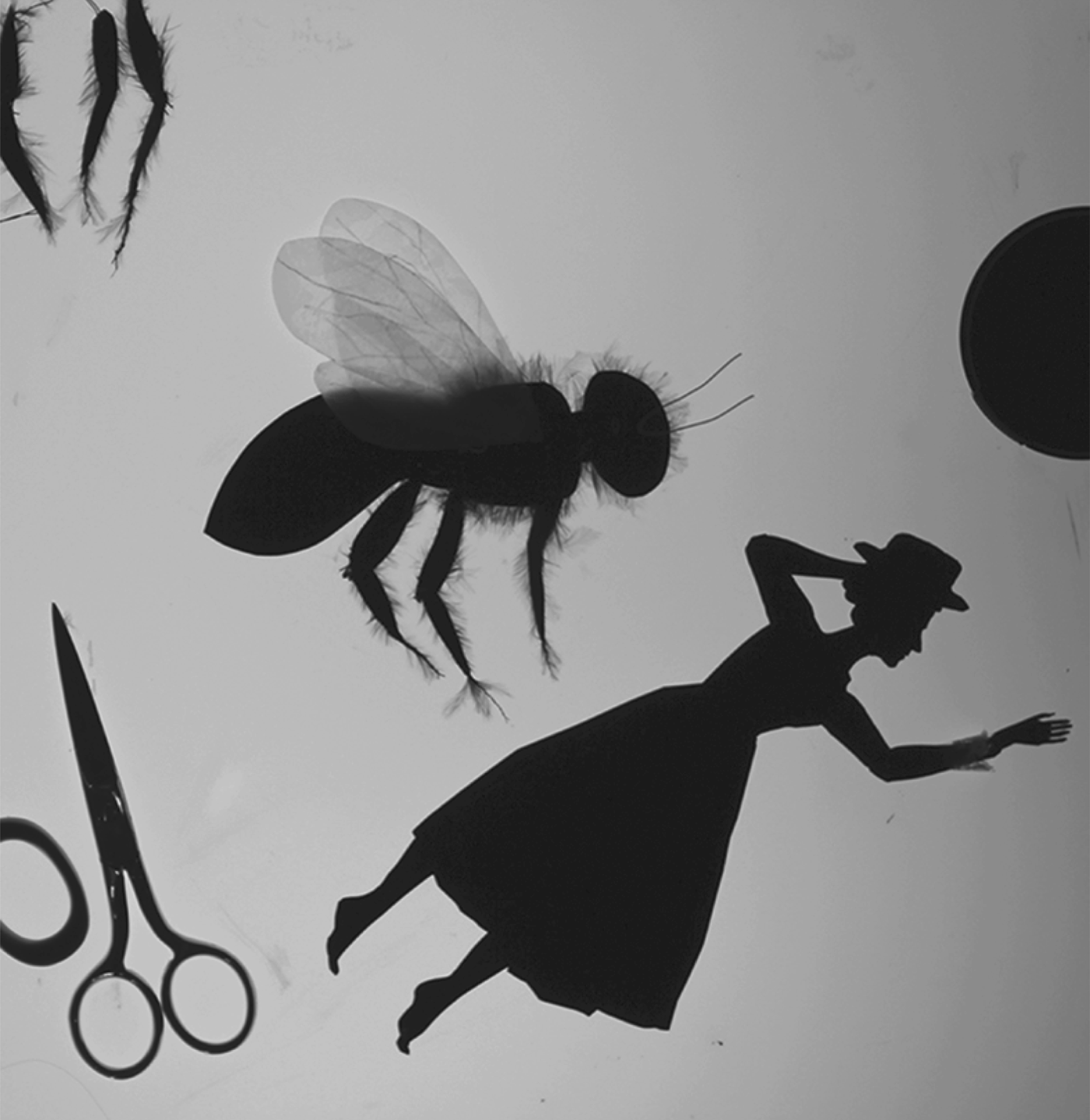
Browne's language of natural mathematics became a useful reference point for Dickinson's relationship with fractions and parts – the four parts of her folded fascicle-books and her careful working with the counted units of hymnal meter. “Mathematicks,” in Browne's language, is another way of describing the mechanical mysteries of nature, the driving force (“Engine”) of nature's will-to-life (Figure 3).
Letter to the World. Suzie Hanna's initial tests for the miniature Emily Dickinson and bee shadow puppets, created from black card, wire, thread, feathers and waxed paper.
But “Bring me a sunset” returns harshly and suddenly to the domestic world, one that confines and constrains the imagination as it turns its back on the world of nature and childish play and shuts the speaker up in prose (Fr. 445), as Dickinson described the mundane life:
If we refer to the Merriam-Webster dictionary that Dickinson would have consulted, we can see that “Alban” house refers first to the white resinous crystalline substance on the outside of a gutta-percha tree, but also to the vestment of white linen reaching to the feet of Roman Catholic clergy, and lastly to the white skin of a corpse. The poem's restless questions lead, in the final stanza, to the ultimate crisis of mortality. How can the speaker accept life on earth if she cannot see a way toward the Heavens, a firm route to eternity?
Dickinson's speakers are in constant search for metaphorical transport. The circling and open-ended questions of “Bring me a sunset in a cup” simulate a restless desire to move beyond world of representation and reality, to find answers to life-after-death elsewhere. Its telescopic relationship with the natural world provided the film with its arc and focus: the film's frames as they move from the poet writing at her desk to the miniaturized figure of the poet flying like an insect through the air with her beloved bee, visiting flowers and supping nectar. But in the outdoor world of nature, a storm breaks out and the insect lovers are forced to return home, to the safe conclave of the domestic world where the miniature Dickinson turns back into the human representative of her “supposed person.” And so the human world turns insect and then human again, a symbolic cycle that is the film's central metaphor.
“Metaphor” derives from the Greek meta, “across” and pherein, “to carry.”Footnote 23 Any definition of metaphor suggests a linguistic transformation that carries the language brain away from lived, embodied experience. For Dickinson, this transport is embodied in the tools of writing. “Who'll let me out some gala day/With implements to fly away?” Dickinson's only real-world implements were her quill pen and pencil (she used both) and paper – sheets of paper she folded into four parts in order to create her fascicle booklets: booklets she stitched together herself, leaving forty in total upon her death. Her writing “chamber” was her bedroom, a place that afforded her “freedom” from the mundane demands of domestic life.Footnote 24 With all this in mind, Hanna and Simmons set about creating a film environment that would render Dickinson's daily struggle to transport herself elsewhere.
In her devotion to letter writing, Dickinson re-enacted a sense of travelling beyond the confines of her Amherst homestead. Moving across space and time, letters enact a form of self-transport on paper. Because of the lag between sender and receiver, letters can also encourage defiance, the sort of retaliatory statements of Dickinson's poem “This is my letter to the world”:
Dickinson's speaker is mourning a lack of intimacy that letters have not brought her. Apparently, the poet can only find true intimacy – “hands,” real touch – in nature, in which “Nature” stands as the transcendental signifier of the divine. It is these divine creating “hands” that the speaker cannot see but wishes to touch.
But beyond this poem, Dickinson's “letter to the world” is also her entire body of poetry that remained largely untouched and unseen during her lifetime. So for whom or what, we might ask, was Dickinson writing: for herself, for others, for posterity or for divine “Nature”? Ralph Waldo Emerson, whom Dickinson read as a young woman, solidified the idea of living with and for a transcendental reality:
I am not solitary whilst I read and write, though nobody is with me. But if a man would be alone, let him look at the stars. The rays that come from those heavenly worlds, will separate between him and what he touches. One might think the atmosphere was made transparent with this design, to give man, in the heavenly bodies, the perpetual presence of the sublime.Footnote 25
From this arose an obvious question: how best to represent Emily Dickinson the metaphysical poet, a writer so committed to the idea of living with and maintaining a plausible transcendent reality?
Letter to the World, the mixed-media animation that emerged from such thoughts, combined representations of the poet in the form of American actress Elisabeth Gray, with a small paper cutout puppet. Large and small, near and far, grand and obscure: such oscillations of size and distance gave the film its major dynamic: the collapsing of large into small – the idea of Heaven into the form of a bumblebee supping nectar from its favourite flower. Such large metaphorical compressions echo Dickinson's working relationship with writing, with her implements.
The film's central drama is the action of the writing poet. Actress Elisabeth Gray depicts Dickinson seated at her writing desk, shot in the form of a pixilated silhouette. Paper is always close to the film's conscious surface, the flat world of what a Plath speaker calls her “cut paper-people.”Footnote 26 We never forget the world of paper, the place and time of writing, the method, the movement and the sound. From the start, the cutout world of papery silhouettes merges with the three-dimensional world of the living body. We hear the poet's quill pen scratching paper, the sound of amplified breathing, the diaphragm lifting and falling, and begin to imagine ourselves passing from outer to inner realities, as though we were inside Dickinson's living, breathing body, passing from the world of her bedroom to the internal universe of her body and mind.
Sound plunges us inside. Even before we see anything onscreen, we hear Simmons's pulsating soundscape. Kant's writing on the German word Stimmung as a precondition of cognitionFootnote 27 is employed here simultaneously as the sound of the voice tuning, the inward tuning of the soul to its environment, and the inner attunement of mind. The sound implies a vocal tuning to mood and atmosphere, the sound of the voice finding its internal feelings and harmonic character. Music encases the film, suggestive of Dickinson's internal chamber of the brain, as in “I heard a funeral in my brain,” where brain functions as a metaphor for Dickinson's self-enclosed poetry of metaphor. Drawing upon T. S. Eliot's essay on Matthew Arnold (1933), Simmons drew attention to what Eliot feared as the psychic chaos of the mind: the mind drawn away from the orthodox structures of church and community.
But Dickinson's poetry speaks consciously aloud. With this in mind, she named her poetry “verse,” and according to the Third International Webster's dictionary (1971) “verse” is defined as “metrical language: speech or writing distinguished from ordinary language by its distinctive patterning of sounds and especially by its more pronounced or elaborate rhythm.”Footnote 28 Verse moves differently from ordinary speech or written language because it is built around metre. Metre is a form of patterned movement that stimulates a sense of words moving through and around the mouth, words as three-dimensional and somatic, born from pronunciation. Accordingly, the film includes rhythmic sound-bites taken from Dickinson's letters and poetry. Drawing from Judy Jo Small's study of Dickinson's use of rhyme, Simmons created a sound-sphere to dismantle the sound effects of the brain in which words, song and music combine to create what Emerson in his essay “The Poet” describes as “that region where the air is music,” or what his friend and associate Thomas Carlyle (whose portrait Dickinson kept on her wall) called the “melody” of thought, “the inward harmony of [mental] coherence which is its soul.”Footnote 29
The metaphorical plot
In Letter to the World the poet's working methods shape the film's plot. The production was created from animated silhouettes of the American actress Elisabeth Gray integrated with stop-motion object and shadow theatre. This technique lends the film its central “double” aesthetic, in which two forms of representation imply a third: and so the embodied actress (in silhouette behind a screen) suggests a shadow version of the nineteenth-century daguerreotype of Emily Dickinson. This life-sized figure collapses into a miniature version of Dickinson: Dickinson as a tiny paper puppet that zooms out of the bedroom window towards the airy clouds, echoing the trajectory of the young Plath's moving from her bedroom world to her Cinderella fantasy.
This formula of two forms producing a third is one way of thinking about metaphor, if we define metaphor as the process by which one body of language is carried over to a second body and, in this process of transport, produces an abstract third. Neuropsychologist Iain McGilchrist has summarized metaphor as a language that carries us across a gap; metaphor is a kind of linguistic transport that begins with embodied experience, followed by a movement away from that experience, and then a final return. In metaphorical language, “Everything has to be expressed in terms of something else,” but this something else is always related to the first experience of embodied life.Footnote 30 McGilchrist quotes the German philosopher Jean Paul Richter, who makes the point, “Ingenious figures of speech can either give soul to the body or body to the spirit”; metaphor reminds us of the common life of the body. Whatever metaphor produces is always related to the first body, as a child is in some ways always related to his parents.Footnote 31 The notion of the metaphoric third is implied in the film's shadow-lantern imagery, an aesthetic produced by strongly contrasting light and dark sequences and one that references nineteenth-century silhouette portraiture and the emergence of the daguerreotype as an early form of photography. “None pursued invisibility as strictly as Dickinson”:Footnote 32 her silhouette conveys contemporaneous details of design, dress and action whilst representing her physical body at one remove, literally behind a screen. “The Soul selects its own society, then shuts the door” (Fr. 409).
Recent scholarship has noted that American transcendentalist philosophy forges a specific connection between the material and the spiritual. Dickinson's poetry, as we have already noted, wrestles with the desire to make manifest what cannot be seen. The early experimenters of photography, L. J. M. Daguerre and William Henry Fox Talbot, conceived of photography as a natural process in which “light inscribed itself onto itself”; that is to say, light built on top of light, choosing natural surfaces as its platform.Footnote 33 This film plays sharply with light and dark, brightness and shadow, and the narrative follows an interplaying sequence of frames that sets light against dark, indoors against outdoors.
The first sequence poses the poet against a window frame cut into four dark-blue squares. Inside the frame sits the white round of planet-earth-cum-moon. Dickinson the poet-persona is seen tossing letters through the window; these are her letters “to the world that never wrote to [her]” (Fr. 519). In the blink of an eye, the poet becomes miniature, and flies through the window to join her beloved bee. Together, they sup nectar and kiss the heads of flowers. But this erotic communion is interrupted by the outbreak of a storm, signalled by the sound of Civil War gunfire. Dickinson's most productive period of writing was the early years of the Civil War, 1860–63. Triggered by the sounds of war, an image of a volcano appears. Hanna and Simmons show how sound itself generates and impacts imagery, as gunfire leads to the image of spewing lava and fire. Soon after, the entire screen begins to flicker with the impact of sound and poet and bee fly off to avoid danger.
In Dickinson's metaphoric world, volcanoes signify the eruption of speech, the violent act of communication after a long period of silence. The metaphor describes, what is, for her, the violent, rupturing act of writing: “Vesuvius dont talk – Etna – don't – one of them – said a syllable – a thousand years ago, and Pompeii heard it, and hid forever – she couldn't look the world in the face afterward” (L 233). What she calls her “still – volcano – life” (Fr. 517) is Dickinson's dormant and silent repository of poetry. It is this world of silent words, words heard only inside the poet's own head, words left hidden and unspoken, that is the film's ultimate metaphor.
At the end of her brief adventure with her bee companion, the poet returns home and begins to prepare the end of her silent life. She passes back into her room through a stormy liquid layer that resembles early photographic silver process. As the image clarifies, we see her preparing a private funeral for her bee, wrapping him in a shroud made from her own veil, laying him inside her pen case and closing the lid. Emily dips her finger into ink leaking from her pen, and pushes her finger down on paper to leave a print. This image metamorphoses into an inky picture of the Earth, a gesture to Dickinson's metaphors of empirical rule over self-created territories (“How many legions overcome the Emperor will say,” Fr. 136); here a version of the world is created from her own fingertip.
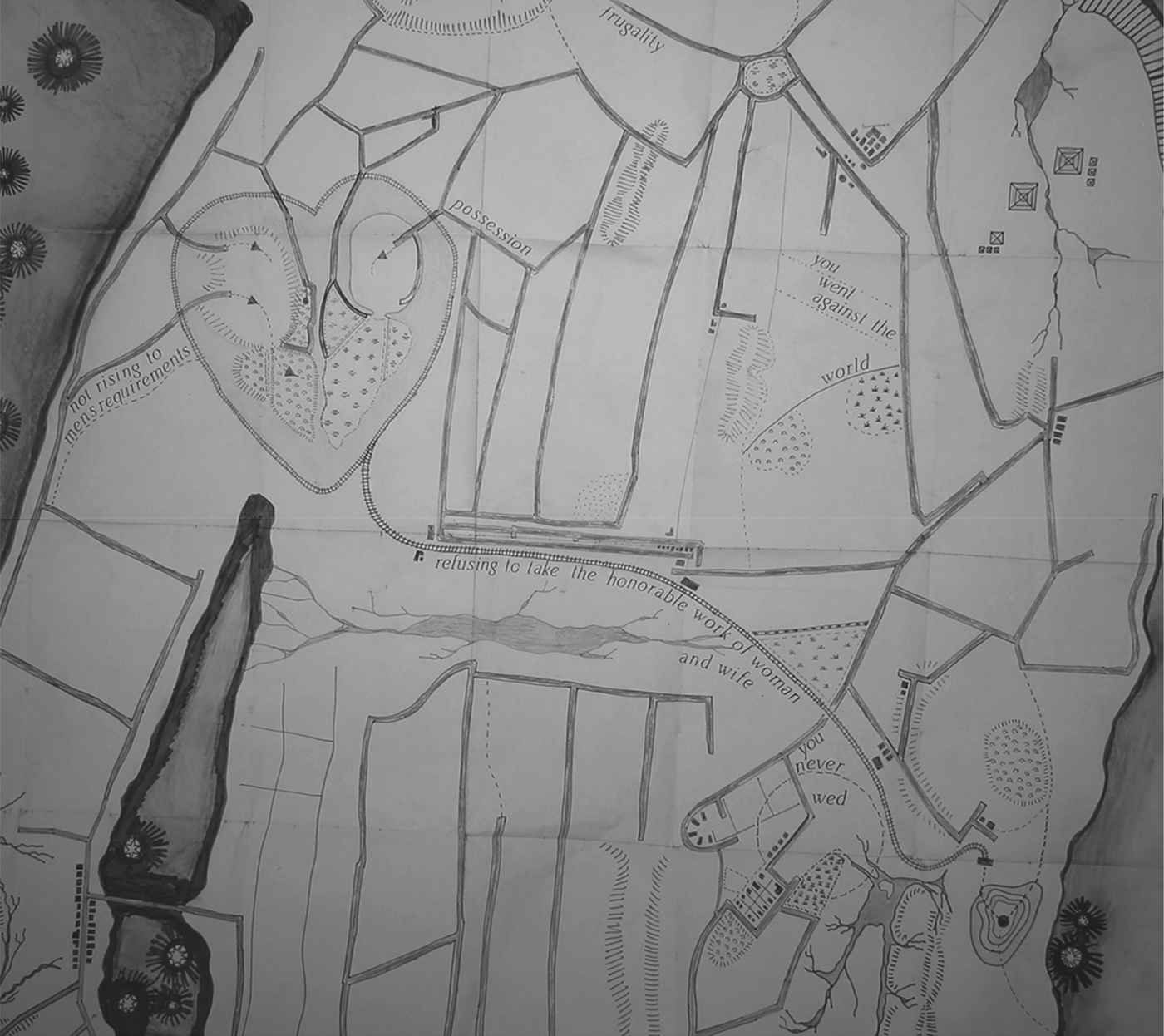
Dickinson wrote to a world that “never” wrote to her, many of her letters went unanswered, and her poetry often reflects her views of what the world might have made of her (“I took my Power in my Hand/And went against the World,” Fr. 660) A letter from the world arrives, but when Emily opens it she is quite overwhelmed to find a map as big as herself, a physical manifestation of her obsession with geographic geometries and comparative scale (“Size circumscribes – it has no room / For petty furniture – / The Giant tolerates no Gnat / For Ease of Gianture,” Fr. 707) (Figure 4).
Letter to the World. A letter in the form of a map that the world sends to Emily Dickinson (detail). Mapmaker: Christa Harris.
The map's design was inspired by the cartographic endeavours of pioneer pathfinders such as Daniel Boone (“Hurrah for Daniel Boone,” she cheers in her early poem “Sic transic gloria mundi” (Fr. 2), and battle maps that were popular during the American Civil War. Instead of naming locations, the map's typographic content is taken from Dickinson's own critique of herself, reflecting her comments through a distorted cartographic mirror of her own body, on her hand “you never wed,” on her eyebrow “too superior for prose,” on her mouth “singing too loudly,” and in her heart “possession.” This is the only scene in the film where we hear the voice of the poet: the voice of Dickinson the poet and the person who, as she approaches the end of her life, resorts to reading aloud harsh condemnations of herself. Losing patience with her own self-critique, she screws up the map into a ball which becomes a revolving planet; a tiny Emily is found kneeling on top of the planet, folding her fascicles and storing them in a chest. This ritual of compression and folding is a reminder of Dickinson's relationship with metaphor: what her speaker calls “the apparatus of the dark” (Fr. 1140), the unrevealed and undisclosed operations of the imagination passed through language.
It is a well-known fact in the Dickinson story that after the poet's death, Dickinson's sister-in-law, Lavinia Dickinson, discovered her poetry fascicles buried within a rosewood chest. Each fascicle comprised four to seven sheets of paper folded, stacked and then sewn together with twine, holding between eleven and twenty-nine poems: forty books of poems, 1,775 poems.Footnote 34 The film responds to this fact with a final return to the poet-as-paper, as the character of Dickinson transmutes back to the two-dimensional puppet form and folds herself inside a flat silhouetted black-and-white chest, pulling the lid down on herself. Hanna's point was to show Dickinson enacting her own burial, folding herself away inside a flat-hinged chest with a small rose window. Dickinson's rosewood chest is the symbolic location of her funeral service, which she conducts herself. Moments later the chest explodes into a firework display of falling flowers, a signifier of Dickinson's herbarium garden rehydrated and brought back to life. But the exploding flowers, accompanied by the sound of musket shots, remind us of Dickinson's enormous poetic output, her most productive period during the years of the American Civil War, 1860–63, and her large literary legacy. As the credits run, flowers are replaced by papery moths made from pages of Dickinson's poems; these are hybrid creatures that return the film to her natural theology, the demands of “Bring me a sunset in a cup.”
Letter to the World ends with the poetry moths fluttering in the smoke and light of a magic lantern. Dickinson died two years before the earliest surviving motion film was shot, but Hanna's point is that her poetic imagination pre-dates the technological possibilities associated with late nineteenth-century moving-image and sound technologies, and forms of recording and representation. Her view on Nature is refracted through a close-up lens that suddenly, and without warning, shifts to a larger, more panoramic view. “The Bees – became as Butterflies,” her speaker declares, an image she “takes” to be “Giants – practicing / Titanic Opera” (Fr. 627). In Dickinson's quick metaphorical transferences we sense a poet who identifies with the detail of the botanist and the filmmaker, but who longs, like the young Plath, to know the omniscient view.
III. HART CRANE'S “TO BROOKLYN BRIDGE”
The authors have begun work on a new film that continues their research into designing representations of metaphor, this time in relation to modernist poet Hart Crane's proem, “To Brooklyn Bridge”: the poem that sits at the front of his epic narrative, The Bridge (1930). Crane's long poem is a mythical allegory of American history embedded in metaphor; a sort of metaphorical Bildungsroman of America that takes as its beginning and ending point the structure of Brooklyn Bridge. Crane's dynamic, wheeling stanzas carry us back and forth through several aerial views of the bridge as it intersects with aspects of New York City:
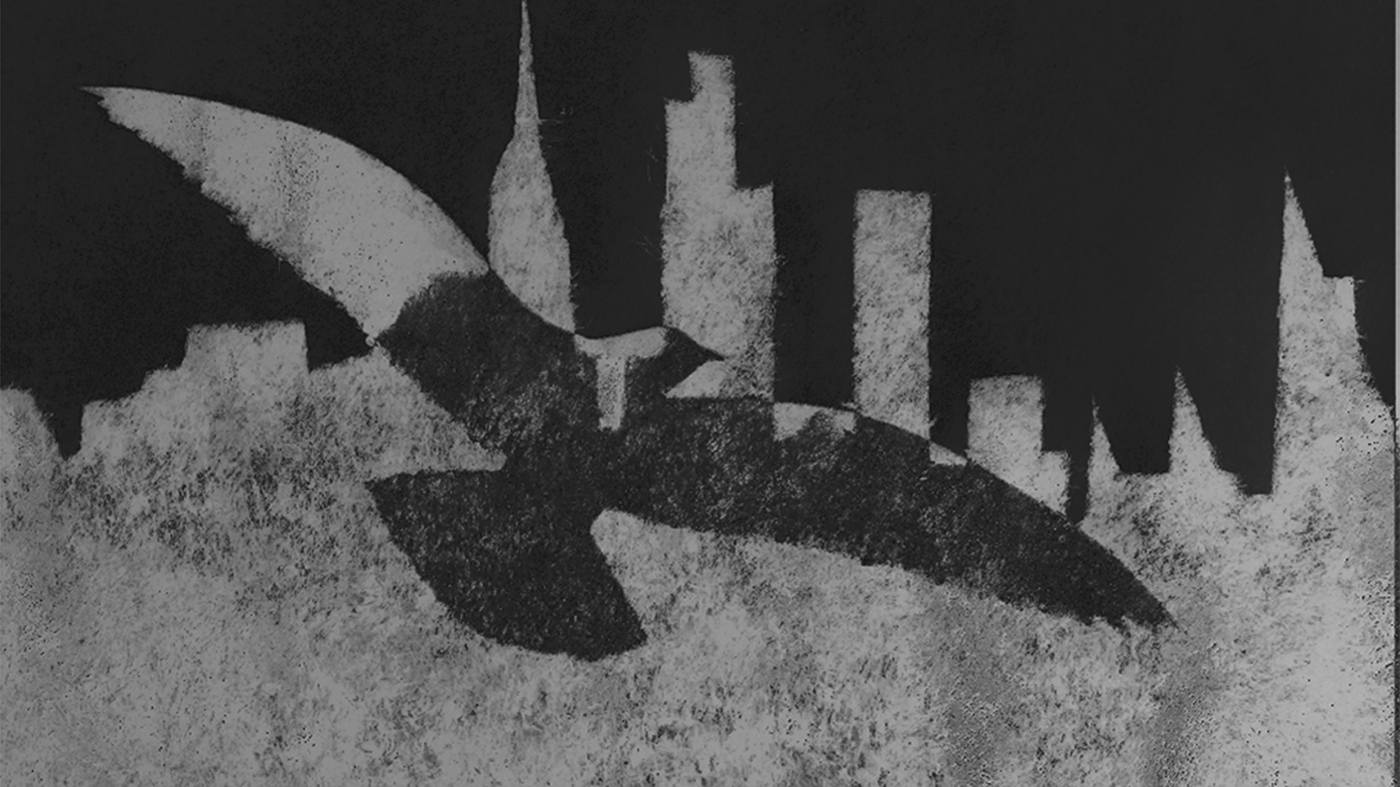
The strongest image here is the “inviolate curve,” an image suggestive of the ever-receding and invisible sightlines of the implied viewer of the scene, a kind of all-seeing Everyman. The inviolate curve of the seeing-eye/I is part of a larger dynamic that Hanna and Simmons are seeking to capture. Crane's Proem celebrates the power of spectacle and the specular, as the “dip” and “pivot” of the seagull's wing turns, on the strong double syllabic emphasis of “shed-ding,” towards other verbal forms. As we read these lines out loud, we convert “dip” into “dipping” and “pivot” into “pivoting,” words which combine with the image and sound of “shedding.” Further along, “shedding” turns into “building,” a strange moment of oxymoronic tension that is part of Crane's wider pattern of paradoxical or suspended logical movement. “Shedding” is the opposite of “building”: one suggests loss and removal, the other development and growth; one is invested in removal from the material world specifically, one is invested entirely in the material. Such paradoxical tensions produce a blocked metaphorical logic, a sense of cognitive arrest (Figure 5).
Hart Crane film, in progress. A frame from an early stencil animation test, simultaneously combining the bird's form and movement with architectural landscape.
Hanna has been exploring how she might convert these illogical tensions into a visual aesthetic for the film by consulting the vorticist imagery of Wyndham Lewis in which positive and negative space are represented by strong curves and lines, an aesthetic also apparent in Joseph Stella's paintings of Brooklyn Bridge (1919–20). The lines and curves of architectural design simulate what Crane described, in a now well-known letter to Harriet Monroe, editor of the modernist journal Poetry (October 1926), as the “illogic” of metaphor.Footnote 36 Metaphorical language, Crane argues, follows its twists and turns, pursues its own bent; it is a bent that reflects the inflections of every individual reader's experience. What one may read into the “inviolate curve that forsakes our eyes,” and its relationship with the “apparitional” sails of the following lines, depends very much upon an individual frame of reference. One reader's line of logic may not be straight; it may well curve away from another's. Certainly it will follow an experiential curve that the words of the poem cannot account for, creating an invisible set of meanings inherent to individual subjectivity and experiential history: a peculiar set of connotations and associations.
As well as making audio recordings investigating scale and architectural fabrication, Simmons is researching Crane's noisy nonlinear, “shamanic,” technique of assembling and connecting poetic phrases, with which he would, later, carefully build his poems.Footnote 37 Crane's Proem is a rich source of metaphoric sonic and auditory descriptions, temporally blending biology, technology and cosmology:
Hanna is animating layered registered stencils, cut directly with a scalpel, so the physical act of the process is evidenced in the film's optical dynamic. Through sonic and visual investigation and representation, Hanna and Simmons are seeking to create tactile material relationships between the bridge and the person that emerges from beneath its shadows and speaks these words:
Crane's “Thee” is an intimation of intimacy. In the relationship between the sun and “Thee” the abstract qualities of the poem begin to settle into something more like a person, which converts in later stanzas into a meeting beneath the bridge: “Under thy shadows by the piers I waited; / Only in darkness is thy shadow clear.” In the figure of “Thee” and the “sun” lies the tradition of the Petrarchan metaphysical conceit, typically tied to the figure of a beloved, as in Shakespeare's Sonnet 130, “My mistress’ eyes are nothing like the sun.”Footnote 39 Crane's Proem asks us to think metaphorically: to move our imagination from the bridge, towards the sun, and then back again, to the figure beneath the bridge. The implication is that it is only along this metaphoric curve that we will find meaning. In his sonnet “To Emily Dickinson,” written during the same period that he was producing The Bridge, Crane suggests that Dickinson's verse requires some “reconcilement of remotest mind,”Footnote 40 some reconcilement with the strangeness of metaphoric language – perhaps some translation work. Crane's obscure, and often incomplete, metaphors will require a similar sort of translation.
As the authors work on this new film, the biggest struggle is to reconcile the far-flung abstract strangeness of such lines as “implicitly thy freedom staying thee” to the familiar narrative of a young man meeting another beneath the shadows of Brooklyn Bridge. How far will the need for story interrupt what Crane calls, in the final line of the Proem, “the curveship” that “lends a myth to God”? How far will the compromises implicit in any interpretation lead away from the voyage Crane may have had in mind when he added “ship” to “curve” and created a compound metaphor that speaks for the reckless metaphorical voyaging his poetry elicits?
Iain McGilchrist states, “Music and poetic language are both part of the world that is delivered by the right hemisphere, the world characterized by betweenness.”Footnote 41 The collaborative research and practice of Bayley, Hanna and Simmons lies in between interfaces of animation, sound and poetry, focussing on interpretation and representation through the curved lens of metaphor.