Introduction
Stevia, scientifically known as Stevia rebaudiana Bertoni with a chromosomal count of 2n = 2x = 22, is an herbaceous plant that originated from Brazil and Paraguay and is classified within the Asteraceae family according to Ramesh et al. (Reference Ramesh, Sing and Megeji2006). The genus Stevia encompasses 200 species found throughout North and South America, showcasing the diverse array of species within the Asteraceae family in the New World, as highlighted by Soejima et al. (Reference Soejima, Tanabe, Takayama, Kawahara, Watanabe, Nakazawa, Mishima and Yahara2017). The medicinal properties of S. rebaudiana have been of interest, particularly in the context of plant secondary metabolites (Tripathi et al., Reference Tripathi, Jadaun, Chandra and Sangwan2016). It is grown for its sweet leaves, which contain sweetening compounds collectively called steviol glycosides (SGs), the primary SGs responsible for its sweetness are stevioside and rebaudioside A. Stevia is experiencing an increasing demand from the food and beverage industries due to its non-caloric sweetening properties (Amin et al., Reference Amin, Ozgen and Selamoglu2017; Putnik et al., Reference Putnik, Bezuk, Barba, Lorenzo, Polunić, Bursać, F. J., P. and D.2020). The demand for stevia products is predicted to have a compound annual growth rate of 9.2% (Azrul-Murad et al., Reference Azrul-Murad, Yong, Tan and Ghani2022) due to the rising preference for sugar-free food products (Le Bihan et al., Reference Le Bihan, Cosson, Rolin and Schurdi-Levraud2020).
In a report (World Health Organization, Guideline: Sugars Intake for Adults and Children, 2015), the consumption of free sugars (monosaccharides and disaccharides) to below 10% of total energy intake across the life is recommended, to both adults and children. This suggestion stems from the correlation between free sugars and poor dietary quality, obesity and susceptibility to non-communicable diseases. Lowering overweight and obesity levels can decrease the likelihood of developing type II diabetes and cardiovascular disease, along with related complications. In contrast to this, stevioside and rebaudioside A have been associated with various health benefits when consumed in recommended amounts (Mohd-Radzman et al., Reference Mohd-Radzman, Ismail, Adam, Jaapar and Adam2013; Parris et al., Reference Parris, Shock and Qian2017; Wang and Wu, Reference Wang and Wu2019; Ameer et al., Reference Ameer, Jiang, Amir, Eun and Victor2020). Brandle (Reference Brandle1999) also emphasized their significance. The SGs also exhibit superior heat stability compared to other natural sugars (Abbas Momtazi-Borojeni et al., Reference Abbas Momtazi-Borojeni, Esmaeili, Abdollahi and Sahebkar2017). Rising health consciousness and demand for natural sweeteners have propelled the utilization of S. rebaudiana as a sweetening agent in food and beverage products (Hajihashemi and Ehsanpour, Reference Hajihashemi and Ehsanpour2014; Yücesan et al., Reference Yücesan, Mohammed, Büyükgöçmen, Altuğ, Kavas, Gürel and Gürel2016), underscoring the significance of stevia and the development of cultivars with high SG content. In India, presently cultivated stevia varieties has low dry herb yield potential (34–43 quintals/hectare) with low rebaudioside A content (4–7.34%) (Dhange et al., Reference Dhange, Srinatha and Kandpal2023). Lack of high herb-yielding and SG-rich genotypes remains a challenge in stevia cultivation; developing improved stevia genotypes through cost-effective breeding approaches holds great potential for the future. Stevia rebaudiana Bertoni is a monoecious, hermaphrodite species but due to its self-incompatibility, cross-pollination and small tiny florets make emasculation and hybridization complex (Miyagawa et al., Reference Miyagawa, Fujikowa, Kohda, Yamasaki, Taniguchi and Tanaka1986; Oddone, Reference Oddone1997) and it makes stevia an ideal plant for polyploidy breeding.
The agronomic traits of S. rebaudiana Bertoni, particularly yield traits, are crucial for enhancing its cultivation and commercial viability. Yield traits encompass various parameters, including leaf biomass, stevioside, rebaudioside A content and overall plant vigour, which are significantly influenced by environmental conditions and genetic factors. The genetic basis of yield traits in stevia is increasingly being elucidated through various breeding strategies. The heritability of traits such as leaf yield and stevioside concentration has been shown to be high, indicating that these traits can be effectively selected for breeding programmes (Amien et al., Reference Amien, Maulana, Ruswandi and Nurjanah2021). Huber and Wehner further emphasized that understanding the genetic variance associated with agronomic traits can facilitate the optimization of cultivar development, which is essential for improving yield and quality in stevia (Huber and Wehner, Reference Huber and Wehner2023). The identification of quantitative trait loci associated with these traits can provide insights into the genetic mechanisms underlying yield performance, allowing for targeted breeding efforts. Additionally, the application of modern biotechnological approaches, such as polyploid induction, has been proposed as a means to enhance the agronomic traits of stevia, potentially leading to increased yields and improved stevioside profiles (Xu et al., Reference Xu, Yuan, Yu, Huang, Sun, Zhang, Liu, Tong, Zhang, Wang, Liu, Wu, Hou and Yang2021).
Colchicine (antimitotic agent) has been extensively used for polyploidization in plants since its initial discovery of this function (Blakeslee and Avery, Reference Blakeslee and Avery1937). It suppresses tubulin protein polymerization during mitosis and prevents proper chromosome separation, resulting in the production of polyploid genotypes known as colchiploids. This process has been employed in various studies to develop tetraploid plants from diploid sources using colchicine treatments during callus induction, proliferation or in vitro shoot apices and leaf explants (Hodkinson et al., Reference Hodkinson, Klaas, Jones, Prickett and Barth2015). For instance, researchers have utilized colchicine to double the chromosome number of peanut plants and restore fertility (Bertioli et al., Reference Bertioli, Seijo, Freitas, Valls, Leal-Bertioli and Moretzsohn2011). Similarly, tetraploid castor plants have been developed from diploid clones through colchicine treatments of haploid plants discovered in the field (Baghyalakshmi et al., Reference Baghyalakshmi, Shaik, Mohanrao, Shaw, Lavanya, Manjunatha and Senthilvel2020). Moreover, colchicine treatment has been instrumental in producing new amphiploids by doubling the chromosome number of F1 hybrids (Li et al., Reference Li, Liu, Zhang, Feng, Liu, Ayliffe, Hao, Ning, Yuan, Yan, Chen and Zhang2018). Additionally, colchicine has been used in creating synthetic allopolyploids through crossing, colchicine treatment and subsequent backcrossing, resulting in the derivation of monosomic alien addition lines (Qiu et al., Reference Qiu, Chen, Liu, Li, Guan, Wang and Chang2011). Therefore, in light of the above-discussed issues and difficulties in the genetic improvement of stevia through conventional breeding methodologies, the purpose of conducting this study was to develop genetic resources in widely cultivated S. rebaudiana through induced polyploidy. Conventional breeding methods for stevia have faced limitations in improving agronomic traits, such as low dry herb yield and rebaudioside A content. By treating seedlings with colchicine to induce polyploidy, the study aimed to develop polyploid genotypes with improved dry leaf yield and SG content, especially rebaudioside A content in leaves. These newly developed polyploid lines will offer valuable resources for future breeding programmes and commercial cultivation.
Materials and methods
Experimental material and location
This study was conducted at the CSIR-CIMAP research centre located at Pantnagar, Uttarakhand, India. The research facility is geospatially positioned at approximately 29° north latitude and 79.38° east longitude, with an elevation of 243 m above mean sea level, falling within the purview of the humid subtropical climate zone of India. The mature seeds of stevia cv. CIM-Mithi collected from the field gene bank at CIMAP Research Center in Pantnagar, Uttarakhand, India, served as the base material for the induction of polyploidy. Moreover, the seeds sourced from field gene bank of Pantnagar have only the CIM-Mithi variety of stevia. No other stevia varieties, breeding lines or wild species were maintained in this gene bank, minimizing the risk of out-crossing and maintaining genetic purity of CIM-Mithi variety. Additionally, the CIMAP research centre spans a large area (around 250 hectares) where only the CIM-Mithi variety was grown, further reducing the chances of contamination through out-crossing. The CIM-Mithi variety of stevia has high dry leaf yield (4.3 t/ha) with high steveoside (12.57%) and rebaudioside (5.8%) contents.
Colchicine treatment
Colchicine treatment followed the method of Grad and Gomaa (Reference Grad and Gomaa2020) with modifications. The solution was applied to the apical meristems of seedlings once they had developed three to four leaves. Seven different treatment doses were administered: 0.0, 0.05, 0.10, 0.15, 0.20, 0.25 and 0.30%, with varying exposure times of 12, 24 and 36 h. Each treatment comprised 30 plants organized into three replications, as outlined in online Supplementary Fig. S1. Small cotton wads were saturated with different concentrations of the colchicine solution and applied on the shoot apex. Throughout the treatment period, the wads were wet by periodically adding the appropriate colchicine solution. Following treatment, the cotton wads were gently removed from the seedlings apical meristem and any leftover colchicine was washed from the shoot apex using distilled water. Treated seedlings were then maintained under green net-house.
Identification of putative polyploids and ploidy confirmation through flow cytometry analysis
The survived plants in each treatment of all three replications were counted after 25 days of colchicine treatment to calculate the mortality rate (%). Colchicine-administered survived plants were relocated from the green net-house to the open experimental field. To promote the growth of the treated buds exclusively, side branches were cut off frequently. The plants were observed for any alterations in leaf morphology, such as larger and thicker leaves and shorter internodes than diploid control. Following a selective removal of morphologically different branches from the colchicine-treated plants, presumed polyploid plants were asexually propagated (through stem cutting method).
Ploidy levels of suspected polyploids were determined using flow cytometry analysis (Cytoflex flow cytometer, Beckman Coulter). Leaf tissue from control plants (2n = 2x = 22) and potential polyploid plants underwent treatment with a hypotonic propidium iodide (PI) lysis buffer containing sodium citrate tribasic dehydrate, RNase A, PI and Tween-20. This buffer also included mercaptoethanol (1%) and PVP-40 (1%) to minimize interference. After filtration (through a 10 μm cell strainer of CellTrics, Sysmex) and collection, the isolated nuclei suspension was analysed using a Cytoflex flow cytometer. Fluorescence intensity of G0/G1 was recorded and data analysis was performed using FCS Express software, following a methodology similar to Doležel et al. (Reference Doležel, Greilhuber and Suda2007).

Morphochemical characterization of confirmed polyploid genotypes
Following flow-cytometry analysis, one triploid, 13 tetraploid and one diploid (control) genotypes were characterized for important agro-morphological traits. All 15 genotypes were laid out in randomized complete block design with three replications and each genotype was planted in 4.5 m length with 4.5 m width dimensioned plots during February to May 2022. The rooted cuttings were planted by maintaining a line-to-line distance of 45 cm and plant-to-plant gaping of 45 cm. For a healthy and disease-free crop, typical agronomic practices were followed, and agro-morphic data were collected from five randomly selected plants from each replication across all 15 treatments. Meteorological data recorded during February to May 2022 have been represented in Fig. 1 for comprehensive illustration and contextualization.
Meteorological data recorded during the morphochemical characterization of confirmed polyploid genotypes. Relative humidity and rainfall data are on the secondary vertical axis, while the remaining parameters are on the primary vertical axis.

Quantification of stevioside and rebaudioside A content in confirmed polyploid genotypes
Before the start of flowering, 100 g of fully developed leaf samples from all 15 genotypes were collected. The collected leaves then air dried at room temperature for 4–5 days. Following manual grinding of the dried leaves with a ceramic mortar and pestle, the powder was kept at a temperature of 3–4°C until high-performance liquid chromatography (HPLC) analysis. For HPLC analysis sample preparation protocol given by Bovanová et al. (Reference Bovanová, Brandšteterová and Baxa1998) was used with some modifications.
The Shimadzu chromatographic system (Shimadzu Corporation, Kyoto, Japan) included LC-20AD pumps, a Rheodyne manual injector, a CTO-20A oven and an SDP-M20 diode array detector. Chromatographic separation was achieved using gradient elution on a Phenomenex C18 column (4.6 × 250 mm, 5 μm) at 35°C. The mobile phase consisted of 10 mM sodium dihydrogen phosphate dihydrate at pH 2.5 (solvent A) and acetonitrile (solvent B). The gradient started with 5% solvent B at a flow rate of 1.0 ml/min. Before use, the mobile phase was degassed for 15 min using ultrasonication (Microclean-109, Oscar Ultrasonics, Mumbai, India; 30.0 × 25.0 × 12.5 cm, 34 ± 3 kHz, PZT Sandwich type six transducer, 250W). Samples and mobile phases were filtered through a 0.45 μm nylon membrane using a Millipore filtration apparatus (Millipore, USA). Detection was set at a wavelength of 210 nm with an injection volume of 20 μl. Data acquisition ranged from 180 to 400 nm to monitor potential co-elution in plant samples, selecting the chromatogram at 210 nm for quantifying stevia phytochemicals due to optimal signal response. Chromatographic data acquisition and processing were performed with LC-MS Solution 3.21 software (Shimadzu Corporation).
Statistical analysis
The Statistical Package for the Social Sciences (SPSS) software version 25.0 (IBM, 2017) was utilized to analyse the morphochemical data collected in this study. An analysis of variance (ANOVA) was performed at a significance level of 5% (P ≤ 0.05) and 1% (P ≤ 0.01) to determine the statistical significance of the observed variables in developed genotypes. In cases, where significant differences were detected, Tukey's HSD test was applied to assess the significance of differences among the means. Correlation analysis was carried out using R Statistical Software version 4.1.2 (R Core Team, 2021). The correlation strength was interpreted using the scale suggested by Ratner (Reference Ratner2009).
Results
Mortality rate estimation, polyploidy induction and flow cytometric analysis
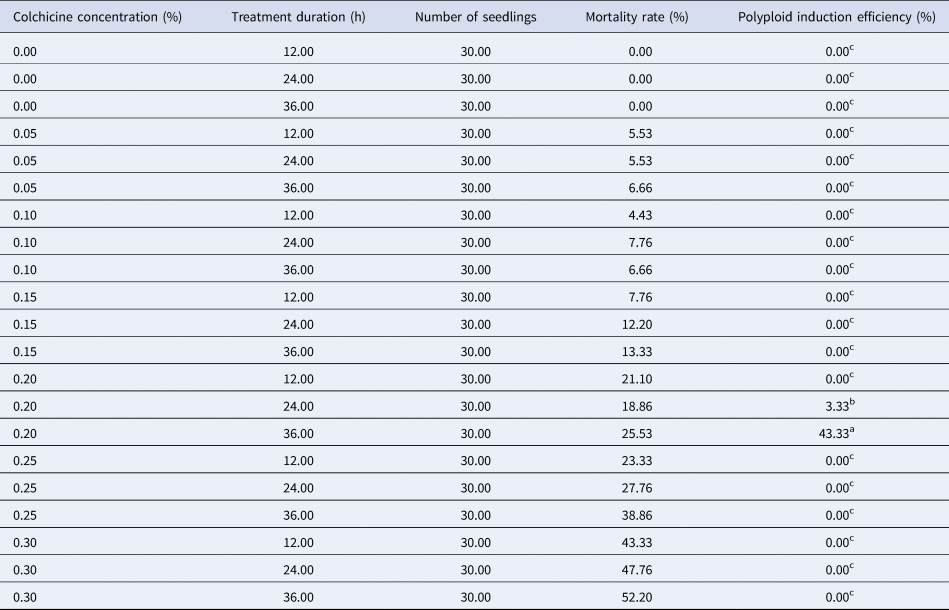
The efficacy of polyploidy induction at various colchicine treatments was examined and is documented in Table 1. The mortality rate ranged from 5.53% at 0.05% colchicine treatment for 12 h to 47.76% at 0.30% colchicine treatment for 36 h. Maximum polyploidy induction of 43.33% with a mortality rate of 25.53% was observed with 0.20% colchicine treatment for 36 h duration. After treatment with optimum colchicine doses the treated seedlings were morphologically compared. The selected presumed polyploid plants underwent verification of ploidy level by exercising flow cytometry analysis which revealed one triploid and 13 tetraploid genotypes. The histograms depicted in Fig. 2 exhibit three discrete peaks, representing DNA content among diploid, triploid and tetraploid plants, respectively with two, three and fourfolds DNA content.
Effects of colchicine concentration and treatment duration on mortality rate, and polyploid induction efficiency in Stevia rebaudiana Bertoni cv. CIM-Mithi

Note: Different capital letters indicate the significance of the difference between two mean values at the P ≤ 0.01 level, as tested by Tukey's Honestly Significant Difference (HSD) Test.
Results of flow cytometric analysis on leaf cell samples for the determination of ploidy levels within the cohort of putative polyploid plants (a) Control (2n = 2x = 22), (b) ST 1 (2n = 3x = 33), (c) ST 2 (2n = 4x = 44), (d) ST 10 (2n = 4x = 44).

Characterization of confirmed colchiploids for morphochemical traits and correlation analysis
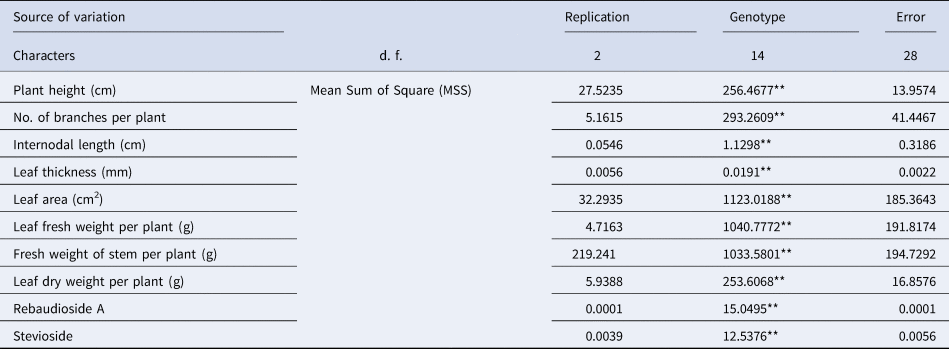
The ANOVA for morphochemical traits reflected significant differences (P ≤ 0.01) among diploid, triploid and tetraploid genotypes for all the studied morphochemical traits (Table 2). The recorded mean data on the leaf yield and its contributing traits among all 14 polyploid genotypes with control diploid genotypes are provided in online Supplementary Table S1. The mean plant height (cm) was lower in triploids (46.90 ± 1.08 cm) and higher in tetraploids (42.33 ± 1.33 to 73.15 ± 0.64 cm) compared to diploids (52.58 ± 0.32 cm). Number of branches per plant has been significantly (P ≤ 0.01) higher among polyploids than in diploids. Tetraploids exhibited the highest number of branches (41.67 ± 0.88), followed by triploids 23.00 ± 5.13, while the control had 16.42 ± 0.09 branches per plant. The tetraploid genotype (UK68) showed the highest number of branches per plant, representing a 153.7% increase compared to the control. Regarding internode length, tetraploids had significantly shorter internodes (2.00 ± 0.00 to 3.13 ± 0.06 cm) compared to diploids, except for UK63, which had a longer internode length (3.90 ± 0.05 cm). Triploids also exhibited a small but significant (P ≤ 0.01) decrease of 8.5% in average internode length compared to the control. The average leaf thickness and leaf area were significantly higher in triploids (0.28 ± 0.0 mm and 52.35 ± 12.3 cm2, respectively) compared to diploids (0.16 ± 0.0 mm and 38.92 ± 0.32 cm2, respectively). In tetraploids, the maximum leaf thickness and leaf area were 0.45 ± 0.01 mm and 102.69 ± 7.95 cm2, respectively, indicating a remarkable increase of up to 181.2% in leaf thickness and 163.8% in leaf area compared to diploids. In tetraploids, the leaves fresh weight per plant ranged from 31.67 ± 3.48 to 85.14 ± 0.58 g and showed significant (P ≤ 0.01) differences. In comparison with the control, the leaf fresh weight of the tetraploids increased by 63.1%, while it decreased by 3.5% in the triploids. Leaf dry weight of tetraploids varied significantly (P ≤ 0.01) and ranged from 3.00 ± 1.52 to 35.88 ± 0.88 g compared to the control; leaf dry weight increased by 107.7% in tetraploids, while decreased in triploids by 9.26%. Moreover, a significant (P ≤ 0.01) variation was observed in average fresh weight of stems per plant in polyploids. In tetraploids, the maximal fresh weight of stem per plant improved by 177.2% compared to diploids and in triploids, the fresh weight of stems increased by 109.9% compared to control. Tetraploids and diploids have very diverse morphologies. The differences in leaf attributes between polyploid genotypes and the diploid control are presented in online Supplementary Fig. S2. Similarly, rebaudioside A in tetraploid genotypes ranged from 0.27 ± 0.003 to 8.32 ± 0.006%, while it was 0.80 ± 0.001% in the triploids. The tetraploid genotype ST6 (8.32 ± 0.006%) showed the highest rebaudioside A content, followed by the control plants (5.02 ± 0.006%). The analysis revealed that the rebaudioside A content in the tetraploid genotype (ST6) was 65.7% higher than the control. In other tetraploid genotypes, a decrease was observed in rebaudioside A content than control. Additionally, the triploid plants exhibited a substantial reduction (84%) in rebaudioside A content than control. Online Supplementary Fig. S3 illustrates HPLC chromatograms depicting rebaudioside A and stevioside content of control, triploid and tetraploid genotypes. The study revealed significant (P ≤ 0.05) variations of rebaudioside A and stevioside among the examined polyploid genotypes, as summarized in online Supplementary Table S1 and Fig. S4. Among the tetraploids stevioside content ranged from 7.10 ± 0.058 to 12.46 ± 0.019%, with the highest stevioside content observed in the tetraploid genotype ST11 (12.46 ± 0.019%) and lowest in ST6 (7.10 ± 0.058%). The triploid genotype ST1 also had a higher stevioside content (12.32%), while the control had 5.36%. The stevioside content in the tetraploid genotype increased by 134%. These complex differences between the polyploids and the control have been concisely summarised in an aesthetically instructive radar plot, as shown in Fig. 3.
Analysis of variance (ANOVA) for agro-morphological and biochemical traits in control and colchiploid genotypes of Stevia rebaudiana Bertoni cv. CIM-Mithi

Note: d. f., degrees of freedom; **significance at the 1 % (P ≤ 0.001) probability level, *significance at the 5 % (P ≤ 0.005) probability level.
Radar chart of mean scores of screened genotypes (control and polyploid) for morphological and biochemical parameters.

Results of correlation analysis among morphochemical traits showed that there was a positive and moderate correlation between traits like stevioside content and leaf thickness (0.5) and the fresh weight of the stem per plant (0.4). Concurrently, a significant (P ≤ 0.01) and strong negative correlation was observed between the stevioside content and rebaudioside A content (−0.7). A moderately negative correlation (−0.4) was observed between rebaudioside A content and leaf thickness. Similar results were also reported for other characters as shown in Fig. 4 that revealed a clear pattern of associations.
Correlation pattern and scatter plot between morphological and biochemical characters in colchicine-induced polyploids. These correlation coefficients provide insights into the associations between the studied traits and steviol glycosides, highlighting potential associations; ***correlations significant at P ≤ 0.001; **correlations significant at P ≤ 0.01; *correlations significant at P ≤ 0.05.

Discussion
The effectiveness of various levels of colchicine treatments was identified by determining plant mortality percentage and polyploid induction ability. The highest polyploid induction ability (43.33%) was noticed in 0.20% colchicine treatment for 36 h followed by 0.20% colchicine treatment for 24 h. Conversely, other treatments, including colchicine concentrations of 0.05, 0.10, 0.15, 0.25 and 0.30% given over 12, 24 and 48 h, failed to induce any polyploids in this study. These results highlighted the importance of optimizing colchicine concentration for effective polyploid induction. The findings of the presented results are consistent with previous research on colchicine-induced polyploidy in gladiolus by Manzoor et al. (Reference Manzoor, Ahmad, Bashir, Baig, Quresh, Shah and Hafiz2018) who reported that 0.1, 0.2 and 0.3% concentrations of colchicine were effective in producing a large number of polyploid plants with altered morphological characters.
Following the successful determination of the right colchicine dosage, the next step of identification of presumed polyploid plants was performed firstly through careful inspection of morphological alterations in all treated plants; this method is supported by the work of Xie et al. (Reference Xie, Zhao, Huang, Chen, Cao, Wang, Shi and Gao2024) in which they morphologically screened suspected polyploids of Begonia × benariensis series varieties and then confirmed their ploidy by flow cytometric analysis. Ye et al.'s (Reference Ye, Tong, Shi, Yuan and Li2010) work also shows that the requirement for additional polyploidy validation using flow cytometry is essential due to the intrinsic limitations of morphological differences as a trustworthy method of identifying polyploids. Among the morphologically selected 37 presumably polyploid plants in this study, flow cytometry identified one triploid (2n = 3x = 33) genotype (ST1) and 13 tetraploid (2n = 4x = 44) genotypes (ST2, ST6, ST9, ST10, ST11, UK3, UK4, UK61, UK63, UK65, UK68, UK69 and UK70). The efficiency of morphological identification of polyploid plants was found to be 37.83%, which shows that we can use morphological changes to identify the putative polyploid plants (to identify a smaller population of putative polyploids) but it is also recommended that other screening methods such as chromosome counting or flow cytometric analysis should be used. The results also showed that the tetraploid induction rate of S. rebaudiana was higher than triploid induction. Similarly, Zhang et al. (Reference Zhang, An, Hu, Lin, Liu, Bao and Chen2018) found only tetraploids using colchicine-induced chromosomal doubling in S. rebaudiana, while Xie et al. (Reference Xie, Zhao, Huang, Chen, Cao, Wang, Shi and Gao2024) reported twice as many tetraploids as triploids in Begonia × benariensis varieties.
After ploidy confirmation through flow cytometry analysis, polyploid genotypes were characterised for agro-morphological and biochemical parameters to investigate the interrelationships among induced plants under field conditions. The results revealed that, the tetraploid genotypes ST 9, UK 4, UK 63 and UK 65 were taller than their diploid counterparts, a feature associated with increased biological yield, which can increase the total leaf yield. Plant height enhancement has already been reported in the investigations on Petroselinum crispum (Nasirvand et al., Reference Nasirvand, Zakaria, Zare and Esmaeilpoor2018) and Salvia officinalis (Kobayashi et al., Reference Kobayashi, Yamashit, Ohta and Hosoki2008) by the application of colchicine. Concurrent with the increasing ploidy, number of branches per plant increased in triploid and tetraploid plants, as in genotypes ST 1, ST 6, ST 9, UK 3, UK 4, UK 63, UK 68 and UK 69. It is important to note that an increase in the number of branches per plant in triploid and tetraploid plants can translate to a proportional increase in leaf fresh and dry weight per plant. More extensive leaf size, stem diameter, root size, length of the single flower, length of the flower stalk and length of fruit among tetraploids as compared to the parental diploid clone were also reported by Adabiyah et al. (Reference Adabiyah, Ratnadewi, Ermayanti, Al Hafiizh and Susanti2023) in stevia.
The influence of larger leaf area and thickness on leaf yield is important in stevia breeding and agronomy due to its significant contribution for higher fresh and dry weight of leaf per plant. The results showed that the leaves of polyploid plants had larger leaf area and thickness than their diploid counterparts. Similarly, the maximum leaf fresh weight of tetraploid plants was raised by 63.00%, while the dry weight increased by 100%. Fresh weight of stems per plant was raised by 20.00–175.00% in the majority of colchiploids as compared to diploid counterparts. In the majority of plants, increase in leaf fresh weight per plant in triploid and tetraploid plants was accompanied by increase in stevioside and reduction in rebaudiocide A. They might be sharing a common biological pathway for their synthesis if one compound increases the other decreases however not only stevioside but the stevioside to rebaudioside A ratio is important for stevia genotypes. The results align with previous studies on S. rebaudiana (Zhang et al., Reference Zhang, An, Hu, Lin, Liu, Bao and Chen2018), showing a 22.00% increase in leaf length and a 37.83% increase in leaf width. Similarly, in P. crispum, Nasirvand et al. (Reference Nasirvand, Zakaria, Zare and Esmaeilpoor2018) reported a 64.31% increase in leaf length and a 91.20% increase in leaf width. Similarly in Papaver somniferum and Centella asiatica change in secondary metabolite profile was recorded as a result of polyploidisation when compared to control (Mishra et al., Reference Mishra, Pathak, Sharma, Trivedi and Shukla2010; Kaensaksiri et al., Reference Kaensaksiri, Soontornchainaksaeng, Soonthornchareonnon and Prathanturarug2011).
Results of HPLC analysis for stevioside and rebaudioside A content across different ploidy levels showed that stevioside content increased by more than 130% in tetraploid plants compared to diploid counterparts, although rebaudioside A content was higher in diploid plants, except tetraploid genotype ST 6 (it showed higher rebaudioside A than control). An increase in biochemical content similar to the presented investigation of tetraploidy responsible for increased level of biochemical content is reported in other medicinally important crops such as Trachyspermum ammi with increased thymol content by 39.31% increase than control (Sadat et al., Reference Sadat, Norouzi, Karimzadeh, Shirkool and Niazian2017); Centella asiatica with increased triterpene glycoside content by 11.06% than control (Kaensaksiri et al., Reference Kaensaksiri, Soontornchainaksaeng, Soonthornchareonnon and Prathanturarug2011); Papaver somniferum, showcasing increased morphine content by 37.40% (Mishra et al., Reference Mishra, Pathak, Sharma, Trivedi and Shukla2010); and Zingiber officinale augmented carotenoid content by 37.05% (Zhou et al., Reference Zhou, Guo, Fu, Xiao and Wu2020). The tetraploid genotype ST 6 demonstrated exceptional qualities, showing a higher rebaudioside A to stevioside ratio. Higher rebaudioside A to stevioside ratio is a key indicator of sweetener quality in stevia (Yadav et al., Reference Yadav, Singh, Dhyani and Ahuja2011; Grad and Gomaa, Reference Grad and Gomaa2020).
The correlation analysis results showed negative correlation among the quantity of rebaudioside A with leaf area (−0.34) and thickness (−0.37). According to these correlations, a reduction in rebaudioside A content is accompanied by increased leaf area and thickness. The strong significant negative relationship between rebaudioside and stevioside A content (−0.72) suggests that these chemical biosynthesis or accumulation patterns may be converging, explaining common regulatory systems or metabolic pathways. The positive and moderate association among fresh weight of stem per plant and number of branches per plant (0.44) suggests that the rise in stem weight per plant associated with corresponding raise in branch number.
Results showed a synchronised increase in leaf fresh weight per plant with an increase in plant height, as demonstrated by the strong positive and statistically significant correlation (0.81) between plant height and leaf fresh weight per plant. However, number of branches per plant (0.39) and internodal length (0.39) show only moderate associations with leaf fresh weight per plant. Alternately internodal length and number of branches per plant show a moderate negative correlation with leaf area (−0.38, −0.34), meaning that an increase in leaf area is associated with a decrease in both of these variables. On the other hand, leaf area and leaf thickness indicate a moderate positive correlation (0.34), indicating a tendency for leaf area to rise in tandem with increased leaf thickness. Furthermore, a moderate positive correlation between plant height (0.55) and branches per plant (0.39) with internodal length is also of significant importance. According to these results, internodal length generally increases in tandem with plant height and number of branches which can be helpful in designing canopy architecture. Future research can build on the current findings by optimizing colchicine treatments under varied environmental conditions to enhance robustness and consistency across different regions. Advanced techniques such as flow cytometry should be employed alongside morphological evaluations for accurate polyploid identification. Additionally, exploring genomic and transcriptomic changes in polyploids can provide insights into the molecular mechanisms underlying increased leaf yield and SG content. Breeding programmes can use identified high-yielding tetraploid genotypes to develop superior cultivars with enhanced glycoside content, improving stevia's commercial viability and meeting growing market demands.
Conclusion
In this study, 0.20% colchicine treatment for 48 h successfully induced polyploidy in S. rebaudiana. This approach generated tetraploid and triploid plants with increased SG content. Preliminary morphological screening proved reliable for identifying polyploids, which were confirmed by flow cytometry. Tetraploids exhibited significant morphological and biochemical differences from diploids, showing potential for targeted breeding. Correlation analysis revealed a negative relationship between rebaudioside A and leaf area (−0.34) and thickness (−0.37), providing insights for yield-related improvements. A promising tetraploid genotype (ST 6) exhibited an 8.32% rebaudioside A content, surpassing the diploid variety CIM-Mithi (5.02%). This is the first Indian study demonstrating colchicine-induced polyploidy in stevia with enhanced SG production, offering valuable insights for breeding programmes. Breeding programmes can leverage the identified high-yielding tetraploid genotypes to create superior S. rebaudiana cultivars with enhanced SG content. This approach can significantly boost the crop's commercial value, addressing the increasing global demand for high-glycoside stevia varieties. The development of such cultivars not only enhances yield and quality but also contributes to more sustainable and profitable production systems for stevia in the agricultural sector.
Supplementary material
The supplementary material for this article can be found at https://doi.org/10.1017/S1479262124000625
Acknowledgements
The authors express their gratitude to the director of CSIR-CIMAP, Lucknow, for the invaluable support and providing resources.
Author contributions
Sivendra Joshi and Abhilasha Gupta analysed the data and wrote original manuscript. Venkatesha K. T. was involved in the conception and design of the study and reviewing of the manuscript. All authors reviewed and commented on the original version of the manuscript. All authors have read and approved the final version of the manuscript.
Competing interests
The authors declare no competing financial or non-financial interests.
Data availability
All data relevant to the study are presented with the manuscript.