The sheep population in Italy is estimated at approximately 8 200 000 head (FAO, 2005) of which 15% are meat-producing sheep. Bergamasca sheep number about 95 000 head and are concentrated mostly in Lombardy, where the animals typically graze under a nomadic system. Elsewhere they are housed for part or all of the year. Sheep have traditionally been marketed as wethers at 16–18 months of age, but the present trend is moving towards the production of lambs to be sold at 3–4 months. The average lactational milk yield is 160–180 kg per ewe and milk production is the main factor influencing lamb growth during the preweaning stage (Susmel & Piasentier, Reference Susmel and Piasentier1989).
Perhaps logically, most studies conducted on mastitis in sheep have been focused on dairy animals. Intramammary infections (IMI) and subclinical mastitis in dairy sheep may adversely affect milk production, increase the somatic cell count (SCC) and decrease milk quality (Bergonier et al. Reference Bergonier, De Crémoux, Rupp, Lagriffoul and Berthelot2003). In dairy sheep flocks, IMI prevalences of 22–48% (Fthenakis, Reference Fthenakis1994) and up to 40% (Leitner et al. Reference Leitner, Chaffer, Zamir, Mor, Glickman, Winkler, Weisblit and Saran2001) has been reported.
The objectives of this study were to determine (1) the relationship of IMI in ewes raised for meat production with growth of suckling lambs, including the effect of the pathogen responsible and (2) the relationships between infection and concentrations of fat, protein, lactose and somatic cells in the milk.
Materials and Methods
The sheep flock, free from brucellosis and mycoplasmosis after serological analysis, used for this investigation was in northern Italy, and consisted of 300 winter-lambing Bergamasca ewes grazing upland pasture (intermediate altitude, often improved pasture grazed with a medium stocking density).
For two consecutive lambing seasons (October–February of 2002–2003 and 2003–2004) 20% of the flock's ewes were randomly selected to be included in the study and no ewe was sampled for two consecutive seasons. Based on simple preliminary estimates, this proportion was expected to provide sufficient power to detect a difference of at least 1·0 kg in the growth of offspring from healthy and infected ewes. Data were recorded for 61 and 54 ewes in the 2002–2003 and 2003–2004 seasons, respectively. At parturition, each ewe and her lambs were placed in a small pen (1·5×1·2 m) for 1–2 d. Then ewes and lambs were moved to a mixing pen with 10–15 other ewes and their lambs, for about 1 week. Finally, ewes and lambs were moved to a larger rearing pen, with 15–70 other ewes and their lambs. Lambs were routinely reared by their birth-dam until weaning at approximately 55–60 d of age. All lambs were identified with their dam and ear-tagged within 12 h of birth. Numbered collars were used to identify the ewes and their respective lambs. Lambs were weighed at birth and 3, 8, 13, 18 and 50 d of age and were not supplemented with any solid feed until weaning. Milk samples were also collected at the same time, starting from day 3. For milk collection, lambs were removed and isolated from ewes for the 8 h prior to sampling. The teats of the ewes were carefully cleaned using cotton swabs and chlorhexidine. The first streams of foremilk were discharged, and then 50 ml of milk was collected aseptically by hand milking from both sides of the udder and pooling the two samples together. Samples were kept at 4°C until bacteriological assay, SCC test, fat, protein and lactose concentrations determinations were performed. None of the ewes studied showed evidence of clinical (chronic or acute) mastitis at the time of sampling.
Microbiological analysis
Bacteriological culturing of pooled milk samples was performed according to Clements et al. (Reference Clements, Taylor and Fitzpatrick2003) and to the International Dairy Federation (FIL-IDF, 1981). Bacteriological interpretation was based on the National Mastitis Council recommendations (NMC, 1999).
Determination of SCC and concentrations of protein, fat and lactose
For each milk sample, SCC was determined by an automated fluorescent microscopic somatic cell counter (Bentley Somacount 150, Bentley Instruments, USA). Ethidium bromide dye was used for specific binding to the DNA in the cell nuclei. Percentages of milk fat, protein and lactose were determined on composite milk samples and assayed by an automated FT (Fourier Transformed) infrared absorption spectrophotometric analyser (Milkoscan, Foss, Denmark). For analytical and statistical evaluation, SCC were logarithmically transformed to somatic cell scores (SCS) on the base 2 (SCS=log2(SCC/100 000)+3), according to Ali & Shook (Reference Ali and Shook1980).
Statistical Analysis
Relationship between mammary infection and growth
The relationship between growth and mammary infection was examined in two ways. First, the total increase in weight from birth to 50 d was used as the dependent variable and analysed with a model that included number of sample days with infection as an independent variable. For this analysis, the number of sampling occasions on which a sample yielded bacteria (out of five sampling occasions) was classified into four different categories according to bacteriological results: 1=no infected samples (out of 5); 2=one infected sample; 3=two infected samples; 4=three to five infected samples. Preliminary analyses had revealed no difference in growth for the lambs of ewes with between three and five infected samples. The other factors in this model were fixed effects of season of lambing; litter size (single or twin); parity of the ewe (from first to fourth); and linear regressions on concentrations of fat, protein and lactose. Preliminary analyses had demonstrated that interactions among fixed effects were non-significant. Ewe was included as a random effect to account for repeated records. Concentrations of the milk components were averages across the five sample dates and weighted according to the number of days between samples. The MIXED procedure of SAS (SAS, 2000) was used for this and all other statistical analyses.
In the second set of analyses, the relationship between various measures of growth and infection was examined separately for each of the five sampling periods (in days 0–3, days 3–8, etc.). For this analysis, T2 models were evaluated. For the first, infection status was simply recorded as either infected or healthy. For the second model, the species of the pathogen was considered. The infection status was assigned to six classes: (1) negative (no infection), (2) CNS (coagulase negative staphylococci), (3) Staphylococcus aureus, (4) Bacillus spp., (5) Gram-negative bacteria and (6) other Gram-positive bacteria. The model included the infection type at both the start and the end of the period evaluated as separate factors in the model. For example, the model evaluating the effect of infection on growth between days 18 and 50 had one effect for infection type at day 18 and another for status at day 50. This approach was taken because the type species of bacteria detected was occasionally different at the start and the end of the periods. The other factors in the model were the same as for the analysis of total weight gain during the entire 50-d period.
Factors affecting milk components
Two models were also applied for the relationships between various factors and concentrations of fat, protein, lactose and somatic cells. Of particular interest was the effect of IMI. The first considered infection as a general dichotomous (healthy/infected) variable; the second considered the same grouping of bacteria as was used for growth. Other fixed effects in the model were season, parity, litter size, and sample number, and ewe was as a random effect. These analyses considered 560 records.
Results
A total of 169 lambs were included in the study, 61 raised as single lambs and 108 raised as twins. Eight lambs died during the study period from respiratory problems. Mean lamb weight at birth was 5·56 kg (sd 0·68), with a range of 3·45–7·10 kg. At birth, twins had a mean weight of 5·36 kg (sd 0·53), which was less than the average weight of single lambs of 5·78 kg (sd 0·76). At the end of the study (50 d) lambs reached a mean weight of 18·1 kg (sd 4·1), with a range of 8·8–25·0 kg. At the end of the study (50 d), twins reached a mean weight of 16·4 kg (sd 3·54), which was less than the single lamb average weight of 19·9 kg (sd 3·60).
Prevalence of intramammary infection
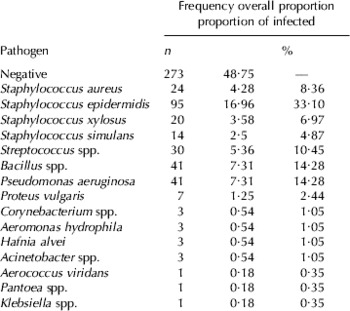
A total of 562 milk samples were collected from 115 lactating ewes. Of the total samples obtained, none corresponded to cases of clinical (chronic or acute) mastitis, 273 to negative cultures, 287 to positive cultures and 2 to contaminated cultures. The contaminated cultures represented <1% of samples from asymptomatic glands, a value very similar to that obtained in other studies of dairy ewes (Ariznabarreta et al. Reference Ariznabarreta, Gonzalo and San Primitivo2002; Marco, Reference Marco1994), and were excluded from the study. The global prevalence of subclinical IMI was 51·2%. Table 1 shows the relative prevalence of each genus, group and bacterial species for total isolates. Thus, the Staphylococcus genus was most commonly responsible for subclinical infections, with a global prevalence of 53·3% among infected udder halves. Coagulase-negative staphylococci represented 44·9% of infected samples: the most frequently isolated species was Staph. epidermidis (73·6%), followed by Staph. xylosus (15·5%) and Staph. simulans (10·9%). The main contagious pathogen, Staph. aureus, was isolated in 8·36% of infected milk samples. Pseudomonas aeruginosa and Bacillus spp., isolated in the same percentage (14·3%) of infected udders, were the second most prevalent pathogens. Streptococcus spp. was isolated in 10·4% of infected samples while other genera (Gram-negative and Gram-positive microrganisms) had a prevalence of <3%.
Proportion of samples from Bergamasca sheep infected by various mammary pathogens

Relationships between mammary infection and lamb growth
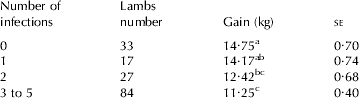
Table 2 shows the least square means in growth as a function of number of infections. Growth was greatest for the lambs of ewes with no infections and decreased as the number of infected samples increased. The greatest difference corresponding to a marginal increase of one infection was between 1 and 2 infections (1·75 kg). The P-value for this difference was 0·06.
Least square means and their standard errors(se) of weight gain from birth to 50 d as a function of the number of sample days (out of five) at which intramammary infection was recorded

a,b,c Least square means sharing a superscript letter were not significantly different (P>0·05)
Among the other factors included in this model, effects of litter size and fat concentration were significant (P⩽0·001 for both). The least square means for growth were 14·2 kg for single lambs v. 12·1 kg for twins. Weight gain increased by 0·84 kg for each percent increase in fat content. Effects of lambing season, ewe parity and percentages of protein and lactose were not significant.
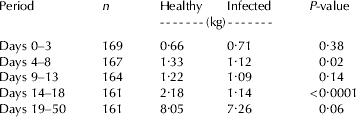
Table 3 shows the comparison of growth for offspring of healthy and infected ewes, broken down by separate periods. In all periods except the first, the weight gain was greater for lambs with uninfected dams. The difference was significant (P<0·05) for days 4–8 and 14–18 and approached significance for the period between days 19 and 50. The greatest difference between healthy and infected classes was for the period from days 14 to 18, which was somewhat surprising, considering that this period was shorter than the final period. With regard to other factors in the model, litter size had a significant effect in all periods except the first. Other factors were significant in some periods, but with no strong and consistent general pattern except that increased fat percentage was consistently associated with increased weight gain.
Least square means of body weight gain (kg) during five periods in the early lives of lambs from ewes with healthy or infected mammary glands

When examining the effects of infections by different bacteria in different periods, the only significant effects observed were between healthy and infected animals (no table shown). No significant differences were detected in the growth of lambs with dams infected by different bacterial species. For the fourth period (days 14–18), the growth of lambs from healthy ewes was significantly greater than gain from lambs of infected ewes for all five bacterial groups. Among these groups, gain was lowest for offspring of ewes infected by Staph. aureus.
Factors affecting milk components
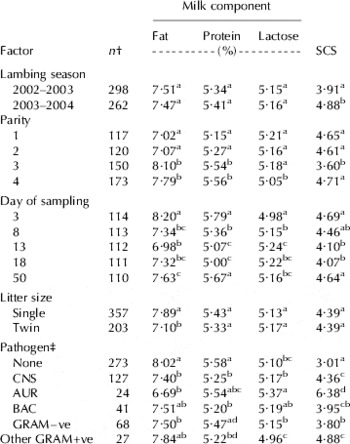
Table 4 presents least square means for different classes of effects included in the analyses of milk contents. Lambing season had little effect on most milk components, bar the SCS, which were increased during the second lambing season (4·88 v. 3·91). Lactation number of ewe had significant relationships with all four component traits. An upward trend in concentrations of fat and protein was observed as parity increased. Stage of the lactation also had a significant effect on milk component concentrations (Table 4).
Least square means of concentrations of fat, protein, lactose and somatic cells (SCS=Log2 transformed) for lambing season, parity, sampling date, litter size, infection status expressed either as healthy and infected or by pathogen

† n=number of observations from each subclass
‡ CNS=coagulase negative staphylococci, AUR=Staphylococcus aureus, BAC=Bacillus
a,b,c,d Values in the same column and subsection of the table that share superscript letters were not significantly different (P>0·05)
Number of lambs had a significant association only with fat percentage. Concentration of fat was much greater (7·89 v. 7·10) among ewes with single lambs than with twins. Infection status had significant detrimental effects on all concentrations, except lactose. SCS were strongly affected by infection status: infected ewes averaged 4·34 SCS v. only 3·01 for uninfected ones. The infective pathogen had significant effects on all measures of milk solids; Staph. aureus consistently had the most detrimental effects.
Discussion
The aim of this study was to establish whether the presence of IMI adversely affected milk parameters of meat breed ewes and growth of lambs. Lambs from uninfected dams gained 3·5 kg more (P<0·05) than lambs from infected (any bacterial species of infection) dams during the age interval from 0 to 50 d. Similarly, lambs from uninfected dams gained 3·2 kg more than lambs from dams infected with Staph. aureus during the same time interval (data not shown). A number of plausible explanations can be presented for this decrease in growth. First, the ewes that were infected may have produced less milk as a result, decreasing the consumption by the young. Previous studies show a tendency for decreased milk yield of sheep both naturally (Gonzalo et al. Reference Gonzalo, Ariznabarreta, Carriedo and San Primitivo2002) and experimentally (Winter et al. Reference Winter, Schilcher, Fuchs and Colditz2003) infected with mammary pathogens. Demonstrating that the decreased growth was a result of decreased milk yield was not possible, however, with this study, as individual milk yield was not measured in the ewes. Decreased milk quality from infected ewes could also help explain the decreased growth. Such data were available from this study and concentrations of both fat and protein were lower in milk from infected ewes. Milk from infected ewes thus provided less energy and protein to support growth. Another possibility is that the bacteria in the milk from infected ewes may have directly decreased the health of the suckling lambs, by establishing new infections of other tissues in the lambs. However, no clinical evidence of sickness in the lambs fed infected milk was observed.
Decreased growth of suckling lambs was also observed in a study conducted on ewes experimentally infected with CNS (Fthenakis & Jones, Reference Fthenakis and Jones1990b). Another study found that ewes receiving antibiotic treatment to prevent mastitis prior to parturition had heavier lambs at 50 d (Croft et al. Reference Croft, Duffield, Menzies, Leslie, Bagg and Dick2000). The treated ewes had less subclinical mastitis, as indicated by palpable udder abnormalities, than did those receiving a placebo, but no difference in clinical mastitis was observed. A third study (Keisler et al. Reference Keisler, Andrews and Moffat1992) concluded that growth performance of lambs, in a management system where they had access to supplemental feed, was not influenced by the quality of milk produced by ewes, or by the degree of subclinical infection present when they suckled. The lambs in that study may have been able to consume solid feed to compensate for any deficit in milk production by their mothers, whereas lambs in our study were not supplemented with solid feed.
Comparison of growth for offspring of healthy and infected ewes, broken down by separate periods showed that, similarly to that found by Fthenakis & Jones (Reference Fthenakis and Jones1990a), most of the growth retardation occurred between days 14 and 18 after lambing, an age at which lambs are highly dependent on milk. The same period was also characterized by a significant decrease of milk quality parameters (fat and protein content). In addition to lamb growth, IMI had also a significant negative effect on fat and protein content and SCC.