In May 1904, a group of cotton spinners gathered in Zurich to find a solution to volatile prices in the American cotton market. Led by the prominent Lancashire businessman Sir Charles Macara, the spinners created an international organization to fight “gamblers” in the world’s cotton exchanges, whom they blamed for rising cotton prices. The new International Federation of Master Cotton Spinners’ and Manufacturers’ Associations (IFMCSMA) united Lancashire’s powerful cotton trade associations with similar groups in continental Europe. Still operating today as the International Textile Manufacturers’ Federation, the federation is one of the oldest examples of an understudied phenomenon: the internationalization of business associations.Footnote 1
For the early business historian H. W. Macrosty, the founding of the IFMCSMA represented an inevitable step in the evolution of capitalism. “The cotton-spinning trade is finding that its old individualist spirit which carried it so far is insufficient to meet modern conditions,” he declared.Footnote 2 Macrosty believed that the vertically and horizontally disintegrated firms of Lancashire and other textile centers would form combines and cartels across national borders to secure their position in the world market. V. I. Lenin reached a similar conclusion, arguing that the IFMCSMA and organizations like it marked the arrival of “late capitalism,” characterized by “the domination of monopolist associations of big employers.”Footnote 3 Sir Charles Macara disagreed: In his view, the IFMCSMA was not a cartel, but rather something like “the birth of a League of Nations,” representing “a new international idea in industry.”Footnote 4 Macara hoped that the IFMCSMA would allow the cotton trade to cope with changes in the global network of agriculture, manufacturing, and distribution on which the industry relied.Footnote 5 His ideas did not mature quite as he had hoped, but the organization he founded has endured for more than a century as a forum for the world’s cotton manufacturers.
The cotton spinners who launched the IFMCSMA were not alone in their “international turn.” A veritable wave of internationalism swept the industrialized world at the turn of the twentieth century. A look through the pages of the Yearbook of International Organizations, first published in 1910, gives a sense of the size of this movement. Some of these groups are well known, such as the intergovernmental groups that addressed important problems like postage, telecommunications, slavery, and narcotics.Footnote 6 As Leonard Woolf noted in his 1916 study of international government, however, many international organizations were toothless. Intergovernmental and nongovernmental groups relied on nation-states to approve and enforce their initiatives, and domestic politics often trumped international interests. As Woolf saw it, effective international governance required truly international “organisms,” and he believed that business organizations such as the IFMCSMA and the International Congress of Chambers of Commerce had led the way by creating mechanisms for governing disputes across national borders. Firms could turn to local courts for remedies, but litigation was costly and laws varied widely from state to state. By participating in international trade associations, firms gained access to a uniform private law that recognized no borders. “The business man in every country is a confirmed internationalist,” Woolf declared.Footnote 7
In the interwar period, business organizations were overshadowed by a new wave of intergovernmental treaties and administrations associated with the League of Nations.Footnote 8 After 1945 the proliferation of intergovernmental bodies continued, and thousands of new nongovernmental organizations (NGOs) were also founded. We now have a wealth of literature on the internationalist movement of the nineteenth and twentieth centuries, but the majority of it focuses on governmental organizations or NGOs operating in the fields of philanthropy and humanitarianism, political rights, or economic development.Footnote 9 Only a handful of business organizations, such as the International Chamber of Commerce and the International Organization for Standardization, have attracted the attention of scholars.Footnote 10
Even though cotton is undoubtedly the “most studied of manufactures,”Footnote 11 the IFMCSMA has escaped the attention of most scholars.Footnote 12 Historians have readily mined the federation’s publications for facts and figures but have shown little interest in the federation as a historical actor in its own right.Footnote 13 F. S. L. Lyon’s early study, Internationalism in Europe, identified the federation as a “parliament of industry” but had little else to say about it.Footnote 14 The IFMCSMA’s successor organizations published several short pieces on the federation’s history, but these are only summaries of past publications and conference reports.Footnote 15 Arthur McIvor’s excellent study of British trade associations highlighted the often underappreciated role of Britain’s Federation of Master Cotton Spinners’ Associations (FMCSA), but it did not mention the FMCSA’s international counterpart at all.Footnote 16 The same is true for Japan, where historians have recognized the importance of Japanese cotton manufacturers’ associations in organizing that country’s nascent textile sector in the late nineteenth century but have not examined Japanese involvement in the IFMCSMA.Footnote 17
The international business associations that garner the most attention from historians are ones that were bad for consumers, workers, or competitors: Adam Smith warned that meetings of manufacturers generally end “in a conspiracy against the public, or in some contrivance to raise prices.” As Harm G. Schröter has observed, American scholars have typically viewed business associations through the lens of trust-busting, supporting Smith’s claim that criminality lurks behind cooperation. Alfred Chandler, for example, sharply contrasted the American approach to industrial cooperation (he called the Sherman Antitrust Act as “an expression of fundamental American values”) with that of Germany, where government and industry shared a “belief in the benefits of industrial cooperation.”Footnote 18 For the past century, many European scholars have argued that cooperation is a necessary outcome of competition. According to Macrosty, industrial associations emerged when “by mutual slaughter the competitors have been reduced to a manageable number.”Footnote 19 George R. Carter, a fellow Briton, saw international associations and combines as management technologies that would allow national industries to compete in global markets.Footnote 20 American scholars have been more successful than their European colleagues in exporting their interpretations of industrial cooperation, however; as a result, the historiography of trade associations is heavily tilted toward studies of cartels and combines.
The Smithian model of cooperation-as-rent-seeking was given a stronger theoretical footing by Mancur Olson and other economists, who saw collusion as a matter of incentives and enforcement. If firms could get away with price fixing and could keep outsiders from benefiting alongside the conspirators, the costs of organization were justified. The only purpose of a trade association was to pursue “distributive objectives, seeking unproductive rents rather than the common or public interest.”Footnote 21 History is undoubtedly full of examples of associations meeting this description. During the nineteenth century, many early trade associations began as “dinner club” groups for firm owners and managers, providing social forums that allowed capitalists to discretely collude, relying on social ties for enforcement.Footnote 22 By the late nineteenth century, many “dinner club” groups had transformed into more formal cartels, conferences, or combines. In industries like hardware wholesaling, firms used their trade association conferences and publications to limit competition and to fix prices among members.Footnote 23 Manufacturers participated in cartels but also cooperated in employers’ associations aimed at controlling the mobility of labor and limiting wages.Footnote 24 Cotton manufacturers in Lancashire and Japan, among other places, cooperated to prevent poaching of skilled workers by rival mills and to limit unionization and wage increases.Footnote 25 The advent of antitrust and labor laws in many countries did not lead to a mass extinction of trade associations, however. “Despite being deprived of their fundamental raison d’être [price fixing],” Richard Tedlow observed, “trade associations not only have not disappeared in the 20th century, they have flourished.” Footnote 26 Firms working in industries ranging from aircraft to zinc formed new international organizations across the past century and continue to participate in national and international associations today.Footnote 27 Without the opportunity to engage in a Smithian conspiracy, what—to borrow Tedlow’s question about American trade associations—have these groups been doing?
For historian Louis Galambos, the answer was politics—or rather, the use of politics to achieve what market collusion could not. Studies of industrial lobbying highlight the geographic limitations of the extant literature, which focuses almost exclusively on regional and national associations in industrialized countries.Footnote 28 The national “container” was crucial for historians like Galambos, who saw post-antitrust trade associations as fundamentally political entities tasked with advancing the interests of member firms through lobbying.Footnote 29 Firms engaged in collective rent-seeking behavior by pushing for the passage of favorable laws and blocking unfavorable ones. Political approaches continue to be important in explaining the behavior of cooperating firms, but in the past two decades scholars also have turned to the toolkit of the “new institutional economics” to explain why firms cooperate even when they appear to lack mechanisms for delivering incentives to a restricted membership.Footnote 30 In associations like commodity exchanges, the incentives for cooperation are fairly easy to identify, even though buyers and sellers who are not members of the exchange receive some benefits alongside dues-paying members. Individuals cooperate within the structure of the exchange because it facilitates trade and reduces transaction costs. Exchanges control membership and establish rules for trade, limiting the need for individuals to gather costly information about trading partners.Footnote 31
Many trade associations do not serve as gatekeepers to specialized markets, however. The idea of “social capital” has been especially useful in explaining the value of associations that are neither cartels nor commercial exchanges. According to Nan Lin, social capital describes an investment in interpersonal relationships that yields access to information, gives influence over the decisions of others, and creates and reinforces the credentials of individuals within a given set of relationships.Footnote 32 In a study of New England jewelers, Francesca Carnevali used the concept of social capital to show how firms in a highly competitive industry benefited from cooperation despite low entry costs that allowed new entrants to threaten established firms. The jewelers’ association’s social events and publications allowed individuals to cultivate personal bonds and enforce a “moral order” within the jewelry trade, one that encouraged honest dealing and limited the scope of acceptable competition among members. Access to information helped jewelers avoid dealing with dishonest agents.Footnote 33 As Podolny and Morton have shown in their study of shipping firms, owners of firms in the same industry often shared class status and social values, and their decisions to cooperate with existing firms and new entrants were influenced by individual social status and reputation.Footnote 34
This article uses the case of the IFMCSMA to explore the workings of an international trade association, illustrating what kinds of things it could—and could not—accomplish. Evidence from cotton industry archives, trade publications, and conference reports supports elements of both the transaction cost and social capital approaches to trade associations. Cotton firms hoped that the IFMCSMA would help them in tangible ways by driving down the price of raw cotton, stabilizing prices year to year, and reforming outdated and costly customs in cotton handling and marketing. The association could deliver on only some of these things, however, and Sir Charles Macara’s ability to build social capital was crucial to the survival of the IFMCSMA. Macara’s reputation in Lancashire helped him cultivate a statesmanlike image internationally, and he built relationships with other established leaders in European cotton industries. The prestige these leaders brought to the IFMCSMA was bolstered by a long list of politicians and royalty who endorsed the IFMCSMA and entertained its members. Under Macara’s presidency, the association lobbied governments for cotton growing in European colonies, sponsored field research, launched an arbitration service, and spearheaded an international campaign to reform the handling and marketing of cotton.
Macara believed that internationalizing the work of trade associations allowed firms to solve important problems, but he and his colleagues discovered that international organization also elevated the problems of efficacy, enforcement, and free riding that national associations faced. In the face of an immediate crisis, the IFMCSMA successfully organized collective action among the national and regional associations that constituted its membership. When the crisis waned, however, the member organizations could not rally enough support among their own member firms to back the IFMCSMA’s most ambitious ideas for regulating the supply of raw cotton. As an international federation of national and regional associations, the IFMCSMA was ultimately only as effective as its member organizations.
From FMCSA to IFMCSMA
Spinning raw fiber into yarn is the first step in transforming cotton into cloth. In the early twentieth century, cotton spinning was the leading sector of the textile industry, requiring large amounts of capital and skilled labor. Great Britain boasted more than 55 million cotton spindles by 1913, most located in Lancashire. This was more than those in all of continental Europe combined; Lancashire’s closest rival in productive power was the United States, which consumed more cotton but did so with only 30 million spindles.Footnote 35 Employers’ organizations had long been a feature of Lancashire’s cotton spinning industry; the most powerful of these, the Federation of Master Cotton Spinners’ Associations, was founded in 1891 by mill owners in southern Lancashire to present a united front against organized labor.Footnote 36 The FMCSA expanded throughout the “American” or coarse-spinning sector, centered on the town of Oldham; by the early twentieth century, the FMCSA represented a majority of the productive capacity in Lancashire’s coarse and fine-spinning sectors.Footnote 37 Macara, who served as FMCSA president from 1894 to 1914, was responsible for the group’s international turn. In many respects he was a typical Lancashire businessman: He spent most of his life in the cotton trade and adhered to the “Manchester School” doctrines of free trade and laissez-faire liberalism. Macara was also committed to Victorian ideals of benevolent paternalism and public service; he spent the last three decades of his life looking for ways to manage private and public interests at local, national, and international scales and was made a baronet in recognition of his work in 1911.Footnote 38
Macara proposed a worldwide association of cotton manufacturers before 1904, but a series of corners in the cotton futures markets finally convinced British and European spinners to listen to Macara’s ideas. Brokers in the New Orleans and New York cotton exchanges cornered the market in the 1902–1903 season, sending prices upward. A charismatic broker named Daniel J. Sully tried to drive prices even higher in the following season, and by early 1904, prices for cotton reached record highs.Footnote 39 The FMCSA’s typical response to market volatility like this was short-time work. Because raw cotton made up so much of the final cost of textiles in Lancashire, mill owners could afford to operate at reduced capacity during periods of uncertainty.Footnote 40 Lancashire firms generally dealt in short-term contracts and smaller production runs than their overseas competitors, allowing them to quickly react when profit margins shrank.Footnote 41 Cotton mill operatives were less able to bear the reduced wages, but short time was still preferable to unemployment.Footnote 42
Much of Lancashire was already on short time when the Sully corner began. Cotton prices had been rising since 1901, and weak demand in some of Lancashire’s key overseas markets had driven down profit margins. Due to the elastic nature of textile consumption, cotton spinners could not simply pass on price increases to consumers. If spinners tried to protect their margins, price-sensitive shoppers would buy cheaper goods or stay out of the market entirely. The FMCSA initially blamed overproduction of textiles for both rising raw material prices and weak demand, and initiated short time to clear the markets of “excess” textiles.Footnote 43 Ninety-three percent of Oldham firms (the biggest European consumers of American cotton) were working short time by mid-1902.Footnote 44 As the cotton corner gathered steam in 1903, Macara and other Lancashire leaders shifted their attention from overproduction to speculation. The FMCSA recast the short-time campaign as a buyers’ boycott aimed at Sully and other “gamblers” in the cotton exchanges. Under an FMCSA-organized plan, firms that continued to work full time paid fines, which were used to compensate mill owners who agreed to cut working hours. Although Macara urged all firms to cut hours, the scheme allowed the most efficient firms or those with contracts to fulfill to continue work while less efficient producers were compensated for depreciation and other charges on their idle factories. If the reduced demand for cotton drove down prices and increased the margin between raw cotton and finished yarn, everyone (except labor) benefited. Such a scheme created obvious free rider problems among firms outside the FMCSA’s membership, but many of these firms also participated in short-time campaigns. The crisis of 1902–1904, in fact, encouraged many independent firms to join trade associations. Between 1903 and 1905, FMCSA membership increased from 42 to 60 percent of all Lancashire spinning firms.Footnote 45
The London Times praised Macara and the FMCSA for realizing that “the only way to deal with speculators who force up the price of an article is to refuse to buy it from them.”Footnote 46 Some spinners wanted more, however: In Oldham, the local FMCSA branch demanded the “international suppression of gambling transactions in cotton.”Footnote 47 Lancashire mill owners tried to convene an international conference to outlaw “cotton gambling” in early 1904, but they were rebuffed by Prime Minister Arthur Balfour, who refused to bring the British government into the controversy.Footnote 48 U.S. lawmakers eventually passed the Cotton Futures Act in 1914 in response to illegal and unfair dealing in the cotton exchanges, but in the meantime, manufacturers were left to find their own solutions to the volatility created by unregulated futures trading.Footnote 49 Macara pressed forward with the idea of an industry-led organization to battle speculation. Building on a late 1903 meeting that brought French and Belgian manufacturers into Lancashire’s short-time campaign, Macara proposed to form an international organization representing the interests of the world’s cotton manufacturers. With financial support from King Leopold of Belgium, Macara published a lavishly bound booklet laying out his idea for an international federation.Footnote 50
The booklet was well received in Europe; cotton spinners’ organizations in Austria, Belgium, Britain, France, Germany, Italy, Portugal, Russia, and Switzerland agreed to send delates to a conference in Zurich. Fifty-nine spinners met there in May 1904 to inaugurate the International Federation of Master Cotton Spinners’ and Manufacturers’ Associations, and they elected Macara as the federation’s first president.Footnote 51 He told his colleagues:
It has been the dream of my life to get the Lancashire cotton industry into one great federation. … It has been a further dream of my life that ultimately it might be possible to get the employers’ associations in all the cotton-using countries of the world to join in a common brotherhood for their mutual benefit and for the benefit of this great industry as a whole.Footnote 52
Macara’s enthusiasm for cooperation across borders reflected a broader fin de siècle interest in cooperation and internationalism, encompassing intergovernmental organizations, NGOs, rings, trusts, cartels, combines, unions, cooperatives, and other forms of social, economic, and political organizations. As a Spanish spinner put it, “[N]owadays individuals cannot live independently, no more socially than economically.”Footnote 53 Faced with international trade unions as well as speculators, farmers’ organizations, shipping rings, and cotton exchanges, Macara concluded, “There is no effective way of dealing with such a situation except by the users of cotton forming a combination as powerful as the combinations of those who dispose of the raw material.”Footnote 54 At a mass meeting in Lancashire, he rhetorically asked, “[W]hat chance can there be for individual employers or small associations who remain isolated or those who subordinate the welfare of the industry as a whole to the paltry personal considerations of the moment?” The work of Lancashire and its European competitors could “only be successfully carried on by combination,” Macara declared.Footnote 55 As a biographer of Macara put it, the IFMCSMA’s founding marked Lancashire’s renunciation of its “divine right to the cotton trade,” inaugurating a new international “commonwealth” of manufacturers.Footnote 56
Cooperation across Borders
Sully’s corner collapsed under its own weight before the IFMCSMA met in May 1904, but the spinners were quick to claim credit for his failure.Footnote 57 Macara boasted that the mere idea of spinners cooperating to organize short time internationally “should have broken the corner in less than a month, and taught a lasting lesson to all who contemplated such an undertaking again.” French spinner M. C. Berger concurred, arguing that short time had been proven as “the most efficacious remedy which can be used against corners.”Footnote 58 In Britain, the FMCSA continued short time throughout 1904 to force cotton prices down, asserting that Sully’s downfall “was very largely brought about by the loyalty of the trade to the short-time movement.”Footnote 59 The spinners were overly confident in their ability to influence cotton prices through short time, but half a century later, members of the international federation still fondly remembered the slogan they cried against the cotton brokers: “Cotton Down, Yarn Up.”Footnote 60
Despite the best efforts of Macara and other leaders, the spinners did not reach a binding agreement on international short time in Zurich. Macara hoped to extend the FMCSA’s model, letting firms or national federations compete for short-time credits, paid for by fines levied on members working at full capacity. In effect, firms would bid to idle their machines and workers.Footnote 61 According to Macara, the internationalization of short time would “enable all to bear an equal share of the burden according to their strength and which will impose a ruinous burden on none.”Footnote 62 Spinners were divided over the plan. The Italian and German delegations were not convinced that they could enforce short time within their own weak national organizations. Some British spinners encouraged the creation of “machinery” for worldwide short time, but others complained that “short time is no remedy, but only an alleviation for the time being.”Footnote 63 In later conferences, it became clear that enforcing an equitable work sharing scheme across the globe would be impossible because of the structure of each national industry. In 1908, for instance, French spinners who wanted short time complained that Lancashire investors were erecting new mills, which the FMCSA was powerless to stop. Baron Cantoni, leader of the Italian spinners’ association, berated his English colleagues for adopting short time only when it suited them; Lancashire firms dealing in short-term contracts for yarn, cloth, and finished goods were quick to adopt short time when prices moved against them, but many spinners in Europe could not do the same. Cantoni protested, “How do you expect us to run short time when we have engaged to deliver goods [over one or two years]?”Footnote 64
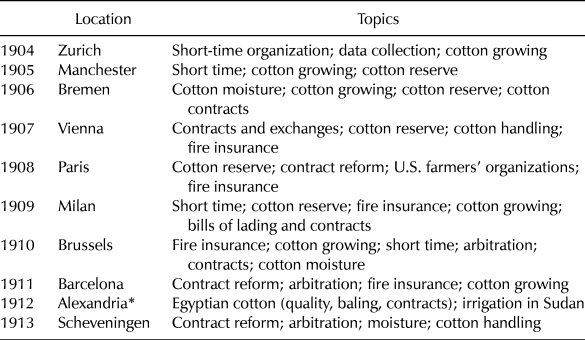
Even though they failed to reach an agreement on short time, the IFMCSMA continued to meet annually through 1913. (Table 1 lists the key topics of the IFMSCMA conferences from 1904 through 1913.) The association paid for its activities with a modest levy on the spindles and looms each member organization represented. Most national associations paid their dues without complaint, although some Lancashire firms balked at the expense.Footnote 65 The organization was headquartered in Manchester and Lancashire men held several key posts in the IFMCSMA, but it was not simply a mouthpiece for British cotton interests. Each country received one vote in the IFMCSMA committee for every million spindles or 40,000 looms, with a limit of twenty votes per country. Lancashire had more spindles than all of continental Europe put together by the turn of the twentieth century, but the federation’s rules barred Lancashire from acting unilaterally in the IFMCSMA.Footnote 66
IFMCMSA annual conferences and major topics, 1904–1913

* No annual conference in 1912; IFMCSMA meeting with Alexandria Cotton Exchange and tour of Egypt and Sudan.
Source: IFMCSMA annual reports, 1904–1913.
The IFMCSMA’s leaders remained focused on the problem of the cotton supply and cotton prices during the decade leading up to World War I. In addition to short-time arrangements, the spinners devoted a large portion of their annual conference to cotton growing programs in African and Asian colonies.Footnote 67 The IFMCSMA enthusiastically supported these ventures, although they were quick to realize that it would be many years before any of these new suppliers could compete with the American South. Several spinners suggested a more immediate solution to market volatility in the form of a cooperative company or cotton buyers’ cartel. Macara and his Austrian colleague Arthur Kuffler envisioned an organization like a reserve bank for raw cotton, holding a million-bale reserve in European warehouses. The company would be contractually obligated to sell its stocks to member firms whenever prices crossed a threshold level. Kuffler argued, “If I have a sure call for the cotton then I do not want to hedge.” He insisted, “I do not want any dealing with futures.” English spinner J. L. Tattersall went even further, calling for cotton firms “to bind themselves to only buy cotton” through the proposed company and even for “Spinners to own the cotton fields.”Footnote 68 This kind of vertical integration was a step too far for most firms, although a few in Britain, Germany, and Portugal did directly or indirectly manage cotton plantations in America and Africa during the early twentieth century.Footnote 69
Manufacturers debated different cotton reserve ideas in 1904 but agreed only on the continuing use of voluntary short time. Kuffler revisited the idea at the 1905 meeting, calling for firms to hold several hundred bales individually, creating a virtual reserve of 200,000 bales. If firms agreed to sell this cotton at a low fixed price during the next corner, he was sure that the speculators would fail.Footnote 70 Sully and other speculators had cornered the futures market with contracts for similar quantities.Footnote 71 In 1906, the Swiss textile manufacturers Ernst Lang offered a more concrete reserve plan.Footnote 72 Lang’s proposal included a reserve company paired with a short-time compensation fund. He put the cost of a company with one million bales in reserve at £480,000 annually, a large sum but one that could be raised with a one-shilling levy on every bale of American cotton bought in Europe (about 0.5 percent of the average price).Footnote 73 In addition to this annual levy on firms using cotton, Lang proposed to raise a £2 million fund on the basis of a 4 or 5 percent dividend, paid with profits on cotton sold by the warehouse company. The fund would support the reserve company but also pay compensation for short time during crisis periods. By paying 2s 6d per idle spindle (which Lang took as equal to annual depreciation), the fund could shut down three million spindles for an entire year, or 72 million spindles for one day a week over three months. Payments would go to the lowest bidder, meaning that mills facing strikes, high labor costs, or other trade difficulties could stop work while more efficient mills continued. The effect, Lang argued, would be “savings” of up to half a million bales of cotton a year, sufficient to cover most seasonal shortcomings in the American crop. Lang argued that the company might never have to stockpile cotton or pay indemnities, as “the mere existence of a powerful organisation will suffice to prevent too great fluctuations and checkmate speculation.”Footnote 74 The reserve firm would not be beholden to any firm or nation, and cotton spinners across the world would enjoy the benefit of stable raw material prices.
Like Macara, Lang believed that Lancashire and the rest of the cotton industry could no longer rely on the invisible hand of the market to manage a worldwide industry. Lang said:
It has long been felt by many far-seeing political economists that by continuing in this spirit of apathy we impede, or at all events bring to bear an unfavourable influence on the natural development of economic life, and finally we are bound to face the catastrophe. What can we learn in this respect from workmen who frequently have not the advantage of a good education? As with politics, the future dangers of the economic battle, whether purely social or purely economical, can only be dealt with by organisation and by the system of an ‘armed peace’.Footnote 75
The very existence of trade unions gave workers bargaining power, Lang argued, and cotton firms had already organized as buyers of labor in employers’ associations like the FMCSA. As organized buyers of cotton, they could influence the cotton exchanges and other actors. Lang believed that the potential benefits of collection action, as well as the costs of inaction, would be sufficient to force firms to participate in the reserve company. “If it comes to the worst,” Lang noted, “the names of firms which are too selfish or have to be excluded from the federation might be published, the buyers of manufactured cotton goods would then be able to assist the general interests by not buying from those outstanding firms.”Footnote 76 Public shaming was a weak enforcement mechanism, but cotton spinners worked in a tightly knit social world where reputation mattered a great deal.Footnote 77 The major cotton centers of Britain, France, and Germany were geographically clustered, and much business was done in face-to-face meetings in places like the Manchester Cotton Exchange.Footnote 78 In this context, Lang’s solution to the free rider problem was at least plausible, if not guaranteed effective.
Replying to criticism from German firms that the reserve company would not be able to handle their specific fiber needs, Lang explained that the company would act like “a large banking institute,” which, through its buying and selling of financial products, influenced “the whole of the financial markets of the country without ever coming into contact with individuals.”Footnote 79 Although different varieties of cotton were not easily substituted in yarn manufacture, Lang argued that stable prices in key grades of American cotton would have a salutary effect on the entire market. The reserve firm would buy additional cotton whenever prices fell below a target level, easing the boom-and-bust cycle of crop expansion and retrenchment in the American South, which, he believed, fueled speculation. Lang warned his colleagues that hostile rhetoric aimed at American cotton farmers would only encourage ongoing crop withholding and acreage reduction movements in the South:
[W]e do not consider whether he is able to live on his earnings or whether he finds it lucrative to continue cotton growing; our sole concern is to ask him to grow a sufficient supply of cotton. If he does not conform to this wish, we tell him that we shall grow cotton in new territories. … [W]e need surely not be astonished if he gets tired of our attitude and answers by a counter move which might have serious consequences for us spinners.Footnote 80
The Lang scheme posed serious organizational challenges, but Lancashire’s manufacturers already had demonstrated how competitive firms could cooperate in the pursuit of common interests. Giant combines coordinated the efforts of many firms in Britain’s fine spinning, bleaching, dyeing, and calico printing sectors.Footnote 81 Oldham and Manchester firms had formed the Cotton Buying Company in 1894 to undercut the Liverpool Cotton Exchange, using the Manchester Ship Canal (completed in the same year) to import cotton.Footnote 82 By 1907, the Cotton Buying Company had ninety-two members and had earned £73,466 in profit, “distributed partly in bonuses partly in interest on capital.”Footnote 83 By 1914 the company handled 772,000 bales annually, and its work was credited with bringing down costs across Lancashire by competing with Liverpool.Footnote 84 Founding an international counterpart of the company to compete with the price-setting and marketing functions of the world’s cotton exchanges would have been challenging, but not impossible.
IFMCSMA members debated the Lang plan and other reserve proposals for four years. Kuffler warned that if Lang’s scheme was not adopted, “the planters will do it.” Referring to new cooperative farmers’ organizations in the American South, he noted, “They are building warehouses everywhere in order to be able to stock the cotton, and they have the money.” J. L. Tattersall also backed Lang’s plan, having become convinced that “the growers, standing firm together, have been the important factor in influencing the price.”Footnote 85 Groups like the National Farmers’ Union were, in fact, building warehouses, and a number of plans for direct trade with manufacturers occupied Southern planters in the years before World War I.Footnote 86 Lancashire spinners who visited the American South in 1906 warned that Americans were obsessed with “the trust principle” and that farmers were planting “the seeds of a gigantic cotton trust.”Footnote 87
In the end, only the Spanish and Swiss delegations endorsed the Lang scheme. Lang blamed Britain’s FMCSA for the plan’s failure, arguing that other countries would have also joined if Lancashire led the way. Lancashire spinners would have doubly benefited from stable prices and access to short-time indemnities, as these firms were in the best position globally to switch quickly to short time. “A good many Continental spinners were astonished that our esteemed President, Mr. Macara, who was the first to draw attention to this very natural measure, had not been able to convince his own members in the English Federation of that advantage in my proposal,” Lang said in 1908.Footnote 88 Macara faced complaints in Lancashire that the IFMCSMA distracted attention from cotton growing in British colonies. Some firms simply refused to cooperate, part of a broader pushback against Macara’s efforts to make the FMCSA a more effective organization in addressing local issues.Footnote 89 The FMCSA did not even get to vote on the Lang plan; a group of spinners invoked a vague provision in the FMCSA charter barring the group from “trading or declaring profits” to block the proposal.Footnote 90
The apparent success of the IFMCSMA in organizing short time on an ad hoc basis also worked against the reserve plan. The coincidence of Sully’s failure in March 1904 with the announcement of the first IFMCSMA meeting led many manufacturers to believe that short time really did work against speculators in the cotton markets. Even Arthur Kuffler, a strong supporter of the reserve company, changed his mind about the need for an international company. “If we have a new corner, we will face it with a better organisation than in 1904, and defeat it,” he said in 1909.Footnote 91 Two years later, Macara admitted defeat. In a disheartened speech in Barcelona, the IFMCSMA president declared, “We shall never have continuity of satisfactory trade until we have put in operation means to deal effectively with those who can increase the price of our raw material by gambling operations,” but his only weapon was more voluntary short time.Footnote 92
Cooperative Successes
Despite its failure to develop effective mechanisms for coordinating international work sharing, the IFMCSMA was successful in addressing two issues facing the cotton industry in the decade before 1914: access to information and contract reform. National governments and private organizations collected data on different sectors of the cotton industry, but there was no definitive set of international statistics on cotton before the IFMCSMA began its work. So-called cotton prophets and cotton guessers offered compilations of data and estimates of the cotton crop and world consumption.Footnote 93 Leading experts, such as Liverpool’s Thomas Ellison or New Orleans’ Alfred Shepperson, published statistical reviews each year, and sensational predictions undoubtedly helped these experts sell copies. Brokers like Sully also distributed newsletters and press notices, hoping to garner support for their bull or bear campaigns in the market. Even when data reporting was honest and efficient—and it often was not—statisticians used varying or incompatible units from year to year and country to country. One Manchester cotton merchant complained, “some of the statisticians calculate 500lbs. to the bale, some 400lbs. to the bale, some 450lbs., and others do not tell you on what basis they are reckoning. Nor do the statistics of any two authorities agree.”Footnote 94 Conversions between weight and bales, or from weight to square or linear yards for cloth, were imprecise at best. Productive capacity could be measured by counting mule spindles and power looms, but ring spindles and automatic looms were often lumped in with older technologies—or in the case of waste, doubling, or ring spindles, converted to mule spindle equivalents. Cotton consumption was often used as a proxy for industrial output, but this measure said nothing about the actual quantity of textiles produced or their value: A pound of fabric for cheap blankets weighed the same as a pound of fine shirting, but the two products had very different values. Some IFMCSMA members also campaigned for metric units to replace the wide array of traditional units developed in Lancashire and other textile centers, but stubborn English manufacturers refused to abandon their pounds and inches for grams and meters.Footnote 95
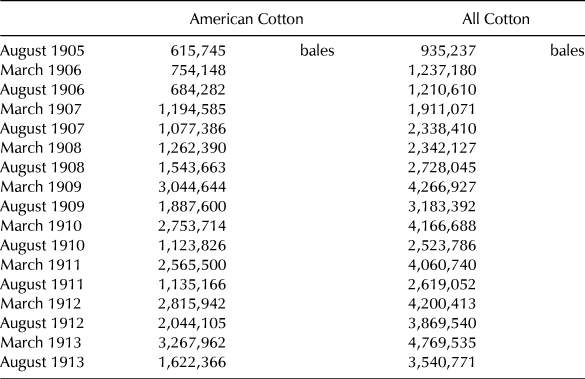
A few countries collected much more data than others. David Jeremy credits the “collective social ethos” of Japan’s cotton spinners for that country’s early efforts to collect data on “wages, consumption, capital, counts spun, electricity and horse-power used, cost of coal, etc.”Footnote 96 Jeremy suggests that Britain lagged behind in this regard, but in fact the FMCSA collected a great deal of information from its members, as well as from nonmember firms. The IFMCSMA used the FCMSA model of self-reported data collection and asked member organizations to collect data and share them internationally. Spinners were interested in changes in manufacturing capacity, but what interested them most in the prewar decade was the “invisible supply” of cotton held in manufacturers’ stores (see Table 2). During a cotton corner, spinners knew only what newspapers, competing brokers, and the U.S. government told them about the cotton supply. Kuffler recalled that in 1903–1904, spinners “believed Sully, and they played his game for him.”Footnote 97 The “visible” supply included cotton offered for sale in the exchanges and cotton in transit, but without knowing how much cotton manufacturers actually had on hand, it was difficult to gauge the true level of demand. Asymmetrical access to information gave privileged actors great influence over prices. This asymmetry sometimes included illicit knowledge. In 1905, the head of the statistical division of the U.S. Department of Agriculture (USDA) was forced to resign over a scandal involving early access to crop reports and manipulation of government estimates.Footnote 98 By 1905, the IFMCSMA began distributing confidential reports on the “invisible supply” to members along with data on agriculture, cotton consumption, and textile output garnered from other sources. In subsequent years the figures were released to the press, allowing buyers and sellers to accurately gauge the supply of cotton.
The “invisible supply”: Cotton in European and (India and Japan) Asian warehouses
Source: Data from IFMCSA annual reports, 1905–1913.
Macara believed that knowledge was key to a well-functioning market, and he thought that knowing how much cotton was available on the open market and in private warehouses would enable manufacturers to agree on fair prices. If speculators tried to corner the crop, manufacturers could use their existing stocks and work short time until the corner failed. In a genuine cotton shortage, manufacturers could adjust prices for their yarn and cloth together, avoiding underselling by individual firms. Ernest Lang was skeptical that this would work, arguing that the information would be useful only with a “perfect organisation” possessing “unlimited authority,” with “the power to enforce a general reduction of output in times of insufficient supply of raw material or of over-production.”Footnote 99 A 1909–1910 cotton corner in America illustrated Lang’s point: Although public reports and promotional materials released by speculators claimed that the world was running out of cotton, the IFMCSMA’s data showed that many mills had large stocks of raw cotton. Firms refused to use their stocks and sell yarn at pre-crisis prices to break the corner; instead they held on to their cotton to see which way prices would move. Firms had, at least, learned their lesson from the Sully corner and kept much greater quantities of cotton on hand than they had in the past. If the IFMCMSA’s data collection did not reshape the cotton market, it did manufacturers and historians a service by describing the size and movement of the cotton industry. By 1911, the IFMCSMA annually published information about the owners of 122,226,091 spindles, which the federation believed represented more than 90 percent of the world’s cotton-spinning machinery.Footnote 100
The IFMCSMA also initiated a series of fact-finding tours to cotton-growing regions and new manufacturing centers. Macara and other Lancashire figures sponsored the first mission, which examined cotton agriculture and manufacturing in America in 1906. This “Lancashire Private Cotton Investigation Commission” agreed to represent the IFMCSMA at a conference with American farmers and manufacturers in Washington, DC. The farmers’ organizations invited the IFMCSMA to return in 1907 for what they called the first International Cotton Congress; more than a hundred European spinners came to Atlanta to meet with the farmers.Footnote 101 Macara led IFMCSMA members on a tour of the South and even attempted to buy a cotton plantation.Footnote 102 Few of the spinners “had seen cotton in boll” before, and they eagerly inspected cotton fields “armed with kodaks and note books.”Footnote 103 The Atlanta congress passed a resolution encouraging direct trade between farmers and manufacturers, and the Manchester Cotton Buying Company signed contracts with several farmers.Footnote 104 The IFMCSMA later commissioned British cotton expert J. A. Todd to tour the American South, hoping to discover once and for all the real cost of production for raw cotton. Todd disappointed the Europeans by reporting that “the profit on cotton growing is not nearly so high as had been imagined.”Footnote 105
IFMCSMA delegations also visited Egypt and Sudan in 1912 as part of a conference and study tour focused on the fine spinning section of the trade, which relied on Egyptian cotton. Macara charged the federation’s secretary, Arno Schmidt, with writing reports of this and other tours. Schmidt enjoyed a long career as the IFMCSMA’s chief investigator. He traveled to India three times before World War I to research cotton agriculture; his reports showed that Indian cotton production could expand significantly, given higher prices and effective marketing reforms. Until Schmidt’s visits to India, the IFMCSMA unconditionally supported groups in Britain, France, and Germany that were promoting cotton growing in African colonies. Schmidt made it clear that India and the Americas would continue to supply most of the world’s cotton for many years to come, and that the cotton industry’s money was best spent stimulating production in these two established cotton-producing regions.Footnote 106
The German-born Schmidt took his wife’s surname when World War I began, and as Arno S. Pearse he continued to produce reports for the IFMCSMA, giving cotton firms (and historians) a detailed look at prices, wages, working conditions, machinery, capital and operating costs, and output levels in the world’s emerging textile centers. His reports often profiled individual (though anonymous) factories, allowing readers to compare aggregate figures with real examples of mill operations. After his reports on India (1910 and 1912–1913; again in 1930), Schmidt/Pearse produced studies of Egypt and Sudan (1912), Brazil (1922–1923), Colombia (1926), the United States (1927–1928), and Japan (with China, 1929; with Hong Kong and Shanghai, 1955). The federation celebrated Pearse for his “perseverance, his diplomatic skill, and his extensive knowledge of languages,” abilities that helped cultivate “a unique community of interests among the leaders of the world cotton textile industry.”Footnote 107
The world’s spinners were well informed about changes in the international structure of the cotton industry thanks to the IFMCSMA’s investigative reports. As Pearse noted in 1930, his report on Japan and China “created a deep and in some quarters a rather unpleasant impression, as it brought home to many the first realization of the formidable changes that have taken place and are likely to develop still further.”Footnote 108 This remark contradicts the received image of Europe, and especially Lancashire, as unaware of and unprepared for competition from Asia.Footnote 109 Writers like Benjamin Bowker, who described the postwar decline of Lancashire in his 1928 book Lancashire Under the Hammer, painted Lancashire spinners as uninformed and provincial: According to Bowker, cotton men were “arrogant” and “mentally and spiritually dead” by the turn of the twentieth century. They “could scarcely see the world for looking at Lancashire, which for them contained all that any world ever need hold.”Footnote 110 This view has had a lasting influence on historians, who have made claims that the British cotton industry “vainly imagined it was unbeatable” while more industrious competitors in Asia “preserved the positive attitudes towards innovation with which the industry had been born.”Footnote 111 Lancashire and its western European counterparts undoubtedly failed to compete with rising textile producers in other parts of the world, but they were not ignorant of new developments.
Reforming Contracts and Arbitration
The IFMCSMA’s biggest success came in its negotiations with the cotton exchanges. Merchants and brokers who traded in the exchanges provided many useful services to manufacturers: They bought cotton from farmers, graded and sorted it, and arranged shipping. Spinners could come to a major cotton exchange and place orders for deliveries, or—especially in Liverpool—shop for specific types of cotton on the spot to fulfill yarn orders. They used futures to hedge their spot cotton purchases and rarely settled futures contracts with actual deliveries of cotton. Standardized contracts for futures or delivery allowed the cotton exchange to act as a guarantor for buyers and sellers of cotton. The exchange lent its credibility to each contract, assuring buyers and sellers that disputes about quality or delivery terms would be arbitrated within the established rules of the exchange.Footnote 112
A smoothly operating commodity exchange requires “bona fide transactions among honest men.”Footnote 113 IFMCSMA members believed that members of the exchanges were abusing the rules to fleece cotton buyers. The corners in cotton futures led some manufacturers to call for the expulsion of “gamblers” in the exchanges, men who bought and sold huge quantities of contracts despite having “no direct connection with the cotton trade.”Footnote 114 Other spinners abandoned futures contracts in favor of alternative contracts for cotton delivery on cost, insurance, and freight (c.i.f.) terms. The c.i.f. contract gave spinners certainty about the price they would pay for the specific cotton they needed to meet a yarn order, although the most common contracts allowed brokers to substitute inferior grades of cotton at a discount. In one egregious case of misconduct, members of the New York Cotton Exchange used cotton grading standards established by the exchange to dump damaged cotton on unsuspecting buyers at a price that did not fairly reflect the quality of the fiber.Footnote 115 Each cotton exchange had its own rules governing contract terms, arbitration, and cotton grading, and the arbitrary nature of these rules greatly irritated cotton spinners. Futures regulation and cotton grading standards ultimately fell to state agencies, but the IFMCSMA led the campaign to reform other aspects of cotton transactions.Footnote 116
Standard c.i.f. contracts included fixed allowances for tare, moisture, and other irregularities in weight and quality. As legal scholar Tilmann Röder has argued, standardized contracts were “cultural technologies.” Preprinted forms saved clerks from the tedium of handwriting, but standardization also contributed to the construction of a lex mercatoria that eliminated the need to sort out competing legal jurisdictions and systems of jurisprudence.Footnote 117 Cotton merchants and mill owners relied almost entirely on the private law of cotton exchanges to settle disputes, a practice that continues today.Footnote 118 As the most influential exchange, Liverpool’s decisions about rules and contracts shaped behavior in other exchanges. Liverpool jealously guarded its members’ monopoly on determining grades and required the parties of each contract to submit to the exchange’s arbitration rules.Footnote 119 Liverpool c.i.f. contracts also required an archaic 6 percent allowance on each bale (gross weight). This practice dated to the mid-nineteenth century, when shippers required heavy covering on bales to minimize fire risks on riverboats. Instead of weighing every bale to establish tare, brokers agreed on a 5 percent standard to cover the heavy jute bagging and steel bands covering the bale, plus a 1 percent “franchise” to cover other irregularities. The rules failed to change as railroads superseded riverboats and as bale sizes evolved.Footnote 120
While merchants added extra packaging to take full advantage of the allowance (and often more), farmers who tried to do the same were punished. According to the USDA, farmers who tried to “tare it up” were blacklisted by merchants and faced price penalties.Footnote 121 Another investigation concluded that the allowance system “in effect establishes a false standard of weights” and gave “an advantage to a skilled class of specialists who best understand the complicated details of the business, with a corresponding disadvantage to the less expert.”Footnote 122 As a critic at an IFMCSMA conference put it, “Trade custom had brought about a condition of things that the American seller was forced to add weight to the cotton by putting on patches … [and] they were paying freight on those patches, money that benefited no one.”Footnote 123 Many spinners did not even check the tare on cotton bales, preferring to give the seller “friendly allowances” rather than risk an arbitration process that might prove costly to the spinner if the arbiters ruled in the seller’s favor. Liverpool’s rules required the buyer to pay for the whole cost of determining tare if the final weight fell within the 6 percent allowance, discouraging spinners from pursuing cases.
At the 1906 IFMCSMA conference, Lancashire spinners urged the adoption of net weight contracts to “do away with the temptation to overload the bale with tare (i.e., to sell canvas and bands at the price of cotton)” [emphasis in original]. H. W. MacAlister argued that the spinner had accepted “without protest” the “rules, contract forms, &c., which have been formulated by Corporations or Exchanges without consultation with him.” He pointed to the example set by New England mills, which had unilaterally adopted a fixed 24-lb tare and dictated their own terms on damaged or substandard cotton to the New York Cotton Exchange. Acting together, they had forced the NYCE to accept change, and MacAlister saw no reason why Europeans could not do the same.Footnote 124 The IFMCSMA and two farmers’ groups—the National Farmers’ Union and the Southern Cotton Association—endorsed a new c.i.f. contract with an “actual tare” clause at the 1907 Atlanta conference, giving farmers and merchants “the power to reduce the weight of canvas upon the bale.”Footnote 125 American manufacturer James MacColl warned cotton brokers “to set their house in order,” lest farmers and manufacturers build on the Atlanta conference and establish direct trade between farmers’ cooperatives and IFMCSMA member associations.Footnote 126
Spinners hoped that contract reform would also force changes in cotton baling and handling, because these issues were at the root of the fight over tare. The traditional American bale (480 lb net weight, nominally 500 lb gross weight) was delivered to buyers looking like “a dirty, damaged, watersoaked and highly inflammable turtle-backed deformity,” as one American put it.Footnote 127 Spinners claimed that hidden water damage ruined as much as 10 percent of baled cotton.Footnote 128 Farmers and spinners agreed that “there was no commodity in the world which was so badly treated as cotton.”Footnote 129 Every time a cotton bale changed hands in the United States, a merchant cut the bagging and took a sample. The ragged holes contributed to “country damage,” the trade term for damage caused between the farm and the seaport. Spinners received allowances for country damage, and merchants passed the losses on to farmers in the form of lower prices. Some farmers accused brokers of using the sampling process to “rake off” cotton between the farmgate and the seaport.Footnote 130 Cotton brokers did keep and resell samples; their “city crop,” as it was euphemistically called, amounted to more than 100,000 bales in the United States in 1913.Footnote 131
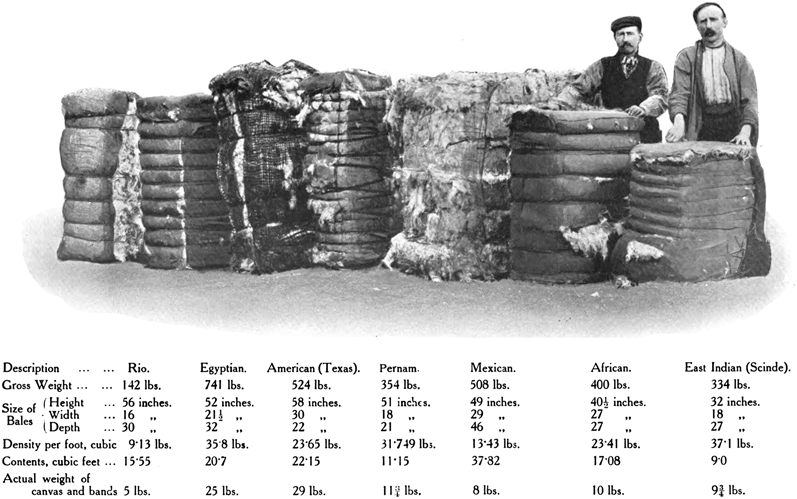
The IFMCSMA exhibited neatly packaged bales from Egypt and British colonies in sub-Saharan Africa at Atlanta in 1907, contrasting them with ragged American bales (see Figure 1).Footnote 132 The federation also promoted new “gin-compression” systems, which produced densely packed square or round bales at the ginnery. These tightly compressed bales were better protected from the elements with light, uniform bagging and bands, and could be shipped much more cheaply by rail and steamship than traditional bales. An American promoter estimated that $30 million would be saved in baling, shipping, and insurance each year on an average American crop. Established ginners and farmers’ organizations fiercely resisted the new presses when they were first licensed under patent in the late nineteenth century, fearing a ginning monopoly, but as key patents expired the IFMCSMA joined with farmers’ groups in calling for the general adoption of denser bales.Footnote 133 Gin-compression was gradually adopted in the South, but the IFMCSMA was unable to reach an agreement on a system of premiums or penalties to encourage better baling. Only Japan’s spinning association succeeded in negotiating with brokers for better bale packaging and marking.Footnote 134 (The National Cotton Association finally agreed on a “universal density” gin-compressed bale for the U.S. cotton crop in 1978.Footnote 135)
“Showing various descriptions of cotton and the condition in which the bales arrive at the factory.” Examples of cotton bales presented at the Atlanta Conference (1907). Source: IFMCSMA, Second Conference of Growers and Spinners, plate 2.
The cotton exchanges were not eager to adopt new contracts and new standards for cotton handling. Their leaders insisted that traditional allowances were time tested and usually benefited the manufacturer, rather than the merchant, but after a series of negotiations the major exchanges began to endorse changes to rules and contracts. The Liverpool Cotton Association agreed to a revised net weight c.i.f. contract in 1908, allowing “enormous economies ... in the cost of baling and covering cotton, in freight, country damage, insurance, &c.”Footnote 136 All the European exchanges fiercely resisted an IFMCSMA proposal for scientific testing of moisture content, however. The Liverpool Cotton Association argued that such a test was “commercially impracticable,” claiming that the problem “was caused by the weather, and that no human effort could control it.”Footnote 137 Although atmospheric humidity was certainly a factor in cotton moisture, a large portion of the American crop was stored outdoors during shipping and storage. Photographs of New Orleans and other seaports show thousands of bales stored outdoors, covered haphazardly with tarpaulins or not covered at all.Footnote 138 French spinners produced similar evidence of poor handling at Le Havre. If exposure to rain were not enough, farmers and merchants intentionally watered cotton in many places. In extremely dry climates this was a necessary part of the ginning and baling process, but in other locations it was an easy way to increase the weight of a bale and thus increase its price.
Spinners had to be careful about paying for water: IFMCSMA tests showed that bales from Savannah averaged 13.8 percent moisture in Liverpool, but cotton from Galveston and New Orleans averaged only 9.2 percent.Footnote 139 If a buyer complained that a shipment was too wet or the staple too short, Liverpool’s rules called for each party to appoint an arbiter to test the cotton by touch. If the arbiters did not agree, an umpire ruled on the case. Only members of the Liverpool Cotton Association could serve as arbiters and umpires, however, and they refused to arbitrate claims without knowing the names of the parties. MacAlister complained that spinners who tried to become members (and thus serve as arbiters) were “blackballed” by the merchants.Footnote 140 He described one case where a spinner’s arbiter asked for 8 lb allowance per bale for moisture; the umpire ruled for 3.75 lb and reduced it to 2.75 lb on appeal. The disgruntled spinner commissioned a scientific test on the whole lot, which showed anywhere from 3 to 30 lb of water per bale.Footnote 141 Spinners might have found a remedy in the courts, but they were reluctant to jeopardize their relationships with members of the cotton exchanges. Lancashire spinners did raise funds to support a lawsuit over moisture in 1889, but no firm proved willing to break with tradition.Footnote 142
The IFMCSMA found it difficult to present a united front on the moisture question. Arthur Kuffler complained, “We are confronted with a well-organised Association who say, ‘We are only going to sell on such-and-such terms.’ We, however, are not in a position to say, ‘Our members will only buy on such-and-such terms.’ If we could only say that, one power would be speaking to another power, but we have no power now.” MacAlister urged his fellow spinners “to do as the Americans do: to fight a trust, establish a trust.”Footnote 143 French spinners established their own testing house at Le Havre and used their results to put pressure on that exchange. They found that they had been paying £130,000 annually for water.Footnote 144 Larger British firms did establish their own testing houses, but smaller firms were likely unwilling to accept the added costs of regular sampling. For their part, the cotton exchanges insisted that they had no way of recouping moisture-related losses from American shippers.
Scientific testing represented a shift away from the personal relationships that had characterized the cotton trade for so long. Instead of trusting a merchant’s reputation and the spinners’ own skill in evaluating cotton, the federation proposed to systematically test cotton. Lancashire spinners urged firms to regularly test samples as “a matter, not of complaint, but of scientific enquiry,” to accumulate “irrefutable data.” The IFMCSMA’s negotiators were unwilling to fully commit to a universal standard for moisture, though, which would have allowed standardization across the industry. Macara instead argued that random testing would have a “moral effect” on brokers and arbiters; having science as the ultimate umpire gave spinners new leverage over the cotton exchanges and encouraged brokers and arbiters to settle disputes amicably within the traditional network of trusted buyers and sellers.Footnote 145
The cotton exchanges were closed, tradition-bound organizations that relied on strong social ties among members. They were justifiably defensive about abandoning rules and norms that had allowed them to control unethical behavior in the past. As Francis Fukuyama has argued, too much investment in social capital within a group can “decrease the degree to which members of that group are able to trust outsiders and work effectively with them. A highly disciplined, well-organized group sharing strong common values may be capable of highly coordinated collective action, and yet may nonetheless be a social liability.”Footnote 146 The IFMCSMA in effect wanted to eliminate much of the cotton exchanges’ social capital by broadening arbitration rules, limiting flexibility in contracts, and replacing the exchanges’ vaunted expertise in grading cotton with a laboratory test. The IFMCSMA was attacking the very institutions that made the exchanges attractive to brokers, and it is no surprise that organizations like the Liverpool Cotton Exchange fought bitterly to hold on to their privileges. A similar struggle played out in the 1920s, when the USDA attempted to impose technocratic standards for cotton grading on the cotton exchanges.Footnote 147
After several years of negotiation, the cotton exchanges did begin to accept reforms. Bremen agreed to adopt Liverpool’s system of duplicate sealed samples for arbitration, and most exchanges endorsed revised c.i.f. contracts. Liverpool adjusted its grading system for lower-quality cotton to harmonize standards with American exchanges. The president of the New York Cotton Exchange admitted before the 1913 IFMCSMA summit, “Custom is a hard thing to change,” but he agreed to try. By June, the NYCE had joined with the IFMCSMA in demanding an international arbitration committee to replace Liverpool’s in-house arbitration system.Footnote 148 World War I interrupted the work of establishing arbitration committees for raw cotton disputes, but the IFMCSMA was able to unilaterally adopt a system of international arbitration for yarn and cloth contracts. Under the agreement, each national association agreed to use IFMCSMA-appointed arbiters to settle disputes. An IFMCSMA representative shared the experience of harmonizing international arbitration standards with national laws at the 1913 meeting of the International Chambers of Commerce, a group that was working on its own framework for international arbitration.Footnote 149
The Limits of International Cooperation
Macara was overly optimistic when he declared in 1911 that “there is no surer means of bringing about universal peace than the instruction of the various nationalities in a true appreciation of their interdependence.”Footnote 150 As the summer of 1914 illustrated, awareness of global economic interconnectedness was no match for militarism and nationalism. Still, the federation enjoyed some success as the world’s “parliament of industry,” and it emerged from World War I with an active agenda. Before the war the federation had begun to expand outside Europe, bringing the rising textile industries of Asia into the organization. Senjiro Watanabe represented Japan at several conferences, and Japan’s cotton textile association joined the federation in 1907. A delegate from the Upper India Chamber of Commerce represented Indian interests at early IFMCSMA meetings, and India’s powerful Bombay Mill Owners’ Association was admitted in 1910.Footnote 151 The following year the federation invited Indian mill magnate N. N. Wadia to join the IFMCSMA leadership committee. After the war, the IFMCSMA further expanded its membership in Europe, Asia, and Latin America.
Much of Macara’s FMCSA constituency in Manchester and Oldham rallied behind the idea of international organization, but other parts of the Lancashire cotton industry were less enthusiastic. Fine spinners in Bolton, who relied on Egyptian rather than American cotton, were reluctant to join the 1904 international short-time campaign. A vote in the Bolton MCSA to begin short time failed; the threshold for collective action was 75 percent, but only 64 percent of members agreed. Some Bolton firms also balked at sharing an £800 bill for participation in the first IFMCSMA meeting.Footnote 152 The Bolton MCSA did join the FMCSA in 1905 and cooperated with subsequent short-time campaigns; McIvor is right to identify “accumulating pressures from a more aggressive textile union movement” as the main explanation for Bolton’s change of heart, but in 1905 the Bolton spinners also felt the effects of a corner in the Alexandria cotton exchange. The Bolton MCSA declared in a 1905 letter, “Speculation is now firmly established as the ‘profit snatcher’ in every season where the crop is not large enough to kill it.”Footnote 153 From that point onward, Bolton firms participated in IFMCSMA events alongside their FMCSA colleagues. Despite being affected by volatile cotton prices, Lancashire’s weaving firms were hostile to Macara’s scheme. The FMCSA and the Cotton Spinners’ and Manufacturers’ Association (CSMA), which represented firms in northern Lancashire, had clashed over issues in the past.Footnote 154 In 1909 the CSMA informed the IFMCSMA that it would no longer pay dues on looms, effectively withdrawing weaving firms from the organization. The weavers curtly reported that “the direct benefit gained, from a manufacturers’ point of view was insufficient to justify the expenditure incurred.” CSMA spinners voted in favor of remaining in the IFMCSMA (1,593,180 spindles to 1,137,178) in that year, but quit the organization entirely in 1913.Footnote 155
The IFMCMSA was unable to convince U.S. manufacturers—by 1904 the largest consumers of raw cotton—to join. Southerners criticized the federation as a “bear” organization intent on driving cotton prices down. “It is very kind of them to assume the task of deciding what is the proper price that the millions of growers of cotton should charge for their staple,” sneered one columnist.Footnote 156 American cotton farmers appealed to the patriotism of northern manufacturers, urging them to stand with farmers in support of higher cotton prices.Footnote 157 From the American point of view, it was “a clearly recognized fact … that the main object of that Federation is to protect special interests of the European trade in which Americans have practically nothing in common.”Footnote 158 The New England Cotton Manufacturers’ Association (NECMA) refused an invitation to send a representative to 1905 IFMCSMA conference. Samuel S. Dale, editor of Boston’s Textile World Record, went on his own and told the Europeans, “Our cotton associations are in thorough sympathy with the general principle of international organisation, but they have not yet reached the point where they are prepared to organize for the restriction of the consumption of American cotton.”Footnote 159 The NECMA (later the National Cotton Manufacturers’ Association) had formed to battle organized labor, much like the FMCSA, but the organization’s power over firms was limited. NECMA members attended some later IFMCSMA conferences and supported the federation’s efforts to reform cotton contracts and handling, but the Americans showed little interest in coordinating their activities with European competitors. Protected from foreign imports by tariffs and engaged in a life-and-death struggle with upstart firms in the American South, the New England firms went on short time only when it served their immediate interests. Southern firms (organized first in the Southern Cotton Spinners’ Association, later the American Cotton Manufacturers’ Association) were also uninterested in the IFMCSMA’s work, although the associations did send delegates to the 1919 World Cotton Conference in New Orleans.
That conference was supposed to rekindle the spirit of the 1907 Atlanta conference, which had brought European and American manufacturers together with farmers. J. Skottowe Wannamaker, head of a new farmers’ association, expressed a desire for “cooperation; that is, working together, which implies friendship, brotherhood, mutual confidence, joint endeavor, mutual sympathy and support.”Footnote 160 The meeting in New Orleans did not accomplish anything, however. Farmers and manufacturers alike were enjoying record prices and were blissfully ignorant of the impending postwar crash in cotton and cloth prices. Two more cotton conferences were held in Britain in 1920 and 1921, but the IFMCSMA’s attempt to bring American agriculture and manufacturing closer to the rest of the world fizzled out.Footnote 161
Macara was forced to resign from the FMCSA presidency in the early stages of World War I, and he left the IFMCMSA presidency in 1915. His proposals for both government and private Anglo-American cotton stockpiles had been ignored at the beginning of the war.Footnote 162 Orders for goods evaporated when the fighting began, and cotton prices plummeted. American cotton farmers reduced production, and by 1917 prices in Europe reached record highs due to short supplies and limited shipping. “We are now reaping the folly of the past,” Macara mournfully declared as Lancashire entered another round of short-time work.Footnote 163 He was delighted when the government-backed Cotton Control Board (CCB) began rationing raw materials and regulating working hours in 1917, doing for Lancashire what Macara hoped the IFMCSMA might have done globally.Footnote 164 Macara argued that within Britain, the FMCSA’s work had been “repeatedly thwarted by firms who held aloof—who claimed to act independently and yet took great care to enjoy, without cost to themselves, all the privileges gained by the federated firms, whilst not submitting to regulations which have imposed on the majority of the firms in the trade a line of action which was not considered at the moment to be so acceptable.” This free-rider problem was solved only with government action, when the CCB “decreed that what is good for three-quarters of the industry must be considered to be beneficial to the whole.”Footnote 165
Macara’s ideas about industrial governance through cooperation proved prescient in the postwar period. He campaigned in vain for a scheme to regulate the supply of raw cotton after the war to avoid a sudden crash when business conditions recovered from wartime shocks.Footnote 166 Before the war, he had also warned of the dangers of unchecked competition. In 1910 he told spinners that “a return to the policy of laissez-faire with its acceptance of the doctrine of the survival of the fittest and the weakest going under” would have a perverse impact on the industry. Firms driven to bankruptcy during periods of weak demand or high raw material prices would be bought for a fraction of their original value, and without heavy capital charges these new entrants could cut prices and drive even the best-managed firms out of business. If national associations or the IFMCSMA protected weaker firms through work sharing, Macara was sure that the industry as a whole would benefit.Footnote 167 His worst fears came true in the 1920s as Lancashire plunged into a destructive cycle of recapitalization, bankruptcy, and price cutting.Footnote 168 Lancashire firms belatedly tried to fix prices and limit competition in the 1920s and 1930s, to no avail.Footnote 169 In the last years of his life, Macara complained about Lancashire businessmen following their “narrowest instincts” and turning their backs on cooperation at the national and international scales.Footnote 170
Without Macara’s leadership, the IFMCSMA lost something of its utopian vision. After the war, the federation focused on new topics, paying less attention to cotton cultivation and more to issues such as factory conditions, worker housing, and other welfare provisions. The depression, the rise of synthetic fibers, and World War II all failed to break the organization. Throughout the twentieth century, the IFMCSMA held regular meetings and published statistical information and technical standards, even as the federation’s founders in Europe went out of business and newer members in Asia and other parts of the world joined the organization. Today the International Textile Manufacturers’ Federation (ITMF) still sponsors research missions in cotton-growing regions, issues reports on agriculture and manufacturing, and connects textile producers around the world. What remains unclear is whether the cotton industry was unique in its international turn. The history of any other international trade association is unexplored territory.
The economists’ toolkit can readily explain why some of the IFMCSMA’s early projects floundered: They involved substantial costs for participating actors and had weak mechanisms for punishing defectors or free-riders. Today the ITMF points to the failure of the cotton reserve scheme as evidence of the federation’s strengths: It “has never been able to impose an agenda on members and has relied implicitly on unanimity emerging among them.” Because of this “parliamentary inclusiveness,” the federation avoided becoming a proxy for “sectional or regional interest groups.”Footnote 171 The IFMCSMA survived not because it offered opportunities for collusion, but because it was an investment in “social capital” for spinners. What initially drew manufacturers together was their shared status as consumers of raw cotton. The pain of unstable cotton prices was not felt evenly across the world, but all manufacturers nonetheless experienced disruptions when prices rose or fell too quickly. Macara and his supporters used this starting point to forge a broader identity for cotton firms. The federation collectively wielded influence against rival organizations like the cotton exchanges that no individual firm could hope to match. The federation also gave members reliable information about the industry that no individual firm could reproduce. The IFMCSMA’s arbitration system for yarn and cloth disputes helped member firms manage trade across international borders and vastly different legal systems. Its later work on technical standards helped streamline trade, although as Amy Quark has warned, such standards also give groups of actors the power to shape and redirect markets.Footnote 172 Finally, the federation empowered member associations. Nations with strong associations—such as Britain—saw the federation as a vehicle for promoting their interests abroad. Firms working in countries which lacked strong associations had to submit to a basic level of discipline (dues-paying) to participate in the international federation, and the federation was credited by Spanish manufacturers with providing an impetus for local organization. To the Spanish spinner Eduardo Calvet, the real value of international organization was to provide “the salutary lessons that can be learned from a mutual knowledge of men and trades.”Footnote 173