In this article, we investigate the reasons for defendants’ decisions to change their pleas from the initial not guilty to guilty subsequently – a phenomenon that greatly contributes to ‘cracked trials’. Cracked trials are trials that do not proceed on the scheduled day of trial and do not need to be rescheduled because the case has already reached an outcome for various reasons. It might involve the prosecution withdrawing all charges due to the witness’ failure to turn up and withdrawal of the evidence, or defendants entering a late guilty plea before or on the day of the trial. This study focuses exclusively on the latter because late guilty pleas have been singled out as a key problem in the administration of justice.
Guilty pleas are the primary mode of criminal case dispositions across common law jurisdictions.Footnote 1 For the state, guilty pleas free up court resources (which would otherwise be needed for lengthy trials), allow prosecutors to devote attention to other matters, and spare witnesses from having to testify and be reimbursed from the public purse. But when a defendant pleads guilty after a trial date has been set, officials claim that this has the effect of squandering public resources.Footnote 2 This is said to ‘crack’ the trial because the trial has been rendered moot. The time and effort that court personnel have put in – judges, prosecutors, defence lawyers, and even law clerks and bailiffs, as well as witnesses and victims who have been summoned to appear – are wasted.
Various government reports and commissions, particularly from England and Wales, attribute cracked trials to tactical defendants ‘playing the system’ in the hope that delaying their pleas may lead to a more favourable outcome, such as prosecutions failing because witnesses fail to appear or because the quality of evidence has deteriorated.Footnote 3 In the past decade, reforms to criminal law and procedure have been initiated to encourage early guilty pleas in England and Wales, namely advanced sentence indications that have been permitted since 2005 and the sliding scale of sentence discounts that came into force in 2007 (see detailed discussion below). Other common law jurisdictions such as Australia and New Zealand have followed suit.Footnote 4 Legal scholars, however, have criticized these reforms for citing government reports as support when these government reports in turn were not based on sound empirical evidence.Footnote 5 Therefore, it is imperative to examine empirically the factors associated with defendants’ decisions to enter late guilty pleas and uncover why certain factors are more salient than others.
Governments seek to encourage early guilty pleas on grounds of efficiency and cost savings. It is argued that the courts simply cannot handle the volume of cases if all defendants choose trial, which take much longer than procedures applicable to guilty pleas.Footnote 6 However, there are studies that demonstrate that some places with lighter caseloads still report high rates of guilty pleas, and scholars have refuted the ‘caseload pressure’ argument.Footnote 7 The problem with ‘cracked trials’ does not merely lie with the defendant’s failure to plead guilty at an early stage of the proceedings, but whether the defendant should have pleaded guilty at all. It is important to note how these reforms to encourage early guilty pleas are likely to undermine due process protections, as defendants are discouraged from contesting the state’s case against them before an impartial tribunal and it raises the possibility of innocent defendants pleading guilty.
Studies on plea decisions and cracked trials are limited, and existing empirical studies are mostly derived from the English and American contexts.Footnote 8 Hong Kong presents a novel, yet comparable, context to other common law jurisdictions given how Hong Kong, despite its return to the People’s Republic of China in 1997, operates under the ‘one country, two systems’ framework where legal institutions developed under British colonial rule are retained.Footnote 9 However, the reforms penalizing late guilty pleas were never initiated prior to 1997. Hong Kong is, therefore, able to provide a context to examine the reasons for late guilty pleas without the influence of government reforms that actively discourage defendants from doing so. This study is timely because at the time of writing and after the data collection was completed, Hong Kong’s Court of Appeal handed down a judgment introducing a sliding scale of sentence discounts to encourage earlier guilty pleas.Footnote 10 The data from this study is thus still relevant to an examination of cracked trials, even without the influence of such reforms, and it may pave the way for future studies on the topic.
This study adopts a quantitatively-led mixed methods approach. Various factors likely to affect defendants’ plea decisions were collected from a large sample of criminal cases and statistical analyses were performed to determine which factors might be significant. Subsequently, semi-structured interviews with defendants were conducted to explore why these variables were determining factors in the late plea decision-making process. This approach allows for a more complete understanding of the reasons behind cracked trials. Overall, the findings do not support the claim that defendants enter late guilty pleas because they are playing the system. Rather, it was found that other factors, namely publicly-funded lawyers and pre-trial detention, played a more significant role that led to defendants cracking their trials.
1. REFORMING THE SYSTEM
The propensity of cracked trials has been a cause for concern by officials in England and Wales. According to judicial statistics from the United Kingdom’s (UK) Ministry of Justice, almost 40 per cent of trials are ‘cracked’ each year in the Magistrates’ Courts and the Crown Court because of defendants entering late guilty pleas.Footnote 11 Cracked trials are said to waste court resources and create unnecessary anxiety for witnesses who had expected to testify.Footnote 12
The cause of late guilty pleas is attributed to tactical defendants taking advantage of the criminal justice process. This belief is stipulated in various government reports and commissions. For instance, the Runciman Report stressed that:
[T]he most common reason for defendants delaying a plea of guilty until the last minute is a reluctance to face the facts until they are at the door of the court. It is often said too that a defendant has a considerable incentive to behave in this way. The longer the delay, the more the likelihood of witnesses becoming intimidated or forgetting to turn up or disappearing. And, if the defendant is remanded in custody, he or she will continue to enjoy the privileges of an unconvicted remand prisoner whereas, once a guilty plea has been entered, the prisoner enters the category of convicted/unsentenced and loses those privileges.Footnote 13
These tactics are considered a deliberate wastage of the courts’ valuable resources. This may be particularly true for experienced defendants, who have more familiarity with the criminal justice process and will evaluate the prospects of conviction differently than first-time defendants, and be more likely to play the system. Past research shows that it takes longer for repeat offenders to have their cases disposed of as compared with first-time offenders.Footnote 14
The White Paper by the Home Office entitled Justice for All, which seeks to modernize the criminal justice system of England and Wales, states that its priority is ‘to rebalance the criminal justice system in favour of the victim and the community so as to reduce crime and bring more offenders to justice’.Footnote 15 In order to achieve this goal, one of the practical steps listed is for ‘new procedures which get the case to trial quickly, with reduced chances of the accused “playing the system” and escaping justice if guilty’.Footnote 16 Since then, new procedures have been implemented to discourage defendants from entering late guilty pleas by providing greater incentives for entries of a plea of guilty at the earliest possible opportunity. Two reforms stand out, namely advanced sentence indications and the sliding scale of sentence reductions for guilty pleas.
A. Advance Sentence Indications
Under the previous rules, the Turner guidelines Footnote 17 , the court was not allowed to give an advance indication of sentence, but where a guilty plea would result in one sentence, a more severe sentence would be imposed in respect of the same offence post-trial and conviction. This was considered to be undue pressure on the defendant to plead guilty and violated the principle that the defendant must have complete freedom of choice as to whether to plead guilty or not. The case of Turner involved the defendant’s counsel, after speaking to the trial judge in private, advising his client to change his plea to guilty. Counsel advised that in his opinion a non-custodial sentence would be imposed following a plea, but if the defendant were convicted after trial, there was a real possibility of imprisonment. Although it was repeated that the final plea decision was the defendant’s alone to make, the defendant thought that the views of his counsel were those of the trial judge’s. On appeal, the defendant’s plea of guilty was treated as a nullity because it cannot be said that the defendant changed his plea out of free choice. The Court of Appeal stressed that while freedom of access between counsel and judge should persist, the judge should refrain from indicating what sentence he or she is minded to impose. The only exception is that the judge is permitted to indicate that a sentence would not take a particular form, such as a fine or a custodial sentence, regardless of whether the defendant pleads guilty or not.Footnote 18
The restrictions towards advanced sentence indications by trial judges were relaxed in the case of R v Goodyear in 2005.Footnote 19 The Court of Appeal which heard the case of Goodyear cited various government reports to justify a re-examination of the Turner guidelines. For example, they quoted the Runciman Report which stated:
A significant number of those who now plead guilty at the last minute would be more ready to declare their hand at an earlier stage if they were given a reliable early indication of the maximum sentence that they would face if found guilty.Footnote 20
The Court also cited the Auld Review, which stated:
Many of the judiciary and most criminal practitioners would like to see a return to the pre-Turner regime, albeit conducted in a more formal manner. They regard the matter pragmatically … as a means of encouraging defendants to face up to their guilt at an early stage and before putting the public, victims and others involved to the expense and trouble of an unnecessary trial. Put another way, it would reduce the number of ‘cracked trials’, that is, of guilty defendants only pleading guilty at the last minute, and of guilty defendants taking their chance with a trial hoping that something may just save them from conviction.Footnote 21
In response, new guidelines were laid down with respect to advanced sentence indications. The English Court of Appeal no longer considers a judicial indication of the sentence as improper pressure on the defendant. Instead, this is considered to be more accurate information for the defendant to make an informed choice.Footnote 22 The judge is permitted to give an advance indication of sentence confined to the maximum sentence if a plea of guilty was entered at the stage when the indication was sought.Footnote 23 The judge may refuse to give an indication or reserve the indication for a later time.Footnote 24 But once an indication is given, it is binding on the judge that gave the indication and on subsequent judges who become responsible for the case. This lapses when the defendant does not plead guilty after a reasonable opportunity to do so.Footnote 25
B. Sentence Discounts
The second reform to reduce late guilty pleas is the sliding scale of sentence discounts introduced in England. This means that if a defendant pleads guilty to an offence, he or she would receive a lighter sentence as compared to the sentence the defendant would have received had the defendant been convicted after trial. Typically, this means a reduced sentence of imprisonment. The sentence discount is justified on efficiency grounds, as a reward for defendants who saved court resources by not electing for time-consuming trials. This justification has been adopted in appellate court decisions and statutes in various jurisdictions.Footnote 26
Section 144 of the UK Criminal Justice Act provides that in determining a sentence where a defendant has entered a guilty plea, the court must consider ‘the stage in the proceedings for the offence at which the offender indicated his intention to plead guilty’.Footnote 27 Since 2007, the UK Sentencing Council (formerly the Sentencing Guidelines Council) implemented the sliding scale for reductions for guilty pleas. The guidelines were subsequently reformed and since June 2017, the discounts have become more stringent. When the defendant pleads guilty at the first stage of proceedings (normally being the first hearing when an indication for plea is sought), then a one-third discount should be given. When the defendant pleads after the first stage, the discount is decreased to a maximum of one-quarter and a sliding scale of reduction is implemented thereafter. When the defendant pleads at the door of the court, then the discount is further reduced to one-tenth.Footnote 28 This is considered to be a measure to encourage defendants to enter a plea at the earliest opportunity as opposed to changing their pleas at the door of the court.
In 2010, the UK Ministry of Justice published a Green Paper that even considered enhancing the sentence discount up to 50 per cent for defendants who plead guilty at the earliest stage.Footnote 29 However, a public survey on sentence reductions for guilty pleas proposed by the Green Paper led to the dismissal of this proposal. While the public were mainly in agreement that defendants should receive a discount for pleading at the earliest opportunity, there were mixed opinions regarding how the sentence reduction should be scaled. Nonetheless, most of the public disagreed that a sentence reduction should go beyond one-third if the defendant pleads guilty at the earliest opportunity.Footnote 30 Taking the public’s attitudes into consideration, the reason for the dismissal of the proposal for a one-half sentence reduction was that ‘the sentence would be too lenient, the wrong message would be sent out to the criminal and it would erode public confidence in the system’.Footnote 31
C. Trial Penalty
It is crucial to point out how these reforms may induce innocent individuals to plead guilty and thus effectively impose a ‘trial penalty’ on defendants that seek to challenge the state’s case against them in trial. Numerous studies have found that defendants convicted after trials receive more severe sentences compared with defendants who plead guilty even when other variables such as type of offence and offender characteristics are controlled for.Footnote 32 For instance, Albonetti discovered that guilty pleas reduced the likelihood of imprisonment and the length of incarceration for drug offenders.Footnote 33 In another study,Footnote 34 Albonetti found that in complex white-collar crimes, guilty pleas result in shorter terms of imprisonment. Ulmer and Bradley showed that there is a 22 per cent longer imprisonment length for defendants convicted by a jury compared with defendants who plead guilty.Footnote 35 Similarly, Ulmer, Eisenstein, and Johnson reported that there was on average a 15 per cent sentence length difference between defendants who pleaded guilty and defendants convicted after trial in federal courts in the United States.Footnote 36
Several plausible explanations are offered for plea and trial sentencing differences. These include rewarding defendants that demonstrate remorse and acceptance of responsibility by pleading guilty, reducing the uncertainty of trialsFootnote 37 and ensuring that the prosecution secures a conviction, and rewarding defendants that contribute to the efficiency of the court system by avoiding trials and at the same time penalizing defendants that elect for ultimately unsuccessful but time-consuming trials.Footnote 38 Sentence discounts for guilty pleas have been criticized for their unfairness because in similar cases, the defendant that is convicted after trial would receive a harsher sentence than those who plead guilty before trial. In effect, a not guilty plea is treated as an aggravating factor.Footnote 39 The reforms illustrated above do not just permit the ‘trial penalty’ but they have now explicitly incorporated it into law.
II. EXISTING EMPIRICAL STUDIES
A persistent theme in the existing literature is that defendants plead guilty or change their pleas to guilty because of ‘advice’ by their lawyers.Footnote 40 The influence of lawyers’ advice is regarded as one of the most prominent factors that lead defendants to cracking their trials.Footnote 41
The ground-breaking study is the early research conducted by Baldwin and McConville in Birmingham’s Crown Court in the late 1970s where 121 plea changers were interviewed within one month of their sentence for their reasons for changing their pleas from not guilty to guilty.Footnote 42 It was discovered that most defendants responded that their late plea decisions resulted from pressures from their legal representatives.Footnote 43 Many defendants did not want to plead guilty but did so because of their defence counsel.Footnote 44
Seventeen years after, McConville and his colleagues conducted another study using a different methodology and came to similar conclusions.Footnote 45 Solicitors’ law firms were shadowed by the researchers, and interactions with clients were noted and analysed. It was argued that solicitors and their clerks do not interview defendants in a manner that allows defendants to tell their side of the story. Rather, interviews were confrontational and intended to pressure defendants to accept the views of the defence lawyers, which is often guilt-presumptive toward their clients.Footnote 46 This is especially true for legally-aided defendants (defendants that are represented by public defenders paid by the government), where they are persuaded that they have low credibility and are discouraged from telling their stories in court.Footnote 47 For defendants that initially pleaded not guilty, defence lawyers may resort to ‘the fears of defendants and exploit their vulnerability in the moments before trial’Footnote 48 such as having to be subjected to cross-examination by the prosecution.
Although not focused on cracked trials, another classic work that deserves mention is Blumberg’s articleFootnote 49 on the practice of defence attorneys in the United States. Here it is asserted that defence lawyers and clients engage in a confidence game where defence attorneys provide defendants with an appearance of help when in reality, the lawyer is motivated to assist the court organization in persuading defendants to plead guilty. In this way, defence lawyers can maintain relationships with court personnel, such as prosecutors, bondsmen, and the police, of whom they are dependent on to maintain and build their practice.
There are scholars who disagree with these assessments. Tague for instance, argues that it would not be in defence lawyers’ self-interest to persuade their clients to plead guilty.Footnote 50 Through thirty-seven interviews with defence lawyers, he argues that there are three reasons for criminal defence barristers to refrain from doing so. First, reputation for defence lawyers is important and that for barristers, they want to have a reputation for skills in advocacy and not getting clients to plead guilty. Second, there is a fear that they may be sanctioned if it were found that they had persuaded their clients to plead guilty. Third, remuneration for trials is higher when compared to guilty pleas. One drawback of the study, as the author notes, is that the interviewees were not chosen at random and all practiced in an area in London with the lowest rate of cracked trials.Footnote 51
If defendants are being denied the opportunity to have their side of the story heard due to pressure by their legal representatives to plead guilty, then reforms made to reduce cracked trials and to have defendants plead guilty earlier would only exacerbate the problem of defendants being treated by court personnel and defence lawyers as mere case numbers to be processed in an assembly line fashion.
In Hong Kong, one studyFootnote 52 that focused on empirically investigating guilty pleas stands out. In courtroom observations of 1,008 initial plea arraignments (the first opportunity where defendants could plead guilty) in the Magistrates’ Courts, a variety of factors associated with plea decisions were recorded. It was found that while controlling for the type of offence, number of criminal charges and demographic characteristics of defendants, defendants who were remanded in custody were three times more likely than defendants on bail to plead guilty. No differences were found between defendants who were represented by publicly-funded lawyers and private lawyers with respect to plea decisions. This study, however, only focused on pleas at the initial plea arraignment stage.
III. METHODOLOGY
A. Research Context
This section provides a background of Hong Kong. In 1997, Hong Kong’s sovereignty was handed back to the People’s Republic of China, ending over a century of colonial governance by the United Kingdom. Based on the 1984 Sino-British Joint Declaration, a high degree of autonomy and the legal institutions of Hong Kong are maintained under the ‘one country, two systems’ framework. Article 8 of the Basic Law, Hong Kong’s mini-constitution, states: ‘The laws previously in force in Hong Kong, that is, the common law, rules of equity, ordinances, subordinate legislation and customary law shall be maintained…’. The precedents that were applied in Hong Kong from England prior to 1997 were adopted into the new special administrative region. Unlike England, Hong Kong did not create a Sentencing Council or overrule the Turner guidelines.Footnote 53 This means Hong Kong continues to operate under the ‘old law’ where advanced sentence indications by judges are prohibited (with the one exception outlined previously). Before the new guideline judgment, defendants who pleaded guilty typically received the one-third sentence discount regardless of the stage of the plea.Footnote 54
Hong Kong’s court system was maintained post-1997 as well, as Article 81 of the Basic Law states: ‘The judicial system previously practiced in Hong Kong shall be maintained except for those changes consequent upon the establishment of the Court of Final Appeal of the Hong Kong Special Administrative Region.’ The Privy Council is no longer the highest court for Hong Kong with the post-1997 creation of the Hong Kong Court of Final Appeal.Footnote 55 Overall, Hong Kong provides a context that is comparable to England and other common law jurisdictions.
Cases are investigated, and arrests are made by law enforcement in Hong Kong. After an investigation is concluded and all the relevant evidence is gathered, it is up to the Prosecutions Division of the Department of Justice to decide on whether to prosecute or not. The Department of Justice is independent in making prosecutorial decisions. This decision is based on two factors: sufficiency of evidence for a reasonable prospect of conviction, and the public interest.Footnote 56 In the Magistrates’ Courts, prosecutions are mainly handled by Court Prosecutors who are responsible for the prosecutions initiated by law enforcement agencies.Footnote 57
Defendants are either represented by a privately-retained lawyer or a publicly-funded lawyer; they may also be self-represented. When the defendant gets to meet a private lawyer depends on when the lawyer is given instructions. Often, when a suspect has been arrested, initial contact with the lawyer is first made by a third party such as a relative or a friend. Depending on how much in advance the lawyer was retained, the defence lawyer may not have full information when advising on the plea before the defendant first appears in court. Such advice should only be given when the statements of the prosecution’s witnesses are assessed.Footnote 58 Given that in Hong Kong, a defendant does not have an automatic right to reverse a plea, where there is insufficient information a plea of not guilty should be entered or an adjournment should be sought.Footnote 59
In the lower criminal courts, known as the Magistrates’ Courts, the Duty Lawyer Scheme provides publicly-funded lawyers called duty lawyers. The Duty Lawyer Service is directed by a council comprising the two legal professional bodies in Hong Kong, namely the Law Society of Hong Kong and the Hong Kong Bar Association, and laypersons not in the legal profession along with an administrator.Footnote 60 The Duty Lawyer Service is subsidized by the Hong Kong Government. Duty lawyers are private practicing solicitors or barristers who are paid to provide advice and representation in a court on either a full or half day basis. Defendants using the Scheme usually meet their legal representatives on the day of their first court appearance. Each duty lawyer represents around ten to twelve defendants at a time. Therefore, a defendant is typically able to secure only a five to ten minutes meeting with their duty lawyer right before they are due to appear before the court. Duty lawyers may only have received general information on defendants’ cases such as the charges and prosecution’s brief facts of the case in their first meeting. In a previous study that measured defendants’ perceptions of lawyers in Hong Kong, it was found that defendants were less satisfied with duty lawyers compared with private lawyers mainly because of the lack of participation that was afforded to them in rushed meetings and a belief that publicly-funded lawyers are government employees. This resulted in mistrust by defendants towards duty lawyers.Footnote 61 Another study revealed that defendants do not regard duty lawyers as competent advocates.Footnote 62
A lacuna exists in Hong Kong with regard to the study of guilty pleas, particularly cracked trials. One exception is a previous empirical study that examined the factors affecting plea decisions at the initial plea arraignment.Footnote 63 In other studies that interviewed defence lawyers with respect to guilty pleas, it was found that defence lawyers also pointed to legal costs and the avoidance of contested trials, which are unpredictable, as reasons for defendants to plead guilty.Footnote 64 These studies, however, are limited to initial plea arraignments and neglect the possibility of cracked trials. The present study extends the systematic investigation of guilty pleas to cracked trials.
B. Mixed Methods Design
A mixed methods design was adopted for this study. First, quantitative data was collected through courtroom observations. Second, qualitative data, namely interviews with defendants, were then gathered and interpreted. This allowed for the use of the qualitative data to help explain the quantitative results.Footnote 65 The advantage of this mixed methods design is that it can provide stronger empirical evidence through the convergence of both methods.Footnote 66
C. Courtroom Observations
The quantitative data for this study was collected through direct observations of criminal proceedings in a Magistrates’ Court in Hong Kong over a 10-month period from January 2015 to October 2015. The methodology is modelled after the previous successful empirical studyFootnote 67 of guilty pleas in Hong Kong at the initial plea arraignment stage discussed above. Like the previous study, the focus of this study is on the Magistrates’ Courts. The Magistrates’ Courts are the busiest courts in Hong Kong. All magistrates in Hong Kong are professional magistrates that sit alone without a jury. The maximum sentence that a convicted defendant can receive is two years of imprisonment (up to three in special circumstances) and a fine of HK$100,000 (approximately US$13,000).Footnote 68
Observations of the proceedings took place five times a week. Entry into the courts was unrestricted because of their open court nature. Cases were first observed during initial plea arraignments in Court No. 1, also known as the plea court. At 9:30 am, defendants are ordered to appear in Court No. 1 and wait in the public gallery before their cases are called. Once called, defendants appear before the court and usually their pleas are taken (the court also deals with other matters like bail hearings and transfers to higher courts) in what is referred to as the plea arraignment. The charge(s) and the offence and particulars of the charge are read out, and the defendants are asked to enter their plea, of either guilty or not guilty. Defendants who plead guilty are usually immediately sentenced. Defendants who plead not guilty are scheduled by the Principal Magistrate, the presiding magistrate in Court No. 1, for trial on a future date at an alternative courtroom in the magistracy before another magistrate. The focus of the current study is on the latter group. A defendant may choose to enter a late guilty plea before the trial date normally by writing to the court to have a plea taken again earlier.
A total of 427 defendants were set for trial in the observation period. The number of defendants is the unit of analysis for this study because individual defendants may have differing plea decisions. The date and courtroom were noted and the cases were tracked using the Hong Kong Judiciary’s daily court list. Each case was followed up and observed until the day of trial to determine whether the defendants changed their pleas to guilty or maintained a not guilty plea. The strategy of courtroom observations allowed for the collection of variables that may otherwise have been overlooked in official statistics.Footnote 69 In particular, it allowed for the tracking of changes that occurred from initial plea arraignments to plea decisions once a trial date has been set. Through speeches made by various parties in the courtroom, such as the court clerks and prosecutors, a lot of information can be collected such as offence type, number of criminal convictions, bail status and demographic characteristics of defendants. The variables are detailed below.
D. Variables
1. Cracked or not
The dependent variable for this study is whether the defendant ‘cracked’ by entering a late guilty plea before the trial has commenced or whether a not guilty plea was maintained.Footnote 70
2. Type of offence
The offences that were observed were categorized into five offence types: (1) theft, which consisted mainly of shoplifting and the stealing of low-valued items; (2) deception, which included offences such as fraud and the sale of counterfeit goods; (3) drugs, which consists mainly of drug possession and drug trafficking of small quantities; (4) offences against the person, which are violent personal offences such as common assault and criminal intimidation; and (5) other offences, which include illegal gambling and driving offences. The category of theft was used as the reference variable with each other type of offence dummy coded separately.
3. Type of legal representation
Defendants can appear before court with: (1) a private lawyer; (2) a duty lawyer, which is a publicly-funded lawyer who provides defendants with free legal advice on first appearance, with subsequent appearances subjected to a single handling charge (the current rate is HK$540; around US$69) after passing a means and merits test, meaning that this is reserved for indigent defendants; or (3) self-represented without a lawyer. Private lawyers acted as the reference variable. Duty lawyers and self-representation were dummy coded.
4. Background of defendant
These include demographic information of the defendant, namely gender and ethnicity (whether the defendant is a non-local Hong Kong Chinese). The number of criminal convictions that a defendant had was also recorded. Criminal convictions are an important variable because, as discussed, defendants who have criminal convictions know more about the operations of the criminal justice process and would possibly be more likely to play the system and crack their trials.
5. Circumstances of the case
These included variables that are relevant to the case. It was recorded whether the defendant had made an admission to the police under caution. This is an important piece of evidence that the prosecutors use in persuading the court that the defendant is indeed guilty. The bail status of the defendant was also recorded. Those who are remanded in custody must await their trial date while locked up in Hong Kong’s remand centres. The number of concurrent charges that the defendant was facing was also recorded.
6. Changes since initial arraignment
Two sets of variables captured the changes that took place since the defendant’s initial plea arraignment. The first set recorded changes in the type of legal representation. These were: (1) whether the defendant went from being represented by a duty lawyer initially to being represented by a private lawyer; (2) whether the defendant went from initially being self-represented to having a duty lawyer; and (3) whether the defendant went from initially being represented by a duty lawyer to self-representation. The second set of variables recorded changes in bail status. These were: (1) whether the defendant went from initially having bail before arraignment to being denied bail afterwards; and (2) whether the defendant went from initially being remanded in custody to being granted bail. For all these variables, the reference is defendants who had no change in status with respect to the type of legal representation and bail since their initial plea arraignment.
E. Interviews with Defendants
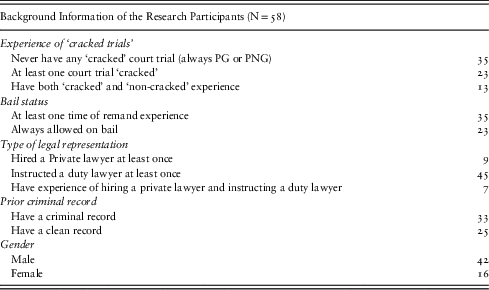
Subsequent semi-structured interviews were conducted with fifty-eight defendants to understand their decision-making with respect to plea decisions. The sample includes defendants who had experienced cracking their trials, pleaded guilty at the first available opportunity, and defendants who had experienced both. Background information about the research participants can be found in Appendix 1. Ethical approval was obtained in the corresponding author’s university before the commencement of the study. The defendants were recruited through referrals by non-governmental organizations that work with defendants across Hong Kong and the interviews took place in a private office of these organizations to allow the defendants to speak candidly. The interviews asked defendants about their plea decision-making process, what factors affected their eventual decision, and why they were important. Prior to each interview, the purpose of the study was explained and written consent was obtained. All the interviews were audio-recorded and later transcribed for analysis. The interviews lasted between 30 minutes to the longest being around 2.5 hours, with the average interview being approximately one-hour long. In order to protect the identity of the interviewees, they are referred to as N1, N2, N3 etc. in the order in which they were interviewed.
F. Research Questions and Hypotheses
The main research questions in this study are what factors affect defendants’ decisions to crack their trials and why these factors are salient. To answer this, several rivalling hypotheses are tested.
H1 Defendants, especially those with more criminal convictions, will ‘play the system’ and enter late guilty pleas because of some tactical advantage.
H2 Defendants who are represented by publicly-funded lawyers are more likely to enter guilty pleas because of ‘advice’ by their legal representatives to do so.
H3 Defendants who want to test the prosecution’s case in trial are more likely to hire a private lawyer.
H4 Defendants who are denied bail are more likely to ‘crack’ because of the hardships of being detained in a remand centre.
G. The Data
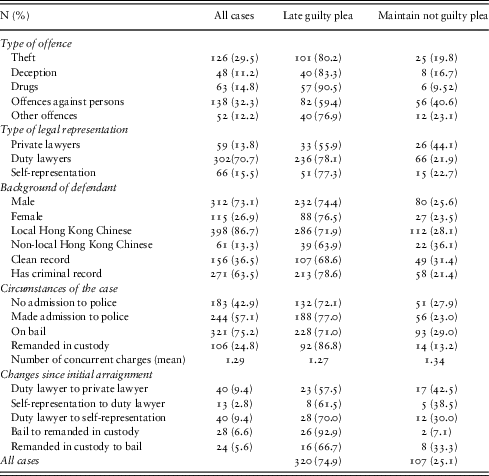
Of the 427 defendants that were set for trial, 320 (74.9 per cent) of cases were cracked by way of a late guilty plea before the commencement of trial, with only 107 cases (25.1 per cent) maintaining a not guilty plea.Footnote 71 Table 1 illustrates the descriptive statistics of the sample in terms of late guilty pleas compared with defendants that maintained their pleas of not guilty. For defendants represented by duty lawyers or who were self-represented, most of them entered a late guilty plea. For defendants with a criminal record, more of them changed their plea from the previous plea of not guilty to one of guilty prior to trial compared with defendants with clean criminal records. A higher percentage of defendants who were remanded in custody chose to enter a late guilty plea compared with the percentage that did so amongst defendants who were continuously granted bail.
Descriptive statistics of the number of late guilty pleas and maintaining of not guilty pleas (N = 427)
IV. QUANTITATIVE RESULTS
A. Late Guilty Plea or Not
To examine the research questions in greater detail, regression analyses were employed. The first regression, Model 1, included all the independent variables except for those relating to changes since initial arraignment. The purpose was to determine whether criminal convictions, admission to police, type of legal representation, and bail status would affect defendants’ decisions to enter late guilty pleas while controlling for the type of offence and demographic characteristics of the defendant. As presented in Table 2, defendants who were represented by duty lawyers or were self-represented were more likely to enter a late guilty plea compared with defendants who had hired private lawyers. Similarly, defendants who were remanded in custody were more disposed to entering a late guilty plea compared with defendants who were on bail. However, both criminal convictions and admission to the police were not found to be statistically significant. The only other variable that was found to be statistically significant was offences against the person. Defendants charged with such offences were negatively associated with the likelihood of entering a late guilty plea compared with those charged with theft. None of the demographic characteristics of defendants, namely gender and ethnicity demonstrated any significance.
Logistic Regressions on Cracked Trials

*p<0.05; **p<0.01
The second regression, Model 2, included some changes since the initial plea arraignment. Specifically, this regression model examined the changes in terms of legal representation. As Table 2 indicates, of the three changes with respect to legal representation, only the change where defendants went from a duty lawyer to a private lawyer was found to be significant. A change from initially being represented by a duty lawyer at the initial plea arraignment to subsequent representation by a private lawyer at re-arraignment was negatively associated with the likelihood of entering a late guilty plea. This is consistent with the previous finding in Model 1 where representation by private lawyers was associated with a lower likelihood of entering a late guilty plea. Once again, defendants who were remanded in custody were more likely to enter a late guilty plea compared with defendants who were on bail.
The third regression, Model 3, examined specifically the changes of bail status since the initial arraignment along with the previous variables of type of offence, type of legal representation, background of the defendant, and the circumstances of the case. The goal was to test the effects of going from having bail to being remanded in custody and conversely the effects of going from being remanded in custody to having bail on the likelihood of entering a late guilty plea. As illustrated in Table 2, neither of these two changes in bail status had any effect on late guilty pleas. This result is contrasted with the previous finding where being remanded in custody was positively associated with the likelihood to enter a late guilty plea. It would appear that prolonged custody is significant whereas loss of bail since initial plea arraignment is not. Being represented by duty lawyers and being self-represented continued to be significantly correlated with a higher likelihood of entering a late guilty plea compared with being represented by a private lawyer. Also, offences against persons continued to demonstrate a negative association with the likelihood of entering a late guilty plea.
The statistical results do not show that defendants with more criminal convictions are more likely to crack their trials because they are ‘playing the system’. In this way, H1 is not supported. However, the results do support H2 and H3 as defendants represented by duty lawyers are more likely to crack, and defendants who hired a private lawyer and those that switched to private representation are more committed to trial. Likewise, prolonged pre-trial detention is positively associated with the likelihood of entering a late guilty plea. Hence, H4 is supported.
V. QUALITATIVE FINDINGS
The interviews help to add meaning to the quantitative results, in particular as to why defendants who are represented by duty lawyers, as compared to those who hired a private lawyer, and defendants who were remanded in custody are more likely to enter late guilty pleas. The interviews also asked about whether defendants considered ‘tactical advantages’ when deciding to enter a late guilty plea.
A. Duty Lawyers
In the minds of the defendants, duty lawyers are paid for by the government and would not act in their interests in advocating for an acquittal. They believe that because they only pay a flat fee to engage the services of a duty lawyer, the duty lawyers would only make ‘minimum’ effort. Therefore, defendants who do not plan on contesting the prosecution at trial would not engage a private lawyer. For instance, one defendant, a 50-year-old female who was convicted of a drug offence, had this to say about duty lawyers:
They would only do the basic and minimum part of their work. They would not care about the result so much … I felt that the duty lawyer did not put much effort into my case. He just followed a standardized working pattern ... Although I did not hire a private lawyer, I think a private lawyer would have been able to put more effort into my case. I regret not hiring a private lawyer. (N51)
Similarly, there are defendants who claimed that duty lawyers would advise them to plead guilty because they did not want to put in the effort to defend their cases. Some defendants had harsh words for duty lawyers, as one younger male defendant who was also convicted of a drug offence through a late guilty plea, stated:
The duty lawyers would only ask you to plead guilty … They are ‘government’ lawyers and will not help you … They have many cases to handle every day. They would only ask you to plead guilty. They will not help you to present your side of the story in trial … They are lazy. They would not help you to argue for your case. (N14)
Other defendants were more neutral in their responses, and said that it depends on whether you are fortunate to get a more responsible duty lawyer or not, as a female defendant in her twenties who pleaded guilty to theft at the first opportunity, said:
I think the duty lawyers are treating their duty as a job only. The final result of the court judgment would not affect their income. Only those who are kind enough would help you to say something in the mitigation process or help you to pass a plea letter to the judge. It really depends on whether I am lucky enough to get a responsible duty lawyer. If the duty lawyer does not put in full effort in the courtroom, it’s impossible for me to voice out my objections. (N58)
Duty lawyers mainly inform defendants of the incentive that a guilty plea would most likely result in a sentence discount. Although advising clients on the sentence discount is not wrong – it is actually the duty of defence lawyers to tell their clients that a guilty plea is a powerful mitigating factor as stipulated by their code of professional conductFootnote 72 – and combined with the view that duty lawyers would not be ideal in securing an acquittal at trial, many defendants felt that their best option was to plead guilty. For many defendants, the most they can hope for from duty lawyers is that they make a plea in mitigation on their behalf in the hope that the court would impose a more lenient sentence. One male defendant in his early twenties who entered a late guilty plea for possession of a dangerous weapon pointed out:
I think the duty lawyer was not ‘qualified’. They just wanted to get a fixed pay. Some might be very good, but some were not. The duty lawyer would be more helpful if you pleaded guilty and planned to make a mitigation plea. However, if you would like to get acquitted, it’s better to get a private lawyer. (N18)
The above illustrates how the choice of lawyer – in particular the decision to engage a private or a publicly-funded lawyer – is shaped by the defendant’s intention to plead guilty, as well as the advice provided by the lawyers to the defendant.
B. Prolonged Remand in Custody
The other significant factor is prolonged pre-trial detention – the defendants who were remanded in custody before their initial plea arraignment were more disposed to cracking. The interviews reveal that the undesirable conditions of being remanded in custody serve as a source of pressure on them, and such conditions are therefore an important reason why defendants want to escape being remanded; and the most direct way for them is to change their plea. One male defendant in his fifties who had been remanded in custody numerous times for a variety of offences stressed:
It’s quite a hard time to be put on remand in [the remand centre]. It’s very crowded. There was not much space for us to move or do exercise. Usually 80 to 90 people stayed in one activity room. The rooms were full of people … Conflicts and fights happened very frequently. There were no air conditioners there. In the summer, the smell of sweat and other bodily smells made the environment very uncomfortable. (N38)
This is compounded by the fact that detainees are not given a job to do in the remand centre. This is unlike prison where prisoners are often given jobs. The same interviewee explained that not having anything to do is worse as the idleness makes the time being remanded unbearable and it makes making a late plea to get their cases over with more appealing. In such a situation, the defendant may ask their lawyer to write to the court indicating a change of plea and hope that the court will call the case earlier for another plea to be taken. The case would normally be heard by the magistrate who was set to hear the trial and not before the Principal Magistrate in Court No. 1. The defendant said:
In [the remand centre], we didn’t have a job to do. In prison, we would have a job to do and we could pass the time more easily. It’s too boring in [the remand centre]. We only have a small television for everyone to watch. For most remanded individuals, it’s difficult to stay there waiting and doing nothing. We would prefer to end the case. (N38)
As the time spent in pre-trial detention increases, there is more incentive for defendants to forego trial, and this may especially be the case when remanded defendants are encouraged by their legal representatives to do so, as a 45-year-old male defendant who was charged and convicted of money laundering recalled:
I pleaded not guilty at the first court session. After being sent to [the remand centre], the government (duty) lawyer came to ask me to plead guilty. He told me that it’s possible for me to receive a shorter punishment. I realized that I had already lost my freedom for more than one month. I had to think if I wanted to continue to go for a trial or if I wanted to plead guilty in order to get a more lenient punishment. (N34)
There may be other detrimental consequences resulting from a lengthy stay in the remand centre that are not as evident. Many defendants come from a lower socio-economic background where they live in public housing and pay their rent monthly. One defendant, a 50-year-old male convicted of theft and selling goods that infringed copyright, explained how he remained in remand for over a month and that cost him his home and personal belongings, as he described:
When I was arrested and detained, no one would pay the rent of the flat in the public housing estate for me. The flat was taken back by the government. I had to re-apply after I was released … No one could help me to pay the rent at that time. When I did not pay the rent for one month, the Housing Authority (the government department responsible for public housing) took back my flat. (N46)
When asked about the belongings he had in his flat, he replied that: ‘They were put on the street and taken away.’ It would appear that as the length of time increases in pre-trial detention, there is more pressure to forego trial by pleading guilty.
C. Tactical Advantage
One factor that deserves more attention is the possibility of defendants waiting to plead guilty because of some tactical advantage. This is, after all, cited as the major reason for cracked trials in government reports. While it was not possible to fully account for tactical advantage in the quantitative analyses, in the interviews we asked the defendants whether they attempted to obtain a tactical advantage. Most of the defendants indicated that they neither attempted to ‘game the system’ nor knew how to do so when deciding on their pleas. Some defendants who had more experience going through the court system revealed that a possible tactic is to delay their guilty pleas in order to avoid sentencing by certain magistrates who were perceived as harsh in their initial plea arraignments in the hope that a subsequent magistrate in the trial court would be more lenient. Although some defendants disclosed that they have tried to do so before, they acknowledged that it is difficult to control the outcome using this tactic and that they quickly gave up on it. For instance, a male defendant who had three criminal convictions for assault stated:
Yes, I did use this tactic. It’s a matter of luck. Sometimes, it’s not possible to avoid a particular judge even if I employed this method. In one of my previous cases, the case ended up being handled by another judge who gave me an even heavier punishment. This is my personal experience. Another defendant who continued to be handled by the original judge was given a more lenient punishment, just half the length of mine. The ‘new’ judge for my case was a woman, I thought she would be more lenient and would understand my difficulty. However, she gave an even heavier punishment to me.
The defendant continued:
I gave up (on this tactic). I did not care who the judge was in my next court hearing. Sometimes, when I was assigned to a lenient judge, he might be on holiday on the date of my trial session. It’s really difficult for me to arrange for myself to be heard by a kind judge. (N36)
Another defendant who wanted to avoid a particular magistrate similarly said:
When Judge [omitted] was the principal magistrate in [Court A], many people would choose to plead not guilty. By pleading not guilty, there is a chance that your case would be allotted to another court for the next session. On the other hand, if Judge [omitted] was not the principal magistrate and your case was being allotted to his court, you had no way to escape from his control. That is very unlucky for you … Sometimes it is not possible for you to escape from the control of a particular judge. The judge could insist on handling your case in some situations. (N38)
In these situations, the magistrate can insist on bringing a particular case back to his or her court for a subsequent hearing. While defendants attempting to ‘play the system’ are a possibility, it is not an easy feat to pull off. Therefore, according to the qualitative findings, H1 is again not supported.
VI. DISCUSSION
Cracked trials are viewed as an increasing problem in the criminal justice process from both an efficiency and due process standpoint. We found no support in this study for the assumption that experienced defendants are delaying their pleas for some tactical advantage. This is important to highlight because the reforms that have taken place to discourage late guilty pleas have been based on this assumption. If it is true that defendants are not ‘playing the system’ and that the justice system penalizes individuals for making late pleas, then reforms do more to undermine the integrity of the justice system and its values, including the presumption of innocence.
Rather, the results reveal that defendants who were represented by duty lawyers were more likely to enter a late guilty plea compared with defendants represented by private lawyers. Moreover, defendants who were remanded in custody were more likely to enter a late guilty plea compared with their counterparts on bail. The perception by defendants that publicly-funded lawyers convinced them to plead guilty and the hardships of being remanded in custody support the notion that it is the pressure of the criminal justice system that leads defendants to crack their trials.
The finding that publicly-funded legal representation influenced cracked trials is consistent with the existing literature. Previous ethnographic studies in England have pointed to publicly-funded lawyers demonstrating a lacklustre effort in defending their clients and encouraging them to plead guilty.Footnote 73 In Hong Kong, while there are no full-time public defenders and duty lawyers are drawn from a list of lawyers in private practice, there is a difference in the way that defendants perceive publicly-funded lawyers as compared with private lawyers.Footnote 74 Defendants who do not plan on contesting the state’s case against them would not hire an expensive private lawyer. At the same time, the image of the duty lawyers is that they are not there to advocate for an acquittal but are there to ask defendants to plead guilty. Another possible reason for why duty lawyers are perceived as encouraging defendants to enter late guilty pleas may be because they do not look at the case closely until there is a need to prepare for trial. When duty lawyers first meet with their clients, they may not have all the relevant information and are given a limited time to discuss with their clients.
Another significant variable is bail status (ie, defendants who are remanded in custody for a prolonged period). What is interesting is that the change from initially being on bail to having bail subsequently cancelled was not found to be significant with respect to late plea decisions. The main reason derived from the interviews is the poor conditions of remand centres. Remand centres are often crowded because of the many detainees processed through them. Unlike in prisons where inmates can work and earn money or attend classes, there is also a lot of idle time in remand centres. Defendants remanded in custody are confined there simply to await trial. Although they are still considered as ‘unconvicted remand prisoners’,Footnote 75 this status is not considered as a benefit because they would not be given tasks that the convicted prisoners would be given. Idle time may be more difficult to endure than time spent performing assigned tasks, which may give inmates a sense of purpose. As the length of stay in remand centres increases, the experience becomes increasingly difficult to bear and detainees have ample time to agonize over their possible conviction. In other words, the pressure on defendants continues to mount with each passing day, and they eventually crack and enter late guilty pleas.Footnote 76 This is consistent with Feeley’s thesisFootnote 77 that ‘the process is the punishment’ (ie the experience of being processed through pre-trial court procedures, including pre-trial detention, is the principal form of punishment for defendants). Such punitive experiences often outweigh the eventual sentences, particularly the relatively lighter sentences imposed by the lower courts.
In the early 1990s, prior to the implementation of advanced sentence indications and the sliding scale of sentence discounts, a Crown Court study was commissioned to examine the scale of innocent defendants pleading guilty in England. Questionnaires were distributed to legal practitioners, and one question specifically asked whether the respondent had concerns that there were innocent defendants pleading guilty. It was discovered that defence lawyers replied that there had been numerous cases where they were concerned that innocent defendants may have pleaded guilty. On an annual basis, the statistics suggest that as many as 1,400 innocent defendants may be pleading guilty each year.Footnote 78 As discussed, the response has been to implement reforms that actively encourage defendants to plead guilty at the earliest opportunity. Since the sliding scale of sentencing discounts has been implemented in England and Wales, it was found that judges generally comply with the guidelines. Most defendants who pleaded guilty at the first available opportunity received a one-third sentence discount and the reductions were lower for late guilty pleas.Footnote 79
This study, which examines a context without reforms that actively discourage late guilty pleas, reveals that there are pressures on defendants to crack their trials. The results indicate that reforms – the advanced sentence indications and a sliding scale of sentence reductions – are likely to do more to enhance the pressures on defendants; such reforms may lower the incidence of cracked trials but will increase pressure on defendants to plead guilty. While these reforms may or may not increase the incidence of innocent people pleading guilty, they will likely increase the incidence of innocent people pleading earlier. The one-third discount (and the subsequent reductions as time passes) may become the overriding factor. The findings of the current study run contrary to the rationales for the reforms of the sliding scale of sentence discounts that effectively punish defendants who do not plead guilty immediately. Cracked trials are not predicated on defendants waiting to game the system; rather, they are a result of the unpleasantness of pre-trial detention and the efforts of publicly-funded lawyers who eventually succeed in convincing their clients to plead guilty.
A better response is to reduce the use and duration of pre-trial detention and to improve the conditions of the remand centre. With respect to defence lawyers, greater financial incentives could be a way to encourage publicly-funded lawyers to take cases to trial especially after the opportunity of an early plea has passed. Besides these, Hong Kong needs to address the problem of its shortage of judges (including magistrates) and find better ways to encourage lawyers to enter the judiciary. This would involve not simply increasing remuneration but also support to the court system to improve the working environment and efficiency for members of the judiciary.Footnote 80
Several limitations of this study need to be highlighted. A limitation needs to be noted with respect to the variables of ‘changes since plea arraignment’. In the sample, there were not many cases where there was a change, so although some variables were significant, their limited frequencies need to be acknowledged. Moreover, this study only focused on one magistrate’s court in Hong Kong, and it did not sample cases that were transferred to the higher courts. Thus, the study only captured cracked trials in the lower courts of Hong Kong. Another limitation is that the focus of this study was on defendants; it would be useful to gain the perspectives of legal practitioners in Hong Kong such as prosecutors and defence lawyers on the subject of guilty pleas and cracked trials.
It is in the interest of the state to balance the need to convict guilty persons efficiently and to ensure that innocent defendants who get caught up in the criminal justice system are acquitted. The criminal justice system would fall into disrepute and lose the confidence of the public if it results in guilty pleas by innocent people. Furthermore, the findings underscore that the defendants’ considerations underpinning their late guilty pleas may have little to do with their guilt. The justice system already incorporates different pressures that would persuade defendants to plead guilty, and the reforms penalising late pleas have increased such pressure on defendants. The balance is therefore increasingly tipped against the defendants who might wish to exercise their legal right to challenge the state to discharge its burden of proof in a contested trial.
APPENDIX 1