Of all the performative claims that the confessional act presumes to make, rarely is it more assured than in its avowal of the confessing ‘I’. Whether of a broadly judicial or sacramental variety, the confession is nothing if not an embodied act of self-revelation and, as such, an actualization of the subject's sovereignty. Of course, this is by no means uniformly positive. Within the courtroom or the oratory, to confess is more often to expose the otherwise veiled, internal subject to the recriminatory eye of the jurist or the priest. It is to assert a shameful self to be acknowledged only so that it may be reprimanded. This is, nonetheless, as much a salving act as it is a reproachful one. To follow Freud in an early reflection upon the logic of these rites, the confessional compels the subject to articulate and, thereby, sluice the guilty secrets that otherwise threaten to disable them.Footnote 2 In this way, confession is conceived as a powerfully enabling act of self-making. The ‘privileged communication’ of the confessant, as civil and common law generally name it, serves to verify as well as fortify the speaking subject. In religious custom, too, the potency of the act resides in its capacity to perform and, to follow the ritual orthodoxies of the confessional outlined by the literary critic Peter Brooks, ‘in a sense create’ the unified inwardness of the confessant. In short, ‘speaking guilt’ is precisely constitutive of the sovereign self.Footnote 3
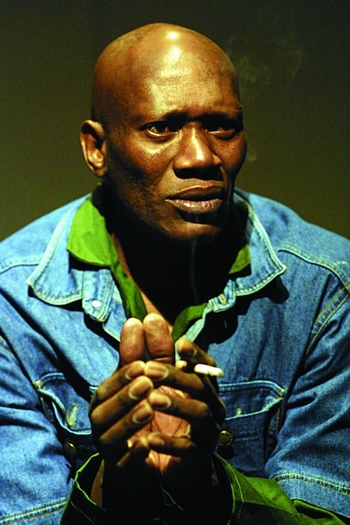
But what claims to sovereignty are available within a moral sphere from which religious instruction has begun its ineluctable retreat, or, more decisively, in the aftermath of the law's catastrophic failure, something witnessed with terrible regularity over the past century? This is one amongst a host of exigent questions to emerge at the beginning to Yaël Farber's He Left Quietly (2002), a confessional drama staged in the immediate wake of South Africa's transition from apartheid. Entering onto a tenebrous performance space, a man appears before the audience in starkly immaterial terms. Only the outline of his frame is visible against the soft, low backlighting that guides his languid progress to a chair at the centre of the stage. Sitting down, the man then lights a cigarette and stares out meditatively towards the audience. During this contemplative, noiseless minute, time appears to eddy. The silence is only broken when the man asks,
When does the soul leave the body? . . . At which precise moment? Does it leave with our last breath? . . . Or the final beat of our heart? Is it possible that I stayed here amongst you – the living – long after my soul quietly left my body behind?Footnote 4
It is a stoical deliberation upon the desolate ‘I’ that appears in body but deprived of spirit before the audience, one that precipitates yet further metaphysical insecurity:
In my life I have died many times. But here I am again and again – alive. I am Duma Joshua Kumalo. Prisoner Number V 34–58. In 1984, I was condemned to death for a crime I did not commit. I spent three years on Death Row, and [served] a further four years of a Life Sentence. I have been measured for the length of my coffin; the size of the rope for my neck; I took the last sacrament . . . And with each of these moments, my soul left my body.Footnote 5
Bearing public witness to his own suffering on death row, the man is not engaged in any conventional confession to wrongdoing. This is no act of guilty self-articulation in either the legal or the spiritual sense. Nonetheless, in line with all such confessional disclosures, the man appears desperate to avow before the audience the markers of his existence – his full name, his institutional alias, even the dimensions of his physical being – and with each marker a claim upon his own fragile sense of selfhood. Instead, he manages only to contour the shape of a subject for whom the ‘deep, recessed, secret self’ has been hollowed out and eviscerated.Footnote 6
Duma Kumalo delivers his confession alone upon the stage in He Left Quietly. Photographer: John Hogg.

This confessional failure is deeply unsettling, and not just for the individual confessant or, indeed, the audience made witness to his traumatized testimony. Rather, Kumalo's faltering claim upon the self also stages, I contend, a profound challenge to the confessional technology made fundamental to the country's own efforts to forge for itself a new national sovereignty, a new stable identity, in the wake of apartheid. It is not simply that his confession, like those many thousands delivered by fellow victims of human rights abuse at the country's Truth and Reconciliation Commission (1996–2001), betrays what Michel Foucault was determined to establish elsewhere as ‘the effect of a power that constrains’ the confessing subject.Footnote 7 Certainly, there is a potential moral violence to the model of reconciliation made central to the country's democratic transition – a violence to which I will return directly. But He Left Quietly also pursues, I want to suggest, a heterodox confessional contract, one that relies, above all, upon an inability to create the self – at least the integrated, autonomous version of the self that ritual institutions like the law attempt to uphold. And by recuperating the negative potential of this confessional inability, I want to explore how Farber's play helps model a form of personhood premised upon the irredeemable, rather than forgivable, suffering inflicted under extreme political conditions like apartheid.
In the context of South Africa's ongoing struggle to redress the traumas of the past there remains a relative urgency to this enterprise. But this is not the sole motivation for returning to a play staged originally in 2002 during a period of comparative national hope, something encumbered since by increasing disillusionment.Footnote 8 Kumalo himself did not live long enough to see the more recent fractures of the democratic national project, passing away in 2006 aged just forty-nine. The tenth anniversary of his death was marked in August 2016 with the inaugural Duma Kumalo Lecture at the Vaal University of Technology, an institution close to Kumalo's former home in Sharpeville, where speakers reflected not just on the suffering he endured as a result of his imprisonment but also on his commitment to South Africa's democratic reconciliation. My article contributes in small part to this commemorative action. More substantially, I presume to retrieve from Kumalo's attenuated confession in He Left Quietly a way of thinking anew the performative claims of the act. From beneath the enduring shadow cast by apartheid, I aim to explore the ways in which his confessional performance bears repeating, or, rather, bears repeated ethical interpretation, even despite its self-evident theatrical finality and existential finitude. There is, I want to claim, an insistence to Kumalo's particular confessional act, a seemingly melancholic compulsion that, whether witnessed onstage in 2002 or, like me, in a recording some years later, does not dim with each exposure but rather obliges its own reiteration, if not in performance then in public criticism and commemoration.
Making the past public: glass confessionals
The vital context to this inquiry remains South Africa's quasi-judicial Truth and Reconciliation Commission. Inaugurated in 1996 as an instrument to undo the schisms of apartheid, this ‘public confessional’, as the sociologist Deborah Posel describes it, was determined to make productive at a national level the sovereignty putatively reclaimed by each individual confessant.Footnote 9 Under Archbishop Desmond Tutu's overtly ritualized chairmanship, the Truth Commission solicited the public testimony of both victims and perpetrators of past abuse in an effort to confront and, thereby, help repair nationally the damage inflicted by the apartheid regime. In Catherine Cole's view, the Commission was designed purposefully as ‘a place of seeing’.Footnote 10 Invoking, as such, many of the fundamental social claims operative within the Greek theatron, it ‘embraced performance’ in an effort, Cole argues, ‘to cope’ with the past.Footnote 11 The Commission was, in her view, a space in which the atrocities of apartheid could find embodied, public rehearsal and, as such, some measure of therapeutic redress. In this respect, Cole figures it as a prototypical ‘social drama’, a descriptor that, following Victor Turner, further substantiates the Commission's own investment in the cathartic, reconciliatory potential of its confessional praxis.Footnote 12 But while its hearings were, indeed, styled as spaces of revelation, the stories solicited by the Commission also extended far beyond the verifiable and the communicable, deep into the terrain of the traumatic. Moreover, examining the 1,800 statements provided publicly by victims of human rights violations in his review of the Commission, Richard Wilson profiles such a litany of individual and collective abuse, from systematic torture and murder to widespread disappearances, few of which have ever been resolved, as to challenge the country's capacity for rationalized response.Footnote 13
Whatever Cole's conviction, the enduring sense of anger and injustice circulating nationally makes clear that the Truth Commission was, in fact, ill-equipped to ‘cope’ with this excess of traumatic experience. This is not to deny the theatrical form structuring, for instance, the Commission's Human Rights Violation Committee (HRVC) hearings, particularly what Cole identifies as the layers of ‘restored behaviour’ underwriting its confessional procedure.Footnote 14 Nor is it to disclaim the remedial possibilities upheld by theatre generally. Rather, it is to challenge the national imperatives that so deeply, even violently, determined the Commission's performative form, particularly in its cathartic ambitions. Indeed, in the years since, it has proven increasingly untenable to uphold the conclusions made by its final report, in which the Commission claimed to have given public exposure to ‘experiences that had been repressed or shut out for years’, to have ‘alleviated feelings of shame’ and ‘restor[ed] dignity and self-respect’.Footnote 15 Even if the HRVC hearings were, for some, broadly affirmative, any thought of national unity was premised, as the anthropologist John Borneman is at pains to point out, ‘on the recuperation of losses that are almost impossible to recuperate, the reconciliation of an end to which there is no end’.Footnote 16 And by choosing, as it did with such insistence, to make forgiveness the constitutive object of its hearings, the Commission effectively delegitimized the public expression of anger. The claims to sovereignty made available as part of its confessional praxis were ones designed to service, it seems, the imperatives of the emergent nation state, rather than the victims themselves. To this extent, the Truth Commission might best be understood, principally, as an inductive ritual for the new nation, one that depended, whether intentionally or otherwise, upon a disavowal of its own traumatized citizenry and their feelings of disenfranchisement.Footnote 17 Without altogether ignoring the Commission's broad achievements, it is important, ultimately, to recognize that for many victims it has been unsuccessful in delivering either material or symbolic redress for the apartheid past.
Such misgivings are by no means exceptional. Indeed, the Commission's compromises, its unevenness and, ultimately, its failures as a confessional arena have been detailed at such length elsewhere as to have become almost hackneyed.Footnote 18 However, they bear some repetition here, not least because they retain profound significance for those left wrestling with their interminable feelings of loss and injustice. Intent on marshalling rather than actively disciplining this traumatic intransigence, theatre-makers in South Africa have, by contrast, helped to establish the stage as a marginal but vitally important space in which to renegotiate apartheid's most obdurate remains. Indeed, South African audiences have been witness to a small host of confessional performances in the years since the Commission's conclusion.Footnote 19 Some are more critical of the Commission than others, but like Farber's He Left Quietly, most refuse to make recourse to its salving, reconciliatory ends.
It is worth noting, in this context, that the modern South African stage is no stranger to confessional forms of performance, especially those of a more belligerent variety. As a revelatory mode of representation under apartheid, much protest theatre provided what playwright Howard Barker has described in a different context as a ‘glass confessional’ in which audiences were charged with responsibility to bear witness to the inward truth of the performer.Footnote 20 Anti-apartheid plays such as Woza Albert! (1981) and Born in the RSA (1985), now canonical in the South African repertoire, were premised above all on their capacity to expose publicly the racial injustice endured by the performers themselves in their everyday lives. Redeploying the workshop practice favoured by this protest tradition, He Left Quietly functions similarly as a confessional arena for Kumalo to testify under the empathic eye of the audience to his traumatic experience on death row.
The play was devised and scripted by Farber in close collaboration with the former inmate; the two worked intensively over the course of several weeks to craft the testimony heard in the final production. This Kumalo delivers himself almost exclusively from his seat at the centre of the stage, speaking in dialogue with a white female interlocutor, played by the production's assistant director, Yana Sakelaris. The story Kumalo tells is as ordinary as it is extraordinary. Having grown up in the Vaal triangle – a poor, black industrial region south of Johannesburg – Kumalo was forced, like the rest of the country's black majority, to endure apartheid's everyday impoverishments. However, following his involvement in a deadly protest in Sharpeville in 1984, the details of which pattern his testimony in He Left Quietly, Kumalo was convicted of murder under the controversial law of common purpose and sentenced to death.Footnote 21 Along with the rest of his co-convicted, a group of fellow protesters known subsequently as the Sharpeville Six, he was eventually granted a last-minute stay of execution in 1988, before being released in 1991 as part of the country's negotiated transition to democracy.
In accounting for the play's confessional scaffolding, Farber claims in her director's notes that Kumalo was ‘driven by a powerful will to have his story told and heard’.Footnote 22 And much like the Truth Commission, Farber's production prioritizes the integrity of the confessant's self-expression, granting Kumalo the opportunity to relay unchallenged the details of his trial along with his experience on death row. It is a story replete with institutional injustice and maltreatment, desperate acts of self-assault and a rare, disquieting insight into the existential collapse occasioned by the knowledge of his imminent execution. Indeed, like many of the submissions heard by the Commission's HRVC, Kumalo's confession uncovers the horror of the apartheid regime in terms so overwhelming that it makes this history difficult, if not also impossible, to comprehend. However, He Left Quietly deviates from the confessional model aimed at by the Commission in its positive refusal to attempt any measure of redemptive relief, individual or otherwise. And, as his opening statement in part confers, Kumalo's powerful will to have his story told and heard appears to be underpinned not by a sense of shame that might be sluiced – as the confessional orthodoxy set out by Brooks would have it – but by an internal devastation, by a disintegration of the speaking subject at the precise point of its own confessional avowal. In this way, Kumalo's confessional imperative appears paradoxically self-defeating, especially when it becomes clear that in pursuing this end he also embarks, night after night, upon a performative exposure of the very traumas that first triggered his thanatopsistic state – that is, his spiralling fixation upon his own death.
To this extent, there can be no denying the ambivalent ethical foundations of Farber's play, particularly Kumalo's own role in the production, which, it seems, risks re-traumatizing as much as consoling the confessant. In this context, it is worth noting that Kumalo's performance in He Left Quietly is by no means the first occasion upon which he appears compelled to confess publicly to his suffering under apartheid. Not only did he appear twice before the Commission, but Farber also witnessed his story originally as part of his performance in the Khulumani Support Group's The Story I Am About to Tell (1997–2001). He was also the principal subject of Ingrid Gavshon's documentary film Facing Death . . . Facing Life (2000), for which he returned to the confines of his cell on death row in order to testify. As such, it is far from evident that these confessional performances have enabled Kumalo to ‘reclaim’, as Farber also argues, something of the sense of selfhood otherwise lost to death row, especially since each iteration upholds the potential to extend rather than end his trauma.Footnote 23
Indeed, reclamation is, I suggest, an erroneous shorthand for the complex, even contradictory, treaty that Kumalo's performance in He Left Quietly brokers with the apartheid past, not least because the nightly reiteration of his suffering on Farber's stage runs counter to the regime of repression – speaking guilt – that ordinarily underwrites confession's self-producing end. It is not simply that Kumalo retains some powerful will to have his story told and heard. Rather, there is also something highly disruptive, at least as far as the technology of confession is concerned, at the root of his unremitting and irredeemable urgency to speak out each night. His persistent desire to confess even to his own internal devastation, or, to follow Freud's account of shame and self-expression in ‘Mourning and Melancholia’, his ‘insistent communicativeness’, exhibits, it seems, a paradoxically insatiable ‘satisfaction in self-exposure’.Footnote 24 Unable to articulate any decisive claim upon the sovereign subject, his confession appears to challenge the self-actualizing imperative that might otherwise be presumed to motivate his nightly confession. Repetition does not appear to yield any relief; rather, it seems to spotlight more intensely the relative failure of his confessional claims upon the self.
This insistence on speaking out again and again is vitally instructive, and not just because it sets Kumalo's confession at direct odds with the redemptive logic upon which institutions like the law, the Church and, belatedly, the Truth Commission have thrived. Indeed, it is the irredeemable, repetitious structure underwriting his nightly performance – rather than the more prosaic theatrical repeatability that Cole figures in those submissions made before the Commission – that brings us to the precise challenge posed by He Left Quietly. For while Kumalo certainly displays as part of his performance a fragmented self in search of repair, the compulsion to communicate this suffering onstage night after night appears not simply to displace the self-actualizing logic of the confessional act. Rather, returning to Freud, this confessional displacement might most productively be understood as symptomatic of a specifically melancholy theatrical structure, one that appears to enable something more than just an abortive claim upon the sovereign self, something that approaches, instead, an ethical act that makes a claim beyond the confines of the confessant.
Melancholy in theory: psychoanalysis, history and performance
Melancholy as a frame through which to approach trauma and its shattering, irredeemable effects upon the individual is already well established, and not just in the fields of psychoanalysis and psychotherapy. For instance, Dominick LaCapra, who regularly privileges the psychical symptoms of traumatic events like the Holocaust in an effort to understand their historical implications, describes how the melancholic survivor of an extreme experience like death row ‘resist[s] working through [the past] because of what might almost be termed a fidelity to trauma, a feeling that one must somehow keep faith with it’.Footnote 25 He reflects, too, upon the melancholic's symptomatic cycles of repetition and reinscription whereby ‘tenses implode as if one were back there in the past reliving the traumatic scene’.Footnote 26 This type of analysis draws explicitly from Freud's elementary distinction between the ‘normal’ process of mourning and the attenuated experience of melancholy. The latter, Freud claims, is incapable of integrating and thereby relinquishing the lost object, whether directly or as ‘some abstraction which has taken the place of [it]’.Footnote 27 Instead, the melancholic's feeling of loss becomes pathological, turning grief's rupture inwards onto the fragile ego. The result, Freud maintains, is a ‘lowering of self-regarding feelings to a degree that finds utterance in self-reproaches and self-revilings, and culminates in a delusional expectation of punishment’.Footnote 28
In performative terms, Kumalo's ‘powerful will’ to enact night after night the traumatizing details of his suffering on death row appears to rehearse, too, the self-reproving symptoms that Freud attributes to the melancholy subject. Indeed, the loss of personal liberty is, in Freud's view, one of melancholy's most prominent beginning points, even if he does not understand its articulation in overt, theatricalized terms. In accounting more fully for the melancholy that determines Kumalo's reiterative confessional performance, however, the theatrical valence of LaCapra's analysis proves more supple than Freud's own. For instance, LaCapra outlines how the melancholic becomes caught in a cyclical ‘acting out’ of the past. Unable to mourn and thereby let go of their loss, victims often find themselves destined to reinscribe their own traumatic experience. Such is the intractability of their suffering, LaCapra concludes, that the melancholy individual remains ‘performatively caught up in the compulsive repetition of traumatic scenes’.Footnote 29 In this, he anticipates the thoroughgoing coextension between the theatrical and the psychotherapeutic that has become a mainstay not just of trauma theory, or indeed of the type of performance analysis deployed by critics like Cole to appraise a social drama like the Truth Commission. Rather, in a consummate account of the therapeutic impulses underpinning contemporary theatre practice itself, Patrick Duggan and Mick Wallis cast trauma's collective and individual catharsis as ‘a key responsibility for theatre/performance practitioners’.Footnote 30 For them, theatre provides ‘a technical apparatus’ through which society might ‘aim to live beyond trauma’.Footnote 31
What this type of analysis regularly omits, however, is the fact that this acting out is not always also a working through, at least not in a psychotherapeutic sense. And when extended to prop up the consoling, and potentially coercive, ambitions of an event like the Commission, this faith in the ‘restorative efficacy’, as Duggan and Wallis put it, of trauma's theatrical rehearsal proves particularly problematic.Footnote 32 In moving, therefore, in the remainder of this article to look in closer detail at the ways in which He Left Quietly might enable us to rethink such traumatic acting out, I choose to prioritize those moments in which Kumalo appears to refuse theatre's redemptive, therapeutic end, those moments of repetition and reiteration that frame most clearly the melancholy compulsion to his performance. For in contradistinction to a critic like LaCapra, who argues that to ‘believe in anything like a viable democratic politics’ is to believe in the ‘ethical solutions’ that flow from a therapeutic working through of injustice,Footnote 33 I want explore how Kumalo's confession alerts us to the democratic solutions that might also begin with a melancholy refusal – that is, with theatre's failure as a site of recovery from trauma and injustice. Again, this is not to embark upon an anti-theatrical interpretation, but rather it is to expand upon the possible ethical charge underwriting Kumalo's performative inability to work through suffering and lay claim to some integrated sovereign self.
Melancholy as theatre: repetition and radical unsettlement
To appreciate theatre's primacy within this confessional schema, it is important to recognize that Farber's stage is as much a precipitant or cue as it is some substitutive theatrical site for Kumalo's melancholy acting out. Indeed, Farber frames his confession in such a way as to figure, but also ensure, a melancholy fidelity with the performer's own traumatic past. This begins when Farber moves, following the play's stoical opening scene, to set the confessant against an unsettling image of the self as other. Neither imagined, nor altogether real, this secondary, surrogate self, named Young Duma and played by the production's only professional performer, Lebohang Elephant, materializes onstage by way of an incantatory ritual. Kumalo, still seated on his chair before the audience but partially veiled by a cloud of cigarette smoke, begins to chant in isiZulu an item of Christian liturgy (Jonah 2:6–7):
The waters closed in over me.
The deep engulfed me.
Reeds were wrapped around my head.
I sank to the base of the mountain.
I went down to the land whose bars closed over me forever.Footnote 34
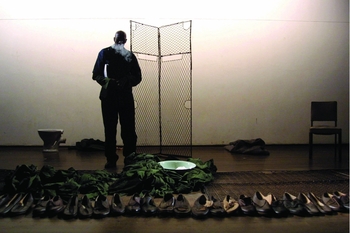
From amidst a heap of old green prison uniforms and shoes piled in a dark corner of the stage, Young Duma rises up, stumbling across the otherwise bare stage like the biblical Jonah – himself dragged down towards the realm of the dead before being unceremoniously regurgitated back into the land of the living. This seeming avatar of death row, dressed in prison garb but not yet encumbered by any traumatized torpor, then lights a cigarette in a gesture designed as much to assert his material presence upon the stage as to make clear his ontological link to Kumalo.Footnote 35 Any of the nominal truth-claims that might be thought to sustain Kumalo's confessional act are here overtaken by a ritualism that inaugurates and then hardens into a surrogate form of the confessant's remembered self, a self that is also made other.
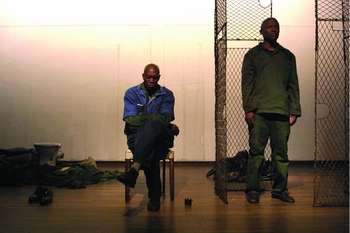
Duma Kumalo and Young Duma, the confessional self and its other, alongside one another in He Left Quietly. Photographer: John Hogg.

The simultaneity onstage of the present and the past, of the confessional self and its embodied other, provides the audience with an external expression of the internal melancholy collapse around which Kumalo's performance more generally turns. It articulates the traumatized ‘duality (or double inscription)’ of time and subjectivity that, to follow LaCapra's logic, so insistently disrupts Kumalo's confessional claim upon the self.Footnote 36 More than just a performative exposition of a psychic division, however, Young Duma also helps to give phenomenological form to the otherwise inexpressible suffering that Kumalo reportedly experienced on death row. For in fashioning this self as other, Farber deploys Young Duma to make legible, if not absolutely knowable, Kumalo's treatment at the hands of the apartheid penal system in a way that the confessant himself, languid and largely immobile for much of the production, cannot. This is, on the one hand, a pragmatic choice on Farber's part. For despite being aged only forty-five at the time of his performance in He Left Quietly, Kumalo's experience on death row had left him chronically fatigued. On the other hand, in spotlighting Kumalo's physical incapacity within the work, Farber also draws the audience's eye to the confessional failure of his body. In this way, Kumalo's inability to give theatrical presence to his experience bears its own witness to the irredeemable loss exacted by death row. His embodied inability is only made more stark by Young Duma's comparatively busy presence upon the stage, regularly pacing behind his authoring, older self – imprisoned by the spatial and temporal boundaries of the stage but not yet burdened by the trauma of death row that Kumalo moves presently to describe.
As Kumalo proceeds, from his chair in the centre of the stage, to relay the facts of his detention under apartheid's notorious Section 29 of the Internal Security Act and his subsequent conviction for murder, Young Duma is the one charged with acting out, in a theatrical and traumatic sense, Kumalo's experiences in all their disquieting detail. From his arrival at Pretoria C-Max Prison, where he was stripped naked and invasively searched, to his first night in the cell, which contained nothing more than a wooden bench and several soiled blankets left by previous inmates, Young Duma ensures that the audience are made witness to the everyday humiliations of Kumalo's incarceration. Standing within a makeshift metal cage that has been erected on the stage, the performer oscillates, almost manically, from states of depressed quietude, reading passages from his prison-issue Bible, to unbridled hysteria, shouting frantically at imagined prison guards. The restored behaviour that Cole ascribes generally to the traumatized confessions heard at the Truth Commission is here made separate to, and at an embodied distance from, the confessant himself. For while Kumalo remains seated throughout, giving stoical voice to the daily abjection that accompanied his time on death row, it is Young Duma who, as his apartheid other, is charged with giving form to its distressing effects. Of course, to recall Richard Schechner's precise description, such restored behaviour is always ‘separate from those who are behaving’.Footnote 37 This confessional separation or ‘secondness’, as Schechner terms it, is merely made extreme upon Farber's stage in an effort to give shape to Kumalo's own peculiarly melancholy sense of his self as ‘someone else’, as traumatically ‘beside himself’ upon the stage.Footnote 38
As far as the fundamental ethics of this dramaturgy extend, Young Duma affords Farber opportunity to give a theatrical account of, without ever making absolutely concrete, Kumalo's extreme suffering on death row. A ritualized figure always in the process of becoming, Young Duma's restored distress remains, in this way, at a distance from the performer's own bodily presence upon the stage. Moreover, like Kumalo, he too is consistently lit obliquely from below and behind, helping to trouble any seeming claim to materiality. Indeed, Young Duma fades with regularity into nothing more than a dark silhouette. As such, the figure retains his reconstituted, surrogate status, maintaining, too, a vital gap between the visceral action that proceeds onstage and its potential to disable in traumatic terms performer and spectator alike. And it is this critical distance, this defamiliarizing breach, I want to suggest, that helps enable the play to work not just as an acting out of injustice but also as an exploration of the ethical possibilities that inhere within trauma's melancholy repetition.
While Young Duma's ritual form helps maintain this fundamental ‘secondness’ to the suffering performed onstage, in key moments He Left Quietly also makes the divide between theatrical action and its potentially traumatizing effect especially acute. For instance, when the white female interlocutor, named simply Woman, recounts how Kumalo attempted suicide during his first few days in prison by eating ‘[broken] glass from a window pane’, Young Duma proceeds at this point to smash a glass on the floor, appearing to ingest its small shards. Writhing in pain next to Kumalo, this surrogate self as other then squats on the stage. ‘You shit blood in the toilet’, reports the woman as a dark pool seeps onto the stage beneath Young Duma: ‘They take you to a doctor. But within hours you are back in your cell’.Footnote 39 Despite its disturbing, at times even horrifying, verisimilitude, such scenes retain a relative indifference before their own violent action. At least, there is a sense in which this action is designed not necessarily to overwhelm the spectator but rather, following Helena Grehan's account of the ethics of traumatic spectatorship, to help precipitate a form of ‘radical unsettlement’ – that is, ‘engaged with the other, with the work and with responsibility’.Footnote 40 For in giving embodied but dislocated form to Kumalo's self – excoriating suffering, He Left Quietly also helps ‘liberate’ the type of complex, even competing, mix of emotional, visceral and intellectual responses crucial, according Grehan, to a spectator's continued and engagement with a work ‘long after they have left the performance space’.Footnote 41 This is by no means a secure or even a uniformly understood outcome, but, as one reviewer of the original production corroborates, Farber's play at least upholds the seemingly contradictory potential to deliver a ‘lingering after-shock’ to its audience.Footnote 42 In this way, He Left Quietly’s unsettling action is vital if the audience is to serve as a possible ‘listening community’ for an experience that, in the received terms of trauma theory, appears otherwise to have ‘annihilated any possibility of address’.Footnote 43
But even while Farber's dramaturgy may be defended along these relatively orthodox lines, it is vital to add that the play's reiterative pattern of restored violence threatens to unsettle more than just its audience. For these scenes also appear to condition a traumatic dislocation between Kumalo and his own confessional claims upon the self. In subjecting himself to the drama's successive, and at times even relentless, display of violence, Kumalo is obliged to bear witness to a type of performative attack upon the integrity of the self, albeit one made other. Traumatically as well as theatrically estranged from his own suffering, Kumalo is in this way made to understand the self through the othering vision of apartheid, finding his personhood reduced to an object of the regime's violent disciplinary procedures, even still.
This loss is by no means confined to Kumalo's embodied claims upon the self, for He Left Quietly figures, too, a punitive errancy at the heart of the performer's confessional voice. For instance, when asked by the young woman, ‘Who is Duma?’ Kumalo's reply is shared by Young Duma in a synchronous avowal: ‘I am’.Footnote 44 In truth, this verbal coextension between the confessant and his surrogate self as other only precedes a more profound rupture. For as the woman moves to interrogate Kumalo, cross-examining him about the protests that led to his arrest in 1984, it is Young Duma who moves to reply and assert authority over the confessional arena: ‘After the police opened fire – I left the scene. I went home’.Footnote 45 No longer assured in its distinction between the confessional self and its traumatic other, the drama proceeds by way of a figurative struggle between the two. And with each of Kumalo's attempts to articulate his experience, Young Duma moves to expropriate the verbal as well as the somatic claims made by the confessant over his own suffering.
No longer merely ‘unsettling’ or ‘restored’, this repossessive behaviour appears to undo absolutely the confessant's claims upon the sovereign self. The confessional self is made impossibly contingent, only ever affirmed against the intractable, othering remains of death row. Estranged from his own experience, even Kumalo's seemingly defiant assertion that ‘inside death row – you find your own voice’ begins to collapse before Young Duma's appropriative acting out.Footnote 46 In this way, Young Duma's ‘secondness’ is figured as much more than a melancholy reiteration; rather, the traumatic other acquires its own violent authority over the confessant, reiterating and reinscribing apartheid's disarticulating ends. Indeed, such is the vicarious but powerful hold maintained by death row that, despite the twenty-odd years separating his arrest and his performance in He Left Quietly, Kumalo is forced to acknowledge to the audience that ‘I have never really come home’:
Every night, I am back there.
Every night – I go home to Death Row.Footnote 47
This is a metatheatrical revelation as much as it is a melancholy one. For while his nightly confession prompts a theatrical return to the time and space of the original trauma-event, a melancholy fidelity to the selfsame trauma is also what, in part, compels his nightly return to Farber's stage. It is not just that the two spaces have become indistinguishable or substitutable, but that each precedes the other in a pattern of interminable reinscription.
Perhaps more significantly, under this analysis, it is also important to recognize the way in which the audience appear fashioned not just as witnesses to, but also as carceral wardens for, Kumalo's nightly return to death row. For far from sustaining his claim to sovereignty, the presence of the audience necessarily solicits, at the very same instant as his own melancholy performance dissolves, his confessional avowal of the self. And while deeply problematic, this complicity with the play's seeming pattern of disarticulation is by no means uniformly deleterious. To follow literary critic Mark Sanders, apartheid generated ‘throughout its life span’, including its afterlife, ‘a common ensemble of complicities’, deforming and forming as part of this history what he calls a ‘responsibility-in-complicity’.Footnote 48 By this, Sanders means to reclaim from apartheid a critical response that does not presume to resist its own collusion. As such, the witness to the past is forced to inhabit a compromised, interstitial position, one that in professing ‘responsibility – be it in the name of justice, resistance to injustice, or merely in the cause of solidarity – entertains the possibility of doing injustice’.Footnote 49 For Sanders, however, this complicity is critical to ‘the basic folded-together-ness of being, of human being, of self and other’ in South Africa, for it refuses, even as it marks out, the ‘apartness’ upon which the trauma of apartheid injustice thrived.Footnote 50
Conclusion: the ethics of melancholy
In working towards a conclusion, I want to propose that rather than merely unsettling the audience, itself an important ambition, Kumalo's performance in He Left Quietly might also be thought to stress the ‘foldedness’ of self and other in such a way as to potentially ‘undo’ the spectator. ‘[I]mplicated in, dependent upon, entangled with and enthralled by’ Kumalo's melancholy confession – to follow Donna McCormack's model of traumatic witnessing – the audience are invited to consider their own self-estrangement as key to the ethical ambitions of the play.Footnote 51 By recognizing their own responsibility-in-complicity, their own internal rivalry of self and other, their own potential to perform injustice in the pursuit of justice, Farber's audience are pressed, it seems, to feel beside themselves, to feel undone by the melancholy structure of Kumalo's confession. Of course, this estrangement is never guaranteed, but it accounts, in part, for the play's capacity to be, as one reviewer put it, at once both ‘overwhelming’ and ‘potent’, both ‘harrowing’ and ‘penetrating’.Footnote 52 It is the spectator's reciprocal self-estrangement that, ultimately, performs the ethical labour of a play like He Left Quietly. For in ‘laying [one]self open to the other’, to return to Sanders, the audience not only enables a process of ‘continuous self-examination’, but also begins to incorporate, if not altogether comprehend, the discontinuity between self and other that is otherwise central to apartheid's violent and enduring authority.Footnote 53
Duma Kumalo stands smoking in He Left Quietly as he contemplates the many people who were hanged during his incarceration on death row. Photographer: John Hogg.

Of course, in realizing any such ethical and, potentially, democratic end, the audience must be led by the performer's own exemplary account. And in He Left Quietly Kumalo's self-abnegation echoes throughout his confession, the performer repeatedly declaring, ‘If not me . . . who?’Footnote 54 Even as he exposes publicly the depths of his peculiar trauma, he actively refuses to demark the borders of the sovereign self. ‘I speak for the dead’, he declares in the play's epilogue, ‘For we who survived must tell the world’.Footnote 55 Kumalo's performance certainly affirms something of the melancholy fidelity that LaCapra finds at stake in a former prisoner's bonds with dead inmates, which often invests shared ‘trauma with value’, making ‘its reliving a painful but necessary commemoration’.Footnote 56 But his confessional insistence also extends far beyond such monumentalizing ends. Instead, Kumalo moves at the play's conclusion, as he did at its beginning, to reduce the confessional ‘I’ to that same arbitrary configuration of letters and integers – ‘Prisoner V 34–58’ – imposed upon him by the administrators of death row. And in reclaiming not the self but this cipher of the self made other, Kumalo's confession closes, as it begins, with the confessant seated before the audience, a cigarette smouldering in one hand. The light then fades before Kumalo departs from the stage, leaving the audience to contemplate what it has witnessed.
In making a return to its own opening tableau, He Left Quietly evidently strives, on the one hand, to stage for the audience the circular, endlessly reiterating quality of Kumalo's confession. On the other hand, it moves to make the audience central to its own ethical praxis. In this respect, what the play sustains is not some expedient therapeusis, whether individual or collective, to be abstracted in order to corroborate a larger national narrative of reconciliation. Rather, in its melancholy reiteration, Kumalo's confession makes to undo this redemptive, self-actualizing structure for performer and spectator alike. And by striving endlessly to incorporate the injustice of apartheid without ever presuming to overcome it, He Left Quietly remains potentially constitutive not of some reconciled, sovereign self, but rather of a democratic community of witnesses, one built from a folded sense of self and other, responsibility and complicity, justice and injustice.
Of course, this remains something of a speculative ambition. For while Kumalo's death brought about an end to his own melancholy rehearsal, South Africa has continued to struggle in the decade since with apartheid's traumatic, symbolic and material remains. But his death must not necessarily be thought to attenuate the force of He Left Quietly. For the archival record of Kumalo's performance, both textual and digital, necessarily continues to unsettle the redemptive logic through which this type of traumatized confession is regularly filtered, at least by ritual institutions like the law or, in the case of South Africa, the Truth Commission. More abstractly, in its critical reception, the play also presses us to reflect on theatre's own melancholy form – that is to say, on the ways in which the trauma underwriting a work like He Left Quietly insists on its reiteration, even beyond its own theatrical finitude. This is significant, as I have sought to stress, not just for the confessant but also for those charged with bearing witness to the confession, for it demands, even if it does not always secure, a reciprocity of feeling, an estrangement of the audience from its own self that recurs beyond the time and space of the performance itself. And only from this enduring reciprocity, I contend, can anything like an ethical end to the injustice of a past as traumatic as apartheid begin to emerge.